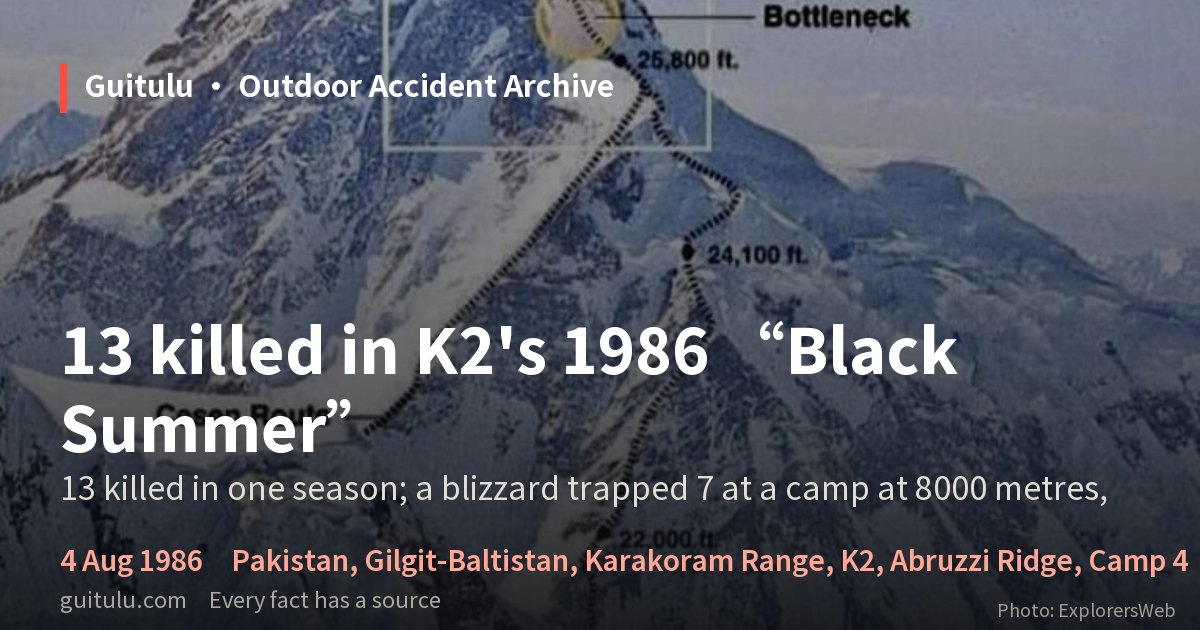
13 killed in one season; a blizzard trapped 7 at a camp at 8000 metres, and only 2 came down
Historical event; survivors have descended the mountain. The two survivors' accounts differ on parts of what happened, including summit times and details of the deaths
MountaineeringInvolves: Hypothermia · Altitude illness · Falls and slips · Extreme weatherNine permitted international mountaineering expeditions; the 7 people trapped at Camp 4 in early August came from several teams, including Austrian, British and Polish teams
Casualties
Dead 13 A total of 13 people died on K2 during the 1986 climbing season; 5 of them died during the blizzard in early August (Tullis, Rouse, Wieser, Hannes and Miodowicz-Wolf). Among those trapped, Bauer and Diemberger survived, both with severe frostbite
Material
45 facts · 12 sources3 accounts differ and are shown side by side
The number at the end of a paragraph is how many facts it rests on; open it to see each fact and how well it is sourced:
Multiple sourcesSingle source. Conflicting accounts and speculation are kept out of the narrative.
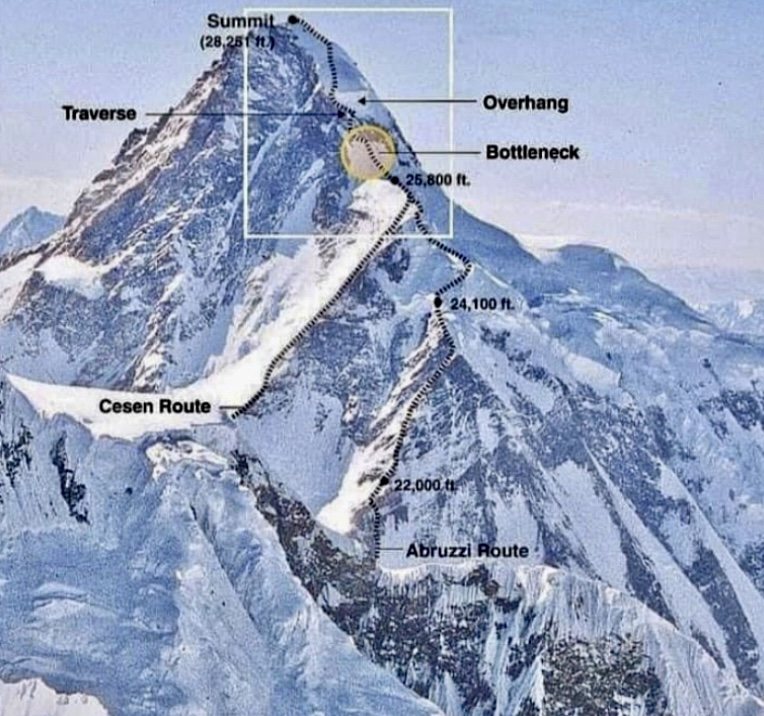
Reported locations along the route (schematic)Schematic
Scroll down and the map flies to where each part happened. The line is Schematic, Lines connect the locations mentioned in reports in sequence. They indicate only the approximate direction, not the actual track. Sources for the location coordinates are listed in places.json.
01
Full route
Locations mentioned in reports are connected in sequence to show the approximate route (schematic).
On 23 June, Polish mountaineer Wanda Rutkiewicz reached the summit of K2, becoming the first woman to do so. F09
French mountaineering couple Maurice and Liliane Barrard went missing during their descent on 24 June after reaching the summit. F10
Polish mountaineer Tadeusz Piotrowski died on 10 July while descending from the summit. F12
It was dark during the descent when Polish climber Wojciech Wróż fell to his death while descending a fixed rope in the Bottleneck. F25
At about 18:00 on 3 August, Božik, Piasecki and Wróż reached the summit via the South-Southwest Ridge (Magic Line), then decided to descend via the Abruzzi Ridge. F24
On 4 August, Muhammad Ali, the Pakistani high-altitude support leader for the Korean team, was struck by falling rock and killed near Camp 1. F27
During the descent, Tullis slipped, pulling Diemberger, who was roped to her, down with her. They slid about 100 metres and were not seriously injured, but had to spend the night in the open at 8400 metres. F32
At about 16:00 on 4 August, Rouse reached the summit of K2. F29
The next morning, a severe storm had already begun lower on the mountain, and Diemberger and Tullis returned to Camp 4 in whiteout conditions. F33
Tullis grew progressively weaker and lost her sight during the snowstorm, and died in her sleep on 7 August. F34
On 8 August, food and fuel at the camp ran out, and snow could no longer be melted for water. F35
At 21:00 that night, Bauer reached Camp 2 and was finally able to melt snow and eat; Diemberger arrived at 22:00. F40
On 10 August, the snow stopped, but strong winds continued. Diemberger and Miodowicz-Wolf were unable to get Rouse to his feet; he was hallucinating and close to death. F36
Bauer and Diemberger both suffered severe frostbite and were evacuated by helicopter on 16 August. F43
Under each fact is a verbatim quote from the original. "Single source" means only one outlet mentioned it; "Accounts differ" means sources contradict each other and this site adopts neither side; "Speculation" is an inference by a reporter or a person involved, not a fact.
The British team originally planned to climb the unclimbed Northwest Ridge, but later abandoned the plan and turned to the Abruzzi Ridge. The leader was Alan Rouse.
Quotes from the original 2
“So without going above the previous high point, we abandoned the route in favour of the Abruzzi Ridge.”
“postanowiła odłączyć się od swojego zespołu i wraz z wyprawą, w której uczestniczył między innymi Alan Rouse, ruszyła drogą wiodącą przez Żebro Abruzzi”
According to AAJ, Austrian Kurt Diemberger and Briton Julie Tullis were the high-altitude film crew for the Italian Quota 8000 expedition, filming for German television.
Quotes from the original 1
“Austrian Kurt Diemberger and Englishwoman Julie Tullis, who were a high-altitude film crew with the Italian Quota 8000 Expedition but were filming for German television”
According to AAJ, Carter, the author of the AAJ review, believed that many mountaineers that year appeared deliberately to have reduced their margin of safety to almost zero, spending too long at excessive altitudes and carrying insufficient food and fuel. These factors, combined with bad weather at a critical time, compounded the effects of a lack of food, water and shelter and of the high altitude.
Quotes from the original 2
“purposefully to cut the margin of safety to nearly zero, to risk total physical and mental exhaustion after too much time spent at excessively high altitude, to carry insufficient food and fuel”
According to AAJ, The book reviewer believed that only the Korean team used oxygen and established well-supplied camps along the route, and that their tents and supplies also helped save the lives of other mountaineers.
Quotes from the original 1
“It is significant that members of this team climbed the mountain and returned safely, and that their tents and supplies helped to save the lives of other climbers.”
According to AAJ, The book reviewer believed that few people that year paid attention to the danger of descending from high altitude in a storm, and that, for example, placing route markers high on the Abruzzi Ridge might have saved lives.
Quotes from the original 1
“During the summer there seemed little regard for the dangers of descending from high on the mountain during a storm; trail markers, placed higher above the Abruzzi Ridge, for example, might have saved lives.”
American mountaineers Smolich and Pennington were killed in an avalanche. Accounts differ on the date: Mayer's report says 20 June, while ExplorersWeb says 21 June.
Quotes from the original 2
“John Smolich and Alan Pennington were tragically killed in an avalanche at the foot of the slope below the Negrotto Col on June 20.”
Polish mountaineer Tadeusz Piotrowski died on 10 July while descending from the summit.
Includes a low-credibility source
Quotes from the original 2
“Tadeusz Piotrowski i Wojciech Wróż zapłacili za swój sukces najwyższą cenę, ginąc odpowiednio 10 lipca i 4 sierpnia 1986 roku, podczas schodzenia ze szczytu.”
Seven people were trapped at Camp 4: Miodowicz-Wolf, Rouse, Tullis, Wiese, Diemberger, Bauer and Imitzer.
Includes a low-credibility source
Quotes from the original 2
“siódemka wspinaczy – Dobrosława Miodowicz-Wolf, Alan Rouse, Julie Tullis, Hannes Wieser, Kurt Diemberger, Willi Bauer i Alfred Imitzer – została uwięziona w obozie czwartym”
According to National Geographic Polska, Rouse's condition deteriorated, and he showed increasingly clear symptoms of cerebral edema caused by altitude sickness.
Quotes from the original 1
“Stan Rouse'a zaczął się pogarszać. Coraz wyraźniej dawały o sobie znać objawy obrzęku mózgu, wywołanego chorobą wysokościową.”
Accounts of Miodowicz-Wolf's death differ: Carter's AAJ review suggests that she may have fallen between Camp 3 and Camp 2; National Geographic Polska says she fell asleep on a fixed rope after descending to about 7100 meters and never woke up.
According to AAJ, Piasecki and Austrian team member Messner returned up the mountain to search for Miodowicz-Wolf, climbing to 7100 meters, where she had last been seen, but found no trace of her.
Several quotations come from different reports by the same media outlet and are counted as one source
Quotes from the original 2
“they finally climbed to 7100 meters, where she had last been seen. Alas, they came upon no trace of her.”
According to AAJ, On 2 August, the weather was excellent. Imitzer, Bauer and Wieser set out for the summit, spent a long time fixing ropes in the Bottleneck and on the ice traverse above it, and turned back at 8400 metres.
Quotes from the original 1
“They took much time to fix ropes in the “Bottleneck” and on the icy traverse above it and had to turn back at 8400 meters.”
According to AAJ, On 3 August, three Korean team members reached the summit; they were the only climbers using supplemental oxygen at the time.
Several quotations come from different reports by the same media outlet and are counted as one source
Quotes from the original 2
“On August 3, while the other climbers rested at Camp IV, South Koreans Jang Bong-Wan, Kim Chang-Sun and Jang Byong-Ho, the only climbers using supplementary oxygen, went to the summit.”
At about 18:00 on 3 August, Božik, Piasecki and Wróż reached the summit via the South-Southwest Ridge (Magic Line), then decided to descend via the Abruzzi Ridge.
Quotes from the original 2
“they reached the summit of K2 on August 3 at six P.M. Because of the difficulty of the ascent, they decided to descend the Abruzzi Ridge.”
According to AAJ, At 05:30 on 4 August, Rouse and Miodowicz-Wolf set out for the summit, followed by Imitzer, Tullis and Diemberger, and finally Bauer and Wieser; Wieser turned back after 100 metres because his gloves were wet and he feared frostbite.
Quotes from the original 2
“Rouse and Mrufka started for the summit at 5:30 A.M., followed by Imitzer alone, then Julie Tullis and Diemberger and finally Bauer and Wieser.”
According to AAJ, Accounts differ on when Diemberger and Tullis reached the summit: Diemberger said it was no later than 17:30 (Carter's AAJ review also gave 17:30); Bauer and Curran said it was 19:00 and believed the two should have turned back earlier.
The two accounts came respectively from survivors Diemberger and Bauer (and Curran's book), both as reported by AAJ.
Quotes from the original 2
“Diemberger and Julie Tullis reached the top at 5:30.”
“Bauer (and Curran) state that Diemberger and Tullis reached the summit at seven P.M. and should have turned back sooner. Diemberger put the summit hour no later than 5:30.”
During the descent, Tullis slipped, pulling Diemberger, who was roped to her, down with her. They slid about 100 metres and were not seriously injured, but had to spend the night in the open at 8400 metres.
Includes a low-credibility source
Quotes from the original 2
“Tullis slipped, pulling her companion off. They fell about 100 meters. Though not seriously hurt, they had to spend the night in the open at 8400 meters.”
According to AAJ, The next morning, a severe storm had already begun lower on the mountain, and Diemberger and Tullis returned to Camp 4 in whiteout conditions.
Quotes from the original 1
“Although a severe storm had begun further down the mountain, they were able to return to the others in Camp IV in a whiteout the next morning.”
According to AAJ, On 10 August, the snow stopped, but strong winds continued. Diemberger and Miodowicz-Wolf were unable to get Rouse to his feet; he was hallucinating and close to death.
Quotes from the original 1
“On August 10 it stopped snowing, but the wind was still at gale force. Diemberger and Mrufka tried in vain to get Rouse up, but he was hallucinating and near death.”
Accounts differ on how Wieser and Imitzer died: Carter's AAJ review says Bauer urged them to descend with him and that they collapsed not far below Camp 4; National Geographic Polska says they had died before the remaining three began their descent.
Quotes from the original 2
“Bauer stirred his companions Wieser and Imitzer into descending with him and Mrufka, but Wieser and Imitzer were so weak that a short distance below Camp IV both collapsed and died.”
According to AAJ, Camp 3 had been destroyed in the snowstorm; from there down, fixed ropes were in place for almost the entire route, and the climbers descended separately.
Quotes from the original 1
“Camp III had been destroyed in the storm. Rope had been fixed almost all the way down from there and each went separately.”
According to AAJ, Bauer and Diemberger waited for her at Camp 2 until noon, then continued their descent together. Bauer went ahead to Base Camp to report what had happened.
Several quotations come from different reports by the same media outlet and are counted as one source
Quotes from the original 2
“They waited for her until noon before descending together past House’s Chimney. Bauer went on ahead to Base Camp and alerted a rescue crew.”
According to AAJ, The book review's author, Dr Charles Houston, considered impaired judgment and even willpower due to oxygen deprivation to be the main cause of most of the deaths.
Quotes from the original 1
“The mind- numbing effect of too little oxygen which blunts judgment, even will, high on these great and beautiful and deadly mountains was surely a major cause of most of the deaths.”
 GuituluGlobal Outdoor Accident Archive