GuituluGlobal Outdoor Accident Archive
01What happened
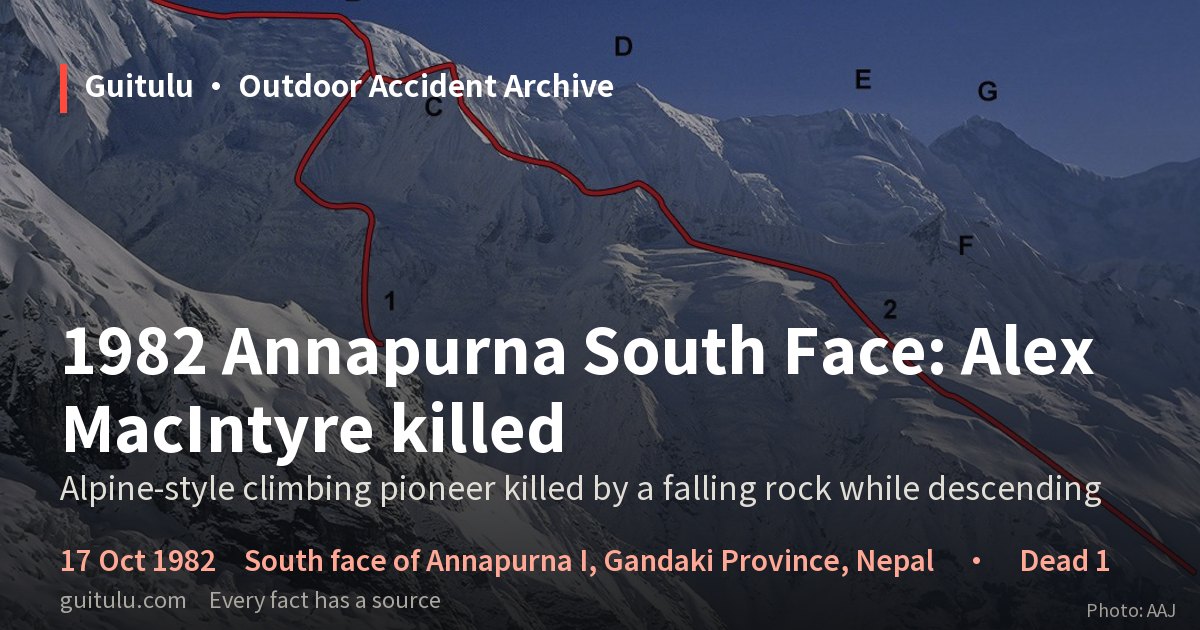
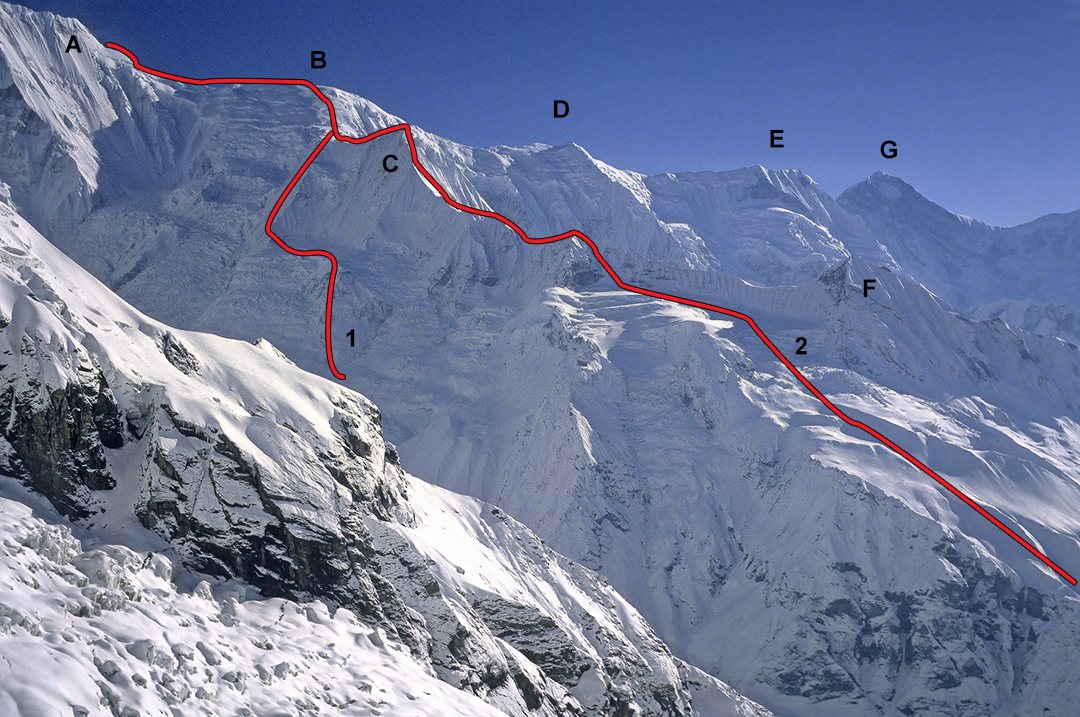
Alex MacIntyre was a British mountaineer known for lightweight, small-team alpine-style climbing without reliance on support. In spring 1982, he, Doug Scott and others made the first ascent of the south face of Shishapangma in alpine style. That autumn, he planned a new route to the right of the Polish Buttress on the south face of Annapurna with his friend René Ghilini, a French mountain guide, and John Porter.Facts it rests onF03Multiple sourcesAlex MacIntyre was a British climber who died on Annapurna in 1982, aged 28.F28Multiple sourcesMacIntyre was known for alpine-style climbing with light equipment, small teams and no reliance on support.F04Multiple sourcesIn spring 1982, MacIntyre, Doug Scott and others made the first ascent of the south face of Shishapangma in alpine style.F02Single sourceRené Ghilini was a friend and companion of MacIntyre and a young French alpine guide of Italian descent. In 1980, MacIntyre invited him to join an expedition to the east face of Dhaulagiri.F06Multiple sourcesIn autumn 1982, MacIntyre, Ghilini and John Porter planned to open a new route on Annapurna's south face, to the right of the Polish Buttress.
According to Porter's report in the American Alpine Journal, this was a lightweight team with a total budget of only 5,500 US dollars. They established base camp at about 4,270 metres on 15 September. In mid-September, when Gillinane and Porter went up to reconnoitre the base of the planned route, the afternoon sun caused meltwater to flow continuously down the entire south face, accompanied by the sound of falling rocks.Facts it rests onF07Single sourceThis was a low-cost, lightweight team with a total budget of only 5500 US dollars. They hired 29 porters to carry supplies to base camp.F09Single sourceOn 15 September, the team established base camp at approximately 14000 feet (approximately 4270 metres), just after the monsoon had ended.F10Single sourceFrom 18 to 20 September, MacIntyre remained in his tent because of a toe infection, while Ghilini and Porter went up to reconnoitre the base of the planned route.F08Single sourceDuring reconnaissance, the afternoon sun caused water to flow continuously down the entire south face, about eight kilometres wide, accompanied by the sound of falling rocks.
Before they set out, Porter felt unwell and stayed at base camp. MacIntyre and Ghilini began climbing the face on 10 October, were forced back by a storm the next day, and set out again on 13 October. According to reports, on the afternoon of 15 October the two appeared above a band of slopes halfway up the south face. On 16 October, they made three unsuccessful attempts to cross a rock band; the ice in the gully was too thin, and they had brought only two pitons. They retreated to camp at the top of the slope band and prepared to descend.Facts it rests onF14Multiple sourcesPorter was unwell before the climb and did not go with them. MacIntyre and Ghilini set out on 10 October.F15Single sourceThe next day, they encountered the second major storm of the trip and were forced to retreat to base camp. They set out again on 13 October in clear, cold weather.F17Single sourceOn the afternoon of 15 October, Porter saw the two climbers from base camp, above the sloping band halfway up the south face.F18Single sourceThe next day, the two tried three routes through a rock band, all without success. The ice in the gullies was too thin to climb, and they had brought only two pitons.F19Single sourceThe two retreated to the top of the ramp, where they spent their final night camped on the face.F11Multiple sourcesThe accident occurred while the two were descending from the face. They had intended to return to base camp to rest before climbing the face again. The report gives the altitude at which they began their descent as about 23625 feet (about 7200 metres).
At about ten the next morning, the two traversed a gully at the bottom of the slope band. A rock then fell from high on the south face and struck MacIntyre on the head, killing him at the scene. Porter was watching from a distance at the time and saw only one figure stop on the slope. According to reports, Ghilini buried him at the scene as best he could, then descended alone and met Porter and the Sherpa Pinjoo, who had come to meet him. The weather later deteriorated, and they were unable to return to the scene.Facts it rests onF20Single sourceAt about ten the following morning, the two traversed a gully at the bottom of the slope band. Porter believed the main danger had passed.F21Multiple sourcesA rock falling from high on the south face struck MacIntyre on the head, killing him at the scene.F22Multiple sourcesPorter was watching the two from a distance when the accident happened. He then saw only one figure stopped on the slope.F23Single sourceMacIntyre fell about 1500 feet (about 460 metres), landing below the bergschrund. Ghilini did his best to bury him there.F24Single sourcePorter ran back to base camp to collect emergency equipment and set out for the south face with the Sherpa Pinjoo. Halfway up the ridge, they saw Ghilini descending alone.F12Single sourceThe weather worsened over the following days, and they were unable to return to the site where he died.
Porter wrote in his report that the deaths of MacIntyre, Joe Tasker and Peter Boardman in the same year were a heavy blow to the ideals of alpine-style climbing. A memorial hut in Scotland is named after him, and there is also a memorial stone for him at Annapurna Base Camp. Porter's later biography of him, “One Day as a Tiger”, won the grand prize at the Banff Mountain Book Festival.Facts it rests onF25Single sourcePorter said in his report that the deaths of MacIntyre, Joe Tasker and Pete Boardman in the same year were a heavy blow to their friends and relatives and to the whole concept of alpine-style climbing.F30Multiple sourcesIn Scotland, the Alex MacIntyre Memorial Hut is named after him and belongs to the British Mountaineering Council and the Scottish Mountaineering Club.F31Single sourceAt Annapurna Base Camp, a stone memorial to MacIntyre bears an inscription meaning “Better one day as a tiger than a thousand years as a sheep”.F27Multiple sourcesPorter later wrote a biography of MacIntyre, “One Day as a Tiger”, which won the grand prize at the Banff Mountain Book Festival and was shortlisted for the Boardman Tasker Prize.
The number at the end of a paragraph is how many facts it rests on; open it to see each fact and how well it is sourced: Multiple sourcesSingle source. Conflicting accounts and speculation are kept out of the narrative.