GuituluGlobal Outdoor Accident Archive 中文
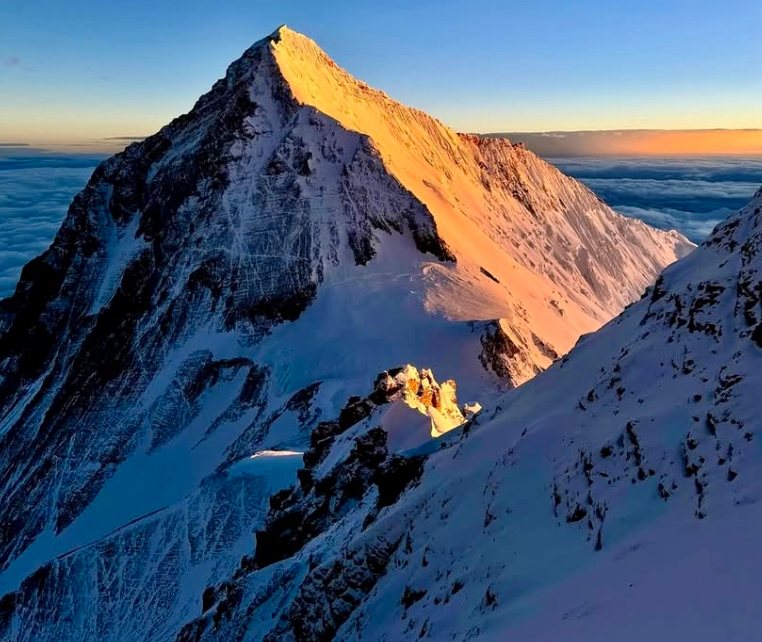
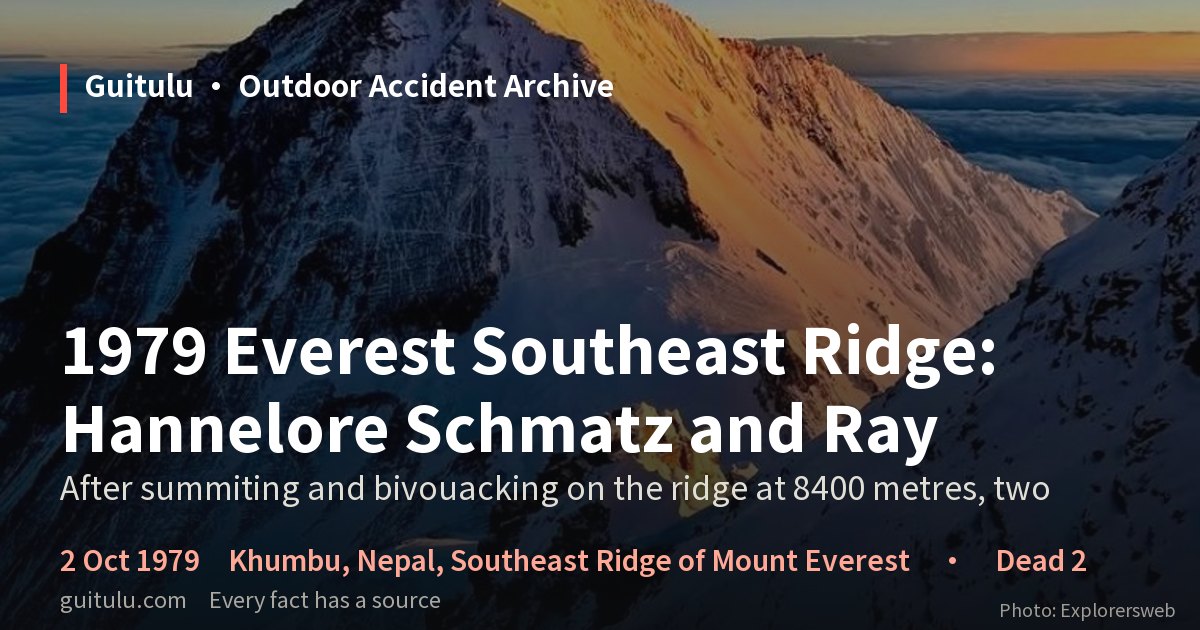
Mount Everest viewed from the direction of Lhotse (terrain reference)

Archive / Mountaineering

1979 Everest Southeast Ridge: Hannelore Schmatz and Ray Genet die on descent

After summiting and bivouacking on the ridge at 8400 metres, two climbers did not make it back to the South Col

Both bodies remained on the mountain; two more people fell to their deaths during a Nepalese police attempt to recover the bodies in 1984

Photo: Explorersweb

Date
Autumn
Place
Khumbu, Nepal, Southeast Ridge of Mount EverestNepal › Koshi Province · Himalaya86.925°E 27.988°N
Activity
MountaineeringInvolves: Hypothermia · Altitude illness · Extreme weather · Sudden illness and exhaustion1979 Swabian Everest Expedition (leader Gerhard Schmatz), 8 members and 5 Sherpas
Casualties
Dead 2 Injured 1Ray Genet (United States) died while bivouacking at approximately 8400 metres; Hannelore Schmatz (West Germany) died during the descent the following day; Sherpa Sungdare suffered severe frostbite
Material
43 facts · 8 sources4 accounts differ and are shown side by side

01What happened

In autumn 1979, German climber Gerhard Schmatz led a small international expedition up Everest via the South Col–Southeast Ridge route. Its members included his wife, Hannelore Schmatz, and American guide Ray Genet, the latter known for his many ascents of Mount McKinley in Alaska. The party was small and moved quickly, and it had no tents on the Southeast Ridge.Facts it rests onF04Multiple sourcesThe expedition was led by German Gerhard Schmatz. Its members included his wife Hannelore Schmatz, American Ray Genet, and members from New Zealand, Switzerland and Germany.F05Multiple sourcesThe expedition chose the standard South Col–Southeast Ridge route.F01Multiple sourcesRay Genet was known in Alaska for his many ascents of Mount McKinley (Denali). He took part in the mountain's first winter ascent in 1967 and was known as Denali's first guide.F08Single sourceThe team was small and fast, set no tents on the Southeast Ridge, and all summit climbers used bottled oxygen from the South Col onward.

Mount Everest viewed from the direction of Lhotse (terrain reference)Photo source: Explorersweb

On 1 October, the first group reached the summit, and 50-year-old Gerhard Schmatz became the oldest person to have climbed Everest at the time. At 5 a.m. on 2 October, the second group set out from the South Col on three ropes. Genet untied himself and climbed alone despite objections from his teammates. Between 1 p.m. and 1:30 p.m., the second group reached the summit in deteriorating weather, and Hannelore became the fourth woman to climb Everest.Facts it rests onF15Multiple sourcesOn 1 October, Gerhard Schmatz and the other members of the first group reached the summit at about 2 p.m. after encountering some difficulties at the Hillary Step.F16Multiple sourcesGerhard Schmatz, then 50, became the oldest person to have summited Everest at the time.F17Multiple sourcesAt 5 a.m. on 2 October, the second group left the South Col in three rope teams. Hannelore Schmatz was on the third rope with the Sherpas Sungdare and Ang Jambu.F18Multiple sourcesShortly after leaving the South Col, Genet untied himself and climbed alone despite his teammates' objections.F19Multiple sourcesThe weather deteriorated, and the second group reached the summit between 1 p.m. and 1:30 p.m., remaining there only a very short time.F20Multiple sourcesHannelore Schmatz became the fourth woman to summit Everest.

Camp on Everest's South ColPhoto source: Explorersweb

During the descent, Genet continued alone behind the others as the wind grew stronger and the temperature fell. At the bottom of the steep section of the Southeast Ridge, Genet ran out of oxygen. He insisted on bivouacking there and refused to descend. The snow was too soft, and only a rudimentary snow cave could be dug. They spent the night in strong winds and extreme cold; the group reportedly had no stove or fuel for melting snow. Genet died during the night.Facts it rests onF21Multiple sourcesOn the descent, Genet again chose to travel alone behind the others.F22Multiple sourcesDuring the descent, the snow and cloud diminished, but the wind became very strong and the temperature fell.F24Multiple sourcesAt the bottom of the steep section, Genet's oxygen ran out, and he insisted on bivouacking there, refusing to continue the descent.F27Multiple sourcesThe snow was too soft to dig a proper shelter, so they dug only a rudimentary snow cave and spent the night in strong winds and extreme cold.F29Single sourceThe group at the bivouac had no stove and no fuel to melt snow.F31Multiple sourcesRay Genet died during the night, and his teammates found him dead the next morning.

On the morning of 3 October, Sherpa Sungdare fetched additional oxygen and began descending with Hannelore; six Sherpas also set out from Camp III to rescue them. When the rescuers met Sungdare, Hannelore had already sat down and died along the way. Her death was attributed to exposure, exhaustion and frostbite; she was the first woman to die on Everest. Sungdare was in critical condition and was taken down the mountain, snow-blind and with severe frostbite to both feet.Facts it rests onF32Multiple sourcesOn the morning of 3 October, Sundare descended to the ridge camp, fetched supplemental oxygen and gave it to Hannelore. The two then began their descent.F33Multiple sourcesEarly on the morning of 3 October, six Sherpas set out from Camp III with oxygen and supplies to carry out a rescue.F34Multiple sourcesRescue Sherpa Nawang Tenzing reached the South Col at 8:30 a.m. and went with Fischbach to meet the two as they descended.F35Multiple sourcesHannelore Schmatz sat down during the descent, said she could not go on, and then died; when the rescuers met Sundare, he said she had just collapsed and died.F37Multiple sourcesHannelore Schmatz died from exposure, exhaustion and frostbite. She was the first woman to die on Everest and the first German citizen to die on the upper mountain.F40Multiple sourcesSundare was in critical condition and was moved to Camp II while receiving oxygen and medical care, then taken to Base Camp on 5 October; he was snow-blind and had severe frostbite on both feet.

Both bodies remained on the mountain. In October 1984, Nepalese police attempted to recover Hannelore's body; a police officer and a guide fell to their deaths during the operation.Facts it rests onF11Multiple sourcesGenet's body was left at the bivouac site and was soon buried by snow.F41Multiple sourcesIn October 1984, Nepalese police organised an operation to recover her body. Police officer Yogendra Bahadur Thapa and guide Ang Dorje fell to their deaths during the operation.

The number at the end of a paragraph is how many facts it rests on; open it to see each fact and how well it is sourced: Multiple sourcesSingle source. Conflicting accounts and speculation are kept out of the narrative.

  • Reported locations along the route (illustrative)Schematic

Satellite imagery Sentinel-2 cloudless 2024 © EOX · Terrain AWS Terrain Tiles · Orange line is schematic · Place coordinates not individually verified

Route review

5 scenes to understand what happened

Scroll down and the map flies to where each part happened. The line is Schematic, Lines connect the locations mentioned in reports in sequence, showing only the approximate direction, not the actual route. Sources for the location coordinates are in places.json.

01

Full route

The places mentioned in the reports are connected in sequence to show the approximate route (schematic).

02

Establishing camps and ascending

The expedition established base camp on 31 August, then set up camps in stages along the South Col–Southeast Ridge route, with Camp IV on the South Col.Facts it rests onF13Single sourceThe expedition left Kathmandu on 31 July and established base camp on 31 August at an altitude of 17400 feet.F14Single sourceCamp III was established on 12 September on the Lhotse Face at an altitude of 23625 feet, and Camp IV was set up on the South Col at 26200 feet.F05Multiple sourcesThe expedition chose the standard South Col–Southeast Ridge route.

03

Second group reaches the summit

The group set out from the South Col at 5 a.m. on 2 October. Genet untied himself partway up and continued alone; the group reached the summit after 1 p.m. in deteriorating weather.Facts it rests onF17Multiple sourcesAt 5 a.m. on 2 October, the second group left the South Col in three rope teams. Hannelore Schmatz was on the third rope with the Sherpas Sungdare and Ang Jambu.F18Multiple sourcesShortly after leaving the South Col, Genet untied himself and climbed alone despite his teammates' objections.F19Multiple sourcesThe weather deteriorated, and the second group reached the summit between 1 p.m. and 1:30 p.m., remaining there only a very short time.F20Multiple sourcesHannelore Schmatz became the fourth woman to summit Everest.

04

A night on the ridge

On the descent to the bottom of the steep section, Genet ran out of oxygen and insisted on bivouacking. The snow cave was rudimentary, the winds were strong and the cold extreme; Genet died during the night.Facts it rests onF24Multiple sourcesAt the bottom of the steep section, Genet's oxygen ran out, and he insisted on bivouacking there, refusing to continue the descent.F27Multiple sourcesThe snow was too soft to dig a proper shelter, so they dug only a rudimentary snow cave and spent the night in strong winds and extreme cold.F31Multiple sourcesRay Genet died during the night, and his teammates found him dead the next morning.

05

The unfinished descent

On the morning of 3 October, the two descended, and a rescue team came up from the South Col to meet them. Hannelore sat down and died on the way; Sungdare was rescued.Facts it rests onF32Multiple sourcesOn the morning of 3 October, Sundare descended to the ridge camp, fetched supplemental oxygen and gave it to Hannelore. The two then began their descent.F34Multiple sourcesRescue Sherpa Nawang Tenzing reached the South Col at 8:30 a.m. and went with Fischbach to meet the two as they descended.F35Multiple sourcesHannelore Schmatz sat down during the descent, said she could not go on, and then died; when the rescuers met Sundare, he said she had just collapsed and died.F40Multiple sourcesSundare was in critical condition and was moved to Camp II while receiving oxygen and medical care, then taken to Base Camp on 5 October; he was snow-blind and had severe frostbite on both feet.

02Timeline

  1. The expedition left Kathmandu on 31 July and established base camp on 31 August at an altitude of 17400 feet. F13

  2. Camp III was established on 12 September on the Lhotse Face at an altitude of 23625 feet, and Camp IV was set up on the South Col at 26200 feet. F14

  3. On 1 October, Gerhard Schmatz and the other members of the first group reached the summit at about 2 p.m. after encountering some difficulties at the Hillary Step. F15

  4. At the bottom of the steep section, Genet's oxygen ran out, and he insisted on bivouacking there, refusing to continue the descent. F24

  5. Hannelore Schmatz became the fourth woman to summit Everest. F20

  6. Ray Genet died during the night, and his teammates found him dead the next morning. F31

  7. At 5 a.m. on 2 October, the second group left the South Col in three rope teams. Hannelore Schmatz was on the third rope with the Sherpas Sungdare and Ang Jambu. F17

  8. The weather deteriorated, and the second group reached the summit between 1 p.m. and 1:30 p.m., remaining there only a very short time. F19

  9. Hannelore Schmatz sat down during the descent, said she could not go on, and then died; when the rescuers met Sundare, he said she had just collapsed and died. F35

  10. On the morning of 3 October, Sundare descended to the ridge camp, fetched supplemental oxygen and gave it to Hannelore. The two then began their descent. F32

  11. Early on the morning of 3 October, six Sherpas set out from Camp III with oxygen and supplies to carry out a rescue. F33

  12. On 4 October, Walter and von Känel tried to go up to find the bodies, but were unsuccessful because of bad weather and strong winds. F39

  13. Sundare was in critical condition and was moved to Camp II while receiving oxygen and medical care, then taken to Base Camp on 5 October; he was snow-blind and had severe frostbite on both feet. F40

  14. In October 1984, Nepalese police organised an operation to recover her body. Police officer Yogendra Bahadur Thapa and guide Ang Dorje fell to their deaths during the operation. F41

03Lessons

Avalanche and high altitude

Turn back before oxygen runs out

After running out of oxygen at the bottom of the steep section, Genet insisted on bivouacking there and refused to descend, drawing those who stayed with him into that night as well. On a high-altitude summit attempt, the oxygen needed for the descent must be accounted for, not just the oxygen needed to reach the summit.Facts it rests onF24Multiple sourcesAt the bottom of the steep section, Genet's oxygen ran out, and he insisted on bivouacking there, refusing to continue the descent.F27Multiple sourcesThe snow was too soft to dig a proper shelter, so they dug only a rudimentary snow cave and spent the night in strong winds and extreme cold.

Hypothermia and overnight gear

Bivouacking without shelter comes at a high cost

The party had no tents on the Southeast Ridge. When they bivouacked, the snow was too soft to dig anything but a rudimentary snow cave, and they reportedly had no stove or fuel. Once forced to spend a night above 8000 metres, there is almost no margin without shelter and heat.Facts it rests onF08Single sourceThe team was small and fast, set no tents on the Southeast Ridge, and all summit climbers used bottled oxygen from the South Col onward.F27Multiple sourcesThe snow was too soft to dig a proper shelter, so they dug only a rudimentary snow cave and spent the night in strong winds and extreme cold.F29Single sourceThe group at the bivouac had no stove and no fuel to melt snow.

Teams and decisions

The party should stay together

Genet twice chose to untie himself and travel alone behind the others. Once a member separates from the party, it is difficult for the others to notice problems in time or decide to retreat while they are at their strongest.Facts it rests onF18Multiple sourcesShortly after leaving the South Col, Genet untied himself and climbed alone despite his teammates' objections.F21Multiple sourcesOn the descent, Genet again chose to travel alone behind the others.

04Fact list 43 facts

Under each fact is a verbatim quote from the original. "Single source" means only one outlet mentioned it; "Accounts differ" means sources contradict each other and this site adopts neither side; "Speculation" is an inference by a reporter or a person involved, not a fact.

  1. F01Multiple sourcesBackground

    Ray Genet was known in Alaska for his many ascents of Mount McKinley (Denali). He took part in the mountain's first winter ascent in 1967 and was known as Denali's first guide.

    Quotes from the original 3

    “Ray Genet, the American, was a legend in Alaska for his many successful climbs of McKinley, including the first winter ascent in 1967.”

    Explorersweb ·

    “He was the first guide on North America's highest mountain, Alaska's Denali (Mount McKinley).”

    Wikipedia ·

    “he later became the first guide on Denali”

    Project Jukebox ·
  2. F02Single sourceBackground

    According to Explorersweb, Hannelore Schmatz had previously summited Tirich Mir in 1974 and had attempted Manaslu and Lhotse.

    Quotes from the original 1

    “She had summited Tirich Mir in 1974 and had attempted Manaslu and Lhotse.”

    Explorersweb ·
  3. F03Single sourceBackground

    According to Explorersweb, Few teams climbed Everest each year in 1979; only six teams attempted it that year.

    Quotes from the original 1

    “In the pre-commercial era, few teams attempted Everest each year. In 1979, there were only six.”

    Explorersweb ·
  4. F04Multiple sourcesBackground

    The expedition was led by German Gerhard Schmatz. Its members included his wife Hannelore Schmatz, American Ray Genet, and members from New Zealand, Switzerland and Germany.

    Quotes from the original 2

    “Our expedition consisted of New Zealander Nick Banks, American Ray Genet, Swiss Hans von Känel, Germans Tilman Fischbach, Günter Kämpfe, Dr. Herman Warth, my wife Hannelore Schmatz and me as leader.”

    AAJ ·

    “The third group that autumn was an international team led by German mountaineer Gerhard Schmatz.”

    Explorersweb ·
  5. F05Multiple sourcesPlan

    The expedition chose the standard South Col–Southeast Ridge route.

    Quotes from the original 2

    “They chose the standard South Col-Southeast Ridge route.”

    Explorersweb ·

    “Schmatz was on an expedition via the South East Ridge route with her husband, Gerhard Schmatz”

    Wikipedia ·
  6. F06Single sourceBackground

    According to AAJ, An editor's note states that Genet had previously been hospitalized with influenza in Kathmandu.

    Quotes from the original 1

    “Genet had fallen ill with flu in Kathmandu and had been hospitalized.”

    AAJ ·
  7. F07Single sourceParticipant's view

    According to AAJ, The editor believed that Genet had most likely not yet recovered his normally exceptional physical strength at the time of the ascent (editor's opinion).

    Quotes from the original 1

    “It is doubtful that he had yet recovered his prodigious strength by this time.”

    AAJ ·
  8. F08Single sourcePlan

    According to Explorersweb, The team was small and fast, set no tents on the Southeast Ridge, and all summit climbers used bottled oxygen from the South Col onward.

    Quotes from the original 2

    “The expedition was small and fast. They had no tent on the Southeast Ridge itself.”

    Explorersweb ·

    “All summiters used supplemental oxygen from the South Col onward.”

    Explorersweb ·
  9. F09Single sourceAftermath

    According to Wikipedia, Sungdare lost most of his fingers and toes to frostbite.

    Quotes from the original 1

    “lost most of his fingers and toes to frostbite”

    Wikipedia ·
  10. F10Single sourceBackground

    According to Explorersweb, Earlier in the expedition, Sungdare had suffered a heart attack and lost consciousness while descending from Camp III to Camp II.

    Quotes from the original 1

    “Earlier in the expedition, Sungdare had suffered a heart attack while descending from Camp 3 to Camp 2 and had been unconscious.”

    Explorersweb ·
  11. F11Multiple sourcesAftermath

    Genet's body was left at the bivouac site and was soon buried by snow.

    Quotes from the original 2

    “Genet’s body remained at the bivouac site, where it was soon covered by snow, disappearing from view.”

    Explorersweb ·

    “Genet's body ultimately disappeared under the snow”

    Wikipedia ·
  12. F12Single sourceParticipant's view

    According to AAJ, The leader said this was the smallest and fastest successful summit team at the time (32 days), and the first team whose members all reached the summit.

    Quotes from the original 1

    “We were the smallest successful expedition, the fastest (32 days), the first in which all members reached the summit and the first married couple.”

    AAJ ·
  13. F13Single sourceMovement

    According to AAJ, The expedition left Kathmandu on 31 July and established base camp on 31 August at an altitude of 17400 feet.

    Quotes from the original 2

    “We left Kathmandu on July 31”

    AAJ ·

    “We set up Base Camp at 17,400 feet on August 31.”

    AAJ ·
  14. F14Single sourceMovement

    According to AAJ, Camp III was established on 12 September on the Lhotse Face at an altitude of 23625 feet, and Camp IV was set up on the South Col at 26200 feet.

    Quotes from the original 1

    “III at 23,625 feet on the Lhotse Face on September 12 and IV at 26,200 feet on the South Col.”

    AAJ ·
  15. F15Multiple sourcesMovement

    On 1 October, Gerhard Schmatz and the other members of the first group reached the summit at about 2 p.m. after encountering some difficulties at the Hillary Step.

    Both the AAJ and Himalayan Journal reports were written by the leader, Gerhard Schmatz himself.

    Quotes from the original 3

    “We got to the summit at two o’clock after some difficulties at the Hillary Step.”

    AAJ ·

    “the party arrived on the summit after some difficulties at the Hillary step at 2 p.m.”

    Himalayan Journal ·

    “They summited at around 2 pm in cloudy but manageable soft-snow conditions.”

    Explorersweb ·
  16. F16Multiple sourcesBackground

    Gerhard Schmatz, then 50, became the oldest person to have summited Everest at the time.

    Quotes from the original 2

    “Gerhard Schmatz, 50 years old, is the oldest person who has ever climbed Everest.”

    Himalayan Journal ·

    “Gerhard Schmatz, who was 50 years old in 1979, was the oldest Everest summiter at the time.”

    Explorersweb ·
  17. F17Multiple sourcesMovement

    At 5 a.m. on 2 October, the second group left the South Col in three rope teams. Hannelore Schmatz was on the third rope with the Sherpas Sungdare and Ang Jambu.

    Both the AAJ and Himalayan Journal reports were written by the leader, Gerhard Schmatz himself.

    Quotes from the original 3

    “Hannelore Schmatz, Sherpa Sundare and Ang Jangbo on a third”

    AAJ ·

    “They left the South Col in good conditions with low clouds at 5 a.m. on 2 October.”

    Himalayan Journal ·

    “The eight climbers left the South Col at 5 am on October 2. They climbed on three ropes.”

    Explorersweb ·
  18. F18Multiple sourcesEvent

    Shortly after leaving the South Col, Genet untied himself and climbed alone despite his teammates' objections.

    Quotes from the original 2

    “Shortly after leaving the South Col, Genet elected to unrope and climb alone despite protests from the party.”

    Himalayan Journal ·

    “Shortly after departure, a tiring Genet unroped, despite objections from the others, and fell behind.”

    Explorersweb ·
  19. F19Multiple sourcesMovement

    The weather deteriorated, and the second group reached the summit between 1 p.m. and 1:30 p.m., remaining there only a very short time.

    Both the AAJ and Himalayan Journal reports were written by the leader, Gerhard Schmatz himself.

    Quotes from the original 3

    “in deteriorating weather reached the summit between 1:00 and 1:30 P.M. A very short time was spent on the top”

    AAJ ·

    “in deteriorating weather reached the summit between 1.00 p.m. and 1.30 p.m.”

    Himalayan Journal ·

    “reached the summit around 1 pm”

    Explorersweb ·
  20. F20Multiple sourcesEvent

    Hannelore Schmatz became the fourth woman to summit Everest.

    Quotes from the original 3

    “My wife was the fourth woman and first Western woman to get to the top.”

    AAJ ·

    “Hannelore Schmatz became the fourth woman, including the first German woman, to summit Everest.”

    Explorersweb ·

    “the fourth woman to summit Mount Everest”

    Wikipedia ·
  21. F21Multiple sourcesMovement

    On the descent, Genet again chose to travel alone behind the others.

    Both the AAJ and Himalayan Journal reports were written by the leader, Gerhard Schmatz himself.

    Quotes from the original 2

    “Genet again elected to travel alone behind the others.”

    AAJ ·

    “Genet again elected to descend alone behind the other parties.”

    Himalayan Journal ·
  22. F22Multiple sourcesEvent

    During the descent, the snow and cloud diminished, but the wind became very strong and the temperature fell.

    Quotes from the original 2

    “the wind became very strong and the temperature dropped”

    AAJ ·

    “Snow fell at first, then it cleared, but a strong wind picked up. Temperatures dropped sharply.”

    Explorersweb ·
  23. F23Multiple sourcesMovement

    At about 5 p.m., the members ahead reached the old ridge camp and saw and heard the remaining members descending the steep section of the Southeast Ridge.

    Quotes from the original 2

    “reached the former site of the Ridge Camp at approx. 5 p.m. and saw and heard the rest of the party descending the steep section of the Southeast ridge.”

    Himalayan Journal ·

    “By about 5 pm, the leading parties reached the site of the former ridge camp at 8,350m–8,400m.”

    Explorersweb ·
  24. F24Multiple sourcesEvent

    At the bottom of the steep section, Genet's oxygen ran out, and he insisted on bivouacking there, refusing to continue the descent.

    Both the AAJ and Himalayan Journal reports were written by expedition leader Gerhard Schmatz himself.

    Quotes from the original 3

    “At the base of the steep section Genet ran out of oxygen; he expressed a strong desire to bivouac and refused to descend.”

    AAJ ·

    “At the base of the steep section Genet's oxygen ran out and he expressed a strong desire to bivouac and refused to continue the descent.”

    Himalayan Journal ·

    “At the base of that section, Genet’s oxygen supply ran out.”

    Explorersweb ·
  25. F25Accounts differEvent

    Accounts differ on whose decision it was to bivouac: the expedition leader's reports and Explorersweb say Genet, having run out of oxygen, insisted on bivouacking and refused to descend; Wikipedia says both were exhausted and stopped to bivouac despite the Sherpas' advice.

    Quotes from the original 3

    “he expressed a strong desire to bivouac and refused to descend”

    AAJ ·

    “He refused to continue and insisted on bivouacking for the night.”

    Explorersweb ·

    “Exhausted from the climb, they had stopped to bivouac at 28,000 feet (8,500 m) as the night approached, despite their Sherpa guides urging them not to stop.”

    Wikipedia ·
  26. F26Accounts differEvent

    Accounts differ on who stayed behind to assist: the expedition leader's reports and Explorersweb say Sundare and Hannelore stayed with Genet, while Ang Jangbu continued down and reached the South Col at 9:30 p.m.; Wikipedia's entry on Genet says both Sherpas stayed at the bivouac site.

    Quotes from the original 3

    “Sundare and Hannelore Schmatz stayed with him and Jangbo continued to descend to the South Col, arriving at 9:30.”

    AAJ ·

    “He later went alone to the South Col, arriving around 9:30 pm.”

    Explorersweb ·

    “The two Sherpa guides, Sungdare Sherpa and Ang Jangbo, stayed with them in their bivouac but Genet did not survive until morning.”

    Wikipedia ·
  27. F27Multiple sourcesEvent

    The snow was too soft to dig a proper shelter, so they dug only a rudimentary snow cave and spent the night in strong winds and extreme cold.

    Quotes from the original 3

    “Because the snow was soft, no suitable shelter could be prepared and the night was spent in high winds and extreme cold”

    AAJ ·

    “the night was spent in high winds and extreme cold at a height of approx. 8400 m.”

    Himalayan Journal ·

    “They dug a poor snow cave in the soft, deep snow.”

    Explorersweb ·
  28. F28Accounts differEvent

    Accounts differ on the altitude of the bivouac site: the expedition leader's reports give about 8400 metres; Explorersweb gives 8400 to 8500 metres; Wikipedia gives 8500 metres.

    Quotes from the original 3

    “at 8400 meters (27,560 feet)”

    AAJ ·

    “Genet, Hannelore Schmatz, and Sungdare Sherpa remained at 8,400m–8,500m.”

    Explorersweb ·

    “they had stopped to bivouac at 28,000 feet (8,500 m)”

    Wikipedia ·
  29. F29Single sourceFound at scene

    According to Explorersweb, The group at the bivouac had no stove and no fuel to melt snow.

    Quotes from the original 1

    “The second party had no stove or fuel for melting snow.”

    Explorersweb ·
  30. F30SpeculationSpeculation

    Some later accounts suggest that lack of oxygen may have affected Genet's judgment.

    Quotes from the original 1

    “Some later accounts suggested that a lack of oxygen may have affected Genet’s judgment.”

    Explorersweb ·
  31. F31Multiple sourcesEvent

    Ray Genet died during the night, and his teammates found him dead the next morning.

    Quotes from the original 4

    “In the morning Genet was dead.”

    AAJ ·

    “During the night, as a strong wind blew, a frostbitten, exhausted Genet died of exposure.”

    Explorersweb ·

    “Genet died on October 2, 1979, while descending Mount Everest with his fellow climber Hannelore Schmatz, succumbing to hypothermia in the night.”

    Wikipedia ·

    “Ray Genet died on October 2, 1979 while descending Mount Everest.”

    Project Jukebox ·
  32. F32Multiple sourcesMovement

    On the morning of 3 October, Sundare descended to the ridge camp, fetched supplemental oxygen and gave it to Hannelore. The two then began their descent.

    Quotes from the original 2

    “On the morning of October 3, Sungdare Sherpa descended a short way to the ridge camp and brought additional oxygen up to Hannelore Schmatz.”

    Explorersweb ·

    “Sundare and Hannelore began the descent.”

    AAJ ·
  33. F33Multiple sourcesEvent

    Early on the morning of 3 October, six Sherpas set out from Camp III with oxygen and supplies to carry out a rescue.

    Both the AAJ and Himalayan Journal reports were written by expedition leader Gerhard Schmatz himself.

    Quotes from the original 3

    “Very early in the morning of October 3 six Sherpas left Camp III with oxygen and supplies for a rescue.”

    AAJ ·

    “Very early in the morning of 3 October six Sherpas left Camp 3 with oxygen and supplies to attempt a rescue of the party.”

    Himalayan Journal ·

    “Early that morning, six Sherpas had left Camp 3 with oxygen and supplies for a rescue attempt.”

    Explorersweb ·
  34. F34Multiple sourcesEvent

    Rescue Sherpa Nawang Tenzing reached the South Col at 8:30 a.m. and went with Fischbach to meet the two as they descended.

    Quotes from the original 2

    “Nawang Tensing arrived at the South Col at 8:30 and with Fischbach began ascending towards the two descending persons, now visible.”

    AAJ ·

    “One of them, Nawang Tenzing, reached the South Col at 8:30 am, and together with Fischbach, began climbing up.”

    Explorersweb ·
  35. F35Multiple sourcesEvent

    Hannelore Schmatz sat down during the descent, said she could not go on, and then died; when the rescuers met Sundare, he said she had just collapsed and died.

    Quotes from the original 3

    “When they reached Sundare, he told them that Hannelore Schmatz had collapsed and died shortly before.”

    AAJ ·

    “Hannelore had sat down at about 8,350m, saying she could go no farther.”

    Explorersweb ·

    “She collapsed and died as she was returning from summiting Everest via the southern route”

    Wikipedia ·
  36. F36Accounts differEvent

    Accounts differ on the date of Hannelore Schmatz's death: the expedition leader's reports and Explorersweb's account indicate that she died on the morning of 3 October; Wikipedia gives 2 October 1979.

    Quotes from the original 2

    “On the morning of October 3, Sungdare Sherpa descended a short way to the ridge camp”

    Explorersweb ·

    “Hannelore Schmatz (16 February 1940 – 2 October 1979)”

    Wikipedia ·
  37. F37Multiple sourcesFound at scene

    Hannelore Schmatz died from exposure, exhaustion and frostbite. She was the first woman to die on Everest and the first German citizen to die on the upper mountain.

    Quotes from the original 2

    “she too died of exposure, exhaustion, and frostbite, thereby becoming the first woman to die on Everest”

    Explorersweb ·

    “Schmatz was the first woman and first German citizen to die on the upper slopes of Everest.”

    Wikipedia ·
  38. F38Multiple sourcesEvent

    According to Sundare, her last words were a request for water.

    Quotes from the original 2

    “According to Sungdare, her last words were a request for water.”

    Explorersweb ·

    “said "Water, Water" to her Sherpa and died”

    Wikipedia ·
  39. F39Single sourceAftermath

    According to Explorersweb, On 4 October, Walter and von Känel tried to go up to find the bodies, but were unsuccessful because of bad weather and strong winds.

    Quotes from the original 1

    “Warth and von Kaenel made a later attempt on October 4 to reach the bodies, but bad weather and high winds stopped them.”

    Explorersweb ·
  40. F40Multiple sourcesAftermath

    Sundare was in critical condition and was moved to Camp II while receiving oxygen and medical care, then taken to Base Camp on 5 October; he was snow-blind and had severe frostbite on both feet.

    Quotes from the original 2

    “Sundare was in critical condition and was evacuated with oxygen and medical care to Camp II and on the 5th to Base Camp.”

    AAJ ·

    “He was snowblind and had severe frostbite to both feet.”

    Explorersweb ·
  41. F41Multiple sourcesAftermath

    In October 1984, Nepalese police organised an operation to recover her body. Police officer Yogendra Bahadur Thapa and guide Ang Dorje fell to their deaths during the operation.

    Quotes from the original 3

    “On October 24, inspector Yogendra Bahadur Thapa and guide Ang Dorjee fell to their deaths from 8,400m during the effort.”

    Explorersweb ·

    “In 1984, police inspector Yogendra Bahadur Thapa, 36, and his guide, Ang Dorjee, 35, fell to their death while trying to recover Schmatz's body on a Nepalese police expedition.”

    Wikipedia ·

    “Two Nepalese climbers died on October 24, 1984, while trying to recover the body of Hannelore Schmatz.”

    Wikipedia ·
  42. F42Multiple sourcesAftermath

    For many years afterward, climbers taking the south-side route passed Hannelore Schmatz's body.

    Quotes from the original 2

    “For years, Schmatz's remains could be seen by anyone attempting to summit Everest by the southern route.”

    Wikipedia ·

    “climbers on the South Col route regularly passed it”

    Explorersweb ·
  43. F43Multiple sourcesAftermath

    Strong winds later blew her body down towards the Kangshung Face, and by the late 2000s it was no longer on the route.

    Quotes from the original 2

    “By the late 2000s, it was no longer on the route.”

    Explorersweb ·

    “The wind eventually blew Schmatz's remains over the edge and down Kangshung Face.”

    Wikipedia ·