GuituluGlobal Outdoor Accident Archive 中文
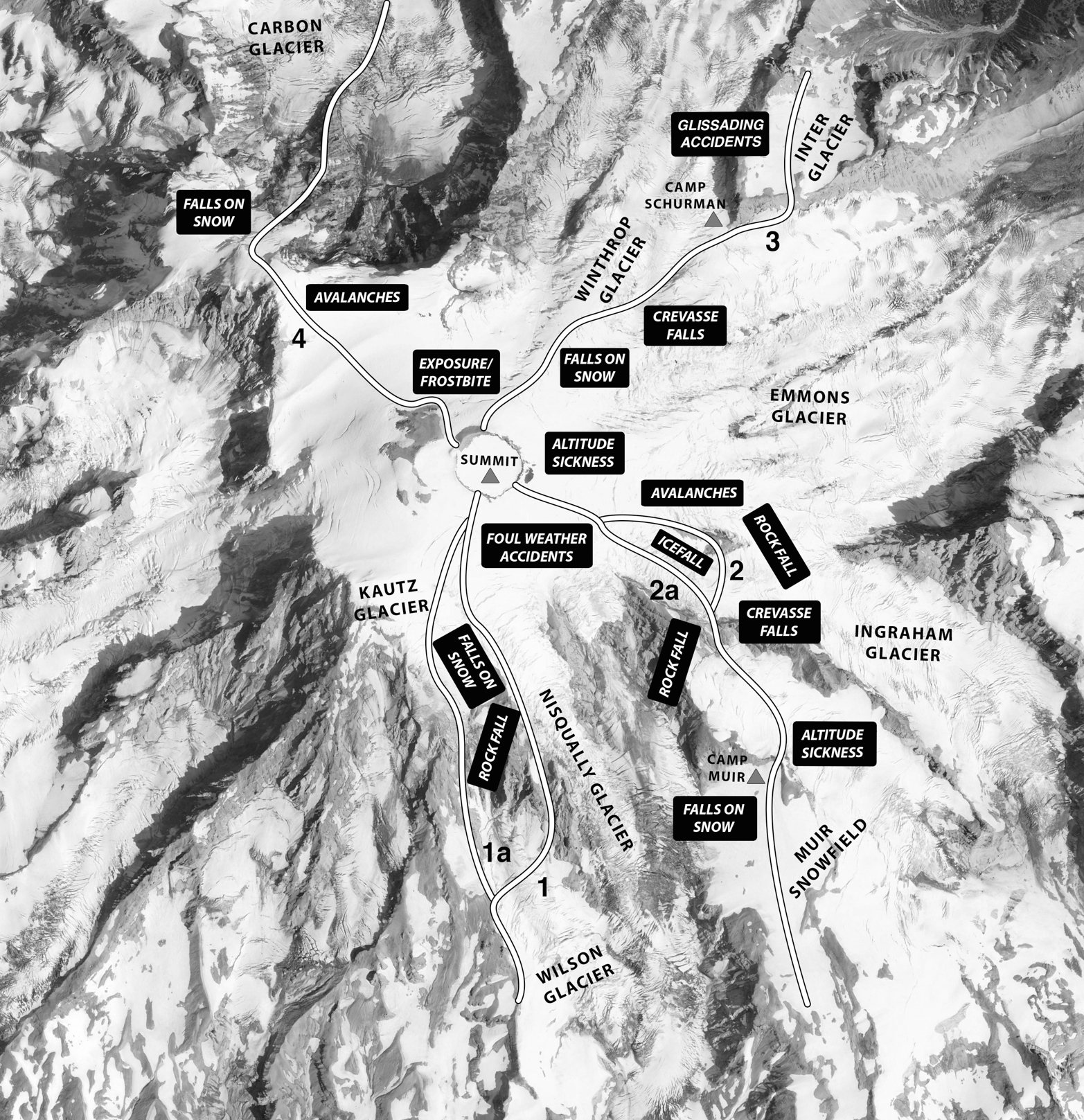
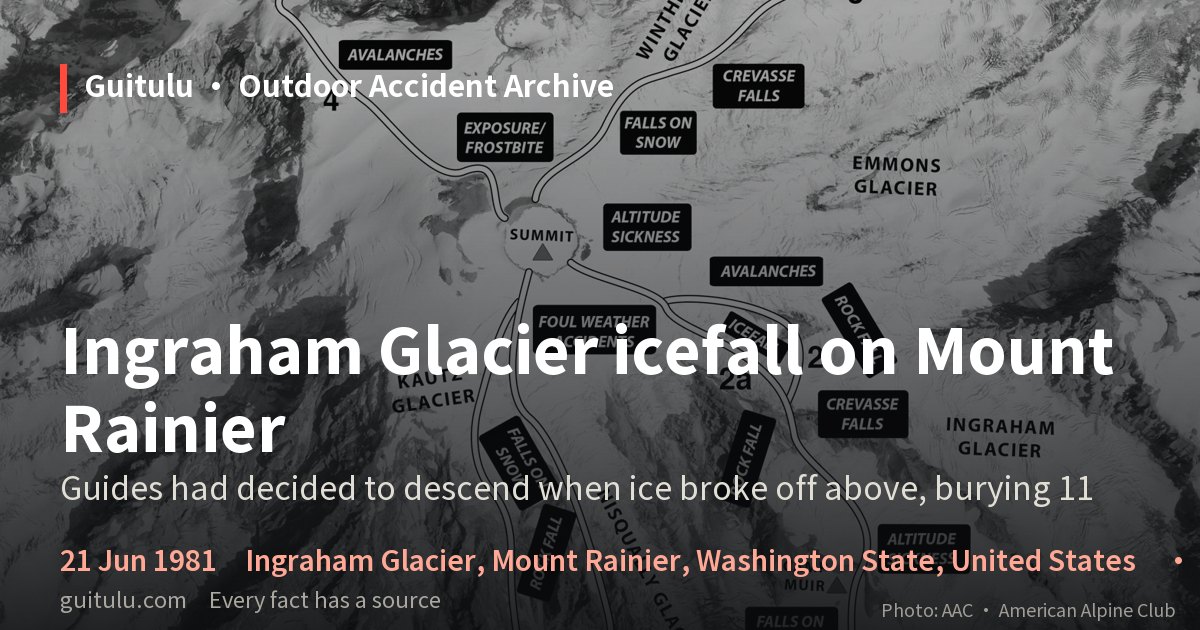
A diagram by the American Alpine Club showing the distribution of accidents on Mount Rainier, marking the locations of avalanche and falling ice accidents around Ingraham Glacier and Disappointment Cleaver

Archive / Mountaineering

Ingraham Glacier icefall on Mount Rainier

Guides had decided to descend when ice broke off above, burying 11 people in the glacier

National Park investigation committee determined the icefall was a random event caused by glacier movement and that the guides were not responsible

Photo: AAC · American Alpine Club

Date
Summer
Place
Ingraham Glacier, Mount Rainier, Washington State, United StatesUnited States › Washington · Cascade Range-121.734°E 46.845°N
Activity
MountaineeringInvolves: Avalanche29 people in an RMI commercial guided party (23 clients and 6 guides)
Casualties
Dead 11 11 people died (10 clients and 1 guide); their bodies have never been recovered
Material
43 facts · 7 sources3 accounts differ and are shown side by side

01What happened

On 21 June 1981, Father's Day, RMI, a concessionaire guide company in Mount Rainier National Park, organized a routine summit climb. The party consisted of 29 people, 23 clients and 6 guides, led by head guide John Day. The clients had just completed a one-day basic mountaineering course the day before and spent the night at Camp Muir. The plan was to take the standard route via Disappointment Cleaver.Facts it rests onF04Single sourceOn 21 June 1981 (Father's Day), RMI, a concessionaire mountaineering guide company in Mount Rainier National Park, organized a routine summit climb.F05Multiple sourcesThe party consisted of 29 people, including 23 clients and 6 RMI guides, led by chief guide John Day.F03Single sourceOn 20 June, the clients had just completed a day of basic mountaineering skills training, then ascended to Camp Muir at an altitude of about 10000 feet to spend the night.F08Single sourceThe planned route to the summit was via Disappointment Cleaver, commonly known as the “standard route”.

A diagram by the American Alpine Club showing the distribution of accidents on Mount Rainier, marking the locations of avalanche and falling ice accidents around Ingraham Glacier and Disappointment CleaverPhoto source: AAC · American Alpine Club

The party crossed the Cowlitz Glacier and passed Cathedral Gap and Ingraham Flats, reaching the foot of Disappointment Cleaver. Along the way, three clients became too tired to continue and were taken back to camp by a guide; the remaining 25 continued in 5 rope teams. According to reports, the avalanche danger forecast above 10000 feet was moderate to high at the time.Facts it rests onF09Single sourceThe party crossed the Cowlitz Glacier, passed through Cathedral Gap and across Ingraham Flats, and reached the base of Disappointment Cleaver.F10Multiple sourcesAlong the way, three clients felt unable to continue and were escorted back to Camp Muir by guide Chris Lynch.F11Multiple sourcesThe remaining 25 people (5 guides and 20 clients) continued toward the base of Disappointment Cleaver in 5 rope teams.F12Single sourceThe avalanche danger above 10000 feet was forecast as moderate to high, and Day had concerns about conditions on the slope.

Day and two other guides climbed onto the ridge and dug a snow pit to check the snow conditions. The remaining party members sat down to wait above a large crevasse, accompanied by two guides. After checking, Day decided to abandon the summit attempt and have the whole party descend. At about 5:45 a.m., ice broke off approximately 800 feet above, breaking into huge blocks that swept down the slope. The party members tried to escape, but most could not get out of the way in time.Facts it rests onF13Multiple sourcesGuides Day, Targett and Whittaker climbed Disappointment Cleaver to assess the snow conditions and avalanche danger, digging a snow pit to conduct tests.F14Multiple sourcesGuides Wilson and O'Brien stayed behind with the other party members as they waited in place.F15Single sourceThe 5 waiting rope teams stopped above a large crevasse, put away their ropes and sat down to wait.F16Multiple sourcesAfter inspecting the conditions, chief guide Day decided to abandon the summit attempt and have the entire party descend.F18Multiple sourcesAt about 5:45 a.m. (before 6 a.m.), the Ingraham Glacier icefall suddenly fractured, and the three guides heard a loud noise from the glacier above.F19Multiple sourcesAbout 800 feet above the waiting party members, a large mass of ice broke away, shattered into huge blocks and swept down the slope, forming an avalanche of ice and snow.F20Multiple sourcesThe party members tried to escape the path of the icefall, but most were unable to get out of the way in time.

11 people died, including 10 clients and one guide, Tom O'Brien. The surviving guides searched urgently but found only a few personal belongings. The weather then deteriorated rapidly, and the search was suspended. The next day, rescuers dug search trenches but found nothing. The search was stopped out of concern for the safety of search and rescue personnel, and the bodies were never found.Facts it rests onF21Multiple sourcesEleven people went missing and died in the icefall, including 10 clients and 1 guide.F22Multiple sourcesThe guide who died was Tom O'Brien.F24Multiple sourcesThe guides conducted an urgent search through the ice debris, finding only a few personal belongings near a crevasse. They did not find the missing people.F30Multiple sourcesAfter the incident, the weather at the scene quickly deteriorated, with heavy snow and extremely poor visibility, creating whiteout conditions.F31Single sourceThat day, ranger Olson suspended the search at the scene with the approval of park superintendent William Briggle.F34Multiple sourcesOn 22 June, the rescue team reached the site, dug search trenches and probed the ice debris, but did not find the victims.F02Multiple sourcesThe search was stopped mainly out of concern for the safety of search and rescue personnel: prolonged work in an area exposed to potential icefalls was too risky, and there was little hope.F38Multiple sourcesThe bodies of the 11 people who died were never found.

According to reports, the National Park Service investigation board issued a report on 20 August, concluding that the guides had followed the safest and most commonly used route, that the ice avalanche was a random event related to glacial movement, and that the guides were not responsible. The accident is still regarded as the deadliest mountaineering accident in the history of Mount Rainier and the United States.Facts it rests onF35Single sourceOn 20 August 1981, a National Park Service investigation board issued a report finding that the guides were not responsible for the incident.F36Single sourceThe investigation board found that the guides had led the party on the safest and most commonly used route and had rested in a sheltered position on Ingraham Flats; the icefall was a random event related to glacier movement.F40Multiple sourcesThis was the worst incident on record on Mount Rainier; the previous worst incidents, in 1959 and 1967, each killed 3 people.F41Multiple sourcesThe incident is considered the worst mountaineering accident in US history.

The number at the end of a paragraph is how many facts it rests on; open it to see each fact and how well it is sourced: Multiple sourcesSingle source. Conflicting accounts and speculation are kept out of the narrative.

  • Reported locations along the route (schematic)Schematic

Satellite imagery Sentinel-2 cloudless 2024 © EOX · Terrain AWS Terrain Tiles · Orange line is schematic · Place coordinates not individually verified

Route review

6 scenes to understand what happened

Scroll down and the map flies to where each part happened. The line is Schematic, Connects the locations mentioned in reports in order, showing only the approximate direction, not the actual track. Sources for the location coordinates are in places.json.

01

Full route

Locations mentioned in reports are connected in order to show the approximate route (illustrative).

04

Checking the ridge

Three guides climbed onto the ridge and dug a snow pit to check the snow conditions, while the remaining party members waited above a crevasse. A decision to descend followed.Facts it rests onF13Multiple sourcesGuides Day, Targett and Whittaker climbed Disappointment Cleaver to assess the snow conditions and avalanche danger, digging a snow pit to conduct tests.F15Single sourceThe 5 waiting rope teams stopped above a large crevasse, put away their ropes and sat down to wait.F16Multiple sourcesAfter inspecting the conditions, chief guide Day decided to abandon the summit attempt and have the entire party descend.

05

Icefall

At about 5:45 a.m., ice broke away above the party and swept down the slope, killing 11 people.Facts it rests onF18Multiple sourcesAt about 5:45 a.m. (before 6 a.m.), the Ingraham Glacier icefall suddenly fractured, and the three guides heard a loud noise from the glacier above.F19Multiple sourcesAbout 800 feet above the waiting party members, a large mass of ice broke away, shattered into huge blocks and swept down the slope, forming an avalanche of ice and snow.F21Multiple sourcesEleven people went missing and died in the icefall, including 10 clients and 1 guide.

06

Search

The weather rapidly worsened. The next day, rescuers dug a trench but found nothing, and the bodies were never found.Facts it rests onF30Multiple sourcesAfter the incident, the weather at the scene quickly deteriorated, with heavy snow and extremely poor visibility, creating whiteout conditions.F34Multiple sourcesOn 22 June, the rescue team reached the site, dug search trenches and probed the ice debris, but did not find the victims.F38Multiple sourcesThe bodies of the 11 people who died were never found.

02Timeline

  1. On 20 June, the clients had just completed a day of basic mountaineering skills training, then ascended to Camp Muir at an altitude of about 10000 feet to spend the night. F03

  2. At about 5:45 a.m. (before 6 a.m.), the Ingraham Glacier icefall suddenly fractured, and the three guides heard a loud noise from the glacier above. F18

  3. The guides conducted an urgent search through the ice debris, finding only a few personal belongings near a crevasse. They did not find the missing people. F24

  4. That day, ranger Olson suspended the search at the scene with the approval of park superintendent William Briggle. F31

  5. Guides Day, Targett and Whittaker climbed Disappointment Cleaver to assess the snow conditions and avalanche danger, digging a snow pit to conduct tests. F13

  6. Along the way, three clients felt unable to continue and were escorted back to Camp Muir by guide Chris Lynch. F10

  7. After inspecting the conditions, chief guide Day decided to abandon the summit attempt and have the entire party descend. F16

  8. On 21 June 1981 (Father's Day), RMI, a concessionaire mountaineering guide company in Mount Rainier National Park, organized a routine summit climb. F04

  9. Two guides led the surviving clients down to Camp Muir, while Day and others remained at the scene to continue searching. F28

  10. Eleven people went missing and died in the icefall, including 10 clients and 1 guide. F21

  11. On 22 June, the rescue team reached the site, dug search trenches and probed the ice debris, but did not find the victims. F34

  12. On 20 August 1981, a National Park Service investigation board issued a report finding that the guides were not responsible for the incident. F35

  13. On the anniversary of the incident, a bronze plaque bearing the names of those who died was installed at the Paradise visitor center as a permanent memorial. F37

03Lessons

Avalanche and high altitude

Icefalls can occur in any weather

A park spokesperson noted at the time that icefalls can occur at any time of year, regardless of weather, and are harder to predict than avalanches. Good weather at departure does not mean it is safe below a glacier.Facts it rests onF33Single sourcePark spokesperson Gary Gregory said at the time that icefalls could happen at any time, regardless of the weather, and were more dangerous and harder to predict than avalanches.F07Single sourceAccording to lead guide Day's later account, the weather was “excellent” when they set out.

Avalanche and high altitude

Minimize time below ice towers

The waiting party members stopped above a large crevasse, approximately 800 feet below the ice that broke off. AAC statistics show a high risk of icefall in the Ingraham Glacier area and recommend choosing colder days and moving through quickly to minimize exposure in the danger zone.Facts it rests onF15Single sourceThe 5 waiting rope teams stopped above a large crevasse, put away their ropes and sat down to wait.F19Multiple sourcesAbout 800 feet above the waiting party members, a large mass of ice broke away, shattered into huge blocks and swept down the slope, forming an avalanche of ice and snow.F42Single sourceAAC statistics show that routes including Ingraham Glacier and Disappointment Cleaver have the highest risks of avalanches, rockfall and icefall. Falling ice on Ingraham Glacier has also caused several other incidents.F43Single sourceAAC recommends choosing colder days to climb these routes and passing through quickly and efficiently to reduce exposure time.

Teams and decisions

A decision to descend also takes time

The guides had already decided to descend after checking the snow conditions when the icefall occurred. On glacial terrain, assessment, regrouping and turning around all take time. Earlier assessment and less time spent gathered in danger zones mean less exposure.Facts it rests onF12Single sourceThe avalanche danger above 10000 feet was forecast as moderate to high, and Day had concerns about conditions on the slope.F13Multiple sourcesGuides Day, Targett and Whittaker climbed Disappointment Cleaver to assess the snow conditions and avalanche danger, digging a snow pit to conduct tests.F16Multiple sourcesAfter inspecting the conditions, chief guide Day decided to abandon the summit attempt and have the entire party descend.F18Multiple sourcesAt about 5:45 a.m. (before 6 a.m.), the Ingraham Glacier icefall suddenly fractured, and the three guides heard a loud noise from the glacier above.

Rescue and self-rescue

Rescuer safety comes first

The weather deteriorated afterward, and a prolonged search in a potential icefall zone was too dangerous. Search and rescue was ultimately stopped for the safety of rescuers. After a large icefall, more people should not be put at risk for a slim hope.Facts it rests onF30Multiple sourcesAfter the incident, the weather at the scene quickly deteriorated, with heavy snow and extremely poor visibility, creating whiteout conditions.F02Multiple sourcesThe search was stopped mainly out of concern for the safety of search and rescue personnel: prolonged work in an area exposed to potential icefalls was too risky, and there was little hope.F31Single sourceThat day, ranger Olson suspended the search at the scene with the approval of park superintendent William Briggle.

04Fact list 43 facts

Under each fact is a verbatim quote from the original. "Single source" means only one outlet mentioned it; "Accounts differ" means sources contradict each other and this site adopts neither side; "Speculation" is an inference by a reporter or a person involved, not a fact.

  1. F01Accounts differAftermath

    Accounts differ on when the search and rescue operation was officially called off: AAC says it was at about 10 p.m. on 22 June (40 hours after the incident); HistoryLink says it was called off on the morning of 23 June, after the rescue team reported that further searching was hopeless.

    The two sources give different dates for the cancellation of the search

    Quotes from the original 2

    “On June 22, at approximately 10 p.m., 40 hours after the accident, search operations were called off.”

    AAC ·

    “On Tuesday morning, June 23, 1981, the rescue team radioed the ranger station at Paradise, advising that further search efforts would be fruitless as well as dangerous.”

    HistoryLink · 2014-08-23
  2. F02Multiple sourcesPost-incident analysis

    The search was stopped mainly out of concern for the safety of search and rescue personnel: prolonged work in an area exposed to potential icefalls was too risky, and there was little hope.

    Quotes from the original 2

    “primarily concerned with the safety of the search personnel”

    AAC ·

    “Prolonged and concentrated exposure to potential icefalls in this area would subject the team members to unwarranted dangers with little hope of success”

    HistoryLink · 2014-08-23
  3. F03Single sourcePlan

    According to HistoryLink, On 20 June, the clients had just completed a day of basic mountaineering skills training, then ascended to Camp Muir at an altitude of about 10000 feet to spend the night.

    Quotes from the original 1

    “They had just completed a demanding one-day course in basic mountain-climbing skills and were heading to Camp Muir (elevation 10,000 feet) to spend the night.”

    HistoryLink · 2014-08-23
  4. F04Single sourceBackground

    According to AAC, On 21 June 1981 (Father's Day), RMI, a concessionaire mountaineering guide company in Mount Rainier National Park, organized a routine summit climb.

    Quotes from the original 1

    “Rainier Mountaineering, Inc. (RMI), the professional climbing concessionaire at Mount Rainier National Park, was conducting a routine climb of the mountain on Father’s Day, June 21, 1981.”

    AAC ·
  5. F05Multiple sourcesBackground

    The party consisted of 29 people, including 23 clients and 6 RMI guides, led by chief guide John Day.

    Quotes from the original 3

    “John Day (22), senior guide for RMI, was leading the party of 29, which included 23 clients and six guides.”

    AAC ·

    “a group of 23 novice mountain climbers, lead by six professional Rainier Mountaineering Inc. guides departed Paradise Inn”

    HistoryLink · 2014-08-23

    “were part of a 29-member group attempting to reach the summit of the 14,410-foot peak”

    The New York Times (excerpted via US Deadly Events) ·
  6. F06Accounts differMovement

    Accounts differ on the departure time from Camp Muir: AAC says about 3:50 a.m.; HistoryLink says about 3:30 a.m.

    The departure times recorded by the two sources differ by about 20 minutes

    Quotes from the original 2

    “left their base camp at Camp Muir (10,000 feet) at approximately 3:50 a.m.”

    AAC ·

    “At approximately 3:30 a.m., the group started on the arduous trek to the summit”

    HistoryLink · 2014-08-23
  7. F07Single sourceEvent

    According to AAC, According to lead guide Day's later account, the weather was “excellent” when they set out.

    Quotes from the original 1

    “in weather that Day later described as “excellent.””

    AAC ·
  8. F08Single sourcePlan

    According to AAC, The planned route to the summit was via Disappointment Cleaver, commonly known as the “standard route”.

    Quotes from the original 1

    “The intended route was via Disappointment Cleaver, commonly called “the standard route.””

    AAC ·
  9. F09Single sourceMovement

    According to HistoryLink, The party crossed the Cowlitz Glacier, passed through Cathedral Gap and across Ingraham Flats, and reached the base of Disappointment Cleaver.

    Quotes from the original 1

    “The climbers traversed the Cowlitz Glacier, climbed through Cathedral Rocks Gap, and crossed Ingraham Flats to the base of Disappointment Cleaver”

    HistoryLink · 2014-08-23
  10. F10Multiple sourcesMovement

    Along the way, three clients felt unable to continue and were escorted back to Camp Muir by guide Chris Lynch.

    Quotes from the original 2

    “guide Chris Lynch (23) returned to Camp Muir with three clients who decided they could not continue.”

    AAC ·

    “three of the climbers decided to return to Camp Muir, stating that they didn’t have stamina to continue. Guide Christopher Lynch led them back down the mountainside.”

    HistoryLink · 2014-08-23
  11. F11Multiple sourcesMovement

    The remaining 25 people (5 guides and 20 clients) continued toward the base of Disappointment Cleaver in 5 rope teams.

    Quotes from the original 2

    “the remaining five roped teams consisting of 25 climbers proceeded to the base of Disappointment Cleaver.”

    AAC ·

    “5 guides and 20 clients en route to the summit are struck by an ice avalanche”

    NPS ·
  12. F12Single sourceBackground

    According to AAC, The avalanche danger above 10000 feet was forecast as moderate to high, and Day had concerns about conditions on the slope.

    Quotes from the original 1

    “The avalanche danger had been forecast as moderate to high above 10,000 feet and he was concerned about the slope conditions.”

    AAC ·
  13. F13Multiple sourcesEvent

    Guides Day, Targett and Whittaker climbed Disappointment Cleaver to assess the snow conditions and avalanche danger, digging a snow pit to conduct tests.

    Quotes from the original 2

    “Day and his fellow guides dug snow pits and checked the avalanche danger and general climbing conditions on the Cleaver.”

    AAC ·

    “guides John R. Day, Michael Targett, and Peter Whittaker ascended Disappointment Cleaver to scout snow conditions and avalanche danger on Emmons Glacier.”

    HistoryLink · 2014-08-23
  14. F14Multiple sourcesEvent

    Guides Wilson and O'Brien stayed behind with the other party members as they waited in place.

    Quotes from the original 2

    “Wilson, O’Brien, and the remaining climbers waited as a group”

    AAC ·

    “Guides Ronald G. Wilson and Thomas M. O’Brien stayed behind with the remaining 20 climbers.”

    HistoryLink · 2014-08-23
  15. F15Single sourceEvent

    According to AAC, The 5 waiting rope teams stopped above a large crevasse, put away their ropes and sat down to wait.

    Quotes from the original 1

    “the five roped teams stopped, coiled in their ropes, and sat down just above a large crevasse to wait for Day.”

    AAC ·
  16. F16Multiple sourcesEvent

    After inspecting the conditions, chief guide Day decided to abandon the summit attempt and have the entire party descend.

    Quotes from the original 2

    “so he made the decision to turn the climb around and go home.”

    AAC ·

    “senior guide John Day decided they shouldn’t continue the climb”

    HistoryLink · 2014-08-23
  17. F17Single sourcePost-incident analysis

    According to HistoryLink, One reason for the descent was that about two feet of new snow had fallen the previous night, and the party lacked experience dealing with it.

    Quotes from the original 1

    “Since the party hadn’t the experience to contend with two feet of fresh, unpredictable snow that had fallen over night”

    HistoryLink · 2014-08-23
  18. F18Multiple sourcesEvent

    At about 5:45 a.m. (before 6 a.m.), the Ingraham Glacier icefall suddenly fractured, and the three guides heard a loud noise from the glacier above.

    Quotes from the original 3

    “Around 5:45 a.m., just as Day, Whittaker, and Targett started back toward the waiting climbers, they heard a very loud crack or roar on the glacier above them.”

    AAC ·

    “Shortly before 6:00 a.m., without warning, the Ingraham Glacier icefall fractured.”

    HistoryLink · 2014-08-23

    “At 5:45 AM June 21, 1981 A Rainier Mountaineering Inc. (RMI) climbing party”

    NPS ·
  19. F19Multiple sourcesEvent

    About 800 feet above the waiting party members, a large mass of ice broke away, shattered into huge blocks and swept down the slope, forming an avalanche of ice and snow.

    Quotes from the original 2

    “Apparently, a very large serac or ice formation toppled over or let go about 800 vertical feet above the waiting”

    AAC ·

    “saw a wall of ice 300 feet wide fall 800 feet and shatter to pieces upon hitting the mountainside.”

    HistoryLink · 2014-08-23
  20. F20Multiple sourcesEvent

    The party members tried to escape the path of the icefall, but most were unable to get out of the way in time.

    Quotes from the original 2

    “most of them were unable to get clear before the snow and ice was upon them.”

    AAC ·

    “attempted to scramble out of harm’s way. But it was too late.”

    HistoryLink · 2014-08-23
  21. F21Multiple sourcesEvent

    Eleven people went missing and died in the icefall, including 10 clients and 1 guide.

    Quotes from the original 4

    “In fact, 11 climbers were missing and 11 others besides Day, Targett, and Wilson had survived the icefall or avalanche.”

    AAC ·

    “10 novice mountain climbers and one guide are killed by an immense avalanche of ice and snow on Ingraham Glacier”

    HistoryLink · 2014-08-23

    “The 11 missing persons, including 10 amateur climbers and one guide”

    The New York Times (excerpted via US Deadly Events) ·

    “In June, 1981, 11 climbers were killed in an ice fall.”

    KNKX · 2014-06-02
  22. F22Multiple sourcesEvent

    The guide who died was Tom O'Brien.

    Quotes from the original 2

    “The missing climbers included guide Tom O’Brien”

    AAC ·

    “11, including guide Tom O’Brien, did not.”

    HistoryLink · 2014-08-23
  23. F23Single sourceEvent

    According to The New York Times (excerpted via US Deadly Events), A report on the day of the incident said the other 18 people survived because they were not in the path of the icefall, and no injuries were reported.

    Quotes from the original 1

    “The 18 other climbers were not in the path of the cascading ice, which broke off a glacier, and escaped with their lives. There was no report of injuries in the group of survivors”

    The New York Times (excerpted via US Deadly Events) ·
  24. F24Multiple sourcesFound at scene

    The guides conducted an urgent search through the ice debris, finding only a few personal belongings near a crevasse. They did not find the missing people.

    Quotes from the original 2

    “Although eyeglasses and other minor personal effects were found, none of the missing climbers could be located above or in the crevasse itself.”

    AAC ·

    “found only a section of rope, a ski cap, a pair of ski goggles, and a headlamp near the edge of a deep crevasse.”

    HistoryLink · 2014-08-23
  25. F25SpeculationSpeculation

    The guides thought the missing people may have been swept into a crevasse or buried beneath large amounts of ice and snow debris.

    Quotes from the original 2

    “assumed that the missing climbers had either been swept into the crevasse or they were buried under an abundance of avalanche debris.”

    AAC ·

    “It appeared that the missing climbers had been swept into the crevasse and buried under tons of glacial ice.”

    HistoryLink · 2014-08-23
  26. F26Single sourceFound at scene

    According to The New York Times (excerpted via US Deadly Events), A report on the day of the incident said the missing people were buried beneath massive blocks of ice to a depth of 70 feet.

    Quotes from the original 1

    “buried by up to 70 feet of boulder-sized chunks of ice”

    The New York Times (excerpted via US Deadly Events) ·
  27. F27Multiple sourcesEvent

    Day reported the incident by radio to National Park Service personnel.

    AAC records that he contacted ranger Gary Olson at Camp Muir; HistoryLink records that he called the Paradise ranger station at 6:10 a.m.

    Quotes from the original 2

    “Day made radio contact with Ranger Gary Olson at Camp Muir and reported the accident”

    AAC ·

    “At 6:10 a.m. senior guide John Day radioed the National Park Service ranger station at Paradise”

    HistoryLink · 2014-08-23
  28. F28Multiple sourcesMovement

    Two guides led the surviving clients down to Camp Muir, while Day and others remained at the scene to continue searching.

    Quotes from the original 2

    “At 6:30 a.m. Wilson and Whittaker departed for Camp Muir with all but one of the surviving RMI clients”

    AAC ·

    “Day and two guides stayed at the crevasse while the other two guides led the surviving climbers down to Camp Muir.”

    HistoryLink · 2014-08-23
  29. F29Accounts differEvent

    Accounts differ on when the rangers arrived at the scene: AAC says about 9:00 a.m.; HistoryLink says 9:30 a.m.

    The two accounts differ by half an hour

    Quotes from the original 2

    “Olson, accompanied by other climbers, reached the accident site at approximately 9:00 a.m.”

    AAC ·

    “At 9:30 a.m., Ranger Gerry Olsen arrived at the crevasse to evaluate the situation.”

    HistoryLink · 2014-08-23
  30. F30Multiple sourcesEvent

    After the incident, the weather at the scene quickly deteriorated, with heavy snow and extremely poor visibility, creating whiteout conditions.

    Quotes from the original 2

    “The weather at the accident scene deteriorated with heavy snowfall and very poor visibility.”

    AAC ·

    “the weather deteriorated rapidly into whiteout conditions.”

    HistoryLink · 2014-08-23
  31. F31Single sourceAftermath

    According to AAC, That day, ranger Olson suspended the search at the scene with the approval of park superintendent William Briggle.

    Quotes from the original 1

    “Olson received permission from Park Superintendent William Briggle to suspend the search.”

    AAC ·
  32. F32Multiple sourcesEvent

    Mountain rescue personnel from Seattle and Tacoma took part in the search and rescue.

    Quotes from the original 2

    “other members of the Seattle and Tacoma Mountain Rescue teams”

    AAC ·

    “volunteers from the Seattle and Tacoma chapters of the Mountain Rescue Association”

    HistoryLink · 2014-08-23
  33. F33Single sourceParticipant's view

    According to The New York Times (excerpted via US Deadly Events), Park spokesperson Gary Gregory said at the time that icefalls could happen at any time, regardless of the weather, and were more dangerous and harder to predict than avalanches.

    Quotes from the original 1

    “He said it was ”more dangerous and unpredictable” than an avalanche because it could occur any time of year, regardless of weather conditions.”

    The New York Times (excerpted via US Deadly Events) ·
  34. F34Multiple sourcesEvent

    On 22 June, the rescue team reached the site, dug search trenches and probed the ice debris, but did not find the victims.

    Quotes from the original 2

    “During the day on Monday, June 22, rescue teams dug three trenches at the top of the crevasse and two near the bottom. No victims were found”

    AAC ·

    “They dug trenches and probed through the rubble, but came away empty handed.”

    HistoryLink · 2014-08-23
  35. F35Single sourceFound at scene

    According to HistoryLink, On 20 August 1981, a National Park Service investigation board issued a report finding that the guides were not responsible for the incident.

    Quotes from the original 1

    “On Wednesday, August 20, 1981, the board of inquiry issued a report that exonerated the guides from any responsibility for the accident.”

    HistoryLink · 2014-08-23
  36. F36Single sourceFound at scene

    According to HistoryLink, The investigation board found that the guides had led the party on the safest and most commonly used route and had rested in a sheltered position on Ingraham Flats; the icefall was a random event related to glacier movement.

    Quotes from the original 2

    “They had led the climbing party up the safest, most heavily traveled route to the summit and had paused to rest in a protected area on Ingraham Flats.”

    HistoryLink · 2014-08-23

    “The icefall avalanche was a random event and related to glacial movement.”

    HistoryLink · 2014-08-23
  37. F37Single sourceAftermath

    According to HistoryLink, On the anniversary of the incident, a bronze plaque bearing the names of those who died was installed at the Paradise visitor center as a permanent memorial.

    Quotes from the original 1

    “a brass plaque listing the names of those who had perished on the mountain on that day.”

    HistoryLink · 2014-08-23
  38. F38Multiple sourcesAftermath

    The bodies of the 11 people who died were never found.

    Quotes from the original 3

    “None of the bodies are recovered”

    NPS ·

    “Occasionally victims are never found, as in the case of 11 people swept to their deaths in an ice fall in 1981 in Mount Rainier’s deadliest accident.”

    HeraldNet · 2014-06-02

    “The bodies of the victims are entombed in a deep crevasse under tons of glacial ice and cannot be recovered.”

    HistoryLink · 2014-08-23
  39. F39Multiple sourcesBackground

    The incident occurred on Ingraham Glacier, between Disappointment Cleaver and Gibraltar Rock, below Disappointment Cleaver.

    Quotes from the original 2

    “on the Ingraham Glacier between Disappointment Cleaver and Gibraltar Rock.”

    HeraldNet · 2014-06-02

    “The deadliest accident in Rainier’s history occurred just below Disappointment Cleaver in 1981”

    AAC ·
  40. F40Multiple sourcesPost-incident analysis

    This was the worst incident on record on Mount Rainier; the previous worst incidents, in 1959 and 1967, each killed 3 people.

    Quotes from the original 2

    “But in the worst previous accidents, in 1959 and 1967, three climbers were killed”

    The New York Times (excerpted via US Deadly Events) ·

    “The deadliest accident in Rainier’s history occurred just below Disappointment Cleaver in 1981”

    AAC ·
  41. F41Multiple sourcesPost-incident analysis

    The incident is considered the worst mountaineering accident in US history.

    Quotes from the original 2

    “the worst climbing accident in United States history”

    AAC ·

    “remains the worst mountaineering accident in American history”

    HistoryLink · 2014-08-23
  42. F42Single sourcePost-incident analysis

    According to AAC, AAC statistics show that routes including Ingraham Glacier and Disappointment Cleaver have the highest risks of avalanches, rockfall and icefall. Falling ice on Ingraham Glacier has also caused several other incidents.

    Quotes from the original 2

    “Liberty Ridge, Ingraham Glacier, Disappointment Cleaver, and the Kautz Glacier have shown the greatest risk of avalanche, rockfall, and icefall.”

    AAC ·

    “Falling ice on the Ingraham Glacier has been the cause of several other incidents.”

    AAC ·
  43. F43Single sourcePost-incident analysis

    According to AAC, AAC recommends choosing colder days to climb these routes and passing through quickly and efficiently to reduce exposure time.

    Quotes from the original 1

    “Mountaineers should attempt to climb these routes on colder days to decrease the risk of falling rocks and ice. Moving quickly and efficiently decreases exposure”

    AAC ·