GuituluGlobal Outdoor Accident Archive 中文
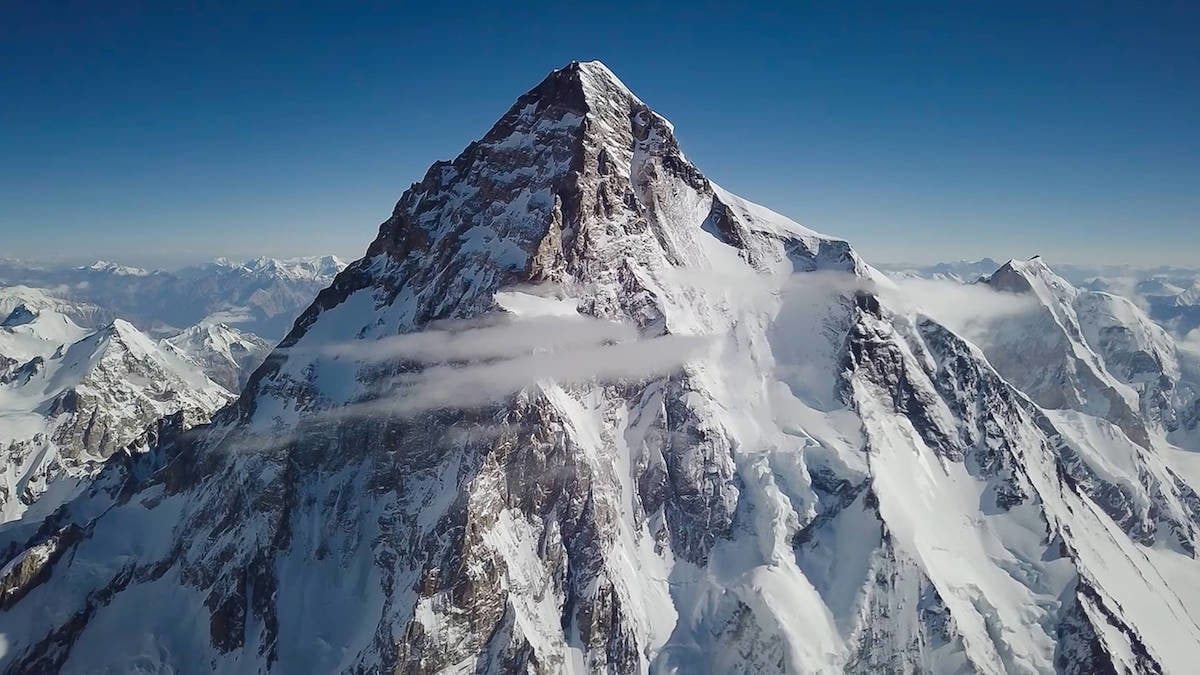
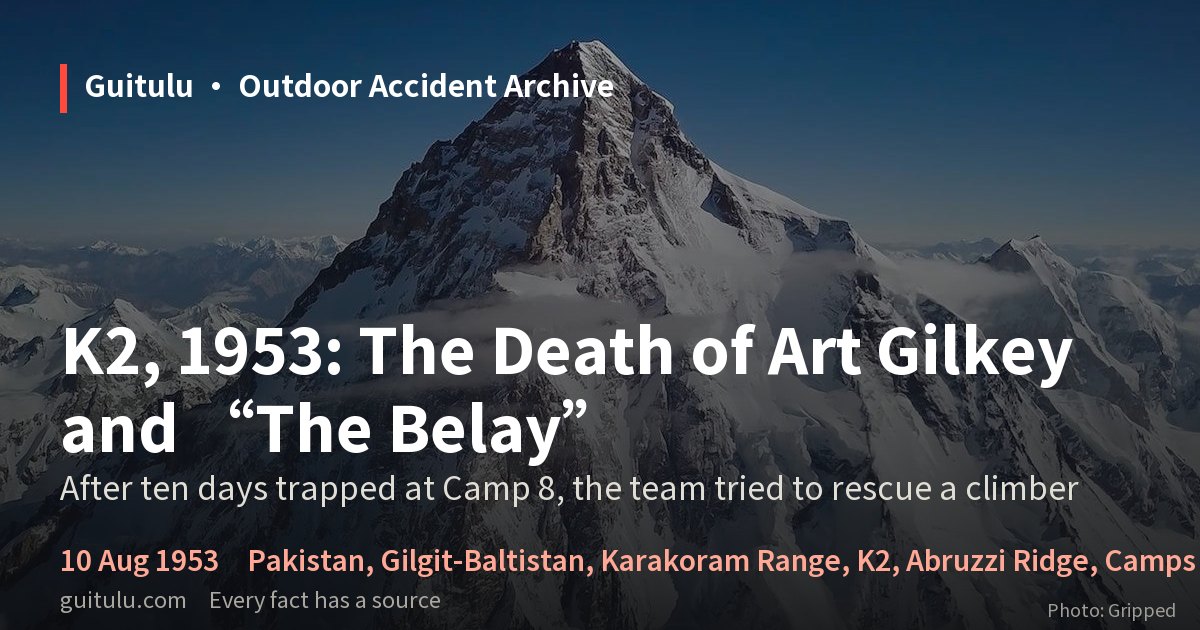
Full view of K2, which the American team attempted to climb via the Abruzzi Ridge in 1953

Archive / Mountaineering

K2, 1953: The Death of Art Gilkey and “The Belay”

After ten days trapped at Camp 8, the team tried to rescue a climber with blood clots; Schoening held his falling teammates, and Gilkey was swept away by an avalanche

Historical event; team members gave differing accounts of how Gilkey became detached from the anchor

Photo: Gripped

Date
Summer
Place
Pakistan, Gilgit-Baltistan, Karakoram Range, K2, Abruzzi Ridge, Camps 7–8Pakistan › Gilgit-Baltistan · Karakoram76.513°E 35.883°N
Activity
MountaineeringInvolves: Avalanche · Falls and slips · Extreme weather · Sudden illness and exhaustionThird American Karakoram Expedition (led by Charles Houston and Robert Bates), 8 climbers
Casualties
Dead 1 Art Gilkey died; his remains were found near base camp in 1993. Houston suffered a concussion and a cracked rib in the fall, Bell suffered severe frostbite to his hands and feet, and the other team members sustained frostbite or injuries of varying severity.
Material
45 facts · 7 sources2 accounts differ and are shown side by side

01What happened

In 1953, Charles Houston and Robert Bates led an American Karakoram expedition in an attempt to make the first ascent of K2, which had yet to be climbed, via the Abruzzi Ridge. The climbing team consisted of 8 people, including Art Gilkey, a geologist from Iowa. After the partition of India and Pakistan, Sherpas could not work in Pakistan. Hunza porters carried supplies only as far as Camp 3; above that, the team members had to carry everything themselves. The entire team climbed without supplemental oxygen.Facts it rests onF01Multiple sourcesIn 1953, Charles Houston and Robert Bates led an American Karakoram expedition in an attempt to make the first ascent of K2, then the highest mountain in the world that had not been summited.F02Multiple sourcesThe climbing team had 8 members: Houston, Bates, Gilkey, Schoening, George Bell, Tony Streather, Dee Molenaar and Bob Craig. Their route was the Abruzzi Ridge.F36Multiple sourcesArt Gilkey was born in Colorado in 1926, grew up in Iowa, and was a geologist.F03Multiple sourcesAfter the partition of India and Pakistan, Sherpas could not work in Pakistan, so the team used Hunza porters instead. The porters carried supplies only as far as Camp 3; above that, the team members carried everything themselves.F04Multiple sourcesThe team did not use supplemental oxygen.

Full view of K2, which the American team attempted to climb via the Abruzzi Ridge in 1953Photo source: Gripped

According to Streather's account, the team set out on foot from Skardu on 5 June, established Camp 4 on 16 July, and reunited at Camp 6 at the end of July. Gilkey and Schoening opened a new route up the steep ice slope below Camp 8, whose altitude was estimated at about 25500 feet. On 2 August, all 8 gathered at Camp 8. The plan was to wait for the weather to improve, then establish Camp 9 at about 27000 feet for a summit attempt.Facts it rests onF07Single sourceOn 5 June, the team crossed the Indus River at Skardu and began a trek of about two weeks to base camp.F08Single sourceCamp 4 was established on 16 July; by the end of July, the whole team had regrouped at Camp 6, at an altitude of about 23400 feet.F10Multiple sourcesGilkey and Schoening opened a previously unclimbed route up the steep ice slope below Camp 8; the camp's altitude was estimated at about 25500 feet.F15Multiple sourcesStarting on 1 August, team members moved into Camp 8 in stages. After Bates and Streather arrived on 2 August, all 8 were together at Camp 8.F16Single sourceAt the time, Camp 8 had enough food and fuel for at least ten days and was less than 3000 feet from the summit. The plan was to establish Camp 9 at about 27000 feet and make a summit attempt once the weather improved.

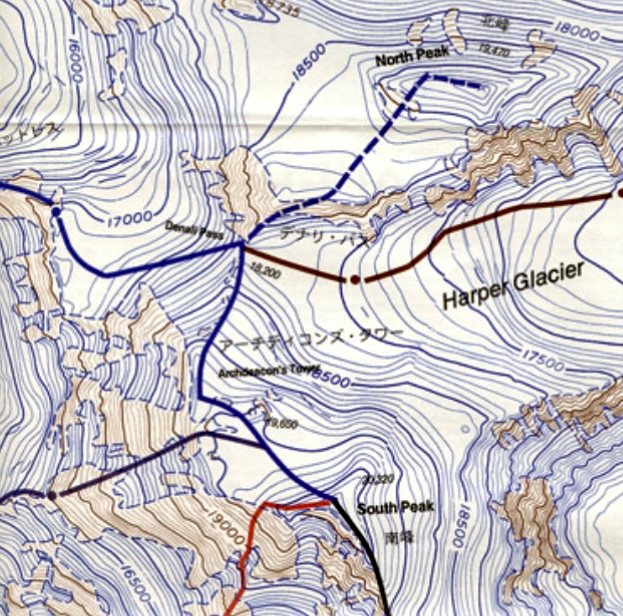
Old photograph of K2, with the climbing route marked by a red dashed linePhoto source: Gripped

A storm then trapped the entire team for about ten days. The stove could not be lit inside the shaking tents, and the climbers could drink only a little water each day. The weather briefly improved on 7 August, but Gilkey fainted with pain in his leg. Houston diagnosed thrombophlebitis, and the team immediately abandoned the summit attempt. The first descent attempt turned back because fresh snow posed an avalanche risk; Craig and Schoening then scouted another route along a ridge of rock, ice and snow. By 10 August, Gilkey had blood clots in both legs that had reached his lungs, and the team's food and fuel were running low.Facts it rests onF12Multiple sourcesThe team was trapped by the storm above 25000 feet for about ten days.F11Multiple sourcesThe storm continued without letup, the tents shook violently, and the stoves could not be lit. The team members could drink very little water each day and were dehydrated.F17Multiple sourcesThe weather briefly improved on 7 August, but Gilkey collapsed with leg pain, and Houston diagnosed thrombophlebitis.F18Multiple sourcesThe whole team then abandoned the summit attempt and decided to devote all their efforts to getting Gilkey down the mountain.F19Multiple sourcesOn 7 August, they made a first attempt to lower Gilkey, but a large amount of fresh snow had accumulated on the slope, creating a risk of triggering an avalanche, and they had to return to Camp 8.F20Multiple sourcesCraig and Schoening scouted an alternative descent route: down a ridge of rock, ice and snow along the south side of the snow slope, avoiding the avalanche-prone slope but departing from the ascent route.F21Multiple sourcesBy 10 August, Gilkey had blood clots in both legs, and the clots had reached his lungs. His condition was critical.F22Multiple sourcesBy then, the team was also short of food and fuel. Everyone was cold and dehydrated, and in worse physical condition than they realized.

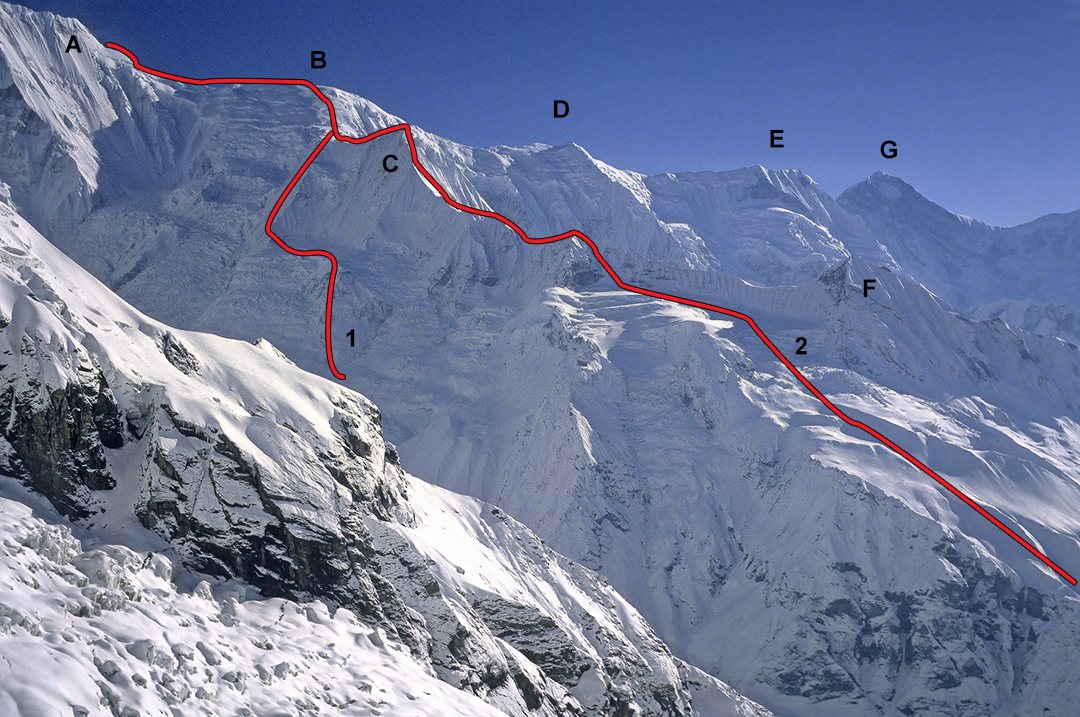
Diagram of the fall during “The Belay”, showing the positions of the team members, the ice slope and Camp 7Photo source: Gripped

On 10 August, with the storm still raging, the team wrapped Gilkey in sleeping bags and a tent to make an improvised stretcher and lowered him down. On a steep ice slope, George Bell slipped and pulled down his ropemate Streather. Their rope became entangled with the others' ropes, and 5 people in total were pulled off the ice slope. Schoening, who was lowering Gilkey, braked with his ice axe and body, holding the 5 falling climbers and Gilkey on his own. The nylon rope stretched thin but did not break. This moment later became known as “The Belay”. Houston suffered a concussion and a cracked rib in the fall, while Bell suffered severe frostbite to his hands and feet.Facts it rests onF23Multiple sourcesOn 10 August, with the storm still continuing, the team wrapped Gilkey in sleeping bags and a tent to make an improvised stretcher and began descending by a new route.F25Multiple sourcesOn a steep ice slope, George Bell slipped, pulling down his rope partner Streather. Their rope became tangled with the others' ropes, and a total of 5 people were pulled off the ice slope.F26Multiple sourcesAt the time, only Schoening, who was lowering Gilkey, had a secure belay anchor. He used his ice axe and body to arrest the fall, holding the 5 falling climbers and Gilkey on his own.F27Multiple sourcesThe 7/16-inch nylon rope was stretched to only about half its original thickness, but did not break.F38Multiple sourcesThe arrest of the fall later became known in mountaineering as “The Belay”.F29Multiple sourcesSeveral people were injured: Houston suffered a concussion and a fractured rib, Bell had severe frostbite on his hands and feet, and everyone had frostbite to varying degrees.

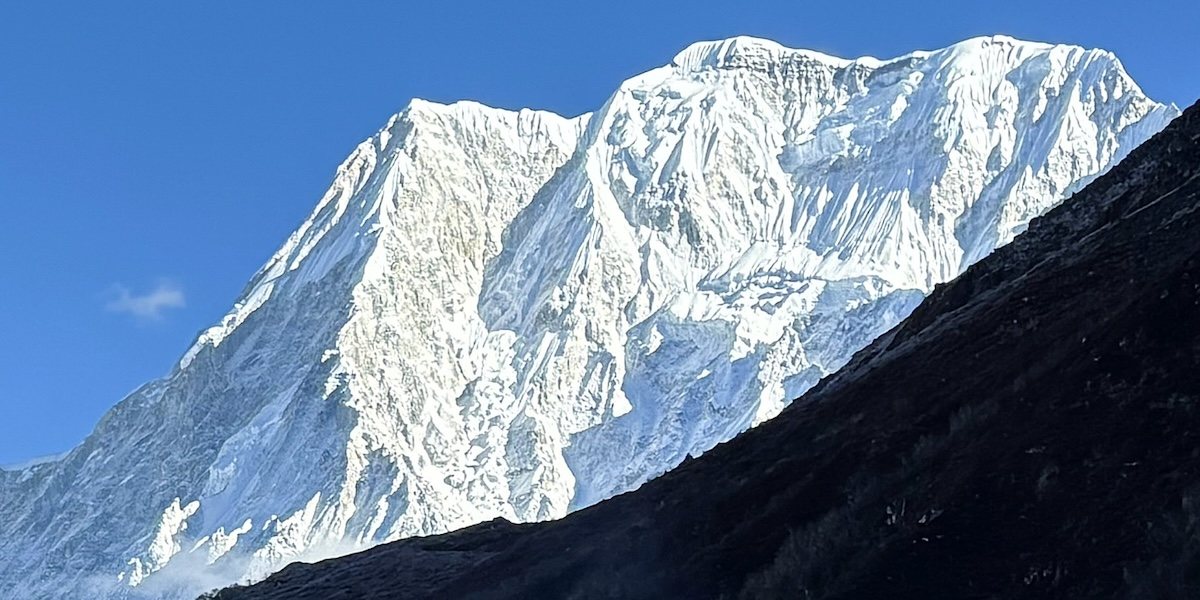
K2 massifPhoto source: Alpinist

To attend to the injured first, the team secured Gilkey to the snow slope with ice axes. When Bates, Streather and Craig returned for him, both he and the ice axes were gone, and there were signs of an avalanche on the slope. Gilkey died. The other 7 retreated to base camp with their injuries and built a memorial cairn for him at the junction of the Savoy and Godwin-Austen glaciers. In 1993, a British climbing team found his remains near K2 base camp; Schoening's ice axe is now on display at the American Mountaineering Museum in Colorado.Facts it rests onF30Multiple sourcesTo get the injured climbers into the tent at Camp 7 first, the team secured Gilkey to the snow slope with an ice axe and left him there temporarily.F32Multiple sourcesAfter getting the injured climbers settled, Bates, Streather and Craig went back for Gilkey, but found that both he and the ice axe securing him were gone, and that traces of an avalanche remained on the slope.F33Multiple sourcesGilkey was swept away by an avalanche and died on 10 August 1953.F14Multiple sourcesThe team built a memorial cairn for Gilkey on a rocky spur at the junction of the Savoia Glacier and the K2 Glacier (Godwin-Austen Glacier).F34Multiple sourcesIn 1993, a British mountaineering team found Gilkey's remains near K2 Base Camp.F45Multiple sourcesSchoening's ice axe from the expedition is now on display at the American Mountaineering Museum in Golden, Colorado.

The number at the end of a paragraph is how many facts it rests on; open it to see each fact and how well it is sourced: Multiple sourcesSingle source. Conflicting accounts and speculation are kept out of the narrative.

  • Reported locations along the route (schematic)Schematic

Satellite imagery Sentinel-2 cloudless 2024 © EOX · Terrain AWS Terrain Tiles · Orange line is schematic · Place coordinates not individually verified

Route review

6 scenes to understand what happened

Scroll down and the map flies to where each part happened. The line is Schematic, Lines connect the locations mentioned in reports in sequence, indicating only the approximate direction, not the actual track. Sources for the location coordinates are in places.json.

01

Full route

Locations mentioned in the reports are connected in sequence to show the approximate route (schematic).

04

The Belay

During the descent with Gilkey on 10 August, 5 people were pulled off an ice slope. Schoening held everyone with his ice axe, on his own.Facts it rests onF25Multiple sourcesOn a steep ice slope, George Bell slipped, pulling down his rope partner Streather. Their rope became tangled with the others' ropes, and a total of 5 people were pulled off the ice slope.F26Multiple sourcesAt the time, only Schoening, who was lowering Gilkey, had a secure belay anchor. He used his ice axe and body to arrest the fall, holding the 5 falling climbers and Gilkey on his own.

05

The empty space on the snow slope

When the team members returned for Gilkey, who had been secured on the snow slope, both he and the ice axe were gone, and traces of an avalanche remained on the slope.Facts it rests onF32Multiple sourcesAfter getting the injured climbers settled, Bates, Streather and Craig went back for Gilkey, but found that both he and the ice axe securing him were gone, and that traces of an avalanche remained on the slope.F33Multiple sourcesGilkey was swept away by an avalanche and died on 10 August 1953.

02Timeline

  1. On 5 June, the team crossed the Indus River at Skardu and began a trek of about two weeks to base camp. F07

  2. Camp 4 was established on 16 July; by the end of July, the whole team had regrouped at Camp 6, at an altitude of about 23400 feet. F08

  3. Starting on 1 August, team members moved into Camp 8 in stages. After Bates and Streather arrived on 2 August, all 8 were together at Camp 8. F15

  4. On 7 August, they made a first attempt to lower Gilkey, but a large amount of fresh snow had accumulated on the slope, creating a risk of triggering an avalanche, and they had to return to Camp 8. F19

  5. The weather briefly improved on 7 August, but Gilkey collapsed with leg pain, and Houston diagnosed thrombophlebitis. F17

  6. Gilkey was swept away by an avalanche and died on 10 August 1953. F33

  7. On a steep ice slope, George Bell slipped, pulling down his rope partner Streather. Their rope became tangled with the others' ropes, and a total of 5 people were pulled off the ice slope. F25

  8. By 10 August, Gilkey had blood clots in both legs, and the clots had reached his lungs. His condition was critical. F21

  9. At the time, only Schoening, who was lowering Gilkey, had a secure belay anchor. He used his ice axe and body to arrest the fall, holding the 5 falling climbers and Gilkey on his own. F26

  10. On 10 August, with the storm still continuing, the team wrapped Gilkey in sleeping bags and a tent to make an improvised stretcher and began descending by a new route. F23

  11. In 1993, a British mountaineering team found Gilkey's remains near K2 Base Camp. F34

03Lessons

Rescue and self-rescue

Evacuation of an injured or ill climber is almost impossible at extreme altitude

At a high camp on an 8000-metre peak, one team member becoming unable to move means that the whole team must take risks. An AAJ book review considered this the central dilemma of the expedition; Streather also believed that continuing to carry Gilkey through more difficult terrain would inevitably lead to more accidents. Before setting out, teams need to think through what they can do if someone becomes ill or injured at altitude.Facts it rests onF43Single sourceThe AAJ book review held that the central problem of the expedition was that one team member became unable to move at an extreme altitude: evacuation was almost impossible, while attempting it could cost the entire team their lives.F41Multiple sourcesStreather later believed that if they had continued carrying Gilkey down into more difficult terrain, more and more serious accidents would inevitably have occurred. The AAJ book reviewer also believed that without the avalanche, the remaining team members might all have died.

Avalanche and high altitude

The longer the wait, the weaker the team

During the storm, the stove could not be lit and the climbers could not get water to drink. Trapped at Camp 8 for about ten days, they were weaker than they realised. According to an AAJ book review, this gradual weakening made their predicament worse when they were later forced to descend. Waiting for weather at a high camp also requires accounting for physical reserves and remaining fuel.Facts it rests onF11Multiple sourcesThe storm continued without letup, the tents shook violently, and the stoves could not be lit. The team members could drink very little water each day and were dehydrated.F12Multiple sourcesThe team was trapped by the storm above 25000 feet for about ten days.F22Multiple sourcesBy then, the team was also short of food and fuel. Everyone was cold and dehydrated, and in worse physical condition than they realized.F42Single sourceThe AAJ book review held that the entire team's week at about 25500 feet, during which they grew progressively weaker, made their predicament worse when they were forced to descend. The stoves performed poorly in the extreme conditions, showing that stove design still needed improvement.

Weather and retreat

Do not treat bad weather as a brief interruption

According to Streather's account, the team believed, based on previous records, that the monsoon had little effect on the Karakoram and that the bad weather was only local. The storm lasted about ten days. An optimistic assessment of the weather can lead a team to remain at altitude too long.Facts it rests onF09Single sourceAt the time, the team members believed, based on previous records, that the monsoon had little effect on the Karakoram and thought the bad weather was only a brief local episode.F12Multiple sourcesThe team was trapped by the storm above 25000 feet for about ten days.

Teams and decisions

A group on multiple ropes needs a genuinely secure belay anchor

One person slipped, several ropes became tangled, and 5 people were pulled off the ice slope at once. At the time, only Schoening had a secure belay anchor, and it held everyone. When a group moves together on steep terrain, the reliability of the anchor determines whether one slip becomes a fall involving the whole team.Facts it rests onF25Multiple sourcesOn a steep ice slope, George Bell slipped, pulling down his rope partner Streather. Their rope became tangled with the others' ropes, and a total of 5 people were pulled off the ice slope.F26Multiple sourcesAt the time, only Schoening, who was lowering Gilkey, had a secure belay anchor. He used his ice axe and body to arrest the fall, holding the 5 falling climbers and Gilkey on his own.

04Fact list 45 facts

Under each fact is a verbatim quote from the original. "Single source" means only one outlet mentioned it; "Accounts differ" means sources contradict each other and this site adopts neither side; "Speculation" is an inference by a reporter or a person involved, not a fact.

  1. F01Multiple sourcesBackground

    In 1953, Charles Houston and Robert Bates led an American Karakoram expedition in an attempt to make the first ascent of K2, then the highest mountain in the world that had not been summited.

    Quotes from the original 3

    “In 1953, the American Karakoram Expedition attempted the first ascent of K2, which at that time was the highest mountain in the world that had not been climbed.”

    Gripped · 2025-12-27

    “Houston was to lead another team of Americans, determined to finish a job he had started many years before”

    Himalayan Journal ·

    “This book is the well written story of the third American attack on the second highest mountain in the world.”

    AAJ ·
  2. F02Multiple sourcesBackground

    The climbing team had 8 members: Houston, Bates, Gilkey, Schoening, George Bell, Tony Streather, Dee Molenaar and Bob Craig. Their route was the Abruzzi Ridge.

    Quotes from the original 2

    “The climbing team consisted of eight members: Houston, Bates, Art Gilkey, Pete Schoening, George Bell, Tony Streather, Dee Molenaar, and Robert Craig.”

    Gripped · 2025-12-27

    “In 1953 Bob Craig, Dee Molenaar, Pete Schoening, George Bell, Art Gilkey, Charlie Houston, Tony Streather and Bob Bates were attempting what would become the Abruzzi Ridge.”

    Alpinist · 2015-01-18
  3. F03Multiple sourcesBackground

    After the partition of India and Pakistan, Sherpas could not work in Pakistan, so the team used Hunza porters instead. The porters carried supplies only as far as Camp 3; above that, the team members carried everything themselves.

    Quotes from the original 3

    “Due to political conditions following the partition of India, Sherpa were not allowed to work in Pakistan.”

    Gripped · 2025-12-27

    “They carried loads with us to III, but from then on all the carrying had to be done by ourselves.”

    Himalayan Journal ·

    “the climbers from Hunza carried loads all the way to Camp III”

    The Friday Times · 2020-09-25
  4. F04Multiple sourcesPlan

    The team did not use supplemental oxygen.

    Quotes from the original 2

    “We had no oxygen and did not plan to use it on our summit bid.”

    Himalayan Journal ·

    “the team carried all loads themselves and used no supplemental oxygen”

    Gripped · 2025-12-27
  5. F05Single sourceBackground

    According to The Friday Times, The ice axe Schoening used had been brought at the insistence of his friend Tom Miller, who had replaced its wooden shaft with stronger hickory.

    Quotes from the original 1

    “Tom had replaced the shaft of his axe with a much stronger length of hickory, and insisted that Pete take it to K2.”

    The Friday Times · 2020-09-25
  6. F06Accounts differMovement

    Accounts differ on the date of arrival at base camp: Streather wrote 19 June in the Himalayan Journal; The Friday Times gives 20 June.

    The two accounts differ by one day

    Quotes from the original 2

    “We reached our Base Camp on 19th June, at about 16,500 feet, at the foot of the south ridge of K2.”

    Himalayan Journal ·

    “they arrived at the base camp on 20 June 1953”

    The Friday Times · 2020-09-25
  7. F07Single sourceMovement

    According to Himalayan Journal, On 5 June, the team crossed the Indus River at Skardu and began a trek of about two weeks to base camp.

    Quotes from the original 1

    “On the 5th of June all was ready, and having crossed the Indus in 'Alexander's Barge' we set out on our two-week trek to Base Camp.”

    Himalayan Journal ·
  8. F08Single sourceMovement

    According to Himalayan Journal, Camp 4 was established on 16 July; by the end of July, the whole team had regrouped at Camp 6, at an altitude of about 23400 feet.

    Quotes from the original 2

    “on 16th July established Camp IV”

    Himalayan Journal ·

    “The climb to Camp VI, 23,400 feet, was again a short one and this camp was fully established, with all of us there, by the end of July.”

    Himalayan Journal ·
  9. F09Single sourcePost-incident analysis

    According to Himalayan Journal, At the time, the team members believed, based on previous records, that the monsoon had little effect on the Karakoram and thought the bad weather was only a brief local episode.

    Quotes from the original 1

    “All previous records had shown that the monsoon has little effect in the Karakoram and we did not believe that this was more than a local spell of bad weather.”

    Himalayan Journal ·
  10. F10Multiple sourcesMovement

    Gilkey and Schoening opened a previously unclimbed route up the steep ice slope below Camp 8; the camp's altitude was estimated at about 25500 feet.

    Quotes from the original 2

    “His feat with Peter Schoening of cutting steps up the steep ice below Camp VIII, a route never made before, was an admirable piece of mountaineering.”

    AAJ · 1954

    “We later estimated the height of this camp, Camp VIII, to be 25,500 feet.”

    Himalayan Journal ·
  11. F11Multiple sourcesEvent

    The storm continued without letup, the tents shook violently, and the stoves could not be lit. The team members could drink very little water each day and were dehydrated.

    Quotes from the original 2

    “The stoves would not stay alight in the flapping tents, so we were not able to get more than a cup or two of liquid to drink”

    Himalayan Journal ·

    “Dehydrated from days of storm that almost prevented use of the stoves for melting snow for drinking purposes”

    AAJ ·
  12. F12Multiple sourcesEvent

    The team was trapped by the storm above 25000 feet for about ten days.

    Quotes from the original 3

    “ten days of that month we had been trapped at over 25,000 feet by the worst of storms”

    Himalayan Journal ·

    “A ten-day blizzard sweeps over the mountain”

    AAJ ·

    “after ten nights and eleven days at 25,500 feet”

    Alpinist · 2015-01-18
  13. F13Single sourceMovement

    According to Himalayan Journal, The next day, the 7 men descended to Camp 6, then took about four more days to reach Camp 2, where Hunza porters met them.

    Quotes from the original 3

    “late that afternoon we reached Camp VI”

    Himalayan Journal ·

    “The Hunzas were there to meet us”

    Himalayan Journal ·

    “It was four days before we eventually reached Camp II.”

    Himalayan Journal ·
  14. F14Multiple sourcesAftermath

    The team built a memorial cairn for Gilkey on a rocky spur at the junction of the Savoia Glacier and the K2 Glacier (Godwin-Austen Glacier).

    Quotes from the original 3

    “The memorial cairn erected to Art by the expedition at the confluence of the Godwin-Austen and Savoia Glaciers”

    AAJ · 1954

    “The Golonel had built a splendid cairn on the spur of rock which juts out between the Savoia and K2 glaciers.”

    Himalayan Journal ·

    “Before leaving the area, the team built a memorial to Gilkey, which is still present.”

    Gripped · 2025-12-27
  15. F15Multiple sourcesMovement

    Starting on 1 August, team members moved into Camp 8 in stages. After Bates and Streather arrived on 2 August, all 8 were together at Camp 8.

    Quotes from the original 2

    “Such was the position when Bates and I reached Camp VIII on 2nd August.”

    Himalayan Journal ·

    “By Aug. 1, 1953, the team had reached Camp VIII at approximately 7,800 metres.”

    Gripped · 2025-12-27
  16. F16Single sourcePlan

    According to Himalayan Journal, At the time, Camp 8 had enough food and fuel for at least ten days and was less than 3000 feet from the summit. The plan was to establish Camp 9 at about 27000 feet and make a summit attempt once the weather improved.

    Quotes from the original 3

    “with food and fuel to last us for at least ten days”

    Himalayan Journal ·

    “we were less than 3,000 feet from the summit”

    Himalayan Journal ·

    “On the first clear day we would all carry loads to Camp IX, which we hoped establish at about 27,000 feet.”

    Himalayan Journal ·
  17. F17Multiple sourcesEvent

    The weather briefly improved on 7 August, but Gilkey collapsed with leg pain, and Houston diagnosed thrombophlebitis.

    Quotes from the original 6

    “the clouds were clearing and the sun was shining although the wind was still blowing strongly”

    Himalayan Journal ·

    “Gilkey complained of pain in one of his legs”

    Himalayan Journal ·

    “Houston looked at it and soon diagnosed thrombophlebitis!”

    Himalayan Journal ·

    “On Aug. 7, Gilkey collapsed outside his tent at Camp VIII. Houston diagnosed him with thrombophlebitis”

    Gripped · 2025-12-27

    “We’d tried to descend with Art on August 7 when he first collapsed”

    Alpinist · 2015-01-18

    “In critical condition from thrombophlebitis suffered at an altitude of 25,500 feet on K2”

    AAJ · 1954
  18. F18Multiple sourcesEvent

    The whole team then abandoned the summit attempt and decided to devote all their efforts to getting Gilkey down the mountain.

    Quotes from the original 3

    “All our plans of going higher were abandoned and we set about preparing to carry Art down.”

    Himalayan Journal ·

    “Without hesitation, the team elected to abandon the attempt on the summit and devote all their energy to getting him off the mountain.”

    The Friday Times · 2020-09-25

    “The team decided to abandon the summit attempt and begin a descent to evacuate Gilkey.”

    Gripped · 2025-12-27
  19. F19Multiple sourcesEvent

    On 7 August, they made a first attempt to lower Gilkey, but a large amount of fresh snow had accumulated on the slope, creating a risk of triggering an avalanche, and they had to return to Camp 8.

    Quotes from the original 2

    “We soon realized that we were in grave danger of starting an avalanche and we were forced to return and reestablish Camp VIII.”

    Himalayan Journal ·

    “three feet of new snow covered the ice slope and the fixed rope, waiting to avalanche, and we had to return to Camp VIII.”

    Alpinist · 2015-01-18
  20. F20Multiple sourcesEvent

    Craig and Schoening scouted an alternative descent route: down a ridge of rock, ice and snow along the south side of the snow slope, avoiding the avalanche-prone slope but departing from the ascent route.

    Quotes from the original 3

    “Craig and Schoening set out to find an alternative route and reported a steep rock and ice ridge some hundred yards to the south of the snow slope.”

    Himalayan Journal ·

    “Later that day, Pete and I reconnoitered an escape route down a rock and snow ridge”

    Alpinist · 2015-01-18

    “the party nevertheless attempts to lower Gilkey down a ridge that is safe from avalanches but away from the route they had used on the ascent”

    AAJ ·
  21. F21Multiple sourcesEvent

    By 10 August, Gilkey had blood clots in both legs, and the clots had reached his lungs. His condition was critical.

    Quotes from the original 3

    “Both his legs were now affected and clots of blood had moved to his lungs.”

    Himalayan Journal ·

    “Art was now close to death from phlebitis in both legs, with clots in his lungs.”

    Alpinist · 2015-01-18

    “Climber Art Gilkey developed a deadly blood clot in his lungs”

    The Seattle Times · 2004-09-24
  22. F22Multiple sourcesEvent

    By then, the team was also short of food and fuel. Everyone was cold and dehydrated, and in worse physical condition than they realized.

    Quotes from the original 3

    “We were much weaker than we realized since the effects of altitude weren’t well understood at the time.”

    Alpinist · 2015-01-18

    “We were suffering particularly from dehydration, for we had not been able to melt much snow”

    Himalayan Journal ·

    “we were running low on food and fuel.”

    Alpinist · 2015-01-18
  23. F23Multiple sourcesEvent

    On 10 August, with the storm still continuing, the team wrapped Gilkey in sleeping bags and a tent to make an improvised stretcher and began descending by a new route.

    Quotes from the original 3

    “We wrapped him again in a sleeping-bag and tent and set out, in the raging storm, to get him down by the new route.”

    Himalayan Journal ·

    “Gilkey was unable to walk and was placed in a makeshift stretcher constructed from a sleeping bag, rope, and tent fabric.”

    Gripped · 2025-12-27

    “By August 10th Gilkey’s condition is so desperate that evacuation is ordered, despite the continuing storm and avalanche danger.”

    AAJ ·
  24. F24Accounts differMovement

    Accounts differ on how much altitude they had lost before the accident: Streather wrote that they had descended only a little over 400 feet in several hours; The Friday Times wrote that they had descended more than 300 meters and were about 180 meters from Camp 7.

    The two accounts differ substantially

    Quotes from the original 2

    “After many hours of exhausting work, feeling extremely tired and cold, we had descended little more than 400 feet.”

    Himalayan Journal ·

    “They had descended more than 300 meters and were within 180 meters of Camp VII, when disaster struck.”

    The Friday Times · 2020-09-25
  25. F25Multiple sourcesEvent

    On a steep ice slope, George Bell slipped, pulling down his rope partner Streather. Their rope became tangled with the others' ropes, and a total of 5 people were pulled off the ice slope.

    Quotes from the original 4

    “in some miraculous way our ropes crossed. Five of us were pulled off the steep ice slope.”

    Himalayan Journal ·

    “George Bell slipped and fell on a patch of hard ice, pulling off his rope-mate Tony Streather.”

    The Friday Times · 2020-09-25

    “Bell slipped on hard ice and fell. Streather was pulled off balance, followed by the remaining climbers as the rope came tight.”

    Gripped · 2025-12-27

    “another climber, George Bell, lost his footing and slid, pulling the others with him.”

    The Seattle Times · 2004-09-24
  26. F26Multiple sourcesEvent

    At the time, only Schoening, who was lowering Gilkey, had a secure belay anchor. He used his ice axe and body to arrest the fall, holding the 5 falling climbers and Gilkey on his own.

    Quotes from the original 5

    “Pete Schoening, who was at the time holding the rope on which we were lowering Art, had the only strong belay, and somehow he held us all.”

    Himalayan Journal ·

    “wrapped the rope around the shaft of his ice axe and his waist. He then braced himself and arrested the fall.”

    Gripped · 2025-12-27

    “As all five along with Gilkey fell a hundred meters to the end of their ropes, their combined weight hit Pete Schoening”

    The Friday Times · 2020-09-25

    “Mr. Schoening held fast with an ice ax.”

    The Seattle Times · 2004-09-24

    “Pete had held five falling men in a series of jolts”

    Alpinist · 2015-01-18
  27. F27Multiple sourcesFound at scene

    The 7/16-inch nylon rope was stretched to only about half its original thickness, but did not break.

    Quotes from the original 3

    “The 7/16-inch rope stretched until it looked like a 1/4-inch line.”

    AAJ ·

    “The nylon ropes which had only recently replaced silk cords shrank to half their diameter but did not snap.”

    The Friday Times · 2020-09-25

    “nylon rope to half its diameter”

    Alpinist · 2015-01-18
  28. F28Multiple sourcesEvent

    Bell fell the farthest: according to Streather's account, more than 200 feet.

    “More than 200 feet” appears only in Streather's account; Craig said only that Bell fell the farthest.

    Quotes from the original 2

    “Bell had fallen more than 200 feet and the rest of us a little less.”

    Himalayan Journal ·

    “George had fallen the farthest.”

    Alpinist · 2015-01-18
  29. F29Multiple sourcesEvent

    Several people were injured: Houston suffered a concussion and a fractured rib, Bell had severe frostbite on his hands and feet, and everyone had frostbite to varying degrees.

    Quotes from the original 3

    “Charlie had a concussion and cracked ribs”

    Alpinist · 2015-01-18

    “George Bell had frozen hands and feet and all of us had some degree of frost-bite.”

    Himalayan Journal ·

    “Multiple members suffered injuries, including frostbite and broken ribs.”

    Gripped · 2025-12-27
  30. F30Multiple sourcesEvent

    To get the injured climbers into the tent at Camp 7 first, the team secured Gilkey to the snow slope with an ice axe and left him there temporarily.

    Quotes from the original 3

    “During the rescue, Art had been left securely anchored on the snow slope by two ice-axes.”

    Himalayan Journal ·

    “I managed to get my axe deep into a patch of neve, and I anchored Art with one of the loose ropes.”

    Alpinist · 2015-01-18

    “Gilkey was anchored to the slope while tents were prepared.”

    Gripped · 2025-12-27
  31. F31Single sourceEvent

    According to Alpinist, According to Craig's recollection, Gilkey was conscious at the time and knew an accident had occurred. He told Craig not to worry about him and to take care of the others first.

    Quotes from the original 1

    ““Don’t worry about me,” he said, with what seemed like a wistful look. “Take care of the others.””

    Alpinist · 2015-01-18
  32. F32Multiple sourcesFound at scene

    After getting the injured climbers settled, Bates, Streather and Craig went back for Gilkey, but found that both he and the ice axe securing him were gone, and that traces of an avalanche remained on the slope.

    Quotes from the original 3

    “Bob, Tony and I roped up to go to Art.”

    Alpinist · 2015-01-18

    “There was no trace of Art or the axes which had anchored him.”

    Himalayan Journal ·

    “When Bates and Streather returned to retrieve him, Gilkey was no longer present.”

    Gripped · 2025-12-27
  33. F33Multiple sourcesEvent

    Gilkey was swept away by an avalanche and died on 10 August 1953.

    Quotes from the original 4

    “Art Gilkey was carried away by an avalanche while he was being evacuated from Camp VIII at 25,500 feet on K2 during a terrible monsoon storm.”

    AAJ · 1954

    “slowly we realized that a small avalanche had come down and taken him away”

    Himalayan Journal ·

    “Gilkey later died when an avalanche carried him away, but the five others lived.”

    The Seattle Times · 2004-09-24

    “Evidence at the site suggested he had been carried away by a small avalanche.”

    Gripped · 2025-12-27
  34. F34Multiple sourcesAftermath

    In 1993, a British mountaineering team found Gilkey's remains near K2 Base Camp.

    Quotes from the original 2

    “In 1993, Gilkey’s remains were discovered near K2 Base Camp by a British expedition, exposed by glacial movement.”

    Gripped · 2025-12-27

    “In 1993, Gilkey’s clothing and remains were discovered close to the Base Camp.”

    The Friday Times · 2020-09-25
  35. F35Single sourceParticipant's view

    According to The Seattle Times, Molenaar, one of those whose fall was arrested, said years later that without Schoening, they would probably all have fallen.

    Quotes from the original 1

    “"I'm sure we would have all gone down," recalls climber Dee Molenaar”

    The Seattle Times · 2004-09-24
  36. F36Multiple sourcesBackground

    Art Gilkey was born in Colorado in 1926, grew up in Iowa, and was a geologist.

    Quotes from the original 2

    “Born in Colorado September 25, 1926, Art grew up in Ames, Iowa”

    AAJ · 1954

    “Then there was Art Gilkey, a geologist from Iowa, a man with great drive and determination.”

    Himalayan Journal ·
  37. F37Single sourcePost-incident analysis

    According to AAJ, According to contemporary accounts, thrombophlebitis was very rare in someone so young and appeared never to have occurred on previous mountaineering or polar expeditions.

    Quotes from the original 2

    “Such an illness appears never to have occurred on any mountain or arctic expedition before, and it is very rare in such a young man.”

    AAJ · 1954

    “Art Gilkey develops the comparatively rare disease”

    AAJ ·
  38. F38Multiple sourcesAftermath

    The arrest of the fall later became known in mountaineering as “The Belay”.

    Quotes from the original 3

    “It's a moment climbers simply refer to, with reverence, as "The Belay."”

    The Seattle Times · 2004-09-24

    “This event became known as “The Belay.””

    Gripped · 2025-12-27

    “It’s considered one of the greatest saves in mountaineering history, and simply called ‘The Belay.’”

    The Friday Times · 2020-09-25
  39. F39SpeculationSpeculation

    Speculation: Houston believed Gilkey may have released himself from the anchor to avoid holding back his teammates; another account speculates that he cut the rope.

    Quotes from the original 3

    “Charlie later liked to speculate that Art had pulled up to the anchor and released himself to spare the rest of us.”

    Alpinist · 2015-01-18

    “Houston believed Gilkey “wiggled himself loose from the line” to save the team from risking their lives.”

    Gripped · 2025-12-27

    “There is speculation that Gilkey cut himself loose to save the lives of his five colleagues.”

    The Friday Times · 2020-09-25
  40. F40Single sourceParticipant's view

    According to Alpinist, Craig, Bates and Streather disagreed: they believed the ice axe was too far above Gilkey for him to have released himself in his physical condition.

    Quotes from the original 1

    “But Bob, Tony and I had no doubt: although Art had that kind of nobility, the ice axes were too far above him.”

    Alpinist · 2015-01-18
  41. F41Multiple sourcesPost-incident analysis

    Streather later believed that if they had continued carrying Gilkey down into more difficult terrain, more and more serious accidents would inevitably have occurred. The AAJ book reviewer also believed that without the avalanche, the remaining team members might all have died.

    Quotes from the original 2

    “if we had continued to try and carry him down over the increasingly difficult climbing below, it is certain that there could have been further and perhaps even more serious accidents.”

    Himalayan Journal ·

    “Indeed they would have perished here except for the providential tangling of the ropes and the subsequent avalanche that made further evacuation unnecessary.”

    AAJ ·
  42. F42Single sourcePost-incident analysis

    According to AAJ, The AAJ book review held that the entire team's week at about 25500 feet, during which they grew progressively weaker, made their predicament worse when they were forced to descend. The stoves performed poorly in the extreme conditions, showing that stove design still needed improvement.

    Quotes from the original 2

    “The gradual deterioration of the party during their week at 25,500 feet (the height of the summit of Nanda Devi!) undoubtedly contributed to the desperate conditions of the forced descent.”

    AAJ ·

    “The partial failure of the stoves to function adequately under these admittedly extreme conditions indicates a need for further developmental work on their design.”

    AAJ ·
  43. F43Single sourcePost-incident analysis

    According to AAJ, The AAJ book review held that the central problem of the expedition was that one team member became unable to move at an extreme altitude: evacuation was almost impossible, while attempting it could cost the entire team their lives.

    Quotes from the original 1

    “The crucial problem of the expedition, however, lay in the incapacitation of a member at extreme altitude, where evacuation was almost impossible and then only at the risk of the loss of the entire party.”

    AAJ ·
  44. F44Single sourceAftermath

    According to The Friday Times, The “Gilkey Memorial” later became a place commemorating climbers who died on K2.

    Quotes from the original 1

    “The Gilkey Memorial as it is now known has become the burial site of climbers who have perished on K2, as well as a memorial to those whose bodies have not been found.”

    The Friday Times · 2020-09-25
  45. F45Multiple sourcesAftermath

    Schoening's ice axe from the expedition is now on display at the American Mountaineering Museum in Golden, Colorado.

    Quotes from the original 2

    “Pete Schoening’s ice axe from the 1953 expedition is preserved and displayed at the American Mountaineering Museum in Golden, Colorado.”

    Gripped · 2025-12-27

    “on display at the American Alpine Club Museum in Colorado”

    The Friday Times · 2020-09-25