GuituluGlobal Outdoor Accident Archive 中文
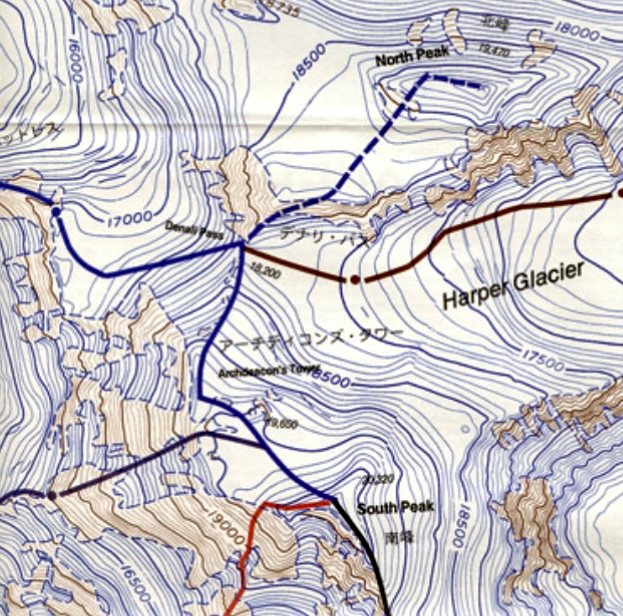
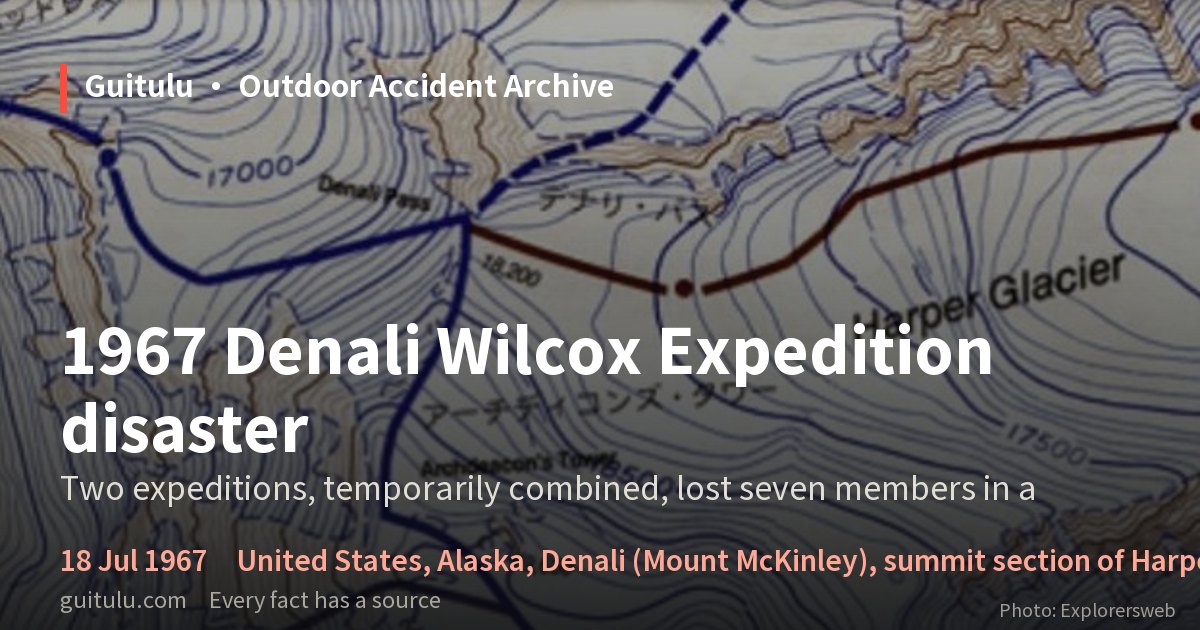
Topographic map of the Muldrow Glacier–Karstens Ridge area, marking Harper Glacier and the North and South Peaks

Archive / Mountaineering

1967 Denali Wilcox Expedition disaster

Two expeditions, temporarily combined, lost seven members in a storm lasting about seven days

Historical event; the cause of the accident remains disputed

Photo: Explorersweb

Date
Summer
Place
United States, Alaska, Denali (Mount McKinley), summit section of Harper GlacierUnited States › Alaska · Alaska Range-150.940°E 63.115°N
Activity
MountaineeringInvolves: Hypothermia · Extreme weatherA 12-person party formed by combining the Wilcox and Colorado expeditions
Casualties
Dead 7 7 people died. Only 3 bodies were found, and they could not be identified; the remaining 4 bodies were never found. 5 people survived, reportedly with exhaustion and mild frostbite.
Material
47 facts · 10 sources7 accounts differ and are shown side by side

01What happened

In the summer of 1967, two young mountaineering expeditions planned to climb Denali, then known as Mount McKinley, by the Muldrow Glacier–Karstens Ridge route on its north side. None of the 9 members of the party led by Joe Wilcox had previously climbed above 4550 meters; the Colorado party led by Howard Snyder was more experienced. The route required a hike of about 63 kilometers from Wonder Lake to the foot of the glacier. The ridge was narrow and exposed, making it particularly vulnerable to high winds.Facts it rests onF01Multiple sourcesThe Wilcox expedition was led by 24-year-old Joe Wilcox of Utah and originally had 9 members.F02Multiple sourcesAnother expedition from Colorado, led by Howard Snyder, planned to take the same route at the same time. Its members had more mountaineering experience.F03Single sourceAccording to reports, all members of the Wilcox expedition had basic mountaineering skills, but none had previously climbed above 4550 metres.F05Multiple sourcesThe combined party took the old Muldrow Glacier–Karstens Ridge route.F44Single sourceAccording to reports, the route begins on the north side and requires an initial hike of about 63 kilometres from Wonder Lake to the foot of the glacier; Karstens Ridge is narrow and exposed and particularly vulnerable to high winds.

Topographic map of the Muldrow Glacier–Karstens Ridge area, marking Harper Glacier and the North and South PeaksPhoto source: Explorersweb

Before departure, a member of the Colorado team was injured in a car accident, leaving the team below the park's minimum of 4 people. On 22 June, at the urging of the National Park Service, the two teams merged into a group of 12, with Wilcox as leader.Facts it rests onF04Multiple sourcesAt the time, National Park Service regulations required mountaineering expeditions to have at least 4 members.F09Multiple sourcesBefore departure, a member of the Colorado expedition was injured in a car accident, leaving the party below the minimum size required by the park.F11Multiple sourcesAt the urging of the National Park Service, the two expeditions combined into a 12-person party, with Wilcox as leader.

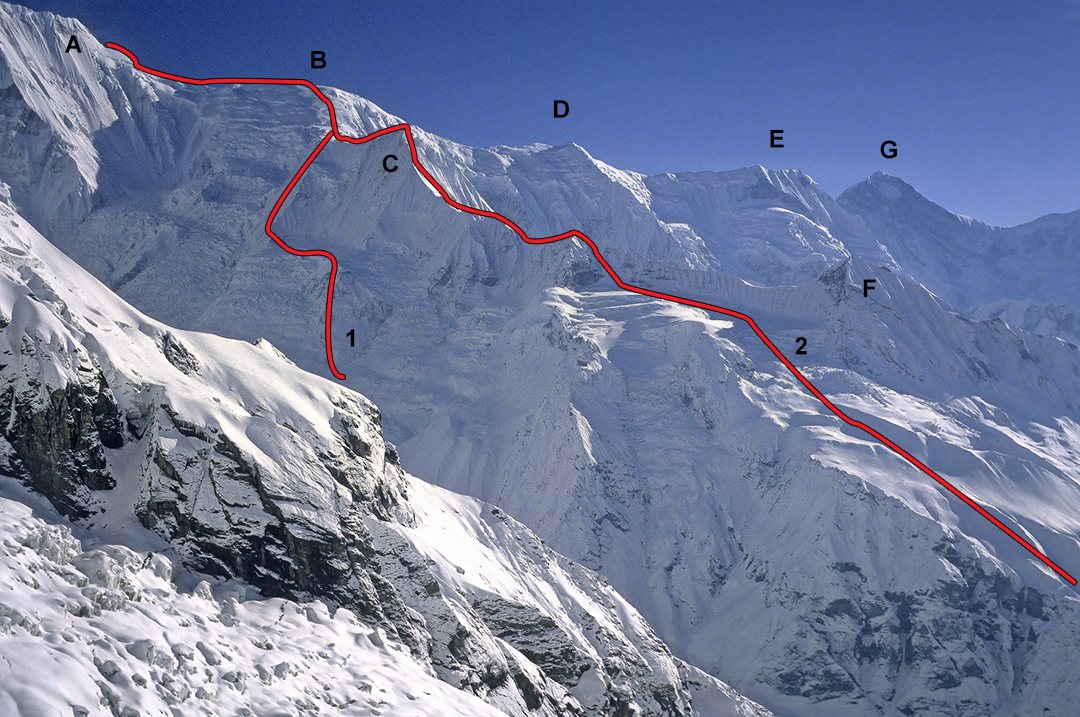
Diagram of the Muldrow Glacier route on Denali, marking Karstens Ridge, Harper Glacier and Deception TowerPhoto source: Explorersweb

According to reports, the team had established a camp on the Harper Glacier by 13 July. On 15 July, Wilcox and three members of the Colorado team reached the summit in good weather, then descended to a lower camp at approximately 15,000 feet. On 17 July, a second group led by Jerry Clark set out for the summit, while Steve Taylor remained at the high camp because he was feeling unwell.Facts it rests onF24Single sourceAccording to reports, by 13 July the party had established a camp on Harper Glacier.F25Multiple sourcesOn 15 July, Wilcox and three members of the Colorado expedition reached the summit in good weather.F28Single sourceOn 17 July, the second group, led by 31-year-old Jerry Clark, set out for the summit.F29Multiple sourcesSteve Taylor remained at high camp because he was feeling unwell and did not take part in the second summit attempt.F30Multiple sourcesOn the same day, the group that had summited first descended to a lower camp on Harper Glacier at about 15,000 feet; they were accompanied by one member of the original Wilcox expedition.

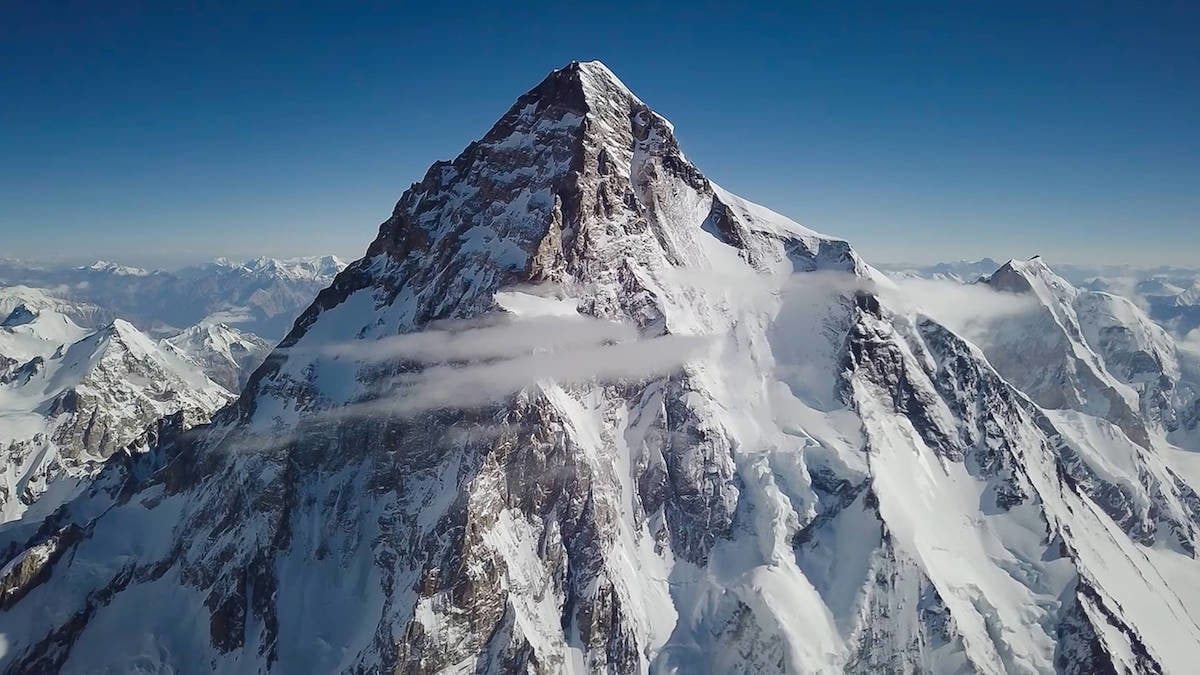
Snowfields and glacial terrain high on DenaliPhoto source: Explorersweb

The second group camped overnight along the way, reached the summit on 18 July in whiteout conditions, and reported to the park by radio. According to reports, Clark said they would begin descending in 10 minutes; no further word was received from them. A storm formed by the collision of high pressure from the south and moist low pressure from the north then enveloped the mountain; the 5 people who remained at the lower camp crowded into a tent and endured the storm.Facts it rests onF31Multiple sourcesThe second summit group camped overnight en route and reached the summit the next day.F32Multiple sourcesOn 18 July, the second group reached the summit in whiteout conditions and reported to the park by radio from the summit.F34Single sourceAccording to reports, Clark said over the radio that they would begin descending in 10 minutes; no further transmissions followed.F35Single sourceThe second group encountered a severe and prolonged storm during the descent.F15Multiple sourcesThe storm has been described as forming when high pressure to the south collided with a moist low-pressure system to the north.F18Multiple sourcesThe 5 people at the lower camp crowded into a three-person tent and survived the storm by huddling together for warmth in the high winds.

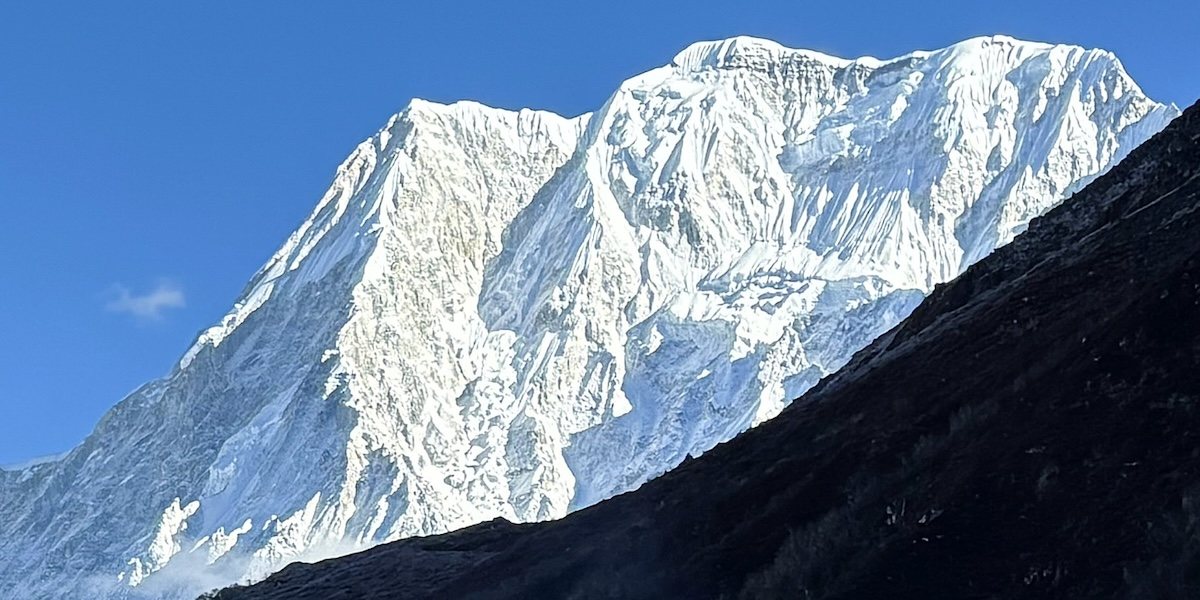
Glacial and ridge terrain in the Denali areaPhoto source: Explorersweb

No one could climb the mountain to conduct a rescue during the storm, and air rescue was also impeded. After the storm, the 5 people at the lower camp descended safely, while all 7 higher on the mountain died. On 28 and 29 July, search teams found 3 bodies at the high camp and below Denali Pass; none could be identified, and the remaining 4 were never found. Another search in late August also found no trace. After the accident, the national park revised its mountaineering regulations.Facts it rests onF21Multiple sourcesDuring the storm, the weather was so severe that no one could go up the mountain to rescue them, and aerial rescue was also hindered.F19Multiple sourcesAll 7 people higher on the mountain died: Jerry Clark, Steve Taylor, Dennis Luchterhand, Mark McLaughlin, Hank Jahns, John Russell and Walter Taylor.F20Multiple sourcesThe 5 people at the lower camp descended safely after the storm. According to AAC records, they suffered only exhaustion and mild frostbite.F36Multiple sourcesOn 28 July, a party from the Alaska Mountaineering Club reached the 17,900-foot camp and found one person who had died there; the next day they found two more below Archdeacon's Tower.F06Multiple sourcesNone of the 3 bodies found could be identified, and the remaining 4 people were never found.F37Single sourceAccording to the AAC record, on 19 August, a group of 6 including Vin and Grace Hoeman and Ray Genet was flown to Kahiltna Glacier; all except Mrs. Hoeman climbed the West Buttress to search for those who had died. On 27 August, 4 of them reached the summit and carefully searched the slopes of Archdeacon's Tower, finding no trace of the remains.F45Single sourceAccording to reports, after the accident Denali National Park changed its climbing regulations, requiring climbers to register in advance, submit their climbing experience, carry two-way radios and contact the park after completing their climb.

The number at the end of a paragraph is how many facts it rests on; open it to see each fact and how well it is sourced: Multiple sourcesSingle source. Conflicting accounts and speculation are kept out of the narrative.

  • Reported places along the route (schematic)Schematic

Satellite imagery Sentinel-2 cloudless 2024 © EOX · Terrain AWS Terrain Tiles · Orange line is schematic · Place coordinates not individually verified

Route review

5 scenes to understand what happened

Scroll down and the map flies to where each part happened. The line is Schematic, Lines connect the places mentioned in reports in sequence, showing only the approximate direction, not the actual track.

01

Full route

The locations mentioned in reports are connected in sequence to show the approximate route (schematic).

02

Long trek from the north

The route began on the north side, with a hike of about 63 kilometers from Wonder Lake to the foot of the glacier.Facts it rests onF44Single sourceAccording to reports, the route begins on the north side and requires an initial hike of about 63 kilometres from Wonder Lake to the foot of the glacier; Karstens Ridge is narrow and exposed and particularly vulnerable to high winds.F05Multiple sourcesThe combined party took the old Muldrow Glacier–Karstens Ridge route.

04

Two summit attempts

The first group reached the summit in good weather on 15 July. The second set out on 17 July and lost contact after reaching the summit on 18 July.Facts it rests onF25Multiple sourcesOn 15 July, Wilcox and three members of the Colorado expedition reached the summit in good weather.F28Single sourceOn 17 July, the second group, led by 31-year-old Jerry Clark, set out for the summit.F32Multiple sourcesOn 18 July, the second group reached the summit in whiteout conditions and reported to the park by radio from the summit.F34Single sourceAccording to reports, Clark said over the radio that they would begin descending in 10 minutes; no further transmissions followed.

05

Storm and search

No one could go up the mountain to rescue them while the storm continued. Only after it had passed did the search team find the deceased at high altitude.Facts it rests onF21Multiple sourcesDuring the storm, the weather was so severe that no one could go up the mountain to rescue them, and aerial rescue was also hindered.F36Multiple sourcesOn 28 July, a party from the Alaska Mountaineering Club reached the 17,900-foot camp and found one person who had died there; the next day they found two more below Archdeacon's Tower.

02Timeline

  1. At the urging of the National Park Service, the two expeditions combined into a 12-person party, with Wilcox as leader. F11

  2. According to reports, by 13 July the party had established a camp on Harper Glacier. F24

  3. On 15 July, Wilcox and three members of the Colorado expedition reached the summit in good weather. F25

  4. On 17 July, the second group, led by 31-year-old Jerry Clark, set out for the summit. F28

  5. On 18 July, the second group reached the summit in whiteout conditions and reported to the park by radio from the summit. F32

  6. According to reports, Clark said over the radio that they would begin descending in 10 minutes; no further transmissions followed. F34

  7. On 28 July, a party from the Alaska Mountaineering Club reached the 17,900-foot camp and found one person who had died there; the next day they found two more below Archdeacon's Tower. F36

  8. According to the AAC record, on 19 August, a group of 6 including Vin and Grace Hoeman and Ray Genet was flown to Kahiltna Glacier; all except Mrs. Hoeman climbed the West Buttress to search for those who had died. On 27 August, 4 of them reached the summit and carefully searched the slopes of Archdeacon's Tower, finding no trace of the remains. F37

03Lessons

Teams and decisions

A hastily combined party lacked more than numbers

The 12-person party was formed at the urging of the park service on the day before departure, and its members differed in experience and leadership style. Some survivors later felt that the two parties had indeed lacked unified leadership. How a party is organized before departure deserves to be treated as seriously as the route itself.Facts it rests onF02Multiple sourcesAnother expedition from Colorado, led by Howard Snyder, planned to take the same route at the same time. Its members had more mountaineering experience.F04Multiple sourcesAt the time, National Park Service regulations required mountaineering expeditions to have at least 4 members.F09Multiple sourcesBefore departure, a member of the Colorado expedition was injured in a car accident, leaving the party below the minimum size required by the park.F11Multiple sourcesAt the urging of the National Park Service, the two expeditions combined into a 12-person party, with Wilcox as leader.F40Single sourceThe survivor Schlichter believed that outside reports had exaggerated personality conflicts among the members, but that the two expeditions did lack unified leadership.

Weather and retreat

The window of good weather was short

The summit was reached on 15 July in good weather. Two days later, the wind had weakened when the second group set out, but they reached the summit the following day in whiteout visibility and subsequently encountered a storm. According to reports, the storm was later described by meteorological authorities as a once-in-a-century event. The descent after a summit attempt requires the same margin as the ascent.Facts it rests onF25Multiple sourcesOn 15 July, Wilcox and three members of the Colorado expedition reached the summit in good weather.F28Single sourceOn 17 July, the second group, led by 31-year-old Jerry Clark, set out for the summit.F32Multiple sourcesOn 18 July, the second group reached the summit in whiteout conditions and reported to the park by radio from the summit.F35Single sourceThe second group encountered a severe and prolonged storm during the descent.F46Single sourceAccording to Explorersweb, the United States National Weather Service later described the storm as a once-in-a-century event.

Avalanche and high altitude

Shelter at high altitude

The 5 people at the lower camp huddled together in a three-person tent through the storm. One book reviewer argued that many might have survived if a large enough snow cave had been dug at the high camp. This is the reviewer's view, but it reminds readers that shelter should be prepared in advance of a prolonged storm.Facts it rests onF18Multiple sourcesThe 5 people at the lower camp crowded into a three-person tent and survived the storm by huddling together for warmth in the high winds.F43Single sourceThe author of the WildSnow review believed that one of the underlying causes was that the first summit group had not placed enough marker wands in the summit section, and that many people might have survived if a sufficiently large snow cave had been dug at high camp.

Rescue and self-rescue

An era without a safety net, and the rules that followed

According to reports, no helicopters at the time could fly to high altitude, and no one was willing or able to climb the mountain to conduct a rescue during the storm. After the accident, Denali National Park required climbers to register in advance, provide details of their mountaineering experience, and carry two-way radios.Facts it rests onF07Multiple sourcesAt the time, no helicopter could fly to such a high altitude, so the bodies that were found had to be left on the mountain.F21Multiple sourcesDuring the storm, the weather was so severe that no one could go up the mountain to rescue them, and aerial rescue was also hindered.F45Single sourceAccording to reports, after the accident Denali National Park changed its climbing regulations, requiring climbers to register in advance, submit their climbing experience, carry two-way radios and contact the park after completing their climb.

04Fact list 47 facts

Under each fact is a verbatim quote from the original. "Single source" means only one outlet mentioned it; "Accounts differ" means sources contradict each other and this site adopts neither side; "Speculation" is an inference by a reporter or a person involved, not a fact.

  1. F01Multiple sourcesBackground

    The Wilcox expedition was led by 24-year-old Joe Wilcox of Utah and originally had 9 members.

    Quotes from the original 3

    “The Wilcox Expedition was nine young men, led by 24-year-old Joe Wilcox from Utah.”

    National Geographic · 2014-07-20

    “The Wilcox expedition, led by 24-year-old Joe Wilcox from Utah, was the first of the two teams attempting the Muldrow Glacier route.”

    Explorersweb · 2025-03-07

    “a nine-man team led by Joe Wilcox”

    AAC · 1982
  2. F02Multiple sourcesBackground

    Another expedition from Colorado, led by Howard Snyder, planned to take the same route at the same time. Its members had more mountaineering experience.

    Quotes from the original 2

    “Snyder and his partners had more mountaineering experience and had climbed at higher altitudes.”

    Explorersweb · 2025-03-07

    “Snyder’s Colorado team had the edge in experience and cohesiveness.”

    Boulder Weekly · 2010-11-04
  3. F03Single sourceBackground

    According to Explorersweb, According to reports, all members of the Wilcox expedition had basic mountaineering skills, but none had previously climbed above 4550 metres.

    Quotes from the original 1

    “They all had basic mountaineering skills but hadn’t climbed higher than 4,550m.”

    Explorersweb · 2025-03-07
  4. F04Multiple sourcesBackground

    At the time, National Park Service regulations required mountaineering expeditions to have at least 4 members.

    Quotes from the original 3

    “NPS rules stated there should be at least four members in an expedition group.”

    Explorersweb · 2025-03-07

    “To climb Denali in 1967, teams had to consist of at least four members to be granted access by the National Park Service.”

    Boulder Weekly · 2010-11-04

    “That put them below the minimum the [National] Park Service required to climb.”

    National Geographic · 2014-07-20
  5. F05Multiple sourcesPlan

    The combined party took the old Muldrow Glacier–Karstens Ridge route.

    Quotes from the original 3

    “Two expeditions, the Colorado Mount McKinley and the Wilcox McKinley expeditions, joined to climb the Karsten’s Ridge route.”

    AAC · 1968

    “two teams aimed to summit via the remote Muldrow Glacier route”

    Explorersweb · 2025-03-07

    “The story is of a climb up the Muldrow Glacier that combined two separate groups”

    AAC · 1982
  6. F06Multiple sourcesFound at scene

    None of the 3 bodies found could be identified, and the remaining 4 people were never found.

    Quotes from the original 3

    “No identifications were made.”

    AAC · 1968

    “The other four climbers were never located.”

    Explorersweb · 2025-03-07

    “(Only three bodies were ever found.)”

    AAC · 1982
  7. F07Multiple sourcesAftermath

    At the time, no helicopter could fly to such a high altitude, so the bodies that were found had to be left on the mountain.

    Quotes from the original 2

    “There was no high-altitude helicopter back then, so they had to leave them on the mountain.”

    National Geographic · 2014-07-20

    “The three bodies were left on the mountain.”

    Explorersweb · 2025-03-07
  8. F08Multiple sourcesAftermath

    After the accident, the National Park Service considered closing the mountain to climbing. George Hall, the park superintendent at the time, worked to keep it open.

    Quotes from the original 2

    “the Park Service had wanted to close it after the incident.”

    Outside · 2014-08-20

    “George Hall successfully advocated for keeping the mountain open when the government threatened to shut it down for good”

    Peninsula Clarion · 2014-10-30
  9. F09Multiple sourcesEvent

    Before departure, a member of the Colorado expedition was injured in a car accident, leaving the party below the minimum size required by the park.

    Quotes from the original 3

    “one of their members had a car accident and broke his arm, which left only three guys.”

    National Geographic · 2014-07-20

    “the team was reduced to three when Steve Lewis broke his arm in a car accident.”

    Explorersweb · 2025-03-07

    “but that person was injured in a car accident just prior to departure to the mountain.”

    Boulder Weekly · 2010-11-04
  10. F10Accounts differEvent

    Accounts differ on how many members the Colorado expedition lost: National Geographic and Explorersweb say one person broke a bone in a car accident, leaving three; a Peninsula Clarion report says two members withdrew at the last minute.

    Quotes from the original 2

    “one of their members had a car accident and broke his arm, which left only three guys.”

    National Geographic · 2014-07-20

    “A group from Colorado had two members back out at the last second”

    Peninsula Clarion · 2014-10-30
  11. F11Multiple sourcesPlan

    At the urging of the National Park Service, the two expeditions combined into a 12-person party, with Wilcox as leader.

    Quotes from the original 3

    “The merger occurred on June 22, and Wilcox took command of the 12-person team.”

    Explorersweb · 2025-03-07

    “Forced by the park service to join teams with a less-organized yet equally ambitious Seattle team”

    Boulder Weekly · 2010-11-04

    “Park officials forced two separate expeditions to act as one”

    WildSnow · 2015-04-09
  12. F12Single sourceMovement

    According to Peninsula Clarion, According to reports, during the climb a stove caught fire and burned a sleeping bag, and a member fell into a crevasse and was rescued.

    Quotes from the original 2

    “A stove fire instantly incinerated a climber’s sleeping bag halfway through the trip.”

    Peninsula Clarion · 2014-10-30

    “A glacial traverse resulted in a fall into a crevasse, followed fortunately by a successful rescue”

    Peninsula Clarion · 2014-10-30
  13. F13Accounts differEvent

    Accounts differ on the altitude of the high camp: AAC gives 17,900 feet, Explorersweb gives 5456 metres (approximately 17,900 feet), and Boulder Weekly gives 19,000 feet.

    Quotes from the original 3

    “A seventh member, Steve Taylor, had remained at their 17,900-foot camp, feeling slightly ill.”

    AAC · 1968

    “started a summit push from their high camp at 5,456m.”

    Explorersweb · 2025-03-07

    “By the time the 12 climbers had reached high camp at 19,000 feet”

    Boulder Weekly · 2010-11-04
  14. F14Accounts differEvent

    Accounts differ on whether a storm warning was received beforehand: Explorersweb says there were reports that a park ranger had warned Wilcox of an approaching storm; a review of “White Winds” says radio records compiled by Wilcox show that the party never received a storm warning.

    Quotes from the original 2

    “Park rangers reportedly warned Wilcox of an approaching storm.”

    Explorersweb · 2025-03-07

    “Wilcox’s documentation of radio logs discloses that at no time was a storm alert given the party”

    AAC · 1982
  15. F15Multiple sourcesPost-incident analysis

    The storm has been described as forming when high pressure to the south collided with a moist low-pressure system to the north.

    Both accounts may have come from Andy Hall's research.

    Quotes from the original 2

    “A wet low came in from the north, and these two systems clashed.”

    National Geographic · 2014-07-20

    “A high-pressure system from the south clashed with a moist low-pressure system from the north”

    Explorersweb · 2025-03-07
  16. F16Accounts differEvent

    Accounts differ on the duration of the storm: National Geographic, Outside and Explorersweb say about 7 days (Explorersweb says it lasted until 25 July); Boulder Weekly says more than 10 days; a review of “White Winds” says Wilcox studied the storm from 18 to 26 July.

    Quotes from the original 4

    “The storm lasted for about seven days.”

    National Geographic · 2014-07-20

    “It would last seven days, to July 25.”

    Explorersweb · 2025-03-07

    “Punishing the mountain for more than 10 days”

    Boulder Weekly · 2010-11-04

    “the storm that affected the McKinley region during that period of July 18 to 26, 1967”

    AAC · 1982
  17. F17Accounts differEvent

    Estimates of wind speeds near the summit differ: Explorersweb says 160–240 kilometres per hour, with an air temperature of minus 26 degrees Celsius in still air; in a National Geographic interview, Andy Hall said some gusts were estimated to exceed 300 miles per hour.

    Quotes from the original 2

    “Near the summit, the wind was 160–240kph, with still-air temperatures of -26ºC.”

    Explorersweb · 2025-03-07

    “Some of the winds are estimated to have been over 300 miles per hour.”

    National Geographic · 2014-07-20
  18. F18Multiple sourcesEvent

    The 5 people at the lower camp crowded into a three-person tent and survived the storm by huddling together for warmth in the high winds.

    Quotes from the original 2

    “sitting at 15,000 in a three-man tent with five guys packed into it, with 100 mph winds pummeling down on them.”

    Outside · 2014-08-20

    “They tried to stay warm by huddling together.”

    Explorersweb · 2025-03-07
  19. F19Multiple sourcesEvent

    All 7 people higher on the mountain died: Jerry Clark, Steve Taylor, Dennis Luchterhand, Mark McLaughlin, Hank Jahns, John Russell and Walter Taylor.

    Quotes from the original 4

    “Jerry Clark (31), Steve Taylor (22), Dennis Luchterhand (24), Mark McLaughlin (23), Hank Janes (25), John Russell (23), and Walt Taylor (24) all died.”

    Explorersweb · 2025-03-07

    “Seven members of the latter died high on the mountain.”

    AAC · 1968

    “killing seven of the 12 college students who were summiting the mountain that day.”

    Outside · 2014-08-20

    “Only five of the men would make it home from North America's highest peak.”

    CSMonitor · 2014-07-03
  20. F20Multiple sourcesAftermath

    The 5 people at the lower camp descended safely after the storm. According to AAC records, they suffered only exhaustion and mild frostbite.

    Quotes from the original 3

    “They were also struck by the storm, but escaped with exhaustion and minor frostbite.”

    AAC · 1968

    “The five climbers at the lower camp made it down alive after the storm ended.”

    Explorersweb · 2025-03-07

    “the five men lower on the peak — the three Coloradans and two Seattle climbers — were able to escape alive.”

    Boulder Weekly · 2010-11-04
  21. F21Multiple sourcesEvent

    During the storm, the weather was so severe that no one could go up the mountain to rescue them, and aerial rescue was also hindered.

    Quotes from the original 3

    “No one was willing to attempt a rescue in the violent storm.”

    Peninsula Clarion · 2014-10-30

    “rescue efforts were hampered by bad weather and poor internal communication by the NPS.”

    Boulder Weekly · 2010-11-04

    “Look, we couldn’t fly. We can’t make the Air Force go.”

    Outside · 2014-08-20
  22. F22Single sourceEvent

    According to Boulder Weekly, According to survivor Paul Schlichter, a C-130 was sent to search for the people on the mountain. They volunteered to accompany the flight to help identify locations, but were told that civilians were not allowed on board; Schlichter himself was still refused permission to board.

    Quotes from the original 2

    “I remember they sent a C-130 to search for the men on the mountain.”

    Boulder Weekly · 2010-11-04

    “They still refused to let me on board.”

    Boulder Weekly · 2010-11-04
  23. F23Single sourceParticipant's view

    According to Outside, Ranger Wayne Merry believed that his request at the time for a reconnaissance flight over the mountain had been ignored.

    Quotes from the original 1

    “Wayne feels like his calls for an aircraft overflight were ignored.”

    Outside · 2014-08-20
  24. F24Single sourceMovement

    According to Explorersweb, According to reports, by 13 July the party had established a camp on Harper Glacier.

    Quotes from the original 1

    “By July 13, the group had set up camp on the Harper Glacier.”

    Explorersweb · 2025-03-07
  25. F25Multiple sourcesEvent

    On 15 July, Wilcox and three members of the Colorado expedition reached the summit in good weather.

    Quotes from the original 3

    “A successful summit climb had been made in good weather on July 15, by Wilcox in company with the Colorado trio”

    AAC · 1982

    “They reached the summit at 6:30 pm in good weather, with a clear sky and light winds.”

    Explorersweb · 2025-03-07

    “Wilcox and the Coloradans made the summit while the eight remaining climbers stayed in high camp”

    Boulder Weekly · 2010-11-04
  26. F26Accounts differEvent

    Accounts differ on the number of people who reached the summit on 15 July: the AAC's 1968 record also lists Anshel Schiff among those who summited that day, for a total of 5; Explorersweb, Boulder Weekly and a review of the book “White Winds” say that Wilcox and three members of the Colorado expedition summited, for a total of 4.

    Quotes from the original 2

    “Five other members, Joseph F. Wilcox, Anshel Schiff, Howard Snyder, Paul Schlichter and Jerry Lewis, had reached the summit on July 15”

    AAC · 1968

    “On July 15, Wilcox, Snyder, Schlichter, and Lewis started a summit push from their high camp at 5,456m.”

    Explorersweb · 2025-03-07
  27. F27Single sourceEvent

    According to Explorersweb, According to reports, on 16 July all 12 people were at the high camp, winds reached 113 kilometers per hour, and everyone had to remain in camp, postponing the second summit attempt.

    Quotes from the original 1

    “On July 16, all 12 members were at high camp when 113kph winds picked up, forcing everybody to remain at camp.”

    Explorersweb · 2025-03-07
  28. F28Single sourceMovement

    According to Explorersweb, On 17 July, the second group, led by 31-year-old Jerry Clark, set out for the summit.

    Quotes from the original 1

    “On July 17, the second group, led by the 31-year-old Clark, went for the summit.”

    Explorersweb · 2025-03-07
  29. F29Multiple sourcesMovement

    Steve Taylor remained at high camp because he was feeling unwell and did not take part in the second summit attempt.

    Quotes from the original 2

    “A seventh member, Steve Taylor, had remained at their 17,900-foot camp, feeling slightly ill.”

    AAC · 1968

    “Steve Taylor remained at high camp because of altitude sickness.”

    Explorersweb · 2025-03-07
  30. F30Multiple sourcesMovement

    On the same day, the group that had summited first descended to a lower camp on Harper Glacier at about 15,000 feet; they were accompanied by one member of the original Wilcox expedition.

    Quotes from the original 3

    “had descended to a camp at 15,000 feet on the Harper Glacier to conserve food and fuel at the high camp.”

    AAC · 1968

    “One of the climbers in the Seattle group chose to descend to Camp 6 at 15,000 feet with the four men returning from the summit.”

    Boulder Weekly · 2010-11-04

    “The group that had summited two days earlier descended to a lower camp at 4,572m.”

    Explorersweb · 2025-03-07
  31. F31Multiple sourcesMovement

    The second summit group camped overnight en route and reached the summit the next day.

    Quotes from the original 2

    “they had reached the top in a white-out after a bivouac the previous night.”

    AAC · 1968

    “The summit group stopped to bivouac, hoping for better weather the next morning.”

    Explorersweb · 2025-03-07
  32. F32Multiple sourcesEvent

    On 18 July, the second group reached the summit in whiteout conditions and reported to the park by radio from the summit.

    Quotes from the original 2

    “radioed to Park Rangers from the summit; they had reached the top in a white-out after a bivouac the previous night.”

    AAC · 1968

    “Clark radioed to say that he, McLaughlin, Walt Taylor, Janes, and Luchterhand had topped out in a whiteout.”

    Explorersweb · 2025-03-07
  33. F33Accounts differEvent

    Accounts differ on whether John Russell reached the summit: the AAC's 1968 record lists him among the 6 people who radioed from the summit on 18 July; Explorersweb says Clark reported that 5 people had summited, and that Russell's situation was unclear and he may have turned back partway.

    Quotes from the original 2

    “On July 18 Jerry Clark, Mark McLaughlin, Walter Taylor, Hank James, Dennis Luchterhand and John Russell radioed to Park Rangers from the summit”

    AAC · 1968

    “John Russell’s situation was unclear; he didn’t summit and might have turned back during the push.”

    Explorersweb · 2025-03-07
  34. F34Single sourceEvent

    According to Explorersweb, According to reports, Clark said over the radio that they would begin descending in 10 minutes; no further transmissions followed.

    Quotes from the original 1

    “Clark said that they would start to descend in 10 minutes. They never radioed again.”

    Explorersweb · 2025-03-07
  35. F35Single sourceEvent

    According to AAC, The second group encountered a severe and prolonged storm during the descent.

    Several quotations come from different reports by the same media outlet and are counted as one source.

    Quotes from the original 2

    “They were apparently caught during their descent by a violent and prolonged storm.”

    AAC · 1968

    “the devastating storm that killed those descending from the second successful summit assault”

    AAC · 1982
  36. F36Multiple sourcesFound at scene

    On 28 July, a party from the Alaska Mountaineering Club reached the 17,900-foot camp and found one person who had died there; the next day they found two more below Archdeacon's Tower.

    Quotes from the original 2

    “The Mountaineering Club of Alaska Expedition reached the 17,900-foot camp on July 28 and found a single victim there. They found two others just below the Archdeacon’s Tower the following day.”

    AAC · 1968

    “Several days after the storm, two bodies were found at Archdeacon’s Tower below the summit.”

    Explorersweb · 2025-03-07
  37. F37Single sourceAftermath

    According to AAC, According to the AAC record, on 19 August, a group of 6 including Vin and Grace Hoeman and Ray Genet was flown to Kahiltna Glacier; all except Mrs. Hoeman climbed the West Buttress to search for those who had died. On 27 August, 4 of them reached the summit and carefully searched the slopes of Archdeacon's Tower, finding no trace of the remains.

    Quotes from the original 2

    “Vin and Grace Hoeman, Ray Genet, Ed Boulton, Chuck Crenchaw and Dick Springgate were flown to the Kahiltna Glacier on August 19.”

    AAC · 1968

    “Although they searched the slopes of the Archdeacon’s Tower carefully, no traces of the bodies were found.”

    AAC · 1968
  38. F38Multiple sourcesAftermath

    Both surviving leaders wrote books: Snyder published The Hall of the Mountain King in 1973, and Wilcox published White Winds in 1981. The two accounts differ.

    Quotes from the original 3

    “later recounted by Howard Snyder in his 1973 book The Hall of the Mountain King”

    Boulder Weekly · 2010-11-04

    “White Winds. Joe Wilcox. Hwong Publishing, Los Alamitos, California, 1981.”

    AAC · 1982

    “Joe Wilcox's White Winds about the expedition published several years after Snyder's book, partly in rebuttle to points in Snyder's account.”

    akfatal.net ·
  39. F39Single sourcePost-incident analysis

    According to AAC, According to a review of White Winds, Wilcox calculated from records at surrounding lowland weather stations that the storm may have been the strongest ever encountered by climbers anywhere in the world; his analytical materials were deposited in the United States National Weather Service library.

    Quotes from the original 2

    “he calculated that the storm may have been the worst ever encountered by mountaineers anywhere on earth.”

    AAC · 1982

    “his documentation has been archived in the library of the National Weather Service.”

    AAC · 1982
  40. F40Single sourceParticipant's view

    According to Boulder Weekly, The survivor Schlichter believed that outside reports had exaggerated personality conflicts among the members, but that the two expeditions did lack unified leadership.

    Quotes from the original 1

    “Some of the personality conflicts that have been reported were overblown, but the teams did suffer from a lack of cohesive leadership.”

    Boulder Weekly · 2010-11-04
  41. F41Multiple sourcesParticipant's view

    Andy Hall, author of Denali's Howl, believed there was no single fatal mistake and that the men were simply in the wrong place at the wrong time.

    Both are statements made by Andy Hall himself in different interviews.

    Quotes from the original 2

    “I don't think there was one thing. Ultimately, they were in the wrong place at the wrong time.”

    CSMonitor · 2014-07-03

    “The real key is that they were in the wrong place at the wrong time.”

    National Geographic · 2014-07-20
  42. F42Multiple sourcesParticipant's view

    Wilcox said it was an era of self-reliance and that they did not expect rescue or any safety net.

    Quotes from the original 2

    “I asked [survivor] Joe Wilcox if he expected a rescue or any kind of safety net. He said no.”

    Outside · 2014-08-20

    “Joe Wilcox says it was the age of self-reliance.”

    CSMonitor · 2014-07-03
  43. F43Single sourceParticipant's view

    According to WildSnow, The author of the WildSnow review believed that one of the underlying causes was that the first summit group had not placed enough marker wands in the summit section, and that many people might have survived if a sufficiently large snow cave had been dug at high camp.

    Quotes from the original 2

    “the expedition’s first summit team made a tragic and obvious mistake in not adequately wanding the summit section of the route.”

    WildSnow · 2015-04-09

    “IF a commodious snowcave had been dug at their upper camp on Harper Glacier, all the men quite possibly would have lived.”

    WildSnow · 2015-04-09
  44. F44Single sourceBackground

    According to Explorersweb, According to reports, the route begins on the north side and requires an initial hike of about 63 kilometres from Wonder Lake to the foot of the glacier; Karstens Ridge is narrow and exposed and particularly vulnerable to high winds.

    Quotes from the original 2

    “The route begins on the north side of McKinley and requires a 63km trek from Wonder Lake to the base of the glacier.”

    Explorersweb · 2025-03-07

    “The ridge is also particularly vulnerable to high winds.”

    Explorersweb · 2025-03-07
  45. F45Single sourceAftermath

    According to Explorersweb, According to reports, after the accident Denali National Park changed its climbing regulations, requiring climbers to register in advance, submit their climbing experience, carry two-way radios and contact the park after completing their climb.

    Quotes from the original 1

    “The 1967 tragedy led Denali National Park to modify climbing protocols, including requiring parties to register in advance, document their mountaineering experience and readiness, carry two-way radios”

    Explorersweb · 2025-03-07
  46. F46Single sourcePost-incident analysis

    According to Explorersweb, According to Explorersweb, the United States National Weather Service later described the storm as a once-in-a-century event.

    Quotes from the original 1

    “National Weather Services later called the storm a once-in-century event.”

    Explorersweb · 2025-03-07
  47. F47Single sourceParticipant's view

    According to Explorersweb, Snyder criticised Wilcox for splitting the party into two groups after the first summit, arguing that this weakened the party's ability to respond as a whole; Wilcox maintained that the party was split so that everyone would have a chance to reach the summit.

    Quotes from the original 1

    “Wilcox defended the split as a chance for everyone to summit, but Snyder argued that it weakened the team’s ability to respond as a unit.”

    Explorersweb · 2025-03-07