The number at the end of a paragraph is how many facts it rests on; open it to see each fact and how well it is sourced:
Multiple sourcesSingle source. Conflicting accounts and speculation are kept out of the narrative.
Perlino descended to base camp first, while Farronato and Caputo stayed at Camp 1, at an altitude of more than 5000 meters, intending to descend later. F02
According to Perlino, the three had reached Camp 2 at 5800 meters together and were climbing toward Camp 3 at 6300 meters when he developed a venous thrombosis in his left foot. All three decided to descend and agreed to return to base camp at 4800 meters. F01
Farronato, Caputo and Perlino, who was from Pinerolo, set out on 7 October to begin the "Panbari Q7" project. F04
According to Perlino, snow began falling on the evening of 27 October and continued for six days; they knew the snowfall was coming, but it arrived two days earlier than forecast. F05
Perlino said the alarm had already been raised on Wednesday, 29 October. F06
According to Perlino, he remained in contact with his two teammates until the evening of Thursday, 30 October, after which there was no further word; the Italian Ministry of Foreign Affairs said contact with the two had been lost since Friday, 31 October. F07
Perlino said the two were buried under about two and a half meters of compacted snow while sleeping in their tent, during the night from Thursday to Friday (30 to 31 October). F08
Perlino and three Nepalis were rescued by helicopter before the bodies of the two climbers were found. F09
On Monday, 3 November, a search and rescue team led by IFMGA guides Narendra Shahi and Pasang Kaji Sherpa set out. The team also included trainee guide Kusang Sherpa and the expedition leader Perlino, who had just been rescued. F10
Search and rescue guide Narendra Shahi said they first located the site using GPS coordinates provided by the expedition leader, then used a Recco detector and dug for three and a half hours before finding the tent. F14
The bodies were taken to the helipad in Samagaun, in preparation for transport by helicopter to Kathmandu. F17
The Italian Ministry of Foreign Affairs confirmed the deaths of the two climbers on 4 November, saying the news had been confirmed by local authorities in Nepal. F16
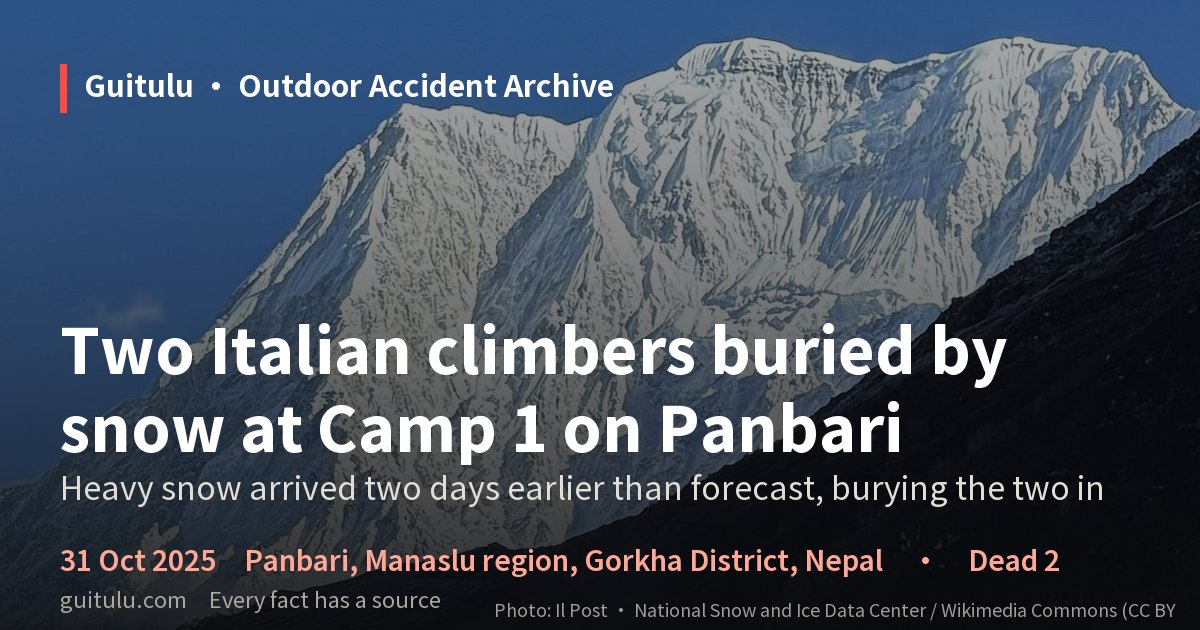
On Tuesday, 4 November, the search and rescue team found the bodies of the two climbers at Camp 1 on Panbari. The Himalayan Times said they were found at an altitude of 5242 meters. F13
Under each fact is a verbatim quote from the original. "Single source" means only one outlet mentioned it; "Accounts differ" means sources contradict each other and this site adopts neither side; "Speculation" is an inference by a reporter or a person involved, not a fact.
According to Perlino, the three had reached Camp 2 at 5800 meters together and were climbing toward Camp 3 at 6300 meters when he developed a venous thrombosis in his left foot. All three decided to descend and agreed to return to base camp at 4800 meters.
Both media outlets reported the same account Perlino gave to Corriere della Sera.
Quotes from the original 2
“al Campo 2 a 5800 metri e stavamo salendo al Campo 3 a 6300 metri”
Perlino descended to base camp first, while Farronato and Caputo stayed at Camp 1, at an altitude of more than 5000 meters, intending to descend later.
Both media outlets reported the same account Perlino gave to Corriere della Sera.
Quotes from the original 2
“Perlino è sceso al campo base, Farronato e Caputo si sono intrattenuti un po’ più a lungo al Campo 1, a oltre 5mila metri.”
“Il primo a partire era stato proprio Perlino, mentre i due compagni di spedizione avevano deciso di fermarsi ancora per smontare il campo e riscendere in un secondo momento.”
Cyclone Montha brought widespread rain and snow to Nepal, stranding trekkers and tourists on several popular routes and severely disrupting mountaineering and trekking activities for several days.
Quotes from the original 2
“Last week, Cyclone Montha triggered heavy rainfall and snowfall across Nepal, leaving trekkers and tourists stranded on several popular Himalayan routes.”
“Climbing and trekking activities had been severely affected over the past six days after Cyclone Montha brought widespread rain and snow across the country.”
According to Perlino, snow began falling on the evening of 27 October and continued for six days; they knew the snowfall was coming, but it arrived two days earlier than forecast.
Quotes from the original 3
“La sera di lunedì ventisette ci ha sorpreso l’inizio della nevicata durata sei giorni. Sapevamo dell’arrivo, ma ha anticipato di due giorni.”
“High winds and heavy snowfall from Cyclone Montha had trapped Farronato and Caputo on October 27, and they were unable to return to Base Camp in the whiteout.”
According to Perlino, he remained in contact with his two teammates until the evening of Thursday, 30 October, after which there was no further word; the Italian Ministry of Foreign Affairs said contact with the two had been lost since Friday, 31 October.
Quotes from the original 3
“Siamo rimasti in contatto sino a giovedì 30 sera, poi più nulla”
“Since Friday 31 October, contact has been lost with two Italian mountaineers, Alessandro Caputo and Stefano Farronato, who were climbing Panbari Peak in Nepal.”
Perlino said the two were buried under about two and a half meters of compacted snow while sleeping in their tent, during the night from Thursday to Friday (30 to 31 October).
The time of the incident comes from Perlino's account to Corriere della Sera; reports differ slightly on the depth of the snow (two to two and a half meters).
Quotes from the original 3
“Dormivano, in tenda e sono stati sepolti sotto 2 metri e mezzo di neve compatta. È accaduto nella notte tra giovedì e venerdì.”
On Monday, 3 November, a search and rescue team led by IFMGA guides Narendra Shahi and Pasang Kaji Sherpa set out. The team also included trainee guide Kusang Sherpa and the expedition leader Perlino, who had just been rescued.
Quotes from the original 3
“The rescue mission was launched on Monday by a team comprising IFMGA guides Narendra Shahi and Pasang Kaji Sherpa, aspirant guide Kusang Sherpa, and expedition leader Valter Perlino.”
According to The Himalayan Times, The search and rescue team first flew to Samagaun, the village closest to the incident site, then went up the mountain to search.
Quotes from the original 1
“had previously flown to Samagaun, nearest village to the incident, in Gorkha to conduct the search and rescue operation”
On Tuesday, 4 November, the search and rescue team found the bodies of the two climbers at Camp 1 on Panbari. The Himalayan Times said they were found at an altitude of 5242 meters.
Quotes from the original 3
“Their bodies were discovered on Tuesday at an altitude of 5,242 meters by a rescue team led by IFMGA guides Narendra Shahi and Pasang Kaji Sherpa.”
Search and rescue guide Narendra Shahi said they first located the site using GPS coordinates provided by the expedition leader, then used a Recco detector and dug for three and a half hours before finding the tent.
ExplorersWeb's search and rescue details were cited from Everest Chronicle.
Quotes from the original 3
“We first tracked the location using GPS coordinates provided by the expedition leader. Then we used a Recco detector to pinpoint the bodies before beginning to dig.”
The Italian Ministry of Foreign Affairs confirmed the deaths of the two climbers on 4 November, saying the news had been confirmed by local authorities in Nepal.
Quotes from the original 3
“Their death was confirmed this morning by the local authorities.”
“contact was lost with two Italian climbers, who were later confirmed to have died while attempting to scale the 6,887-metre (22,595-foot) Panbari mountain”
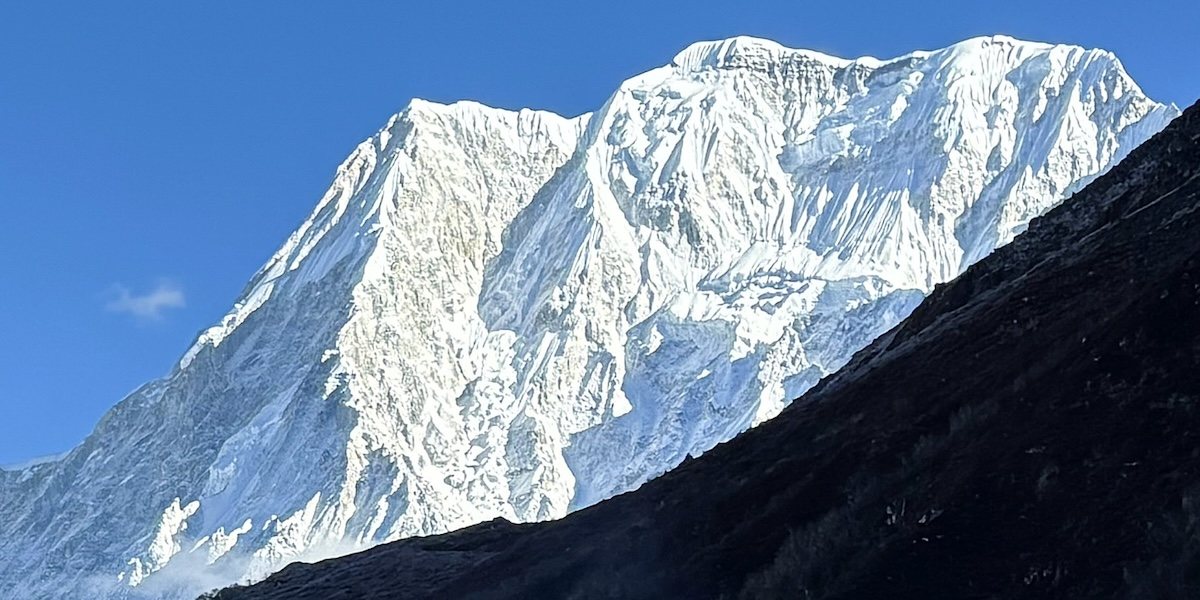
Panbari is 6887 metres high and lies in the Manaslu area of Gorkha District, Nepal. It is a rarely climbed peak.
Quotes from the original 2
“I due stavano cercando di scalare il monte Panbari, una vetta poco frequentata di 6.887 metri nella zona del Manaslu (8.163 metri), l’ottava montagna più alta al mondo.”
The team was called the "Italian Panbari Q7 Expedition" and was organised by Sherpa Alpine Trekking Service. The two climbers obtained their climbing permits through the company.
Quotes from the original 2
“The operation was supported by Sherpa Alpine Trekking Service, the same company that had organized the original expedition, 'Italian Panbari Q7 Expedition'.”
“Stefano and Alessandro had obtained climbing permission through Sherpa Alpine Trekking Service Pvt. Ltd. under permit number 102, according to the DoT.”
“the bodies of Farronato Stefano, 51, and Caputo Alessandro, 28, members of the Italian Panpari Q7 Expedition, were recovered at Camp 1 of Panpari Himal (6,887 metres)”
According to Sky TG24, Farronato was an experienced climber who had completed numerous expeditions and visited some of the most remote places in the world.
Quotes from the original 1
“Veterano della montagna, aveva portato a termine molte spedizioni, anche nei luoghi più inospitali della terra”
Perlino could not say why the two had stopped at Camp 1; he speculated that it may have been because they were tired. He said they were in good condition at the time and had gas and food.
This is Perlino's own speculation
Quotes from the original 2
“Non so perché. Forse per stanchezza hanno deciso di fermarsi al C1: stavano bene, avevano gas e viveri.”
According to Everest Chronicle, The Nepal Tourism Board said in a statement that it had learned from the expedition's liaison officer and the organising company that the two were trapped at Camp 1.
Quotes from the original 1
“it had received information from the expedition’s liaison officer and the concerned agency that the two were stranded at Camp 1”
Accounts differ on when contact with the two was lost: The Himalayan Times and Everest Chronicle said contact was lost after they were trapped by heavy snow on 28 October; the Italian Ministry of Foreign Affairs said contact had been lost since 31 October; Perlino said contact was maintained until the evening of 30 October.
Nepali media may be counting from the day they were trapped, while the Italian side counts from the last contact
Quotes from the original 4
“The pair had gone missing since October 28 after being trapped by heavy snowfall.”
Republica's account, citing police, differs from other sources: it said the two reached the summit on 1 October, were trapped by heavy snow during the descent, and went missing on 13 October; Sky TG24, however, said the team did not set out until 7 October, while Perlino described turning back during the climb to Camp 3.
Republica's dates and account of a summit are not corroborated by other sources
Quotes from the original 3
“The two climbers had reached the 22,595-foot peak on October 1 and went missing on October 13 after being trapped by heavy snowfall while descending.”
According to Republica, Since the two went missing, local authorities, the trekking company, security forces and residents have been searching for them.
Quotes from the original 1
“Local authorities, trekking agencies, security forces and local residents had been conducting search operations since their disappearance.”
Accounts differ on how the two were buried: The Himalayan Times and Il Fatto Quotidiano say it was an avalanche; the Italian foreign ministry and Il Post say only that they encountered heavy snow or a snowstorm at Camp 1 and were buried by snow.
Sources differ on whether they were buried by an avalanche or continuing snowfall
Quotes from the original 4
“have been confirmed dead in two separate avalanche incidents triggered by recent heavy snowfall across the Himalayas”
According to Il Fatto Quotidiano, Perlino's wife said his feet were too swollen to fit into his mountaineering boots, but he continued to help with the search despite the pain.
Quotes from the original 1
“Aveva il piede gonfio, non riusciva ad infilare lo scarpone. Nonostante il dolore ha fornito il suo aiuto alle ricerche.”
According to ExplorersWeb, The author of the ExplorersWeb article believed that the cyclone had been forecast well in advance and that climbers should have descended before the storm arrived on 27 October, but several teams were still trapped on mountains and high mountain passes, including the Italians on Panbari.
This is the ExplorersWeb author's commentary, offering a different perspective from Perlino's statement that "the snow arrived two days earlier than forecast"
Quotes from the original 2
“The cyclonic system was expected, with weather forecasts warning of bad weather days in advance. Climbers should have been down from the mountains by the time it hit on October 27.”
According to ExplorersWeb, ExplorersWeb reported that Recco reflectors are now mandatory for Everest climbers, but there is no such requirement on lower peaks.
Quotes from the original 1
“They are now mandatory for Everest climbers, but there is no such regulation for lesser peaks.”
According to Il Post, Il Post analysed that the heavy precipitation left large amounts of snow at higher elevations, followed by clear skies and high temperatures, increasing the risk of avalanches.
Quotes from the original 1
“Le fortissime precipitazioni hanno portato a un grosso accumulo di neve in quota, a cui però è seguito un periodo di sole e temperature alte che ha aumentato il rischio di valanghe”
 GuituluGlobal Outdoor Accident Archive