The number at the end of a paragraph is how many facts it rests on; open it to see each fact and how well it is sourced:
Multiple sourcesSingle source. Conflicting accounts and speculation are kept out of the narrative.
ImgScene photos all from news coverage; copyright belongs to the original authors
Diagram of the route on the Eiger North Face, marking the Hinterstoisser Traverse, tunnel opening and other locationsPhoto source: About Mountains
In August 1935, Munich climbers Karl Mehringer and Max Sedlmayr encountered a sudden change in the weather on the North Face and froze to death at about 3300 metres, at a place thereafter known as the “Death Bivouac”. F01
On the first day, Hinterstoisser used a tension traverse (with the aid of a taut rope) to cross a steep, smooth rock slab before the First Icefield. The section was subsequently named after him. F21
After all four had crossed the traverse, they retrieved the rope used for the crossing, leaving no fixed rope. F22
On 18 July 1936, two parties, Kurz and Hinterstoisser and the Austrians Willy Angerer and Edi Rainer, began climbing the North Face at the same time. F19
Because Angerer was seriously injured, the party decided to retreat. According to Avvenire, the retreat began on 20 July. F23
On 21 July, Hinterstoisser, Angerer and Rainer died; only Kurz survived. F26
Kurz called for help. Railway workers heard him and raised the alarm, and Swiss guides came out onto the rock face through the tunnel opening to rescue him. F29
During the descent, a railway worker leaned out of a tunnel opening and shouted up to the climbers, who replied that everything was fine. F24
That evening, darkness had fallen and the storm was worsening. The rescuers could not reach Kurz and had to return to the tunnel, promising to come back the next morning. F30
Hinterstoisser disconnected himself from his teammates to set up the final rappel. An avalanche then swept across the face and carried him down the rock face. F25
Kurz began to rappel, but the knot between the two ropes caught on his carabiner and could not pass through. He could descend no farther. F35
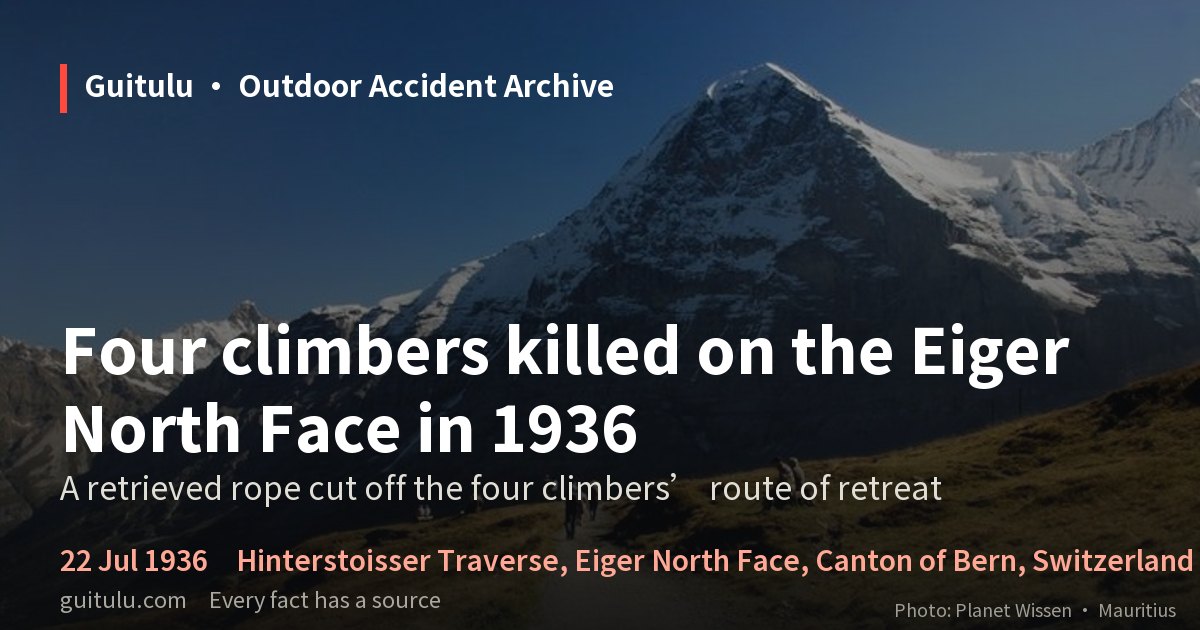
On 22 July 1936, exhausted and half-frozen, Kurz was suspended a few metres above the rescuers, who could not reach him. He died before their eyes. F36
Kurz spent the night on the rope and was still alive the next morning, but one of his hands was severely frostbitten. F31
On 24 July 1938, Heckmair, Vörg, Harrer and Kasparek became the first to reach the summit via the Eiger North Face. F40
Under each fact is a verbatim quote from the original. "Single source" means only one outlet mentioned it; "Accounts differ" means sources contradict each other and this site adopts neither side; "Speculation" is an inference by a reporter or a person involved, not a fact.
In August 1935, Munich climbers Karl Mehringer and Max Sedlmayr encountered a sudden change in the weather on the North Face and froze to death at about 3300 metres, at a place thereafter known as the “Death Bivouac”.
Quotes from the original 3
“Doch ein Wetterumsturz wurde für die beiden zur Falle. Nach mehreren Tagen erfroren die Männer in 3300 Metern Höhe. Diese Wandstelle heißt seither "Todesbiwak".”
Accounts differ on when the bodies were found: according to Abendzeitung, Kurz was recovered a month later and Hinterstoisser was not found until a year later; according to Historic Mysteries, Hinterstoisser's body was found at the foot of the mountain a few days later.
The two sources give conflicting accounts of when Hinterstoisser's body was found
Quotes from the original 2
“Einen Monat später wurde er geborgen, Andi Hinterstoisser gar erst ein Jahr nach seinem Absturz.”
The Berlin Olympics were taking place in 1936, and German media and Nazi propaganda portrayed the conquest of the North Face as a task bound up with national confidence.
Quotes from the original 2
“Die Presse stilisiert im Olympiajahr die Bezwingung der Nordwand zu einer sportlichen Pflicht für das neue deutsche Selbstbewusstsein.”
“decidiu instrumentalizar a paixão desmedida de ambos pela alta montanha para exaltar a raça ariana e celebrar os valores do Terceiro Reich no âmbito dos Jogos Olímpicos de Berlim de 1936”
According to Abendzeitung, Kurz and Hinterstoisser did not in fact fit the Greater German propaganda image of the time, but they did want the gold medals offered as a reward.
Quotes from the original 1
“Toni Kurz und Andi Hinterstoisser passen eigentlich nicht in das großdeutsche Propagandageknatter. Aber die ausgelobte Goldmedaille wollen sie.”
That year, a group of 10 German and Austrian climbers came to the Eiger. One died during a training climb, and several others withdrew because of bad weather, leaving four to set out.
Culture Trip and Historic Mysteries are both secondary overviews that do not identify their historical sources.
Quotes from the original 2
“Things started badly when one member of a 10-man team died during a training climb. This, and terrible weather conditions, convinced five of the climbers to walk away.”
“In July 1936, ten climbers from Germany and Austria attempted to climb the north face of Eiger, and the trip was a disaster from day one. Before the climb began, one of the climbers was already dead, killed in a training climb”
Angerer was injured by falling rock during the climb. He moved more slowly, slowing down the whole party.
Quotes from the original 3
“Una scarica di sassi colpisce in pieno Angerer che, gravemente ferito alla testa, è costretto a progredire molto lentamente, rallentando anche i compagni.”
Accounts differ on where Angerer was injured: Avvenire and About Mountains say the head; Culture Trip says the shoulder; Historic Mysteries says below the shoulder blade.
After returning to the traverse, Hinterstoisser spent several hours trying to cross it in reverse. The rock was covered in ice, and he was unable to get across.
Quotes from the original 3
“Per cinque ore, Hinterstoisser, il più forte del gruppo, cerca di forzare il passaggio, ma ogni volta cade e deve ricominciare da capo.”
Unable to cross the traverse, the four had no choice but to descend by a series of abseils along a direct route where rockfalls and avalanches were frequent.
Quotes from the original 3
“Als das Wetter umschlug, mussten die Männer über die steinschlag- und lawinengefährdete Direttissima umkehren.”
Tourists below the mountain had been watching the four climb through telescopes, and the viewing platform at Kleine Scheidegg became a popular destination that summer.
Quotes from the original 3
“O terraço da estação de trem de Kleine Scheidegg e seus binóculos panorâmicos tinham se tornado a maior atração local naquele verão de 1936”
According to About Mountains, Those who came to rescue them were ordinary Swiss mountain guides. The authorities had previously forbidden them from carrying out any rescue on the North Face.
Quotes from the original 1
“The rescuers were ordinary Swiss mountain guides (who, incidentally, had been forbidden by the authorities from attempting any rescues at all on the lethal Eigerwand).”
On the first day, Hinterstoisser used a tension traverse (with the aid of a taut rope) to cross a steep, smooth rock slab before the First Icefield. The section was subsequently named after him.
Quotes from the original 3
“Vor dem ersten Eisfeld gelingt Andi Hinterstoisser erstmals die Seilquerung einer steilen Plattenzone, sie trägt bis heute seinen Namen.”
“The four climbers made contact with a rail guard at Eigerwand station, about halfway down their descent, and a climber said everything was going alright.”
Hinterstoisser disconnected himself from his teammates to set up the final rappel. An avalanche then swept across the face and carried him down the rock face.
Quotes from the original 4
“Enquanto cravava pitões na rocha para elaborar a ancoragem do último rapel, uma avalanche de neve arrastou Hinterstoisser.”
Kurz called for help. Railway workers heard him and raised the alarm, and Swiss guides came out onto the rock face through the tunnel opening to rescue him.
Quotes from the original 3
“Pedindo ajuda aos gritos, conseguiu que um trabalhador da ferrovia o ouvisse e desse o alerta. Guias suíços foram em seu auxílio”
That evening, darkness had fallen and the storm was worsening. The rescuers could not reach Kurz and had to return to the tunnel, promising to come back the next morning.
Quotes from the original 2
“Guias suíços foram em seu auxílio, mas anoitecia e a tempestade aumentava. Prometeram regressar pela manhã.”
“And night was now falling. They comforted Toni Kurz as best they could. Then as his despairing cries echoed around the crags they retreated into the tunnel.”
“Next, Kurz was to climb, one handed, back up the rope to the ledge where Rainer’s body stood clamped to the rockface. Somehow, numb and one-handed, Kurz achieved this.”
Kurz separated the rope into strands and joined them into a thin cord, which he lowered to the rescuers below and used to pull up a new rope.
Quotes from the original 3
“aiutandosi coi denti, sfilaccia i trefoli della fune di canapa ottenendo un cordino abbastanza lungo che raggiunge i soccorritori, ma non abbastanza robusto da reggere il suo peso”
“With one gloved hand and his teeth, he unravelled the three strands. After five hours of painful labour he had made a cord, too weak for climbing, but long enough to lower to the guides below.”
“Even the new rope was not quite long enough, but fortunately the guides had a spare which they knotted onto it just before it lifted out of their reach.”
On 22 July 1936, exhausted and half-frozen, Kurz was suspended a few metres above the rescuers, who could not reach him. He died before their eyes.
Quotes from the original 4
“Total erschöpft und halb erfroren hängt der Berchtesgadener Toni Kurz am 22. Juli 1936 nur wenige Meter über den Köpfen einer Rettungsmannschaft in der Eiger Nordwand.”
Accounts differ on Kurz's distance from the rescuers: Avvenire says 15 metres; Itatiaia says 3 metres; Abendzeitung and Planet Wissen say “a few metres”; Culture Trip says “only a few inches”.
The distances given by the sources differ considerably
Accounts of Kurz's last words differ: most sources record them as “Ich kann nicht mehr” (I can't go on); Abendzeitung records them as “Ach, es geht nicht” (Ah, it's no use).
Accounts of the original German words do not fully agree
“a face norte do Eiger foi escalada pelos alemães Anderl Heckmair e Ludwig Vörg e pelos austríacos Heinrich Harrer e Fritz Kasparek, em 24 de julho de 1938”
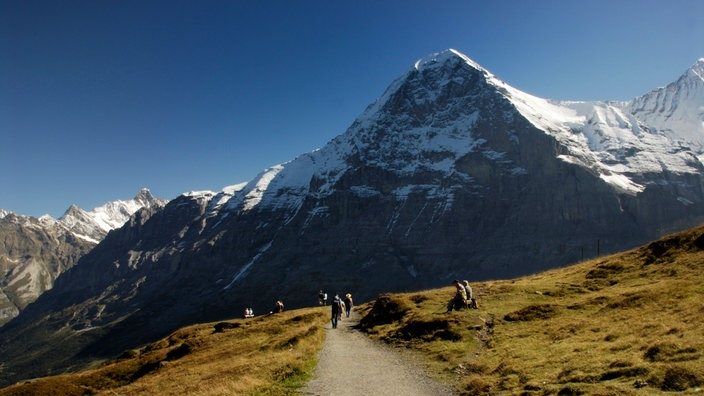
The Eiger North Face is approximately 1800 meters high, extending from the Kleine Scheidegg pass to the summit at an altitude of approximately 3970 meters.
Quotes from the original 2
“alta più di 1.800 metri, che dai prati del valico del Kleine Scheidegg (2.061 metri), porta ai 3.970 metri della vetta”
The tension traverse could only be completed in one direction and could not necessarily be repeated in reverse; once the rope was retrieved, the way back was effectively cut off.
Quotes from the original 3
“However, the tension traverse is a one-way manoeuvre.”
The tunnel opening is approximately 3.8 kilometers into the Jungfrau Railway tunnel. Originally used to remove excavated material during the tunnel's construction, it later became a traditional escape route from the North Face.
Quotes from the original 2
“Das Stollenloch bei Kilometer 3,8 ist der traditionelle Fluchtweg aus der Wand und so mancher Bergsteiger verdankt ihm sein Leben.”
“a flash of daylight on the left marks Kilometre 3.8, the Stollenloch hole used, while the tunnel was being built, for ejecting rubble over the Eiger's north face”
 GuituluGlobal Outdoor Accident Archive