GuituluGlobal Outdoor Accident Archive 中文
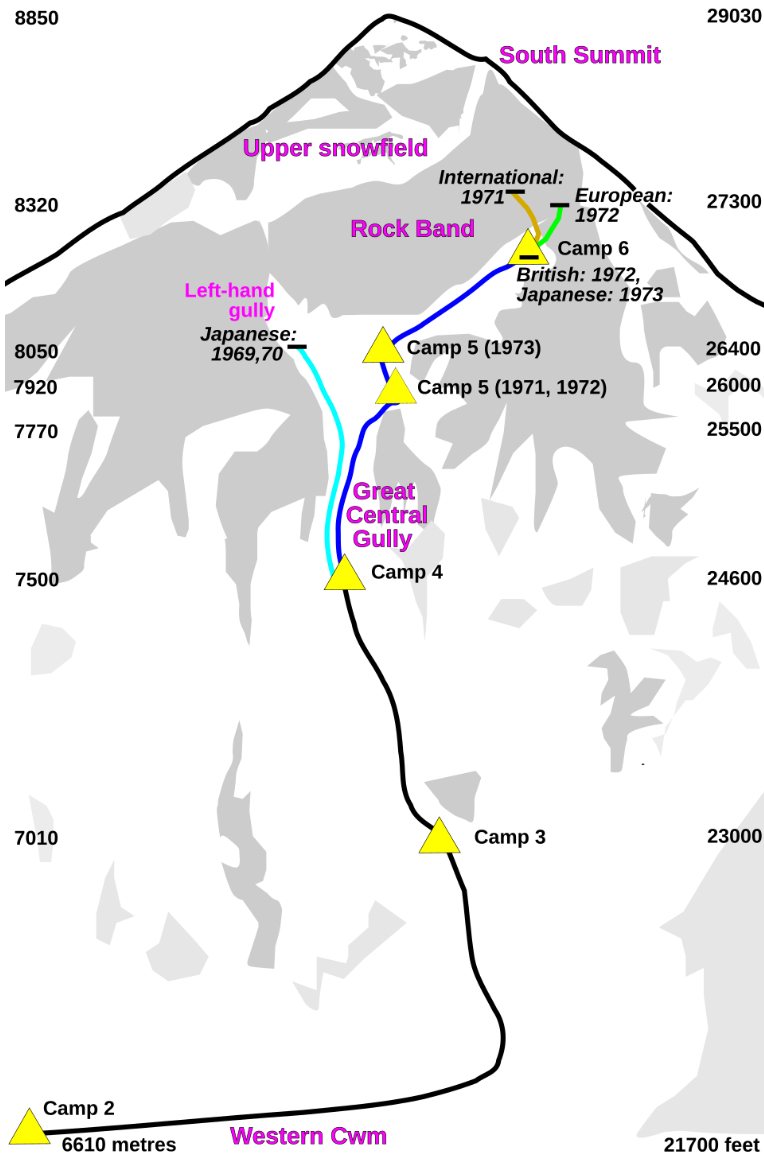
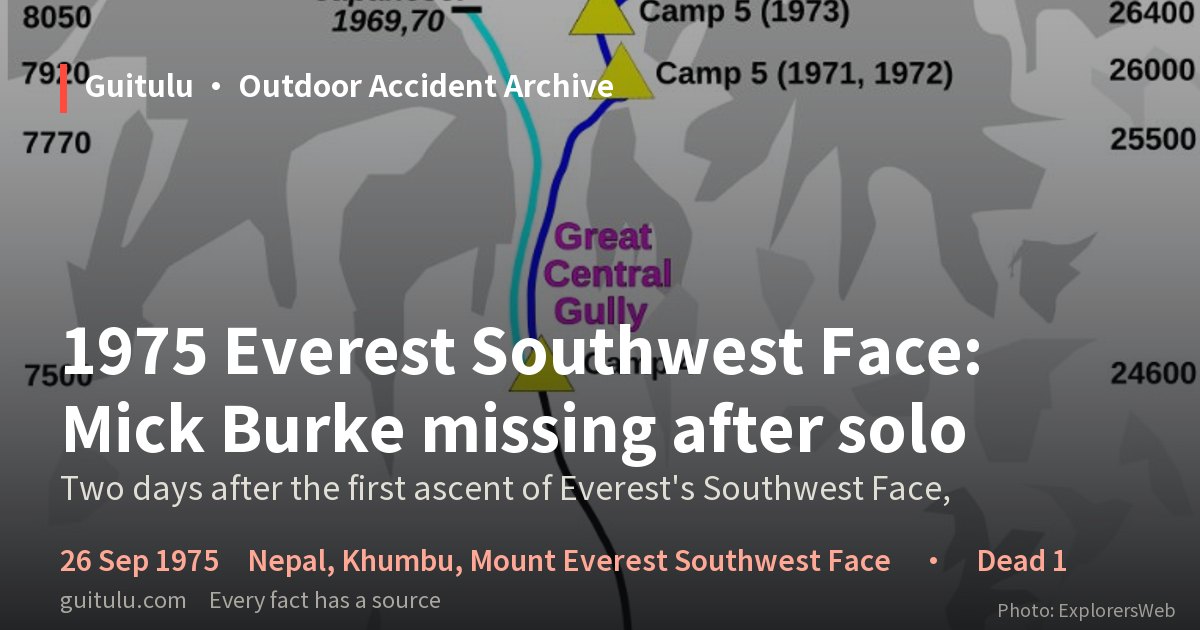
Diagram of routes attempted by various teams on Everest's Southwest Face before 1975

Archive / Mountaineering

1975 Everest Southwest Face: Mick Burke missing after solo summit bid

Two days after the first ascent of Everest's Southwest Face, photographer Burke set out alone for the summit and never returned

Presumed to have died in a fall; whether he reached the summit and the whereabouts of his body remain unknown

Photo: ExplorersWeb

Date
Autumn (post-monsoon)
Place
Nepal, Khumbu, Mount Everest Southwest FaceNepal › Koshi Province · Himalaya86.925°E 27.988°N
Activity
MountaineeringInvolves: Getting lost and losing contact · Extreme weatherSecond summit party of the 1975 British Everest Southwest Face expedition (leader Chris Bonington): Martin Boysen, Peter Boardman, Mick Burke and Pertemba
Casualties
Dead 1 Injured 2Mick Burke went missing on the summit ridge and is presumed dead; his body has never been found. Boardman suffered frostbite and Pertemba snow blindness. Sherpa Mingma Nuru also died on the approach to the mountain (accounts of the cause of death differ).
Material
50 facts · 10 sources4 accounts differ and are shown side by side

01What happened

In autumn 1975, Chris Bonington led a British expedition to make another attempt on Everest's Southwest Face. Mick Burke was the expedition's photographer, filming the climb for the BBC; he was the first Briton to climb the Nose route on El Capitan and had also taken part in the unsuccessful 1972 attempt on the Southwest Face. The expedition established base camp on 25 August. On 20 September, Estcourt and Braithwaite broke through the rock band, while Burke and Bonington supported them by carrying ropes from below; two days later, Burke also helped carry supplies up to Camp VI.Facts it rests onF04Multiple sourcesMick Burke was a British mountaineer who served as photographer on the 1975 expedition, filming the climb for the BBC.F46Multiple sourcesBurke was the first Briton to climb the Nose route on El Capitan in Yosemite.F02Multiple sourcesBurke took part in Bonington's 1972 Everest Southwest Face expedition.F08Multiple sourcesThe expedition established base camp on 25 August.F14Multiple sourcesOn 20 September, Estcourt and Braithwaite opened a route through the rock band, supported by Bonington and Burke carrying ropes behind them.F15Multiple sourcesOn 22 September, Burke, Bonington, Thompson and others carried supplies including ropes, food and oxygen up to Camp VI.

Diagram of routes attempted by various teams on Everest's Southwest Face before 1975Photo source: ExplorersWeb

On 24 September, Doug Scott and Dougal Haston reached the summit, completing the first ascent of the Southwest Face, and spent a night without a tent at approximately 8750 metres. The second summit party consisted of Boysen, Boardman, Burke and Sherpa leader Pertemba. According to reports, Burke had arrived at the highest camp late the previous night, and Bonington had ordered him not to attempt the summit; Burke argued against the order.Facts it rests onF17Multiple sourcesOn 24 September, Doug Scott and Dougal Haston reached the summit, completing the first ascent of Everest's Southwest Face.F18Multiple sourcesAfter reaching the summit, Scott and Haston spent a night at about 8750 metres without a tent.F09Multiple sourcesThe second summit party arranged by Bonington consisted of Martin Boysen, Peter Boardman, Mick Burke and Sherpa leader Pertemba.F19Multiple sourcesBurke had arrived at the highest camp late the previous evening.F20Single sourceAfter learning that Burke had arrived late at camp, Bonington ordered him not to make a summit attempt, which Burke contested.

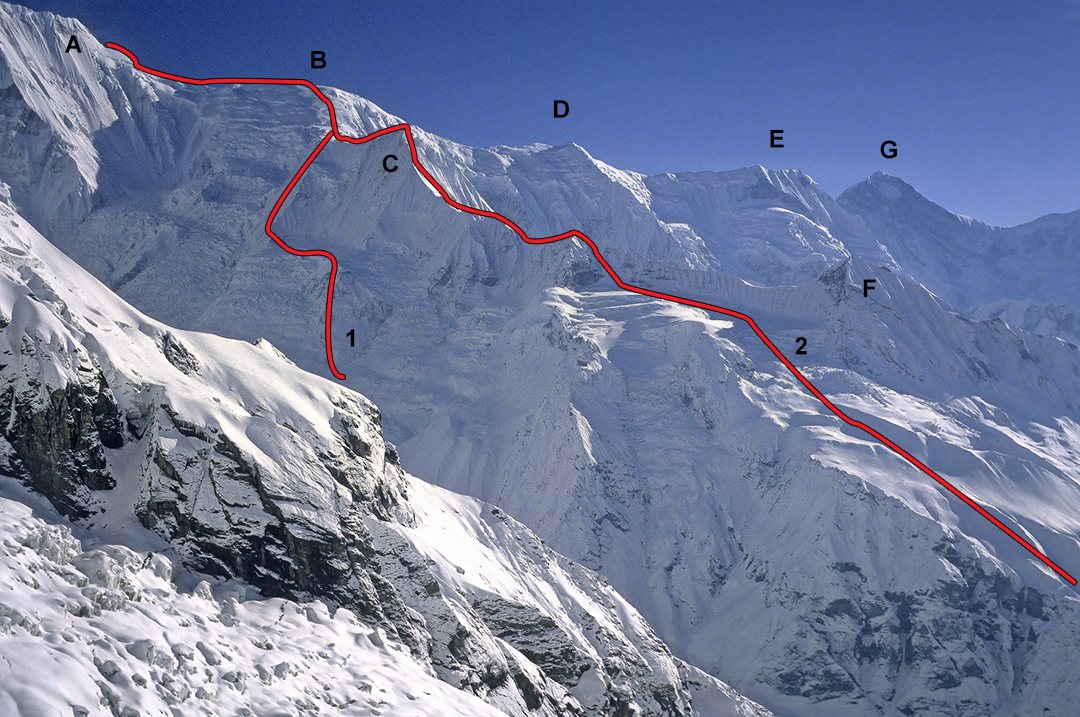
Terrain leading through the rock band to the upper snowfield via the ice gully on the leftPhoto source: ExplorersWeb

On 26 September, the four set out from Camp VI. The wind was strong, and high-altitude cirrus clouds suggested that the weather might change. Boysen turned back after losing a crampon and experiencing an oxygen-system failure, and Burke decided to continue alone. Boardman and Pertemba, who were ahead, thought Burke had returned with Boysen, and the two reached the summit in fog at around 1 p.m. On their descent, they unexpectedly encountered Burke climbing towards the summit. Burke asked them to accompany him back to the summit to film, and they eventually agreed that the two would wait for him at the South Summit.Facts it rests onF21Multiple sourcesOn 26 September, Boysen, Burke, Boardman and Pertemba set out from Camp VI for the summit.F22Multiple sourcesThe weather was poor when they set out, with strong winds, and high-altitude cirrus clouds suggested the weather might change.F23Multiple sourcesBoysen returned to camp after a crampon came off and his oxygen equipment malfunctioned.F24Multiple sourcesAfter Boysen turned back, Burke decided to continue upward alone.F25Multiple sourcesBoardman and Pertemba, who were ahead, did not see Burke and assumed he had returned to camp with Boysen.F27Multiple sourcesBoardman and Pertemba reached the summit at around 1 p.m.F28Multiple sourcesWhen the two reached the summit, it was shrouded in mist, and they could not see the distant views.F29Multiple sourcesOn their descent, Boardman and Pertemba unexpectedly met Burke, who was climbing alone toward the summit.F31Multiple sourcesBurke asked the two to accompany him back to the summit so he could film, but they eventually agreed that Boardman and Pertemba would wait for him at the South Summit.

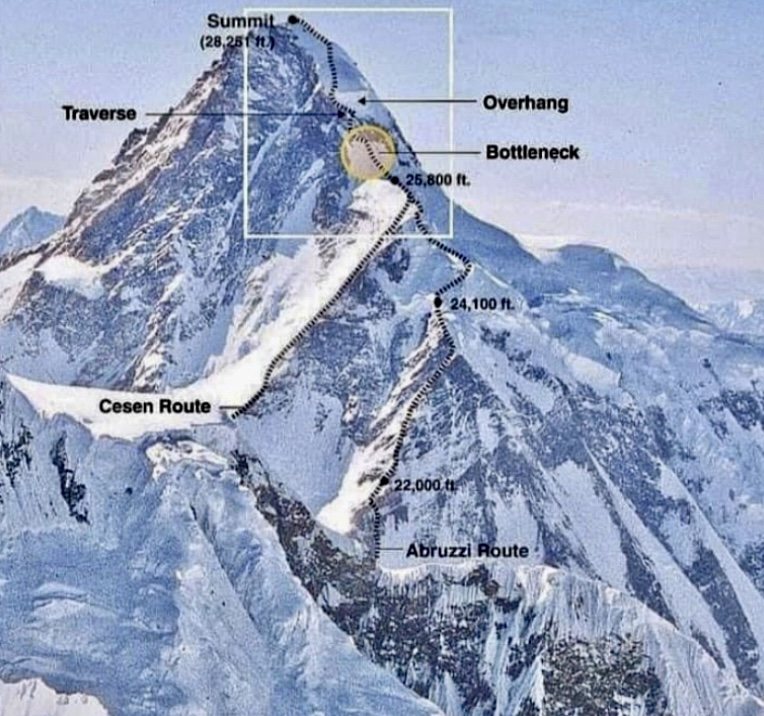
The 1975 British team's climbing route on Everest's Southwest FacePhoto source: ExplorersWeb

Within half an hour of their separation, the weather deteriorated sharply into a complete whiteout. Burke never appeared, and Boardman decided to descend for the safety of the two men. They had difficulty finding the fixed ropes and did not return to Camp VI until after dark. That night, Boysen reported by radio that Burke had not returned. The storm continued, and those in the camp could not leave their tents, making search and rescue impossible. The team eventually had to accept that Burke had died.Facts it rests onF34Multiple sourcesWithin half an hour of their separation, the weather deteriorated rapidly, and the clouds closed in, creating a complete whiteout.F36Multiple sourcesBurke never appeared, and Boardman decided to descend for the two men's safety.F37Multiple sourcesThe two had difficulty finding the fixed rope leading to Camp VI and did not return to the camp and rejoin Boysen until after dark.F38Single sourceAt 7:30 p.m. that evening, Boysen told the camp below by radio that Boardman and Pertemba had returned, but Burke had not.F43Multiple sourcesThe storm continued on 27 September, and the people at camp could not leave their tents.F11Multiple sourcesBad weather made search and rescue impossible.F12Multiple sourcesAfter another day and night, the team had to accept that Burke had died.

Haston climbing near the Hillary Step during the 1975 expedition, with the cornices on the summit ridge visiblePhoto source: ExplorersWeb

Boardman suffered frostbite and Pertemba snow blindness. After the weather improved on 28 September, Bonington ordered everyone off the Southwest Face. Burke's body has never been found. Bonington believed that Burke reached the summit and that the accident happened during his descent, but no one has been able to confirm this.Facts it rests onF42Multiple sourcesBoardman suffered frostbite, and Pertemba had snow blindness.F44Single sourceThe weather improved on 28 September, and Bonington ordered everyone to descend from the Southwest Face.F47Multiple sourcesBurke's body has never been found.F48Multiple sourcesBonington believed Burke must have reached the summit and that the accident happened during the descent.

The number at the end of a paragraph is how many facts it rests on; open it to see each fact and how well it is sourced: Multiple sourcesSingle source. Conflicting accounts and speculation are kept out of the narrative.

ImgScene photos all from news coverage; copyright belongs to the original authors

  • Reported waypoints (schematic)Schematic

Satellite imagery Sentinel-2 cloudless 2024 © EOX · Terrain AWS Terrain Tiles · Orange line is schematic · Place coordinates not individually verified

Route review

7 scenes to understand what happened

Scroll down and the map flies to where each part happened. The line is Schematic, Connects the waypoints mentioned in reports in sequence, indicating only the approximate direction, not the actual track. Sources for the location coordinates are given in places.json.

01

Full route

The locations mentioned in reports are connected in sequence to show the approximate route (illustrative).

02

Return to the Southwest Face

On 25 August, Bonington's British expedition established base camp. Photographer Burke filmed with the team and helped carry supplies.Facts it rests onF08Multiple sourcesThe expedition established base camp on 25 August.F04Multiple sourcesMick Burke was a British mountaineer who served as photographer on the 1975 expedition, filming the climb for the BBC.F15Multiple sourcesOn 22 September, Burke, Bonington, Thompson and others carried supplies including ropes, food and oxygen up to Camp VI.

04

Continuing alone

Boysen turned back, and Burke continued alone. Boardman and Pertemba thought he had returned and reached the summit in fog at around 1 p.m.Facts it rests onF23Multiple sourcesBoysen returned to camp after a crampon came off and his oxygen equipment malfunctioned.F24Multiple sourcesAfter Boysen turned back, Burke decided to continue upward alone.F25Multiple sourcesBoardman and Pertemba, who were ahead, did not see Burke and assumed he had returned to camp with Boysen.F27Multiple sourcesBoardman and Pertemba reached the summit at around 1 p.m.

05

Encounter on the ridge

During the descent, the two met Burke as he was climbing toward the summit. They agreed to wait for him at the South Summit, and Burke continued toward the summit alone.Facts it rests onF29Multiple sourcesOn their descent, Boardman and Pertemba unexpectedly met Burke, who was climbing alone toward the summit.F31Multiple sourcesBurke asked the two to accompany him back to the summit so he could film, but they eventually agreed that Boardman and Pertemba would wait for him at the South Summit.F33Multiple sourcesBurke continued alone toward the summit, while Boardman and Pertemba descended to the South Summit to wait for him.

06

Whiteout and waiting

Within half an hour, the weather deteriorated sharply. Burke did not appear, and the two descended for safety, returning to camp only after dark.Facts it rests onF34Multiple sourcesWithin half an hour of their separation, the weather deteriorated rapidly, and the clouds closed in, creating a complete whiteout.F36Multiple sourcesBurke never appeared, and Boardman decided to descend for the two men's safety.F37Multiple sourcesThe two had difficulty finding the fixed rope leading to Camp VI and did not return to the camp and rejoin Boysen until after dark.

02Timeline

  1. The expedition established base camp on 25 August. F08

  2. On 20 September, Estcourt and Braithwaite opened a route through the rock band, supported by Bonington and Burke carrying ropes behind them. F14

  3. On 22 September, Burke, Bonington, Thompson and others carried supplies including ropes, food and oxygen up to Camp VI. F15

  4. On 24 September, Doug Scott and Dougal Haston reached the summit, completing the first ascent of Everest's Southwest Face. F17

  5. The two had difficulty finding the fixed rope leading to Camp VI and did not return to the camp and rejoin Boysen until after dark. F37

  6. Within half an hour of their separation, the weather deteriorated rapidly, and the clouds closed in, creating a complete whiteout. F34

  7. Burke continued alone toward the summit, while Boardman and Pertemba descended to the South Summit to wait for him. F33

  8. On their descent, Boardman and Pertemba unexpectedly met Burke, who was climbing alone toward the summit. F29

  9. On 26 September, Boysen, Burke, Boardman and Pertemba set out from Camp VI for the summit. F21

  10. At 7:30 p.m. that evening, Boysen told the camp below by radio that Boardman and Pertemba had returned, but Burke had not. F38

  11. Boardman and Pertemba reached the summit at around 1 p.m. F27

  12. Boysen returned to camp after a crampon came off and his oxygen equipment malfunctioned. F23

  13. The storm continued on 27 September, and the people at camp could not leave their tents. F43

  14. The weather improved on 28 September, and Bonington ordered everyone to descend from the Southwest Face. F44

03Lessons

Teams and decisions

Being alone at altitude multiplies the risk

After his companion turned back, Burke continued his summit bid alone, while the two ahead did not know he was still on the mountain. If the weather turns bad on the summit ridge, a climber without a companion has no one to notice and help in time. When a party separates on summit day, everyone should know one another's locations and plans.Facts it rests onF24Multiple sourcesAfter Boysen turned back, Burke decided to continue upward alone.F25Multiple sourcesBoardman and Pertemba, who were ahead, did not see Burke and assumed he had returned to camp with Boysen.F06Single sourceIn 1975, it was generally believed that Everest should be climbed with a companion.

Weather and retreat

Summit weather can change in half an hour

Strong winds and high-altitude cirrus clouds were already present early that morning. The two reached the summit in fog, and within half an hour of their separation, conditions became a whiteout. High-altitude cirrus clouds and thickening fog are signals to take seriously; the closer climbers get to the summit, the more margin they need to leave for the descent.Facts it rests onF22Multiple sourcesThe weather was poor when they set out, with strong winds, and high-altitude cirrus clouds suggested the weather might change.F28Multiple sourcesWhen the two reached the summit, it was shrouded in mist, and they could not see the distant views.F34Multiple sourcesWithin half an hour of their separation, the weather deteriorated rapidly, and the clouds closed in, creating a complete whiteout.

Avalanche and high altitude

Set a limit on waiting

Boardman and Pertemba waited at the South Summit for a long time before descending for their own safety. They only just managed to find the fixed ropes and return to camp after dark. When waiting for a companion, set a latest departure time beforehand, or more people may be left in danger.Facts it rests onF36Multiple sourcesBurke never appeared, and Boardman decided to descend for the two men's safety.F37Multiple sourcesThe two had difficulty finding the fixed rope leading to Camp VI and did not return to the camp and rejoin Boysen until after dark.F42Multiple sourcesBoardman suffered frostbite, and Pertemba had snow blindness.

Teams and decisions

Cumulative fatigue cannot be ignored

Burke arrived at the highest camp very late on the night before the summit attempt, and the leader had also been concerned that he had spent too long at high altitude. Attempting the summit after several consecutive days of strenuous load carrying may impair both physical strength and judgment.Facts it rests onF15Multiple sourcesOn 22 September, Burke, Bonington, Thompson and others carried supplies including ropes, food and oxygen up to Camp VI.F19Multiple sourcesBurke had arrived at the highest camp late the previous evening.F10Single sourceBonington recalled that, as he descended, he had urged those with Burke to make sure Burke came back, because Burke had spent too long at high altitude.

04Fact list 50 facts

Under each fact is a verbatim quote from the original. "Single source" means only one outlet mentioned it; "Accounts differ" means sources contradict each other and this site adopts neither side; "Speculation" is an inference by a reporter or a person involved, not a fact.

  1. F01Single sourceBackground

    According to AAJ, During the 1970 Annapurna South Face expedition, it was Burke who opened the route through the key rock band.

    Quotes from the original 1

    “It was he who had forced the rock band, the key to the south face of Annapurna in 1970.”

    AAJ ·
  2. F02Multiple sourcesBackground

    Burke took part in Bonington's 1972 Everest Southwest Face expedition.

    Quotes from the original 3

    “In the autumn of 1972, Chris Bonington led a strong British party, including Doug Scott, Dougal Haston, and Mick Burke.”

    ExplorersWeb · 2025-09-24

    “Nel 1972 tenta un team britannico diretto da Bonington, e che comprende Haston, Scott, Nick Estcourt, Mick Burke e Hamish MacInnes”

    Montagna.TV ·

    “He had been to our high point on Everest in 1972”

    AAJ ·
  3. F03Single sourceBackground

    According to ExplorersWeb, The 1972 attempt turned back at 8230 metres because of high winds, cold and insufficient supplies. Team member Tony Tighe was killed by a falling serac in the icefall.

    Quotes from the original 1

    “Brutal winds, cold, and poor supplies forced them to turn back at 8,230m, and Tony Tighe was killed in the Icefall by a falling serac.”

    ExplorersWeb · 2025-09-24
  4. F04Multiple sourcesBackground

    Mick Burke was a British mountaineer who served as photographer on the 1975 expedition, filming the climb for the BBC.

    Quotes from the original 3

    “Mick Burke, a Manchester rock expert, filmed the ascent for the BBC.”

    ExplorersWeb · 2025-09-24

    “Mick Burke, a noted climber, mountaineer and BBC Cameraman disappeared during the Mount Everest Expedition of 1975”

    Mountain Heritage Trust ·

    “Mick Burke, a BBC cameraman who had been accompanying them”

    RSGS · 2021-09-24
  5. F05Single sourceBackground

    According to ExplorersWeb, The 1975 expedition consisted of 18 climbers and about 60 Sherpas and other support personnel.

    Quotes from the original 1

    “Bonington assembled a team of 18 climbers and approximately 60 Sherpas, plus other support staff.”

    ExplorersWeb · 2025-09-24
  6. F06Single sourcePost-incident analysis

    According to Mark Horrell, In 1975, it was generally believed that Everest should be climbed with a companion.

    Quotes from the original 1

    “In 1975, it was generally assumed sensible practice to climb Everest with a partner.”

    Mark Horrell · 2023-04-05
  7. F07Accounts differEvent

    The Sherpa Mingma Norbu died on the approach to the mountain. Accounts of the cause differ: ExplorersWeb says he drowned in a river; STV says he died in a fall.

    The two media outlets give differing accounts of the cause of death

    Quotes from the original 2

    “On August 23, during the trek to Base Camp, Mingma Nuru Sherpa tragically drowned in a river.”

    ExplorersWeb · 2025-09-24

    “A young Sherpa, Mingma Nuru, was killed in a fall on the trek to Base Camp”

    STV News ·
  8. F08Multiple sourcesMovement

    The expedition established base camp on 25 August.

    Quotes from the original 2

    “We had established Base Camp on August 25, just three weeks earlier than in 1972.”

    AAJ ·

    “The team set Base Camp on August 25”

    ExplorersWeb · 2025-09-24
  9. F09Multiple sourcesPlan

    The second summit party arranged by Bonington consisted of Martin Boysen, Peter Boardman, Mick Burke and Sherpa leader Pertemba.

    Quotes from the original 2

    “Martin Boysen, Pete Boardman, Mick Burke and Pertemba, our Sirdar, would have second go for the summit.”

    Himalayan Journal ·

    “Pete was chosen to make the second summit attempt along with Martin Boysen, Pertemba and Mick Burke.”

    Boardman Tasker · 2025-05-01
  10. F10Single sourceParticipant's view

    According to STV News, Bonington recalled that, as he descended, he had urged those with Burke to make sure Burke came back, because Burke had spent too long at high altitude.

    Quotes from the original 1

    “Make sure Mick comes back. He’s been up high too long. He should be back.”

    STV News ·
  11. F11Multiple sourcesAftermath

    Bad weather made search and rescue impossible.

    Quotes from the original 2

    “bad weather forced any rescue attempts to be abandoned.”

    RSGS · 2021-09-24

    “A storm that set in shortly after made rescue attempts impossible.”

    STV News ·
  12. F12Multiple sourcesAftermath

    After another day and night, the team had to accept that Burke had died.

    Quotes from the original 2

    “But after another day and another night of storm we had to admit to ourselves that he was dead”

    AAJ ·

    “All hope of Mick returning slowly faded.”

    Himalayan Journal ·
  13. F13Single sourceMovement

    According to ExplorersWeb, On 6 September, Scott and Burke began climbing the Southwest Face, fixing ropes for Camp IV.

    Quotes from the original 1

    “Scott and Burke began to climb the face on September 6, fixing 370m of rope to a buttress for Camp 4 at 7,200m.”

    ExplorersWeb · 2025-09-24
  14. F14Multiple sourcesEvent

    On 20 September, Estcourt and Braithwaite opened a route through the rock band, supported by Bonington and Burke carrying ropes behind them.

    Quotes from the original 3

    “Mick Burke and I carried loads of rope in support of Estcourt and Braithwaite that day”

    AAJ ·

    “On September 20, Estcourt and Braithwaite, supported by Bonington and Burke, cracked it.”

    ExplorersWeb · 2025-09-24

    “They then descended to Chris and Mick Burke, who were climbing in support”

    Himalayan Journal ·
  15. F15Multiple sourcesMovement

    On 22 September, Burke, Bonington, Thompson and others carried supplies including ropes, food and oxygen up to Camp VI.

    Quotes from the original 3

    “Chris, Mike Thompson and Mick Burke arrived with other vital supplies—rope, food and oxygen.”

    AAJ ·

    “during which Bonington, Mike Thompson, Mick Burke, Ang Phurba and Pertemba carried ropes, fuel and oxygen up the Rock Band to Camp 6”

    RSGS · 2021-09-24

    “Pertemba, Mike Thompson, Chris and Mick came up with vital loads to the camp site.”

    Himalayan Journal ·
  16. F16Single sourceBackground

    According to Himalayan Journal, Burke was not selected for the first summit party. He carried heavy film camera equipment up the mountain, determined to film as much of the summit attempt as possible.

    Quotes from the original 1

    “Mike Burke, disappointed at not being in the first assault party, came up with a dead weight of cine equipment, determined to film all he could of our push”

    Himalayan Journal ·
  17. F17Multiple sourcesEvent

    On 24 September, Doug Scott and Dougal Haston reached the summit, completing the first ascent of Everest's Southwest Face.

    Quotes from the original 3

    “Mount Everest, First Ascent of the Southwest Face, September 24, 1975 (Haston, Scott)”

    AAJ ·

    “On Sept. 24, 1975, Doug Scott and Dougal Haston stood on the summit of Everest after the first complete ascent of the Southwest Face”

    ExplorersWeb · 2025-09-24

    “At 6pm on September 24, Dougal Haston, from Edinburgh and Doug Scott from Nottingham made history”

    STV News ·
  18. F18Multiple sourcesEvent

    After reaching the summit, Scott and Haston spent a night at about 8750 metres without a tent.

    Quotes from the original 3

    “The two climbers were forced to bivouac at 8,750m.”

    ExplorersWeb · 2025-09-24

    “had to spend a night in the open at 8,750m on the South Summit, without tent or sleeping bags”

    Mark Horrell · 2023-04-05

    “they were forced to spend the night in a hand-dug cave on the mountain without tents, food or oxygen”

    STV News ·
  19. F19Multiple sourcesMovement

    Burke had arrived at the highest camp late the previous evening.

    Quotes from the original 2

    “Burke had been the last climber to reach camp the night before, and the last to set out that morning.”

    Mark Horrell · 2023-04-05

    “quando sa che Burke è arrivato alla tenda in ritardo”

    Montagna.TV ·
  20. F20Single sourceEvent

    According to Montagna.TV, After learning that Burke had arrived late at camp, Bonington ordered him not to make a summit attempt, which Burke contested.

    Quotes from the original 1

    “gli ordina di non partire per la vetta. Ma Mick risponde per le rime.”

    Montagna.TV ·
  21. F21Multiple sourcesMovement

    On 26 September, Boysen, Burke, Boardman and Pertemba set out from Camp VI for the summit.

    Quotes from the original 2

    “That morning of September 26, at 3:30 Martin Boysen, Mick Burke, Pete Boardman and our sardar, Pertemba, had set out”

    AAJ ·

    “On September 26, Martin Boysen, Pete Boardman, Mick Burke, and Pertemba Sherpa left Camp 6.”

    ExplorersWeb · 2025-09-24
  22. F22Multiple sourcesEvent

    The weather was poor when they set out, with strong winds, and high-altitude cirrus clouds suggested the weather might change.

    Quotes from the original 2

    “Even at dawn the wind was gusting strongly, and there was a threat of high cirrus cloud in the sky”

    AAJ ·

    “The weather was not good, with strong winds and cirrus clouds that warned of changing conditions.”

    ExplorersWeb · 2025-09-24
  23. F23Multiple sourcesEvent

    Boysen returned to camp after a crampon came off and his oxygen equipment malfunctioned.

    Quotes from the original 3

    “one of Martin’s crampons fell off. He had already had trouble with his oxygen”

    AAJ ·

    “Martin lost his crampons at the first difficult step and, with faulty oxygen equipment adding to his problems, he decided to return to Camp 6.”

    Himalayan Journal ·

    “A frustrated Boysen turned back early after his oxygen set packed up and he lost a crampon”

    Mark Horrell · 2023-04-05
  24. F24Multiple sourcesEvent

    After Boysen turned back, Burke decided to continue upward alone.

    Quotes from the original 3

    “After Boysen had turned back he had decided to carry on by himself.”

    AAJ ·

    “Mick carried on along the ropes and up the tracks left by Pete and Pertemba.”

    Himalayan Journal ·

    “But Burke was alone.”

    Mark Horrell · 2023-04-05
  25. F25Multiple sourcesEvent

    Boardman and Pertemba, who were ahead, did not see Burke and assumed he had returned to camp with Boysen.

    Quotes from the original 3

    “They had seen no sign of Mick Burke and assumed that he had gone back with Boysen.”

    AAJ ·

    “In fact, they thought the second pair had returned to the tents.”

    Himalayan Journal ·

    “They assumed that Mick had returned to Camp Six with Martin”

    Boardman Tasker · 2025-05-01
  26. F26Multiple sourcesEvent

    Boardman and Pertemba reached the South Summit at 10:30 a.m. Pertemba's oxygen equipment froze, and it took about an hour and a half to fix.

    ExplorersWeb's account is based on Bonington's article in AAJ

    Quotes from the original 2

    “reaching the south summit of Everest by 10:30 A.M.”

    AAJ ·

    “Boardman and Pertemba reached the South Summit by 10:30 am. Soon after, Pertemba’s oxygen bottle iced up, and it took 90 minutes to fix.”

    ExplorersWeb · 2025-09-24
  27. F27Multiple sourcesEvent

    Boardman and Pertemba reached the summit at around 1 p.m.

    Quotes from the original 4

    “They reached it at 1:10 P.M.”

    AAJ ·

    “Finally, Boardman and Pertemba Sherpa summited at 1:10 pm, flying Nepal’s flag.”

    ExplorersWeb · 2025-09-24

    “reached the summit roped together shortly after 1pm”

    Mark Horrell · 2023-04-05

    “Pete and Pertemba reached the summit at one o’clock”

    Boardman Tasker · 2025-05-01
  28. F28Multiple sourcesFound at scene

    When the two reached the summit, it was shrouded in mist, and they could not see the distant views.

    Quotes from the original 2

    “Unfortunately, a mist gathered, blocking out all the fine views we had experienced.”

    Himalayan Journal ·

    “they found themselves enclosed in a fine mist”

    Mark Horrell · 2023-04-05
  29. F29Multiple sourcesEvent

    On their descent, Boardman and Pertemba unexpectedly met Burke, who was climbing alone toward the summit.

    Quotes from the original 3

    “Just below the summit they were astonished to meet Mick Burke, who was sitting down having a rest.”

    AAJ ·

    “On their descent, they passed Burke who was heading up.”

    Gripped · 2015-09-24

    “During the descent of a subsequent climb, Peter Boardman and Pertemba Sherpa encountered filmmaker Mick Burke, who hoped to capture footage from the peak.”

    STV News ·
  30. F30Accounts differEvent

    Accounts differ on where they met: Bonington wrote in AAJ that it was a short distance below the summit; in another book he wrote that it was above the Hillary Step; Montagna.TV placed it below the Hillary Step; and Mark Horrell placed it a few hundred metres below the summit.

    Accounts differ on the meeting location

    Quotes from the original 4

    “Just below the summit they were astonished to meet Mick Burke”

    AAJ ·

    “were amazed to meet up with him just above the Hillary Step as they descended”

    Boardman Tasker · 2025-05-01

    “Sotto allo Hillary Step incontrano Mick Burke”

    Montagna.TV ·

    “A few hundred metres below the summit, a strange object took shape through the mist”

    Mark Horrell · 2023-04-05
  31. F31Multiple sourcesEvent

    Burke asked the two to accompany him back to the summit so he could film, but they eventually agreed that Boardman and Pertemba would wait for him at the South Summit.

    Quotes from the original 3

    “He even tried to persuade them to go back to the summit with him so that he could film them on top”

    AAJ ·

    “He asked Pete and Pertemba to return with him to get some summit film, but they were reluctant to do so.”

    Himalayan Journal ·

    “Mick even tried to persuade them to come back to the top so that he could film them. They agreed instead that Pete and Pertemba would wait at the South Summit.”

    Boardman Tasker · 2025-05-01
  32. F32Accounts differEvent

    Accounts differ on who decided against returning to the summit together: Bonington said in AAJ that Boardman refused; Mark Horrell said Boardman had agreed, but Burke changed his mind and asked them to wait at the South Summit.

    Quotes from the original 2

    “you do not retrace your steps lightly at 29,000 feet and Pete declined”

    AAJ ·

    “But when Boardman accepted, he changed his mind and asked them to wait for him at the South Summit.”

    Mark Horrell · 2023-04-05
  33. F33Multiple sourcesEvent

    Burke continued alone toward the summit, while Boardman and Pertemba descended to the South Summit to wait for him.

    Quotes from the original 2

    “Mick therefore carried on alone over the broad easy section to the top, while Pete and Pertemba went down to the South Summit to await his return.”

    Himalayan Journal ·

    “And so Mick Burke plodded on alone towards the summit of Everest, the goal of his ambition, and the other pair started down”

    AAJ ·
  34. F34Multiple sourcesEvent

    Within half an hour of their separation, the weather deteriorated rapidly, and the clouds closed in, creating a complete whiteout.

    Quotes from the original 2

    “within half an hour, weather conditions deteriorated dramatically, with the cloud closing in to form a complete white-out and the snow gusting furiously.”

    AAJ ·

    “Boardman and Pertemba waited at the South Summit, but within half an hour, the weather dramatically deteriorated.”

    ExplorersWeb · 2025-09-24
  35. F35Accounts differEvent

    Accounts differ on how long Boardman and Pertemba waited at the South Summit: AAJ says one hour and fifteen minutes; the Himalayan Journal says an hour or more; ExplorersWeb says one hour; and Mark Horrell says an hour and a half.

    Quotes from the original 4

    “They sat there shivering in the driving wind for an hour and a quarter”

    AAJ ·

    “They waited for an hour, maybe more”

    Himalayan Journal ·

    “In whiteout conditions, Boardman and Pertemba Sherpa waited an hour, then descended”

    ExplorersWeb · 2025-09-24

    “Boardman and Pertemba waited on the South Summit for an hour and a half”

    Mark Horrell · 2023-04-05
  36. F36Multiple sourcesEvent

    Burke never appeared, and Boardman decided to descend for the two men's safety.

    Quotes from the original 2

    “It was an agonizing decision to make, but the only course open was to retreat, particularly since he felt responsible for his companion Pertemba as well as himself.”

    AAJ ·

    “When Pertemba said he could no longer feel his fingers and toes, they decided it was time to descend for their own safety.”

    Mark Horrell · 2023-04-05
  37. F37Multiple sourcesMovement

    The two had difficulty finding the fixed rope leading to Camp VI and did not return to the camp and rejoin Boysen until after dark.

    Quotes from the original 3

    “They had the greatest difficulty in finding the end of the fixed rope that led back to Camp VI and only got back an hour after dark.”

    AAJ ·

    “It was well after dark when they finally stumbled in to rejoin Boysen at Camp 6.”

    Himalayan Journal ·

    “Boardman and Pertemba Sherpa waited an hour, then descended, barely finding the fixed ropes.”

    ExplorersWeb · 2025-09-24
  38. F38Single sourceEvent

    According to AAJ, At 7:30 p.m. that evening, Boysen told the camp below by radio that Boardman and Pertemba had returned, but Burke had not.

    Quotes from the original 1

    “Pete and Pertemba have just got back, but Mick hasn’t.”

    AAJ ·
  39. F39SpeculationSpeculation

    It is thought that Burke may have stepped through a snow cornice on the summit ridge in the whiteout and fallen down the Kangshung Face on the eastern side.

    Quotes from the original 4

    “much more likely walked over one of the cornices which overlook the huge Kangshung face of Everest”

    AAJ ·

    “Mick probably fell through a cornice, perhaps just below the Hillary Step.”

    Himalayan Journal ·

    “Nobody knows what happened to Burke, but a cornice fall to the Kangshung Face is likely.”

    ExplorersWeb · 2025-09-24

    “it is generally assumed that in the thickening mist he fell through a cornice down the Kangshung Face into China”

    Mark Horrell · 2023-04-05
  40. F40Single sourceBackground

    According to Mark Horrell, Burke wore glasses while climbing.

    Quotes from the original 1

    “He had climbed in glasses”

    Mark Horrell · 2023-04-05
  41. F41SpeculationSpeculation

    It is thought that Burke may have reached the summit, but no one can confirm whether he did.

    Quotes from the original 3

    “The route was repeated two days later by Boardman and Pertemba, and probably by Mick Burke, who disappeared in a storm during the descent.”

    Himalayan Journal ·

    “He was presumed to have made it to the top, but never returned.”

    STV News ·

    “Nobody knows whether he reached the summit.”

    Mark Horrell · 2023-04-05
  42. F42Multiple sourcesAftermath

    Boardman suffered frostbite, and Pertemba had snow blindness.

    Quotes from the original 2

    “Pertemba was suffering from snow blindness and Boardman had frostbite and was exhausted”

    AAJ ·

    “Boardman and Pertemba made it down, but with frostbite and snowblindness, respectively.”

    ExplorersWeb · 2025-09-24
  43. F43Multiple sourcesAftermath

    The storm continued on 27 September, and the people at camp could not leave their tents.

    Quotes from the original 2

    “The next day, September 27, the storm raged unabated. There was no question of leaving their tent”

    AAJ ·

    “They spent the next day recovering from their ordeal, pinned down in the tents by the full fury of the storm.”

    Himalayan Journal ·
  44. F44Single sourceAftermath

    According to Himalayan Journal, The weather improved on 28 September, and Bonington ordered everyone to descend from the Southwest Face.

    Quotes from the original 1

    “On the following day, September 28, the weather was much improved, and Chris ordered everyone to come down off the face.”

    Himalayan Journal ·
  45. F45Single sourceAftermath

    According to ExplorersWeb, The 1976 documentary Everest the Hard Way used footage filmed by Burke.

    Quotes from the original 1

    “The same year, Burke’s footage was used in a documentary titled Everest the Hard Way.”

    ExplorersWeb · 2025-09-24
  46. F46Multiple sourcesBackground

    Burke was the first Briton to climb the Nose route on El Capitan in Yosemite.

    Quotes from the original 3

    “including being the first Briton to climb the Nose on El Capitan”

    AAJ ·

    “In 1970, Burke became the first Briton to climb the Nose of El Capitan.”

    ExplorersWeb · 2025-09-24

    “Burke and now-Canadian Rob Wood had made the first British ascent of The Nose in Yosemite.”

    Gripped · 2015-09-24
  47. F47Multiple sourcesFound at scene

    Burke's body has never been found.

    Quotes from the original 2

    “He was last seen near the summit and his body was never found.”

    Gripped · 2015-09-24

    “His body has never been found.”

    Mark Horrell · 2023-04-05
  48. F48Multiple sourcesParticipant's view

    Bonington believed Burke must have reached the summit and that the accident happened during the descent.

    Both accounts come from Bonington himself (the AAJ article and his book Ascent).

    Quotes from the original 2

    “I am absolutely certain that he reached the top of Everest and the accident would have occurred on the descent.”

    AAJ ·

    “I’m sure that Mick reached the summit”

    Boardman Tasker · 2025-05-01
  49. F49Single sourceParticipant's view

    According to AAJ, Bonington believed Burke's decision to continue alone was a calculated risk, and that this was part of mountaineering.

    Quotes from the original 1

    “In going on alone he took a calculated risk, something that is an integral part of mountaineering.”

    AAJ ·
  50. F50Single sourceParticipant's view

    According to Himalayan Journal, Scott wrote that the whole team unanimously supported Boardman and Pertemba's decision to descend, believing that they too might have been engulfed by the storm had they continued to wait.

    Quotes from the original 1

    “Nevertheless, the whole team was unanimous in supporting Pete's and Pertemba's decision to return : the storm might otherwise have wiped out not only Mick, but Pete and Pertemba as well if they had stayed.”

    Himalayan Journal ·