GuituluGlobal Outdoor Accident Archive 中文
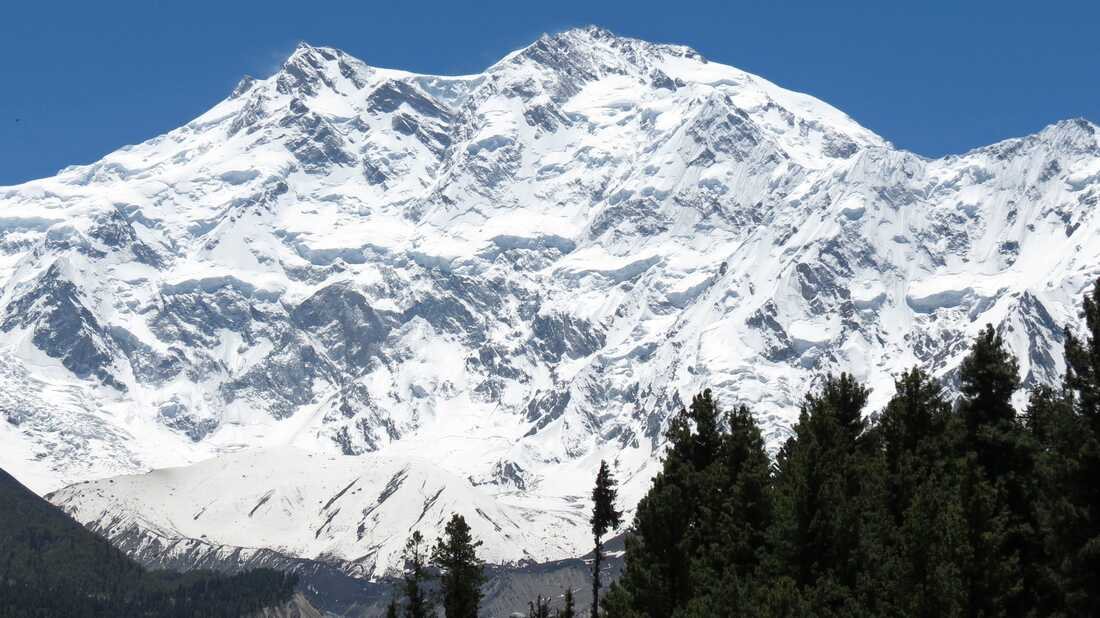
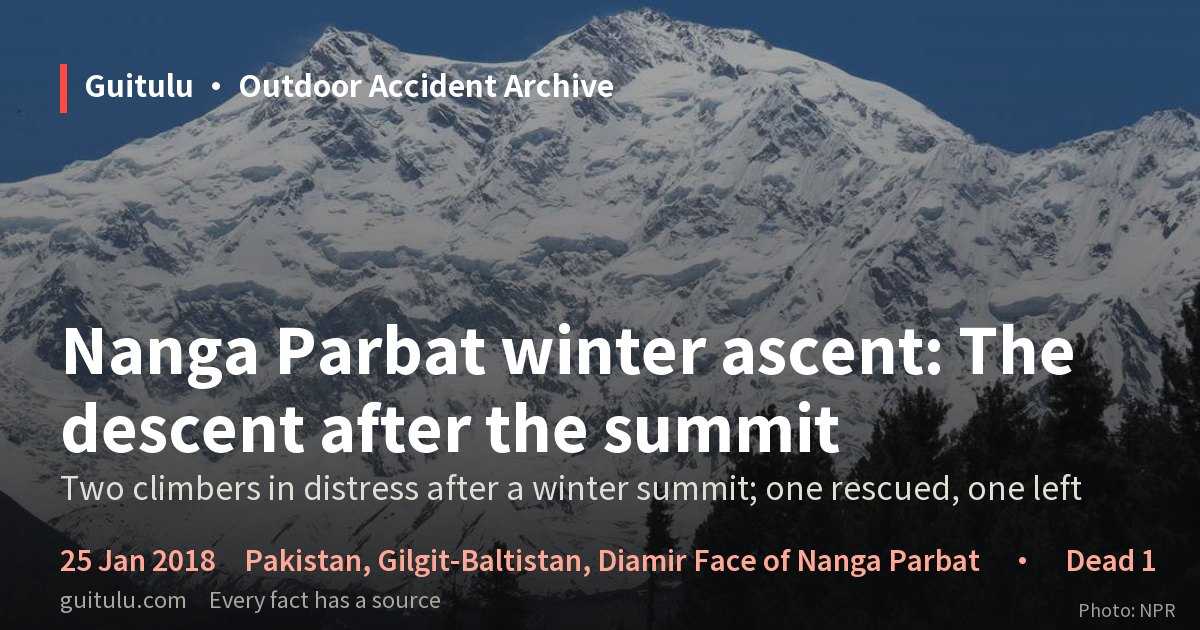
Panorama of Nanga Parbat

Archive / Mountaineering

Nanga Parbat winter ascent: The descent after the summit

Two climbers in distress after a winter summit; one rescued, one left on the mountain

Revol was rescued by Polish team members who came from K2; Mackiewicz could not be rescued

Photo: NPR

Date
Winter
Place
Pakistan, Gilgit-Baltistan, Diamir Face of Nanga ParbatPakistan › Gilgit-Baltistan · Himalaya74.590°E 35.238°N
Activity
MountaineeringInvolves: Altitude illness · Extreme weather2 people (French climber Elisabeth Revol and Polish climber Tomasz Mackiewicz)
Casualties
Dead 1 Injured 1Mackiewicz was presumed dead, and his body could not be brought down; Revol suffered severe frostbite to her hands and feet
Material
46 facts · 9 sources4 accounts differ and are shown side by side

01What happened

In January 2018, Polish climber Tomasz Mackiewicz made his seventh winter attempt on Nanga Parbat, accompanied by French climber Elisabeth Revol. According to reports, the two began their summit push on 20 January and reached approximately 7300 metres on 24 January. They summited on 25 January, making the second winter ascent of the mountain; Revol also became the first woman to summit it in winter.Facts it rests onF03Multiple sourcesThis was Polish climber Tomasz Mackiewicz's seventh winter attempt on Nanga Parbat.F11Single sourceThe two began their summit push on 20 January.F12Single sourceThe two reached approximately 7300 metres on 24 January, after which communication was lost.F13Multiple sourcesRevol and Mackiewicz summited Nanga Parbat on 25 January 2018.F14Multiple sourcesThis was the second winter ascent of Nanga Parbat, and Revol became the first woman to summit the mountain in winter.

Panorama of Nanga ParbatPhoto source: NPR

At the summit or just after they began descending, Mackiewicz developed snow blindness and said he could not see anything. He had severe frostbite and symptoms of pulmonary edema and could not move on his own. The two took shelter in a crevasse, and Revol used a satellite phone to call for help. She then put Mackiewicz in a sleeping bag, left most of the equipment and descended alone to seek help. She said that leaving her companion was not a decision she made herself, but one she was forced to make.Facts it rests onF15Multiple sourcesAt the summit or just after the descent began, Mackiewicz developed snow blindness and said he could not see anything.F20Multiple sourcesMackiewicz had severe frostbite and snow blindness and could not move on his own.F16Multiple sourcesMackiewicz developed symptoms of pulmonary oedema.F17Multiple sourcesDuring the descent, the two took shelter in a crevasse.F19Multiple sourcesRevol used a satellite phone to call for help, reporting that the two were in trouble.F22Multiple sourcesRevol placed Mackiewicz in a sleeping bag, left most of the equipment and descended alone to seek help.F24Multiple sourcesRevol said leaving Mackiewicz was not her own decision but one she was forced to make; she described the decision as “terrible and painful”.

Diagram of camp locations on the Diamir side of Nanga Parbat (the original image marks the 2016 first winter ascent route)Photo source: Alan Arnette · Wspinanie.pl

According to reports, the weather worsened on 26 January and strong winds arose. After descending alone, Revol spent another night in a crevasse without a tent and experienced hallucinations caused by altitude sickness. At the time, a Polish team was attempting the world's first winter ascent of nearby K2, and its members were acclimatized to high altitude. On 27 January, Pakistani military helicopters transported four team members to Nanga Parbat. Urubko and Bielecki began climbing the Kinshofer route at around 5:30 p.m., ascending more than 1000 metres over approximately eight hours through the night.Facts it rests onF25Single sourceOn 26 January, the weather worsened and strong winds began to blow.F26Multiple sourcesAfter descending alone, Revol spent another night in a crevasse without a tent.F29Multiple sourcesRevol experienced hallucinations caused by altitude sickness and took off her shoes.F05Multiple sourcesA Polish team was then attempting the first winter ascent of nearby K2, and its members had completed their high-altitude acclimatisation.F31Multiple sourcesOn 27 January, a Pakistani military helicopter transported Botor, Urubko, Bielecki and Tomala from K2 to Nanga Parbat.F33Multiple sourcesAt around 5:30 pm, Urubko and Bielecki began climbing the Kinshofer route, while Tomala and Botor stayed at the landing site to establish a camp as backup.F34Multiple sourcesThe two climbed continuously through the night, gaining more than 1000 metres in about eight hours.

Diagram of the location track of rescuers Urubko and Bielecki's nighttime ascent, marked with their altitude at each timePhoto source: Alan Arnette

The rescuers found Revol at approximately 6000 metres, with frostbite on both hands and her left foot. They judged that if they left her to go up in search of Mackiewicz, she would die, and that even if they found him, they would be unable to help him. They therefore decided to escort her down, taking turns lowering her on a rope. On 28 January, the three reached Camp 1 and were evacuated by helicopter.Facts it rests onF36Multiple sourcesThe rescuers found Revol at around 6000 metres.F38Multiple sourcesRevol suffered frostbite on both hands and her left foot.F40Multiple sourcesThe rescuers determined that Revol would die if they left her to go up in search of Mackiewicz, and that they would be unable to help him even if they found him. They therefore decided to accompany Revol down the mountain.F42Multiple sourcesRevol could not descend the steep Kinshofer route on her own. The two rescuers took turns lowering her on a rope and descending with her.F43Multiple sourcesOn 28 January, the three reached Camp 1 and were evacuated by helicopter.

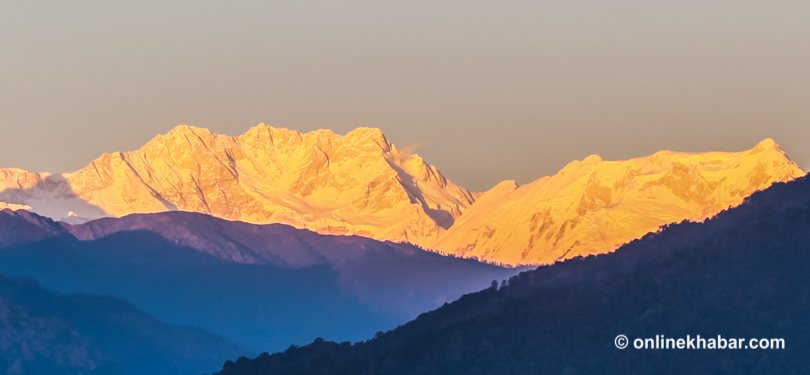
Nanga Parbat massifPhoto source: Gripped

Revol travelled via Skardu and Islamabad and flew back to France for treatment on 30 January. Mackiewicz could not be rescued and was presumed dead. The remaining funds from the rescue crowdfunding campaign were redirected to support his family.Facts it rests onF44Multiple sourcesRevol was first taken to a hospital in Skardu, transferred to Islamabad the next day, and flown back to France for treatment on 30 January.F06Multiple sourcesMackiewicz could not be rescued and was presumed dead.F09Multiple sourcesThe remaining funds from the rescue crowdfunding campaign were redirected to support Mackiewicz's family.

The number at the end of a paragraph is how many facts it rests on; open it to see each fact and how well it is sourced: Multiple sourcesSingle source. Conflicting accounts and speculation are kept out of the narrative.

ImgScene photos all from news coverage; copyright belongs to the original authors

Satellite imagery Sentinel-2 cloudless 2024 © EOX · Terrain AWS Terrain Tiles · Position is schematic, geocoded from place names · Place coordinates not individually verified

Route review

6 scenes to understand what happened

Scroll down and the map flies to where each part happened.

01

The incident area

The reports do not provide enough locations along the way, so the map shows only the approximate location and terrain of the incident area.

03

Distress on the descent

Mackiewicz was snow-blind, severely frostbitten and unable to move on his own. Revol called for help by satellite phone, put him in a sleeping bag and descended alone.Facts it rests onF15Multiple sourcesAt the summit or just after the descent began, Mackiewicz developed snow blindness and said he could not see anything.F20Multiple sourcesMackiewicz had severe frostbite and snow blindness and could not move on his own.F19Multiple sourcesRevol used a satellite phone to call for help, reporting that the two were in trouble.F22Multiple sourcesRevol placed Mackiewicz in a sleeping bag, left most of the equipment and descended alone to seek help.

04

Climbing through the night

On 27 January, a helicopter brought K2 team members to the mountain. Urubko and Bielecki climbed more than 1000 metres through the night along the Kinshofer route.Facts it rests onF31Multiple sourcesOn 27 January, a Pakistani military helicopter transported Botor, Urubko, Bielecki and Tomala from K2 to Nanga Parbat.F33Multiple sourcesAt around 5:30 pm, Urubko and Bielecki began climbing the Kinshofer route, while Tomala and Botor stayed at the landing site to establish a camp as backup.F34Multiple sourcesThe two climbed continuously through the night, gaining more than 1000 metres in about eight hours.

02Timeline

  1. The two arrived in Pakistan on 16 December 2017, planning to climb via the Diamir Face, a route familiar to both of them. F02

  2. The two reached approximately 6300 metres during an acclimatisation climb on 3 January, after which strong winds arrived. F10

  3. The two began their summit push on 20 January. F11

  4. The two reached approximately 7300 metres on 24 January, after which communication was lost. F12

  5. Revol used a satellite phone to call for help, reporting that the two were in trouble. F19

  6. Revol and Mackiewicz summited Nanga Parbat on 25 January 2018. F13

  7. On 26 January, the weather worsened and strong winds began to blow. F25

  8. Revol placed Mackiewicz in a sleeping bag, left most of the equipment and descended alone to seek help. F22

  9. At around 5:30 pm, Urubko and Bielecki began climbing the Kinshofer route, while Tomala and Botor stayed at the landing site to establish a camp as backup. F33

  10. On 27 January, a Pakistani military helicopter transported Botor, Urubko, Bielecki and Tomala from K2 to Nanga Parbat. F31

  11. On 28 January, the three reached Camp 1 and were evacuated by helicopter. F43

  12. The rescuers found Revol at around 6000 metres. F36

  13. Revol was first taken to a hospital in Skardu, transferred to Islamabad the next day, and flown back to France for treatment on 30 January. F44

03Lessons

Avalanche and high altitude

The descent follows the summit

The two summited on 25 January; according to reports, the weather worsened and strong winds arose the next day. During the descent, Mackiewicz developed snow blindness, severe frostbite and symptoms of pulmonary edema, and could not move on his own. Plans for winter high-altitude climbing should account for the strength and time needed for the descent, as well as changes in the weather.Facts it rests onF13Multiple sourcesRevol and Mackiewicz summited Nanga Parbat on 25 January 2018.F25Single sourceOn 26 January, the weather worsened and strong winds began to blow.F15Multiple sourcesAt the summit or just after the descent began, Mackiewicz developed snow blindness and said he could not see anything.F20Multiple sourcesMackiewicz had severe frostbite and snow blindness and could not move on his own.F16Multiple sourcesMackiewicz developed symptoms of pulmonary oedema.

Rescue and self-rescue

High-altitude rescue is constrained by weather

After Revol called for help by satellite phone, the people able to come were K2 team members nearby who were already acclimatized to high altitude, transported by military helicopter. According to Revol, she heard a helicopter, but it could not land because of strong winds. When calling for help at high altitude in winter, one cannot count on rescue arriving quickly.Facts it rests onF19Multiple sourcesRevol used a satellite phone to call for help, reporting that the two were in trouble.F05Multiple sourcesA Polish team was then attempting the first winter ascent of nearby K2, and its members had completed their high-altitude acclimatisation.F31Multiple sourcesOn 27 January, a Pakistani military helicopter transported Botor, Urubko, Bielecki and Tomala from K2 to Nanga Parbat.F30Single sourceRevol said she could hear the helicopter, but it was unable to land because of strong winds.

Teams and decisions

Rescuers also have to make choices

After finding Revol, the two rescuers judged that if they left her to look for Mackiewicz, she would die, and that even if they found him, they would be unable to help him. They therefore escorted her down first. When rescue resources are limited, save those who can be saved first.Facts it rests onF40Multiple sourcesThe rescuers determined that Revol would die if they left her to go up in search of Mackiewicz, and that they would be unable to help him even if they found him. They therefore decided to accompany Revol down the mountain.

04Fact list 46 facts

Under each fact is a verbatim quote from the original. "Single source" means only one outlet mentioned it; "Accounts differ" means sources contradict each other and this site adopts neither side; "Speculation" is an inference by a reporter or a person involved, not a fact.

  1. F01Multiple sourcesBackground

    The first winter ascent of Nanga Parbat was completed in 2016 by three climbers from Italy, Spain and Pakistan.

    Quotes from the original 2

    “Nanga Parbat’s first winter ascent was achieved in 2016 by Simone Moro of Italy, Ali Sadpara of Pakistan and Alex Txikon of Spain.”

    Alpinist · 2018-01-31

    “In February 2016, three climbers from Italy, Spain and Pakistan became the first to ascend Nanga Parbat in winter.”

    The Irish Times · 2018-01-30
  2. F02Single sourcePlan

    According to Alan Arnette, The two arrived in Pakistan on 16 December 2017, planning to climb via the Diamir Face, a route familiar to both of them.

    Quotes from the original 1

    “The duo arrived in Pakistan on December 16 planning to travel to base camp and climb via the Diamer Face – a route both knew well.”

    Alan Arnette · 2018-01-28
  3. F03Multiple sourcesBackground

    This was Polish climber Tomasz Mackiewicz's seventh winter attempt on Nanga Parbat.

    Quotes from the original 3

    “It was Mackiewicz's seventh attempt on the mountain, and his third with Revol as a partner.”

    NPR · 2018-01-29

    “This was his seventh attempt on the peak.”

    Alan Arnette · 2018-01-28

    “This was Revol's fourth attempt and Mackiewicz’s seventh.”

    National Geographic · 2019-02-27
  4. F04Accounts differBackground

    Accounts differ on which attempt this was for French climber Elisabeth Revol: The Irish Times and Alan Arnette say it was her third; National Geographic says it was her fourth.

    This may depend on whether attempts in other years are counted

    Quotes from the original 3

    “It was her third try; Mackiewicz’s seventh.”

    The Irish Times · 2018-01-30

    “She was on her third attempt.”

    Alan Arnette · 2018-01-28

    “This was Revol's fourth attempt and Mackiewicz’s seventh.”

    National Geographic · 2019-02-27
  5. F05Multiple sourcesBackground

    A Polish team was then attempting the first winter ascent of nearby K2, and its members had completed their high-altitude acclimatisation.

    Quotes from the original 3

    “We are prepared, we have equipment, we are acclimatized.”

    NPR · 2018-01-29

    “The Polish team had already adjusted to the altitude and offered the only possibility of saving Revol and Mackiewicz.”

    The Irish Times · 2018-01-30

    “hoping to make the first winter ascent of the world's only 8,000-meter peak that hadn’t been climbed in winter”

    National Geographic · 2019-02-27
  6. F06Multiple sourcesAftermath

    Mackiewicz could not be rescued and was presumed dead.

    Quotes from the original 2

    “Mackiewicz, who was making his seventh attempt at a wintertime ascent of Nanga Parbat, has been declared dead.”

    NPR · 2018-01-29

    “Tomek Mackiewicz of Poland is presumed dead”

    Alpinist · 2018-01-31
  7. F07Single sourceAftermath

    According to National Geographic, Revol said she did not realise Mackiewicz had died until she returned to France.

    Quotes from the original 1

    “I didn’t realize that he died until I was back in France”

    National Geographic · 2019-02-27
  8. F08Multiple sourcesAftermath

    The four rescuers subsequently returned to K2 base camp to continue their winter ascent.

    Quotes from the original 2

    “The four Polish K2 expedition members returned to K2 base camp where they plan to continue their winter attempt.”

    Alpinist · 2018-01-31

    “Following the rescue attempt, Urubko and his team returned to K2.”

    AFP · 2018-03-08
  9. F09Multiple sourcesAftermath

    The remaining funds from the rescue crowdfunding campaign were redirected to support Mackiewicz's family.

    Quotes from the original 2

    “The money left over from the crowdfunding effort that saved her will be donated to Mackiewicz's family”

    NPR · 2018-01-29

    “the page is now dedicated to help support Mackiewicz’s wife and his three children”

    Alpinist · 2018-01-31
  10. F10Single sourceMovement

    According to Alan Arnette, The two reached approximately 6300 metres during an acclimatisation climb on 3 January, after which strong winds arrived.

    Quotes from the original 1

    “They touched 6300 meters on an acclimatization rotation on January 3 but then, as is expected on the high peaks in winter, the winds moved in.”

    Alan Arnette · 2018-01-28
  11. F11Single sourceMovement

    According to Alpinist, The two began their summit push on 20 January.

    Quotes from the original 1

    “Revol and Mackiewicz reportedly launched their summit push on January 20 and summited January 25.”

    Alpinist · 2018-01-31
  12. F12Single sourceMovement

    According to Alan Arnette, The two reached approximately 7300 metres on 24 January, after which communication was lost.

    Quotes from the original 1

    “On January 24, they had reached 7,300 meters and followers cheered them on. Then, all communications stopped.”

    Alan Arnette · 2018-01-28
  13. F13Multiple sourcesEvent

    Revol and Mackiewicz summited Nanga Parbat on 25 January 2018.

    Quotes from the original 3

    “Revol reports that the pair had reached the summit of Nanga Parbat on the 25th January”

    Explorersweb · 2018-02-05

    “Masha Gordon, a friend of Revol’s, said the pair summited on January 25.”

    Alpinist · 2018-01-31

    “But when they summited on January 25, 2018”

    National Geographic · 2019-02-27
  14. F14Multiple sourcesFound at scene

    This was the second winter ascent of Nanga Parbat, and Revol became the first woman to summit the mountain in winter.

    Quotes from the original 3

    “were the second team to do so. She is the first woman.”

    The Irish Times · 2018-01-30

    “summited Nanga Parbat (8126m) in Pakistan for the mountain’s second winter ascent”

    Alpinist · 2018-01-31

    “the first alpine-style winter ascent and the first female winter ascent”

    National Geographic · 2019-02-27
  15. F15Multiple sourcesEvent

    At the summit or just after the descent began, Mackiewicz developed snow blindness and said he could not see anything.

    Quotes from the original 2

    “shortly after they began to descend he was complaining that he had been struck by snow blindness and could no longer see”

    Explorersweb · 2018-02-05

    “he answered, “I can’t see you. I can’t see anything.””

    National Geographic · 2019-02-27
  16. F16Multiple sourcesEvent

    Mackiewicz developed symptoms of pulmonary oedema.

    Quotes from the original 2

    “pulmonary and brain edema”

    The Irish Times · 2018-01-30

    “sintomo di un edema polmonare”

    Montagna.tv · 2019-10-16
  17. F17Multiple sourcesEvent

    During the descent, the two took shelter in a crevasse.

    Quotes from the original 2

    “When they reached a crevasse at around 7,280 meters, Mackiewicz could go no further.”

    National Geographic · 2019-02-27

    “Taking shelter in a crevasse overnight”

    Explorersweb · 2018-02-05
  18. F18Single sourceEvent

    According to National Geographic, By the time they reached the crevasse at approximately 7280 metres, Mackiewicz could no longer descend.

    Quotes from the original 1

    “When they reached a crevasse at around 7,280 meters, Mackiewicz could go no further.”

    National Geographic · 2019-02-27
  19. F19Multiple sourcesEvent

    Revol used a satellite phone to call for help, reporting that the two were in trouble.

    Quotes from the original 3

    “Revol contacted her logistician in the French Alps via satphone on the night of January 25th-26th to tell him that she and Mackiewicz were in trouble.”

    The Irish Times · 2018-01-30

    “before going farther down to call for help on a satellite phone”

    Gripped · 2018-01-28

    “while Revol made repeated calls for help”

    Explorersweb · 2018-02-05
  20. F20Multiple sourcesEvent

    Mackiewicz had severe frostbite and snow blindness and could not move on his own.

    Quotes from the original 3

    “Mackiewicz had become snow-blind, he had extensive frostbite, and he was disoriented and unable to move independently.”

    Alpinist · 2018-01-31

    “Mackiewicz had frostbite and snowblindness.”

    NPR · 2018-01-29

    “Mackiewicz was immobilised by severe frostbite, snow blindness and pulmonary and brain edema.”

    The Irish Times · 2018-01-30
  21. F21Single sourceEvent

    According to Explorersweb, Revol said she was told she had to leave her companion and descend to an altitude the rescuers could reach.

    Quotes from the original 1

    “She explains how she was told that she would have to leave her climbing partner in order to descend far enough to be reached by rescuers”

    Explorersweb · 2018-02-05
  22. F22Multiple sourcesEvent

    Revol placed Mackiewicz in a sleeping bag, left most of the equipment and descended alone to seek help.

    Quotes from the original 3

    “Revol secured him in a sleeping bag inside a crevasse at 7280 meters and continued down alone for help.”

    Alpinist · 2018-01-31

    “She left him in a sleeping bag with most of their gear and began descending the Kinshofer Route.”

    National Geographic · 2019-02-27

    “She left Tomek with the majority of her kit”

    Explorersweb · 2018-02-05
  23. F23Accounts differEvent

    Accounts differ on the altitude at which Mackiewicz was left: The Irish Times, Alpinist, National Geographic and a report from rescue team leader Botor say approximately 7280 metres; Explorersweb quotes Revol as saying approximately 7000 metres; Alan Arnette elsewhere gives 7400 metres.

    Quotes from the original 4

    “abandon her rope partner, Kildare-based Polish climber Tomasz Mackiewicz (43) at 7,280m”

    The Irish Times · 2018-01-30

    “Revol secured him in a sleeping bag inside a crevasse at 7280 meters”

    Alpinist · 2018-01-31

    “describing the decision to leave Mackiewicz in the tent at about 7,000m as “terrible and painful.””

    Explorersweb · 2018-02-05

    “The choice was made to leave Tomek in a tent at 7,400 meters”

    Alan Arnette · 2018-01-28
  24. F24Multiple sourcesParticipant's view

    Revol said leaving Mackiewicz was not her own decision but one she was forced to make; she described the decision as “terrible and painful”.

    Quotes from the original 2

    ““it wasn’t a decision I made, it was imposed upon me” she has explained”

    Explorersweb · 2018-02-05

    “The decision, she said, was “imposed on me”, describing it as “terrible and painful”.”

    AFP · 2018-03-08
  25. F25Single sourceEvent

    According to Alpinist, On 26 January, the weather worsened and strong winds began to blow.

    Quotes from the original 1

    “On January 26 the weather had deteriorated with high winds.”

    Alpinist · 2018-01-31
  26. F26Multiple sourcesEvent

    After descending alone, Revol spent another night in a crevasse without a tent.

    Quotes from the original 3

    “she spent another night in a crevasse, with no tent or duvet for shelter”

    Explorersweb · 2018-02-05

    “of her night in a crevasse at 6,100 meters”

    National Geographic · 2019-02-27

    “she had already spent two nights above 6,000 metres without a tent”

    AFP · 2018-03-08
  27. F27Multiple sourcesEvent

    Revol's friend Masha Gordon launched a GoFundMe campaign to raise money for the rescue.

    Quotes from the original 2

    “A friend named Masha Gordon set up a GoFundMe page to raise the tens of thousands of dollars it would cost to have a rescue.”

    NPR · 2018-01-29

    “Masha Gordon, a Russian-born British businesswoman, set up a crowdfunding webpage to support the rescue efforts.”

    Gripped · 2018-01-28
  28. F28Single sourceEvent

    According to National Geographic, K2 team leader Krzysztof Wielicki asked the team members whether they were willing to interrupt their K2 climb to go to the rescue. All agreed, and he selected Bielecki, Urubko, Tomala and Botor.

    Quotes from the original 1

    ““Every single one said yes,” he recalled. He chose Bielecki, Urubko, Piotr Tomala, and Jarosław Botor.”

    National Geographic · 2019-02-27
  29. F29Multiple sourcesEvent

    Revol experienced hallucinations caused by altitude sickness and took off her shoes.

    Quotes from the original 3

    “she was suffering from hallucinations brought on by altitude sickness. These caused her to discard one of her own shoes”

    Explorersweb · 2018-02-05

    “Revol began experiencing altitude-induced hallucinations. At one point she removed her shoes for five hours”

    AFP · 2018-03-08

    “of having removed her boots for a phantom woman who had requested them”

    National Geographic · 2019-02-27
  30. F30Single sourceEvent

    According to Explorersweb, Revol said she could hear the helicopter, but it was unable to land because of strong winds.

    Quotes from the original 1

    “She could hear helicopters but they were unable to land due to the wind”

    Explorersweb · 2018-02-05
  31. F31Multiple sourcesEvent

    On 27 January, a Pakistani military helicopter transported Botor, Urubko, Bielecki and Tomala from K2 to Nanga Parbat.

    Quotes from the original 3

    “Jaroslaw Botor, Denis Urubko, Adam Bielecki and Piotr Tomala were helicoptered by the Pakistan Army to Nanga Parbat on January 27.”

    Alpinist · 2018-01-31

    “Two high-altitude helicopters picked up the four rescuers from the K2 base camp on January 27”

    National Geographic · 2019-02-27

    “The Pakistani army helicopter transported four Poles from K2 to Nanga Parbat”

    The Irish Times · 2018-01-30
  32. F32Accounts differEvent

    Accounts differ on the altitude of the rescue team's landing site: NPR, The Irish Times and Gripped say 4800 metres; Alpinist says it was Camp 1 (4900 metres), and Alan Arnette says 4900 metres.

    Quotes from the original 4

    “leaving them at a base camp at 4,800m late on January 27th”

    The Irish Times · 2018-01-30

    “lifted them to 4,800 metres on Nanga Parbat”

    Gripped · 2018-01-28

    “two helicopters had to make multiple attempts to land at Camp I (4900m) on the Kinshofer Route”

    Alpinist · 2018-01-31

    “Urubko and Bielecki were dropped at 4,900-meters”

    Alan Arnette · 2018-01-28
  33. F33Multiple sourcesMovement

    At around 5:30 pm, Urubko and Bielecki began climbing the Kinshofer route, while Tomala and Botor stayed at the landing site to establish a camp as backup.

    Quotes from the original 3

    “At about 5:30 p.m. Urbuko and Bielecki–who Wielicki said were “best acclimatized”–started climbing the Kinshofer Route while Botor and Piotr Tomala set up Camp I.”

    Alpinist · 2018-01-31

    “Piotr and Jarosław would remain at the landing site for backup while Bielecki and Urubko would start climbing.”

    National Geographic · 2019-02-27

    “Two of the men, Denis Urubko and Adam Bielecki, began the climb up, while two others set up a camp.”

    NPR · 2018-01-29
  34. F34Multiple sourcesMovement

    The two climbed continuously through the night, gaining more than 1000 metres in about eight hours.

    Reports give slightly different figures for the elevation gained, from more than 1000 metres to 1200 metres.

    Quotes from the original 3

    “they climbed 1,200m in just eight hours, an ascent that usually takes two to three days”

    The Irish Times · 2018-01-30

    “They covered more than 1,000 metres in about eight hours”

    AFP · 2018-03-08

    “keeping up a nearly superhuman pace of 150 meters an hour for eight hours up the steep terrain”

    National Geographic · 2019-02-27
  35. F35Single sourcePlan

    According to National Geographic, The two carried very little equipment: no camping equipment or sleeping bags, only a small amount of food and drink, a bivouac sack, a stove and spare gloves.

    Quotes from the original 1

    “no bivouac gear, no sleeping bag, just a bit of food, some drink, a bivvy sack, a stove, gas, and spare mitts”

    National Geographic · 2019-02-27
  36. F36Multiple sourcesEvent

    The rescuers found Revol at around 6000 metres.

    Quotes from the original 3

    “Bielecki and Urubko found Revol at around 6,000m”

    The Irish Times · 2018-01-30

    “found by Urubko and Bielecki at around 3am at approximately 6,000m”

    Explorersweb · 2018-02-05

    “slightly above the second camp at about 6100 meters”

    Alpinist · 2018-01-31
  37. F37Accounts differEvent

    Accounts differ on when Revol was found: National Geographic and Alan Arnette say around midnight; NPR and The Irish Times say around 2 am on 28 January; Explorersweb says around 3 am.

    Quotes from the original 5

    “Urubko discovered Revol at around midnight.”

    National Geographic · 2019-02-27

    “They found Revol at midnight.”

    Alan Arnette · 2018-01-28

    “it was around 2 a.m. Sunday before they finally found Revol”

    NPR · 2018-01-29

    “At about 2am on Sunday, Bielecki and Urubko found Revol at around 6,000m.”

    The Irish Times · 2018-01-30

    “found by Urubko and Bielecki at around 3am”

    Explorersweb · 2018-02-05
  38. F38Multiple sourcesFound at scene

    Revol suffered frostbite on both hands and her left foot.

    Quotes from the original 2

    “Her hands and left foot were frostbitten.”

    Alpinist · 2018-01-31

    “was suffering from severe frostbite to her hands and left foot”

    Explorersweb · 2018-02-05
  39. F39Multiple sourcesEvent

    Revol was wearing only thin gloves, which the rescuers replaced with warm gloves.

    Quotes from the original 2

    “replace her thin gloves with warm mitts”

    National Geographic · 2019-02-27

    “In hopes of saving her fingers he gave her his own gloves.”

    AFP · 2018-03-08
  40. F40Multiple sourcesEvent

    The rescuers determined that Revol would die if they left her to go up in search of Mackiewicz, and that they would be unable to help him even if they found him. They therefore decided to accompany Revol down the mountain.

    Quotes from the original 3

    “We understood that if we left Revol and went up for Mackiewicz, she would die”

    National Geographic · 2019-02-27

    “We knew that even if we got to Tomek, we couldn’t help him.”

    The Irish Times · 2018-01-30

    “Urubko said, she had a “hundred percent” chance of survival — while there was “no chance” of saving Mackiewicz.”

    AFP · 2018-03-08
  41. F41Single sourceParticipant's view

    According to Gripped, Revol's friend Giambiasi said that, because of the weather and altitude, rescuing Mackiewicz would put the rescuers in extreme danger and could not be attempted.

    Quotes from the original 1

    “The rescue for Tomasz is unfortunately not possible – because of the weather and altitude it would put the life of rescuers in extreme danger.”

    Gripped · 2018-01-28
  42. F42Multiple sourcesMovement

    Revol could not descend the steep Kinshofer route on her own. The two rescuers took turns lowering her on a rope and descending with her.

    Quotes from the original 3

    “They took turns lowering her, doing tandem rappels and climbing alongside her on the snow slopes.”

    National Geographic · 2019-02-27

    “Urubko and Bielecki “started lowering Revol” to the base of the wall at approximately 5000 meters”

    Alpinist · 2018-01-31

    “Revol would not be able to climb down the steep Kinshofer route by herself.”

    AFP · 2018-03-08
  43. F43Multiple sourcesEvent

    On 28 January, the three reached Camp 1 and were evacuated by helicopter.

    Quotes from the original 2

    “The climbers were evacuated by helicopter from Camp I at 4 p.m. on January 28”

    Alpinist · 2018-01-31

    “It took them five and a half hours to reach Camp One, from where they were evacuated by helicopter.”

    AFP · 2018-03-08
  44. F44Multiple sourcesAftermath

    Revol was first taken to a hospital in Skardu, transferred to Islamabad the next day, and flown back to France for treatment on 30 January.

    Quotes from the original 2

    “She was flown to the Skardu hospital, and the next day to Islamabad. On January 30th, she flew back to France to begin treatment.”

    National Geographic · 2019-02-27

    “was on her way from Islamabad, Pakistan to a hospital in the French Alps late on Tuesday”

    The Irish Times · 2018-01-30
  45. F45Multiple sourcesAftermath

    Revol had severe frostbite on her hands and feet and still faced the possibility of amputation at the time.

    Quotes from the original 2

    “Revol is suffering from severe frostbite on her hands and feet, and French doctors will decide whether to amputate.”

    The Irish Times · 2018-01-30

    “there is still the potential that these will require amputation”

    Explorersweb · 2018-02-05
  46. F46Multiple sourcesBackground

    Nanga Parbat is in Pakistan and has an elevation of 8126 metres. It is the world's ninth-highest peak and is known as the “Killer Mountain”.

    Quotes from the original 2

    “Pakistan's Nanga Parbat — literally "Naked Mountain," also known as "Killer Mountain" — is the world's ninth highest mountain.”

    NPR · 2018-01-29

    “the world’s ninth highest peak, Nanga Parbat at 8,126-meters/26,660 feet”

    Alan Arnette · 2018-01-28