GuituluGlobal Outdoor Accident Archive 中文
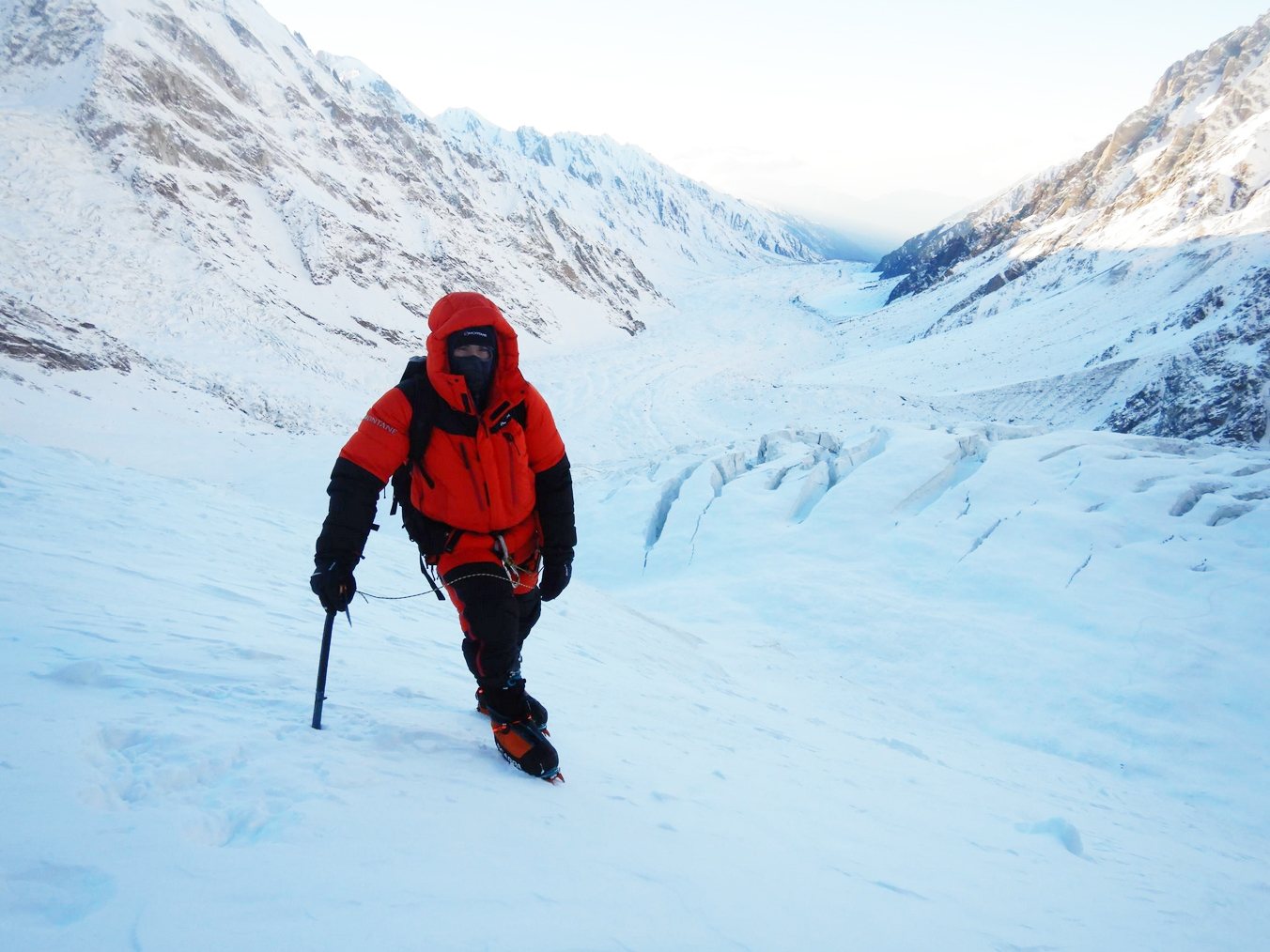
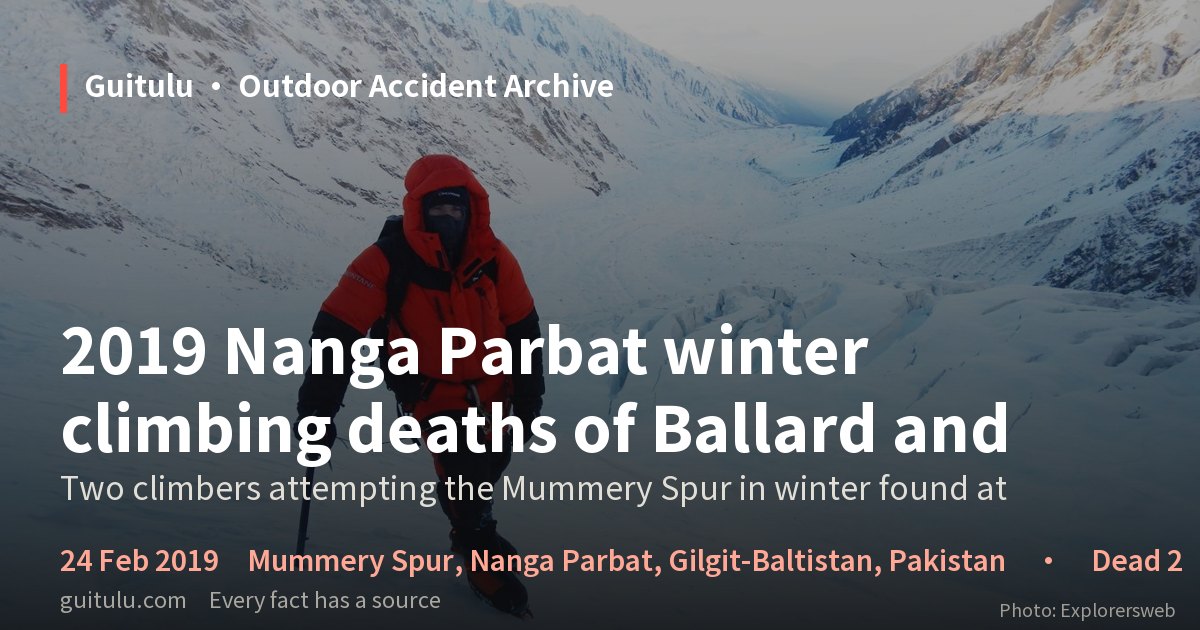
Expedition members travelling on a glacier on Nanga Parbat (image accompanying Ballard's camp journal)

Archive / Mountaineering

2019 Nanga Parbat winter climbing deaths of Ballard and Nardi

Two climbers attempting the Mummery Spur in winter found at approximately 5900 metres

Reports reached no definitive conclusion on the cause of death; bodies remain on the mountain

Photo: Explorersweb

Date
Winter
Place
Mummery Spur, Nanga Parbat, Gilgit-Baltistan, PakistanPakistan › Gilgit-Baltistan · Himalaya74.590°E 35.238°N
Activity
Winter mountaineering2 people (Tom Ballard of the United Kingdom and Daniele Nardi of Italy)
Casualties
Dead 2 Both bodies were observed through a telescope at approximately 5900 metres and identified; they were not brought down the mountain
Material
36 facts · 13 sources3 accounts differ and are shown side by side

01What happened

Nanga Parbat, at an altitude of 8126 metres, is in Pakistan's Gilgit-Baltistan region. In late December 2018, 30-year-old British climber Tom Ballard and 42-year-old Italian climber Daniele Nardi arrived in Pakistan, planning to attempt a new route up the Mummery Spur in winter. According to reports, the spur had never been climbed in its entirety. Nardi had made several previous attempts on Nanga Parbat, while this was Ballard's first time climbing an 8000-metre peak.Facts it rests onF35Single sourceNanga Parbat is 8126 metres high, is located in Gilgit-Baltistan, Pakistan, and is the ninth-highest mountain in the world.F10Multiple sourcesThe two men who died were 30-year-old British climber Tom Ballard and 42-year-old Italian climber Daniele Nardi. They were attempting to open a new route on the Mummery Spur.F04Multiple sourcesThe two men arrived in Pakistan in late December 2018. After reaching base camp, they made slow progress because of bad weather and deep snow.F36Multiple sourcesThe Mummery Spur had never before been climbed in its entirety; reportedly, only the Messner brothers had descended via the spur, in 1970.F05Multiple sourcesThis was Ballard's first climb on an 8000-metre peak; he had never previously been above 6000 metres. Nardi, meanwhile, had made several previous attempts on Nanga Parbat (reports said four).

Expedition members travelling on a glacier on Nanga Parbat (image accompanying Ballard's camp journal)Photo source: Explorersweb

In January, the two gradually established camps above base camp. According to Ballard's own journal, Camp 1 was at approximately 4700 metres and Camp 3 at approximately 5700 metres. When they tried to establish Camp 4 at approximately 6000 metres, the wind was so strong that they could barely stand, and they had to retreat. He also wrote that they had turned back several times without staying overnight because of the threat of avalanches. On one occasion, shortly after they turned back, a large avalanche engulfed their original ascent route.Facts it rests onF06Single sourceBallard wrote that Camp 1 was established at approximately 4700 metres; Camp 3 was at approximately 5700 metres, in a crevasse, and was still frequently windy.F07Single sourceBallard's journal said that they tried to establish Camp 4 at approximately 6000 metres, but the wind was so strong they could barely stand. They could only secure a bag of equipment to an ice screw and retreat to Camp 3.F08Single sourceAccording to Ballard's account, they went up to Camps 2 and 3 several times, but on several occasions turned back without spending the night because of the threat of avalanches. On going up, they also found their tent buried in snow.F09Single sourceBallard also wrote that they had turned back from Camp 1 because they had a bad feeling; shortly afterwards, a large avalanche engulfed their ascent route.

A camp tent half-buried in snow (image accompanying Ballard's camp journal)Photo source: Explorersweb

On 24 February, the two made their last contact with the outside world; a satellite phone location showed them at approximately 6300 metres. According to Climbing magazine, Nardi said they would descend to Camp 4 at approximately 6000 metres to shelter from a storm. Base camp was unable to contact them again. Search and rescue was initially affected by the weather and tensions between India and Pakistan, and nearby airspace was temporarily closed. On 28 February, a Pakistan Army helicopter searched along the spur for approximately three and a half hours, finding no one and seeing only a tent at approximately 5500 metres.Facts it rests onF11Multiple sourcesOn 24 February, the two men made their last contact with base camp and their families. Their satellite phone location showed them at approximately 6300 metres.F12Single sourceAccording to Climbing magazine, Nardi said during the call that they were descending to Camp 4 at approximately 6000 metres to shelter from a storm.F15Multiple sourcesBase camp was unable to contact the two men after that. Early search and rescue efforts were hampered by bad weather and tensions between India and Pakistan, and surrounding airspace was closed for a time.F16Single sourceOn 28 February, a Pakistan Army helicopter searched the spur between 5100 and 7000 metres for approximately three and a half hours. It found no people, seeing only a tent at approximately 5500 metres.

In early March, Spanish mountaineer Alex Txikon's team and Pakistani mountaineer Ali Sadpara arrived at base camp. On 5 March, the search and rescue team climbed above Camp II, where an ice tower collapsed, triggering an avalanche and forcing team members to take cover. It was subsequently reported that Txikon had used a telescope between base camp and Camp I to observe the ridge from a different angle and had seen two people at approximately 5900 metres. On 9 March, the Italian ambassador to Pakistan announced that the search and rescue team had confirmed they were Nardi and Ballard, and the search ended.Facts it rests onF20Multiple sourcesThe weather was bad in early March, and helicopters were temporarily unable to take off; Spanish climber Alex Txikon's team and Pakistani climber Ali Sadpara subsequently arrived at base camp to join the search and rescue effort.F22Multiple sourcesOn 5 March, the search and rescue team climbed above Camp 2, where a serac collapsed and triggered an avalanche. Team members were forced to take cover, and a drone went out of control; the team considered it very dangerous to continue climbing the spur.F24Multiple sourcesBetween base camp and Camp 1, Txikon used a telescope to observe the ridge from a different angle, saw the two at about 5900 metres, and took photos and video.F26Multiple sourcesOn 9 March, Pontecorvo, Italy's ambassador to Pakistan, announced that Txikon and the search and rescue team had confirmed that the figures seen at approximately 5900 metres were Nardi and Ballard, and that the search had ended.

According to reports, the bodies were in a small gully on the spur, in a location that was difficult to reach. There were several avalanches a day on that section of the spur, and the bodies could not be recovered that year. Nardi's team wrote in a statement that a part of them would remain on Nanga Parbat forever. Years later, Climbing magazine wrote that the bodies were still on the mountain and said that Nardi's family did not want them recovered. Reports reached no definitive conclusion on the cause of death.Facts it rests onF27Single sourceThe bodies were in a small gully on the ridge, slightly higher than Camp 3 and below Camp 4.F28Single sourceAccording to Explorersweb, the bodies were not buried by an avalanche, but their location was difficult to reach, and several avalanches occurred on that section of the ridge each day, making recovery impossible that season.F29Multiple sourcesNardi's team issued a statement on his Facebook page saying that the search had ended and that “a part of them will remain forever on Nanga Parbat”.F34Multiple sourcesThe bodies were not brought down from the mountain: reports in 2019 said they could not be recovered for the time being; Climbing magazine wrote in 2022 that the bodies were still on the mountain and that Nardi's family hoped they would not be recovered.

The number at the end of a paragraph is how many facts it rests on; open it to see each fact and how well it is sourced: Multiple sourcesSingle source. Conflicting accounts and speculation are kept out of the narrative.

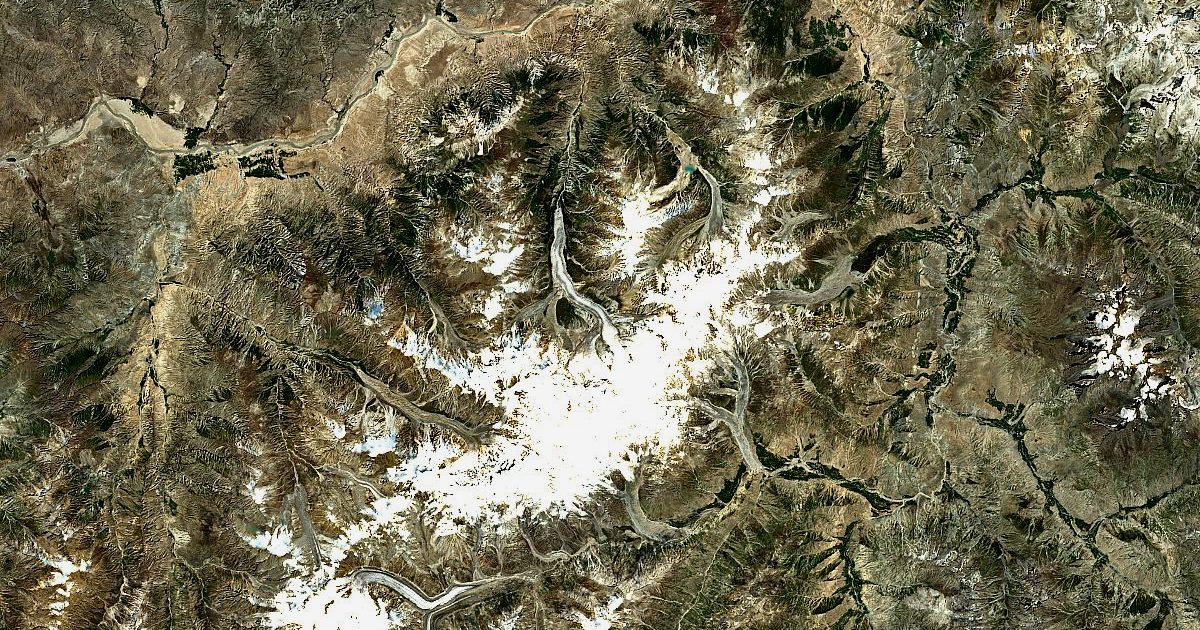
Satellite imagery Sentinel-2 cloudless 2024 © EOX · Terrain AWS Terrain Tiles · Position is schematic, geocoded from place names · Place coordinates not individually verified

Route review

6 scenes to understand what happened

Scroll down and the map flies to where each part happened.

01

Area of the incident

The reports do not provide enough waypoints, so the map shows only the approximate location and terrain of the incident area.

02

Expedition and route

They arrived at the end of 2018; progress at base camp was slow because of bad weather and deep snow. They planned a winter attempt on the Mummery Spur, which had never been climbed in its entirety.Facts it rests onF04Multiple sourcesThe two men arrived in Pakistan in late December 2018. After reaching base camp, they made slow progress because of bad weather and deep snow.F36Multiple sourcesThe Mummery Spur had never before been climbed in its entirety; reportedly, only the Messner brothers had descended via the spur, in 1970.

03

Establishing camps in stages

According to Ballard's journal, Camp 1 was at approximately 4700 metres and Camp 3 at approximately 5700 metres; they turned back several times because of the threat of avalanches.Facts it rests onF06Single sourceBallard wrote that Camp 1 was established at approximately 4700 metres; Camp 3 was at approximately 5700 metres, in a crevasse, and was still frequently windy.F08Single sourceAccording to Ballard's account, they went up to Camps 2 and 3 several times, but on several occasions turned back without spending the night because of the threat of avalanches. On going up, they also found their tent buried in snow.

04

Last contact

On 24 February, a satellite phone location placed them at approximately 6300 metres; base camp was unable to contact them thereafter.Facts it rests onF11Multiple sourcesOn 24 February, the two men made their last contact with base camp and their families. Their satellite phone location showed them at approximately 6300 metres.F15Multiple sourcesBase camp was unable to contact the two men after that. Early search and rescue efforts were hampered by bad weather and tensions between India and Pakistan, and surrounding airspace was closed for a time.

05

Search and rescue

In early March, Txikon's team and Ali Sadpara arrived at base camp; on 5 March, the search and rescue team encountered a serac collapse above Camp 2.Facts it rests onF20Multiple sourcesThe weather was bad in early March, and helicopters were temporarily unable to take off; Spanish climber Alex Txikon's team and Pakistani climber Ali Sadpara subsequently arrived at base camp to join the search and rescue effort.F22Multiple sourcesOn 5 March, the search and rescue team climbed above Camp 2, where a serac collapsed and triggered an avalanche. Team members were forced to take cover, and a drone went out of control; the team considered it very dangerous to continue climbing the spur.

06

Discovery

Txikon saw the two men through a telescope from a position between base camp and Camp 1, at around 5900 metres. Their identities were confirmed on 9 March, and the search ended.Facts it rests onF24Multiple sourcesBetween base camp and Camp 1, Txikon used a telescope to observe the ridge from a different angle, saw the two at about 5900 metres, and took photos and video.F26Multiple sourcesOn 9 March, Pontecorvo, Italy's ambassador to Pakistan, announced that Txikon and the search and rescue team had confirmed that the figures seen at approximately 5900 metres were Nardi and Ballard, and that the search had ended.

02Timeline

  1. The two men arrived in Pakistan in late December 2018. After reaching base camp, they made slow progress because of bad weather and deep snow. F04

  2. Ballard's journal said that they tried to establish Camp 4 at approximately 6000 metres, but the wind was so strong they could barely stand. They could only secure a bag of equipment to an ice screw and retreat to Camp 3. F07

  3. On 24 February, the two men made their last contact with base camp and their families. Their satellite phone location showed them at approximately 6300 metres. F11

  4. On 28 February, a Pakistan Army helicopter searched the spur between 5100 and 7000 metres for approximately three and a half hours. It found no people, seeing only a tent at approximately 5500 metres. F16

  5. The weather was bad in early March, and helicopters were temporarily unable to take off; Spanish climber Alex Txikon's team and Pakistani climber Ali Sadpara subsequently arrived at base camp to join the search and rescue effort. F20

  6. On 5 March, the search and rescue team climbed above Camp 2, where a serac collapsed and triggered an avalanche. Team members were forced to take cover, and a drone went out of control; the team considered it very dangerous to continue climbing the spur. F22

  7. Between base camp and Camp 1, Txikon used a telescope to observe the ridge from a different angle, saw the two at about 5900 metres, and took photos and video. F24

  8. According to Explorersweb, the bodies were not buried by an avalanche, but their location was difficult to reach, and several avalanches occurred on that section of the ridge each day, making recovery impossible that season. F28

  9. On 9 March, Pontecorvo, Italy's ambassador to Pakistan, announced that Txikon and the search and rescue team had confirmed that the figures seen at approximately 5900 metres were Nardi and Ballard, and that the search had ended. F26

03Lessons

Avalanche and high altitude

Turning back is common on avalanche-prone routes

According to Ballard's own account, they turned back several times because of the threat of avalanches and also saw a large avalanche engulf their ascent route. The Mummery Spur was reported to be steep and prone to avalanches, and the search and rescue team later also encountered an ice tower collapse. The objective hazards of a route do not disappear with thorough preparation.Facts it rests onF08Single sourceAccording to Ballard's account, they went up to Camps 2 and 3 several times, but on several occasions turned back without spending the night because of the threat of avalanches. On going up, they also found their tent buried in snow.F09Single sourceBallard also wrote that they had turned back from Camp 1 because they had a bad feeling; shortly afterwards, a large avalanche engulfed their ascent route.F22Multiple sourcesOn 5 March, the search and rescue team climbed above Camp 2, where a serac collapsed and triggered an avalanche. Team members were forced to take cover, and a drone went out of control; the team considered it very dangerous to continue climbing the spur.F36Multiple sourcesThe Mummery Spur had never before been climbed in its entirety; reportedly, only the Messner brothers had descended via the spur, in 1970.

Teams and decisions

Experience should match the difficulty of the route

According to reports, the spur had never been climbed in its entirety, and Ballard, who accompanied Nardi, was climbing an 8000-metre peak for the first time and had never been above 6000 metres. A new route in winter is an extremely high bar for anyone; when choosing an objective beyond one's experience, it is especially important to set retreat limits in advance.Facts it rests onF05Multiple sourcesThis was Ballard's first climb on an 8000-metre peak; he had never previously been above 6000 metres. Nardi, meanwhile, had made several previous attempts on Nanga Parbat (reports said four).F36Multiple sourcesThe Mummery Spur had never before been climbed in its entirety; reportedly, only the Messner brothers had descended via the spur, in 1970.F03Single sourceThe first winter ascent of Nanga Parbat was completed in 2016, but the route was not the Mummery Spur.

Communication and location

The location of the last contact is crucial

The satellite phone location showed the outside world that the two were last at approximately 6300 metres, allowing the search to be concentrated on the spur between 5100 and 7000 metres. After leaving base camp, regularly informing those at base of one's plans, location and next steps is a prerequisite for search and rescue teams to narrow the search area.Facts it rests onF11Multiple sourcesOn 24 February, the two men made their last contact with base camp and their families. Their satellite phone location showed them at approximately 6300 metres.F12Single sourceAccording to Climbing magazine, Nardi said during the call that they were descending to Camp 4 at approximately 6000 metres to shelter from a storm.F16Single sourceOn 28 February, a Pakistan Army helicopter searched the spur between 5100 and 7000 metres for approximately three and a half hours. It found no people, seeing only a tent at approximately 5500 metres.

Rescue and self-rescue

High-altitude search and rescue is limited by weather, airspace and avalanches

This search and rescue operation was affected in turn by bad weather, airspace closure and avalanche risk, and the team had to switch to observing from a distance using telescopes and drones. The bodies still cannot be safely recovered from their location, showing that rescue capabilities themselves have significant limits on spurs like this.Facts it rests onF15Multiple sourcesBase camp was unable to contact the two men after that. Early search and rescue efforts were hampered by bad weather and tensions between India and Pakistan, and surrounding airspace was closed for a time.F20Multiple sourcesThe weather was bad in early March, and helicopters were temporarily unable to take off; Spanish climber Alex Txikon's team and Pakistani climber Ali Sadpara subsequently arrived at base camp to join the search and rescue effort.F22Multiple sourcesOn 5 March, the search and rescue team climbed above Camp 2, where a serac collapsed and triggered an avalanche. Team members were forced to take cover, and a drone went out of control; the team considered it very dangerous to continue climbing the spur.F28Single sourceAccording to Explorersweb, the bodies were not buried by an avalanche, but their location was difficult to reach, and several avalanches occurred on that section of the ridge each day, making recovery impossible that season.

04Fact list 36 facts

Under each fact is a verbatim quote from the original. "Single source" means only one outlet mentioned it; "Accounts differ" means sources contradict each other and this site adopts neither side; "Speculation" is an inference by a reporter or a person involved, not a fact.

  1. F01Single sourceBackground

    According to Pamir Times, The Mummery Spur is named after the climber Mummery, who died in an avalanche while attempting to climb Nanga Parbat in 1895.

    Quotes from the original 1

    “a mountaineer killed in 1895 by avalanche while trying to scale the peak”

    Pamir Times · 2019-03-09
  2. F02Single sourceBackground

    According to ITV News, In 2015, Ballard became the first person to solo climb the six great north faces of the Alps in a single winter.

    Quotes from the original 1

    “In 2015 Mr Ballard became the first person ever to solo climb all six major north faces of the Alps in one winter.”

    ITV News · 2019-03-09
  3. F03Single sourceBackground

    According to Climber, The first winter ascent of Nanga Parbat was completed in 2016, but the route was not the Mummery Spur.

    Quotes from the original 2

    “The first winter ascent of Nanga Parbat was made in 2016”

    Climber · 2019-03-06

    “although not via the Mummery Spur which Tom Ballard and Daniele Nardi were attempting to climb”

    Climber · 2019-03-06
  4. F04Multiple sourcesPlan

    The two men arrived in Pakistan in late December 2018. After reaching base camp, they made slow progress because of bad weather and deep snow.

    Quotes from the original 2

    “They had arrived in Pakistan at the end of December 2018”

    Climbing · 2022-10-16

    “The two men arrived with their team at base camp in December, but made little progress up the mountain due to harsh weather and deep snow along the route.”

    Outside · 2019-03-10
  5. F05Multiple sourcesBackground

    This was Ballard's first climb on an 8000-metre peak; he had never previously been above 6000 metres. Nardi, meanwhile, had made several previous attempts on Nanga Parbat (reports said four).

    Quotes from the original 3

    “It was his first time on an 8,000-meter peak, and he’d never even been above 6,000 meters.”

    Climbing · 2022-10-16

    “Nardi had attempted to climb Nanga Parbat on four previous occasions.”

    Climber · 2019-03-06

    “had already tried Nanga Parbat in winter four times”

    Climbing · 2022-10-16
  6. F06Single sourceMovement

    According to Explorersweb, Ballard wrote that Camp 1 was established at approximately 4700 metres; Camp 3 was at approximately 5700 metres, in a crevasse, and was still frequently windy.

    Quotes from the original 2

    “We established Camp 1 at 4,700m.”

    Explorersweb · 2019-01-30

    “Camp 3 (circa 5,700m) is situated in a crevasse/bergschrund.”

    Explorersweb · 2019-01-30
  7. F07Single sourceMovement

    According to Explorersweb, Ballard's journal said that they tried to establish Camp 4 at approximately 6000 metres, but the wind was so strong they could barely stand. They could only secure a bag of equipment to an ice screw and retreat to Camp 3.

    Quotes from the original 1

    “We could barely stand up in the wind. So we left a rucksack full of kit attached to three ice screws and abseiled back down to Camp 3.”

    Explorersweb · 2019-01-30
  8. F08Single sourceMovement

    According to Climbing, According to Ballard's account, they went up to Camps 2 and 3 several times, but on several occasions turned back without spending the night because of the threat of avalanches. On going up, they also found their tent buried in snow.

    Quotes from the original 2

    “Always the threat of avalanches made us turn back without spending the night”

    Climbing · 2022-10-16

    “Each time they went back up, they found their tents buried by recent slides.”

    Climbing · 2022-10-16
  9. F09Single sourceEvent

    According to Climbing, Ballard also wrote that they had turned back from Camp 1 because they had a bad feeling; shortly afterwards, a large avalanche engulfed their ascent route.

    Quotes from the original 2

    “We even turned back from [Camp I] because we didn’t have a good feeling.”

    Climbing · 2022-10-16

    “Well-founded as a huge avalanche engulfed our line of ascent shortly after.”

    Climbing · 2022-10-16
  10. F10Multiple sourcesBackground

    The two men who died were 30-year-old British climber Tom Ballard and 42-year-old Italian climber Daniele Nardi. They were attempting to open a new route on the Mummery Spur.

    Quotes from the original 2

    “were attempting a new route on the Mummery Rib, a steep and dangerous avalanche-prone area on the Himalayan peak”

    Outside · 2019-03-10

    “The men were the 42-year old Italian climber Daniele Nardi and 30-year-old Tom Ballard of the U.K.”

    Climbing · 2022-10-16
  11. F11Multiple sourcesEvent

    On 24 February, the two men made their last contact with base camp and their families. Their satellite phone location showed them at approximately 6300 metres.

    Quotes from the original 3

    “The pair last made contact on February 24 from an elevation of around 6,300 meters (nearly 20,700 feet) on Nanga Parbat.”

    ITV News · 2019-03-09

    “The GPS data from that call put Nardi and Ballard at 6,300 meters.”

    Climbing · 2022-10-16

    “dopo aver raggiunto i 6.300 metri erano dovuti tornare per il maltempo al campo 4”

    Il Post · 2019-03-09
  12. F12Single sourceEvent

    According to Climbing, According to Climbing magazine, Nardi said during the call that they were descending to Camp 4 at approximately 6000 metres to shelter from a storm.

    Quotes from the original 1

    “He said that they were descending to 6,000 meters”

    Climbing · 2022-10-16
  13. F13Accounts differEvent

    Accounts differ about what was said during the last contact: Climbing said they intended to continue descending to Camp 3; Voice of America said they intended to continue upward the next day.

    The two accounts differ on whether they would descend or continue upward

    Quotes from the original 2

    “He made one final call to base camp to say the two were going to try to descend further, to Camp III at 5,700 meters.”

    Climbing · 2022-10-16

    “saying they would be moving upward the next day”

    VOA · 2019-03-09
  14. F14Accounts differEvent

    The date of the last contact is given as either 24 February or 23 February; most sources give 24 February.

    Pamir Times gives 23 February

    Quotes from the original 2

    “The pair last made contact on February 24”

    ITV News · 2019-03-09

    “The two mountaineers had made last contact with their base camp on February 23.”

    Pamir Times · 2019-03-09
  15. F15Multiple sourcesAftermath

    Base camp was unable to contact the two men after that. Early search and rescue efforts were hampered by bad weather and tensions between India and Pakistan, and surrounding airspace was closed for a time.

    Quotes from the original 2

    “Early searches were disrupted by the conflict between Pakistan and India over disputed territories in Kashmir.”

    Grough · 2019-03-09

    “the air space around Nanga Parbat has been totally closed off, including to rescue helicopters”

    Outside · 2019-03-10
  16. F16Single sourceAftermath

    According to Climber, On 28 February, a Pakistan Army helicopter searched the spur between 5100 and 7000 metres for approximately three and a half hours. It found no people, seeing only a tent at approximately 5500 metres.

    Quotes from the original 2

    “On February 28th Pakistan Army helicopters made an extensive three and a half hour search of the Mummery Spur between 5100m and 7000m.”

    Climber · 2019-03-06

    “They didn’t find any sign of the climbers but reported seeing a tent at about 5500m.”

    Climber · 2019-03-06
  17. F17Single sourceAftermath

    According to Outdoor Journal, Txikon was attempting a winter ascent of K2 at the time; he largely abandoned his own climb to lead the search and rescue effort.

    Quotes from the original 1

    “Experienced Spanish climber Alex Txikon mostly abandoned his own winter attempt on K2, to lead the search and rescue effort.”

    Outdoor Journal · 2019-03-11
  18. F18SpeculationSpeculation

    Speculation: Txikon thought the two men may already have been very cold and exhausted. The wind was strong and it was late, and any small mistake could have been fatal.

    Quotes from the original 1

    “They were probably really cold and exhausted. It was high wind. It was late.”

    Climbing · 2022-10-16
  19. F19SpeculationSpeculation

    Speculation: Simone Moro thought the two men may have been struck by ice falling from above. He said the real danger on the Mummery Spur was not ordinary avalanches, but the collapse of hanging seracs on both sides.

    Quotes from the original 2

    “they were hit by a block of falling ice”

    Climbing · 2022-10-16

    “big parts of seracs falling from above”

    Climbing · 2022-10-16
  20. F20Multiple sourcesAftermath

    The weather was bad in early March, and helicopters were temporarily unable to take off; Spanish climber Alex Txikon's team and Pakistani climber Ali Sadpara subsequently arrived at base camp to join the search and rescue effort.

    Quotes from the original 2

    “Unfortunately, bad weather in early March prevented the search helicopters from flying.”

    Climber · 2019-03-06

    “four Spanish rescuers were flown to the area by military helicopter on Monday and were joined by Pakistani mountaineer Ali Sadpara at base camp”

    ITV News · 2019-03-09
  21. F21Single sourceParticipant's view

    According to Climber, On 4 March, The Times website quoted Simone Moro as saying that attempting the Mummery Spur was “suicidal” because of the avalanche risk.

    This was Moro's assessment of the route, not a conclusion about the cause of this accident.

    Quotes from the original 1

    “an attempt on the Mummery Spur was “suicidal” because of avalanches”

    Climber · 2019-03-06
  22. F22Multiple sourcesEvent

    On 5 March, the search and rescue team climbed above Camp 2, where a serac collapsed and triggered an avalanche. Team members were forced to take cover, and a drone went out of control; the team considered it very dangerous to continue climbing the spur.

    Quotes from the original 2

    “a serac fell about 500 above them causing an avalanche and they had to take evasive action to escape the avalanche”

    Climber · 2019-03-10

    “a serac fell around 500 meters above and triggered an avalanche”

    Explorersweb · 2019-03-09
  23. F23Multiple sourcesAftermath

    On 6 March, Climber magazine reported that the search and rescue operation had found no trace of the two men, who were presumed dead, and that the operation had been suspended for a time.

    Quotes from the original 2

    “Tom Ballard and Daniele Nardi are presumed dead.”

    Climber · 2019-03-06

    “The continuing rescue operation was suspended on Wednesday but resumed after two ‘silhouettes’ were spotted on the mountain.”

    Grough · 2019-03-09
  24. F24Multiple sourcesFound at scene

    Between base camp and Camp 1, Txikon used a telescope to observe the ridge from a different angle, saw the two at about 5900 metres, and took photos and video.

    Quotes from the original 2

    “This position enabled a different perspective and Txikon successfully located the two bodies at c.5900m.”

    Climber · 2019-03-10

    “The two “shapes” at about 5,900m that Alex Txikon spotted two days ago through a telescope”

    Explorersweb · 2019-03-09
  25. F25Accounts differFound at scene

    Accounts differ as to how and when they were spotted: Climbing said Txikon saw them using a drone on 5 March, at an altitude of approximately 5800 metres; other sources said they were spotted using a telescope around 7 March, at an altitude of approximately 5900 metres.

    The dates, methods and altitudes (5800/5900 metres) contradict one another

    Quotes from the original 2

    “Two days later, on March 5, Txikon spotted Ballard and Nardi’s bodies with the drone.”

    Climbing · 2022-10-16

    “On the final day of the search (March 7th) Alex Txikon once more scoured the Mummery Spur using his telescope”

    Climber · 2019-03-10
  26. F26Multiple sourcesEvent

    On 9 March, Pontecorvo, Italy's ambassador to Pakistan, announced that Txikon and the search and rescue team had confirmed that the figures seen at approximately 5900 metres were Nardi and Ballard, and that the search had ended.

    Quotes from the original 2

    “the silhouettes spotted on Mummery at about 5900 meters are those of Daniele and Tom”

    ITV News · 2019-03-09

    “i corpi dei due alpinisti sono stati infine avvistati con il telescopio sulla parete, a circa 5.900 metri”

    Il Post · 2019-03-09
  27. F27Single sourceFound at scene

    According to Outside, The bodies were in a small gully on the ridge, slightly higher than Camp 3 and below Camp 4.

    Quotes from the original 2

    “It showed their bodies positioned in a small gulley at approximately 19,356 feet on the Mummery spur.”

    Outside · 2019-03-10

    “This was a bit higher than their Camp 3 location but below Camp 4.”

    Outside · 2019-03-10
  28. F28Single sourceFound at scene

    According to Explorersweb, According to Explorersweb, the bodies were not buried by an avalanche, but their location was difficult to reach, and several avalanches occurred on that section of the ridge each day, making recovery impossible that season.

    Quotes from the original 2

    “The bodies, which had not been buried in an avalanche as originally thought, are in a difficult-to-reach location.”

    Explorersweb · 2019-03-09

    “Several avalanches per day are raking that part of the Mummery Spur, and it will not be possible to retrieve them this season.”

    Explorersweb · 2019-03-09
  29. F29Multiple sourcesAftermath

    Nardi's team issued a statement on his Facebook page saying that the search had ended and that “a part of them will remain forever on Nanga Parbat”.

    Quotes from the original 2

    “A part of them will always remain on the Nanga Parbat.”

    Climber · 2019-03-10

    “A part of them will always remain on Nanga Parbat.”

    VOA · 2019-03-09
  30. F30SpeculationSpeculation

    Reports reached no conclusion about the cause of their deaths; it may have been a fall, an avalanche, or both.

    Quotes from the original 1

    “The cause of death is unknown. It may have been a fall, an avalanche, or a combination of the two.”

    Outside · 2019-03-10
  31. F31SpeculationSpeculation

    Speculation: Climber magazine noted that the two appeared still to be connected by a rope and that avalanche debris was visible in the photographs, leading some to speculate that one of them fell, possibly in connection with an avalanche.

    Quotes from the original 1

    “As both climbers appear to be roped together still, speculation is that one of the climbers had fallen - possibly as a result of an avalanche”

    Climber · 2019-03-10
  32. F32SpeculationSpeculation

    Speculation: Reinhold Messner believed the two may have been swept away by an avalanche.

    Quotes from the original 1

    “La sua ipotesi è che i due siano stati travolti da una valanga.”

    Il Fatto Quotidiano · 2019-03-10
  33. F33Single sourceParticipant's view

    According to Il Fatto Quotidiano, Messner said that a few years earlier he had told Nardi that climbing the Mummery Spur was not an act of heroism, but stupidity.

    Quotes from the original 1

    “salire sullo sperone Mummery non è un atto eroico, ma è stupidità”

    Il Fatto Quotidiano · 2019-03-10
  34. F34Multiple sourcesAftermath

    The bodies were not brought down from the mountain: reports in 2019 said they could not be recovered for the time being; Climbing magazine wrote in 2022 that the bodies were still on the mountain and that Nardi's family hoped they would not be recovered.

    Only Climbing mentioned the family's wishes.

    Quotes from the original 2

    “Ballard’s and Nardi’s bodies remain on Nanga Parbat. Nardi’s family expressed their wish that the bodies not be recovered.”

    Climbing · 2022-10-16

    “I corpi non possono essere recuperati, almeno per ora.”

    Il Post · 2019-03-09
  35. F35Single sourceBackground

    According to ITV News, Nanga Parbat is 8126 metres high, is located in Gilgit-Baltistan, Pakistan, and is the ninth-highest mountain in the world.

    Quotes from the original 1

    “Located in Pakistan's Gilgit Baltistan area, it is the ninth highest mountain in the world at 8,126 metres (26,660 feet).”

    ITV News · 2019-03-09
  36. F36Multiple sourcesBackground

    The Mummery Spur had never before been climbed in its entirety; reportedly, only the Messner brothers had descended via the spur, in 1970.

    Quotes from the original 2

    “mai percorsa se non in discesa dai fratelli Messner quando uno dei sue, Gunther, perse la vita”

    Il Fatto Quotidiano · 2019-03-10

    “Non ci era mai riuscito nessuno, e tantomeno d’inverno”

    Il Post · 2019-03-09