GuituluGlobal Outdoor Accident Archive 中文
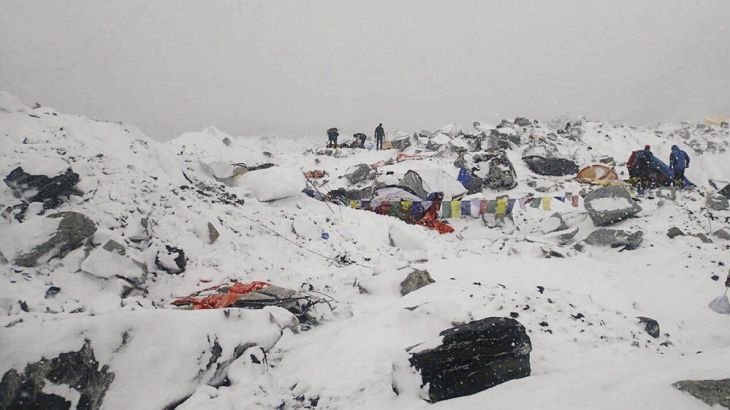
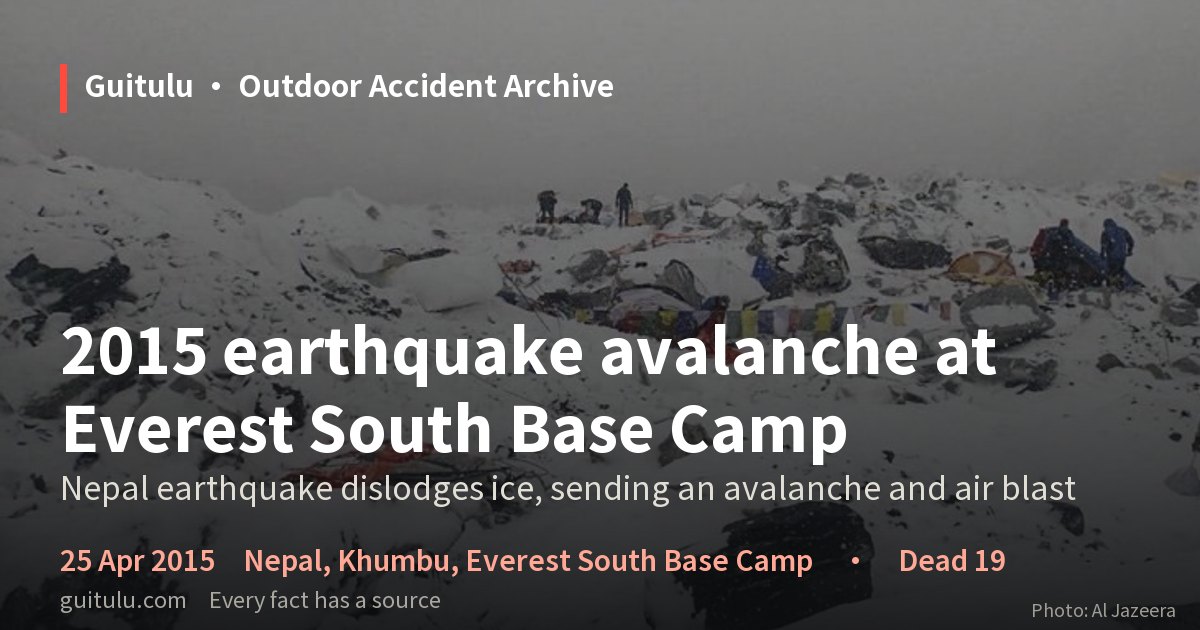
Everest Base Camp after the avalanche, with tent debris scattered among snow and rocks

Archive / Mountaineering

2015 earthquake avalanche at Everest South Base Camp

Nepal earthquake dislodges ice, sending an avalanche and air blast through Everest South Base Camp

Teams evacuated afterward; no one summited Everest from the south side in spring 2015

Photo: Al Jazeera

Date
Spring
Place
Nepal, Khumbu, Everest South Base CampNepal › Koshi Province · Himalaya86.849°E 28.000°N
Activity
MountaineeringInvolves: AvalancheClimbers, Sherpa high-altitude support staff and logistics personnel from multiple commercial expeditions
Casualties
Dead 19 Injured 61Reported death tolls changed over time, ranging from 17 to more than 21; more than 60 injured
Material
45 facts · 12 sources3 accounts differ and are shown side by side

01What happened

At 11:56 local time on Saturday, 25 April 2015, a powerful earthquake struck Nepal. It was the spring climbing season on the south side of Everest, and numerous expeditions were stationed at Base Camp, with more than a thousand climbers, guides and logistics personnel in total.Facts it rests onF08Multiple sourcesA strong earthquake occurred at 11:56 on Saturday, 25 April 2015, Nepal local time.F02Multiple sourcesWhen the earthquake struck, the spring climbing season was underway on Everest's south side, and numerous expeditions were based at base camp.F10Multiple sourcesThere were more than one thousand people at Everest Base Camp when the incident occurred, including climbers, guides and logistics personnel.

Everest Base Camp after the avalanche, with tent debris scattered among snow and rocksPhoto source: Al Jazeera

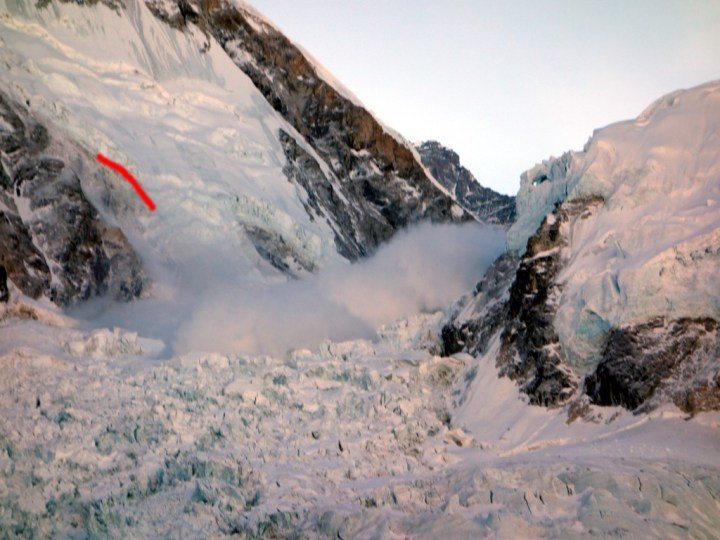
The earthquake dislodged a large mass of ice from an ice cliff on the saddle between Pumori and Lingtren, and an avalanche from the Pumori side swept into Base Camp. The falling ice produced a massive powder snow avalanche and air blast that struck the upper section of Base Camp, blowing many tents across the Khumbu Glacier; rocks carried along also injured people. According to eyewitnesses, the air blast caused many of the deaths and injuries, and some people who took shelter behind rocks or blocks of ice in time survived.Facts it rests onF11Multiple sourcesThe earthquake caused a large mass of ice to break off an ice cliff on the saddle between Pumori and Lingtren.F12Multiple sourcesAn avalanche from the direction of Pumori swept into Everest Base Camp.F13Multiple sourcesThe collapsing ice formed a large powder snow avalanche and air blast, which struck the upper part of base camp and blew many tents across the Khumbu Glacier.F15Multiple sourcesThe avalanche and air blast carried a large number of rocks, which injured some people at base camp.F16Single sourceAccording to eyewitnesses, many of the casualties at base camp were caused by the massive air blast generated by the avalanche.F17Multiple sourcesSurvivors recalled that some people escaped by taking shelter behind rocks or blocks of ice in time.

A helicopter lands at Everest Base Camp after the avalanchePhoto source: Gripped

Snow began falling after the avalanche, and helicopters were unable to reach Base Camp that day; communications were also disrupted for a time. The Everest ER medical team and doctors from the expeditions set up a temporary treatment point at an undamaged camp. On the morning of 26 April, the weather improved and several helicopters reached Base Camp. The injured were first taken to the village of Pheriche, where the Himalayan Rescue Association had a clinic. More than 60 people were injured, and the dead included people from Nepal, the United States, Japan and China, among other countries, including the physician for an American expedition.Facts it rests onF26Multiple sourcesSnow began falling after the avalanche, and helicopters were unable to fly to base camp to evacuate the injured on 25 April.F27Multiple sourcesCommunications in the area were disrupted after the earthquake, making casualty details difficult to confirm immediately.F25Multiple sourcesThe Everest ER medical team and doctors from the various teams set up a temporary treatment point at an undamaged camp.F33Multiple sourcesThe weather improved on the morning of 26 April, and several helicopters flew to base camp.F34Multiple sourcesThe injured were first flown by helicopter to Pheriche, a village below base camp with a Himalayan Rescue Association clinic.F32Multiple sourcesMore than 60 people were injured.F22Multiple sourcesMarisa Eve Girawong, a team medic for Madison Mountaineering, died at base camp.F23Multiple sourcesThree Americans were among the dead, one of whom was a Google employee.F24Multiple sourcesForeign nationals from Japan and China were also among the dead.

Everest Base Camp after the avalanche, with camp facilities destroyedPhoto source: National Geographic

The earthquake also destroyed the route through the Khumbu Icefall, leaving climbers and Sherpas at Camps 1 and 2 in the Western Cwm unable to descend on foot. A strong aftershock at midday on 26 April triggered more avalanches, and an attempt by several guides to repair the route from above was unsuccessful. Several commercial teams decided to evacuate by helicopter instead; on 27 April, the weather improved and helicopters made repeated trips to pick people up from the high camps. Because of the thin air, each flight could carry only two people.Facts it rests onF29Multiple sourcesThe route through the Khumbu Icefall was destroyed in the earthquake.F30Multiple sourcesAfter the icefall route was destroyed, climbers and Sherpas at Camps 1 and 2 in the Western Cwm could not descend on foot through the icefall to base camp.F35Single sourceAnother strong aftershock occurred at midday on 26 April, triggering more avalanches; Dan Mazur, a guide at Camp 1, said there were avalanches on three sides of the camp.F36Multiple sourcesSeveral guides tried to repair the icefall route from the top down, but aftershocks and warming weather prevented them from succeeding.F37Multiple sourcesSeveral commercial teams decided to use helicopters to fly people from the Western Cwm back to base camp.F38Multiple sourcesThe weather improved on 27 April, and helicopters picked up people from Camps 1 and 2 and flew them back to base camp; because of the thin air, each flight could carry only two people.

Base Camp tents overturned and torn by the avalanchePhoto source: National Geographic

According to reports, almost all teams at Base Camp on the Nepal side subsequently abandoned their Everest and Lhotse climbs for the year. No one summited Everest by any route in 2015, the first time since 1974.Facts it rests onF40Single sourceAlmost all teams at base camp on the Nepal side decided to abandon their 2015 climbs of Everest and Lhotse.F41Single sourceNo one reached the summit of Everest by any route in 2015, the first time this had happened since 1974.

The number at the end of a paragraph is how many facts it rests on; open it to see each fact and how well it is sourced: Multiple sourcesSingle source. Conflicting accounts and speculation are kept out of the narrative.

ImgScene photos all from news coverage; copyright belongs to the original authors

  • Reported locations along the route (schematic)Schematic

Satellite imagery Sentinel-2 cloudless 2024 © EOX · Terrain AWS Terrain Tiles · Orange line is schematic · Place coordinates not individually verified

Route review

6 scenes to understand what happened

Scroll down and the map flies to where each part happened. The line is Schematic, Lines connect the locations mentioned in reports in sequence, showing only the approximate direction, not the actual track. Sources for the location coordinates are given in places.json.

01

Full route

The locations mentioned in reports are connected in sequence to show the approximate course of events (schematic).

02

Earthquake strikes

At 11:56 on 25 April 2015, a powerful earthquake struck Nepal. It was climbing season on the south side of Everest, and more than a thousand people were stationed at Base Camp.Facts it rests onF08Multiple sourcesA strong earthquake occurred at 11:56 on Saturday, 25 April 2015, Nepal local time.F02Multiple sourcesWhen the earthquake struck, the spring climbing season was underway on Everest's south side, and numerous expeditions were based at base camp.F10Multiple sourcesThere were more than one thousand people at Everest Base Camp when the incident occurred, including climbers, guides and logistics personnel.

03

Ice collapses

A large mass of ice collapsed from the saddle between Pumori and Lingtren. An avalanche and air blast swept into the upper section of Base Camp, blowing many tents across the Khumbu Glacier.Facts it rests onF11Multiple sourcesThe earthquake caused a large mass of ice to break off an ice cliff on the saddle between Pumori and Lingtren.F12Multiple sourcesAn avalanche from the direction of Pumori swept into Everest Base Camp.F13Multiple sourcesThe collapsing ice formed a large powder snow avalanche and air blast, which struck the upper part of base camp and blew many tents across the Khumbu Glacier.

04

Waiting for clear weather

Snow fell that day, preventing helicopters from reaching the camp. The weather improved the next morning, and helicopters reached Base Camp and took the injured to Pheriche.Facts it rests onF26Multiple sourcesSnow began falling after the avalanche, and helicopters were unable to fly to base camp to evacuate the injured on 25 April.F33Multiple sourcesThe weather improved on the morning of 26 April, and several helicopters flew to base camp.F34Multiple sourcesThe injured were first flown by helicopter to Pheriche, a village below base camp with a Himalayan Rescue Association clinic.

05

Icefall route cut off

The route through the Khumbu Icefall was destroyed, leaving people at camps in the Western Cwm unable to descend on foot. Attempts to repair the route were unsuccessful.Facts it rests onF29Multiple sourcesThe route through the Khumbu Icefall was destroyed in the earthquake.F30Multiple sourcesAfter the icefall route was destroyed, climbers and Sherpas at Camps 1 and 2 in the Western Cwm could not descend on foot through the icefall to base camp.F36Multiple sourcesSeveral guides tried to repair the icefall route from the top down, but aftershocks and warming weather prevented them from succeeding.

02Timeline

  1. An avalanche occurred in the Khumbu Icefall the previous year (April 2014), killing 16 Nepali high-altitude workers. F01

  2. Snow began falling after the avalanche, and helicopters were unable to fly to base camp to evacuate the injured on 25 April. F26

  3. A strong earthquake occurred at 11:56 on Saturday, 25 April 2015, Nepal local time. F08

  4. An avalanche from the direction of Pumori swept into Everest Base Camp. F12

  5. Several guides tried to repair the icefall route from the top down, but aftershocks and warming weather prevented them from succeeding. F36

  6. The injured were first flown by helicopter to Pheriche, a village below base camp with a Himalayan Rescue Association clinic. F34

  7. Another strong aftershock occurred at midday on 26 April, triggering more avalanches; Dan Mazur, a guide at Camp 1, said there were avalanches on three sides of the camp. F35

  8. The weather improved on the morning of 26 April, and several helicopters flew to base camp. F33

  9. The weather improved on 27 April, and helicopters picked up people from Camps 1 and 2 and flew them back to base camp; because of the thin air, each flight could carry only two people. F38

  10. Almost all teams at base camp on the Nepal side decided to abandon their 2015 climbs of Everest and Lhotse. F40

  11. On 29 April, another avalanche fell from Everest's West Shoulder onto the Khumbu Icefall; the north side in Tibet was also closed that day over concerns about aftershocks. F39

  12. No one reached the summit of Everest by any route in 2015, the first time this had happened since 1974. F41

03Lessons

Avalanche and high altitude

Base Camp's protection has limits

Everest Base Camp normally relies on its distance from avalanche paths and the barriers formed by moraine terrain to protect it from avalanches. This time, the earthquake dislodged a large mass of ice from the saddle between Pumori and Lingtren. Several experienced guides and climbers said an avalanche of this scale had never occurred in the area.Facts it rests onF42Multiple sourcesBase camp is usually protected from avalanches by its distance from avalanche paths and by the barrier provided by the moraine terrain.F11Multiple sourcesThe earthquake caused a large mass of ice to break off an ice cliff on the saddle between Pumori and Lingtren.F20Multiple sourcesSeveral experienced guides and climbers said that an avalanche of this scale had never occurred in the area before.

Avalanche and high altitude

Air blasts and flying rocks can also be deadly

According to eyewitnesses, many of the deaths and injuries at Base Camp were caused by the enormous air blast produced by the avalanche, and rocks carried along also injured people. Survivors recalled that some people survived by taking shelter behind rocks or blocks of ice in time.Facts it rests onF16Single sourceAccording to eyewitnesses, many of the casualties at base camp were caused by the massive air blast generated by the avalanche.F15Multiple sourcesThe avalanche and air blast carried a large number of rocks, which injured some people at base camp.F17Multiple sourcesSurvivors recalled that some people escaped by taking shelter behind rocks or blocks of ice in time.

Rescue and self-rescue

Helicopter rescue depends on the weather

Snow began falling on the day of the avalanche, and helicopters could not reach Base Camp to evacuate the injured. They did not arrive until the weather improved the next morning. At the camps above the icefall, the thin air meant each helicopter flight could carry only two people.Facts it rests onF26Multiple sourcesSnow began falling after the avalanche, and helicopters were unable to fly to base camp to evacuate the injured on 25 April.F33Multiple sourcesThe weather improved on the morning of 26 April, and several helicopters flew to base camp.F38Multiple sourcesThe weather improved on 27 April, and helicopters picked up people from Camps 1 and 2 and flew them back to base camp; because of the thin air, each flight could carry only two people.

Teams and decisions

After the route down was cut off

The earthquake destroyed the route through the Khumbu Icefall, leaving people at Camps 1 and 2 unable to descend on foot. Aftershocks triggered more avalanches, and an attempt to repair the route was unsuccessful. Several teams eventually decided to evacuate by helicopter.Facts it rests onF29Multiple sourcesThe route through the Khumbu Icefall was destroyed in the earthquake.F30Multiple sourcesAfter the icefall route was destroyed, climbers and Sherpas at Camps 1 and 2 in the Western Cwm could not descend on foot through the icefall to base camp.F35Single sourceAnother strong aftershock occurred at midday on 26 April, triggering more avalanches; Dan Mazur, a guide at Camp 1, said there were avalanches on three sides of the camp.F36Multiple sourcesSeveral guides tried to repair the icefall route from the top down, but aftershocks and warming weather prevented them from succeeding.F37Multiple sourcesSeveral commercial teams decided to use helicopters to fly people from the Western Cwm back to base camp.

04Fact list 45 facts

Under each fact is a verbatim quote from the original. "Single source" means only one outlet mentioned it; "Accounts differ" means sources contradict each other and this site adopts neither side; "Speculation" is an inference by a reporter or a person involved, not a fact.

  1. F01Multiple sourcesBackground

    An avalanche occurred in the Khumbu Icefall the previous year (April 2014), killing 16 Nepali high-altitude workers.

    Quotes from the original 2

    “Last April, 16 high altitude workers were killed in an avalanche that struck the icy slope in Khumbu icefall on Mt Everest.”

    The Himalayan Times · 2015-04-25

    “where 16 Nepalese high-altitude workers perished in an avalanche last April.”

    National Geographic · 2015-04-26
  2. F02Multiple sourcesBackground

    When the earthquake struck, the spring climbing season was underway on Everest's south side, and numerous expeditions were based at base camp.

    Quotes from the original 2

    “where climbing season is in full swing with dozens of expeditions deployed among several mountains.”

    National Geographic · 2015-04-25

    “A wall of snow, rock and ice swept through Base Camp when the climbing season was in full swing.”

    Alpine Mag ·
  3. F03Single sourceBackground

    According to Alan Arnette, By the end of April 2015, no fixed ropes had been installed or supplies carried above Camp 2.

    Quotes from the original 1

    “This year, 2015, nothing had been fixed or positioned above Camp 2.”

    Alan Arnette · 2015-04-29
  4. F04Accounts differAftermath

    Accounts of the death toll vary: The Himalayan Times reported at least 13 on the day of the incident; Al Jazeera and Reuters reported at least 17; PBS, National Geographic and The Kathmandu Post reported 18; Alpine Mag reported 19, and Alan Arnette reported more than 19; National Geographic reported at least 21 the following day.

    The death toll rose daily as the search progressed, and the reports were published at different times.

    Quotes from the original 8

    “At least 13 mountaineers were killed and many went missing”

    The Himalayan Times · 2015-04-25

    ““Seventeen have been reported dead so far and 61 are injured,” he said.”

    Al Jazeera · 2015-04-26

    “an avalanche that killed at least 17 people.”

    Reuters · 2015-04-27

    “On Mount Everest, 18 people died in a quake-related avalanche.”

    PBS ·

    “As we got a clear picture of the disaster scene on Everest, at least 18 had died.”

    The Kathmandu Post · 2015-05-29

    “The earthquake triggered an avalanche on Mount Everest that killed 19 climbers”

    Alpine Mag ·

    “Over 19 people have reportedly lost their lives at EBC”

    Alan Arnette · 2015-04-29

    “Reports now indicate that at least 21 individuals died in the event”

    National Geographic · 2015-04-26
  5. F05Multiple sourcesEvent

    Uninjured climbers and Sherpas took part in the search and helped the injured.

    Quotes from the original 2

    “Hamill and others who were not injured worked to help injured climbers and Sherpas and transport wounded into helicopters.”

    PBS ·

    “International Mountain Guides’ sirdar Ang Jangbu could be heard uncovering the injured and dead and calling for stretchers and more manpower.”

    Outside · 2015-04-25
  6. F06Accounts differEvent

    Accounts of the number of people at camps above the icefall vary: National Geographic's first report gave approximately 100 to 200; Reuters and National Geographic's report the following day gave approximately 100; Alan Arnette said there were 170 people in the Western Cwm.

    The estimates used different criteria and were made at different times.

    Quotes from the original 4

    “approximately 100-200 climbers and Sherpas were acclimatizing at camps higher up on the mountain”

    National Geographic · 2015-04-25

    “An estimated 100 climbers and guides were safe but trapped at camps 1 and 2”

    Reuters · 2015-04-27

    “approximately a hundred climbers remained at Camp 1 and Camp 2 in the Western Cwm”

    National Geographic · 2015-04-26

    “the hopes of 170 people now in the Western Cwm lay on their shoulders”

    Alan Arnette · 2015-05-06
  7. F07Multiple sourcesEvent

    After the Icefall Doctors' camp was destroyed by the avalanche, they withdrew to Gorak Shep.

    Quotes from the original 2

    “have reportedly been forced to retreat from Base Camp to Gorak Shep, the closest settlement to Base Camp, after their part of the camp was obliterated by the avalanche”

    National Geographic · 2015-04-26

    “The Icefall Doctors reed to Gorak Shep after their camp was destroyed.”

    Alan Arnette · 2015-04-29
  8. F08Multiple sourcesEvent

    A strong earthquake occurred at 11:56 on Saturday, 25 April 2015, Nepal local time.

    Quotes from the original 2

    “The quake struck at 11:56 AM on Saturday, April 25th local time.”

    National Geographic · 2015-04-25

    “a 7.8 magnitude earthquake hit Nepal at 11:56 AM on Saturday April 25.”

    Alan Arnette · 2015-04-29
  9. F09Accounts differEvent

    Accounts of the earthquake's magnitude vary: National Geographic, PBS and Alan Arnette reported 7.8; Outside and Reuters reported 7.9.

    The magnitudes cited by media outlets were inconsistent in early reports.

    Quotes from the original 4

    “The USGS rates the initial shock as 7.8 on the Richter scale.”

    National Geographic · 2015-04-25

    “after a 7.8-magnitude earthquake on April 25 caused avalanches in Nepal”

    PBS ·

    “a 7.9-magnitude earthquake struck northeastern Nepal”

    Outside · 2015-04-25

    “Saturday's 7.9 magnitude earthquake”

    Reuters · 2015-04-27
  10. F10Multiple sourcesBackground

    There were more than one thousand people at Everest Base Camp when the incident occurred, including climbers, guides and logistics personnel.

    Quotes from the original 2

    “more than 500 climbers and over 600 support staff and guides were staying for acclimatisation in their camps.”

    The Himalayan Times · 2015-04-25

    “Including support staff, the population of Everest Base Camp is more than 1,000 people.”

    National Geographic · 2015-04-25
  11. F11Multiple sourcesEvent

    The earthquake caused a large mass of ice to break off an ice cliff on the saddle between Pumori and Lingtren.

    National Geographic cited a blog by Eric Simonson of International Mountain Guides (IMG).

    Quotes from the original 2

    ““The earthquake caused a huge block of ice to fall from the ice cliff in the saddle between Pumori and Lingtren”, he wrote”

    National Geographic · 2015-04-25

    “The ice serac that released was triggered by the earthquake. It between Pumori and Lintgren on a saddle at 20,177 feet”

    Alan Arnette · 2015-04-29
  12. F12Multiple sourcesEvent

    An avalanche from the direction of Pumori swept into Everest Base Camp.

    Quotes from the original 3

    “as the avalanche from Pumori side buried the base camp”

    The Himalayan Times · 2015-04-25

    “The most significant of these fell from a hanging glacier on the northern shoulder of 23,494-foot Pumori”

    Outside · 2015-04-25

    “The avalanche that slid down from Pumori had washed down the Base Camp by nearly a kilometre.”

    The Kathmandu Post · 2015-05-29
  13. F13Multiple sourcesEvent

    The collapsing ice formed a large powder snow avalanche and air blast, which struck the upper part of base camp and blew many tents across the Khumbu Glacier.

    National Geographic cited IMG guide Simonson's blog; Al Jazeera cited an account on another team's website.

    Quotes from the original 2

    “created a huge aerosol avalanche and accompanying air blast that hit the upper part of Everest [Base Camp] and blew many tents across the Khumbu Glacier towards the lower Icefall”

    National Geographic · 2015-04-25

    “prompted a “huge aerosol avalanche” that struck the upper section of base camp, blowing tents across the mountain”

    Al Jazeera · 2015-04-26
  14. F14Multiple sourcesEvent

    The earthquake also triggered avalanches on several surrounding peaks, including Nuptse.

    Quotes from the original 3

    “Other large avalanches were reported as coming off Nuptse”

    National Geographic · 2015-04-25

    “saying the quake had “resulted in avalanches off of all the mountains around us.””

    Outside · 2015-04-25

    “a huge avalanche announced it’s arrival to my right, off Nuptse.”

    Alan Arnette · 2015-05-06
  15. F15Multiple sourcesEvent

    The avalanche and air blast carried a large number of rocks, which injured some people at base camp.

    Quotes from the original 2

    “Apparently the air blast and earthquake also caused many big rocks to shift, which were the cause of some of the crushing injuries suffered by climbers in the upper section of Base Camp.”

    Outside · 2015-04-25

    “it also picked up loose rocks, boulders – they became projectiles hitting anything, and anyone in their way.”

    Alan Arnette · 2015-05-06
  16. F16Single sourceFound at scene

    According to National Geographic, According to eyewitnesses, many of the casualties at base camp were caused by the massive air blast generated by the avalanche.

    Quotes from the original 1

    “many of the Base Camp casualties resulted from the immense air blast generated by the avalanche.”

    National Geographic · 2015-04-26
  17. F17Multiple sourcesFound at scene

    Survivors recalled that some people escaped by taking shelter behind rocks or blocks of ice in time.

    Quotes from the original 2

    “only a few feet away if a person hid behind a rock or an ice bank they escaped unharmed.”

    National Geographic · 2015-04-26

    “Some who had managed to duck or run behind blocks survived.”

    The Kathmandu Post · 2015-05-29
  18. F18Multiple sourcesFound at scene

    Sleeping, dining and kitchen tents in the affected camps were flattened or swept away.

    Quotes from the original 2

    “Dining, cooking, sleeping tents, everything vanished.”

    PBS ·

    “Personal sleeping tents were flattened, large dining and cooking tents were sent tumbling.”

    Alan Arnette · 2015-04-29
  19. F19Multiple sourcesFound at scene

    The damage was concentrated in parts of base camp; some more distant camps within base camp were largely unaffected.

    Quotes from the original 3

    “while the lower portion of Base Camp survived relatively unscathed.”

    National Geographic · 2015-04-25

    “The camps farther down the glacier (like the IMG camp) were untouched.”

    Outside · 2015-04-25

    “Camps above and below our general area, mid EBC, were almost complete spared.”

    Alan Arnette · 2015-04-29
  20. F20Multiple sourcesPost-incident analysis

    Several experienced guides and climbers said that an avalanche of this scale had never occurred in the area before.

    Quotes from the original 2

    “It is worth noting that, over many expeditions, we have never seen an avalanche in this area that was even remotely of this scale.”

    Outside · 2015-04-25

    “The event was unprecedented for Everest Base Camp. Teams have camped in this area for decades.”

    Alan Arnette · 2015-04-29
  21. F21Multiple sourcesEvent

    Romanian climber Alex Gavan said on Twitter that a massive avalanche had occurred.

    Quotes from the original 2

    “Romanian Climber Alex Gavan said on Twitter that there had been a huge avalanche and many people were up on the mountain.”

    The Himalayan Times · 2015-04-25

    “Gavan described a “huge avalanche” coming off Pumori”

    National Geographic · 2015-04-25
  22. F22Multiple sourcesEvent

    Marisa Eve Girawong, a team medic for Madison Mountaineering, died at base camp.

    Quotes from the original 3

    “US-based Madison Mountaineering said its doctor Marisa Eve Girawong had died in the avalanche.”

    Al Jazeera · 2015-04-26

    “As he waited, Madison learned that one of his teammates, Marisa Eve Girawong, had passed away in Base Camp.”

    National Geographic · 2015-04-26

    “our team Doctor and Base Camp Manager, Marisa Eve Girawong was killed.”

    Alan Arnette · 2015-04-29
  23. F23Multiple sourcesEvent

    Three Americans were among the dead, one of whom was a Google employee.

    Quotes from the original 2

    “Three Americans were killed, the U.S. State Department said on Sunday, including a Google engineer, a medic and a filmmaker.”

    Reuters · 2015-04-27

    “Dan Fredinburg, Google executive, was among the handful of victims to have been identified so far.”

    Al Jazeera · 2015-04-26
  24. F24Multiple sourcesEvent

    Foreign nationals from Japan and China were also among the dead.

    Quotes from the original 3

    “Japan's foreign ministry on Monday said a Japanese man was among those killed on the Everest”

    Reuters · 2015-04-27

    ““One of our Chinese clients, who was with another team, was among the dead in base camp,””

    The Himalayan Times · 2015-04-25

    “We had lost one Japanese, an Australian and a Chinese climber.”

    The Kathmandu Post · 2015-05-29
  25. F25Multiple sourcesEvent

    The Everest ER medical team and doctors from the various teams set up a temporary treatment point at an undamaged camp.

    Quotes from the original 2

    “With the help of nearly every able bodied friend in base camp, we moved our clinic to the IMG camp where we are caring for patients.”

    Outside · 2015-04-25

    “Doctors from expeditions and the medical volunteers at EverestER created a MASH unit at one untouched camp.”

    Alan Arnette · 2015-05-06
  26. F26Multiple sourcesEvent

    Snow began falling after the avalanche, and helicopters were unable to fly to base camp to evacuate the injured on 25 April.

    Quotes from the original 3

    “snowy weather that prevented any helicopters from reaching Base Camp today”

    National Geographic · 2015-04-25

    “In the immediate aftermath of the avalanche, it had begun to snow and no helicopters were able to make flights in to evacuate the wounded.”

    Outside · 2015-04-25

    “Snowfalls on Saturday had thwarted efforts to airlift survivors before the skies cleared on Sunday morning.”

    Al Jazeera · 2015-04-26
  27. F27Multiple sourcesEvent

    Communications in the area were disrupted after the earthquake, making casualty details difficult to confirm immediately.

    Quotes from the original 2

    “details were not available due to poor communication network in the region.”

    The Himalayan Times · 2015-04-25

    “most of the cellular system in Nepal is not working because of the earthquake.”

    National Geographic · 2015-04-25
  28. F28Single sourceFound at scene

    According to The Kathmandu Post, According to an expedition organiser, some survivors lost their food and tents, and their outer clothing was torn.

    Quotes from the original 1

    “But they were left with no food or tent and their jackets were torn.”

    The Kathmandu Post · 2015-05-29
  29. F29Multiple sourcesFound at scene

    The route through the Khumbu Icefall was destroyed in the earthquake.

    Quotes from the original 3

    ““The icefall route that was fixed earlier collapsed,” DoT official Shrestha said.”

    The Himalayan Times · 2015-04-25

    ““#Icefall route destroyed,” reported Dan Mazur”

    National Geographic · 2015-04-25

    “The treacherous route through the Khumbu Icefall—a series of aluminum ladders and safety lines that span yawning crevasses—was wiped out by the avalanche.”

    Outside · 2015-04-25
  30. F30Multiple sourcesEvent

    After the icefall route was destroyed, climbers and Sherpas at Camps 1 and 2 in the Western Cwm could not descend on foot through the icefall to base camp.

    Quotes from the original 2

    “which rendered the treacherous Khumbu icefalls leading up to them from base camp impassable.”

    Reuters · 2015-04-27

    “Blocking them from easily descending to help their comrades was the Khumbu Icefall”

    National Geographic · 2015-04-26
  31. F31Multiple sourcesEvent

    Dave Hahn, a guide at Camp 1, said by satellite phone that, amid the snowstorm, they had decided to remain at camp and wait for the weather to improve.

    The two reports quoted the same satellite phone update.

    Quotes from the original 2

    “good mountaineering sense dictates that we stay put and ride this storm out.”

    National Geographic · 2015-04-25

    “Good mountaineering sense dictates that we stay put and ride this storm out. It may take a little time, but we are OK.”

    Outside · 2015-04-25
  32. F32Multiple sourcesAftermath

    More than 60 people were injured.

    Quotes from the original 2

    ““Seventeen have been reported dead so far and 61 are injured,” he said.”

    Al Jazeera · 2015-04-26

    “More than 60 people were injured”

    Reuters · 2015-04-27
  33. F33Multiple sourcesEvent

    The weather improved on the morning of 26 April, and several helicopters flew to base camp.

    Quotes from the original 2

    “six helicopters landed at the base camp after weather conditions improved overnight.”

    Al Jazeera · 2015-04-26

    “This morning, several helicopters managed to reach Base Camp, but weather conditions remained challenging.”

    National Geographic · 2015-04-26
  34. F34Multiple sourcesEvent

    The injured were first flown by helicopter to Pheriche, a village below base camp with a Himalayan Rescue Association clinic.

    Quotes from the original 3

    “Instead, the injured were shuttled to Pheriche, a small village approximately 12 miles below Base Camp where a medical clinic operated by the Himalayan Rescue Association is located.”

    National Geographic · 2015-04-26

    “Others are being airlifted to Pheriche.”

    Al Jazeera · 2015-04-26

    “which I heard was ferrying climbers to Firiche from the Base Camp.”

    The Kathmandu Post · 2015-05-29
  35. F35Single sourceEvent

    According to National Geographic, Another strong aftershock occurred at midday on 26 April, triggering more avalanches; Dan Mazur, a guide at Camp 1, said there were avalanches on three sides of the camp.

    Quotes from the original 2

    “Then, at 12:54 PM, local time, a significant aftershock, which registered 6.7 on the Richter scale, set off more slides in the area.”

    National Geographic · 2015-04-26

    “Avalanches on 3 sides.”

    National Geographic · 2015-04-26
  36. F36Multiple sourcesEvent

    Several guides tried to repair the icefall route from the top down, but aftershocks and warming weather prevented them from succeeding.

    Quotes from the original 3

    “As of nightfall on Sunday, April 26th, efforts to re-establish the route through the icefall appear to have failed”

    National Geographic · 2015-04-26

    ““We are coming back – too warm, no route.” Was all that was said on the radio from the expert climbing guides.”

    Alan Arnette · 2015-05-06

    “In spite of heroic efforts by a few commercial guides to re-establish the upper route in the Icefall, the aftershocks made it too risky.”

    Alan Arnette · 2015-04-29
  37. F37Multiple sourcesPlan

    Several commercial teams decided to use helicopters to fly people from the Western Cwm back to base camp.

    Quotes from the original 2

    “we are working on a plan to evacuate the climbers and sherpas up in the Western Cwm by helicopter down to EB”

    National Geographic · 2015-04-26

    “Garrett Madison made the decision to take advantage of the weather to helicopter down to EBC as did other major commercial teams.”

    Alan Arnette · 2015-04-29
  38. F38Multiple sourcesEvent

    The weather improved on 27 April, and helicopters picked up people from Camps 1 and 2 and flew them back to base camp; because of the thin air, each flight could carry only two people.

    Quotes from the original 3

    “On Monday, good weather allowed helicopters to rescue stranded climbers from camps one and two and dropped them at base camp”

    Gripped · 2015-04-27

    “Each helicopter is only capable of carrying two climbers due to the thin air, Gavan said from base camp.”

    Reuters · 2015-04-27

    “The pilots did an amazing job of touching down for 30 seconds while two people jumped on board with their climbing pack.”

    Alan Arnette · 2015-04-29
  39. F39Single sourceAftermath

    According to Alan Arnette, On 29 April, another avalanche fell from Everest's West Shoulder onto the Khumbu Icefall; the north side in Tibet was also closed that day over concerns about aftershocks.

    Quotes from the original 2

    “Another avalanche off Everest West Shoulder onto the Khumbu Icefall occurred this afternoon (April 29)”

    Alan Arnette · 2015-04-29

    “The Chinese Tibetan Mountaineering Association (CTMA) closed Everest North April 29 for fear of after shocks.”

    Alan Arnette · 2015-04-29
  40. F40Single sourceAftermath

    According to Alan Arnette, Almost all teams at base camp on the Nepal side decided to abandon their 2015 climbs of Everest and Lhotse.

    Quotes from the original 1

    “Almost every team, but not all, at EBC – Nepal has made the decision to abandon 2015 Everest and Lhotse climbs.”

    Alan Arnette · 2015-04-29
  41. F41Single sourceAftermath

    According to Alan Arnette, No one reached the summit of Everest by any route in 2015, the first time this had happened since 1974.

    Quotes from the original 1

    “For the first time since 1974, Everest would have no summits by any route, from any camp, by any means.”

    Alan Arnette · 2015-05-06
  42. F42Multiple sourcesBackground

    Base camp is usually protected from avalanches by its distance from avalanche paths and by the barrier provided by the moraine terrain.

    Quotes from the original 2

    “Typically, Base Camp is insulated from avalanches by distance—camps are set back several hundred yards from any avalanche path—and by a series of sand-trap-like moraine lakes and hillocks”

    Outside · 2015-04-25

    “it gained speed and was compressed as it hit the morane that normally protects EBC.”

    Alan Arnette · 2015-04-29
  43. F43Single sourceBackground

    According to Alan Arnette, This serac and similar ice formations had collapsed before, but on a smaller scale; in one instance in 2003, only the air blast swept across base camp, causing no damage.

    Quotes from the original 1

    “This serac and others similar have released before including a small one I witnessed and videoed last week off Pumori and a large one in 2003 that sprayed me at EBC with a air blast but no damage.”

    Alan Arnette · 2015-04-29
  44. F44Single sourceBackground

    According to Alan Arnette, Camp 1 is closer than Camp 2 to the mountain walls on either side and is more vulnerable to a direct avalanche impact.

    Quotes from the original 1

    “Camp 1 was in a more precarious location that Camp 2, closer to the walls, exposed to direct hits from avalanches.”

    Alan Arnette · 2015-05-06
  45. F45Single sourceParticipant's view

    According to The Kathmandu Post, Temba Tsheri Sherpa, an organizer of an affected expedition, wrote that until then, Base Camp had been considered the safest place on the mountain.

    Quotes from the original 1

    “The Base Camp, till now, was supposed to be the safest place in the mountains.”

    The Kathmandu Post · 2015-05-29