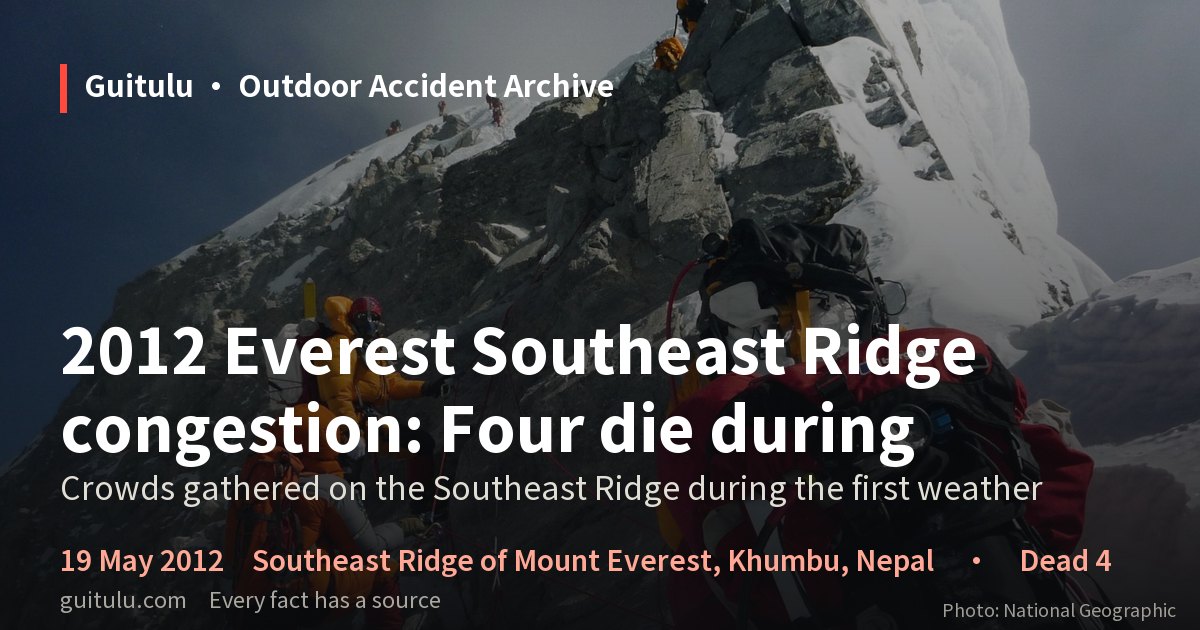
Dead 4 Four people died during the descent: German Eberhard Schaaf, Canadian Shriya Shah-Klorfine, South Korean Song Won-bin, and Chinese national Ha Wenyi
Material
45 facts · 12 sources5 accounts differ and are shown side by side
The number at the end of a paragraph is how many facts it rests on; open it to see each fact and how well it is sourced:
Multiple sourcesSingle source. Conflicting accounts and speculation are kept out of the narrative.
Scroll down and the map flies to where each part happened.
01
The area of the incident
The reports do not provide enough locations along the route; the map shows only the approximate location and terrain of the area where the incident occurred.
That year, Sherpas did not finish fixing ropes all the way to the summit until 18 May, later than in recent years. F11
Song Won-bin and his teammates began their descent after reaching the summit on 19 May. F30
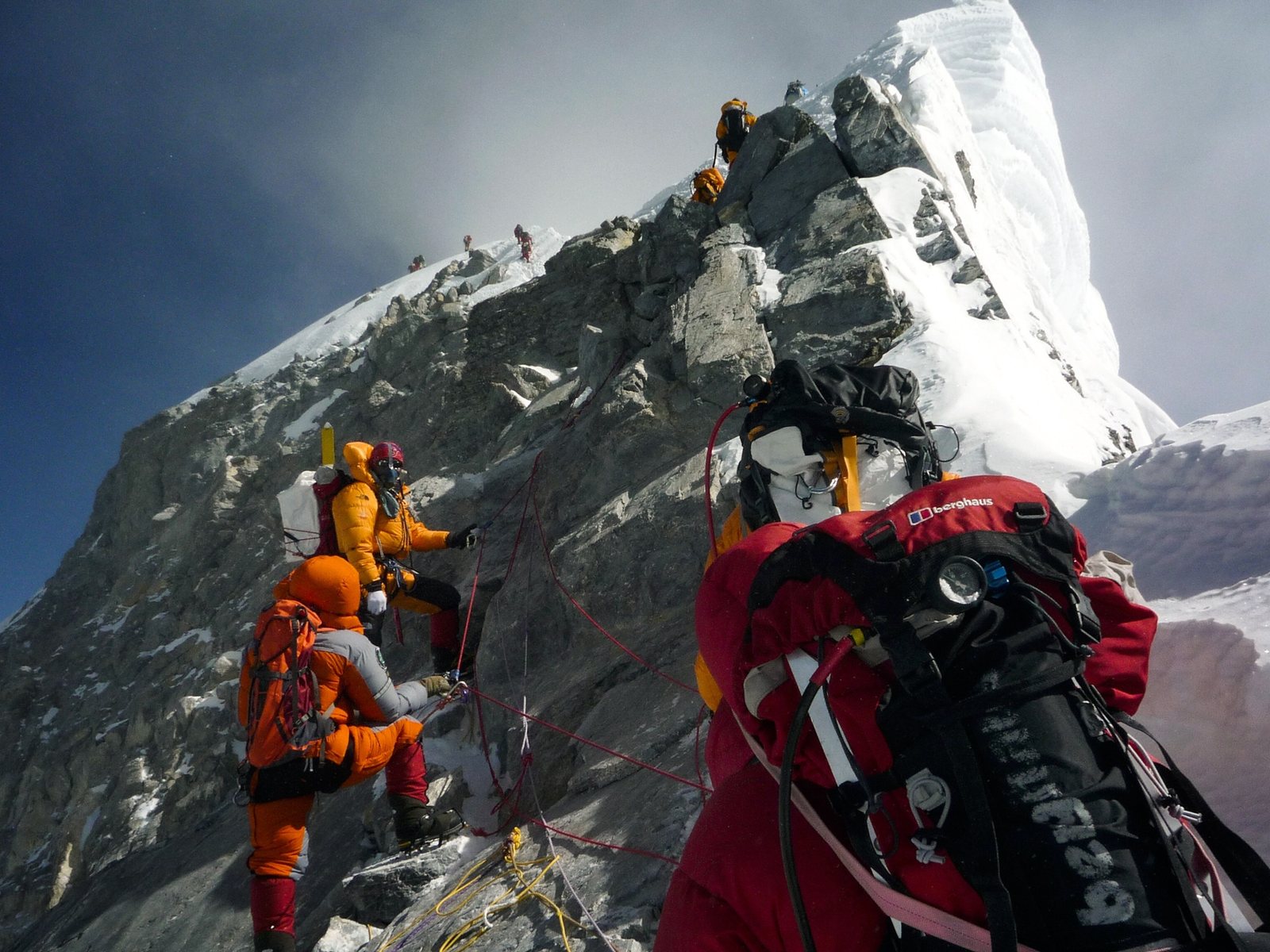
At 2:30 pm on 19 May, climbers were still queuing below the Hillary Step and continuing towards the summit. F16
According to reports, after Shah-Klorfine's group reached the Balcony in the morning, they were delayed for two hours because there were too many people ahead. F19
On 19 May, a Chinese climber and a Nepalese Sherpa guide were reported missing. F35
At around 10 to 10:30 pm on 19 May, Shah-Klorfine collapsed during the descent and subsequently died. F26
Shah-Klorfine reached the summit shortly after 2 pm on 19 May. F22
The reported wait below the Hillary Step ranged from 1 to 2 and a half hours. F15
According to Maclean's, in the early hours of 20 May, American climber Jon Kedrowski encountered a disoriented Ha Wenyi below the Balcony while descending. F37
At 3 am on 20 May, American climber Kedrowski abandoned his summit attempt less than 300 meters from the summit because the wind was too strong. F38
According to Outside, there were 7 helicopter rescues at Camp II over those days. F39
According to Alan Arnette, before the second window on 25 May, climbing companies arranged for extra Sherpas and emergency oxygen at the South Col. F40
Under each fact is a verbatim quote from the original. "Single source" means only one outlet mentioned it; "Accounts differ" means sources contradict each other and this site adopts neither side; "Speculation" is an inference by a reporter or a person involved, not a fact.
According to Maclean's, According to Maclean's, a 2008 University of Toronto study found that most deaths on Everest occurred during descent above 8000 metres, and that most of those who died had not reached the summit until after 10 am.
Quotes from the original 1
“Most fatalities occur above 8000 m on the descent from the summit, and involve climbers who reached the peak after 10 a.m.”
Two summit weather windows were forecast for Everest in spring 2012: the first around 18 May and the second around 25 May, each lasting only two or three days.
Quotes from the original 2
“Two weather windows had been identified. The first was around May 18th and the second, May 25th.”
According to National Geographic, IMG head Simonson said the weather had been poor earlier in the season, and teams that might otherwise have attempted the summit earlier had not set out, concentrating the summit attempts.
Quotes from the original 1
“so teams that might have normally climbed earlier didn't go”
According to OutdoorHub, According to Gyanendra Shrestha, an official with Nepal's mountaineering department, congestion caused climbers to wait longer and spend too much time at high altitude; many had limited oxygen supplies and had not anticipated the additional time.
IBTimes also quoted the same passage.
Quotes from the original 1
“Many of them are believed to be carrying a limited amount of oxygen not anticipating the extra time spent”
Accounts differ as to where Ha Wenyi's body was found: Mail & Guardian said it was on Everest's north face at 8600 metres; Outside said it was on the south face at the Triangular Face, below Shah-Klorfine; Maclean's said it was in a rocky gully.
Quotes from the original 3
“after the body of a missing Chinese climber was found at 8 600m on the north side of the mountain on Monday”
According to National Geographic, Luanne Freer, a doctor with the Himalayan Rescue Association, said that, based on accounts from others and teammates, high-altitude cerebral edema may have been a factor in several of the deaths.
Quotes from the original 1
“high altitude cerebral edema"—or HACE, a buildup of fluid in the brain—"was likely a factor in several of the deaths”
Thakuri, head of the climbing company with which Shah-Klorfine was climbing, and Park Gye-hoon, leader of the Korean team, both believed that congestion was partly responsible for the deaths.
Quotes from the original 2
“Shah-Klorfine's death was caused in part by overcrowding in the mountain's so-called "death zone"”
According to National Geographic, A Nepalese tourism ministry spokesperson said that because the weather was difficult to predict, it was impossible to dictate who would summit on which day, and that everyone wanted to go up as soon as the weather improved.
Quotes from the original 1
“We cannot say who gets to get to the summit on which dates because of the unpredictable weather. When weather clears up, they all want to benefit”
According to Outside, According to Outside, Swiss meteorological organisation Meteotest forecast winds of 10 to 30 kilometres per hour on 18 May, rising to 40 kilometres per hour on 20 May.
Quotes from the original 1
“The forecast from Swiss meteorology service Meteotest predicted winds of 10–30km/hr on the 18th, rising to 40km/h on the 20th”
Accounts differ as to the number of people on Everest that weekend: CBC said about 150 people were climbing that day; National Geographic said about 200 to 300 people reached the summit over the weekend; Outside said about 300 climbers, guides and Sherpas crowded the upper Southeast Ridge; Maclean's said the line Shah-Klorfine was following exceeded 500 people.
The sources used different counting criteria (number climbing, number summiting, combined total for both sides).
Quotes from the original 4
“The estimated 150 people making their way up the peak that day caused many bottlenecks along the route”
According to National Geographic, The IMG team set out at 8 pm the previous evening. The first members reached the summit before 5 am, and even the slowest reached it before 10 am.
Quotes from the original 1
“Our team left at eight o'clock on the previous evening, and we had our first people summiting before 5 a.m. Even the slowest climbers were on top by 10 a.m.”
According to National Geographic, IMG head Simonson said some people did not reach the summit until 2 or 3 pm, when there was hardly anyone left on the mountain to help if something went wrong.
Quotes from the original 1
“Some were at the summit as late as two or three in the afternoon. By that time of day there're not too many people up there. So if you have a problem, there's no one to help you.”
According to The Globe and Mail, According to reports, after Shah-Klorfine's group reached the Balcony in the morning, they were delayed for two hours because there were too many people ahead.
Quotes from the original 1
“they reached The Balcony in the morning but faced delays of two hours because of the high volume of climbers on the route ahead”
The two Sherpa guides tried to help her descend, taking turns supporting her and setting up rescue ropes in an attempt to lower her down the Triangular Face.
Quotes from the original 2
“Temba and Dawa Dendi rigged up a rescue rope and attempted to lower her down the Triangular Face”
German doctor Eberhard Schaaf was climbing with Asian Trekking. According to the company, he died from altitude sickness, including high-altitude cerebral edema.
Quotes from the original 3
“Dr. Eberhard Schaaf of Germany, climbing with AT died from high altitude cerebral edema (HACE)”
Accounts differ on where Schaaf died: Asian Trekking said the South Summit; Outside said between the Hillary Step and the South Summit; and a Nepalese liaison officer told The Himalayan Times it was the South Col.
Quotes from the original 3
“the German had probably died of altitude sickness at the mountain’s south summit”
According to Korea JoongAng Daily, According to South Korean team leader Park Gye-hoon, Song appeared to have been caught in congestion when he went missing.
Quotes from the original 1
“Park said Song appeared to be stuck in the congestion at the time he went missing.”
According to Maclean's, According to Maclean's, in the early hours of 20 May, American climber Jon Kedrowski encountered a disoriented Ha Wenyi below the Balcony while descending.
Quotes from the original 1
“On the way back down in the early hours of May 20, just below the Balcony, Kedrowski encountered Ha Wenyi, a Chinese climber, who had become disoriented.”
According to Maclean's, At 3 am on 20 May, American climber Kedrowski abandoned his summit attempt less than 300 meters from the summit because the wind was too strong.
Quotes from the original 1
“By 3 a.m., he was less than 300 m from Everest's peak, but the wind had picked up to the point where it threatened to blow him off the mountain. He abandoned his ascent.”
According to Alan Arnette, According to Alan Arnette, before the second window on 25 May, climbing companies arranged for extra Sherpas and emergency oxygen at the South Col.
Quotes from the original 1
“the organizers stationed extra Sherpas at the South Col with emergency oxygen, manpower ready to help their climbers”
Climbers are usually advised not to enter the danger zone above the South Col too late, and many guides believe they should turn back by 1 pm at the latest.
Quotes from the original 2
“Climbers are generally advised not to attempt the dangerous area too late in the day in order to conserve their strength for the return trip.”
Canadian climber Shriya Shah-Klorfine was from Toronto, was 33 years old and was born in Kathmandu. Her climb was organized by Nepal's Utmost Adventure Trekking.
Quotes from the original 3
“Ms. Shah-Klorfine was born in Kathmandu and grew up in Mumbai before moving to Toronto with her husband.”
“Ganesh Thakuri, the managing director of Utmost Adventure Trekking, the Kathmandu company that Shriya had paid more than $70,000 to guide her up the mountain”
According to Maclean's, According to Maclean's, Shah-Klorfine had no previous mountaineering experience, apart from a trek in Nepal to an altitude of approximately 3500 meters.
Quotes from the original 1
“had no background in mountaineering beyond a trekking vacation in Nepal a few years ago that had taken her up to 3,500 m”
South Korean climber Song Won-bin's team consisted of alumni of Chungnam High School, who were climbing Everest to celebrate the 50th anniversary of their school's founding.
Quotes from the original 2
“The 10-member group were alumni of Chungnam High School in South Chungcheong, who planned the trip to celebrate the 50th anniversary of the school.”
 GuituluGlobal Outdoor Accident Archive