Khumbu Icefall, south side of Mount Everest, Khumbu, NepalNepal › Koshi Province · Himalaya86.870°E 28.002°N
Activity
Mountaineering (route fixing and transport)Involves: AvalancheNepali mountain guides transporting supplies and fixing the route for commercial climbing teams, most of them Sherpas
Casualties
Dead 16 Injured 916 people died, including 3 whose bodies were never found; according to Wikipedia, 9 people were injured. All those killed were Nepali; no foreign climbers were killed.
Material
45 facts · 11 sources2 accounts differ and are shown side by side
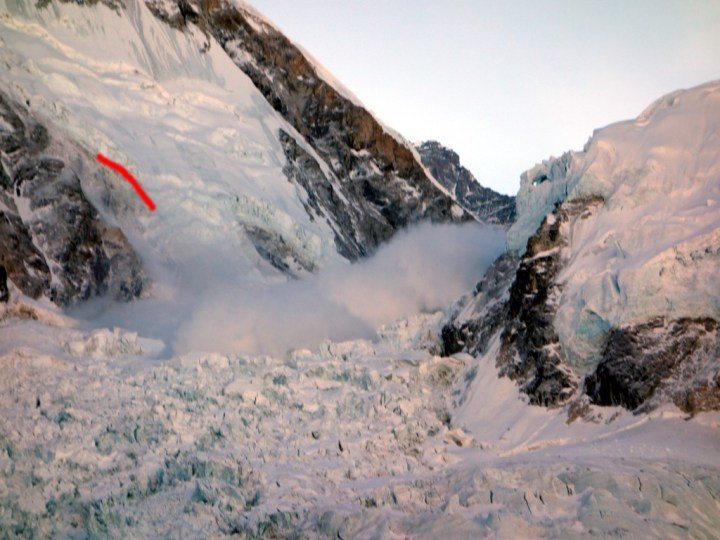
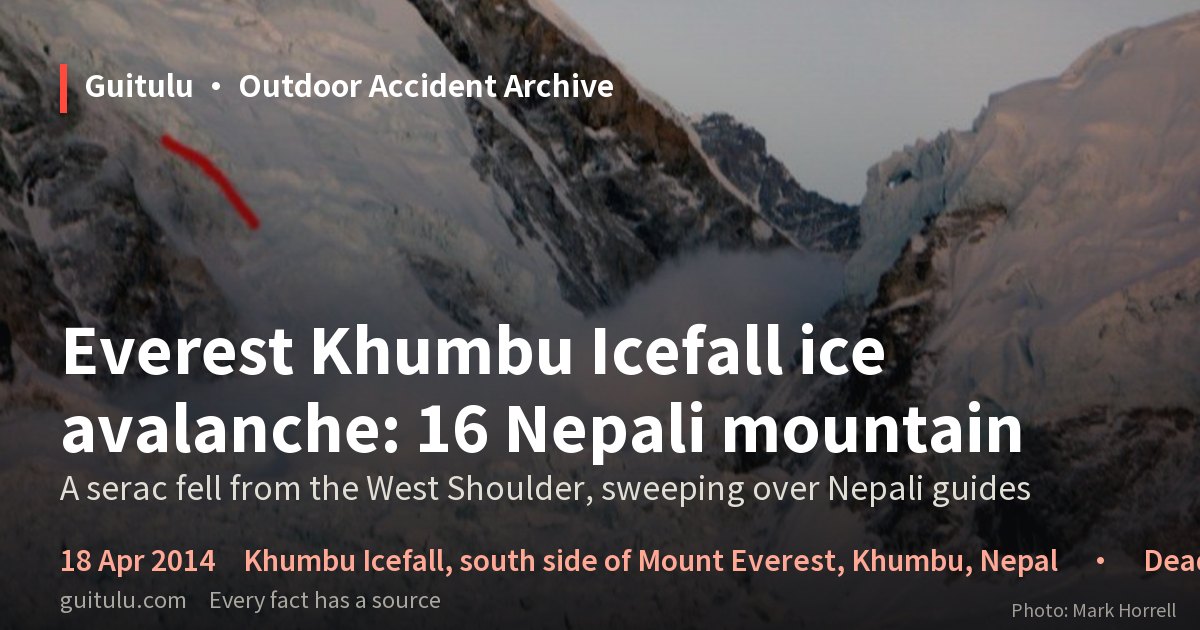
An ice avalanche sweeping across the Khumbu Icefall, photographed by a witness near Base Camp, with a red line marking the location of the collapsed seracPhoto source: Mark Horrell
The number at the end of a paragraph is how many facts it rests on; open it to see each fact and how well it is sourced:
Multiple sourcesSingle source. Conflicting accounts and speculation are kept out of the narrative.
ImgScene photos all from news coverage; copyright belongs to the original authors
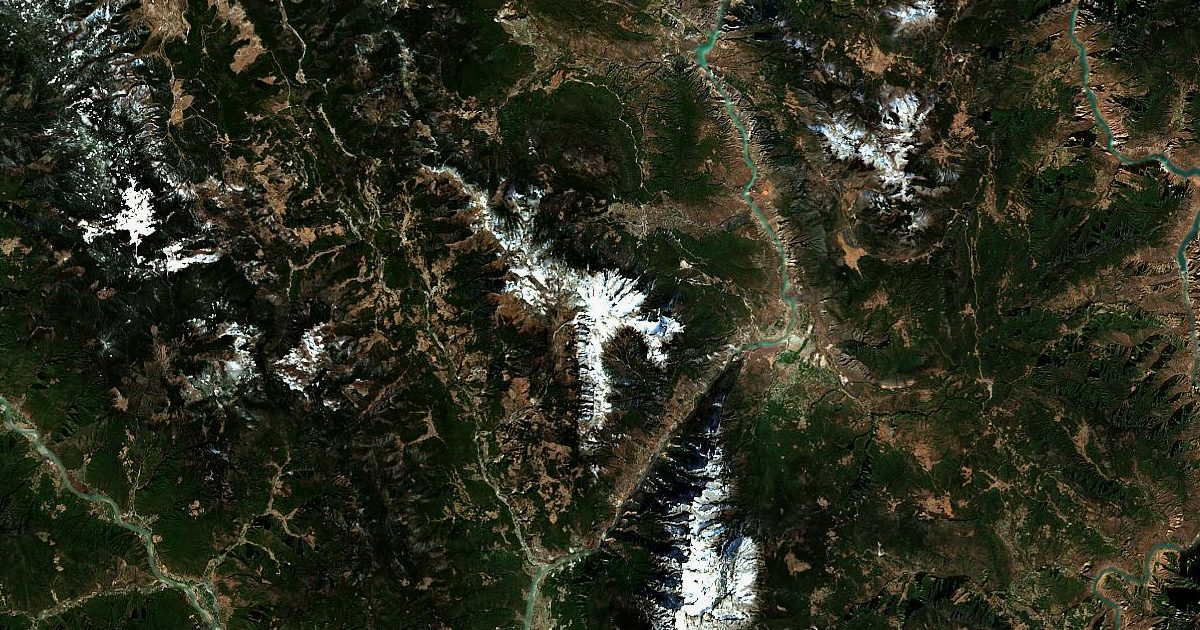
Climbers crossing a crevasse in the Khumbu Icefall on a ladderPhoto source: National GeographicDiagram of the Khumbu Icefall route and hanging glacier danger zone (National Geographic)Photo source: National GeographicSatellite image marking the location of the collapsed serac and that season's route through the icefall (National Geographic)Photo source: National GeographicNational Geographic diagram estimating the volume and weight of the collapsed seracPhoto source: National Geographic
Reported points along the route (schematic)Schematic
Scroll down and the map flies to where each part happened. The line is Schematic, Lines connect the points mentioned in reports in sequence and indicate only the approximate direction, not the actual track.
01
Full route
The locations mentioned in reports are connected in sequence to show the approximate course of events (schematic).
In spring 2012, Himalayan Experience owner Russell Brice considered the risks of the Khumbu Icefall and avalanches too great and called off his company's climbing teams. F02
By late April, most climbing teams had abandoned their climbs and left base camp. F10
At around 10 a.m., helicopters began transporting the dead and injured back to Base Camp, where the Himalayan Rescue Association's Base Camp clinic set up an emergency room. F30
Early on the morning of 18 April 2014, an ice avalanche occurred in the Khumbu Icefall on the south side of Mount Everest. F13
The ice avalanche killed 16 people in total. All those killed were Nepali; no foreign climbers died. F25
Shortly after the accident, the Nepali government announced that it would give each victim's family 40,000 Nepali rupees (about $400), enough only to cover funeral expenses, prompting discontent among the Sherpa community. F33
After about 48 hours, the search and rescue operation was stopped on the grounds that the risk was too great. F32
On 22 April, Sherpa guides announced that they would stop climbing work for the rest of the year in memory of their colleagues who had died. F34
The Nepali government subsequently announced that it would give each victim's family a further 500,000 Nepali rupees. F35
After the accident, Nepal adjusted the traditional climbing route; in February 2015, the authorities announced a new route through the middle of the icefall. F39
On the first anniversary, climbing teams stopped climbing for one day in mourning, and the Nepali government announced the establishment of a welfare fund for victims of mountaineering accidents. F40
A year later, the 25 April 2015 Nepal earthquake triggered an avalanche on the south side of Mount Everest that killed more people than this ice avalanche. F41
Under each fact is a verbatim quote from the original. "Single source" means only one outlet mentioned it; "Accounts differ" means sources contradict each other and this site adopts neither side; "Speculation" is an inference by a reporter or a person involved, not a fact.
In spring 2012, Himalayan Experience owner Russell Brice considered the risks of the Khumbu Icefall and avalanches too great and called off his company's climbing teams.
Quotes from the original 2
“halted his expedition because he felt the Khumbu and the avalanches were simply too dangerous, particularly for his Sherpas.”
According to National Geographic, At the time, the fixed ropes and ladders were set up on the left side of the icefall. This route had fewer dangers within the icefall, but passed directly beneath the hanging glacier on the West Shoulder.
Quotes from the original 2
“Presently the ropes and ladders are strung up the left-hand side of the icefall”
According to National Geographic, Kaji Sherpa was flown by helicopter to Kathmandu, where he was treated in hospital for a punctured lung and two broken ribs.
Quotes from the original 1
“He was helicoptered to Kathmandu and has been recovering from a punctured lung and two broken ribs”
According to National Geographic, Mountaineer Conrad Anker believed that crossing the Khumbu Icefall was “essentially Russian roulette”, with nowhere to escape.
Quotes from the original 1
“"It's essentially a game of Russian roulette," says Anker. "There is nowhere to run, nowhere to hide."”
The guides issued an ultimatum to the government, demanding increased compensation, changes to insurance payouts and the establishment of a welfare fund, or else all climbing on Everest would be cancelled.
Quotes from the original 3
“The guides had threatened to cancel all climbing on Mount Everest and issued an ultimatum to the government, demanding higher compensation, an agreement to revise insurance payments and a welfare fund.”
“have threatened to call off the climbing season a week from now unless the government of Nepal agrees to provide better insurance, better pay, and better relief funds for the families of the dead and injured.”
According to National Geographic, Adventure Consultants, which lost three Sherpa guides, announced its withdrawal from climbing that season; the Discovery Channel cancelled its planned broadcast from the summit of Everest.
Quotes from the original 2
“Adventure Consultants, a climbing outfit that lost three Sherpas in the disaster, officially announced it was pulling out for this climbing season”
According to Mark Horrell, A fund established by the American Alpine Club raised 50,000 US dollars for the families of those killed by the end of April.
Quotes from the original 1
“A fund set up by the American Alpine Club had raised $50,000 before the end of April.”
Accounts differ on the time of the ice avalanche: Mark Horrell, a later National Geographic report and the BBC (quoted by UIAA) recorded it as about 6:45 local time; National Geographic's initial report and its interview with an injured person gave it as about 6:30.
All are approximate times; the difference may come from estimates by different witnesses.
Quotes from the original 3
“At approximately 6.45am on Friday 18 April, 2014”
According to officials, the guides went up the mountain early in the morning to fix ropes and prepare the route for the climbing season.
Here, UIAA cites an official account quoted by the Associated Press.
Quotes from the original 2
“The Sherpa guides had climbed up the slope early in the morning to fix ropes for climbers and prepare the route for mountaineers when the avalanche hit”
According to Mark Horrell, A ladder on a steep section of the icefall shifted, causing a bottleneck. At the time of the ice avalanche, 40 to 50 Sherpas were waiting above the ladder to descend.
Quotes from the original 2
“A ladder had fallen out of position at a steep section of the route through the Icefall, causing a bottleneck.”
According to National Geographic, When the ice tower collapsed, survivor Kaji Sherpa had no time to get out of the way and was knocked down and partially buried by ice. Almost all the Sherpas climbing together behind him had disappeared.
Quotes from the original 2
“Kaji looked up, but before he could move, he was thrown down and half buried by a crushing weight of ice.”
According to Mark Horrell, A group of Western clients of International Mountain Guides (IMG) was also in the icefall at the time, only about 15 minutes from the accident site.
Quotes from the original 1
“a team of western clients from International Mountain Guides (IMG) were climbing through the Icefall at the time and just 15 minutes away from the tragedy”
According to Mark Horrell, Sherpas and Western guides acclimatised to the altitude went up to the accident site. Some brought ladders to repair the route, while others brought shovels to help search for those killed.
Quotes from the original 2
“Those who were already acclimatised to the altitude, including Sherpas and western guides, headed up to the avalanche site.”
According to Mark Horrell, At around 10 a.m., helicopters began transporting the dead and injured back to Base Camp, where the Himalayan Rescue Association's Base Camp clinic set up an emergency room.
Quotes from the original 1
“At around 10am helicopters began arriving to bring down the dead and injured to Base Camp, where an emergency room had been set up at the Himalayan Rescue Association’s Everest Base Camp Medical Clinic.”
Shortly after the accident, the Nepali government announced that it would give each victim's family 40,000 Nepali rupees (about $400), enough only to cover funeral expenses, prompting discontent among the Sherpa community.
Quotes from the original 3
“Two days after the tragedy the Government of Nepal announced they would provide 40,000 Nepalese rupees (around $400 USD) to each of the families of the deceased.”
Accounts differ on the number of people whose bodies were not found: a National Geographic article interviewing an injured guide on 24 April said two people had not yet been found; a National Geographic report on 20 April, as well as the Associated Press and AFP, said three.
Quotes from the original 2
“Two of the climbers have yet to be recovered from the ice”
According to National Geographic, A National Geographic cartographer compared two satellite images from 7 April and 26 April and confirmed the original location of the ice that had collapsed.
Quotes from the original 1
“superimposed two satellite photos of Everest—one from April 7, 2014, and the other from April 26, 2014—on top of one another.”
According to a rough estimate by National Geographic, the collapsed ice tower was approximately 34.5 metres high and weighed approximately 14.3 million kilograms.
The figures on Wikipedia are drawn from the same National Geographic estimate and are not independent measurements.
Quotes from the original 2
“It was 113 feet (34.5 meters) high and weighed as much as 657 fully loaded Greyhound buses, about 31.5 million pounds (14.3 million kilograms).”
After the accident, Nepal adjusted the traditional climbing route; in February 2015, the authorities announced a new route through the middle of the icefall.
Quotes from the original 2
“the Nepali authorities announced in February 2015 that a new route, up the centre of the icefall, would be followed instead.”
According to AFP, On the first anniversary, climbing teams stopped climbing for one day in mourning, and the Nepali government announced the establishment of a welfare fund for victims of mountaineering accidents.
Quotes from the original 2
“All teams here have decided not to climb today to mourn the friends we lost last year,”
A year later, the 25 April 2015 Nepal earthquake triggered an avalanche on the south side of Mount Everest that killed more people than this ice avalanche.
Quotes from the original 2
“In 2015, a powerful earthquake triggered an avalanche that killed 18 people at Everest's base camp before the climbing season began.”
According to AFP, Afterward, insurance payouts for guides who died were increased to 1.5 million Nepalese rupees, and helicopters were also permitted to transport supplies to high camps, reducing the number of times guides had to cross the icefall.
Quotes from the original 2
“The insurance payout was increased to 1.5 million Nepali rupees ($11,250) if someone is killed.”
According to National Geographic, Client climbers usually cross the Khumbu Icefall only six to eight times in a season, while Sherpa guides may cross it 30 to 40 times in a season.
Quotes from the original 2
“a Sherpa can easily make the mortal trek 30 to 40 times in a season.”
 GuituluGlobal Outdoor Accident Archive