2012 Mont Maudit avalanche in the Mont Blanc massif
Early-morning avalanche above Chamonix swept away rope teams ascending Mont Blanc
Rescue operations have ended; accounts differ on what triggered the avalanche, and the reports on which this archive is based contain no final investigation findings
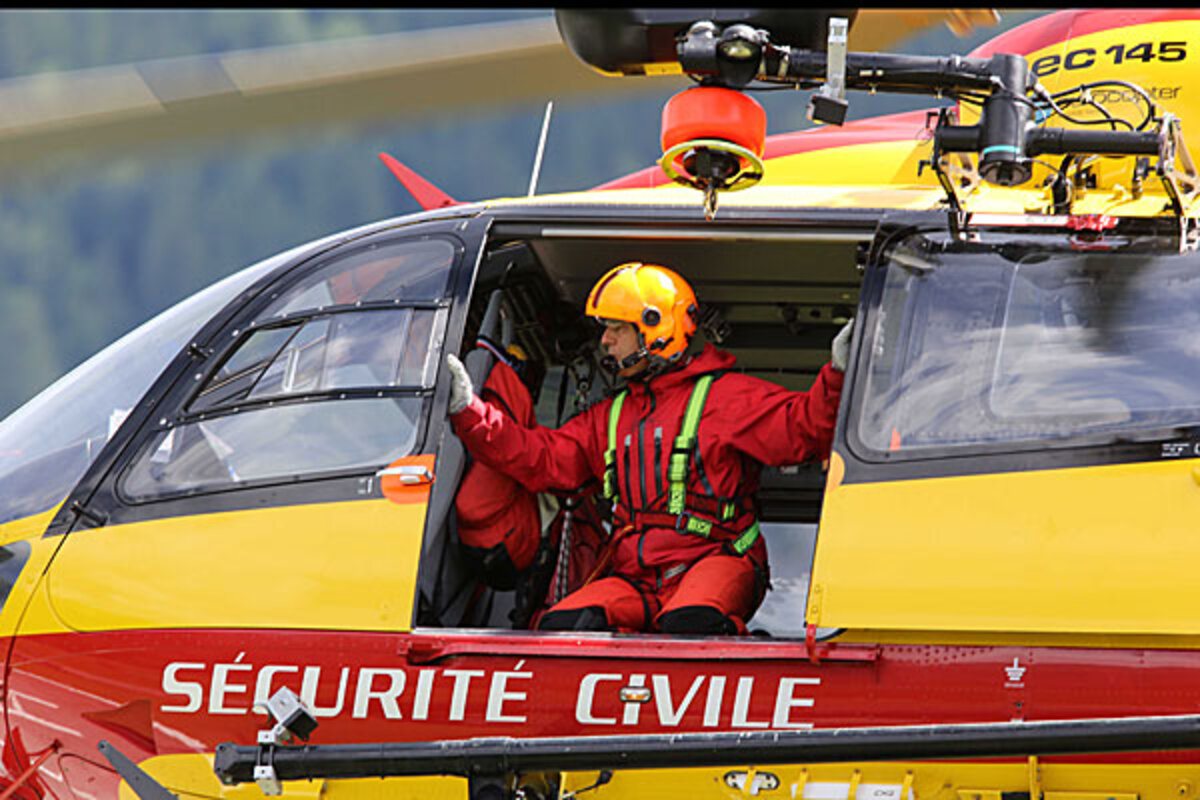
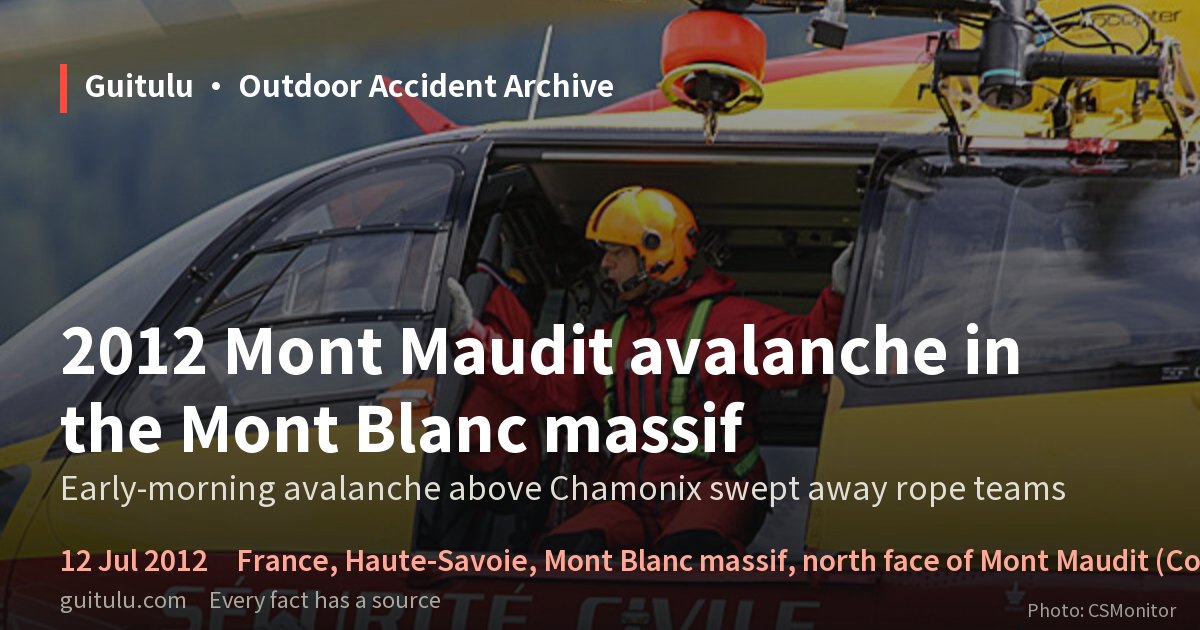
A French Civil Security (Sécurité Civile) rescue helicopter, with rescue personnel inside the cabin (photo accompanying the report, not taken at the accident site; exact location not specified)Photo source: CSMonitor
The number at the end of a paragraph is how many facts it rests on; open it to see each fact and how well it is sourced:
Multiple sourcesSingle source. Conflicting accounts and speculation are kept out of the narrative.
Scroll down and the map flies to where each part happened. The line is Schematic, Connects the waypoints mentioned in reports in sequence. It shows only the approximate direction, not the actual track.
01
Full route
The locations mentioned in reports are connected in sequence to show the approximate course of events (illustrative).
According to the Associated Press, heavy rain fell in Chamonix in the days before the incident, falling as snow above 3000 metres. F01
According to the Associated Press, local authorities had previously warned mountaineers to take care because of unusually heavy spring snowfall. F02
There were at least 28 people on the route where the incident occurred, all of whom had set out after eating breakfast at the Cosmiques Hut in the early morning. F06
About 50 rescuers took part in the search and rescue, including rescue personnel from Italy who reinforced the Chamonix High Mountain Gendarmerie Platoon (PGHM). F23
The avalanche occurred at about 4000 metres on Mont Maudit in the Mont Blanc massif. F04
After the incident, other mountaineers at the scene immediately went to help, and rescuers arrived shortly afterwards. F22
Police received an alert at about 5:25 a.m. from an injured person. F05
Four mountaineers were initially reported missing; later that day, all were confirmed safe and had not been caught in the avalanche. F16
The snow in the avalanche deposit was estimated to be about 6 metres deep, making search and rescue difficult. F21
French officials said this was the deadliest mountain accident in recent years; AFP said it was the worst mountaineering accident in France since August 2008. F25
Chamonix arranged a church memorial service for the Saturday afternoon after the accident. F29
Under each fact is a verbatim quote from the original. "Single source" means only one outlet mentioned it; "Accounts differ" means sources contradict each other and this site adopts neither side; "Speculation" is an inference by a reporter or a person involved, not a fact.
According to CSMonitor, According to the Associated Press, heavy rain fell in Chamonix in the days before the incident, falling as snow above 3000 metres.
Quotes from the original 1
“Several days ago Chamonix saw a monsoon-like downpour, which turned to snow at an altitude of 9,850 feet (3,000 meters).”
According to CSMonitor, According to the Associated Press, local authorities had previously warned mountaineers to take care because of unusually heavy spring snowfall.
Quotes from the original 1
“Regional authorities had warned climbers to be careful because of an unusually snowy spring.”
According to CSMonitor, A mountaineer who had turned back at roughly the same location a few days before the incident said it was too dangerous there and everyone was waiting for something to happen, but had not expected it to be on such a scale.
This is one mountaineer's personal view.
Quotes from the original 1
“It was too dangerous. Everyone has been waiting for something to happen there”
There were at least 28 people on the route where the incident occurred, all of whom had set out after eating breakfast at the Cosmiques Hut in the early morning.
Quotes from the original 2
“The 28 had all left the Cosmiques Hut after the 01:00 breakfast.”
According to Terra Daily, According to AFP, the party to which the victims belonged had more than 20 people and set out at about 1:30 a.m. from a base at 3600 metres.
Quotes from the original 1
“left a base at 3,600 metres at around 1:30 am local time”
Reports differed on the nationalities of those killed: the British Mountaineering Council reported 2 Germans, 2 Swiss, 2 Spaniards and 3 Britons; AFP and the Associated Press reported 3 Britons, 3 Germans, 2 Spaniards and 1 Swiss person.
Accounts differ on the numbers of Germans and Swiss, but all report a total of 9 deaths, including 3 Britons.
Quotes from the original 2
“two Germans, two Swiss, two Spaniards and three British”
Reports differed on the number of injured: the prefect of Haute-Savoie, France, said 9 people were injured, Chamonix.net reported 12 the following day, and the Associated Press reported about a dozen.
Accounts differed on why the 4 “missing people” were not caught in the avalanche: AFP said 2 Britons took another route and 2 Spaniards had given their hut berths to people who were later killed; Chamonix.net said 2 people had cancelled their reservations and the other 2 had already turned back at Mont Blanc du Tacul.
The two sources gave different accounts of the whereabouts of the 4 people.
Quotes from the original 2
“the two Spaniards thought missing had resold their spots in the refuge”
Accounts differed on what triggered the avalanche: the British Mountaineering Council and grough said it may have been triggered by a collapsing serac; the Associated Press quoted officials as saying a mountaineer may have inadvertently dislodged a slab of ice; Chamonix.net said a wind slab more than 40 centimetres thick fractured.
These were inferences in early reports; the reports used by this archive contain no final investigation findings.
According to BMC, The British Mountaineering Council relayed an account from Daniele Ollier of SAV: the avalanche occurred in two stages, first when a serac collapsed and struck mountaineers higher up, followed by a wind-slab avalanche that swept people below about 200 metres.
Quotes from the original 1
“the initial serac fall hit the climbers who were higher on the Maudit face, then the windslab avalanche took out the climbers below, sweeping them for 200 metres.”
It is thought that snow brought by southerly winds over the previous two days may have contributed to the formation of a wind slab, which came loose as mountaineers passed over it.
Quotes from the original 2
“windslab snow accumulated in the last two days by prevailing south winds may have contributed”
About 50 rescuers took part in the search and rescue, including rescue personnel from Italy who reinforced the Chamonix High Mountain Gendarmerie Platoon (PGHM).
Quotes from the original 2
“About 50 rescuers, including from Italy, had joined the search”
According to See Chamonix, According to reports, afternoon sunshine warmed the snow that day, and rescuers themselves faced risks from unstable snow conditions.
Quotes from the original 1
“concern later in the day for the safety of the rescuers themselves, working in the unstable conditions”
French officials said this was the deadliest mountain accident in recent years; AFP said it was the worst mountaineering accident in France since August 2008.
According to Terra Daily, AFP quoted the secretary-general of the Petzl Foundation as saying that the increase in mountaineers was itself a danger because it slowed down rope teams.
This is an expert's personal view, not a finding of the investigation into this accident.
Quotes from the original 1
“The increased use is a danger in and of itself because it slows down the rope parties”
According to Terra Daily, The head of France's national mountain guides' union believed that crowds in the same area could lead to behaviour that would not normally occur, such as rope teams overtaking one another on unsuitable terrain.
This is a general view from an industry professional, not a finding of the investigation into this accident.
Quotes from the original 1
“This can make rope parties pass each other in unsuitable terrain.”
 GuituluGlobal Outdoor Accident Archive