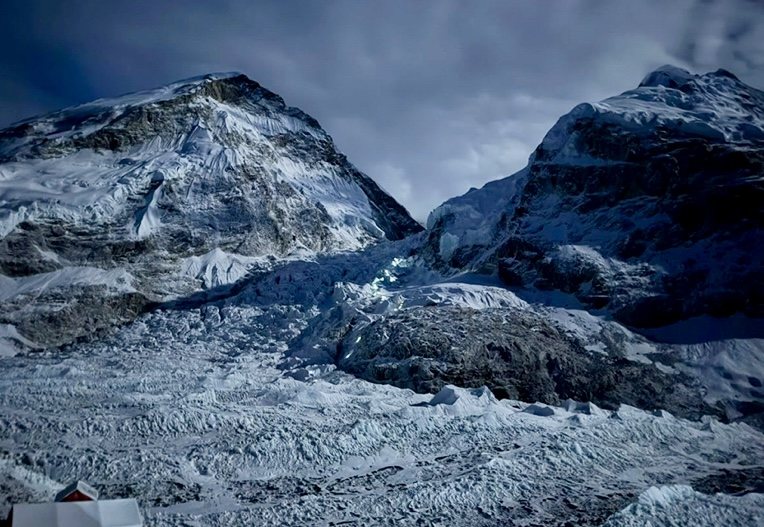
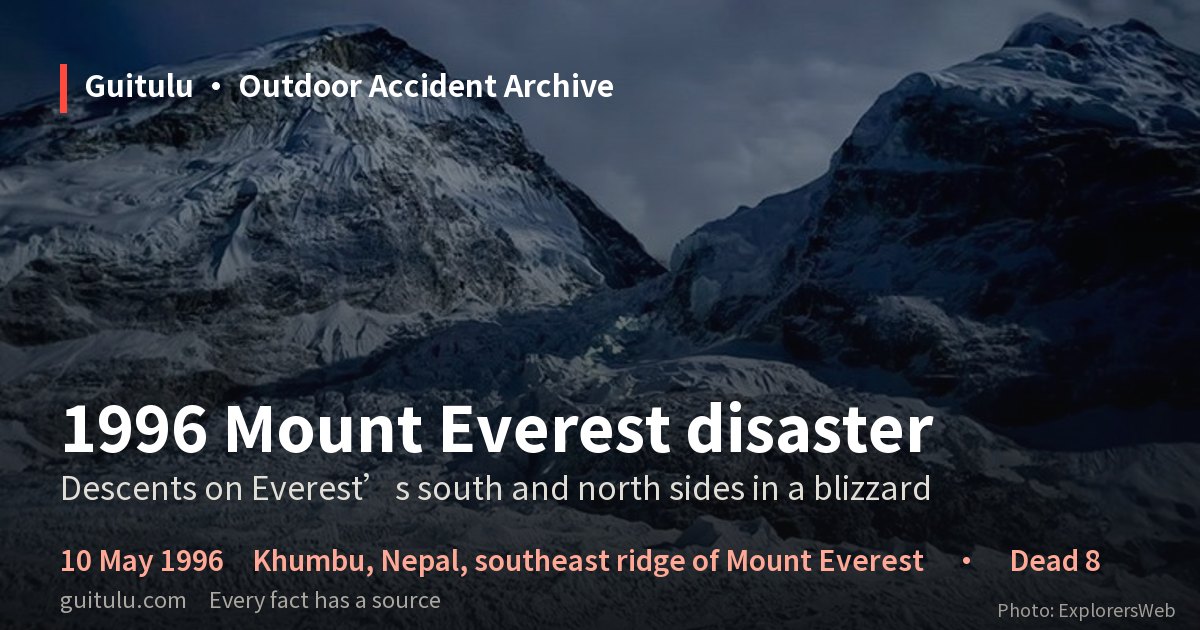
Dead 8 Eight people died in the 10–11 May 1996 blizzard (five on the south side and three on the north side); 12 people died during the entire spring climbing season that year.
Material
45 facts · 11 sources2 accounts differ and are shown side by side
The number at the end of a paragraph is how many facts it rests on; open it to see each fact and how well it is sourced:
Multiple sourcesSingle source. Conflicting accounts and speculation are kept out of the narrative.
Reported locations along the route (schematic)Schematic
Scroll down and the map flies to where each part happened. The line is Schematic, Locations mentioned in reports are connected in sequence, showing only the approximate direction, not the actual track. Sources for the location coordinates are in places.json.
01
Full route
The locations mentioned in reports are connected in sequence to show the approximate course of events (schematic).
On 9 May, Taiwanese team member Chen Yu-nan was injured in a fall on the Lhotse Face and later died during the descent. F06
Hall personally accompanied his client Hansen, and they did not reach the summit until about 4 p.m. F20
Hall's client Beck Weathers suffered severe vision impairment near the Balcony and was unable to continue upward, so he stayed there to wait for the team to return. F15
From about 3 p.m., clouds enveloped the upper mountain. By evening, a blizzard had fully set in, reducing visibility, burying the fixed ropes and obliterating the tracks back to Camp IV. F22
Hansen died during the descent on the night of 10 May. F28
After midnight on 10 May, the teams set out from Camp IV on the South Col for the summit. F10
Fixed ropes were not in place on time at key sections, including the Balcony and the Hillary Step, causing a chain of delays. F12
Fischer did not reach the summit until approximately 3:45 p.m., well past the turnaround time. F19
Early on 11 May, Hall called Base Camp by radio, saying he was on the South Summit. F34
On 11 May, Sherpa rescuers climbed toward Hall in the storm but were forced to turn back not far from him because it was too dangerous, leaving oxygen and hot tea. F35
Boukreev left camp during the storm to search and rescue, bringing several climbers from the lost group back to camp. F32
Later that day, Weathers regained consciousness and walked back to camp alone. F41
Weathers was later evacuated from the mountain by helicopter, in what was described as one of the highest-altitude helicopter rescues at the time. F42
Afterward, Krakauer published Into Thin Air and Boukreev published The Climb; the two books give conflicting accounts of some events. F43
Under each fact is a verbatim quote from the original. "Single source" means only one outlet mentioned it; "Accounts differ" means sources contradict each other and this site adopts neither side; "Speculation" is an inference by a reporter or a person involved, not a fact.
Those who died belonged to three teams: Hall's Adventure Consultants, Fischer's Mountain Madness, and the Indo-Tibetan Border Police expedition.
Quotes from the original 2
“a blizzard on Mount Everest caused the death of eight climbers from three climbing parties: Rob Hall’s Adventure Consultants, Scott Fischer’s Mountain Madness, and the Indo-Tibetan Border Police expedition”
On the north side, three members of the Indo-Tibetan Border Police team (Tsewang Smanla, Dorje Morup, and Tsewang Paljor) died near the summit; they had reported by radio that they had reached the summit, but some believe they did not actually reach it.
Quotes from the original 2
“three Indian climbers on the ITBP team radioed their team that they had reached the summit. When the storm came in, all three were caught near the top of the mountain and died.”
“Three climbers (Tsewang Smanla, Dorje Morup, and Tsewang Paljor) reported reaching the summit in zero visibility, though it’s believed they stopped short.”
“Lots and lots of people were so slow getting up the Hillary Step, and you sort of had to wait your turn in line before you could climb that piece of rock face.”
Hall's client Beck Weathers suffered severe vision impairment near the Balcony and was unable to continue upward, so he stayed there to wait for the team to return.
Includes a low-credibility source
Quotes from the original 2
“By the time that I get up to the Balcony, I realized that I pretty much was out of the game.”
Hall's clients Hutchison, Kasischke and Taske, concerned that they would not have enough oxygen after the delays, turned back to Camp IV before reaching the summit.
Quotes from the original 2
“Hutchison, Kasischke and Taske returned towards Camp IV as they feared they would run out of supplementary oxygen due to the delays.”
“And I thought, "If I keep going now, I'll be out of oxygen, get to the summit, but I'll be coming back down to the South Col in the dark and without oxygen and more tired than I am now."”
Accounts differ on the prescribed turnaround time: ExplorersWeb says it was 2 p.m.; Hall's client Kasischke says in a documentary that it was 1 p.m.; Krakauer says Hall's rule was 1 or 2 p.m.
The people involved give different accounts of the prescribed turnaround time
Quotes from the original 3
“Everyone was supposed to turn around by 2 pm to return to the high camp before dark”
From about 3 p.m., clouds enveloped the upper mountain. By evening, a blizzard had fully set in, reducing visibility, burying the fixed ropes and obliterating the tracks back to Camp IV.
Quotes from the original 2
“By 3 pm, clouds began to cover the upper slopes of Everest. However, the real storm didn’t hit until 5 pm.”
According to reports and survivors' accounts, winds during the blizzard reached at least 80 miles per hour, and temperatures were in the minus 20s or 30s throughout the night.
Quotes from the original 2
“exhausted, oxygen-starved climbers struggled to overcome 80-mile-per-hour winds and minus-35 degree temperatures”
According to Wikipedia, According to Ratcliffe's account in his book, the weather forecast received by expedition leaders including Hall and Fischer before their summit push on 10 May had predicted that a major storm would develop after 8 May and reach its peak on 11 May.
Quotes from the original 1
“weather reports delivered to expedition leaders including Rob Hall and Scott Fischer before their planned summit attempts on 10 May forecast a major storm developing after 8 May and peaking in intensity on 11 May”
Beginning in the afternoon, Hall repeatedly called for help by radio, saying that Hansen was exhausted, that he could not get Hansen down the Hillary Step, and that he needed bottled oxygen.
Quotes from the original 2
“Rob Hall, the leader of the Adventure Consultants Team, was unable to descend the Hillary Step with his client, Doug Hanson, who had collapsed, and Rob needed bottled oxygen”
A group of descending climbers became lost in the blizzard on the South Col. Only a few hundred metres from Camp IV, they could not find the tents and eventually huddled together near the edge of the Kangshung Face.
Quotes from the original 2
“On the South Col, a group of 11 people became lost in the whiteout. They were only 300m from Camp 4 (high camp), but they couldn’t find the tents in the wind and zero visibility.”
Five people died on the south side (the Nepal side): Rob Hall, Scott Fischer, Doug Hansen, Andy Harris and Yasuko Namba; three people died on the north side.
Includes a low-reliability source
Quotes from the original 2
“Auf der Südseite sind es Rob Hall, Scott Fischer, Doug Hansen, Andy Harris und Yasuko Namba.”
Accounts differ on whether the Japanese Fukuoka team on the north side encountered Indian team members who were still alive on their way up and did not help them: ExplorersWeb says the Japanese team passed Indian team members who were still alive and severely frostbitten during their summit push and continued to the summit; FRONTLINE says this was an allegation by an Indian individual, that the Japanese side denied it, and that the Indian border police subsequently withdrew the claim.
Accounts differ; the allegation was withdrawn by the organisation to which the person who made it belonged
Quotes from the original 2
“On May 11, 1996, a Japanese team climbing toward the summit passed the Indian climbers, who were still alive but suffering from severe frostbite.”
“The Japanese denied the allegation. On June 11, the ITBP retracted Kohli's statement, saying his remarks were personal and not the opinion of the organization.”
On 11 May, Sherpa rescuers climbed toward Hall in the storm but were forced to turn back not far from him because it was too dangerous, leaving oxygen and hot tea.
The two sources give different distances: The Seattle Times says about 650 feet; the Base Camp manager in FRONTLINE says about 100 vertical metres.
Quotes from the original 2
“Sherpa rescuers had clawed their way to within 650 feet of him before turning back Saturday, fearing for their lives in the ferocious storm. They left oxygen and a thermos on a ridge below him.”
“They were about a hundred vertical meters below him, and they had to turn around. And they left some tea in the hope that Rob might possibly get to it.”
While stranded, Hall was connected by radio to Base Camp's satellite phone and spoke with his wife, Jan Arnold, who was in New Zealand and pregnant with their child.
Quotes from the original 2
“Hall used his fading radio to link up with a satellite telephone at the base of the mountain to speak to his wife, Jan Arnold, in Christchurch, New Zealand.”
“Währenddessen wird Scott Fischer am Nachmittag des 11. Mai von Sherpas noch lebend gefunden. Bei ihm befindet sich der taiwanische Bergsteiger Makalu Gau, der später gerettet werden kann.”
On the morning of 11 May, when people from the camp found Weathers and Yasuko Namba, both were severely frostbitten and barely responsive. They were thought to be beyond rescue and were left where they were.
Quotes from the original 2
“He found both alive, but barely responsive and severely frostbitten, and in no condition to move.”
“Jon Krakauer’s “Into Thin Air” shaped global understanding of the disaster, but Anatoli Boukreev fiercely disputed parts of the narrative in his own book, “The Climb”.”
According to WBUR, Krakauer believes that the disaster was not caused by one or two factors, but resulted from the accumulation of a series of seemingly small wrong decisions.
Quotes from the original 1
“There were a series of bad decisions, small but very bad decisions. So, it wasn’t one thing or two things or five things, it was this cascade of bad decisions that added up to disaster.”
The disaster prompted widespread questions about commercial mountaineering on Everest and is regarded as a turning point for the commercial mountaineering industry.
Quotes from the original 2
“The 1996 disaster gained wide publicity and raised questions about the commercialization of Everest.”
 GuituluGlobal Outdoor Accident Archive