GuituluGlobal Outdoor Accident Archive 中文
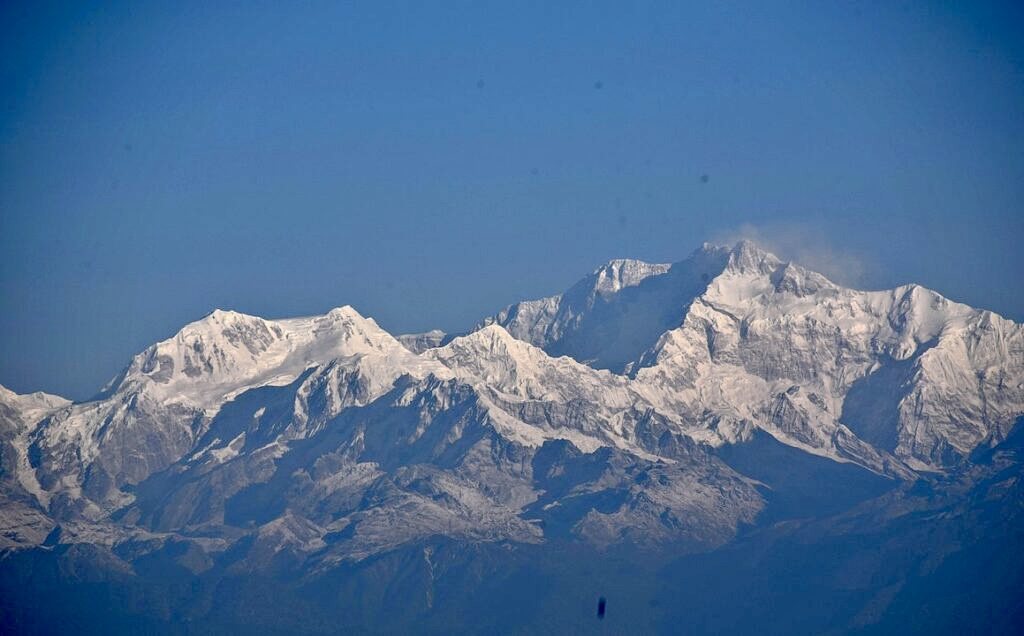
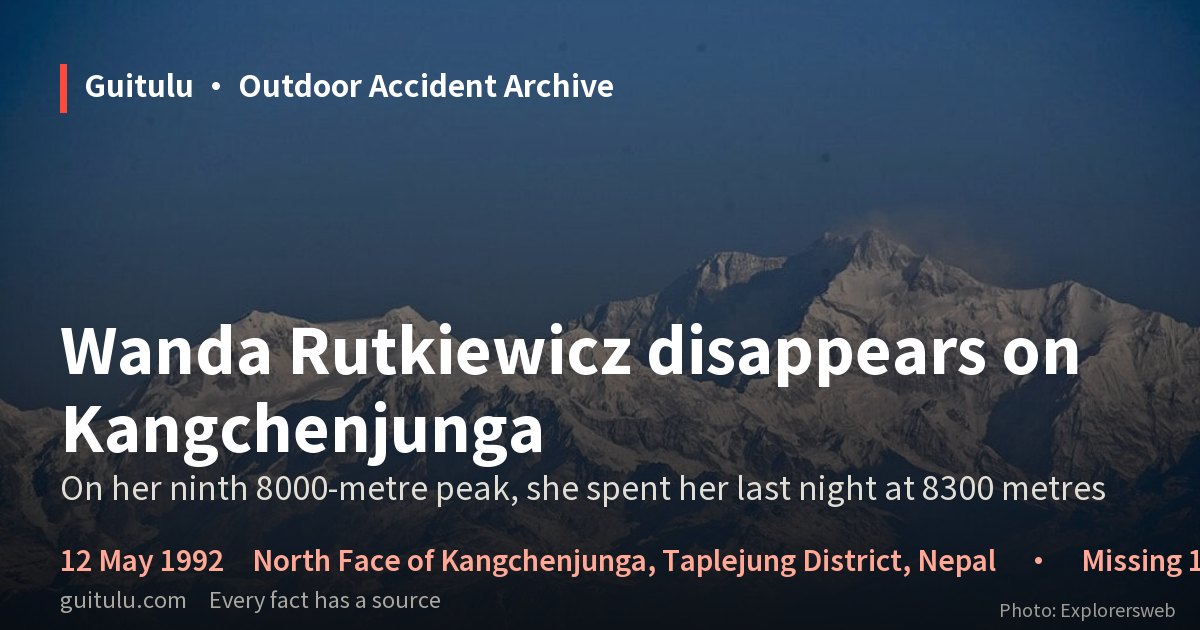
Distant view of the Kangchenjunga massif

Archive / Mountaineering

Wanda Rutkiewicz disappears on Kangchenjunga

On her ninth 8000-metre peak, she spent her last night at 8300 metres

Missing; whether she reached the summit and where she died are unknown

Photo: Explorersweb

Date
Spring
Place
North Face of Kangchenjunga, Taplejung District, NepalNepal › Koshi Province · Himalaya88.147°E 27.703°N
Activity
MountaineeringInvolves: Hypothermia · Altitude illness · Getting lost and losing contactMexican–Polish joint mountaineering team (6 people); Rutkiewicz and Carlos Carsolio made the summit push as a pair
Casualties
Missing 1 Rutkiewicz (49) went missing after bivouacking at approximately 8250–8300 metres; her remains have not been confirmed found to date. Two team members were evacuated with frostbite during the same season
Material
45 facts · 7 sources4 accounts differ and are shown side by side

01What happened

In spring 1992, Wanda Rutkiewicz, who had already summited 8 peaks over 8000 metres, joined a 6-person team led by the Mexican climber Carlos Carsolio to climb Kangchenjunga via the North Face. It was the ninth peak in her “Dream Caravan” plan. The first summit attempt on 24 April was abandoned because of severe cold and frostbite suffered by two Mexican team members. Two other members also withdrew because they felt unwell, leaving only Carsolio and Rutkiewicz, who agreed to attempt the summit each at their own pace.Facts it rests onF04Multiple sourcesBefore this expedition, Rutkiewicz had summited 8 peaks over 8000 metres.F05Multiple sourcesShe was pursuing a project called “Caravan of Dreams”, with the goal of summiting all 14 peaks over 8000 metres.F08Multiple sourcesThe team in spring 1992 was led by Mexican climber Carlos Carsolio and comprised 6 people: 4 Mexicans and 2 Poles (Rutkiewicz and Arkadiusz Gąsienica-Józkowy).F11Multiple sourcesOn 24 April, the whole team abandoned the first summit attempt. Avila and Alfredo Carsolio suffered frostbite and subsequently left the team and returned home for treatment.F12Multiple sourcesTwo other team members, Delgado and Gąsienica, were unwell and unable to take part in the second summit attempt, leaving only Carsolio and Rutkiewicz.

Distant view of the Kangchenjunga massifPhoto source: Explorersweb

On 10 May, the two climbed between Camp III and Camp IV, and Rutkiewicz decided to bivouac where she was. Carsolio reached the ice cave at Camp IV at 6:30 a.m. on 11 May; she did not arrive until 7 p.m. that evening. According to reports, her stove had broken and she was dehydrated.Facts it rests onF14Multiple sourcesOn 10 May, while the two were climbing between Camp III and Camp IV, Rutkiewicz decided to bivouac where she was.F16Multiple sourcesCarsolio reached the ice cave at Camp IV at 6:30 a.m. on 11 May.F17Multiple sourcesRutkiewicz did not reach Camp IV until 7 p.m. on 11 May.F18Single sourceHer stove had broken, and she was already dehydrated when she reached Camp IV.

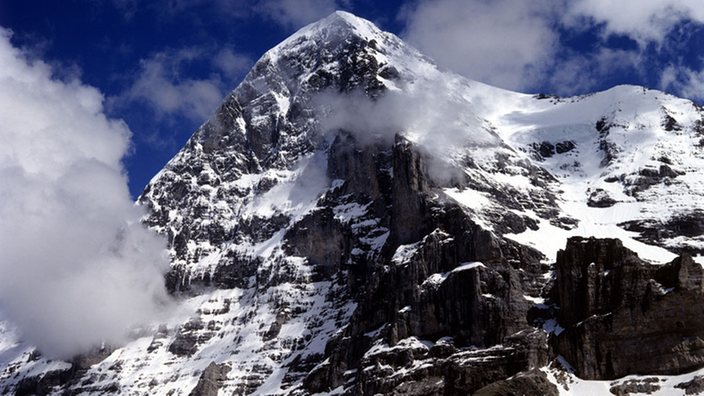
The North Face of Kangchenjunga, the side climbed by the 1992 teamPhoto source: Explorersweb

At 3:30 a.m. on 12 May, the two set out from Camp IV. Rutkiewicz was slower than Carsolio and soon fell behind. Carsolio reached the summit alone at 5 p.m. On his descent, at around 8 p.m., he met her at approximately 8250–8300 metres: she was sitting in a snow cave hollowed out by the wind, preparing to bivouac. She had no sleeping bag, stove, fuel or food, only a bivouac sack, headlamp, 20 metres of rope and spare gloves. She said she was very cold and her down jacket was not warm enough.Facts it rests onF19Multiple sourcesAt 3:30 a.m. on 12 May, the two set out from Camp IV for the summit.F20Multiple sourcesRutkiewicz was slower than Carsolio and soon fell behind; although Carsolio had to break trail through deep snow, he remained far ahead.F22Multiple sourcesCarsolio reached the summit alone at 5 p.m., becoming the first Latin American to summit Kangchenjunga.F23Multiple sourcesOn his descent, Carsolio encountered Rutkiewicz at about 8 p.m. at approximately 8250–8300 metres.F24Multiple sourcesShe was in a wind-scooped snow cave, preparing to bivouac.F25Multiple sourcesShe had no sleeping bag, stove burner, fuel or food.F26Multiple sourcesShe carried a headlamp, 20 metres of rope, spare gloves and goggles, and a bivouac sack.F27Multiple sourcesShe told Carsolio that she was cold and her down jacket was not warm enough, and wrapped the bivouac sack around herself.

She was alert and intended to continue towards the summit the next morning. Carsolio urged her to descend with him, but she was determined to stay. They spent about 10 minutes together, and Carsolio told her he would descend to Camp II and wait for her. This was the last time anyone saw her.Facts it rests onF29Multiple sourcesShe planned to continue her summit push the day after the bivouac.F30Multiple sourcesThe two were together for about 10 minutes; according to Carsolio, she was alert.F31Multiple sourcesCarsolio tried to persuade her to descend with him, but she was determined to stay.F32Multiple sourcesCarsolio told her that he would first return to Camp IV for the night, then descend to Camp II to wait for her.F33Multiple sourcesThis was the last time anyone saw her.

On 13 May, observers at a lower camp saw no movement on the mountain. Carsolio waited at Camp II until 16 May, then descended after leaving her food, fuel and a radio. On 21 May, the remaining team members left base camp in bad weather. Whether she reached the summit remains unknown; in 1995, Italian climbers found a woman's body on the mountain, but accounts of its identity differed, and it was not confirmed to be hers.Facts it rests onF36Multiple sourcesOn 13 May, the day she was expected to attempt the summit, team members at a lower camp watched the mountain but saw no movement.F39Multiple sourcesBy 16 May she still had not arrived, and Carsolio descended from Camp II to Base Camp, leaving food, fuel, water, a radio and other supplies for her in the Camp II tent.F40Multiple sourcesOn 21 May, the remaining team members left Base Camp in bad weather.F42Multiple sourcesOn 29 April 1995, Italian mountaineers found the body of a woman on Kangchenjunga.F33Multiple sourcesThis was the last time anyone saw her.

The number at the end of a paragraph is how many facts it rests on; open it to see each fact and how well it is sourced: Multiple sourcesSingle source. Conflicting accounts and speculation are kept out of the narrative.

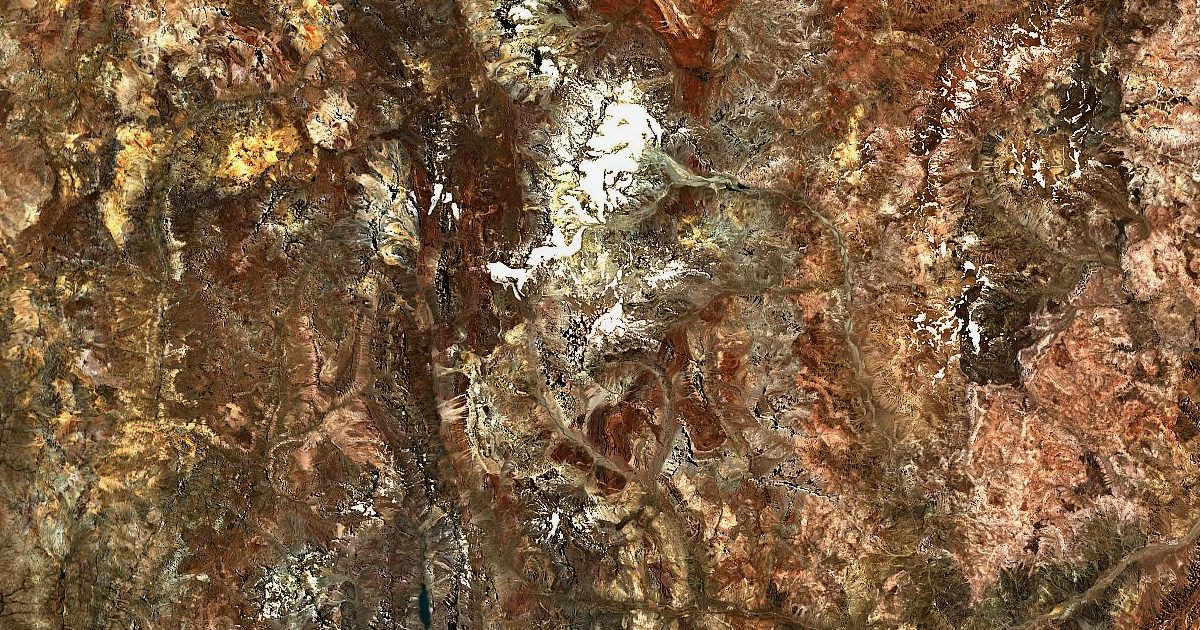
Satellite imagery Sentinel-2 cloudless 2024 © EOX · Terrain AWS Terrain Tiles · Position is schematic, geocoded from place names · Place coordinates not individually verified

Route review

6 scenes to understand what happened

Scroll down and the map flies to where each part happened.

01

The area of the incident

The reports do not provide enough locations along the route; the map shows only the approximate location and terrain of the area where the incident occurred.

02

The team on the North Face

In spring 1992, the six-person team set out from base camp on the north side to climb the North Face. The first summit attempt in April was abandoned after team members suffered frostbite, and in the end only two remained.Facts it rests onF08Multiple sourcesThe team in spring 1992 was led by Mexican climber Carlos Carsolio and comprised 6 people: 4 Mexicans and 2 Poles (Rutkiewicz and Arkadiusz Gąsienica-Józkowy).F09Single sourceThe Mexican team arrived at base camp on 11 March.F11Multiple sourcesOn 24 April, the whole team abandoned the first summit attempt. Avila and Alfredo Carsolio suffered frostbite and subsequently left the team and returned home for treatment.F12Multiple sourcesTwo other team members, Delgado and Gąsienica, were unwell and unable to take part in the second summit attempt, leaving only Carsolio and Rutkiewicz.

03

A day falling behind

On 10 May she bivouacked between Camps III and IV, and did not reach Camp IV until 7 p.m. on 11 May. According to reports, her stove had broken and she was dehydrated.Facts it rests onF14Multiple sourcesOn 10 May, while the two were climbing between Camp III and Camp IV, Rutkiewicz decided to bivouac where she was.F17Multiple sourcesRutkiewicz did not reach Camp IV until 7 p.m. on 11 May.F18Single sourceHer stove had broken, and she was already dehydrated when she reached Camp IV.

04

Summit day

The two set out at 3:30 a.m. on 12 May. She soon fell behind, and Carsolio reached the summit alone at 5 p.m.Facts it rests onF19Multiple sourcesAt 3:30 a.m. on 12 May, the two set out from Camp IV for the summit.F20Multiple sourcesRutkiewicz was slower than Carsolio and soon fell behind; although Carsolio had to break trail through deep snow, he remained far ahead.F22Multiple sourcesCarsolio reached the summit alone at 5 p.m., becoming the first Latin American to summit Kangchenjunga.

05

The last snow cave

At about 8 p.m., Carsolio encountered her in a snow cave at about 8250–8300 metres. She had no sleeping bag or stove and was determined to attempt the summit the next day. This was the last time anyone saw her.Facts it rests onF23Multiple sourcesOn his descent, Carsolio encountered Rutkiewicz at about 8 p.m. at approximately 8250–8300 metres.F24Multiple sourcesShe was in a wind-scooped snow cave, preparing to bivouac.F25Multiple sourcesShe had no sleeping bag, stove burner, fuel or food.F29Multiple sourcesShe planned to continue her summit push the day after the bivouac.F33Multiple sourcesThis was the last time anyone saw her.

06

Waiting

No further signs of activity were seen from the lower camps. Carsolio waited until the 16th, then left supplies and descended. The team left base camp on 21 May.Facts it rests onF36Multiple sourcesOn 13 May, the day she was expected to attempt the summit, team members at a lower camp watched the mountain but saw no movement.F39Multiple sourcesBy 16 May she still had not arrived, and Carsolio descended from Camp II to Base Camp, leaving food, fuel, water, a radio and other supplies for her in the Camp II tent.F40Multiple sourcesOn 21 May, the remaining team members left Base Camp in bad weather.

02Timeline

  1. The Mexican team arrived at base camp on 11 March. F09

  2. On 24 April, the whole team abandoned the first summit attempt. Avila and Alfredo Carsolio suffered frostbite and subsequently left the team and returned home for treatment. F11

  3. On 10 May, while the two were climbing between Camp III and Camp IV, Rutkiewicz decided to bivouac where she was. F14

  4. Rutkiewicz did not reach Camp IV until 7 p.m. on 11 May. F17

  5. This was the last time anyone saw her. F33

  6. Carsolio reached the summit alone at 5 p.m., becoming the first Latin American to summit Kangchenjunga. F22

  7. At 3:30 a.m. on 12 May, the two set out from Camp IV for the summit. F19

  8. On his descent, Carsolio encountered Rutkiewicz at about 8 p.m. at approximately 8250–8300 metres. F23

  9. At noon on 13 May, Carsolio left Camp IV and descended to Camp II. F34

  10. On 13 May, the day she was expected to attempt the summit, team members at a lower camp watched the mountain but saw no movement. F36

  11. By 16 May she still had not arrived, and Carsolio descended from Camp II to Base Camp, leaving food, fuel, water, a radio and other supplies for her in the Camp II tent. F39

  12. On 21 May, the remaining team members left Base Camp in bad weather. F40

  13. On 29 April 1995, Italian mountaineers found the body of a woman on Kangchenjunga. F42

03Lessons

Hypothermia and overnight gear

Without overnight equipment on summit day, there is no margin

When she left Camp IV, she had no sleeping bag, stove or food. When darkness fell above 8000 metres, she could only spend the night wrapped in a bivouac sack in a snow cave. A lightweight summit push depends on being able to return to camp the same day; once the pace falls short, the same equipment is not enough to get through a night.Facts it rests onF25Multiple sourcesShe had no sleeping bag, stove burner, fuel or food.F26Multiple sourcesShe carried a headlamp, 20 metres of rope, spare gloves and goggles, and a bivouac sack.F27Multiple sourcesShe told Carsolio that she was cold and her down jacket was not warm enough, and wrapped the bivouac sack around herself.F24Multiple sourcesShe was in a wind-scooped snow cave, preparing to bivouac.

Teams and decisions

A slow pace is a signal that needs to be taken seriously

From Camp III onwards, she fell noticeably behind, was forced to bivouac between camps on the first night and fell far behind again on summit day. Setting a turnaround time in advance and descending if the planned altitude has not been reached by then is more reliable than making the decision at altitude.Facts it rests onF14Multiple sourcesOn 10 May, while the two were climbing between Camp III and Camp IV, Rutkiewicz decided to bivouac where she was.F17Multiple sourcesRutkiewicz did not reach Camp IV until 7 p.m. on 11 May.F20Multiple sourcesRutkiewicz was slower than Carsolio and soon fell behind; although Carsolio had to break trail through deep snow, he remained far ahead.F23Multiple sourcesOn his descent, Carsolio encountered Rutkiewicz at about 8 p.m. at approximately 8250–8300 metres.

Hypothermia and overnight gear

A broken stove means a shortage of water

At high altitude, drinking water comes almost entirely from melting snow. After her stove broke, she was already dehydrated before the summit push and had no means of heating anything during the bivouac. When critical equipment fails, it should be treated as a reason to adjust the plan.Facts it rests onF18Single sourceHer stove had broken, and she was already dehydrated when she reached Camp IV.F25Multiple sourcesShe had no sleeping bag, stove burner, fuel or food.

Rescue and self-rescue

Separate summit pushes mean no one can provide support

The two agreed to make their summit attempts separately and met for only ten minutes in the end. After she stayed behind above 8000 metres, she had no communications; from lower down, observation was possible only with the naked eye, and providing support was out of the question. When a small team splits up at extreme altitude, each person assumes all the risks alone.Facts it rests onF16Multiple sourcesCarsolio reached the ice cave at Camp IV at 6:30 a.m. on 11 May.F30Multiple sourcesThe two were together for about 10 minutes; according to Carsolio, she was alert.F36Multiple sourcesOn 13 May, the day she was expected to attempt the summit, team members at a lower camp watched the mountain but saw no movement.F39Multiple sourcesBy 16 May she still had not arrived, and Carsolio descended from Camp II to Base Camp, leaving food, fuel, water, a radio and other supplies for her in the Camp II tent.

04Fact list 45 facts

Under each fact is a verbatim quote from the original. "Single source" means only one outlet mentioned it; "Accounts differ" means sources contradict each other and this site adopts neither side; "Speculation" is an inference by a reporter or a person involved, not a fact.

  1. F01Multiple sourcesBackground

    In 1978, she summited Mount Everest, becoming the first European woman and the third woman in the world to reach the summit.

    Includes low-credibility sources

    Quotes from the original 2

    “The first was Everest in 1978, when she became the first European woman and the third woman of any nation to ascend it.”

    AAJ ·

    “On 16 October 1978, Wanda Rutkiewicz became the third woman, although she was the first European-born woman to conquer the summit of Mount Everest.”

    Travesía Pirenaica · 2022-03-08
  2. F02Multiple sourcesBackground

    In 1986, she became the first woman to summit K2.

    Quotes from the original 2

    “1986 stieg sie als erste Frau überhaupt auf den K2.”

    Bergwelten · 2018-03-06

    “conquista il K2, prima donna al mondo”

    Montagna.tv ·
  3. F03Single sourceBackground

    According to AAJ, In 1991, she attempted Kangchenjunga from the southwest with a Slovenian team.

    Quotes from the original 1

    “which she had attempted with the Slovenes from the southwest in 1991”

    AAJ ·
  4. F04Multiple sourcesBackground

    Before this expedition, Rutkiewicz had summited 8 peaks over 8000 metres.

    Quotes from the original 3

    “Wanda Rutkiewicz had eight 8000ers already to her credit.”

    AAJ ·

    “Before Kangchenjunga, Rutkiewicz had already climbed eight of the 8,000’ers.”

    Explorersweb · 2024-02-14

    “She climbed eight of the fourteen 8000ers”

    Himalayan Journal ·
  5. F05Multiple sourcesPlan

    She was pursuing a project called “Caravan of Dreams”, with the goal of summiting all 14 peaks over 8000 metres.

    Quotes from the original 2

    “Rutkiewicz, meanwhile, was doing her Caravan of Dreams project. It consisted of climbing all 14 8,000m peaks.”

    Explorersweb · 2024-02-14

    “Sie nannte ihr atemberaubendes Vorhaben „Karawane der Träume“.”

    Bergwelten · 2018-03-06
  6. F06Single sourceParticipant's view

    According to AAJ, Before setting out, she told Carsolio that she would not be fast, did not want to take risks, and had great respect for Kangchenjunga.

    Quotes from the original 1

    ““I will not be quick. I don’t want to take risks. I have a lot of respect for Kangchenjunga,””

    AAJ ·
  7. F07Accounts differBackground

    Accounts differ on the altitude of Camp IV: the American Alpine Journal and Explorersweb give 7900 metres; the Himalayan Journal and Travesía Pirenaica give 7950 metres.

    Quotes from the original 4

    “Camp IV at 7900 meters”

    AAJ ·

    “Camp 4 (7,900m)”

    Explorersweb · 2024-02-14

    “Camp 4 (7950 m)”

    Himalayan Journal ·

    “starting from Camp IV at an altitude of 7,950 metres”

    Travesía Pirenaica · 2022-03-08
  8. F08Multiple sourcesBackground

    The team in spring 1992 was led by Mexican climber Carlos Carsolio and comprised 6 people: 4 Mexicans and 2 Poles (Rutkiewicz and Arkadiusz Gąsienica-Józkowy).

    Quotes from the original 2

    “Mexican Carlos Carsolio, leader of a team of four Mexicans and two Poles”

    AAJ ·

    “The party consisted of six members: Carlos Carsolio (leader), Elsa Avila, Alfredo Carsolio, and Andres Delgado, all from Mexico, and Wanda Rutkiewicz and Arkadiusz Gasienica-Jozkowy from Poland.”

    Explorersweb · 2024-02-14
  9. F09Single sourceMovement

    According to Explorersweb, The Mexican team arrived at base camp on 11 March.

    Quotes from the original 1

    “The Mexican Kangchenjunga Expedition arrived at Base Camp very early in the spring, on March 11.”

    Explorersweb · 2024-02-14
  10. F10Multiple sourcesMovement

    On 22 April, the team established Camp IV in strong winds. The camp platform was too narrow for tents, so they had to dig snow caves.

    Quotes from the original 2

    “On April 22, they set up Camp 4 at 7,900m in a very strong wind. The camp platform was too narrow for a tent so they had to dig a cave.”

    Explorersweb · 2024-02-14

    “got to the ice cave which was Camp IV”

    AAJ ·
  11. F11Multiple sourcesEvent

    On 24 April, the whole team abandoned the first summit attempt. Avila and Alfredo Carsolio suffered frostbite and subsequently left the team and returned home for treatment.

    Quotes from the original 2

    “on April 24, the whole team, including the Polish climbers, aborted the summit push. Avila and Alfredo Carsolio were already frostbitten.”

    Explorersweb · 2024-02-14

    “Carsolio’s wife Elsa Avila and his brother Alfredo, did get seriously frostbitten and had to go home for medical treatment”

    AAJ ·
  12. F12Multiple sourcesEvent

    Two other team members, Delgado and Gąsienica, were unwell and unable to take part in the second summit attempt, leaving only Carsolio and Rutkiewicz.

    Quotes from the original 2

    “However, Delgado and Arek had health issues and could not launch a second summit push.”

    Explorersweb · 2024-02-14

    “Arkadiusz Gasienica and Andrés Delgado, who had been unwell and unable to go for the summit”

    AAJ ·
  13. F13Single sourceParticipant's view

    According to AAJ, Carsolio said in Kathmandu that he believed she could not have survived because of the bad weather, extreme exhaustion and lack of water.

    Quotes from the original 1

    “but I am sure that she cannot have survived because of the bad weather and because she was extremely tired and without drink”

    AAJ ·
  14. F14Multiple sourcesMovement

    On 10 May, while the two were climbing between Camp III and Camp IV, Rutkiewicz decided to bivouac where she was.

    Quotes from the original 2

    “were climbing between destroyed Camp III at 7300 meters on the north face and Camp IV at 7900 meters when Wanda at eleven P.M. decided to bivouac”

    AAJ ·

    “she would stop and bivouac at 7,450m”

    Explorersweb · 2024-02-14
  15. F15Accounts differMovement

    Accounts differ on when Rutkiewicz began her bivouac on 10 May: the American Alpine Journal says 11 p.m.; Explorersweb says about two hours after leaving Camp III at 3:15 p.m.

    Quotes from the original 2

    “Wanda at eleven P.M. decided to bivouac”

    AAJ ·

    “At 3:15 pm, they left Camp 3 together in deep snow. After two hours, Rutkiewicz shouted to Carsolio that she was very tired”

    Explorersweb · 2024-02-14
  16. F16Multiple sourcesMovement

    Carsolio reached the ice cave at Camp IV at 6:30 a.m. on 11 May.

    Quotes from the original 2

    “Carsolio continued on and got to the ice cave which was Camp IV at 6:30 A.M.”

    AAJ ·

    “only managed to reach it at 6:30 am the following day, May 11.”

    Explorersweb · 2024-02-14
  17. F17Multiple sourcesMovement

    Rutkiewicz did not reach Camp IV until 7 p.m. on 11 May.

    Quotes from the original 2

    “Rutkiewicz arrived only at seven P.M.”

    AAJ ·

    “That day, Rutkiewicz joined him at Camp 4 at 7 pm.”

    Explorersweb · 2024-02-14
  18. F18Single sourceEvent

    According to Explorersweb, Her stove had broken, and she was already dehydrated when she reached Camp IV.

    Quotes from the original 1

    “She was unhappy because her stove had stopped working and she was dehydrated.”

    Explorersweb · 2024-02-14
  19. F19Multiple sourcesMovement

    At 3:30 a.m. on 12 May, the two set out from Camp IV for the summit.

    Quotes from the original 3

    “The pair left Camp IV at 3:30 A.M. on the 12th in good weather.”

    AAJ ·

    “On May 12 at 3:30 am, Carsolio and Rutkiewicz left Camp 4 toward the summit of Kangchenjunga.”

    Explorersweb · 2024-02-14

    “Carlos Carsolio and Wanda left Camp 4 (7950 m) at 3:30 am to climb directly to the summit.”

    Himalayan Journal ·
  20. F20Multiple sourcesEvent

    Rutkiewicz was slower than Carsolio and soon fell behind; although Carsolio had to break trail through deep snow, he remained far ahead.

    Quotes from the original 2

    “she was climbing even more slowly than usual, and he went far ahead of her despite his having to break trail in deep snow”

    AAJ ·

    “Rutkiewicz was slower than Carsolio and immediately fell behind.”

    Explorersweb · 2024-02-14
  21. F21Single sourceEvent

    According to Explorersweb, Carsolio fixed ropes in two snow gullies for the descent.

    Quotes from the original 1

    “Carsolio fixed ropes in two couloirs for their descent.”

    Explorersweb · 2024-02-14
  22. F22Multiple sourcesEvent

    Carsolio reached the summit alone at 5 p.m., becoming the first Latin American to summit Kangchenjunga.

    Quotes from the original 2

    “Carsolio reached the top alone at five P.M., the first Latin American to gain Kangchenjunga’s summit.”

    AAJ ·

    “Carsolio nevertheless summited late that day, at 5 pm.”

    Explorersweb · 2024-02-14
  23. F23Multiple sourcesEvent

    On his descent, Carsolio encountered Rutkiewicz at about 8 p.m. at approximately 8250–8300 metres.

    Quotes from the original 3

    “he met Rutkiewicz three hours later between 8250 and 8300 meters”

    AAJ ·

    “On the way down, he met Rutkiewicz at 8,250m at 8 pm.”

    Explorersweb · 2024-02-14

    “The last time Wanda Rutkiewicz was seen she was on the northwestern face of Kangchenjunga at 8300 m.”

    Himalayan Journal ·
  24. F24Multiple sourcesFound at scene

    She was in a wind-scooped snow cave, preparing to bivouac.

    Quotes from the original 3

    “She was inside a wind hole, a kind of cave carved out of the snow by the wind”

    AAJ ·

    “preparing her bivouac in a kind of cave that the wind had carved out of snow”

    Explorersweb · 2024-02-14

    “he left her huddled in a shallow snow cave”

    Himalayan Journal ·
  25. F25Multiple sourcesFound at scene

    She had no sleeping bag, stove burner, fuel or food.

    Quotes from the original 3

    “She had no sleeping bag, stove, fuel or food”

    AAJ ·

    “Rutkiewicz had no stove, no fuel, and no food.”

    Explorersweb · 2024-02-14

    “obwohl sie keinen Schlafsack, keinen Kocher und auch keine Verpflegung dabeihat”

    Bergwelten · 2018-03-06
  26. F26Multiple sourcesFound at scene

    She carried a headlamp, 20 metres of rope, spare gloves and goggles, and a bivouac sack.

    Quotes from the original 2

    “She did have a headlamp, 20 meters of rope, extra gloves, extra goggles”

    AAJ ·

    “She carried 20m of 5mm rope, a bivy sack, headlamp, extra gloves and goggles”

    Explorersweb · 2024-02-14
  27. F27Multiple sourcesEvent

    She told Carsolio that she was cold and her down jacket was not warm enough, and wrapped the bivouac sack around herself.

    Quotes from the original 2

    “She told him she was cold, that her old down suit was not warm enough.”

    AAJ ·

    “she told Carsolio that her down suit was not warm enough so she wore her bivy bag around her shoulders”

    Explorersweb · 2024-02-14
  28. F28Multiple sourcesEvent

    That night was very cold, but there was no wind.

    Quotes from the original 2

    ““It was a very cold night, but clear and not windy.””

    AAJ ·

    “The night was not windy but was very cold.”

    Explorersweb · 2024-02-14
  29. F29Multiple sourcesPlan

    She planned to continue her summit push the day after the bivouac.

    Quotes from the original 3

    “She planned to go for the summit the next morning.”

    AAJ ·

    “Wanda was determined to spend the night there and climb to the summit the next day”

    Himalayan Journal ·

    “und will es am nächsten Tag versuchen”

    Bergwelten · 2018-03-06
  30. F30Multiple sourcesEvent

    The two were together for about 10 minutes; according to Carsolio, she was alert.

    Quotes from the original 2

    “They were together for perhaps ten minutes; she was clear mentally.”

    AAJ ·

    “During the 10 minutes they were together”

    Explorersweb · 2024-02-14
  31. F31Multiple sourcesEvent

    Carsolio tried to persuade her to descend with him, but she was determined to stay.

    The report published in the AAJ does not mention the attempt to persuade her.

    Quotes from the original 3

    “Carsolio tried to convince her to turn back. But Rutkiewicz was determined to continue.”

    Explorersweb · 2024-02-14

    “He tried to persuade her to go down with him, but Wanda was determined to spend the night there”

    Himalayan Journal ·

    “Carsolio tried to convince her to go down with him. However, she did not want to accept this approach”

    Travesía Pirenaica · 2022-03-08
  32. F32Multiple sourcesPlan

    Carsolio told her that he would first return to Camp IV for the night, then descend to Camp II to wait for her.

    Quotes from the original 2

    “I told her I was going to Camp IV for the night and would descend to Camp II and wait for her there.”

    AAJ ·

    “Carsolio told Rutkiewicz that he would wait for her at Camp 2.”

    Explorersweb · 2024-02-14
  33. F33Multiple sourcesEvent

    This was the last time anyone saw her.

    Quotes from the original 3

    “Then Carsolio went on down, never to see or hear from her again.”

    AAJ ·

    “It was the last time that Carsolio saw Rutkiewicz.”

    Explorersweb · 2024-02-14

    “Nobody ever saw her anymore.”

    Himalayan Journal ·
  34. F34Multiple sourcesMovement

    At noon on 13 May, Carsolio left Camp IV and descended to Camp II.

    Quotes from the original 2

    “Carsolio left Camp IV at noon on the 13th”

    AAJ ·

    “on May 13 at noon, he continued down to Camp 2”

    Explorersweb · 2024-02-14
  35. F35Accounts differAftermath

    Accounts differ on whether supplies were left for her at Camp IV: the American Alpine Journal says there was no food or fuel left at the camp; Explorersweb says Carsolio left supplies for her after she failed to arrive while he was waiting for her.

    Quotes from the original 2

    “There was no food or fuel left at Camp IV.”

    AAJ ·

    “He waited for her but when she did not show up, he left supplies for her”

    Explorersweb · 2024-02-14
  36. F36Multiple sourcesAftermath

    On 13 May, the day she was expected to attempt the summit, team members at a lower camp watched the mountain but saw no movement.

    Quotes from the original 2

    “A member at a lower camp watched the mountain on the 13th, the day when she should have gone to the summit, and saw no movement that day.”

    AAJ ·

    “On May 12 and 13, Delgado scoped the mountain from Camp 2 with binoculars to try to see the light from her headlamp. Nothing.”

    Explorersweb · 2024-02-14
  37. F37SpeculationSpeculation

    The American Alpine Journal suggests that she may have left the bivouac site before dawn on 13 May, while it was still dark, and passed out of sight after reaching above 8400 metres.

    Quotes from the original 1

    “But she could have left her bivouac during the dark early morning hours and would have been out of sight when she reached 8400 meters.”

    AAJ ·
  38. F38Multiple sourcesAftermath

    She was listed as missing.

    Some sources are of low credibility

    Quotes from the original 2

    “Viene data per scomparsa il 13 maggio 1992”

    Montagna.tv ·

    “Depuis, elle est officiellement considérée comme disparue.”

    LACRUX · 2024-12-26
  39. F39Multiple sourcesAftermath

    By 16 May she still had not arrived, and Carsolio descended from Camp II to Base Camp, leaving food, fuel, water, a radio and other supplies for her in the Camp II tent.

    Quotes from the original 2

    “When she had failed to appear by the morning of the 16th, he left for Base Camp, leaving at Camp II a tent, sleeping bag, walkie-talkie radio”

    AAJ ·

    “On May 16, Carsolio left Rutkiewicz some food, fuel, water in a thermos, a walkie-talkie, some medicine, and emergency oxygen in the tent at Camp 2.”

    Explorersweb · 2024-02-14
  40. F40Multiple sourcesAftermath

    On 21 May, the remaining team members left Base Camp in bad weather.

    Quotes from the original 2

    “The three remaining members finally left Base Camp in very bad weather on May 21”

    AAJ ·

    “The team finally left Base Camp on May 21, in very bad weather.”

    Explorersweb · 2024-02-14
  41. F41Accounts differAftermath

    Accounts differ on whether the body found in 1995 was Rutkiewicz's: Montagna.tv says it was hers; Explorersweb and the Himalayan Journal say there were tablets with Bulgarian writing in the body's pocket, and that it was more likely Yordanka Dimitrova, a Bulgarian mountaineer who went missing in autumn 1994; Bergwelten says her body was never found.

    The body's identity was never formally confirmed

    Quotes from the original 4

    “Tre anni dopo, nel 1995, il suo corpo è stato ritrovato sul versante opposto rispetto a quello dove era stata vista l’ultima volta”

    Montagna.tv ·

    “The Italian mountaineers found a pill in the suit’s chest pocket with Bulgarian lettering, so the body likely belonged to Dmitrova.”

    Explorersweb · 2024-02-14

    “the finding of Bulgarian-made tablets in a pocket indicated that it was more likely that it was the corpse of a Bulgarian climber, Yordanka Dimitrova”

    Himalayan Journal ·

    “Ihre Leiche wurde jedenfalls nie gefunden.”

    Bergwelten · 2018-03-06
  42. F42Multiple sourcesAftermath

    On 29 April 1995, Italian mountaineers found the body of a woman on Kangchenjunga.

    Quotes from the original 2

    “On April 29, 1995, Fausto de Stefani, Marco Galezzi, and Silvio Mondinelli found a woman’s body”

    Explorersweb · 2024-02-14

    “29 April 1995 - 7900/8000 meters. We found the body of a woman”

    Himalayan Journal ·
  43. F43Single sourceParticipant's view

    According to Bergwelten, Carsolio later said that he probably should have persuaded her to descend with him, but that she was focused solely on reaching the summit at the time.

    Quotes from the original 1

    “„hätte ich sie überreden sollen, mit mir abzusteigen. Aber sie war nur auf den Gipfel konzentriert.“”

    Bergwelten · 2018-03-06
  44. F44SpeculationSpeculation

    One theory suggests that she may have descended the Southwest Face after reaching the summit.

    Quotes from the original 1

    “One theory suggests that after summiting, she may have descended via the southwest face.”

    Explorersweb · 2024-02-14
  45. F45SpeculationSpeculation

    There have since been persistent rumours that she is still alive and living in seclusion in a monastery, but none have been substantiated.

    Some sources are of low credibility

    Quotes from the original 2

    “some mountaineers allegedly saw a woman from behind in a Buddhist monastery who looked like Wanda Rutkiewicz. This rumor proved nothing, of course”

    Explorersweb · 2024-02-14

    “À ce jour, des rumeurs persistent selon lesquelles elle serait toujours en vie.”

    LACRUX · 2024-12-26