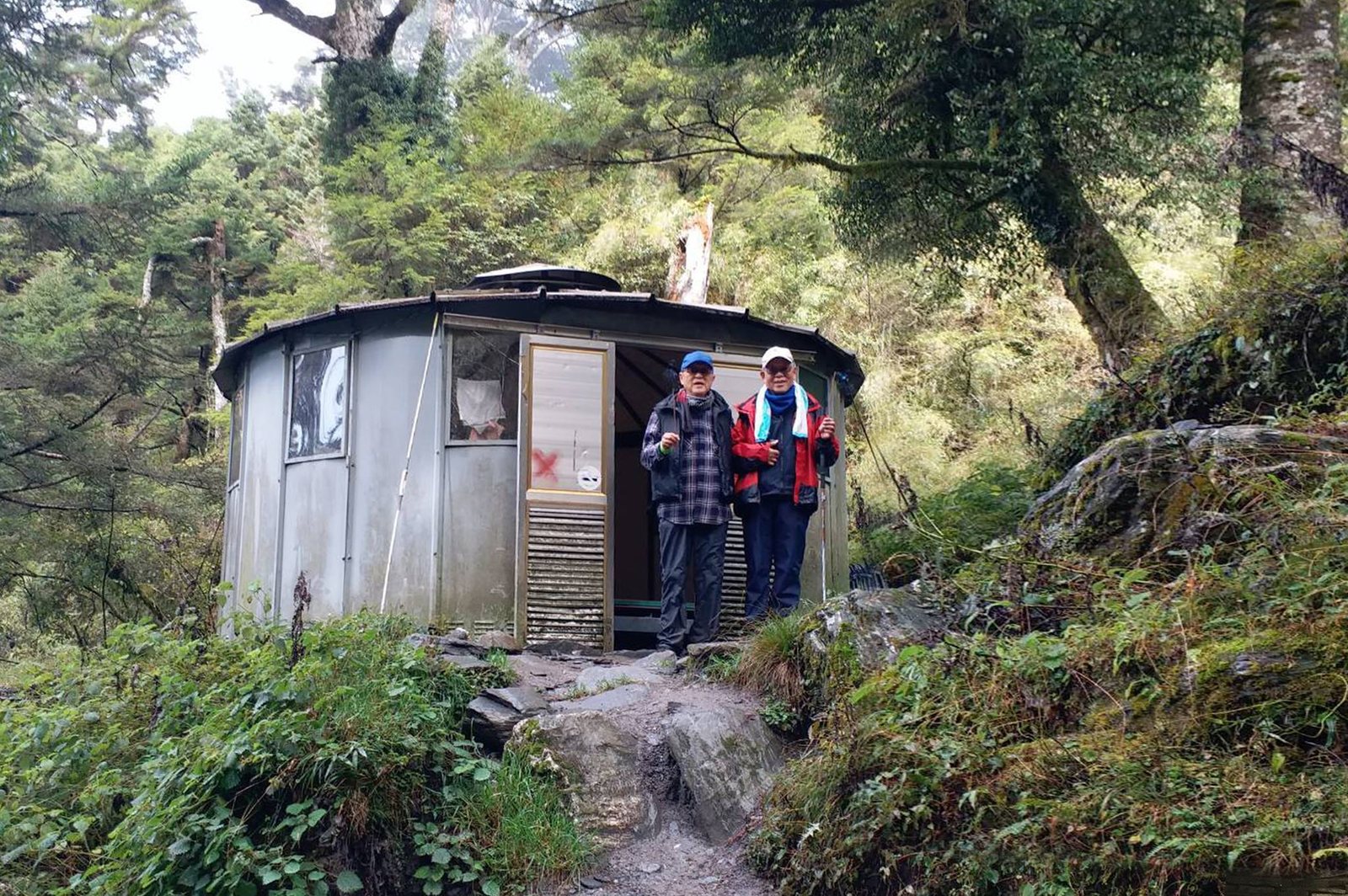
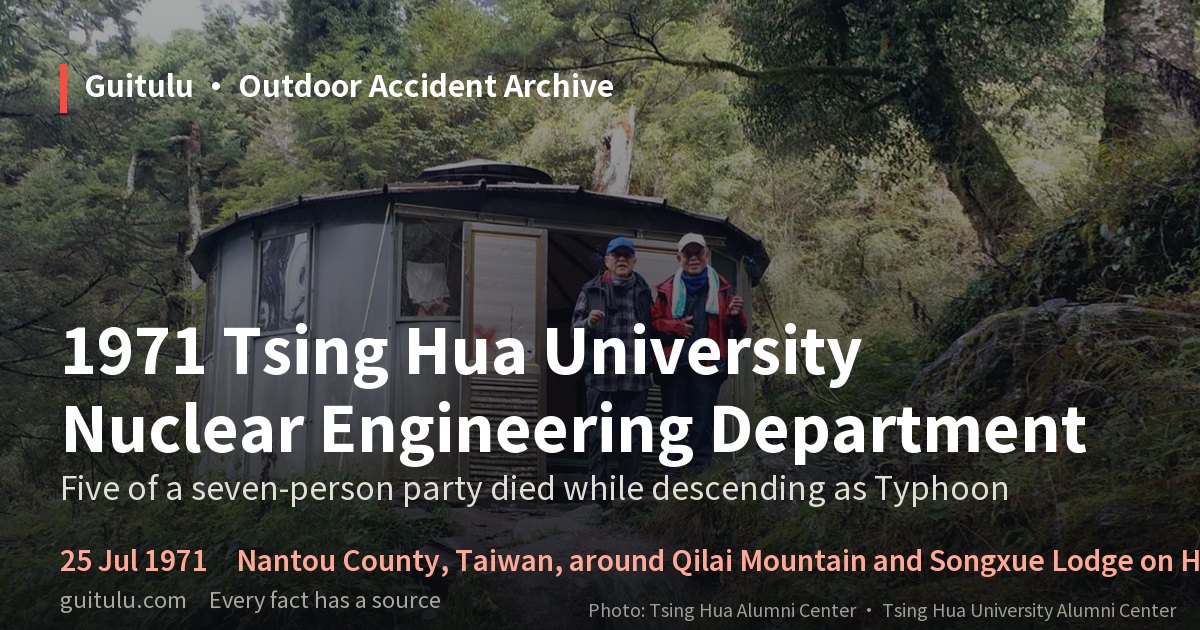
Chenggong Fort shelter on Qilai Mountain, photographed during an alumni revisit in 2020Photo source: Tsing Hua Alumni Center · Tsing Hua University Alumni Center
The number at the end of a paragraph is how many facts it rests on; open it to see each fact and how well it is sourced:
Multiple sourcesSingle source. Conflicting accounts and speculation are kept out of the narrative.
Reported places along the route (schematic)Schematic
Scroll down and the map flies to where each part happened. The line is Schematic, Connects the places along the route mentioned in reports in sequence; it indicates only the approximate direction, not the actual track.
01
Full route
The places mentioned in reports are connected in sequence to show the approximate route (schematic).
The party set out from Hsinchu for Qilai Mountain on 21 July. F07
On 22 July, the party arrived at Dayuling and walked to Hehuan Mountain, spending the night at Songxue Lodge. F08
At about 2 p.m. on 23 July, the weather changed slightly, and the leader decided to camp at Qianxi, where the team spent the night outdoors. F11
On 24 July, the team reached the area around Qilai Ridge. F12
After learning from a radio broadcast that the typhoon was about to make landfall, the team decided to abandon the summit attempt, break camp and descend, returning to Songxue Lodge. F16
The mountain accident ultimately left five team members dead and two survivors. F27
Shortly after 6 p.m., while they were still some distance from Songxue Lodge, Bai Shengheng, Qian Di and Qiu Ruichang had fallen behind, leaving only four of the seven-person group. F22
At about 2 p.m. on the 25th, the sky suddenly darkened. The group pressed on against winds of approximately force 14 and had difficulty finding their direction. F19
About 50 metres from Songxue Lodge, Lai Shuqing also collapsed. Only Shi Nengjian reached Songxue Lodge to seek help. F24
According to reports, on 27 July, search and rescue personnel found the bodies of Bai Shengheng, Qian Di and Qiu Ruichang. The searchers included police officers from the Renai Precinct in Nantou, Tsing Hua instructors and young Indigenous people. F28
To commemorate the students who died and improve mountaineering safety, Tsing Hua University and its mountaineering club raised funds to establish three “Chenggong Fort” mountain shelters on Qilai Mountain. F30
On 23 July 2021, Tsing Hua University's Nuclear Engineering Department held the “50th Anniversary Memorial for the Qilai Mountain Disaster” by video. F33
Under each fact is a verbatim quote from the original. "Single source" means only one outlet mentioned it; "Accounts differ" means sources contradict each other and this site adopts neither side; "Speculation" is an inference by a reporter or a person involved, not a fact.
According to Black Bar, Afterward, students from the Tsing Hua University mountaineering club wrote to Chiang Ching-kuo, then director of the China Youth Corps, asking for help building Qilai Lodge (later Chenggong Fort).
Quotes from the original 1
“清華大學的登山社學生,寫信給時任救國團主任的蔣經國,請求其允諾協助建設奇萊山莊(後來的成功堡)”
Students from the Tsing Hua University mountaineering club wrote to Chiang Ching-kuo, then director of the China Youth Corps, asking him to agree to help build Qilai Lodge (later Chenggong Fort) (machine translation)
Of the seven, the leader Bai Shengheng, mountaineering club president Qiu Ruichang, badminton club president Gong Shiwu and photography club president Qian Di were third-year students in Tsing Hua University's Department of Nuclear Engineering.
Quotes from the original 2
“分別是核工系72級四位大三同學:領隊柏盛亨、登山社長邱瑞昌、羽球社長龔士武、攝影社長錢迪”
They were four third-year students from the nuclear engineering department's class of 72: leader Bai Shengheng, mountaineering club president Qiu Ruichang, badminton club president Gong Shiwu and photography club president Qian Di (machine translation)
Tsing Hua University nuclear engineering department third-year students Bai Shengheng, Qiu Ruichang, Gong Shiwu and Qian Di, first-year student Wu Jianchang, and physics department third-year student Lai Shuqing (machine translation)
The others in the party were Wu Jianchang, a first-year nuclear engineering student at Tsing Hua University; Lai Shuqing, a third-year physics student at Tsing Hua University; and Shi Nengjian, a third-year physics student at National Taiwan University. In the end, only Lai Shuqing and Shi Nengjian survived.
Quotes from the original 2
“及核工系74級大一吳建昌,僅72級物理系大三賴淑卿與台大物理系大三施能健兩人倖存”
and Wu Jianchang, a first-year student from the nuclear engineering department's class of 74; only Lai Shuqing, a third-year physics student from the class of 72, and Shi Nengjian, a third-year physics student at National Taiwan University, survived (machine translation)
According to Central News Agency, Survivor Lai Shuqing said outsiders mistakenly believed they had climbed the mountain knowing a typhoon was approaching. In fact, there had been a typhoon before their departure, and the party waited for it to pass before going up the mountain. Radio reception was poor after they entered the mountains, and they did not learn that Nadine was approaching until they reached the ridge.
Quotes from the original 2
“原本有前一個颱風,登山隊等待颱風離去後才上山,卻還不知後面還有娜定颱風”
There had originally been an earlier typhoon, and the mountaineering party waited for the typhoon to leave before going up the mountain, but did not yet know that Typhoon Nadine was following behind (machine translation)
It was not until two days after entering the mountains, when they reached the ridge, that they learned of Nadine's approach to Taiwan (machine translation)
According to Black Bar, According to reports, a detective from the Nantou Ren'ai police precinct commented at the time that, with more mountaineering experience, they would have known that the best thing to do when the wind and rain struck was to first find shelter and conserve their strength, rather than rush desperately down the mountain.
If they had more mountaineering experience, they would know that when wind and rain strike and the temperature drops sharply, the best way to stay alive in the mountains is not to rush desperately down the mountain, but first to find a place sheltered from the wind and rain (machine translation)
According to Tsing Hua Alumni Center, Dozens of black-and-white photographs documenting the climb were preserved in the camera left behind by Qian Di. Survivors Lai Shuqing and Shi Nengjian arranged the photographs in order from memory and provided descriptions.
Quotes from the original 2
“當年在錢迪遺留的照相機中,幸存了數十張黑白照片”
Dozens of black-and-white photographs survived in the camera left behind by Qian Di at the time (machine translation)
On 21 July 1971, a seven-person party made up of students from Tsing Hua University and National Taiwan University arrived in Taichung City from Hsinchu (machine translation)
According to Tsing Hua Alumni Center, In 1971, the Tsing Hua University mountaineering club assembled a team of seven, planning to leave Songxue Lodge on Hehuan Mountain on 23 July and travel over Qilai North Peak, Main Peak and South Peak, then return via Tianchi to the Tun Yuan trailhead.
In 1971, the Tsing Hua University mountaineering club organised a group of seven people, departing from Songxue Lodge on 23 July and planning to climb Qilai North Peak, Main Peak and South Peak, then return via Tianchi to the Tun Yuan trailhead (machine translation)
After learning from a radio broadcast that the typhoon was about to make landfall, the team decided to abandon the summit attempt, break camp and descend, returning to Songxue Lodge.
Quotes from the original 3
“領隊柏盛亨聽到廣播,颱風即將登陸,決定馬上下山”
The leader, Bai Shengheng, heard on the radio that the typhoon was about to make landfall and decided to descend immediately (machine translation)
Accounts differ on exactly when the leader learned the news from the radio: one says he decided to descend immediately after hearing the broadcast at 3 a.m.; another says the wind and rain were strong at 3 a.m. and he only learned from the radio that the typhoon was approaching near daybreak.
The two accounts differ on the time of the broadcast
Quotes from the original 2
“凌晨3時山區開始起風下雨,領隊柏盛亨聽到廣播”
At 3 a.m., wind and rain began in the mountains, and the leader, Bai Shengheng, heard a radio broadcast (machine translation)
According to Black Bar, During the descent, the group returned to the Qianxi area and ate some dry food to regain their strength.
Quotes from the original 1
“七人好不容易跋涉到了23日留宿的乾溪處,在那裏吃了一些乾糧補充體力”
The seven people made their way with difficulty to Qianxi, where they had stayed overnight on the 23rd, and ate some dry food there to regain their strength (machine translation)
At about 2 p.m. on the 25th, the sky suddenly darkened. The group pressed on against winds of approximately force 14 and had difficulty finding their direction.
Quotes from the original 3
“下午2點,天色暗了下來,頂著14級的強風,根本分不清楚方向”
At 2 p.m., the sky darkened, and, facing force 14 winds, they could not tell which way they were going at all (machine translation)
According to reports, the group members were cold and shivering all over in the bitter cold, and some even had cramps, making them unable to speed up their descent.
Includes a low-credibility source
Quotes from the original 2
“渾身冰冷發抖,甚至有抽筋現象,沒有辦法加速下山”
Cold and shivering all over, and even experiencing cramps, they had no way to speed up their descent (machine translation)
Shi Nengjian was the first to leave his backpack behind and hurry toward Songxue Lodge without it; the others followed.
Includes a low-credibility source
Quotes from the original 2
“首先號召眾人丟下背包,捨棄負重全速往松雪樓前進”
He was the first to urge everyone to leave their backpacks behind, abandon their loads and head toward Songxue Lodge at full speed (machine translation)
Shortly after 6 p.m., while they were still some distance from Songxue Lodge, Bai Shengheng, Qian Di and Qiu Ruichang had fallen behind, leaving only four of the seven-person group.
Includes a low-credibility source
Quotes from the original 2
“到了下午6點多,他們仍未抵達松雪樓,但柏盛亨、錢迪、跟邱瑞昌已經掉隊了”
By shortly after 6 p.m., they still had not reached Songxue Lodge, but Bai Shengheng, Qian Di and Qiu Ruichang had already fallen behind (machine translation)
About 50 metres from Songxue Lodge, Lai Shuqing also collapsed. Only Shi Nengjian reached Songxue Lodge to seek help.
Quotes from the original 2
“在距離松雪樓50公尺處,賴淑卿也倒了下來,施能健成了隊伍之中唯一一個能抵達松雪樓的人”
At a point 50 metres from Songxue Lodge, Lai Shuqing also collapsed, and Shi Nengjian became the only person in the group able to reach Songxue Lodge (machine translation)
Songxue Lodge staff members Wu Xiyang, Huang Wanhuo and others found Lai Shuqing lying on the ground 50 metres outside Songxue Lodge (machine translation)
According to Black Bar, According to reports, on 27 July, search and rescue personnel found the bodies of Bai Shengheng, Qian Di and Qiu Ruichang. The searchers included police officers from the Renai Precinct in Nantou, Tsing Hua instructors and young Indigenous people.
By 27 July, police officers from the Nantou Renai Precinct, Tsing Hua instructors, young Indigenous people and others who had gone up the mountain to search and rescue had found the bodies of Bai Shengheng, Qian Di and Qiu Ruichang (machine translation)
According to PTT, The headline of a newspaper report on 27 July at the time said that seven university students had encountered danger while mountaineering, with two frozen to death and three missing.
Quotes from the original 1
“兩人遭凍斃三人失蹤”
Two frozen to death, three missing (machine translation)
To commemorate the students who died and improve mountaineering safety, Tsing Hua University and its mountaineering club raised funds to establish three “Chenggong Fort” mountain shelters on Qilai Mountain.
Quotes from the original 3
“募資籌設了三座成功堡供休息避難”
Raised funds to establish three Chenggong Forts for rest and shelter (machine translation)
According to Black Bar, According to reports, the Chenggong Forts were completed in July 1972, and a stainless steel memorial plaque bearing the names of the five people who died was hung on the door of each one.
Quotes from the original 2
“成功堡於1972年7月順利建造完成”
The Chenggong Forts were successfully completed in July 1972 (machine translation)
A stainless steel memorial plaque hung on the door of each of the three Chenggong Forts, bearing the names of the five people who died (machine translation)
On 1 December 2020, four alumni from the Nuclear Engineering Department's class of '72 followed the route taken that year to Qianxi to pay their respects. The farthest point reached was Chenggong Fort No. 2, built by Tsing Hua teachers and students after the mountain accident.
Quotes from the original 2
“到當年休息紮營的乾溪邊,向故友默哀致意”
Went to Qianxi, where they had rested and camped that year, to pay silent respects to their old friends (machine translation)
The farthest point reached was Chenggong Fort No. 2, built for mountaineers by Tsing Hua teachers and students after the mountain accident (machine translation)
According to The Storm Media, Qilai Mountain lies on the boundary between Nantou County and Hualien County, on the northern section of the main ridge of the Central Mountain Range. Taiwanese mountaineers commonly call Qilai Main Peak “Black Qilai”.
Quotes from the original 2
“奇萊山的地理位置位於南投縣與花蓮縣的交界處,地處中央山脈主稜北段”
Qilai Mountain is geographically located on the boundary between Nantou County and Hualien County, on the northern section of the main ridge of the Central Mountain Range (machine translation)
 GuituluGlobal Outdoor Accident Archive