GuituluGlobal Outdoor Accident Archive 中文
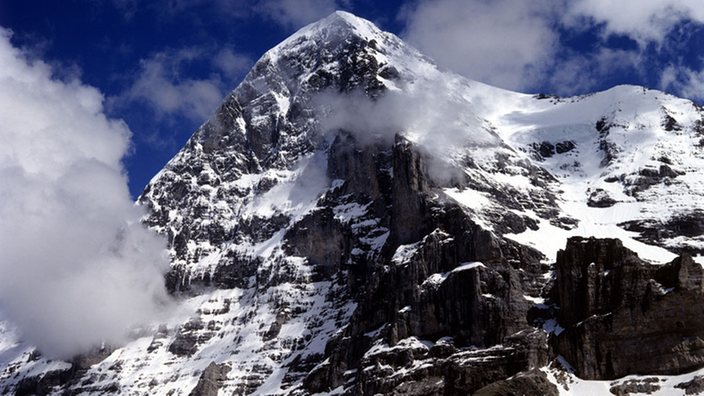
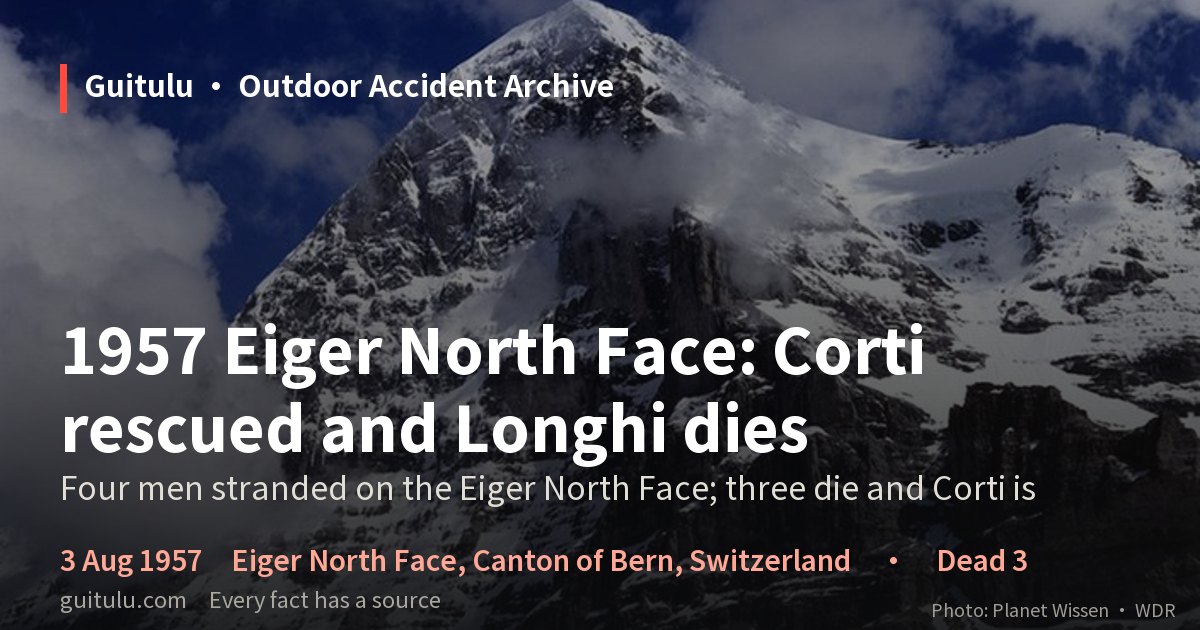
The snow-covered Eiger North Face

Archive / Mountaineering

1957 Eiger North Face: Corti rescued and Longhi dies

Four men stranded on the Eiger North Face; three die and Corti is hauled to the summit by steel cable

Corti rescued; Longhi's body brought down in 1959; two Germans' bodies found in 1961

Photo: Planet Wissen · WDR

Date
Summer
Place
Eiger North Face, Canton of Bern, SwitzerlandSwitzerland › Bern · Alps8.005°E 46.578°N
Activity
MountaineeringInvolves: Falls and slips · Rockfall and collapse · Extreme weather · Sudden illness and exhaustionItalians Claudio Corti and Stefano Longhi, Germans Günther Nothdurft and Franz Mayer
Casualties
Dead 3 Injured 1Longhi died on the north face; the two German climbers died on the descent after reaching the summit, and their bodies were found in 1961 on the descent route on the west side; Corti was injured and rescued
Material
35 facts · 11 sources3 accounts differ and are shown side by side

01What happened

On 3 August 1957, Claudio Corti and Stefano Longhi, from Lecco, Italy, entered the Eiger North Face, aiming to make the first Italian ascent of the face. They initially took the wrong starting route and, after a night bivouacked on the mountain, descended to regain the correct route, losing a day. They then encountered the German climbers Nothdurft and Mayer, and the four continued climbing together.Facts it rests onF30Multiple sourcesOn 3 August 1957, Claudio Corti and Stefano Longhi of Lecco, Italy, entered the Eiger North Face to begin their climb.F01Multiple sourcesThe two men intended to complete the first Italian ascent of the Eiger North Face.F06Multiple sourcesThe two initially went to the wrong starting point on the route and spent the night outdoors without a tent. The next day, they descended partway before returning to the correct route, losing a day.F07Multiple sourcesAfter returning to the correct route, they met German climbers Günther Nothdurft and Franz Mayer, and the four decided to climb together.

The snow-covered Eiger North FacePhoto source: Planet Wissen · WDR

The four made very slow progress and encountered bad weather and a snowstorm. After Longhi slipped and fell, his hands were frozen and he could not climb back up the rope. His companions had to lower him to a small ledge below. According to reports, they were then about 300 metres from the summit, and Corti wanted to reach it as quickly as possible and then come down to organise a rescue.Facts it rests onF08Multiple sourcesThe four made very slow progress; according to Corti's later account and a TIME book review, one of the Germans was in poor condition.F09Multiple sourcesThe weather was bad during the climb, and the party encountered a snowstorm.F11Multiple sourcesAfter Longhi fell, his hands were frozen and he could not climb back up the rope or tie a prusik knot himself. His companions were also unable to pull him up, so they had to lower him onto a small ledge below.F12Single sourceAt this point they were about 300 metres from the summit. Corti intended to reach the summit as quickly as possible, then descend and organise a rescue for Longhi.

As they continued upward, Corti was struck on the head by falling rock and injured while leading. The two Germans secured him to the rock face, left him their bivouac sacks and continued climbing toward the summit. Spectators at Kleine Scheidegg below had been watching through telescopes.Facts it rests onF13Multiple sourcesThe other three continued upward, and Corti was injured when a falling rock struck him on the head while he was leading.F14Multiple sourcesThe two Germans secured the injured Corti to the rock face and left their bivouac sack with him, then continued climbing toward the summit.F16Multiple sourcesSpectators at Kleine Scheidegg below the mountain watched the entire sequence of events through telescopes.

A multinational rescue team of about 50 people secured a winch at the summit and lowered a rescuer down the north face on a steel cable to bring Corti back up to the summit. According to reports, this was the first successful rescue on the Eiger North Face. The rescuers were unable to save Longhi, who died on the north face. His body remained on the face for about two years and was not brought down until 1959.Facts it rests onF22Multiple sourcesThe rescue was a large operation, involving about 50 people from several countries.F18Multiple sourcesRescuers secured a winch on the Eiger summit and used a steel cable to lower a rescuer down the North Face and bring Corti back to the summit.F24Single sourceThis was the first successful rescue on the Eiger North Face.F26Multiple sourcesThe rescuers were unable to save Longhi, who died on the North Face.F31Multiple sourcesLonghi's body remained on the North Face for about two years and was not brought down until 1959.

Afterward, Corti was accused of being responsible for his companions' deaths. Heinrich Harrer publicly accused him in The White Spider, published in 1959. In 1961, the bodies of the two Germans were found on the descent route on the west side of the Eiger, proving that they had reached the summit and descended on the west side, corroborating Corti's account. After Spreafico's book was published in 2008, Corti was vindicated after more than half a century. He died in 2010.Facts it rests onF04Multiple sourcesAfterward, Corti was blamed for his companion's death and even suspected of involvement in the deaths of the two Germans.F32Multiple sourcesHeinrich Harrer publicly accused Corti in The White Spider, published in 1959.F33Multiple sourcesIn 1961, the bodies of the two Germans were found on the descent route on the western side of the Eiger, proving that they had reached the summit and descended the western side, thereby corroborating Corti's account.F34Multiple sourcesIn 2008, Giorgio Spreafico published Il prigioniero dell’Eiger, and Corti was vindicated after more than half a century of criticism.F35Multiple sourcesCorti died in February 2010 at the age of 81.

The number at the end of a paragraph is how many facts it rests on; open it to see each fact and how well it is sourced: Multiple sourcesSingle source. Conflicting accounts and speculation are kept out of the narrative.

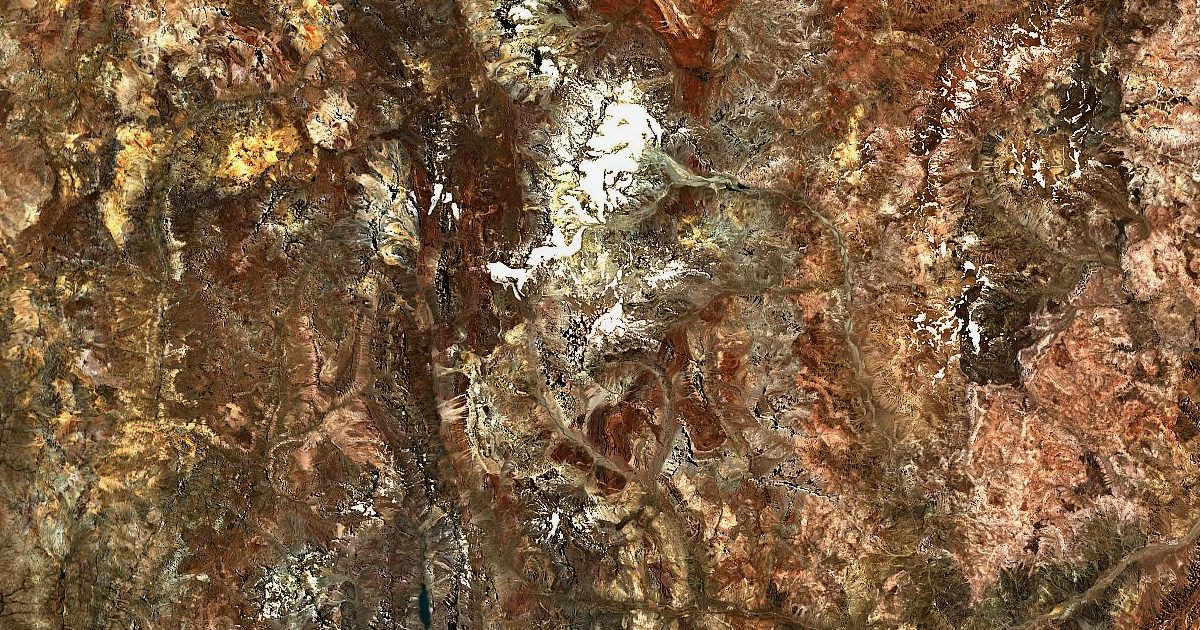
Satellite imagery Sentinel-2 cloudless 2024 © EOX · Terrain AWS Terrain Tiles · Position is schematic, geocoded from place names · Place coordinates not individually verified

Route review

7 scenes to understand what happened

Scroll down and the map flies to where each part happened.

01

The accident area

The reports do not provide enough locations along the route, so the map shows only the approximate location and terrain of the accident area.

02

Entering the north face

On 3 August 1957, Corti and Longhi entered the Eiger North Face, initially taking the wrong starting route and losing a day.Facts it rests onF30Multiple sourcesOn 3 August 1957, Claudio Corti and Stefano Longhi of Lecco, Italy, entered the Eiger North Face to begin their climb.F06Multiple sourcesThe two initially went to the wrong starting point on the route and spent the night outdoors without a tent. The next day, they descended partway before returning to the correct route, losing a day.

03

Four climbers join together

After returning to the correct route, they joined two Germans. The four made slow progress and encountered a snowstorm.Facts it rests onF07Multiple sourcesAfter returning to the correct route, they met German climbers Günther Nothdurft and Franz Mayer, and the four decided to climb together.F08Multiple sourcesThe four made very slow progress; according to Corti's later account and a TIME book review, one of the Germans was in poor condition.F09Multiple sourcesThe weather was bad during the climb, and the party encountered a snowstorm.

04

Fall and rockfall

After slipping and falling, Longhi was lowered to a small ledge; Corti was struck by falling rock while leading and was secured to the rock face.Facts it rests onF11Multiple sourcesAfter Longhi fell, his hands were frozen and he could not climb back up the rope or tie a prusik knot himself. His companions were also unable to pull him up, so they had to lower him onto a small ledge below.F13Multiple sourcesThe other three continued upward, and Corti was injured when a falling rock struck him on the head while he was leading.F14Multiple sourcesThe two Germans secured the injured Corti to the rock face and left their bivouac sack with him, then continued climbing toward the summit.

02Timeline

  1. After Longhi fell, his hands were frozen and he could not climb back up the rope or tie a prusik knot himself. His companions were also unable to pull him up, so they had to lower him onto a small ledge below. F11

  2. After returning to the correct route, they met German climbers Günther Nothdurft and Franz Mayer, and the four decided to climb together. F07

  3. The rescuers were unable to save Longhi, who died on the North Face. F26

  4. The other three continued upward, and Corti was injured when a falling rock struck him on the head while he was leading. F13

  5. The weather was bad during the climb, and the party encountered a snowstorm. F09

  6. Rescuers secured a winch on the Eiger summit and used a steel cable to lower a rescuer down the North Face and bring Corti back to the summit. F18

  7. The two Germans secured the injured Corti to the rock face and left their bivouac sack with him, then continued climbing toward the summit. F14

  8. The two initially went to the wrong starting point on the route and spent the night outdoors without a tent. The next day, they descended partway before returning to the correct route, losing a day. F06

  9. On 3 August 1957, Claudio Corti and Stefano Longhi of Lecco, Italy, entered the Eiger North Face to begin their climb. F30

  10. Longhi's body remained on the North Face for about two years and was not brought down until 1959. F31

  11. Heinrich Harrer publicly accused Corti in The White Spider, published in 1959. F32

  12. In 1961, the bodies of the two Germans were found on the descent route on the western side of the Eiger, proving that they had reached the summit and descended the western side, thereby corroborating Corti's account. F33

  13. In 2008, Giorgio Spreafico published Il prigioniero dell’Eiger, and Corti was vindicated after more than half a century of criticism. F34

  14. Corti died in February 2010 at the age of 81. F35

03Lessons

Teams and decisions

Taking the wrong route consumes reserves

The two initially took the wrong starting route, spent an extra night bivouacked and lost a day. They later joined another party, and their overall progress was slow. On a big rock face known for falling rock and changing weather, every extra day consumes strength and the available weather window.Facts it rests onF06Multiple sourcesThe two initially went to the wrong starting point on the route and spent the night outdoors without a tent. The next day, they descended partway before returning to the correct route, losing a day.F08Multiple sourcesThe four made very slow progress; according to Corti's later account and a TIME book review, one of the Germans was in poor condition.

Hypothermia and overnight gear

A fall in bad weather carries a higher cost

After Longhi slipped and fell, his hands were frozen and he could not even climb back up the rope; his companions could not pull him up either. The cold turned a fall that was not in itself fatal into a predicament from which he could not save himself.Facts it rests onF09Multiple sourcesThe weather was bad during the climb, and the party encountered a snowstorm.F11Multiple sourcesAfter Longhi fell, his hands were frozen and he could not climb back up the rope or tie a prusik knot himself. His companions were also unable to pull him up, so they had to lower him onto a small ledge below.

Teams and decisions

Think carefully before splitting up to seek help

After the injuries, the party split up: Longhi remained on the small ledge, Corti was secured to the rock face, and the two Germans continued to the summit to seek help. In the end, only Corti survived. Before separating at altitude, assess how long each person can hold out and whether those seeking help can descend safely.Facts it rests onF11Multiple sourcesAfter Longhi fell, his hands were frozen and he could not climb back up the rope or tie a prusik knot himself. His companions were also unable to pull him up, so they had to lower him onto a small ledge below.F14Multiple sourcesThe two Germans secured the injured Corti to the rock face and left their bivouac sack with him, then continued climbing toward the summit.F33Multiple sourcesIn 1961, the bodies of the two Germans were found on the descent route on the western side of the Eiger, proving that they had reached the summit and descended the western side, thereby corroborating Corti's account.F28Single sourceCorti was the only survivor of the four.

Rescue and self-rescue

A survivor's account takes time to verify

Corti's account afterward was unclear, and he was accused of being responsible for his companions' deaths. His account was not corroborated until the Germans' bodies were found in 1961. Accident investigations should wait for evidence rather than draw conclusions first.Facts it rests onF05Multiple sourcesImmediately after the accident, Corti's account of what happened was unclear, and some of his statements were inconsistent.F04Multiple sourcesAfterward, Corti was blamed for his companion's death and even suspected of involvement in the deaths of the two Germans.F33Multiple sourcesIn 1961, the bodies of the two Germans were found on the descent route on the western side of the Eiger, proving that they had reached the summit and descended the western side, thereby corroborating Corti's account.

04Fact list 35 facts

Under each fact is a verbatim quote from the original. "Single source" means only one outlet mentioned it; "Accounts differ" means sources contradict each other and this site adopts neither side; "Speculation" is an inference by a reporter or a person involved, not a fact.

  1. F01Multiple sourcesPlan

    The two men intended to complete the first Italian ascent of the Eiger North Face.

    Quotes from the original 3

    “Il tentativo di compiere la prima italiana sulla parte Nord dell’Eiger, compiuto nel 1957 dai lecchesi Claudio Corti e Stefano Longhi”

    Montagna.TV · 2019-05-25

    “The Eiger’s North face at the time hadn’t had an Italian ascent.”

    Up-Climbing · 2010-02-28

    “il suo ruolo nella prima scalata italiana della Nord dell'Eiger”

    tio.ch · 2010-02-04
  2. F02Single sourceBackground

    According to TIME, Corti was 29 and Longhi was 44 at the time.

    Quotes from the original 2

    “To Claudio Corti, 29, the Eiger was an obsession.”

    TIME ·

    “He had to settle for a good-natured, 44-year-old factory worker, Stefano Longhi, who had never made a strenuous climb.”

    TIME ·
  3. F03Single sourceBackground

    According to Montagna.TV, Corti and Longhi set out without telling others.

    Quotes from the original 1

    “Quell’estate, Corti e Longhi partirono di nascosto per tentare la prima italiana sull’Eiger”

    Montagna.TV · 2010-02-03
  4. F04Multiple sourcesAftermath

    Afterward, Corti was blamed for his companion's death and even suspected of involvement in the deaths of the two Germans.

    Quotes from the original 3

    “The most unjust and wildest was to have caused the death of the Germans by having delayed the ascent.”

    Up-Climbing · 2010-02-28

    “poi venne accusato di essere il colpevole della morte dei tedeschi e di Stefano Longhi.”

    Montagna.TV · 2010-02-03

    “l’accusa di aver ucciso i suoi compagni, smentita solo anni dopo.”

    Montagna.TV ·
  5. F05Multiple sourcesPost-incident analysis

    Immediately after the accident, Corti's account of what happened was unclear, and some of his statements were inconsistent.

    Quotes from the original 2

    “Doch Cortis' Beschreibungen sind widersprüchlich und ungenau.”

    Planet Wissen · 2019-07-22

    “Straight after the accident, Corti’s reconstruction, when he was still suffering from nightmares of all kinds, was certainly not very clear.”

    Up-Climbing · 2010-02-28
  6. F06Multiple sourcesMovement

    The two initially went to the wrong starting point on the route and spent the night outdoors without a tent. The next day, they descended partway before returning to the correct route, losing a day.

    Quotes from the original 2

    “Die unerfahrenen Kletterer gerieten zunächst auf eine falsche Route, mussten unter freiem Himmel ohne Zelt übernachten und sich am nächsten Morgen wieder ein Stück abseilen.”

    Planet Wissen · 2019-07-22

    “They mistook the start of the route, losing a day.”

    Up-Climbing · 2010-02-28
  7. F07Multiple sourcesMovement

    After returning to the correct route, they met German climbers Günther Nothdurft and Franz Mayer, and the four decided to climb together.

    Quotes from the original 3

    “Once they’d abseiled back onto the correct line, the Germans Günther Nothdurft and Franz Mayer caught them up.”

    Up-Climbing · 2010-02-28

    “trafen sie dort auf zwei andere Bergsteiger, die Deutschen Günther Nothdurft und Franz Mayer.”

    Planet Wissen · 2019-07-22

    “Part way up they met two Germans also making the climb and joined forces.”

    TIME ·
  8. F08Multiple sourcesMovement

    The four made very slow progress; according to Corti's later account and a TIME book review, one of the Germans was in poor condition.

    The claim that Nothdurft was exhausted comes from Corti's later account.

    Quotes from the original 3

    “the four decided to all climb together, led by Corti, but they moved terribly slowly, also due to the bad conditions.”

    Up-Climbing · 2010-02-28

    “Die vier kamen nur langsam voran, "weil Nothdurft schwächelte", wie Corti später behauptete.”

    Planet Wissen · 2019-07-22

    “One of the Germans developed stomach cramps, and Longhi ran out of breath.”

    TIME ·
  9. F09Multiple sourcesEvent

    The weather was bad during the climb, and the party encountered a snowstorm.

    Quotes from the original 2

    “turned into a calvary, full of unforeseen events, and with terrible weather.”

    Up-Climbing · 2010-02-28

    “La cordata venne investita dalla bufera”

    Montagna.TV · 2010-02-03
  10. F10Accounts differEvent

    Accounts differ on when Longhi slipped and fell: Planet Wissen says he fell after midday on 8 August while following; Up-Climbing says he fell on 9 August, the seventh day of the climb, upon reaching the “White Spider” icefield.

    The dates given in the two retrospective accounts differ by one day

    Quotes from the original 2

    “Trotz Schwäche stiegen die Deutschen am Mittag des 8. August vor, wurden aber von Corti wieder eingeholt. Als Stephano Longhi nachsteigen wollte, rutschte er aus und stürzte.”

    Planet Wissen · 2019-07-22

    “On 9 August, after 7 days’ effort, they were at the White Spider”

    Up-Climbing · 2010-02-28
  11. F11Multiple sourcesEvent

    After Longhi fell, his hands were frozen and he could not climb back up the rope or tie a prusik knot himself. His companions were also unable to pull him up, so they had to lower him onto a small ledge below.

    Quotes from the original 2

    “Stefano Longhi fell a few metres, and wasn’t able to climb back up the rope or even make a prussik knot, so cold were his hands. His companions belayed him down to a ledge.”

    Up-Climbing · 2010-02-28

    “Es gelang Corti nicht, seinen Gefährten über den Überhang zu sich zu ziehen.”

    Planet Wissen · 2019-07-22
  12. F12Single sourcePlan

    According to Up-Climbing, At this point they were about 300 metres from the summit. Corti intended to reach the summit as quickly as possible, then descend and organise a rescue for Longhi.

    Quotes from the original 1

    “At this point only 300 metres separated them from the summit and Corti wanted to climb this stretch as quickly as possible and then re-descend to organise Stefano’s rescue.”

    Up-Climbing · 2010-02-28
  13. F13Multiple sourcesEvent

    The other three continued upward, and Corti was injured when a falling rock struck him on the head while he was leading.

    Quotes from the original 3

    “Doch dann wurde auch Corti bei einem Steinschlag am Kopf verletzt.”

    Planet Wissen · 2019-07-22

    “While he was leading, he was struck on the head by a falling rock, and he fell badly, about 30m.”

    Up-Climbing · 2010-02-28

    “Corti venne colpito da una scarica di sassi”

    Montagna.TV · 2010-02-03
  14. F14Multiple sourcesEvent

    The two Germans secured the injured Corti to the rock face and left their bivouac sack with him, then continued climbing toward the summit.

    Quotes from the original 2

    “Die beiden Deutschen überließen Corti ihren Biwaksack.”

    Planet Wissen · 2019-07-22

    “the two Germans, who by this stage were the freshest, lashed him to the face and finally climbed to the top.”

    Up-Climbing · 2010-02-28
  15. F15Single sourceEvent

    According to tio.ch, After being injured, Corti was stranded about 300 metres from the summit.

    Quotes from the original 1

    “L'alpinista, ferito e bloccato a 300 metri dalla vetta”

    tio.ch · 2010-02-04
  16. F16Multiple sourcesEvent

    Spectators at Kleine Scheidegg below the mountain watched the entire sequence of events through telescopes.

    Quotes from the original 2

    “die das folgende Drama von der Passhöhe "Kleine Scheidegg" aus mit Fernrohren verfolgten.”

    Planet Wissen · 2019-07-22

    “Below, spectators began gathering, like a Greek chorus, to watch the tragedy unfold.”

    TIME ·
  17. F17Accounts differEvent

    Accounts differ on what happened to the two Germans: a TIME book review says both fell to their deaths; Up-Climbing, Planet Wissen and Montagna.TV say both reached the summit and died from exhaustion during the descent, and that their bodies were later found on the descent route on the west side.

    The TIME book review was written around the time the Germans' bodies were found; later retrospective accounts drew on the location where the bodies were found in 1961

    Quotes from the original 3

    “By this time both Germans had fallen to their deaths”

    TIME ·

    “But their bad luck wasn’t finished, when they died of exhaustion during the descent.”

    Up-Climbing · 2010-02-28

    “Die deutschen Bergsteiger schafften es zwar mit letzter Kraft auf den Gipfel, doch für den Abstieg reichte es nicht mehr.”

    Planet Wissen · 2019-07-22
  18. F18Multiple sourcesEvent

    Rescuers secured a winch on the Eiger summit and used a steel cable to lower a rescuer down the North Face and bring Corti back to the summit.

    Quotes from the original 2

    “Securing a winch to the ice on the razor-thin summit, the rescuers lowered a man on cable down the north wall.”

    TIME ·

    “Using a complex system, Claudio Corti was reached and winched up to the summit, in a bad way, but alive.”

    Up-Climbing · 2010-02-28
  19. F19Single sourceEvent

    According to Montagna.TV, The photograph of Corti leaning on the shoulder of rescuer Alfred Hellepart is one of the most famous photographs in mountaineering history.

    Quotes from the original 1

    “La foto di Corti in spalla al suo salvatore Alfred Hellepart è fra le più famose della storia dell’alpinismo.”

    Montagna.TV ·
  20. F20Single sourceEvent

    According to TIME, It took rescuers three hours to bring Corti back.

    Quotes from the original 1

    “After three agonizing hours, he managed to bring back Corti.”

    TIME ·
  21. F21Accounts differEvent

    Accounts differ on how Corti was rescued: most sources say he was hauled up to the summit on a steel cable from the summit; Explorersweb says Terray and others lowered him 600 metres, and that Longhi died when the rope became stuck during the descent.

    The Explorersweb account conflicts with other sources

    Quotes from the original 2

    “Terray secured Corti with ropes, and the team lowered him 600m to safety. Longhi, barely conscious, died during the descent when his rope jammed.”

    Explorersweb · 2025-07-25

    “Claudio Corti was reached and winched up to the summit”

    Up-Climbing · 2010-02-28
  22. F22Multiple sourcesEvent

    The rescue was a large operation, involving about 50 people from several countries.

    Quotes from the original 3

    “Three climbers died but one was spectacularly rescued in an effort involving an international team of 50 alpinists.”

    swissinfo · 2013-07-24

    “The effort, involving 50 people, was one of mountaineering’s greatest rescues.”

    Explorersweb · 2025-07-25

    “venne salvato dopo nove giorni con un'operazione di soccorso che mobilitò decine di uomini di sei nazioni.”

    tio.ch · 2010-02-04
  23. F23Multiple sourcesEvent

    The rescuers came from six countries.

    Quotes from the original 2

    “Seguì l’operazione di soccorso più imponente del secolo, che durò 9 giorni e coinvolse alpinisti di 6 nazioni diverse.”

    Montagna.TV ·

    “un'operazione di soccorso che mobilitò decine di uomini di sei nazioni.”

    tio.ch · 2010-02-04
  24. F24Single sourceFound at scene

    According to Planet Wissen, This was the first successful rescue on the Eiger North Face.

    Quotes from the original 1

    “Es war die erste erfolgreiche Rettung an der Nordwand überhaupt.”

    Planet Wissen · 2019-07-22
  25. F25Single sourceEvent

    According to Montagna.TV, Italian mountaineer Riccardo Cassin was also on the front line of the rescue and initially did not know that two of his compatriots were stranded.

    Quotes from the original 1

    “che vide in prima fila un Riccardo Cassin ignaro che due suoi compaesani si trovassero sulla parete”

    Montagna.TV ·
  26. F26Multiple sourcesEvent

    The rescuers were unable to save Longhi, who died on the North Face.

    Quotes from the original 4

    “Für seinen Freund Stephano Longhi jedoch kam jede Hilfe zu spät.”

    Planet Wissen · 2019-07-22

    “Unfortunately for Stefano Longhi, help arrived too late.”

    Up-Climbing · 2010-02-28

    “But storms kept rescuers from reaching Longhi.”

    TIME ·

    “Longhi morì in parete”

    Montagna.TV · 2010-02-03
  27. F27Single sourceEvent

    According to Planet Wissen, The last words rescuers heard Longhi shout were “fame, freddo” (hungry, cold), after which he died of exhaustion.

    Quotes from the original 1

    “Die Retter hörten nur noch seine legendär gewordenen letzten Worte "fame, freddo" (Hunger, Kälte), dann starb er vor ihren Augen an Erschöpfung.”

    Planet Wissen · 2019-07-22
  28. F28Single sourceAftermath

    According to Montagna.TV, Corti was the only survivor of the four.

    Several quotations come from different reports by the same outlet and are counted as one source

    Quotes from the original 3

    “Corti fu l’unico sopravvissuto”

    Montagna.TV · 2010-02-03

    “Solo Claudio Corti fu trovato ancora vivo.”

    Montagna.TV ·

    “Solo Corti si salvò.”

    Montagna.TV ·
  29. F29Multiple sourcesAftermath

    The accident prompted a strong response in Switzerland and was reported in newspapers across Europe.

    Quotes from the original 2

    “Few mountain accidents have stirred so much emotion in Switzerland as the tragedy that took place on the Eiger North Face in August, 1957.”

    swissinfo · 2013-07-24

    “salvato in extremis da una colossale operazione di soccorso di cui parlarono i giornali di tutta Europa”

    Montagna.TV · 2010-02-03
  30. F30Multiple sourcesMovement

    On 3 August 1957, Claudio Corti and Stefano Longhi of Lecco, Italy, entered the Eiger North Face to begin their climb.

    Quotes from the original 2

    “Die Eiger-Tragödie von 1957 begann am 3. August, als der Kletterer Stephano Longhi zusammen mit seinem Gefährten Claudio Corti in die Eiger-Nordwand einstieg.”

    Planet Wissen · 2019-07-22

    “Corti had been training all summer and set out on August 3rd with the young and highly-motivated Lecco climber Stefano Longhi.”

    Up-Climbing · 2010-02-28
  31. F31Multiple sourcesAftermath

    Longhi's body remained on the North Face for about two years and was not brought down until 1959.

    Quotes from the original 3

    “Seine Leiche hing wie ein makaberes Mahnmal zwei Jahre lang in der Wand und wurde erst 1959 geborgen.”

    Planet Wissen · 2019-07-22

    “Finalmente nel 1959 il corpo di Longhi venne riportato in patria.”

    Montagna.TV ·

    “il cui corpo resta per due anni esposto in parete”

    Montagna.TV · 2019-05-25
  32. F32Multiple sourcesAftermath

    Heinrich Harrer publicly accused Corti in The White Spider, published in 1959.

    Quotes from the original 2

    “With his book “The White Spider”, published in 1959, the Austrian climber spelled out in black and white his accusations about Corti.”

    Up-Climbing · 2010-02-28

    “che per primo gettò discredito su Corti nel suo libro "Il ragno bianco".”

    Montagna.TV ·
  33. F33Multiple sourcesFound at scene

    In 1961, the bodies of the two Germans were found on the descent route on the western side of the Eiger, proving that they had reached the summit and descended the western side, thereby corroborating Corti's account.

    Quotes from the original 3

    “Only 4 years later, in 1961, with the discovery of Günther Nothdurft and Franz Mayer’s bodies on the west face, Claudio Corti’s words took on a different meaning”

    Up-Climbing · 2010-02-28

    “I due, raggiunta la cima, avevano iniziato la discesa dalla parete opposta, la Ovest”

    Montagna.TV ·

    “Ihre Leichen wurden 1961 gefunden.”

    Planet Wissen · 2019-07-22
  34. F34Multiple sourcesAftermath

    In 2008, Giorgio Spreafico published Il prigioniero dell’Eiger, and Corti was vindicated after more than half a century of criticism.

    Quotes from the original 2

    “But it was only with the publication of Giorgio Spreafico’s “The prisoner of the Eiger”, in 2008, 50 years after the tragedy”

    Up-Climbing · 2010-02-28

    “era stato riabilitato dopo oltre mezzo secolo di critiche”

    tio.ch · 2010-02-04
  35. F35Multiple sourcesAftermath

    Corti died in February 2010 at the age of 81.

    Quotes from the original 2

    “Claudio Corti passed away on 3 February 2010 in Lecco. He was 81 years old.”

    Up-Climbing · 2010-02-28

    “l'alpinista Claudio Corti, di 81 anni”

    tio.ch · 2010-02-04