MountaineeringInvolves: Falls and slips · Extreme weatherSix members of the British Ogre expedition (Doug Scott, Chris Bonington, Mo Anthoine, Clive Rowland, Nick Estcourt, Paul Braithwaite)
Casualties
Injured 2Scott broke both legs, Bonington broke ribs in a fall during the descent, and several people suffered frostbite; all survived
Material
45 facts · 8 sources2 accounts differ and are shown side by side
The number at the end of a paragraph is how many facts it rests on; open it to see each fact and how well it is sourced:
Multiple sourcesSingle source. Conflicting accounts and speculation are kept out of the narrative.
ImgScene photos all from news coverage; copyright belongs to the original authors
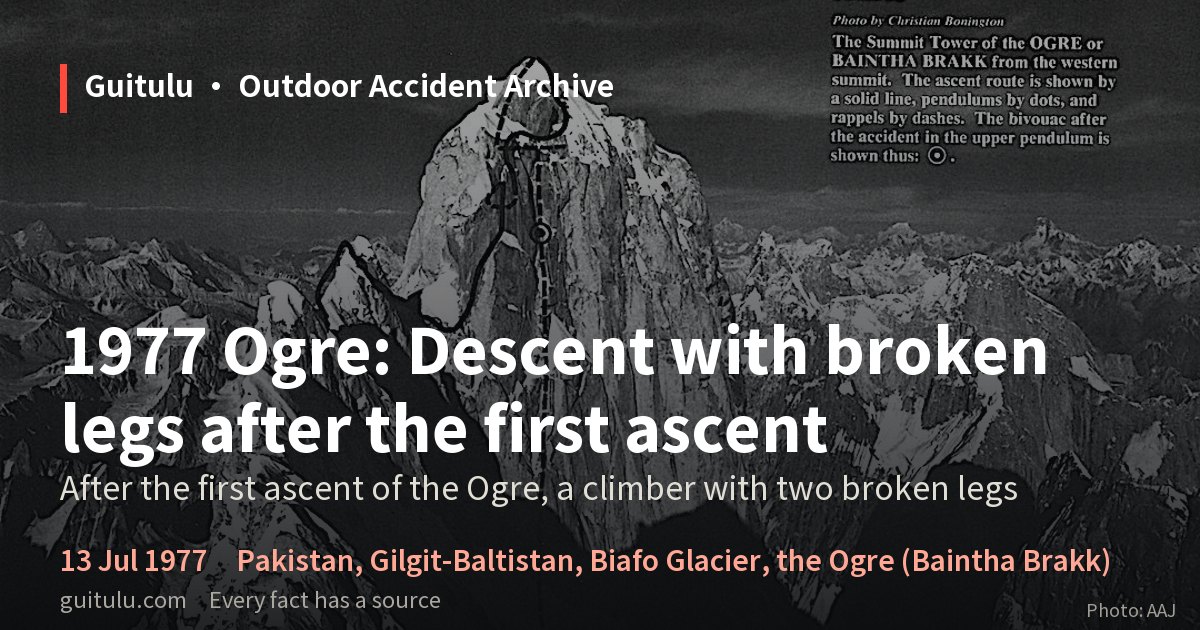
Scott crawling on his knees on a snow slope on the west ridge during the descent in 1977Photo source: AAJScott crawling on the glacier's snow surface during the descent in 1977Photo source: AAJDiagram showing the locations of the Ogre and the surrounding Latok peaks (annotated aerial image)Photo source: ExplorerswebBonington and Scott descending the Ogre in 1977, with Scott kneeling on a snow slopePhoto source: Montagna.tv · Montagna.tv
Reported locations along the route (schematic)Schematic
Scroll down and the map flies to where each part happened. The line is Schematic, Lines connect the locations mentioned in reports in sequence, showing only the approximate direction, not the actual track. Sources for the location coordinates are in places.json.
01
Full route
Locations mentioned in reports are connected in sequence to show the approximate route (schematic).
Early in the climb, a falling rock struck Braithwaite's leg, leaving him unable to continue climbing. F03
On 11 July, Scott, Bonington, Anthoine and Rowland set out for the summit. F25
On 13 July, Scott and Bonington made the first ascent of the Ogre main summit. F26
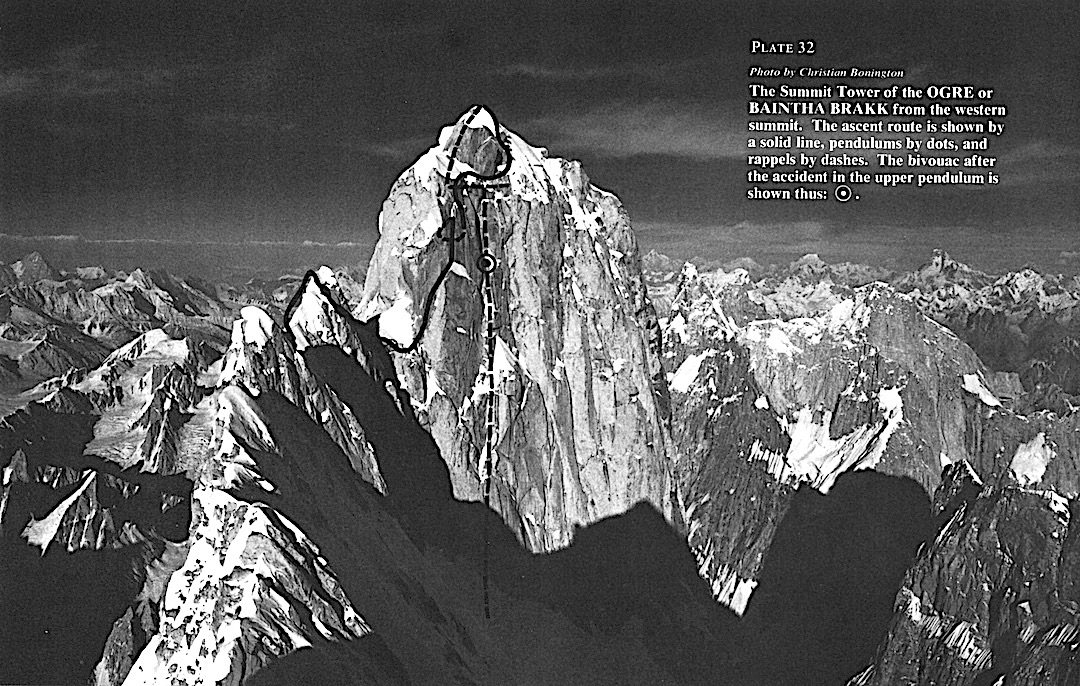
During the first abseil after the summit, Scott stepped onto a thin layer of ice on the rock face in the fading light. His feet slipped, and he swung out and struck the rock face. F28
Early on 14 July, the two continued to rappel. Anthoine and Rowland climbed up to meet them and kicked large steps in the snow; Scott crawled on his knees back to the snow cave. F35
On 19 July, the weather improved, and the group descended to the old camp at the col to search for food, finding only a small amount left. F37
Late on 20 July, Scott crawled across the final stretch of moraine and returned to base camp. F40
On 20 July, after waiting a long time for the others, Estcourt thought they had died, left a note and descended to seek help. F39
Under each fact is a verbatim quote from the original. "Single source" means only one outlet mentioned it; "Accounts differ" means sources contradict each other and this site adopts neither side; "Speculation" is an inference by a reporter or a person involved, not a fact.
The 1977 British Ogre expedition had six members: Mo Anthoine, Chris Bonington, Paul Braithwaite, Nick Estcourt, Clive Rowland and Doug Scott. The team had no leader.
Quotes from the original 3
“a British expedition comprising Mo Anthoine, Chris Bonington, Paul Braithwaite, Nick Estcourt, Clive Rowland and Doug Scott”
The weather turned into a snowstorm. On their first attempt to climb back over the West Peak, the team members were unable to advance because the snow was too deep and the storm too severe, and returned to the snow cave.
Quotes from the original 3
“Mo and Clive went out to try it, but after an hour or so returned to the warmth of the cave.”
Accounts differ on the date when the four crossed back over the West Peak in a blizzard: Scott wrote in his account in the journal that it was 15 July; an excerpt from Scott's book says that a blizzard was raging on the morning of 15 July and they were unable to cross that day, while Bonington's account also says they crossed the day after being confined for a day.
The dates in Scott's two accounts differ
Quotes from the original 3
“The next day, 15 July, there was less wind and we ail set off out into the heavy snowfall.”
According to AAJ, As they descended to the top of the fixed rope, the two ropes were of unequal length. Scott slipped off the end of the shorter one but managed to grab the fixed rope as he passed it.
Quotes from the original 1
“Doug now started down, didn’t notice that the short end was hanging loose and rappelled off it”
Bonington then also slipped off the end of the shorter of the two ropes. He fell about twenty feet before being caught by the other, secured rope, and broke his ribs in the fall.
Quotes from the original 4
“I went straight off the end of the shorter one, fell about twenty feet before the tied off rope held me.”
The day after the fall, Bonington's condition deteriorated sharply. He had a cough and chest pain and suspected he had pulmonary edema, though the others doubted this.
Quotes from the original 2
“I began to suspect pulmonary oedema, in which case I needed to get down as soon as possible; but the others were skeptical.”
Several members suffered frostbite during the descent: Anthoine lost feeling in both feet, Rowland suffered frostbite to his toes, and Scott to his fingers.
According to AAJ, Estcourt and Braithwaite, who had stayed behind, had originally planned to call the porters to break camp on 13 July. They saw the summit team near the summit on 13 July and descending on 14 July, with no sign of trouble, so they dismantled the advanced base camp and sent most of the porters down to Askole with Braithwaite. Estcourt and six porters stayed behind.
Quotes from the original 2
“They had seen us near the summit on the 13th, and obviously on our way down on the 14th. There was nothing to indicate that we had had an accident.”
Accounts differ on the number of days from the injury to the return to base camp: Scott's journal account says seven days thereafter; Scott said eight days when discussing his book; Gripped and Montagna.tv say eight days; Explorersweb says a week.
Different counting methods
Quotes from the original 5
“And that's how it was done over the next seven days”
The helicopter could carry only one person at a time and made a forced landing on arriving in Skardu with Scott aboard; it could not be used afterward.
Quotes from the original 2
“coming into Skardu the engine cut out, and we suddenly plummeted twenty feet to the ground”
During the first abseil after the summit, Scott stepped onto a thin layer of ice on the rock face in the fading light. His feet slipped, and he swung out and struck the rock face.
Quotes from the original 5
“in the gathering darkness, unwittingly placed it on a veneer of water ice”
According to UIAA, Scott wrote in his book that there were no knots in the ends of the two ropes and that, fortunately, he remained conscious after the fall.
Quotes from the original 1
“Luckily I was still conscious for there was no knot on the end of the double ropes.”
Early on 14 July, the two continued to rappel. Anthoine and Rowland climbed up to meet them and kicked large steps in the snow; Scott crawled on his knees back to the snow cave.
Quotes from the original 3
“By digging out big bucket steps for Doug he was able to crawl on his knees all the way back to the cave.”
The team decided to retreat along the ascent route, which required recrossing the West Peak before descending along the route where the fixed ropes and tents were located.
Quotes from the original 2
“The others favoured a return over the top of the west summit since we should be heading towards fixed ropes and our two tents.”
According to Himalayan Journal, Abseiling along the fixed ropes was not difficult for Scott. He descended about 2500 feet in about 4 hours, then began crawling across the glacier ice.
Quotes from the original 1
“Abseiling down fixed ropes was no real problem for me, so I was able to descend 2,500 ft in four hours.”
According to UIAA, Media reports at the time focused on the two well-known climbers, Scott and Bonington, and largely omitted the role of Anthoine and Rowland in escorting them down the mountain.
Quotes from the original 1
“the selfless roles played by Anthoine and Rowland in shepherding Scott and Bonington off the mountain had been essentially written out of the story”
According to AAJ, Bonington believed they were fortunate to have brought enough gas canisters; otherwise, they would not have been able to melt snow for water.
Quotes from the original 1
“It was also fortunate that we had an ample stock of gas cylinders, for without them we should have been unable to melt snow.”
 GuituluGlobal Outdoor Accident Archive