GuituluGlobal Outdoor Accident Archive 中文
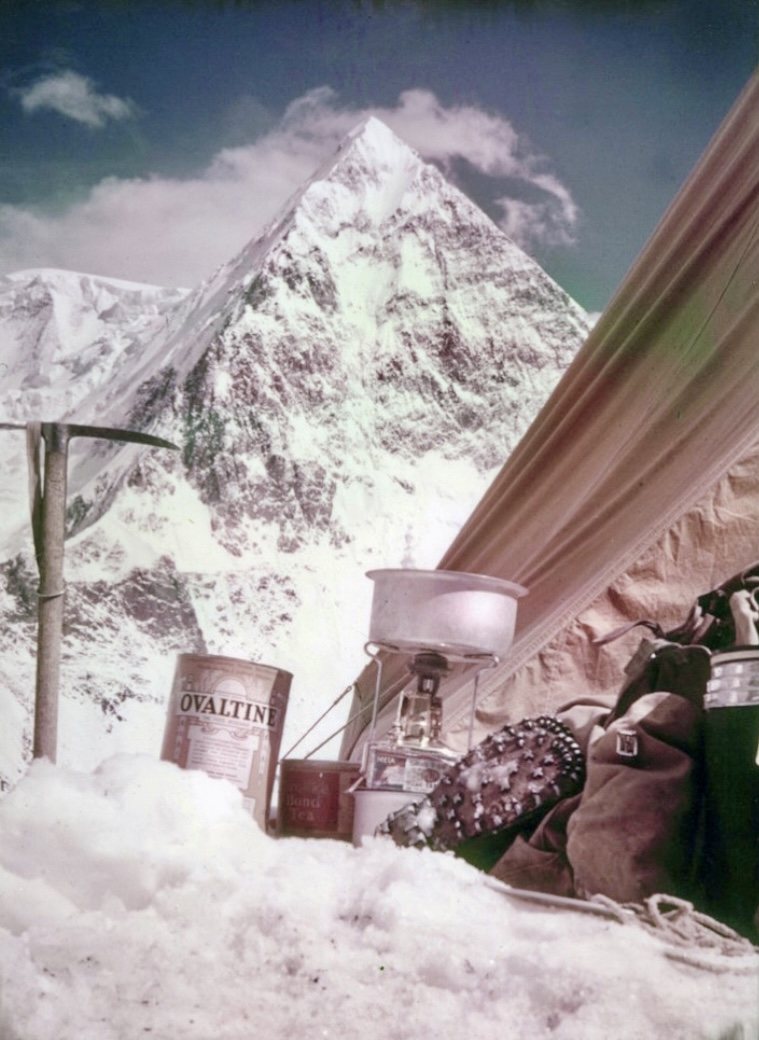
K2 photographed from a camp during the 1939 expedition

Archive / Mountaineering

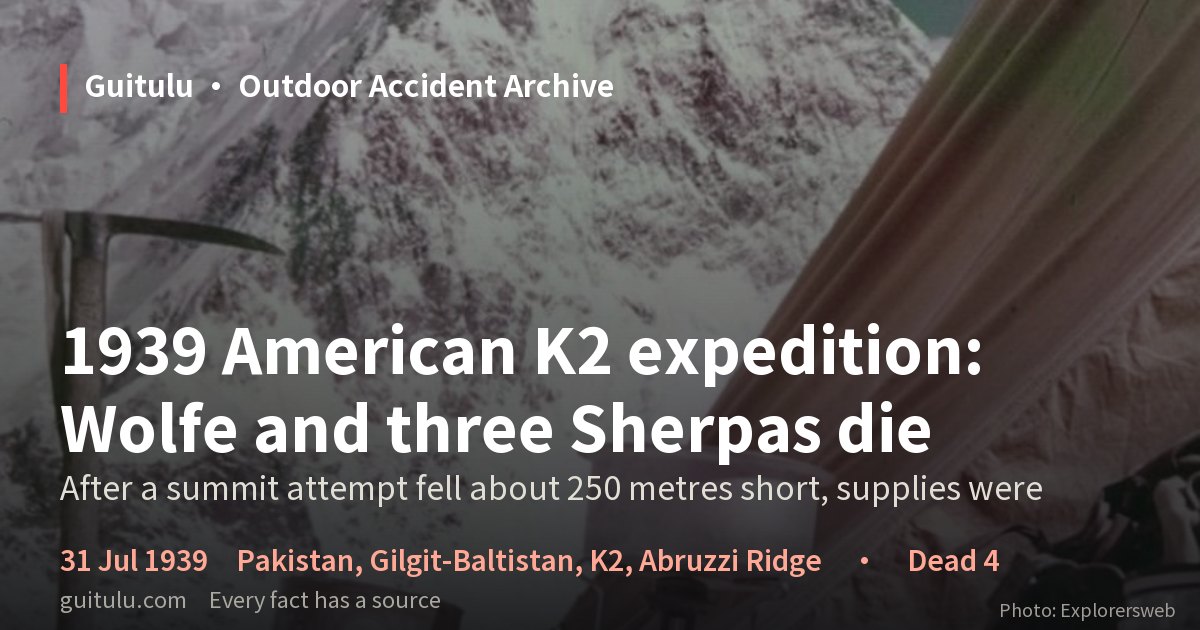
1939 American K2 expedition: Wolfe and three Sherpas die

After a summit attempt fell about 250 metres short, supplies were removed from the high camps; neither the man left behind nor his rescuers returned

Some of Wolfe's remains were found on the Godwin-Austen Glacier in 2002

Photo: Explorersweb

Date
Summer
Place
Pakistan, Gilgit-Baltistan, K2, Abruzzi RidgePakistan › Gilgit-Baltistan · Karakoram76.513°E 35.883°N
Activity
MountaineeringInvolves: Altitude illness · Extreme weather · Sudden illness and exhaustion1939 American K2 expedition: 6 American members and 9 Sherpas, led by Fritz Wiessner
Casualties
Dead 4 American team member Dudley Wolfe and Sherpas Pasang Kikuli, Pasang Kitar and Pinso died, becoming the first four people to die on K2
Material
46 facts · 11 sourcesSources agree

01What happened

In 1939, Fritz Wiessner led the second American attempt to climb K2. The team had six American members and nine Sherpas, including Dudley Wolfe, a wealthy novice mountaineer. On 31 May, the team reached base camp on the Godwin-Austen Glacier and planned to climb the Abruzzi Ridge without bottled oxygen.Facts it rests onF01Multiple sourcesThe 1939 K2 expedition was led by Fritz Wiessner and was the second American attempt to climb K2.F02Multiple sourcesThe expedition consisted of six American members—Wiessner, Wolfe, Cromwell, Sheldon, Kranmer and Durrance—and also recruited nine Sherpas in Darjeeling.F03Multiple sourcesDudley Wolfe was a wealthy American with little mountaineering experience, who was invited to join the team largely to help finance the expedition.F08Multiple sourcesOn 31 May, the team reached base camp on the Godwin-Austen Glacier at the foot of K2, planning to climb the Abruzzi Ridge without bottled oxygen.

K2 photographed from a camp during the 1939 expeditionPhoto source: Explorersweb

In mid-July, Durrance descended because of altitude sickness, leaving only Wiessner, Wolfe and the Sherpa Pasang Lama at the highest point. On 17 July, Wolfe could not get past the bergschrund above Camp 8 and returned to camp; Wiessner and Pasang Lama camped on the shoulder of the southeast ridge and made a summit attempt on 19 July. At 6:30 p.m., Pasang Lama was unwilling to continue into the night, and the two turned back about 250 metres from the summit. They lost their crampons on the descent, and another attempt on 21 July was also unsuccessful.Facts it rests onF13Multiple sourcesIn mid-July, Durrance had difficulty breathing above Camp 6 and turned back because of altitude sickness, while Wiessner and Wolfe continued upward.F14Multiple sourcesOn 14 July, Durrance was unwell and descended from Camp 6 to Camp 2 with assistance from Pasang Kikuli and Dawa.F16Multiple sourcesOn 17 July, Wolfe made several unsuccessful attempts to cross the bergschrund above Camp 8 and returned to Camp 8.F17Multiple sourcesWiessner and Pasang Lama continued up to the shoulder of the Southeast Ridge and pitched a summit camp there (Camp 9).F18Multiple sourcesOn 19 July, Wiessner and Pasang Lama made a summit attempt from Camp 9.F19Multiple sourcesAt 6:30 p.m., Wiessner wanted to continue climbing, but Pasang Lama was unwilling to reach the summit at night and refused to go on, leaving the two with no choice but to descend.F20Multiple sourcesAccording to records, the highest point the two reached was only about 250 metres (about 800 feet) from the summit.F21Multiple sourcesDuring the descent at night, Pasang Lama lost his crampons while rappelling. The two returned to Camp 9 at 2:30 a.m.F23Multiple sourcesOn 21 July, the two tried again by a snow gully on the east side, but without crampons they had to cut steps in the hard snow. Progress was too slow, and they returned to Camp 9 that day.

Camp 2 on K2's Abruzzi Ridge in 1939Photo source: Explorersweb

Meanwhile, three Sherpas called uphill from Camp 7 and received no response. Concluding that the summit party had come to harm, they removed sleeping bags and other supplies from the camps below and returned to base camp on 23 July to report that the summit party had died. On 22 July, Wiessner and the other two descended to Camp 7 and found that the sleeping bags had been removed; Wolfe's sleeping bag had also been lost in a slip on the way. The next day, Wolfe stayed at Camp 7 while Wiessner and Pasang Lama descended to fetch supplies. They found every camp emptied along the way and returned to base camp on 24 July.Facts it rests onF22Multiple sourcesOn 20 July, the Sherpas Pasang Kitar, Tsering Pindar and Pinso climbed to Camp 7 and called up to Camp 8, but received no response and concluded that something had happened to the people above.F27Multiple sourcesThe Sherpas then removed sleeping bags and other supplies from the camps below Camp 7 and returned to Base Camp on 23 July, reporting that the summit party had died.F24Multiple sourcesOn 22 July, Wiessner and Pasang Lama descended to Camp 8, where Wolfe said that no one had come up from below in the past few days. The three continued down together to Camp 7.F25Multiple sourcesDuring the descent, all three slipped and fell, and Wolfe's sleeping bag was lost in the fall.F26Multiple sourcesAt Camp 7, they found that the sleeping bags and air mattresses stored there had been removed, leaving the three to share one sleeping bag for the night.F28Multiple sourcesOn 23 July, Wolfe stayed at Camp 7 to wait while Wiessner and Pasang Lama descended to get supplies.F29Multiple sourcesWiessner and Pasang Lama continued down, finding that the sleeping bags, air mattresses and most of the food had been removed from Camps 6, 5, 4 and 2.F30Multiple sourcesOn 24 July, Wiessner and Pasang Lama returned to Base Camp, encountering a party led by Cromwell searching on the glacier along the way.

Diagram of the upper route on K2, marking the highest point reached in 1939Photo source: Explorersweb

On 28 July, Pasang Kikuli and Tsering climbed from base camp to Camp 6 in a single day. The next day, Pasang Kikuli, Pasang Kitar and Pinso found Wolfe at Camp 7. He was too weak and unwilling to descend that day; he had reportedly not eaten for several days. After a storm delayed them for a day, the three set out again on 31 July to bring him down. They were never seen again, and the agreed signal was never seen. Wiessner went up the mountain again to search and was trapped by a snowstorm. On 9 August, the team left base camp because of insufficient supplies.Facts it rests onF32Multiple sourcesOn 28 July, Pasang Kikuli and Tsering carried sleeping bags from Base Camp to Camp 6 in a single day.F33Multiple sourcesOn 29 July, Pasang Kikuli, Pasang Kitar and Pinso reached Camp 7 and found Wolfe. He was extremely weak and unwilling to descend that day, and asked them to return the next day; the three returned to Camp 6 that day.F34Single sourceThe Sherpas found that Wolfe had not eaten for several days and had no matches to light the stove, so he could not cook.F36Multiple sourcesOn 30 July, a storm on the mountain trapped the three Sherpas at Camp 6, unable to move.F37Multiple sourcesOn 31 July, the three Sherpas set out again for Camp 7 to bring Wolfe down. If he refused to descend, they were to ask him to write a note confirming that they had done their best.F39Multiple sourcesThe three Sherpas were never seen again; Tsering waited at Camp 6 without result and returned alone to Base Camp to report.F38Multiple sourcesThe party had agreed in advance with Base Camp on a fire signal to use in an emergency, but no signal was ever seen from the mountain.F40Multiple sourcesWiessner subsequently led another search party up the mountain, but they were trapped by a snowstorm for three consecutive days and had to retreat.F41Multiple sourcesOn 9 August, the party left Base Camp because supplies were insufficient.

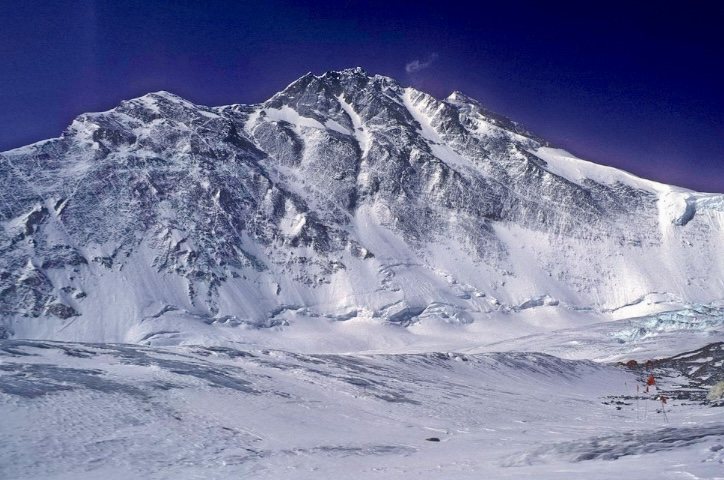
K2 seen from the direction of the Godwin-Austen GlacierPhoto source: Mark Horrell

Wolfe and the three Sherpas were the first four people to die on K2. Disputes over responsibility continued for decades. In 1992, Kaufman and Putnam, drawing on Durrance's diary and other material, concluded that responsibility was shared among several parties. In 2002, Jordan and Rhodes found human bones on the Godwin-Austen Glacier beside a glove marked “WOLFE”; they were thought to be Wolfe's remains.Facts it rests onF05Multiple sourcesWolfe and the three Sherpas were the first four recorded deaths on K2.F44Multiple sourcesIn 1992, Kaufman and Putnam published a book based on materials including Durrance's diary, concluding that responsibility was shared by several parties, including Wiessner.F45Multiple sourcesIn 2002, Jennifer Jordan and Jeff Rhoads found human bones and fragments of old equipment on the Godwin-Austen Glacier at the foot of K2. The remains were believed to be Wolfe's.F46Multiple sourcesA glove bearing the name “WOLFE” was found beside the remains, which were identified as Wolfe's on that basis, but this was not confirmed with 100 percent certainty.

The number at the end of a paragraph is how many facts it rests on; open it to see each fact and how well it is sourced: Multiple sourcesSingle source. Conflicting accounts and speculation are kept out of the narrative.

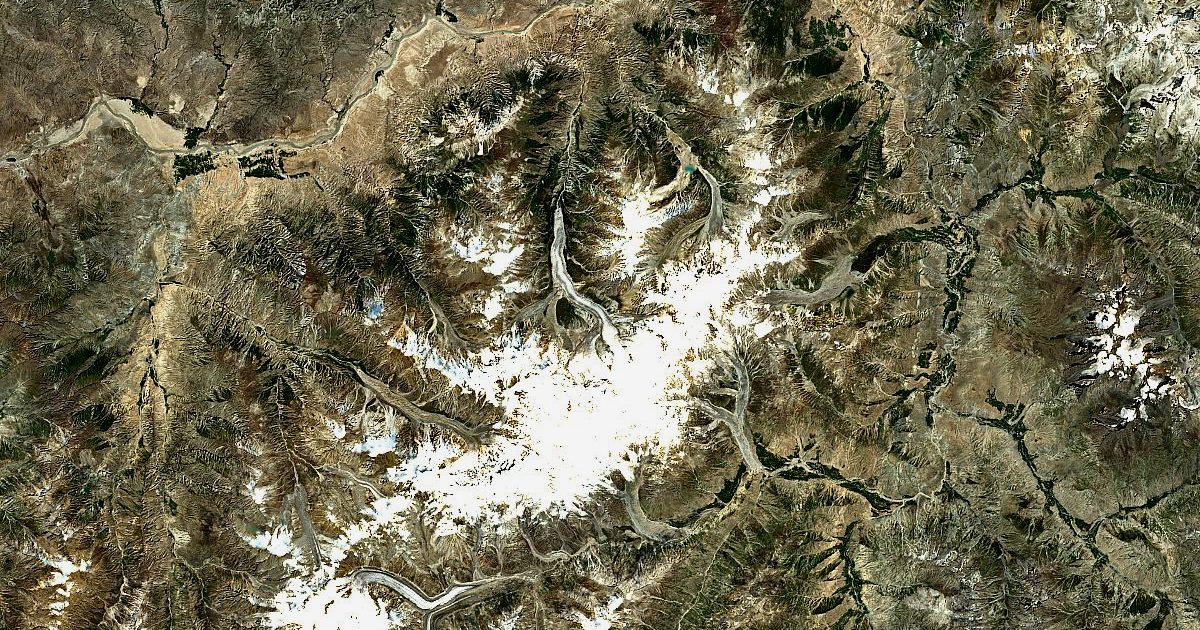
  • Reported places passed through (illustrative)Schematic

Satellite imagery Sentinel-2 cloudless 2024 © EOX · Terrain AWS Terrain Tiles · Orange line is schematic · Place coordinates not individually verified

Route review

6 scenes to understand what happened

Scroll down and the map flies to where each part happened. The line is Schematic, Lines connect the places mentioned in reports in sequence, showing only the approximate direction, not the actual route. Sources for place coordinates are listed in places.json.

01

Full route

Locations mentioned in reports are connected in sequence to show the approximate course of events (schematic).

03

About 250 metres short

On 19 July, Wiessner and Pasang Lama made a summit attempt, turning back in the evening about 250 metres from the summit.Facts it rests onF18Multiple sourcesOn 19 July, Wiessner and Pasang Lama made a summit attempt from Camp 9.F19Multiple sourcesAt 6:30 p.m., Wiessner wanted to continue climbing, but Pasang Lama was unwilling to reach the summit at night and refused to go on, leaving the two with no choice but to descend.F20Multiple sourcesAccording to records, the highest point the two reached was only about 250 metres (about 800 feet) from the summit.

04

Camps emptied

The Sherpas below believed the summit party had died and removed sleeping bags along the route; Wolfe remained alone at Camp 7.Facts it rests onF27Multiple sourcesThe Sherpas then removed sleeping bags and other supplies from the camps below Camp 7 and returned to Base Camp on 23 July, reporting that the summit party had died.F28Multiple sourcesOn 23 July, Wolfe stayed at Camp 7 to wait while Wiessner and Pasang Lama descended to get supplies.F29Multiple sourcesWiessner and Pasang Lama continued down, finding that the sleeping bags, air mattresses and most of the food had been removed from Camps 6, 5, 4 and 2.

02Timeline

  1. The expedition left Srinagar on 2 May and trekked toward K2. F07

  2. On 31 May, the team reached base camp on the Godwin-Austen Glacier at the foot of K2, planning to climb the Abruzzi Ridge without bottled oxygen. F08

  3. On 17 July, Wolfe made several unsuccessful attempts to cross the bergschrund above Camp 8 and returned to Camp 8. F16

  4. On 19 July, Wiessner and Pasang Lama made a summit attempt from Camp 9. F18

  5. During the descent at night, Pasang Lama lost his crampons while rappelling. The two returned to Camp 9 at 2:30 a.m. F21

  6. On 20 July, the Sherpas Pasang Kitar, Tsering Pindar and Pinso climbed to Camp 7 and called up to Camp 8, but received no response and concluded that something had happened to the people above. F22

  7. On 22 July, Wiessner and Pasang Lama descended to Camp 8, where Wolfe said that no one had come up from below in the past few days. The three continued down together to Camp 7. F24

  8. On 23 July, Wolfe stayed at Camp 7 to wait while Wiessner and Pasang Lama descended to get supplies. F28

  9. The Sherpas then removed sleeping bags and other supplies from the camps below Camp 7 and returned to Base Camp on 23 July, reporting that the summit party had died. F27

  10. On 24 July, Wiessner and Pasang Lama returned to Base Camp, encountering a party led by Cromwell searching on the glacier along the way. F30

  11. On 28 July, Pasang Kikuli and Tsering carried sleeping bags from Base Camp to Camp 6 in a single day. F32

  12. On 29 July, Pasang Kikuli, Pasang Kitar and Pinso reached Camp 7 and found Wolfe. He was extremely weak and unwilling to descend that day, and asked them to return the next day; the three returned to Camp 6 that day. F33

  13. On 31 July, the three Sherpas set out again for Camp 7 to bring Wolfe down. If he refused to descend, they were to ask him to write a note confirming that they had done their best. F37

  14. On 9 August, the party left Base Camp because supplies were insufficient. F41

  15. In 2002, Jennifer Jordan and Jeff Rhoads found human bones and fragments of old equipment on the Godwin-Austen Glacier at the foot of K2. The remains were believed to be Wolfe's. F45

03Lessons

Teams and decisions

Confirm the situation of people higher up before dismantling camps

The Sherpas below concluded that the summit party had died solely because their calls went unanswered and removed the sleeping bags along the route. As a result, those who actually descended could not find overnight equipment along the way. Removing camps and supplies is a decision that can affect the lives of team members higher up and should be done only after confirming the situation.Facts it rests onF22Multiple sourcesOn 20 July, the Sherpas Pasang Kitar, Tsering Pindar and Pinso climbed to Camp 7 and called up to Camp 8, but received no response and concluded that something had happened to the people above.F27Multiple sourcesThe Sherpas then removed sleeping bags and other supplies from the camps below Camp 7 and returned to Base Camp on 23 July, reporting that the summit party had died.F26Multiple sourcesAt Camp 7, they found that the sleeping bags and air mattresses stored there had been removed, leaving the three to share one sleeping bag for the night.F29Multiple sourcesWiessner and Pasang Lama continued down, finding that the sleeping bags, air mattresses and most of the food had been removed from Camps 6, 5, 4 and 2.

Avalanche and high altitude

Do not leave an exhausted person alone at altitude

Wolfe waited alone at Camp 7. By the time rescuers reached him several days later, he was too weak and unwilling to descend. The longer a person stays at high altitude, the harder it becomes to descend independently and the harder a rescue becomes.Facts it rests onF28Multiple sourcesOn 23 July, Wolfe stayed at Camp 7 to wait while Wiessner and Pasang Lama descended to get supplies.F33Multiple sourcesOn 29 July, Pasang Kikuli, Pasang Kitar and Pinso reached Camp 7 and found Wolfe. He was extremely weak and unwilling to descend that day, and asked them to return the next day; the three returned to Camp 6 that day.

Communication and location

Maintain reliable communication between those above and below

According to reports, messages between camps were passed only by handwritten notes, and the agreed signal never appeared. Those higher and lower on the mountain had to guess at one another's circumstances, and misjudgments accumulated.Facts it rests onF12Single sourceAt the time, messages were passed between camps by handwritten notes.F38Multiple sourcesThe party had agreed in advance with Base Camp on a fire signal to use in an emergency, but no signal was ever seen from the mountain.

Rescue and self-rescue

Rescuers can also be trapped by weather

After the three Sherpas first found Wolfe, a storm forced them to wait an extra day at Camp 6; subsequent searches were also blocked by successive snowstorms. High-altitude rescue must account for both the weather and the rescuers' own route back.Facts it rests onF36Multiple sourcesOn 30 July, a storm on the mountain trapped the three Sherpas at Camp 6, unable to move.F40Multiple sourcesWiessner subsequently led another search party up the mountain, but they were trapped by a snowstorm for three consecutive days and had to retreat.

04Fact list 46 facts

Under each fact is a verbatim quote from the original. "Single source" means only one outlet mentioned it; "Accounts differ" means sources contradict each other and this site adopts neither side; "Speculation" is an inference by a reporter or a person involved, not a fact.

  1. F01Multiple sourcesBackground

    The 1939 K2 expedition was led by Fritz Wiessner and was the second American attempt to climb K2.

    Quotes from the original 2

    “Led by Fritz Wiessner, the 1939 expedition was the second American effort to climb 8,611m K2, the second-highest peak in the world.”

    Explorersweb ·

    “It was actually the second U.S. attempt.”

    NPR ·
  2. F02Multiple sourcesBackground

    The expedition consisted of six American members—Wiessner, Wolfe, Cromwell, Sheldon, Kranmer and Durrance—and also recruited nine Sherpas in Darjeeling.

    Quotes from the original 2

    “A party comprising Fritz Wiessner, Dudley Wolfe, Eaton Cromwell, George Sheldon, Chappel Cranmer, and Jack Durrance was formed early in 1939 to attempt to climb K2.”

    Himalayan Journal ·

    “The party included nine Sherpas: Pasang Kikuli (sirdar/head Sherpa), Pasang Dawa Lama, Pasang Kitar, Phinsoo, Tse Tendrup, Dawa, Tsering, Sonam, and Pemba Kitar.”

    Explorersweb ·
  3. F03Multiple sourcesBackground

    Dudley Wolfe was a wealthy American with little mountaineering experience, who was invited to join the team largely to help finance the expedition.

    Quotes from the original 2

    “a rich American climbing novice, who had been invited on the expedition largely to help finance its execution.”

    AAJ ·

    “Wolfe, though an inexperienced climber, had a lot of financial resources at his disposal.”

    NPR ·
  4. F04Single sourceBackground

    According to Himalayan Journal, The Sherpa Pasang Kikuli was an experienced veteran who was only 28 when he died.

    Quotes from the original 1

    “This veteran of the hills, though only 28 years of age, is indeed a loss.”

    Himalayan Journal ·
  5. F05Multiple sourcesAftermath

    Wolfe and the three Sherpas were the first four recorded deaths on K2.

    Quotes from the original 2

    “These were the first four fatalities on the mountain”

    AAJ ·

    “These four deaths (Wolfe and the three Sherpas) were the first fatalities in K2’s history.”

    Explorersweb ·
  6. F06Single sourceAftermath

    According to Explorersweb, Afterward, deputy leader Cromwell cabled the American Alpine Club, placing the main responsibility on Wiessner.

    Quotes from the original 1

    “Cromwell sent a cable to the American Alpine Club (AAC), assigning primary responsibility for the tragedy to Wiessner.”

    Explorersweb ·
  7. F07Multiple sourcesMovement

    The expedition left Srinagar on 2 May and trekked toward K2.

    Quotes from the original 2

    “On the 2nd of May we said goodbye to Srinagar”

    AAJ ·

    “The party left Srinagar on the 2nd May”

    Himalayan Journal ·
  8. F08Multiple sourcesMovement

    On 31 May, the team reached base camp on the Godwin-Austen Glacier at the foot of K2, planning to climb the Abruzzi Ridge without bottled oxygen.

    Quotes from the original 2

    “At last, on May 31st, we turned the corner onto the Godwin- Austen Glacier and beheld K2.”

    AAJ ·

    “The group arrived at Base Camp on May 31, 1939, aiming to ascend K2 via the Abruzzi Route without bottled oxygen.”

    Explorersweb ·
  9. F09Single sourcePlan

    According to AAJ, After a reconnaissance, Wiessner considered the Abruzzi Ridge more suitable than the Northeast Ridge.

    Quotes from the original 1

    “With this view we were convinced that the Abruzzi ridge was the better”

    AAJ ·
  10. F10Multiple sourcesEvent

    In late June, the team encountered a prolonged, severe storm at Camp 4.

    Quotes from the original 2

    “while at Camp IV, terrific storms came up”

    AAJ ·

    “They were stuck in an eight-day storm.”

    Diane Rehm Show · 2010-08-31
  11. F11Multiple sourcesBackground

    Camp VII was at an altitude of approximately 24,700 feet (approximately 7,500 metres).

    Quotes from the original 3

    “now we were faced with spending the night at 24,700 ft.”

    AAJ ·

    “Camp seven in 1939 was just about 24,700 feet.”

    Diane Rehm Show · 2010-08-31

    “remained alone in Camp 7 at about 7,529m”

    Explorersweb ·
  12. F12Single sourcePost-incident analysis

    According to Mark Horrell, At the time, messages were passed between camps by handwritten notes.

    Quotes from the original 1

    “the 1939 team did all their communication using handwritten notes carried from camp to camp.”

    Mark Horrell · 2015-10-21
  13. F13Multiple sourcesMovement

    In mid-July, Durrance had difficulty breathing above Camp 6 and turned back because of altitude sickness, while Wiessner and Wolfe continued upward.

    Wiessner's report gives the date as 12 July; the Himalayan Journal gives it as 13 July.

    Quotes from the original 2

    “Durrance started but had to turn back owing to mountain sickness.”

    Himalayan Journal ·

    “Durrance had great difficulty in breathing.”

    AAJ ·
  14. F14Multiple sourcesMovement

    On 14 July, Durrance was unwell and descended from Camp 6 to Camp 2 with assistance from Pasang Kikuli and Dawa.

    Quotes from the original 2

    “Durrance, ill at Camp 6, descended with difficulty with the aid of Pasang Kikuli and Dawa to Camp 2.”

    Himalayan Journal ·

    “which camp Durrance had left, ill, on the 14th”

    AAJ ·
  15. F15Multiple sourcesMovement

    On 14 July, Wiessner, Wolfe and the Sherpa Pasang Lama camped at Camp 8.

    Quotes from the original 2

    “Wiessner, Wolfe, and their three Sherpas went on to Camp 8, Pasang Lama remaining with the two climbers there”

    Himalayan Journal ·

    “started on the 14th for Camp VIII over snowfields to the right of the shoulder ridge.”

    AAJ ·
  16. F16Multiple sourcesEvent

    On 17 July, Wolfe made several unsuccessful attempts to cross the bergschrund above Camp 8 and returned to Camp 8.

    Quotes from the original 2

    “trying again and again, he finally gave up, and returned to Camp VIII”

    AAJ ·

    “Wolfe turned back at a bergschrund three ropes' length above Camp 8 to that camp.”

    Himalayan Journal ·
  17. F17Multiple sourcesMovement

    Wiessner and Pasang Lama continued up to the shoulder of the Southeast Ridge and pitched a summit camp there (Camp 9).

    Quotes from the original 2

    “Wiessner and Pasang Lama reached the shoulder on the south-east ridge, about 25,354 feet, and pitched a tent.”

    Himalayan Journal ·

    “Crossing the slope to the shoulder of the S. E. ridge, we made camp”

    AAJ ·
  18. F18Multiple sourcesEvent

    On 19 July, Wiessner and Pasang Lama made a summit attempt from Camp 9.

    Quotes from the original 3

    “19th July. Wiessner and Pasang Lama made an attempt on the summit.”

    Himalayan Journal ·

    “Wiessner and Pasang Dawa reached their highest point of 8,385m on July 19.”

    Explorersweb ·

    “What if, on that fateful July 19, Wiessner had turned right onto the ice instead of left onto the rocks?”

    AAJ ·
  19. F19Multiple sourcesEvent

    At 6:30 p.m., Wiessner wanted to continue climbing, but Pasang Lama was unwilling to reach the summit at night and refused to go on, leaving the two with no choice but to descend.

    Quotes from the original 3

    “Pasang Lama refused to proceed ; the time was 6.30 p.m.”

    AAJ ·

    “It was 6.30pm, and although Wiessner wanted to continue, Pasang refused”

    Mark Horrell · 2015-10-21

    “Pasang Dawa Lama was terrified of being on the summit at night. He refused to move.”

    Explorersweb ·
  20. F20Multiple sourcesEvent

    According to records, the highest point the two reached was only about 250 metres (about 800 feet) from the summit.

    The altitude of the highest point comes from Wiessner's own estimate.

    Quotes from the original 2

    “It is claimed that a point 27,450 feet was reached, that is, a point only 800 feet below the summit.”

    Himalayan Journal ·

    “Wiessner and Pasang Dawa Lama got to within 250m of the summit”

    Mark Horrell · 2015-10-21
  21. F21Multiple sourcesEvent

    During the descent at night, Pasang Lama lost his crampons while rappelling. The two returned to Camp 9 at 2:30 a.m.

    Quotes from the original 3

    “unstrapping them, he lost them. We reached Camp IX at 2.30 a.m.”

    AAJ ·

    “They reached Camp 9, exhausted, at around 2:30 am on July 20.”

    Explorersweb ·

    “both men returned to camp exhausted at 2.30am”

    Mark Horrell · 2015-10-21
  22. F22Multiple sourcesEvent

    On 20 July, the Sherpas Pasang Kitar, Tsering Pindar and Pinso climbed to Camp 7 and called up to Camp 8, but received no response and concluded that something had happened to the people above.

    Quotes from the original 2

    “They shouted to the upper camp but received no response.”

    Himalayan Journal ·

    “Tendrup calling up to Camp VIII but receiving no answer”

    AAJ ·
  23. F23Multiple sourcesEvent

    On 21 July, the two tried again by a snow gully on the east side, but without crampons they had to cut steps in the hard snow. Progress was too slow, and they returned to Camp 9 that day.

    Quotes from the original 3

    “Without crampons, they had to laboriously cut steps in hard, icy snow.”

    Explorersweb ·

    “Step-cutting was necessary”

    AAJ ·

    “21st July. Another attempt was made on the summit.”

    Himalayan Journal ·
  24. F24Multiple sourcesMovement

    On 22 July, Wiessner and Pasang Lama descended to Camp 8, where Wolfe said that no one had come up from below in the past few days. The three continued down together to Camp 7.

    Quotes from the original 2

    “Wolfe was much pleased to see us, telling us no one had been up from below.”

    AAJ ·

    “There they found Wolfe, who explained that no one had arrived from below since the 17th.”

    Himalayan Journal ·
  25. F25Multiple sourcesEvent

    During the descent, all three slipped and fell, and Wolfe's sleeping bag was lost in the fall.

    Quotes from the original 2

    “Wolfe had lost his sleeping-bag in the slip”

    AAJ ·

    “They had a very nasty fall, trying to get the three of them back down off of the mountain.”

    NPR ·
  26. F26Multiple sourcesFound at scene

    At Camp 7, they found that the sleeping bags and air mattresses stored there had been removed, leaving the three to share one sleeping bag for the night.

    Quotes from the original 2

    “with one air-mattress and one sleeping-bag between the three of us”

    AAJ ·

    “but there were no sleeping-bags or mattresses.”

    Himalayan Journal ·
  27. F27Multiple sourcesEvent

    The Sherpas then removed sleeping bags and other supplies from the camps below Camp 7 and returned to Base Camp on 23 July, reporting that the summit party had died.

    Quotes from the original 3

    “reached the base on the 23rd, where they reported that an accident had occurred.”

    Himalayan Journal ·

    “arriving at Basecamp July 23rd, telling the Sahibs at Basecamp that the summit party had been killed.”

    AAJ ·

    “the lower team stripped the intermediate camps of sleeping bags, stoves, and food.”

    Explorersweb ·
  28. F28Multiple sourcesMovement

    On 23 July, Wolfe stayed at Camp 7 to wait while Wiessner and Pasang Lama descended to get supplies.

    Quotes from the original 2

    “Wolfe, tired but well, decided to remain at Camp 7, to await the return of Wiessner and Pasang Lama”

    Himalayan Journal ·

    “Wolfe accordingly remained at Camp VII, while Pasang Lama and I started down to Camp VI”

    AAJ ·
  29. F29Multiple sourcesFound at scene

    Wiessner and Pasang Lama continued down, finding that the sleeping bags, air mattresses and most of the food had been removed from Camps 6, 5, 4 and 2.

    Includes a low-credibility source

    Quotes from the original 2

    “found Camps 6, 5, 4, and 2 all evacuated of sleeping- bags, mattresses, and of almost all food.”

    Himalayan Journal ·

    “they found this camp, and then all camps from there down to Camp 2, completely abandoned.”

    Cranfield K2 History ·
  30. F30Multiple sourcesMovement

    On 24 July, Wiessner and Pasang Lama returned to Base Camp, encountering a party led by Cromwell searching on the glacier along the way.

    Quotes from the original 3

    “24th July. Wiessner and Pasang Lama reached the Base Camp, meeting a search party headed by Cromwell”

    Himalayan Journal ·

    “Cromwell and three Sherpas we found on the glacier”

    AAJ ·

    “When finally on July 24th Wiessner and Pasang made it to Base Camp”

    Cranfield K2 History ·
  31. F31Multiple sourcesEvent

    On 25 July, Durrance went up the mountain with Dawa, Pinso and Pasang Kitar to bring Wolfe down. Because of Dawa's physical condition, Durrance later decided to return immediately to seek help.

    Quotes from the original 2

    “On July 25th, Durrance with Dawa, Phinsoo and Kitar went up to bring down Wolfe”

    AAJ ·

    “Owing to Dawa's condition Durrance decided to return immediately and call assistance.”

    Himalayan Journal ·
  32. F32Multiple sourcesEvent

    On 28 July, Pasang Kikuli and Tsering carried sleeping bags from Base Camp to Camp 6 in a single day.

    Quotes from the original 2

    “On the 28th, Tsering and Kikuli started up with sleeping-bags, reaching Camp VI in one day”

    AAJ ·

    “Pasang Kikuli and Tsering accomplished the amazing feat of reaching Camp 6 in a single day from the base.”

    Himalayan Journal ·
  33. F33Multiple sourcesEvent

    On 29 July, Pasang Kikuli, Pasang Kitar and Pinso reached Camp 7 and found Wolfe. He was extremely weak and unwilling to descend that day, and asked them to return the next day; the three returned to Camp 6 that day.

    Quotes from the original 3

    “He was unwilling and too weak to descend, and asked them to return on the following day, when he would be ready.”

    AAJ ·

    “He staggered to his feet but insisted on being left for another day as he was too weak to descend.”

    Himalayan Journal ·

    “Finally on July 29th they made it but, as Wolfe was not fit to descend immediately”

    Cranfield K2 History ·
  34. F34Single sourceFound at scene

    According to Himalayan Journal, The Sherpas found that Wolfe had not eaten for several days and had no matches to light the stove, so he could not cook.

    Quotes from the original 1

    “He had eaten nothing for several days, had no matches with which to light a stove, and could cook nothing.”

    Himalayan Journal ·
  35. F35SpeculationSpeculation

    Some commentary has suggested that Wolfe's refusal to descend may have been related to confusion caused by prolonged time at high altitude.

    Quotes from the original 2

    “possibly due to altitude-induced delirium.”

    Explorersweb ·

    “so who knows if he was even aware of what he was telling the sherpas?”

    NPR ·
  36. F36Multiple sourcesEvent

    On 30 July, a storm on the mountain trapped the three Sherpas at Camp 6, unable to move.

    Quotes from the original 3

    “30th July. A storm raged over the mountain and movement was impossible.”

    Himalayan Journal ·

    “The 30th brought bad weather.”

    AAJ ·

    “Unfortunately, a storm delayed them at this stage”

    Cranfield K2 History ·
  37. F37Multiple sourcesEvent

    On 31 July, the three Sherpas set out again for Camp 7 to bring Wolfe down. If he refused to descend, they were to ask him to write a note confirming that they had done their best.

    Quotes from the original 3

    “If this was impossible, they would ask him to sign a note that they had done all they could to save him.”

    Himalayan Journal ·

    “or else obtain from him a chit exonerating them from responsibility.”

    AAJ ·

    “it was not until July 31st that Pasang and two of the Sherpas again pushed upwards to fetch him.”

    Cranfield K2 History ·
  38. F38Multiple sourcesFound at scene

    The party had agreed in advance with Base Camp on a fire signal to use in an emergency, but no signal was ever seen from the mountain.

    Quotes from the original 2

    “Fire signals had been pre-arranged with Basecamp in case of difficulties, but none were observed at any time.”

    AAJ ·

    “none of the prearranged signals from above were seen.”

    Himalayan Journal ·
  39. F39Multiple sourcesEvent

    The three Sherpas were never seen again; Tsering waited at Camp 6 without result and returned alone to Base Camp to report.

    Quotes from the original 3

    “They were not seen again. Tsering waited for them at Camp 6.”

    Himalayan Journal ·

    “it was Tsering, who returned to Basecamp at noon of the same day.”

    AAJ ·

    “who went missing when they tried to rescue him.”

    Mark Horrell · 2015-10-21
  40. F40Multiple sourcesEvent

    Wiessner subsequently led another search party up the mountain, but they were trapped by a snowstorm for three consecutive days and had to retreat.

    Quotes from the original 2

    “where we were held by heavy snowstorms for three successive days”

    AAJ ·

    “Unfortunately he was delayed by yet another storm lasting for 3 days”

    Cranfield K2 History ·
  41. F41Multiple sourcesAftermath

    On 9 August, the party left Base Camp because supplies were insufficient.

    Quotes from the original 2

    “9th August. The party, owing to shortage of supplies, left the base”

    Himalayan Journal ·

    “Augus 9th all left for Askole”

    AAJ ·
  42. F42Single sourceAftermath

    According to Explorersweb, A report published in 1940 by the American Alpine Club's investigating committee did not clearly assign responsibility.

    Quotes from the original 1

    “The committee’s published report in 1940 was intentionally non-committal.”

    Explorersweb ·
  43. F43Single sourceAftermath

    According to Explorersweb, In 1956, Wiessner published a long article in the journal Appalachia in his own defence.

    Quotes from the original 1

    “In 1956, Wiessner published a detailed defence in the journal Appalachia”

    Explorersweb ·
  44. F44Multiple sourcesPost-incident analysis

    In 1992, Kaufman and Putnam published a book based on materials including Durrance's diary, concluding that responsibility was shared by several parties, including Wiessner.

    Quotes from the original 2

    “suggesting that responsibility was shared”

    Explorersweb ·

    “Relying heavily upon Durrance's recently revealed diaries, Kauffman and Putnam place the blame elsewhere, partly upon Wiessner himself.”

    AAJ ·
  45. F45Multiple sourcesAftermath

    In 2002, Jennifer Jordan and Jeff Rhoads found human bones and fragments of old equipment on the Godwin-Austen Glacier at the foot of K2. The remains were believed to be Wolfe's.

    Quotes from the original 3

    “Rhoades and fellow film maker Jennifer Jordan were exploring the Godwin-Austen Glacier when they discovered the remains of human bones”

    AAJ ·

    “Parts of Wolfe’s skeletal remains were finally discovered in 2002 on the Godwin-Austen Glacier”

    Explorersweb ·

    “stumbled across a bleached skeleton amid archaic climbing gear from a much earlier era”

    Vail Daily ·
  46. F46Multiple sourcesFound at scene

    A glove bearing the name “WOLFE” was found beside the remains, which were identified as Wolfe's on that basis, but this was not confirmed with 100 percent certainty.

    Quotes from the original 3

    “Then finally a glove was uncovered with the name Wolfe clearly written on it.”

    AAJ ·

    “a weathered canvas and leather mitten with the word “WOLFE” written on it in capital letters”

    Vail Daily ·

    “I'd say 99 percent.”

    Diane Rehm Show · 2010-08-31