The number at the end of a paragraph is how many facts it rests on; open it to see each fact and how well it is sourced:
Multiple sourcesSingle source. Conflicting accounts and speculation are kept out of the narrative.
Reported locations along the route (schematic)Schematic
Scroll down and the map flies to where each part happened. The line is Schematic, The locations mentioned in reports are connected in sequence, indicating only the approximate direction, not the actual track. Sources for the location coordinates are in places.json.
01
Full route
Locations mentioned in reports are connected in sequence to show the approximate route (schematic).
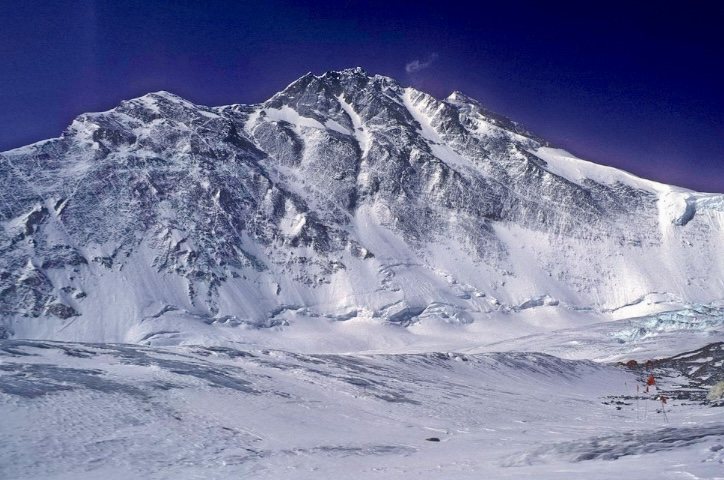
On 16 March, the team arrived at base camp on the north side of Everest after a three-day drive from Lhasa. F04
On 4 April, the team established an advanced camp on the East Rongbuk Glacier. F07
Bonington and Clarke travelled by truck to the village of Kharta on the east side of Everest, then walked approximately 40 miles (approximately 64 kilometres) over Langma La Pass to the head of the Kangshung Glacier to inspect the entire East Face. F15
On 4 May, Boardman led the climb on the First Pinnacle. The terrain was ice and broken rock, with almost no reliable protection points. F18
On 5 May, after leading a steep slope of soft snow, Renshaw felt an unusual tingling and numbness on one side of his body. F19
On 15 May, Boardman and Tasker left Advance Base Camp and took six hours to climb to the second snow cave. F21
On 16 May, the two reached the third snow cave, where there were ample supplies of food, fuel and approximately 800 feet (approximately 244 metres) of fixed rope. F22
The last radio contact with the two was on the evening of 16 May. Boardman sounded optimistic and said that both were in good condition. F24
The two continued climbing until evening. They were last seen near the Second Pinnacle, then moved to the east side of the ridge and disappeared from view; according to Bonington's recollection, it was around 9 p.m. F28
On 19 May, Bonington and Gordon opened a route to the North Col, but still did not see the two. F33
Gordon kept watch alone at Advance Base Camp until 28 May, but saw no sign of them. F34
In May 1992, Kazakh members of a joint Japanese-Kazakh team found a body near the Second Pinnacle at approximately 8200 metres. It was later identified as Boardman. F38
In 1995, a Japanese university mountaineering team reached the summit of Everest by the entire Northeast Ridge, marking the first complete ascent of the route. F39
Under each fact is a verbatim quote from the original. "Single source" means only one outlet mentioned it; "Accounts differ" means sources contradict each other and this site adopts neither side; "Speculation" is an inference by a reporter or a person involved, not a fact.
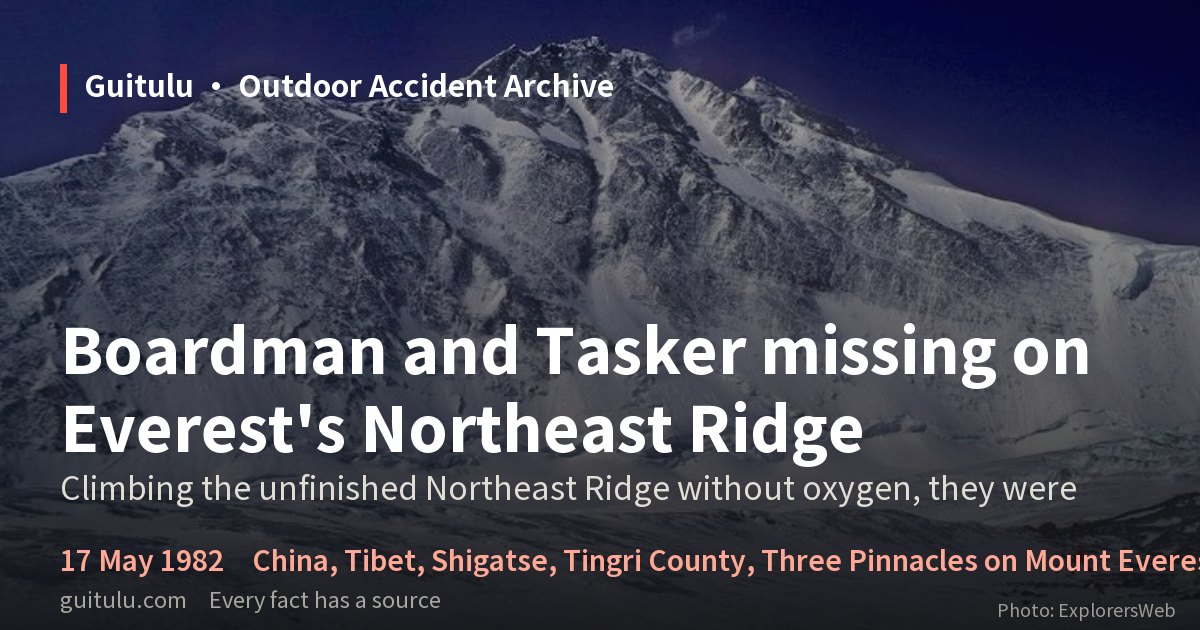
The 1982 British Everest expedition was led by Chris Bonington. The climbing team consisted of Bonington, Peter Boardman, Joe Tasker and Dick Renshaw; expedition doctor Charles Clarke and Adrian Gordon provided support.
Quotes from the original 3
“The climbing team consisted of Peter Boardman, Dick Renshaw, Joe Tasker and myself, supported by Charles Clarke who was expedition doctor and Adrian Gordon”
The team effectively used siege tactics, but used fixed ropes sparingly and dug snow caves rather than pitching tents at all the lower camps, to cope with high winds and reduce loads.
Quotes from the original 2
“The team was, in effect, employing siege tactics but using a minimal quantity of fixed rope and digging snow holes for all the lower camps.”
Bonington felt he had reached his physical limit and withdrew from the summit attempt. Instead, he went with Gordon to establish a food depot on the North Col and mark a descent route for the two climbers.
Quotes from the original 3
“Back at base camp I also came to the conclusion that I had gone as far as I was able”
Bonington and Clarke travelled by truck to the village of Kharta on the east side of Everest, then walked approximately 40 miles (approximately 64 kilometres) over Langma La Pass to the head of the Kangshung Glacier to inspect the entire East Face.
Quotes from the original 2
“drove by truck to the village of Kharta on the eastern side of the mountain and then made a forty mile trek over the Langma La (pass) and up the Kangshung glacier”
On 4 May, Boardman led the climb on the First Pinnacle. The terrain was ice and broken rock, with almost no reliable protection points.
Quotes from the original 2
“On 4 May Pete and I started climbing the First Pinnacle, Pete making a very bold lead up ice and broken rock that provided no secure cracks for piton anchors.”
On 16 May, the two reached the third snow cave, where there were ample supplies of food, fuel and approximately 800 feet (approximately 244 metres) of fixed rope.
Quotes from the original 3
“They were well set up, with a good stock of food and fuel and about 800 ft of rope”
On 16 May, Bonington and Gordon attempted to climb to the North Col, but were stopped approximately 300 feet (approximately 90 metres) below it by a wide crevasse and a wall of ice pinnacles.
Quotes from the original 2
“we were still about 300 ft below the North Col, our way barred by a broad crevasse below a serac wall”
On 17 May, Bonington and Gordon watched the two through a telescope from Advance Base Camp throughout the day. The two had apparently set out very early and had reached their previous high point by 9 a.m.
Quotes from the original 2
“they were at the previous high point by nine in the morning”
Progress then slowed, and over the entire day they fixed only approximately four rope lengths (approximately 200 metres) on new ground, mostly on the northwest side of the ridge.
Quotes from the original 2
“it took them the rest of the day to run out around four rope lengths on new ground, most of it on the northwest side”
The two continued climbing until evening. They were last seen near the Second Pinnacle, then moved to the east side of the ridge and disappeared from view; according to Bonington's recollection, it was around 9 p.m.
Quotes from the original 4
“They climbed late into the evening, reaching the foot of the Second Pinnacle, where they disappeared round the corner onto the snow on the eastern side of the ridge.”
Accounts differ on the altitude at which the two were last seen: the Boardman Tasker Prize website and Montagna.tv say approximately 8250 metres; ExplorersWeb says approximately 8300 metres; and an AAJ book review says 27,000 feet (approximately 8230 metres).
The sources rely on visual observations from a distance, and the altitudes are only estimates.
Quotes from the original 4
“attempting to traverse The Pinnacles on the unclimbed North East Ridge at around 8250 metres”
On 18 May, Bonington and Gordon set out for the North Col, watching the ridge along the way. The other side of the ridge was blocked by steep rock, and the two would necessarily have come back into view if they had continued forward.
Quotes from the original 2
“concentrating on the area where we knew they had to come back into view since the way on the other side of the ridge was barred by steep rock”
According to AAJ, In spring 1992, a joint Japanese-Kazakh team found items left by the 1982 British team above 7200 metres on the Northeast Ridge, including two sleeping bags, two backpacks and a notebook.
Quotes from the original 1
“Above Camp IV, at 7200 meters, they came upon signs of the 1982 expedition: two sleeping bags, two rucksacks, a notebook and other small items.”
In May 1992, Kazakh members of a joint Japanese-Kazakh team found a body near the Second Pinnacle at approximately 8200 metres. It was later identified as Boardman.
Quotes from the original 3
“On May 15, near the top of the second pinnacle, the Kazakhs stumbled on a corpse, which has since been identified as that of Peter Boardman.”
“Boardman’s body was found ten years later, in the spring of 1992, by Kazakh climbers on the Northeast Ridge at approximately 8,200m, near the second pinnacle.”
In 1995, a Japanese university mountaineering team reached the summit of Everest by the entire Northeast Ridge, marking the first complete ascent of the route.
Quotes from the original 2
“The entire East-Northeast Ridge route was finally climbed to the summit in 1995 (and descended by the same route) by members of the Nihon University expedition from Japan”
The ridge begins at the Lhakpa La pass, at an altitude of approximately 6510 metres (21,350 feet), between the East Rongbuk Glacier and the Kangshung Glacier.
Quotes from the original 2
“che inizia dai 6510 metri del Raphu La, un valico tra il ghiacciaio orientale di Rongbuk e quello di Kangshung”
The main difficulty of the route lies near its end, between approximately 26,000 and 27,500 feet in altitude: a series of rock pinnacles (called The Pinnacles, or the Three Pinnacles, by Bonington). Only after this section does the route join the traditional North Ridge route.
Quotes from the original 3
“with its main difficulties situated near its end between 26,000 ft and 27,500 ft, where the ridge was joined by the north ridge”
In the pinnacles section, the ridge narrows into a snow arête obstructed by a series of rock pinnacles. It is approximately 800 metres long and rises approximately 400 metres before joining the North Ridge route used by earlier expeditions.
Quotes from the original 2
“The ridge now narrowed into a knife- edged crest of snow, barred by a series of rocky pinnacles”
“the ridge narrowed into a snow crest blocked by rocky pinnacles, stretching 800m and rising 400m to join the North Ridge route used by earlier expeditions”
Bonington later recalled that the most critical difficulty of the route was that a small team needed to spend a long time at high altitude; a Kirkus review also considered that the team members had spent too long at high altitude.
Quotes from the original 2
“the key factor being the debilitating length of time that a small team would need to spend at high altitude”
The exact cause of the two men's deaths remains unknown. Speculation suggests that they may have fallen, or that they may have become exhausted or suffered hypothermia while bivouacking.
Quotes from the original 2
“What happened remains a mystery; they may have slipped and fallen, or succumbed to exhaustion during a bivouac.”
 GuituluGlobal Outdoor Accident Archive