GuituluGlobal Outdoor Accident Archive 中文
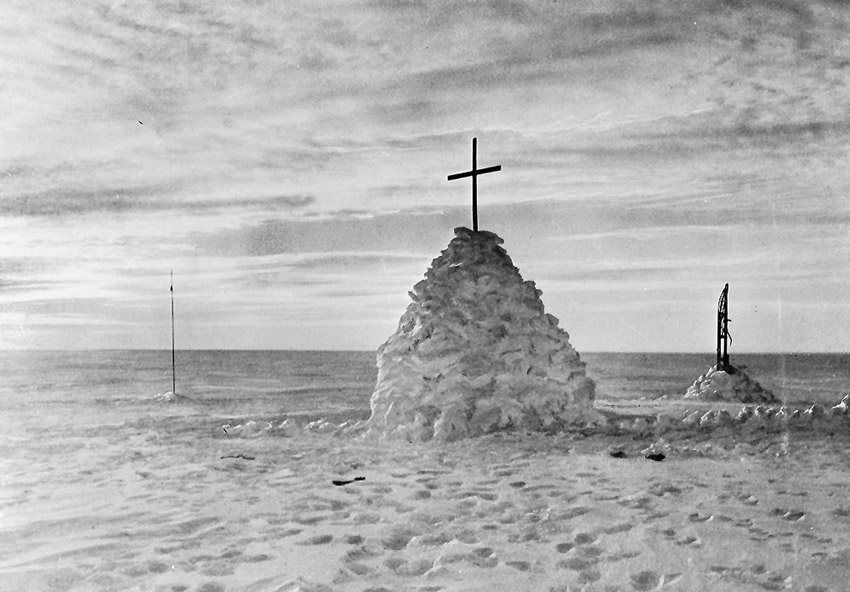
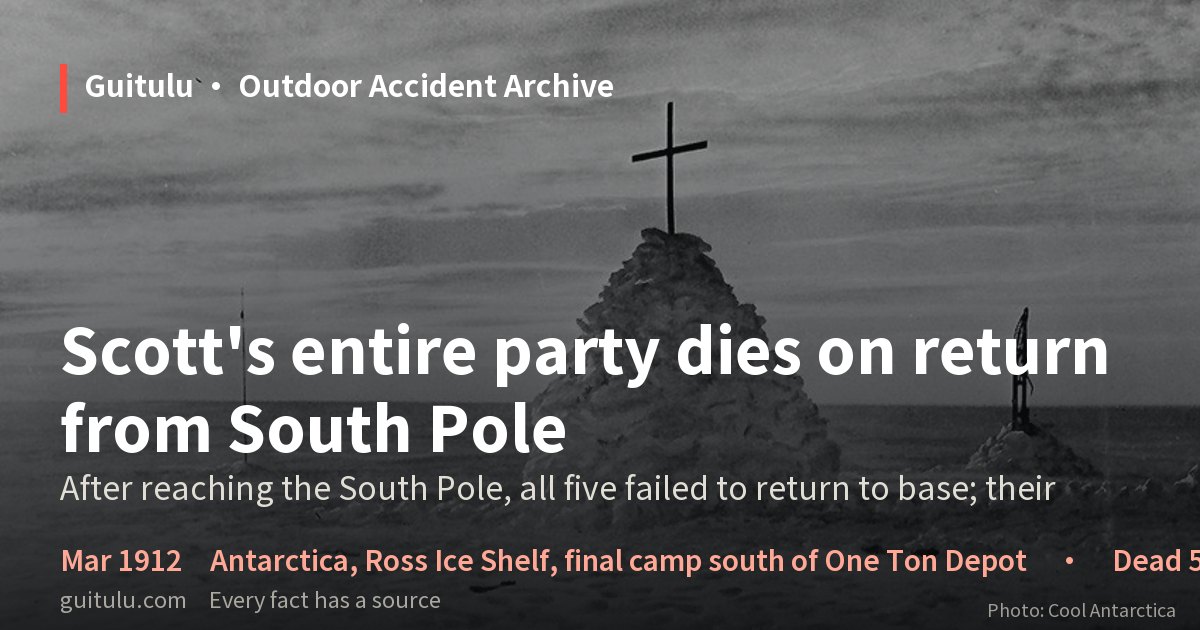
Snow cairn built for Scott and his two companions on the Ross Ice Shelf, topped by a cross made from skis

Archive / Other

Scott's entire party dies on return from South Pole

After reaching the South Pole, all five failed to return to base; their final camp was about 18 kilometres from a depot

The course of events is broadly clear; researchers still debate the relative contributions of weather, rations, fuel and scurvy to the deaths.

Photo: Cool Antarctica

Date
Late Antarctic summer to early autumn (January–March 1912)
Place
Antarctica, Ross Ice Shelf, final camp south of One Ton DepotAntarctica › Ross Dependency · Ross Ice Shelf-171.240°E -81.550°N
Activity
Polar expeditionInvolves: Hypothermia · Extreme weatherBritish Antarctic Expedition (Terra Nova, 1910–1913), five-member polar party: Robert Falcon Scott, Edward Wilson, Henry Bowers, Lawrence Oates, Edgar Evans
Casualties
Dead 5 Evans died on 17 February; Oates left the tent in mid-March and was never seen again; Scott, Wilson and Bowers died at the final camp in late March, and their bodies were found by a search and rescue party in November 1912.
Material
46 facts · 9 sources5 accounts differ and are shown side by side

01What happened

In 1910, the British Antarctic Expedition led by Scott set out, hoping to become the first party to reach the South Pole. Only when the ship stopped in Melbourne did he receive a telegram from Amundsen and learn that the Norwegian party was also heading to Antarctica. On 1 November 1911, Scott set out from Ross Island and headed south along the Beardmore Glacier route, establishing depots along the way. Supporting parties turned back in stages, and the five men pulled their own sledges for the final approximately 150 miles.Facts it rests onF01Multiple sourcesThe British Antarctic Expedition led by Scott set out in 1910, hoping to become the first party to reach the South Pole.F02Multiple sourcesIt was not until the expedition ship Terra Nova stopped at Melbourne, Australia, in September 1910 that Scott received a telegram from Amundsen and learned that the Norwegian party was also heading to Antarctica.F03Multiple sourcesFood depots were established along the southward route for the polar party's return journey, and support parties turned back in stages during the approach to the pole.F04Multiple sourcesOn 1 November 1911, Scott set out from Ross Island for the South Pole via the Beardmore Glacier route opened by Shackleton.F07Multiple sourcesThe five members of the polar party were Scott, Wilson, Bowers, Oates and Evans; for the final approximately 150 miles, they pulled the sledges themselves.

Snow cairn built for Scott and his two companions on the Ross Ice Shelf, topped by a cross made from skisPhoto source: Cool Antarctica

On 16 January 1912, the party discovered that the Norwegians had already reached the South Pole, and Scott wrote in his diary of terrible disappointment. On the return journey, the weather was extremely severe, rations were insufficient, and the men were also troubled by frostbite. On 17 February, Evans died after being injured in a heavily crevassed area of the glacier, becoming the first member of the polar party to die.Facts it rests onF09Multiple sourcesOn 16 January 1912, the party discovered that the Norwegians had already reached the South Pole; Scott wrote in his diary that it was a terrible disappointment and that he was sorry for his loyal companions.F10Multiple sourcesOn the return journey, the party encountered extremely severe weather, had insufficient rations and suffered from frostbite.F12Multiple sourcesEdgar Evans suffered a concussion in the broken ice on the glacier and died on 17 February 1912, becoming the first member of the polar party to die.

Map of the polar party's outward and return route, with key dates markedPhoto source: Cool Antarctica

From late February, the party found less fuel than expected at the depots. Scott said in a letter that he could not explain it. According to reports, daytime temperatures on the Ross Ice Shelf were often around minus 30 degrees, and the party faced headwinds throughout their journey; later research concluded that temperatures on the ice shelf were significantly lower than usual at the time. In mid-March, Oates was unable to continue because of frostbite. He walked out of the tent alone into a blizzard and was never seen again.Facts it rests onF13Multiple sourcesFrom around 24 February 1912, the party found less fuel than expected at depots along the route, and Scott said in a letter that he could not explain the shortage.F14Single sourceScott recorded that on the Ross Ice Shelf at 82° south, temperatures were often -30° during the day and -47° at night, and that the party faced a headwind throughout their travel.F15Multiple sourcesSubsequent research concluded that temperatures on the ice shelf from late February to mid-March were markedly lower than usual: Cool Antarctica says daily minimum temperatures were 10 to 20 degrees Fahrenheit below normal; THE, citing Solomon's research, says the temperature difference between the ice shelf and the Cape Evans base was twice the usual amount.F17Multiple sourcesUnable to continue because of frostbite and wishing not to hold back his companions, Oates walked alone out of the tent into a blizzard and was never seen again; Scott recorded his words: “I am just going outside and may be some time.”

Daily ration per person for the polar party: pemmican, biscuits, butter, sugar, cocoa and teaPhoto source: Cool Antarctica

The final camp was only about 11 miles (about 18 kilometres) from One Ton Depot. A prolonged blizzard trapped the three men in their tent, and their food and fuel soon ran out. Scott, Wilson and Bowers died of starvation and severe cold in late March. According to reports, Scott's final diary entry was written on 29 March.Facts it rests onF19Multiple sourcesThe final camp was only about 11 miles (about 18 kilometres) from One Ton Depot.F20Multiple sourcesA prolonged blizzard trapped the three men in their tent, preventing them from continuing towards the depot.F21Multiple sourcesThe three soon ran out of food and fuel and grew increasingly weak, eventually becoming unable to leave the tent.F23Multiple sourcesScott, Wilson and Bowers died of starvation and extreme cold in their tent in late March 1912.F31Multiple sourcesScott's final diary entry was written on 29 March 1912 and ended with “For God's sake look after our people”.

Group photo of Scott's party after reaching the South PolePhoto source: Cool Antarctica

In early March, Cherry-Garrard reached One Ton Depot with a dog team to meet the party. He waited until around 10 March before returning to base because rations were nearly exhausted. On 12 November 1912, a search and rescue party found the tent half-buried in snow and the bodies of the three men on the Ross Ice Shelf. They left the bodies in place, covered them with the tent canvas, built a snow cairn and erected a cross made from skis.Facts it rests onF26Multiple sourcesIn early March 1912, Cherry-Garrard reached One Ton Depot with a dog team and Dimitri, hoping to meet the polar party on its return; he waited at the depot until 10 March.F27Multiple sourcesCherry-Garrard's rations were running low and his companion reported being ill. He did not continue south and returned to base around 10 March.F34Multiple sourcesNearly eight months later, on 12 November 1912, a search and rescue party found the tent half buried in snow on the Ross Ice Shelf, along with the bodies of Scott, Wilson and Bowers.F33Multiple sourcesThe search and rescue party left the bodies where they were, covered them with the tent fabric, piled snow over them to form a mound, and marked it with a cross made from skis.

The number at the end of a paragraph is how many facts it rests on; open it to see each fact and how well it is sourced: Multiple sourcesSingle source. Conflicting accounts and speculation are kept out of the narrative.

ImgScene photos all from news coverage; copyright belongs to the original authors

  • Reported locations along the route (schematic)Schematic

Satellite imagery Sentinel-2 cloudless 2024 © EOX · Terrain AWS Terrain Tiles · Orange line is schematic · Place coordinates not individually verified

Route review

5 scenes to understand what happened

Scroll down and the map flies to where each part happened. The line is Schematic, Reported locations along the route are connected in sequence, showing only the approximate direction, not the actual track.

01

Full route

The locations mentioned in reports are connected in sequence to show the approximate course of the journey (schematic).

02Timeline

  1. The British Antarctic Expedition led by Scott set out in 1910, hoping to become the first party to reach the South Pole. F01

  2. On 1 November 1911, Scott set out from Ross Island for the South Pole via the Beardmore Glacier route opened by Shackleton. F04

  3. On 16 January 1912, the party discovered that the Norwegians had already reached the South Pole; Scott wrote in his diary that it was a terrible disappointment and that he was sorry for his loyal companions. F09

  4. Edgar Evans suffered a concussion in the broken ice on the glacier and died on 17 February 1912, becoming the first member of the polar party to die. F12

  5. From around 24 February 1912, the party found less fuel than expected at depots along the route, and Scott said in a letter that he could not explain the shortage. F13

  6. Unable to continue because of frostbite and wishing not to hold back his companions, Oates walked alone out of the tent into a blizzard and was never seen again; Scott recorded his words: “I am just going outside and may be some time.” F17

  7. The final camp was only about 11 miles (about 18 kilometres) from One Ton Depot. F19

  8. In early March 1912, Cherry-Garrard reached One Ton Depot with a dog team and Dimitri, hoping to meet the polar party on its return; he waited at the depot until 10 March. F26

  9. Scott's final diary entry was written on 29 March 1912 and ended with “For God's sake look after our people”. F31

  10. Nearly eight months later, on 12 November 1912, a search and rescue party found the tent half buried in snow on the Ross Ice Shelf, along with the bodies of Scott, Wilson and Bowers. F34

03Lessons

Teams and decisions

Calculate supplies before advancing

Rations and fuel originally intended for four men ultimately had to support five; the depots along the way also held less fuel than expected. Once supply reserves are reduced on a polar expedition, any weather delay directly eats into the margin of safety.Facts it rests onF06Multiple sourcesScott had originally planned a four-man polar party but decided at the last moment to include Bowers, meaning that rations and fuel prepared for four had to serve five.F13Multiple sourcesFrom around 24 February 1912, the party found less fuel than expected at depots along the route, and Scott said in a letter that he could not explain the shortage.F37Multiple sourcesOn the journey south, a gale trapped the party in their tents for four days near 83° south, consuming rations and fuel.

Hypothermia and overnight gear

Low temperatures can change travel speed

Later research concluded that temperatures on the ice shelf that year were significantly lower than usual and that the snow surface was also more difficult to haul over. Planned speeds should allow a margin for the worst low-temperature and snow-surface conditions, rather than being based on an average year.Facts it rests onF15Multiple sourcesSubsequent research concluded that temperatures on the ice shelf from late February to mid-March were markedly lower than usual: Cool Antarctica says daily minimum temperatures were 10 to 20 degrees Fahrenheit below normal; THE, citing Solomon's research, says the temperature difference between the ice shelf and the Cape Evans base was twice the usual amount.F14Single sourceScott recorded that on the Ross Ice Shelf at 82° south, temperatures were often -30° during the day and -47° at night, and that the party faced a headwind throughout their travel.F10Multiple sourcesOn the return journey, the party encountered extremely severe weather, had insufficient rations and suffered from frostbite.

Weather and retreat

The greatest danger can be closest to the depot

The final camp was only about 18 kilometres from the depot, but the men were trapped in their tent by a blizzard and could no longer move once their food and fuel ran out. The closer the objective, the more important it is to make decisions while reserves of strength and fuel remain, rather than waiting until trapped.Facts it rests onF19Multiple sourcesThe final camp was only about 11 miles (about 18 kilometres) from One Ton Depot.F20Multiple sourcesA prolonged blizzard trapped the three men in their tent, preventing them from continuing towards the depot.F21Multiple sourcesThe three soon ran out of food and fuel and grew increasingly weak, eventually becoming unable to leave the tent.

Rescue and self-rescue

Set clear trigger conditions for support plans

The dog team sent to meet the party waited at the depot until around 10 March, then returned because rations were nearly exhausted. When the support party should set out, how long it should wait and when it should turn back need to be set out clearly in advance and made known to both parties, so that each does not have to make decisions amid uncertainty.Facts it rests onF26Multiple sourcesIn early March 1912, Cherry-Garrard reached One Ton Depot with a dog team and Dimitri, hoping to meet the polar party on its return; he waited at the depot until 10 March.F27Multiple sourcesCherry-Garrard's rations were running low and his companion reported being ill. He did not continue south and returned to base around 10 March.

04Fact list 46 facts

Under each fact is a verbatim quote from the original. "Single source" means only one outlet mentioned it; "Accounts differ" means sources contradict each other and this site adopts neither side; "Speculation" is an inference by a reporter or a person involved, not a fact.

  1. F01Multiple sourcesBackground

    The British Antarctic Expedition led by Scott set out in 1910, hoping to become the first party to reach the South Pole.

    Quotes from the original 3

    “Scott launched the British Antarctic Expedition in 1910”

    PBS NOVA · 2002-03-26

    “Scott hoped that his party would be the first to reach the geographic South Pole”

    Eton College · 2019-09-18

    “Captain Robert Scott and four others hoped to be the first to reach the South Pole”

    Cool Antarctica · 2007-08-22
  2. F02Multiple sourcesBackground

    It was not until the expedition ship Terra Nova stopped at Melbourne, Australia, in September 1910 that Scott received a telegram from Amundsen and learned that the Norwegian party was also heading to Antarctica.

    Quotes from the original 2

    “He was not told of Amundsen's attempt until he received a telegram from Amundsen in September 1910 when the Terra Nova was in Melbourne, Australia.”

    Cool Antarctica · 2007-08-22

    “he shocked the world and Robert Falcon Scott with a telegram unveiling his secret intention”

    PBS NOVA · 2002-03-26
  3. F03Multiple sourcesPlan

    Food depots were established along the southward route for the polar party's return journey, and support parties turned back in stages during the approach to the pole.

    Quotes from the original 2

    “they laid depots of food and supplies to be used by those going to the pole during their return journey, and turned back in small groups as they got closer to the pole”

    Cool Antarctica · 2007-08-22

    “The support teams traveled as far as Polar Plateau taking the sledge dogs with them.”

    Columbia CCNMTL ·
  4. F04Multiple sourcesMovement

    On 1 November 1911, Scott set out from Ross Island for the South Pole via the Beardmore Glacier route opened by Shackleton.

    Quotes from the original 2

    “set out from Ross Island on November 1, 1911, following the Beardmore Glacier route trailblazed by Shackleton”

    PBS NOVA · 2002-03-26

    “He set off on the 1st of November 1911 with sixteen men”

    Cool Antarctica · 2007-08-22
  5. F05Accounts differBackground

    Amundsen's party reached the South Pole about a month before Scott's party, but accounts differ on the date: Live Science and Cool Antarctica give 14 December 1911, while PBS NOVA gives 15 December.

    Quotes from the original 3

    “Norwegian explorer Roald Amundsen had gotten there first, on Dec. 14, 1911”

    Live Science · 2012-03-29

    “about a month after Amundsen's party had reached the Pole on the 14th of December 1911”

    Cool Antarctica · 2007-08-22

    “His team set out on October 19 with four men and 52 dogs and arrived at the Pole on December 15.”

    PBS NOVA · 2002-03-26
  6. F06Multiple sourcesPlan

    Scott had originally planned a four-man polar party but decided at the last moment to include Bowers, meaning that rations and fuel prepared for four had to serve five.

    Quotes from the original 2

    “This meant that all the planned rations and fuel for four now needed to supply five”

    Cool Antarctica · 2007-08-22

    “With five men sharing rations meant for four”

    PBS NOVA · 2002-03-26
  7. F07Multiple sourcesBackground

    The five members of the polar party were Scott, Wilson, Bowers, Oates and Evans; for the final approximately 150 miles, they pulled the sledges themselves.

    Quotes from the original 2

    “Scott, E. Wilson, Lt H.R. Bowers, Capt. L.E.G. Oates and Petty officer E. Evans traveled the last 150 miles to the pole hauling their own sledges”

    Columbia CCNMTL ·

    “Oates, Bowers, Scott, Wilson, Evans.”

    Cool Antarctica · 2007-08-22
  8. F08Accounts differEvent

    Sources differ on the date Scott's party reached the South Pole: PBS NOVA and the Eton College archives give 17 January 1912; Cool Antarctica gives 18 January; and Columbia CCNMTL gives 16 January.

    The sources may respectively record the days when the party found signs of the Norwegians, reached the pole and posed for a photograph at Amundsen's tent.

    Quotes from the original 4

    “They arrived at the Pole on January 17, 1912”

    PBS NOVA · 2002-03-26

    “On 17 January 1912, the British party arrived at the Pole”

    Eton College · 2019-09-18

    “They reached the Pole on the 18th of January 1912.”

    Cool Antarctica · 2007-08-22

    “Scott and his four companions reached the south pole on January 16, 1912”

    Columbia CCNMTL ·
  9. F09Multiple sourcesEvent

    On 16 January 1912, the party discovered that the Norwegians had already reached the South Pole; Scott wrote in his diary that it was a terrible disappointment and that he was sorry for his loyal companions.

    Quotes from the original 2

    “On Jan. 16, after a two-and-a-half month slog across a glacier, over the Transantarctic Mountains, and through blinding snow, the team discovered they'd been beaten to the South Pole.”

    Live Science · 2012-03-29

    “It is a terrible disappointment, and I am very sorry for my loyal companions.”

    Cool Antarctica · 2007-08-22
  10. F10Multiple sourcesEvent

    On the return journey, the party encountered extremely severe weather, had insufficient rations and suffered from frostbite.

    Quotes from the original 2

    “Scott and his companions met horrific weather conditions on the return journey.”

    Columbia CCNMTL ·

    “During the return journey, the men faced treacherous weather conditions along with a lack of adequate food”

    Eton College · 2019-09-18
  11. F11Single sourceEvent

    According to SPRI, Scott wrote that the party did not encounter a single completely fine day while crossing the Beardmore Glacier on the return journey.

    Quotes from the original 1

    “on our return we did not get a single completely fine day”

    SPRI ·
  12. F12Multiple sourcesEvent

    Edgar Evans suffered a concussion in the broken ice on the glacier and died on 17 February 1912, becoming the first member of the polar party to die.

    THE cites Solomon's view that Evans may have died of cerebral oedema.

    Quotes from the original 4

    “we got into frightfully rough ice and Edgar Evans received a concussion of the brain”

    SPRI ·

    “Edgar Evans died on the 17th of Feb 1912”

    Cool Antarctica · 2007-08-22

    “Evans was the first to die suffering from a concussion.”

    Columbia CCNMTL ·

    “the death of Edgar Evans (because of a cerebral oedema, suggests Solomon)”

    THE · 2002-01-18
  13. F13Multiple sourcesFound at scene

    From around 24 February 1912, the party found less fuel than expected at depots along the route, and Scott said in a letter that he could not explain the shortage.

    Quotes from the original 2

    “From this date onwards, Scott's party had less fuel at each depot than they had expected”

    Cool Antarctica · 2007-08-22

    “a shortage of fuel in our depÙts for which I cannot account”

    SPRI ·
  14. F14Single sourceEvent

    According to SPRI, Scott recorded that on the Ross Ice Shelf at 82° south, temperatures were often -30° during the day and -47° at night, and that the party faced a headwind throughout their travel.

    Quotes from the original 1

    “On the Barrier in lat. 82º, 10,000 feet lower, we had -30º in the day, -47º at night pretty regularly, with continuous head wind during our day marches.”

    SPRI ·
  15. F15Multiple sourcesPost-incident analysis

    Subsequent research concluded that temperatures on the ice shelf from late February to mid-March were markedly lower than usual: Cool Antarctica says daily minimum temperatures were 10 to 20 degrees Fahrenheit below normal; THE, citing Solomon's research, says the temperature difference between the ice shelf and the Cape Evans base was twice the usual amount.

    Quotes from the original 2

    “The daily minima from late February until the final camp were an additional -10 to -20F below what would normally be expected in that area at that time of year.”

    Cool Antarctica · 2007-08-22

    “in the critical period from late-February to mid-March, when temperatures on the barrier were 38F lower than temperatures at the expedition's coastal base at Cape Evans, double the usual differential”

    THE · 2002-01-18
  16. F16Single sourcePost-incident analysis

    According to THE, Solomon's research concluded that when temperatures fell below -20 degrees Fahrenheit, the snow surface became like sandpaper, making it increasingly difficult to pull the sledges; during this period, Oates and then Scott had their movement restricted by frostbite to their feet.

    Quotes from the original 2

    “Below - 20F, sledging becomes increasingly difficult, as ice takes on the characteristics of sandpaper.”

    THE · 2002-01-18

    “frost-bitten feet crippled first Oates and then Scott in this critical period”

    THE · 2002-01-18
  17. F17Multiple sourcesEvent

    Unable to continue because of frostbite and wishing not to hold back his companions, Oates walked alone out of the tent into a blizzard and was never seen again; Scott recorded his words: “I am just going outside and may be some time.”

    Quotes from the original 3

    “He said, 'I am just going outside and may be some time.' He went out into the blizzard and we have not seen him since”

    Live Science · 2012-03-29

    “Unable to continue marching due to his frostbitten feet, Oates walked to his death in a blizzard.”

    Columbia CCNMTL ·

    “He didn’t want to slow them down and left the camp and walked into a blizzard, he wasn’t seen again.”

    FSJ · 2022-11-02
  18. F18Accounts differEvent

    Accounts differ on the date Oates walked out of the tent: the Eton College archives give 16 March; Cool Antarctica gives 17 March.

    Live Science says Scott recorded this in his diary on 16 March.

    Quotes from the original 2

    “On 16 March, Oates left the tent, walking out into a blizzard.”

    Eton College · 2019-09-18

    “Captain Lawrence Oates "The Soldier" had walked out of the tent to his death on the 17th of March”

    Cool Antarctica · 2007-08-22
  19. F19Multiple sourcesFound at scene

    The final camp was only about 11 miles (about 18 kilometres) from One Ton Depot.

    Quotes from the original 4

    “their last camp was 11 miles from the One Ton Depot”

    Columbia CCNMTL ·

    “unable to continue toward a cache of food at a pre-established depot only 11 miles (18 kilometers) away”

    Live Science · 2012-03-29

    “just 18 kilometers from a food depot called One Ton”

    Polar Journal ·

    “We arrived within 11 miles of our old One Ton Camp with fuel for one last meal and food for two days.”

    SPRI ·
  20. F20Multiple sourcesEvent

    A prolonged blizzard trapped the three men in their tent, preventing them from continuing towards the depot.

    Quotes from the original 3

    “Due to the continuing blizzard, they were unable to continue traveling.”

    Columbia CCNMTL ·

    “For more than a week, a raging storm had kept the trio holed up in their tent on the Antarctic ice sheet”

    Live Science · 2012-03-29

    “For four days we have been unable to leave the tent – the gale howling about us.”

    SPRI ·
  21. F21Multiple sourcesEvent

    The three soon ran out of food and fuel and grew increasingly weak, eventually becoming unable to leave the tent.

    Quotes from the original 2

    “They soon ran out of food and fuel.”

    Columbia CCNMTL ·

    “they ran out of both food and fuel becoming weaker until they could no longer leave the tent”

    Cool Antarctica · 2007-08-22
  22. F22Single sourceParticipant's view

    According to SPRI, At the final camp, Scott wrote his “Message to the Public”, arguing that the disaster was not the result of poor organisation but of misfortune encountered while taking necessary risks.

    Quotes from the original 1

    “The causes of the disaster are not due to faulty organisation, but to misfortune in all risks which had to be undertaken.”

    SPRI ·
  23. F23Multiple sourcesEvent

    Scott, Wilson and Bowers died of starvation and extreme cold in their tent in late March 1912.

    Quotes from the original 2

    “died in their tent in late March 1912 of exposure and starvation”

    FSJ · 2022-11-02

    “Scott, Wilson, and Bowers died of starvation and exposure.”

    Columbia CCNMTL ·
  24. F24SpeculationSpeculation

    Conjecture: Scott may have been the last of the three to die.

    Quotes from the original 2

    “It seems that he was the last of the three to die.”

    Cool Antarctica · 2007-08-22

    “Scott apparently died after his companions did.”

    Live Science · 2012-03-29
  25. F25Accounts differPost-incident analysis

    Accounts differ on whether the final blizzard described in Scott's diary, said to have lasted nine days from 21 to 29 March, actually occurred: Solomon ruled out the possibility of a nine-day blizzard in her book; new research by atmospheric scientist Mira Zinkova suggests that the final blizzard was likely much as Scott described it.

    Quotes from the original 2

    “the final chapter dismisses the possibility of the nine-day blizzard, which Scott's journal claimed had kept the explorers tent-bound before their deaths”

    THE · 2002-01-18

    “shows that “the final blizzard probably unfolded as Scott described it.””

    Polar Journal ·
  26. F26Multiple sourcesMovement

    In early March 1912, Cherry-Garrard reached One Ton Depot with a dog team and Dimitri, hoping to meet the polar party on its return; he waited at the depot until 10 March.

    Quotes from the original 2

    “he led a dog team to One-Ton Depot in early March 1912, hoping to meet the party on its return”

    THE · 2002-01-18

    “Cherry-Garrard remained at One Ton Depot until the 10th of March”

    Cool Antarctica · 2007-08-22
  27. F27Multiple sourcesMovement

    Cherry-Garrard's rations were running low and his companion reported being ill. He did not continue south and returned to base around 10 March.

    Quotes from the original 2

    “With his supplies almost exhausted, and his companion, Dimitri Gerof, complaining of illness, Cherry turned for home.”

    THE · 2002-01-18

    “when he had no further rations to stay any longer and returned to the expedition base”

    Cool Antarctica · 2007-08-22
  28. F28Single sourceMovement

    According to Cool Antarctica, Scott, Wilson and Bowers made their final camp on 19 March 1912.

    Quotes from the original 1

    “They had made camp for the last time ten days earlier on the 19th of March.”

    Cool Antarctica · 2007-08-22
  29. F29Single sourceFound at scene

    According to Polar Journal, Records at the Cape Evans base show that a gale began on 19 March 1912 and lasted 54 hours; the wind rose again on 24 March and lasted 3 days and 10 hours.

    Quotes from the original 1

    “On March 19, at Cape Evans, an initial gale set in and lasted 54 hours. On March 23, the wind dropped and changed direction, before picking up again on March 24 for 3 days and 10 hours.”

    Polar Journal ·
  30. F30Single sourceEvent

    According to Live Science, Scott's diary entry of 22 March said that the blizzard continued, Wilson and Bowers were unable to set out, the fuel had run out, and only one or two days' worth of food remained.

    Quotes from the original 1

    “"Blizzard bad as ever," Scott wrote a week earlier, on March 22, 1912. "Wilson and Bowers unable to start. Tomorrow last chance. No fuel and only one or two of food left”

    Live Science · 2012-03-29
  31. F31Multiple sourcesEvent

    Scott's final diary entry was written on 29 March 1912 and ended with “For God's sake look after our people”.

    Quotes from the original 3

    “On Thursday, March 29, Scott recorded his final entry:”

    Live Science · 2012-03-29

    “The last entry in Scott's diary was on the 29th of March 1912”

    Cool Antarctica · 2007-08-22

    “with the last entry saying “For God’s sake look after our people.””

    FSJ · 2022-11-02
  32. F32SpeculationSpeculation

    Inferred: Scott is generally thought to have died around 29 March, the date of his final diary entry, but the exact date cannot be determined.

    Quotes from the original 1

    “it is assumed but not certain that this was the date on which he died”

    Cool Antarctica · 2007-08-22
  33. F33Multiple sourcesAftermath

    The search and rescue party left the bodies where they were, covered them with the tent fabric, piled snow over them to form a mound, and marked it with a cross made from skis.

    Quotes from the original 3

    “They then built a cairn of snow on top of them before making a cross out of skis to place on top.”

    FSJ · 2022-11-02

    “The searchers covered the tent with snow, marked it with a cross made from skis, and left the dead men where they lay.”

    Live Science · 2012-03-29

    “The tent poles were removed and the bodies covered by the tent fabric”

    Cool Antarctica · 2007-08-22
  34. F34Multiple sourcesFound at scene

    Nearly eight months later, on 12 November 1912, a search and rescue party found the tent half buried in snow on the Ross Ice Shelf, along with the bodies of Scott, Wilson and Bowers.

    Quotes from the original 3

    “found in the tent nearly eight months later on the 12th of November 1912”

    Cool Antarctica · 2007-08-22

    “Eight months later, in November 1912, a search party found three frozen bodies in a tent half-buried by snow.”

    Live Science · 2012-03-29

    “The group found the tent and the bodies of Scott, Bowers and Wilson inside.”

    FSJ · 2022-11-02
  35. F35Single sourceFound at scene

    According to FSJ, The search and rescue party found Scott's diary, which recorded their final days.

    Quotes from the original 1

    “Scott’s diary was found and recorded the final days of the men.”

    FSJ · 2022-11-02
  36. F36Multiple sourcesPlan

    Scott relied mainly on Siberian ponies and two motor sledges for transport rather than sled dogs; the party members had insufficient experience driving dogs and were more inclined to haul sledges by hand.

    Quotes from the original 3

    “Scott decided to rely mainly on Siberian ponies and two motor sledges rather than sledge dogs.”

    Columbia CCNMTL ·

    “Novice dog drivers, the team favored manhauling—pulling sledges themselves.”

    PBS NOVA · 2002-03-26

    “He also took dog teams, though didn't train his men sufficiently in their use and didn't use them as much as he could.”

    Cool Antarctica · 2007-08-22
  37. F37Multiple sourcesEvent

    On the journey south, a gale trapped the party in their tents for four days near 83° south, consuming rations and fuel.

    Quotes from the original 3

    “the long gale in 83º S., stopped us”

    SPRI ·

    “the one that pinned Scott down in the tent for 4 days on the way to the pole, consuming rations and fuel”

    Cool Antarctica · 2007-08-22

    “an unusually wet blizzard kept Scott tent-bound for four days”

    THE · 2002-01-18
  38. F38Single sourceBackground

    According to Cool Antarctica, Of the five men, only Bowers had no skis and had to walk in the soft snow.

    Quotes from the original 1

    “though Bowers didn't have skis, the other four had them as planned but he had to trudge through deep soft snow by walking”

    Cool Antarctica · 2007-08-22
  39. F39Single sourcePost-incident analysis

    According to Cool Antarctica, Later estimates put the party's rations at about 4500 kcal per person per day on the outward journey and about 3800 kcal on the return, while they consumed about 7000 kcal per day, amounting to prolonged chronic starvation.

    Quotes from the original 2

    “provided about 4,500 kilocalories per man per day on the way to the Pole and about 3,800 on the return journey”

    Cool Antarctica · 2007-08-22

    “We now know that they were expending in the region of 7,000 kilocalories per day”

    Cool Antarctica · 2007-08-22
  40. F40Single sourcePost-incident analysis

    According to Cool Antarctica, The reduction in fuel at the depots was associated with leaks from fuel cans stored there.

    Quotes from the original 1

    “fuel that was already running out in the latter stages as canisters in depots had leaked”

    Cool Antarctica · 2007-08-22
  41. F41Multiple sourcesAftermath

    Cherry-Garrard blamed himself for the rest of his life for not continuing south from the depot to meet the party.

    Quotes from the original 2

    “Cherry was tormented by the belief that he should have pressed on from the depot to try to save them.”

    THE · 2002-01-18

    “held himself responsible for the rest of his life for not going further south when Scott was so close”

    Cool Antarctica · 2007-08-22
  42. F42Single sourceAftermath

    According to FSJ, The grave has been covered by snow and has gradually sunk into the ice under the weight of accumulated snow.

    Quotes from the original 1

    “The grave site itself is now covered in drifting snow and has been moving downward into the ice due to the weight of accumulating snow.”

    FSJ · 2022-11-02
  43. F43Single sourceAftermath

    According to FSJ, A permanent memorial to Scott's party was later erected on Observation Hill near McMurdo Station at the southern end of Ross Island.

    Quotes from the original 1

    “A permanent memorial to Scott and his men has since been erected on Observation Hill near McMurdo Station”

    FSJ · 2022-11-02
  44. F44Single sourceFound at scene

    According to PBS NOVA, The party still had about 30 pounds of geological samples with them when they died.

    Quotes from the original 1

    “Scott's team was carrying 30 pounds of geological samples when they died.”

    PBS NOVA · 2002-03-26
  45. F45Multiple sourcesPost-incident analysis

    In The Coldest March, scientist Susan Solomon argued that exceptionally severe weather was the main cause of the polar party's deaths.

    Quotes from the original 2

    “Solomon argues instead that unseasonably adverse weather conditions were the primary cause of the deaths of Scott, Bowers, Oates and Wilson.”

    THE · 2002-01-18

    “attesting, through atmospheric studies, that his shattering failure was indeed due to abysmal climatic circumstances”

    Polar Journal ·
  46. F46Accounts differPost-incident analysis

    Accounts differ on how much of a role scurvy played in the deaths: PBS NOVA and the Eton College archives say the men suffered severely from scurvy; Solomon's research as reported by THE and Cool Antarctica, however, hold that they had not eaten sledging rations long enough for scurvy to develop fully.

    Quotes from the original 4

    “the party was ravaged by malnutrition, scurvy, snowblindness, exhaustion, and injury”

    PBS NOVA · 2002-03-26

    “the ravages of scurvy and frostbite”

    Eton College · 2019-09-18

    “in modern tests, subjects develop scurvy only when deprived of vitamin C for between 19 and 30 weeks”

    THE · 2002-01-18

    “The length of time the party were exclusively eating sledging rations was not enough to develop scurvy fully”

    Cool Antarctica · 2007-08-22