GuituluGlobal Outdoor Accident Archive 中文
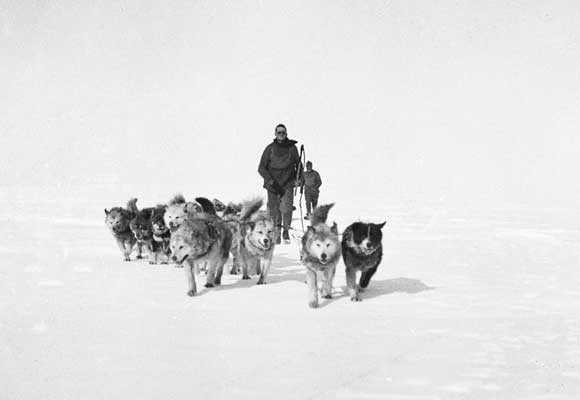
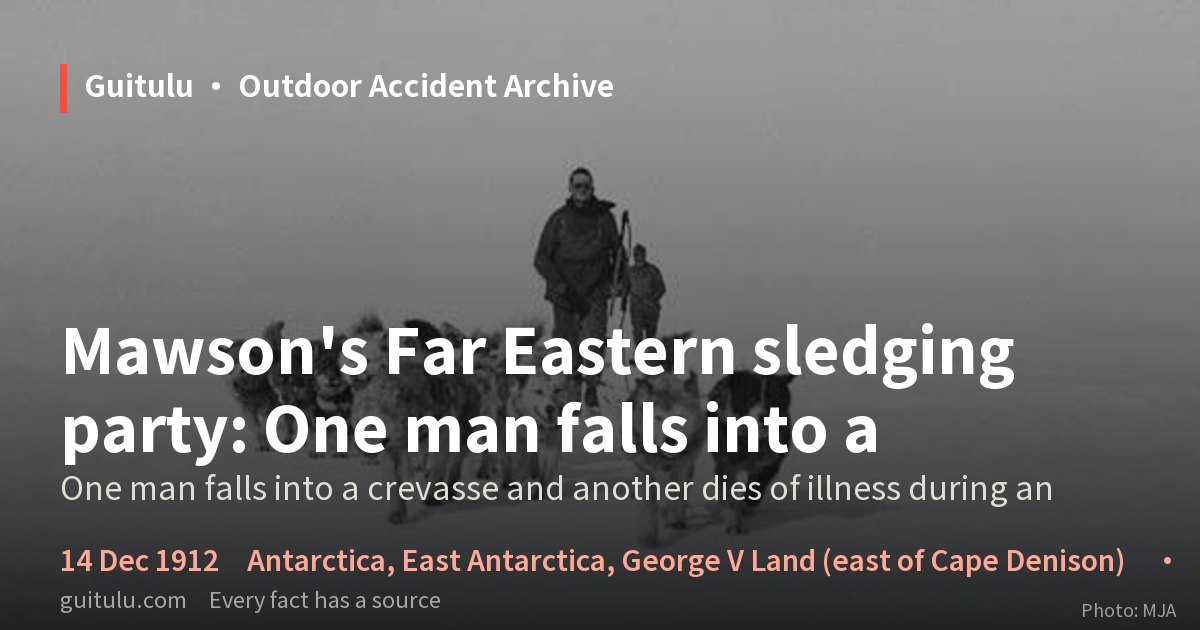
Members of the Australasian Antarctic Expedition travelling across the ice with sled dogs (historical photograph)

Archive / Other

Mawson's Far Eastern sledging party: One man falls into a crevasse, another dies on the return journey, and Mawson walks back to base alone

One man falls into a crevasse and another dies of illness during an Antarctic survey; their leader walks back to base alone

The sequence of events is clear; the cause of Mertz's death remains disputed, with explanations including vitamin A poisoning, severe starvation and a sudden change in diet.

Photo: MJA

Date
Antarctic summer (November 1912 to February 1913)
Place
Antarctica, East Antarctica, George V Land (east of Cape Denison)Antarctica › Australian Antarctic Territory · East Antarctic Ice Sheet148.000°E -68.500°N
Activity
Polar explorationInvolves: Hypothermia · Crevasses and glaciers · Extreme weather · Sudden illness and exhaustionThree members of the Far Eastern Sledging Party of the Australasian Antarctic Expedition (1911–1914): Douglas Mawson, Belgrave Ninnis and Xavier Mertz
Casualties
Dead 2 Ninnis died after falling into a crevasse on 14 December 1912; his body was not recovered. Mertz died on the return journey in January 1913; Mawson returned to base alone.
Material
45 facts · 10 sources5 accounts differ and are shown side by side

01What happened

On 10 November 1912, Australasian Antarctic Expedition leader Douglas Mawson set out from Cape Denison with Belgrave Ninnis and Xavier Mertz, using two teams of sled dogs to survey the unknown coast to the east. Of the several sledging parties, theirs travelled the farthest and had the most dangerous assignment. Ninnis and Mertz were friends responsible for looking after the sled dogs. Hidden crevasses were a constant threat along the way, and men, dogs and sledges had all broken through the snow cover.Facts it rests onF04Multiple sourcesMawson, Ninnis and Mertz formed the Far Eastern Sledging Party and set out from Cape Denison on 10 November 1912 to survey the unknown coastal region east of the base.F01Multiple sourcesThe Far Eastern Sledging Party had the longest and most dangerous assignment of the several sledging parties Mawson planned: to survey the most distant unknown coast east of Cape Denison.F39Multiple sourcesNinnis and Mertz were responsible for looking after the expedition's sled dogs and were close friends.F03Multiple sourcesHidden crevasses were a continuing threat during the first few weeks, with men, dogs or sleds repeatedly breaking through snow covers. On one occasion, Ninnis broke through the snow cover of a crevasse over which they had unknowingly camped and avoided falling in only by spreading his arms.

Members of the Australasian Antarctic Expedition travelling across the ice with sled dogs (historical photograph)Photo source: MJA

As supplies were used up, Mawson reduced the three sledges to two, placing the best dogs and most of the food on Ninnis's sledge. He thought that if a snow cover collapsed, he himself, travelling in front, would be the first to come to harm. After midday on 14 December, Mertz signalled that there was another crevasse ahead. Mertz crossed safely on skis, as did Mawson's sledge, but Ninnis, following on foot beside the sledge, silently broke through the snow bridge. When the two men looked back, they saw only a large hole in the snow, with an injured dog and some items about 150 feet below. Their rope was too short to descend. They called out for about three hours without response, and Mawson recited a funeral prayer.Facts it rests onF06Multiple sourcesAs supplies were consumed, Mawson reduced the three sleds to two and put the best dogs and most of the food on the sled at the rear with Ninnis. He believed that if a snow cover collapsed, his own sled in front would be the first to be endangered.F10Multiple sourcesAfter midday on 14 December, Mertz, who was in front, raised his ski pole to signal another crevasse. Mawson's sled crossed it diagonally, and he looked back to warn Ninnis; Ninnis instead crossed it straight on, at a right angle.F11Multiple sourcesMertz on skis and Mawson riding on his sled crossed safely, but Ninnis, walking alongside the sled behind them, silently broke through the snow bridge and fell into the crevasse along with the sled and dogs.F12Multiple sourcesMertz stopped and looked back. Mawson turned to find that Ninnis and his sled team had disappeared, and when he hurried back, he saw only a large hole in the snow.F13Multiple sourcesThe two men looked down into the crevasse and saw only an injured, whimpering dog and some items on a snow ledge about 150 feet (about 50 metres) below; they saw neither Ninnis nor his sled.F14Multiple sourcesThe rope they had brought was too short to descend into the crevasse.F15Multiple sourcesThe two men called down into the crevasse for about three hours without a response, after which Mawson read a funeral prayer.

Three men travelling with sled dog teams on the ice in the distance (historical photograph)Photo source: RAHS

The best dogs, almost all the dog food, most of the rations and the main tent fell with Ninnis. They were now about 500 kilometres from base, with only 6 weak dogs, a piece of tent fabric without poles, sleeping bags and about 10 days' rations, while the return journey would take at least 30 days. The two abandoned the coastal route, where crevasses were numerous and the sea ice unreliable, and returned inland. They used sledge runners and skis to support the tent fabric for shelter, and as the dogs became exhausted one by one, they were killed for food.Facts it rests onF16Multiple sourcesThe best dogs, almost all the dog food and most of the men's rations, as well as the main tent, fell with Ninnis.F17Multiple sourcesAt the time of the incident, they were about 500 kilometres (nearly 300 miles) from base.F18Multiple sourcesThe only supplies remaining were 6 weakened dogs, a spare tent canvas without poles, sleeping bags and about 10 days of rations, while the return journey would take at least 30 days.F19Multiple sourcesThe two men considered descending to the coast, but decided that crossing the crevasse field was too dangerous and that the sea ice was unreliable. They chose to return by the inland route and kill dogs for food when their rations ran out.F20Multiple sourcesThey used sled runners and Mertz's skis as supports to pitch the spare tent canvas for shelter.F07Multiple sourcesOn the return journey, the sled dogs became exhausted one by one and were killed for food.

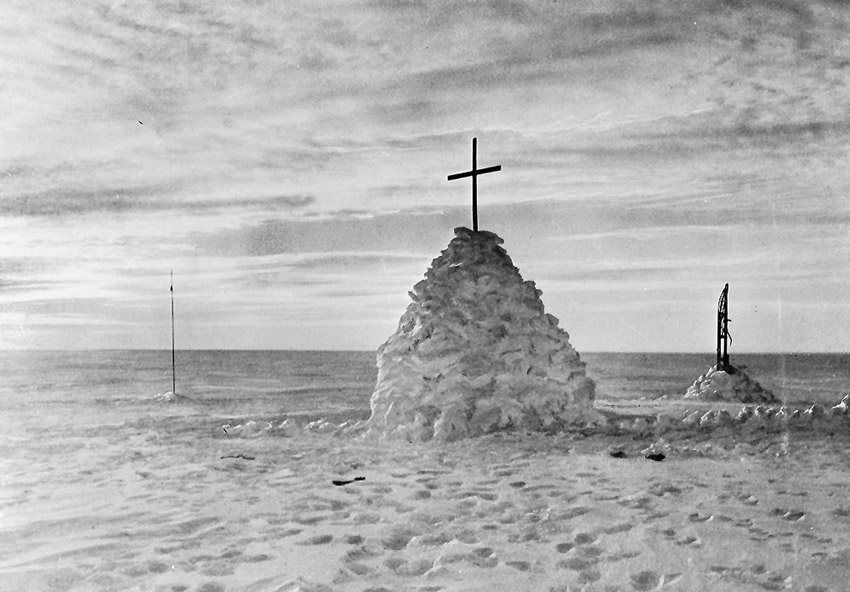
Plaque commemorating Ninnis and Mertz beneath the memorial cross at Cape DenisonPhoto source: RAHS

Both men suffered peeling skin, hair loss and weight loss. The last dog died on 28 December. Around New Year's Day, about 160 kilometres from base, Mertz grew increasingly weak, and Mawson at one point put him on the sledge and pulled it alone. Mertz died in early January 1913, and Mawson buried him with his sleeping bag beneath blocks of snow.Facts it rests onF08Multiple sourcesBoth men developed symptoms including peeling skin, hair loss and weight loss.F21Multiple sourcesThe last dog, Ginger, died on 28 December; before that, the two men had put on harnesses and pulled the sled alongside her.F25Multiple sourcesAround New Year's Day 1913, about 160 kilometres from base, Mertz grew increasingly weak amid hunger, arduous travel, a poor diet, cold and damp.F26Single sourceAround 5 January, Mawson persuaded Mertz to sit on the sledge and pulled him alone for about 2.5 miles.F28Multiple sourcesMawson buried Mertz, still in his sleeping bag, under blocks of snow.

Homemade sun compass used by the expedition (Australian Museum collection)Photo source: Australian Museum · Australian Museum

Mawson set out alone, believing he had no hope of survival and continuing so that his body and diary could be found later. He sawed the sledge in half to reduce its weight. The skin on the soles of his feet came off in one piece, and on 17 January he fell into another crevasse, avoiding a fall to the bottom only because the sledge caught in the snow. On 29 January he found food and a note left by teammates searching for him. He reached the supply depot at Aladdin's Cave on 1 February, only to be held up by a blizzard for several days. By the time he returned to base, the Aurora, which had come to collect them, had left only a few hours earlier. He and the 6 teammates who had stayed behind spent another winter at Cape Denison, returning to Australia only in February 1914.Facts it rests onF24Multiple sourcesMawson believed he had no hope of survival but kept going so that his body and the two men's diaries could be found later.F23Multiple sourcesMawson used a knife to saw the sledge in half to reduce its weight.F29Multiple sourcesThree days after Mertz died, Mawson discovered that the skin on the soles of his feet had come off in one piece.F31Multiple sourcesOn 17 January, Mawson fell through the snow cover of a crevasse and was left suspended. The sledge behind him became lodged in the snow and was not pulled down, preventing him from falling to the bottom as Ninnis had.F32Multiple sourcesOn 29 January, Mawson found a snow mound marker covered with black cloth, containing food and a note left by teammates searching for him.F33Multiple sourcesOn 1 February, Mawson reached a supply point called Aladdin's Cave, not far from base, and was then trapped in the cave by a blizzard for several days.F35Multiple sourcesWhen Mawson returned to base, the Aurora, which had come to collect the party, had left only a few hours earlier, and he could only watch the ship sail away.F22Multiple sourcesSix team members stayed at the base to wait and search for the missing party, and Mawson spent another winter with them at Cape Denison.F36Multiple sourcesThe Aurora returned to Cape Denison on 13 December 1913, and Mawson returned to Australia in February 1914.

The number at the end of a paragraph is how many facts it rests on; open it to see each fact and how well it is sourced: Multiple sourcesSingle source. Conflicting accounts and speculation are kept out of the narrative.

ImgScene photos all from news coverage; copyright belongs to the original authors

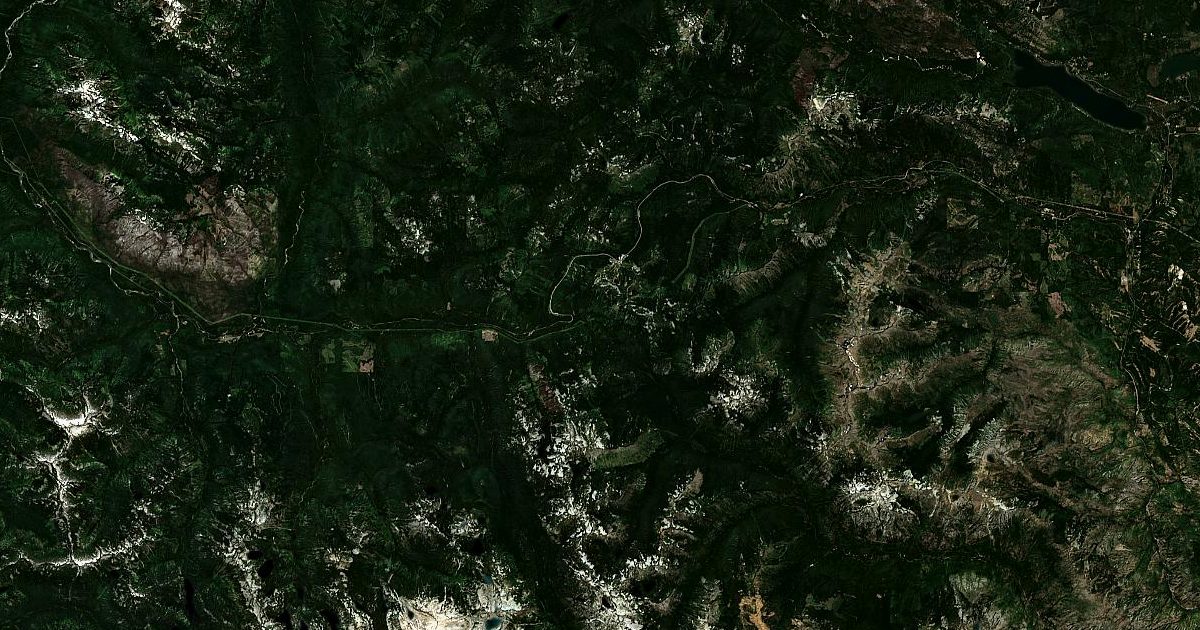
  • Reported places along the route (schematic)Schematic

Satellite imagery Sentinel-2 cloudless 2024 © EOX · Terrain AWS Terrain Tiles · Orange line is schematic · Place coordinates not individually verified

Route review

6 scenes to understand what happened

Scroll down and the map flies to where each part happened. The line is Schematic, Lines connect the places mentioned in reports in sequence. They indicate only the approximate direction, not the actual track. Sources for the place coordinates are in places.json.

01

Full journey

The locations mentioned in the reports are connected in sequence to show the approximate route (schematic).

02

Setting out east

On 10 November 1912, Mawson, Ninnis and Mertz set out from Cape Denison with two teams of sled dogs to survey the unknown coast to the east.Facts it rests onF04Multiple sourcesMawson, Ninnis and Mertz formed the Far Eastern Sledging Party and set out from Cape Denison on 10 November 1912 to survey the unknown coastal region east of the base.F01Multiple sourcesThe Far Eastern Sledging Party had the longest and most dangerous assignment of the several sledging parties Mawson planned: to survey the most distant unknown coast east of Cape Denison.

03

The crevasse

On 14 December, about 500 kilometres from base, Ninnis, travelling on foot, broke through a snow bridge and fell into a crevasse along with most of the rations and the main tent.Facts it rests onF11Multiple sourcesMertz on skis and Mawson riding on his sled crossed safely, but Ninnis, walking alongside the sled behind them, silently broke through the snow bridge and fell into the crevasse along with the sled and dogs.F16Multiple sourcesThe best dogs, almost all the dog food and most of the men's rations, as well as the main tent, fell with Ninnis.F17Multiple sourcesAt the time of the incident, they were about 500 kilometres (nearly 300 miles) from base.

04

Return inland

With only about 10 days' rations left, the two men abandoned the coastal route and returned inland, killing sled dogs for food.Facts it rests onF18Multiple sourcesThe only supplies remaining were 6 weakened dogs, a spare tent canvas without poles, sleeping bags and about 10 days of rations, while the return journey would take at least 30 days.F19Multiple sourcesThe two men considered descending to the coast, but decided that crossing the crevasse field was too dangerous and that the sea ice was unreliable. They chose to return by the inland route and kill dogs for food when their rations ran out.F07Multiple sourcesOn the return journey, the sled dogs became exhausted one by one and were killed for food.

06

The ship has sailed

He reached Aladdin's Cave on 1 February and was trapped by a blizzard; by the time he returned to base, the “Aurora” had left only a few hours earlier.Facts it rests onF33Multiple sourcesOn 1 February, Mawson reached a supply point called Aladdin's Cave, not far from base, and was then trapped in the cave by a blizzard for several days.F35Multiple sourcesWhen Mawson returned to base, the Aurora, which had come to collect the party, had left only a few hours earlier, and he could only watch the ship sail away.

02Timeline

  1. Mawson, Ninnis and Mertz formed the Far Eastern Sledging Party and set out from Cape Denison on 10 November 1912 to survey the unknown coastal region east of the base. F04

  2. As supplies were consumed, Mawson reduced the three sleds to two and put the best dogs and most of the food on the sled at the rear with Ninnis. He believed that if a snow cover collapsed, his own sled in front would be the first to be endangered. F06

  3. The only supplies remaining were 6 weakened dogs, a spare tent canvas without poles, sleeping bags and about 10 days of rations, while the return journey would take at least 30 days. F18

  4. Mertz on skis and Mawson riding on his sled crossed safely, but Ninnis, walking alongside the sled behind them, silently broke through the snow bridge and fell into the crevasse along with the sled and dogs. F11

  5. After midday on 14 December, Mertz, who was in front, raised his ski pole to signal another crevasse. Mawson's sled crossed it diagonally, and he looked back to warn Ninnis; Ninnis instead crossed it straight on, at a right angle. F10

  6. The two men called down into the crevasse for about three hours without a response, after which Mawson read a funeral prayer. F15

  7. The two men considered descending to the coast, but decided that crossing the crevasse field was too dangerous and that the sea ice was unreliable. They chose to return by the inland route and kill dogs for food when their rations ran out. F19

  8. The last dog, Ginger, died on 28 December; before that, the two men had put on harnesses and pulled the sled alongside her. F21

  9. Around New Year's Day 1913, about 160 kilometres from base, Mertz grew increasingly weak amid hunger, arduous travel, a poor diet, cold and damp. F25

  10. Mawson buried Mertz, still in his sleeping bag, under blocks of snow. F28

  11. Three days after Mertz died, Mawson discovered that the skin on the soles of his feet had come off in one piece. F29

  12. On 17 January, Mawson fell through the snow cover of a crevasse and was left suspended. The sledge behind him became lodged in the snow and was not pulled down, preventing him from falling to the bottom as Ninnis had. F31

  13. On 29 January, Mawson found a snow mound marker covered with black cloth, containing food and a note left by teammates searching for him. F32

  14. On 1 February, Mawson reached a supply point called Aladdin's Cave, not far from base, and was then trapped in the cave by a blizzard for several days. F33

  15. When Mawson returned to base, the Aurora, which had come to collect the party, had left only a few hours earlier, and he could only watch the ship sail away. F35

  16. The Aurora returned to Cape Denison on 13 December 1913, and Mawson returned to Australia in February 1914. F36

03Lessons

Avalanche and high altitude

Distribute weight and travel roped together on glaciers

The person on skis and the person on the sledge crossed the same crevasse, but the person on foot broke through the snow bridge. On snow-covered glaciers, distributing weight with skis or snowshoes and roping people together for protection is more reliable than judging from experience which crevasses are dangerous.Facts it rests onF11Multiple sourcesMertz on skis and Mawson riding on his sled crossed safely, but Ninnis, walking alongside the sled behind them, silently broke through the snow bridge and fell into the crevasse along with the sled and dogs.F03Multiple sourcesHidden crevasses were a continuing threat during the first few weeks, with men, dogs or sleds repeatedly breaking through snow covers. On one occasion, Ninnis broke through the snow cover of a crevasse over which they had unknowingly camped and avoided falling in only by spreading his arms.

Teams and decisions

Do not concentrate essential supplies in one place

The best dogs, almost all the dog food, most of the rations and the main tent were all on the same sledge. A single fall left the two remaining men in a desperate situation. When travelling in a group, food, tents and stoves should be carried separately, so that if anything happens to one person, the others can still look after themselves.Facts it rests onF06Multiple sourcesAs supplies were consumed, Mawson reduced the three sleds to two and put the best dogs and most of the food on the sled at the rear with Ninnis. He believed that if a snow cover collapsed, his own sled in front would be the first to be endangered.F16Multiple sourcesThe best dogs, almost all the dog food and most of the men's rations, as well as the main tent, fell with Ninnis.F18Multiple sourcesThe only supplies remaining were 6 weakened dogs, a spare tent canvas without poles, sleeping bags and about 10 days of rations, while the return journey would take at least 30 days.

Rescue and self-rescue

Carry a rope long enough for crevasse rescue

The two men could see a snow ledge in the crevasse, but their rope was too short for them to descend and investigate. Glacier travel requires a main rope of sufficient length, hauling and ascending equipment, and advance practice in crevasse rescue.Facts it rests onF14Multiple sourcesThe rope they had brought was too short to descend into the crevasse.F13Multiple sourcesThe two men looked down into the crevasse and saw only an injured, whimpering dog and some items on a snow ledge about 150 feet (about 50 metres) below; they saw neither Ninnis nor his sled.

Hypothermia and overnight gear

When food runs short, limit losses early and choose a safer route

After losing most of their rations, the two abandoned the more dangerous coastal route, returned in a known direction and reduced their load as much as possible. Prolonged hunger and cold nevertheless caused their physical condition to deteriorate rapidly. Expedition plans should include sufficient extra rations for emergencies.Facts it rests onF18Multiple sourcesThe only supplies remaining were 6 weakened dogs, a spare tent canvas without poles, sleeping bags and about 10 days of rations, while the return journey would take at least 30 days.F19Multiple sourcesThe two men considered descending to the coast, but decided that crossing the crevasse field was too dangerous and that the sea ice was unreliable. They chose to return by the inland route and kill dogs for food when their rations ran out.F25Multiple sourcesAround New Year's Day 1913, about 160 kilometres from base, Mertz grew increasingly weak amid hunger, arduous travel, a poor diet, cold and damp.F23Multiple sourcesMawson used a knife to saw the sledge in half to reduce its weight.

04Fact list 45 facts

Under each fact is a verbatim quote from the original. "Single source" means only one outlet mentioned it; "Accounts differ" means sources contradict each other and this site adopts neither side; "Speculation" is an inference by a reporter or a person involved, not a fact.

  1. F01Multiple sourcesPlan

    The Far Eastern Sledging Party had the longest and most dangerous assignment of the several sledging parties Mawson planned: to survey the most distant unknown coast east of Cape Denison.

    Quotes from the original 2

    “His own Far Eastern Party would be the strongest with the most ambitious and dangerous task ahead.”

    Australian Antarctic Division · 2012-05-23

    “Mawson was bent on making the deepest push of all into the unknown.”

    National Geographic · 2013-01-01
  2. F02Single sourcePlan

    According to Australian Antarctic Division, The journey was originally planned to take about two months, and sled loads, rations and supply depots had been carefully arranged before departure.

    Quotes from the original 1

    “They had carefully planned sledge loads, rations and food depots to keep both the men and the 16 dogs comfortably nourished throughout the two-month trek.”

    Australian Antarctic Division ·
  3. F03Multiple sourcesEvent

    Hidden crevasses were a continuing threat during the first few weeks, with men, dogs or sleds repeatedly breaking through snow covers. On one occasion, Ninnis broke through the snow cover of a crevasse over which they had unknowingly camped and avoided falling in only by spreading his arms.

    Quotes from the original 2

    “There were several anxious moments early in the trip when men, dogs or sledges broke through. On one occasion Ninnis saved himself by flinging his arms out as he dropped through the lid of a five-metre-wide crevasse they had unknowingly pitched their tent on.”

    Australian Antarctic Division · 2012-05-23

    “The men had crossed two major glaciers and scores of hidden crevasses—deep fissures in the ice camouflaged by thin snowbridges.”

    National Geographic · 2013-01-01
  4. F04Multiple sourcesPlan

    Mawson, Ninnis and Mertz formed the Far Eastern Sledging Party and set out from Cape Denison on 10 November 1912 to survey the unknown coastal region east of the base.

    Quotes from the original 3

    “On 10 November 1912, Douglas Mawson, Belgrave Ninnis and Xavier Mertz began their ‘Far East Sledging Journey’, using two dog teams to explore the coast to the distant east.”

    Australian Antarctic Division ·

    “The three men set out from Cape Denison on 10 November 1912 as the Far Eastern Party”

    RAHS · 2021-06-21

    “Mawson set off on the ambitious Far Eastern Party on November 10, 1912, the trio keen to explore King George V Land in eastern Antarctica.”

    ABC · 2021-05-25
  5. F05Accounts differPlan

    Accounts differ on the number of sled dogs taken at departure: the Australian Antarctic Division website says 16; the Royal Australian Historical Society and the South Australian Medical Heritage Society say 17.

    Quotes from the original 3

    “keep both the men and the 16 dogs comfortably nourished throughout the two-month trek.”

    Australian Antarctic Division ·

    “With them went seventeen sledging dogs.”

    RAHS · 2021-06-21

    “would use 17 dogs and 3 sleds”

    SAMHS · 2018-08-01
  6. F06Multiple sourcesPlan

    As supplies were consumed, Mawson reduced the three sleds to two and put the best dogs and most of the food on the sled at the rear with Ninnis. He believed that if a snow cover collapsed, his own sled in front would be the first to be endangered.

    Quotes from the original 3

    “Mawson had put the best dogs and most of the food on the second sled with Ninnis. Mawson not unreasonably thought that if a crevasse lid gave way then his sled and the poorer dogs and non-essential equipment would be lost.”

    SAMHS · 2018-08-01

    “Mawson had thought the first sled would be the one to encounter any difficulty, so kept essential supplies to a minimum and hitched it to the weakest dogs.”

    RAHS · 2021-06-21

    “It was the heavier sledge, with most of the food and all of the stronger dogs, which was lost in the crevasse.”

    MJA · 2005-12-05
  7. F07Multiple sourcesEvent

    On the return journey, the sled dogs became exhausted one by one and were killed for food.

    Quotes from the original 3

    “But during the next two weeks, the dogs gave out one by one.”

    National Geographic · 2013-01-01

    “To survive, they had no option but to kill and eat the six remaining dogs.”

    MJA · 2005-12-05

    “On the return journey, dog after dog gave out and was eaten.”

    SAMHS · 2018-08-01
  8. F08Multiple sourcesEvent

    Both men developed symptoms including peeling skin, hair loss and weight loss.

    Quotes from the original 2

    “Their skin and hair began to fall off; they suffered abdominal pain, weight loss, and dizziness”

    RAHS · 2021-06-21

    “Both suffered dramatic skin desquamation, and by the end of December Mertz was unwell.”

    SAMHS · 2018-08-01
  9. F09Single sourceEvent

    According to Australian Antarctic Division, On 14 December, the weather was clear, the temperature was about minus 6 degrees Celsius, and the party was only a few days from its planned turnaround.

    Quotes from the original 1

    “It was clear and warm, just −6°C and they were just a few days from turning for home.”

    Australian Antarctic Division · 2012-05-23
  10. F10Multiple sourcesEvent

    After midday on 14 December, Mertz, who was in front, raised his ski pole to signal another crevasse. Mawson's sled crossed it diagonally, and he looked back to warn Ninnis; Ninnis instead crossed it straight on, at a right angle.

    Quotes from the original 3

    “Just after noon that day, Mertz had held up his ski pole, signaling yet another crevasse.”

    National Geographic · 2013-01-01

    “Ninnis altered course to cross the crevasse at right angles. Mawson had crossed tangentially which was regarded as more dangerous.”

    SAMHS · 2018-08-01

    “My sledge crossed a crevasse obliquely & I called back to Ninnis … to watch it”

    Australian Antarctic Division ·
  11. F11Multiple sourcesEvent

    Mertz on skis and Mawson riding on his sled crossed safely, but Ninnis, walking alongside the sled behind them, silently broke through the snow bridge and fell into the crevasse along with the sled and dogs.

    Quotes from the original 3

    “Mertz skied across and Mawson rode across on his sledge. Ninnis, on foot, broke through the snow bridge without a sound.”

    Australian Antarctic Division · 2012-05-23

    “Mawson also rode across on his sled whereas Ninnis jogged along side”

    SAMHS · 2018-08-01

    “They had fallen through the snow bridge without a sound”

    RAHS · 2021-06-21
  12. F12Multiple sourcesEvent

    Mertz stopped and looked back. Mawson turned to find that Ninnis and his sled team had disappeared, and when he hurried back, he saw only a large hole in the snow.

    Quotes from the original 3

    “I looked behind & saw no sign of Ninnis & his team. I … hurried back to find a great gaping hole in the ground.”

    Australian Antarctic Division ·

    “Suddenly he came to the edge of a gaping hole in the surface, 11 feet wide.”

    National Geographic · 2013-01-01

    “There was nothing to see but a hole in the snow.”

    Australian Antarctic Division · 2012-05-23
  13. F13Multiple sourcesFound at scene

    The two men looked down into the crevasse and saw only an injured, whimpering dog and some items on a snow ledge about 150 feet (about 50 metres) below; they saw neither Ninnis nor his sled.

    Quotes from the original 3

    “One hundred fifty feet down, a husky lay moaning on a snow shelf, its back evidently broken.”

    National Geographic · 2013-01-01

    “A dog and a food bag were just visible on a ledge 50m below, but nothing else.”

    Australian Antarctic Division · 2012-05-23

    “Nothing could be seen other than a dog about 150 feet down.”

    SAMHS · 2018-08-01
  14. F14Multiple sourcesEvent

    The rope they had brought was too short to descend into the crevasse.

    Quotes from the original 3

    “Our ropes not long enough to go down”

    Australian Antarctic Division ·

    “The rope they carried was not long enough to reach the ledge where the dogs were, let alone deeper into the crevasse.”

    RAHS · 2021-06-21

    “They had far too little rope to lower themselves into the crevasse to search for their companion.”

    National Geographic · 2013-01-01
  15. F15Multiple sourcesEvent

    The two men called down into the crevasse for about three hours without a response, after which Mawson read a funeral prayer.

    Quotes from the original 3

    “We called and sounded for three hours, then went on a few miles to a hill and took position observations. Came back, called and sounded for an hour. Read the Burial Service.”

    ABC · 2021-05-25

    “After three hours, with no response or signs of life, they said a prayer and had to move on.”

    NAA · 2024-04-04

    “After hours of calling they surrendered hope and Mawson read the burial service.”

    Australian Antarctic Division · 2012-05-23
  16. F16Multiple sourcesFound at scene

    The best dogs, almost all the dog food and most of the men's rations, as well as the main tent, fell with Ninnis.

    Quotes from the original 3

    “Gone with Ninnis were their best dogs, most of their food, their main tent and its supports.”

    Australian Antarctic Division · 2012-05-23

    “Gone with him were the team’s most valuable gear, including their three-man tent, the six best huskies, all the food for the dogs, and nearly all the men’s food.”

    National Geographic · 2013-01-01

    “Ninnis fell through a hidden crevasse, taking with him his sledge, six dogs and most of the party’s food supplies.”

    Australian Museum ·
  17. F17Multiple sourcesEvent

    At the time of the incident, they were about 500 kilometres (nearly 300 miles) from base.

    ABC quotes the chairman of the Mawson's Huts Foundation as saying “500 miles”, which is inconsistent with other sources.

    Quotes from the original 3

    “They were 500km from the hut.”

    Australian Antarctic Division · 2012-05-23

    “travelling 500 kilometres from base camp across glaciers pitted with hidden crevasses.”

    RAHS · 2021-06-21

    “the trio had reached a point nearly 300 miles from the hut.”

    National Geographic · 2013-01-01
  18. F18Multiple sourcesFound at scene

    The only supplies remaining were 6 weakened dogs, a spare tent canvas without poles, sleeping bags and about 10 days of rations, while the return journey would take at least 30 days.

    Quotes from the original 3

    “They had six weak dogs, a spare tent cover with no poles, their sleeping bags and 10 days food for a journey of at least 30.”

    Australian Antarctic Division · 2012-05-23

    “He and Mertz now faced a thirty-day return journey with ten days’ worth of food, minimal supplies, no dog food and no tent.”

    RAHS · 2021-06-21

    “We had our sleeping bags, a week and a half food, the spare tent without poles, and our private bags and cooker and kerosene.”

    ABC · 2021-05-25
  19. F19Multiple sourcesPlan

    The two men considered descending to the coast, but decided that crossing the crevasse field was too dangerous and that the sea ice was unreliable. They chose to return by the inland route and kill dogs for food when their rations ran out.

    Quotes from the original 3

    “The pair pondered descending to the coast, but dismissed it as too dangerous across the grain of the crevasse fields and with the sea ice too uncertain. Instead they decided to follow the contour of the inland route, killing and eating the dogs as their food ran out.”

    Australian Antarctic Division · 2012-05-23

    “Mawson and Mertz made the decision to retrace their steps across the glacier back to camp, rather than attempt a longer route via the coast.”

    RAHS · 2021-06-21

    “Mawson did consider heading to the coast but dismissed this as being too long and the route to the coast too difficult.”

    SAMHS · 2018-08-01
  20. F20Multiple sourcesEvent

    They used sled runners and Mertz's skis as supports to pitch the spare tent canvas for shelter.

    Quotes from the original 2

    “they pitched a spare tent cover over a frame concocted of sledge runners and Mertz’s skis.”

    National Geographic · 2013-01-01

    “they cut poles from the abandoned sledge to create a makeshift canvas tent.”

    RAHS · 2021-06-21
  21. F21Multiple sourcesEvent

    The last dog, Ginger, died on 28 December; before that, the two men had put on harnesses and pulled the sled alongside her.

    Quotes from the original 2

    “The last dog, Ginger, died on 28 December.”

    RAHS · 2021-06-21

    “By now, only Ginger, the pluckiest of the surviving dogs, could haul. The two men put on their chest-and-hip harnesses and pulled the sledge alongside her”

    National Geographic · 2013-01-01
  22. F22Multiple sourcesAftermath

    Six team members stayed at the base to wait and search for the missing party, and Mawson spent another winter with them at Cape Denison.

    Quotes from the original 3

    “Six men had stayed behind, willing to brave another Antarctic winter to search for their lost companions”

    RAHS · 2021-06-21

    “Mawson and six men who had remained behind to search for him were consequently forced to endure a second unplanned winter (1913) at Cape Denison.”

    Australian Museum ·

    “Mawson spent the next 10 months recovering at Cape Denison with six other men who had remained to look for the missing expeditioners.”

    ABC · 2021-05-25
  23. F23Multiple sourcesEvent

    Mawson used a knife to saw the sledge in half to reduce its weight.

    Quotes from the original 2

    “Using only the serrated blade of his knife, he cut the sledge in half.”

    National Geographic · 2013-01-01

    “Another time, he cut one of the sledges in half using a pocket knife.”

    MJA · 2005-12-05
  24. F24Multiple sourcesEvent

    Mawson believed he had no hope of survival but kept going so that his body and the two men's diaries could be found later.

    Quotes from the original 2

    “Without hope of reaching safety, he was determined to push on at least so his body could be found and his diary tell their story.”

    Australian Antarctic Division · 2012-05-23

    “But he was determined to travel as far as he could so his body, and his and Mertz’s diaries, could be found.”

    RAHS · 2021-06-21
  25. F25Multiple sourcesEvent

    Around New Year's Day 1913, about 160 kilometres from base, Mertz grew increasingly weak amid hunger, arduous travel, a poor diet, cold and damp.

    Quotes from the original 2

    “By New Year’s Day, 160km from the hut, Mertz was weakening, wracked by hunger, the hard travel, the poor diet, the constant cold and the damp conditions of their makeshift tent.”

    Australian Antarctic Division · 2012-05-23

    “Something was wrong with Mertz. He was rapidly losing strength.”

    National Geographic · 2013-01-01
  26. F26Single sourceEvent

    According to National Geographic, Around 5 January, Mawson persuaded Mertz to sit on the sledge and pulled him alone for about 2.5 miles.

    Quotes from the original 1

    “Though racked with pain himself, Mawson persuaded Mertz to ride the sledge. Summoning extraordinary powers, Mawson pulled the terrible load by himself for two and a half miles.”

    National Geographic · 2013-01-01
  27. F27Accounts differEvent

    Accounts differ on the date of Mertz's death: most sources give 8 January 1913 (at about 2 a.m.); ABC quotes the chair of the Mawson's Huts Foundation as giving 7 January.

    Quotes from the original 4

    “At 2 a.m. on January 8, Mertz died in his sleep.”

    National Geographic · 2013-01-01

    “Mertz died on 8 January 1913.”

    MJA · 2005-12-05

    “Xavier Mertz died a month later, on 8 January 1913.”

    NAA · 2024-04-04

    “Two-hundred kilometres from the safety of the huts, Mertz succumbed and died on January 7.”

    ABC · 2021-05-25
  28. F28Multiple sourcesAftermath

    Mawson buried Mertz, still in his sleeping bag, under blocks of snow.

    Quotes from the original 3

    “Mawson buried his friend, still in the sleeping bag, beneath a mound of snow blocks”

    National Geographic · 2013-01-01

    “Mawson buried Mertz in his sleeping bag and cut down his sled and reduced his load to absolute essentials.”

    SAMHS · 2018-08-01

    “Mawson buried his friend with blocks of ice and marked the position with a ski.”

    ABC · 2021-05-25
  29. F29Multiple sourcesEvent

    Three days after Mertz died, Mawson discovered that the skin on the soles of his feet had come off in one piece.

    Quotes from the original 3

    “Three days after Mertz’s death, Mawson discovered to his horror that the soles of his feet had completely detached from the skin beneath them”

    National Geographic · 2013-01-01

    “3 days later would discover that the complete soles of his feet had separated.”

    SAMHS · 2018-08-01

    “The soles of his feet had peeled off completely.”

    RAHS · 2021-06-21
  30. F30Multiple sourcesEvent

    The agreed return date for the sledging parties was 15 January; Mawson was still on the way when that day passed.

    Quotes from the original 2

    “January 15, the date set for the return of the exploratory parties came and went.”

    Australian Antarctic Division · 2012-05-23

    “The expedition’s relief ship Aurora was scheduled to arrive at Commonwealth Bay on January 15”

    National Geographic · 2013-01-01
  31. F31Multiple sourcesEvent

    On 17 January, Mawson fell through the snow cover of a crevasse and was left suspended. The sledge behind him became lodged in the snow and was not pulled down, preventing him from falling to the bottom as Ninnis had.

    Quotes from the original 4

    “On 17 January he fell into a crevasse, saved only from Ninnis’ fate by his sledge getting stuck in a snowdrift.”

    RAHS · 2021-06-21

    “Two days later, Mawson crashed through the lid of a large crevasse, dangling helplessly above the abyss as his sledge behind him edged towards the lip.”

    Australian Antarctic Division · 2012-05-23

    “Miraculously, the sledge stuck fast in the deep snow, anchoring him.”

    National Geographic · 2013-01-01

    “While crossing Mertz Glacier, Mawson plunged through the lid of a crevasse.”

    SAMHS · 2018-08-01
  32. F32Multiple sourcesEvent

    On 29 January, Mawson found a snow mound marker covered with black cloth, containing food and a note left by teammates searching for him.

    Quotes from the original 2

    “It was a snow cairn covered with a black cloth. Inside, he found a message from three teammates who had been out searching and a bag of food”

    National Geographic · 2013-01-01

    “On 29 January at approximately two p.m., twenty-one days after Mertz’s death, Mawson spotted a cairn with a store of food inside and a note”

    RAHS · 2021-06-21
  33. F33Multiple sourcesEvent

    On 1 February, Mawson reached a supply point called Aladdin's Cave, not far from base, and was then trapped in the cave by a blizzard for several days.

    Quotes from the original 2

    “finally managed to reach the supply depot at Aladdin’s Cave on February 1. He was forced to wait for a break in the weather to chance the last nine kilometres to safety.”

    Australian Antarctic Division · 2012-05-23

    “A blizzard kept Mawson inside the cave for the next five days.”

    RAHS · 2021-06-21
  34. F34Accounts differEvent

    Accounts differ on the date Mawson returned to base: most sources give 8 February 1913; a lecture by the South Australian Medical Heritage Society gives 9 February.

    Quotes from the original 3

    “A month later, on 8 February 1913, Mawson reached Base Camp”

    MJA · 2005-12-05

    “He finally reached the base on 8 February 1913”

    Australian Museum ·

    “Mawson would eventually reach base on the 9th of February, 1913, after the departure of the relief ship”

    SAMHS · 2018-08-01
  35. F35Multiple sourcesEvent

    When Mawson returned to base, the Aurora, which had come to collect the party, had left only a few hours earlier, and he could only watch the ship sail away.

    Quotes from the original 3

    “only to learn that his ship, the Aurora, had departed a few hours earlier, unable to wait any longer in the extreme conditions.”

    Australian Museum ·

    “Mawson had missed catching the Aurora by a mere five hours.”

    National Geographic · 2013-01-01

    “he could see the Aurora on the horizon, steaming away, unable to wait any longer for a party feared lost.”

    Australian Antarctic Division · 2012-05-23
  36. F36Multiple sourcesAftermath

    The Aurora returned to Cape Denison on 13 December 1913, and Mawson returned to Australia in February 1914.

    Quotes from the original 3

    “On December 13, 1913, the Aurora returned to Cape Denison.”

    Australian Antarctic Division · 2012-05-23

    “Mawson finally returned to the Australian mainland in February 1914.”

    Australian Museum ·

    “When Mawson finally reached Australia in February 1914, he was greeted as a national hero”

    National Geographic · 2013-01-01
  37. F37SpeculationSpeculation

    Hypothesis: In 1969, Cleland and Southcott proposed that Mertz and Mawson may have suffered vitamin A poisoning from eating dog liver; Shearman supported this theory in 1978.

    Quotes from the original 2

    “In 1969, Cleland and Southcott proposed that Mertz died of vitamin A toxicity and Mawson suffered from the effects of hypervitaminosis A”

    MJA · 2005-12-05

    “Cleland and Southcott, (Sir John Cleland, pathologist, retired 1948 and Ronald Vernon Southcott, medical zoologist and long serving Chairman of the Museum) were the first to propose hypervitaminosis A as the likely cause in 1969”

    SAMHS · 2018-08-01
  38. F38SpeculationSpeculation

    Hypothesis: A 2005 medical journal article proposed that Mertz may have died from severe starvation, compounded by his inability as a near-vegetarian to adapt to a diet consisting mainly of dog meat. The psychological stress of losing a close friend and dogs he had personally cared for may also have contributed.

    Quotes from the original 1

    “Mertz died as he was unable to tolerate the change from his usual vegetarian diet to a diet of mainly dog meat.”

    MJA · 2005-12-05
  39. F39Multiple sourcesBackground

    Ninnis and Mertz were responsible for looking after the expedition's sled dogs and were close friends.

    Quotes from the original 3

    “Ninnis and Mertz were international additions on the trip, selected to look after the huskies.”

    ABC · 2021-05-25

    “The two would become close friends and jointly cared for the dogs.”

    SAMHS · 2018-08-01

    “We also know that Mertz and Ninnis were close friends.”

    MJA · 2005-12-05
  40. F40Multiple sourcesBackground

    Mertz was a Swiss skiing champion and mountaineer; Ninnis was a lieutenant in the British Army.

    Quotes from the original 2

    “Ninnis was a Lieutenant in the British Army, and Mertz was a Swiss mountaineer who held degrees in engineering and glaciology and was a national ski champion.”

    ABC · 2021-05-25

    “he chose 29-year-old Swiss ski champion Xavier Mertz and 25-year-old Belgrave Ninnis, an eager, likeable Englishman serving in the Royal Fusiliers.”

    National Geographic · 2013-01-01
  41. F41Accounts differBackground

    Accounts differ on Ninnis's age at death: the Royal Australian Historical Society and National Geographic say 25; a lecture by the South Australian Medical Heritage Society says 23.

    Quotes from the original 3

    “Belgrave Edward Sutton Ninnis was twenty-five when he died.”

    RAHS · 2021-06-21

    “25-year-old Belgrave Ninnis”

    National Geographic · 2013-01-01

    “He was 23 years old.”

    SAMHS · 2018-08-01
  42. F42Accounts differPost-incident analysis

    There are differing accounts of the cause of Mertz's death: some believe it was vitamin A poisoning from eating dog liver; other researchers believe the main causes were severe starvation, hypothermia and physical exhaustion, or that it resulted from a vegetarian suddenly switching to a diet of dog meat. Mawson himself at different times believed the cause was colitis and peritonitis caused by a ruptured appendix.

    Quotes from the original 4

    “One explanation for his death is an excessive intake of vitamin A”

    NAA · 2024-04-04

    “Other experts suggested that Mertz’s collapse was due simply to hypothermia, overexertion, and near starvation.”

    National Geographic · 2013-01-01

    “I propose that Mawson and Mertz suffered from the effects of severe food deprivation, not from hypervitaminosis A”

    MJA · 2005-12-05

    “In 1913, Mawson discussed Mertz's illness with Mclean and they concluded that he had died from Colitis.”

    SAMHS · 2018-08-01
  43. F43Multiple sourcesAftermath

    Mertz Glacier and Ninnis Glacier were later named after the two men who died.

    Quotes from the original 2

    “Today the Mertz and Ninnis Glaciers sit side-by-side on the Antarctic coast.”

    RAHS · 2021-06-21

    “showing the glaciers named after the two men who died.”

    MJA · 2005-12-05
  44. F44SpeculationSpeculation

    Hypothesis: Ninnis was walking beside the sledge, with his weight concentrated over a small area. This may explain why he fell through the snow bridge while the other two, one on skis and one on the sledge, did not.

    Quotes from the original 2

    “Ninnis’ weight was concentrated in a very small area, enough to break through the snow entirely.”

    RAHS · 2021-06-21

    “Ninnis jogged along side and this may have been relevant in breaching the lid of the crevasse.”

    SAMHS · 2018-08-01
  45. F45Single sourceParticipant's view

    According to RAHS, Some historians have criticised Mawson, saying that as leader he should have required all party members to use skis.

    Quotes from the original 1

    “Some historians have criticised Mawson, arguing that as leader he should have insisted on skis for his men.”

    RAHS · 2021-06-21