GuituluGlobal Outdoor Accident Archive 中文
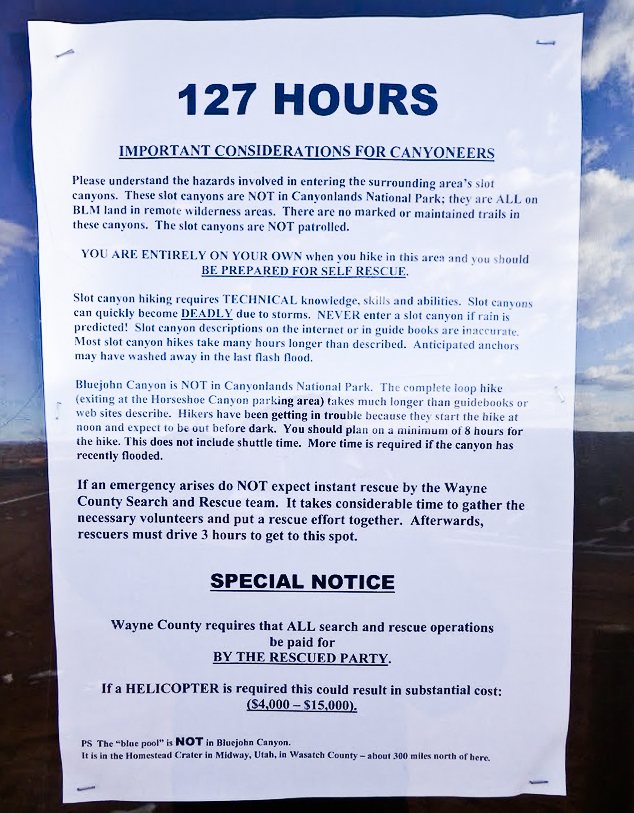
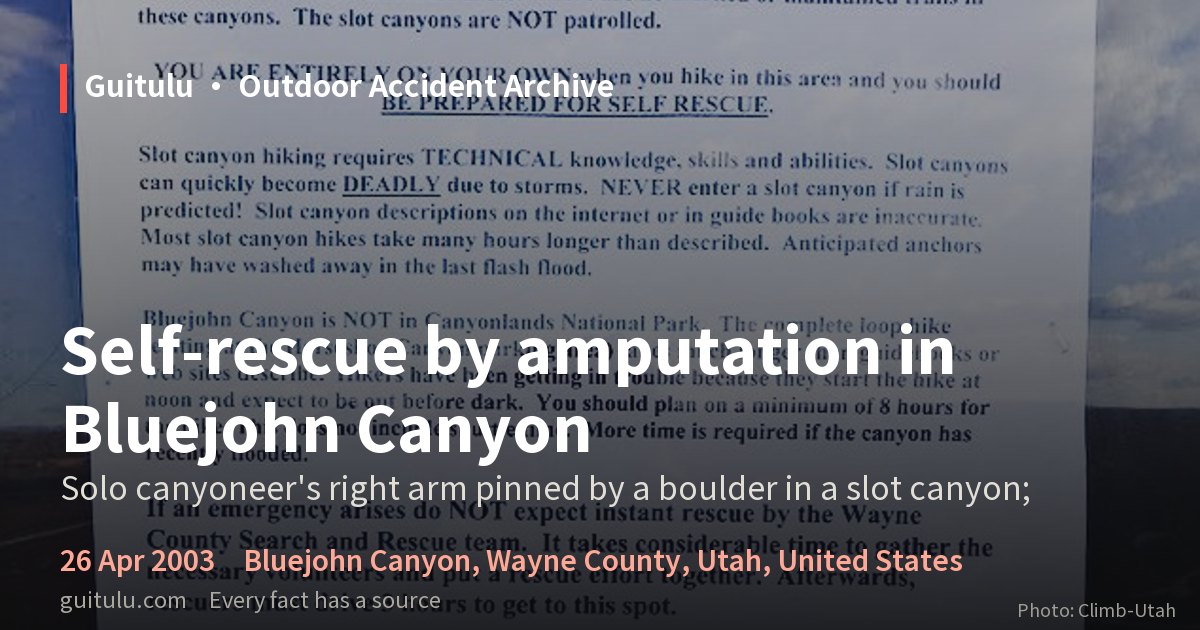
A canyon exploration safety notice posted locally after the release of 127 Hours, warning that Bluejohn Canyon is remote, that search and rescue in Wayne County takes time, and that the person rescued may have to bear the cost

Archive / Other

Self-rescue by amputation in Bluejohn Canyon

Solo canyoneer's right arm pinned by a boulder in a slot canyon; amputated it after five days to escape

After freeing himself, he was picked up by helicopter, taken to hospital and recovered

Photo: Climb-Utah

Date
Spring
Place
Bluejohn Canyon, Wayne County, Utah, United StatesUnited States › Utah · Colorado Plateau-110.288°E 38.347°N
Activity
CanyoneeringInvolves: Rockfall and collapse1 person, traveling alone
Casualties
Injured 1His right forearm was pinned by a boulder; he was rescued after amputating it himself
Material
44 facts · 11 sources4 accounts differ and are shown side by side

01What happened

Bluejohn Canyon is a remote slot canyon in the Maze area of southeastern Utah, United States, south of the Horseshoe Canyon Unit of Canyonlands National Park. On 26 April 2003, Aron Ralston, a 27-year-old mountaineer living in Aspen, Colorado, parked his pickup at the Horseshoe Canyon trailhead and rode a mountain bike about 15 miles to the Bluejohn Canyon trailhead. He planned to travel through the canyon in one day. Before setting out, he did not tell anyone where he was going.Facts it rests onF43Multiple sourcesBluejohn Canyon is a remote slot canyon in The Maze region of southeastern Utah, south of the Horseshoe Canyon unit of Canyonlands National Park.F01Multiple sourcesRalston was 27 at the time and lived in Aspen, Colorado. He was an experienced mountaineer and outdoor enthusiast.F10Multiple sourcesThe trip was originally intended to last just one day.F11Multiple sourcesHe parked his pickup truck at the Horseshoe Canyon trailhead and rode a mountain bike about 15 miles to the Bluejohn Canyon trailhead, where he locked the bike to a tree.F12Multiple sourcesBefore setting out, Ralston did not tell anyone where he was going.

A canyon exploration safety notice posted locally after the release of 127 Hours, warning that Bluejohn Canyon is remote, that search and rescue in Wayne County takes time, and that the person rescued may have to bear the costPhoto source: Climb-Utah

That day, as he climbed over a boulder wedged between the walls of a slot about 3 feet wide, the boulder shifted and pinned his right arm against the rock wall. He tried to move it using equipment including ropes and anchors, but was unsuccessful. At night, temperatures fell to around zero degrees Celsius, and on 29 April (Tuesday) he ran out of water. Believing his chances of survival were slim, he recorded a message for his family and carved his name and the date into the rock wall.Facts it rests onF15Multiple sourcesOn 26 April (Saturday), as Ralston was climbing over a boulder wedged between the walls of a slot about 3 feet wide in Bluejohn Canyon, the boulder moved and pinned his right arm against the rock wall, leaving him unable to free himself.F04Multiple sourcesAfter becoming trapped, he tried unsuccessfully to move the boulder using climbing equipment including ropes and anchors.F05Multiple sourcesWhile he was trapped, nighttime temperatures fell to around 30 degrees Fahrenheit (around zero degrees Celsius).F17Multiple sourcesHe ran out of water on 29 April (Tuesday).F07Multiple sourcesAfter concluding that his chances of survival were slim, he used a video camera to record a message for his family and carved his name, birth month and year, and what he thought would be his date of death into the rock wall.

Ralston did not show up for work for several days, and his colleagues reported him missing to the authorities. Aspen police used credit card records to find that he had bought food in Moab, Utah, and notified local authorities to begin a search. According to reports, personnel from several state, federal and county agencies began searching at about 10 a.m. on 1 May; search and rescue personnel found his pickup near the Horseshoe Canyon trailhead.Facts it rests onF09Multiple sourcesRalston's coworkers noticed that he had not come to work for several days and reported him missing to the authorities; the Emery County Sheriff's Office was notified.F18Multiple sourcesBy tracing his credit card transactions, Aspen police found that he had bought fuel in Glenwood Springs and food in Moab, Utah, then notified local authorities to begin a search.F21Single sourceAt about 10 a.m. on 1 May (Thursday), personnel from the Utah Department of Public Safety, the Bureau of Land Management, the National Park Service, and Emery, Wayne and Grand counties began searching.F22Multiple sourcesOn 1 May, search and rescue personnel found his pickup truck in the area of the Horseshoe Canyon trailhead.

That same morning, after several unsuccessful attempts, Ralston used the knife on a multitool to amputate his trapped right forearm and applied a tourniquet, a process that took about an hour in all. He then set up a rope and descended to the canyon floor, walked along the canyon into neighboring Horseshoe Canyon, and encountered a Dutch family of tourists there. They gave him water and signaled to a search and rescue helicopter. At about 3 p.m., a Utah Department of Public Safety helicopter found him, about four hours after the amputation; he was taken to a hospital in Moab, walked into the emergency room himself, and was later transferred to Grand Junction, Colorado.Facts it rests onF08Multiple sourcesBefore the final amputation, he had made several unsuccessful attempts; Ralston said there were three in total.F23Multiple sourcesOn the morning of 1 May (Thursday), Ralston concluded that amputation was the only way he could survive. He severed his right forearm with the knife on his multitool, applied a tourniquet and administered first aid to himself.F24Multiple sourcesAccording to Ralston, the amputation and bandaging took about an hour in all.F26Multiple sourcesAfter reaching the canyon floor, he walked downstream into the neighboring Horseshoe Canyon.F28Multiple sourcesIn Horseshoe Canyon, he met a family of tourists from the Netherlands (a couple and their son), who gave him water and helped signal the search and rescue helicopter.F29Multiple sourcesAt about 3 p.m. on 1 May, a Utah Department of Public Safety helicopter found him.F30Multiple sourcesHe was rescued about four hours after amputating his arm.F32Multiple sourcesThe helicopter took about 12 minutes to transport him to Allen Memorial Hospital in Moab, Utah. He walked into the emergency room himself and was later transferred to St. Mary's Hospital in Grand Junction, Colorado.

Rescuers returned to the canyon that day but were unable to move the boulder; the rock at the place where he had been trapped was later removed by workers. After recovering, Ralston continued mountaineering. He published an autobiography in 2004, and in 2010 the experience was adapted into the film “127 Hours”.Facts it rests onF33Multiple sourcesThat day, rescuers returned to the canyon to retrieve the severed arm, but could not move the boulder.F44Single sourceThe boulder at the site where he was trapped was later removed by workers to prevent anyone else from being endangered.F39Multiple sourcesIn 2004, Ralston published his autobiography, Between a Rock and a Hard Place, which Danny Boyle later adapted into the film 127 Hours, released in 2010.F40Multiple sourcesAfter the amputation, Ralston continued mountaineering and in March 2005 completed his plan to climb all of Colorado's peaks above 14000 feet alone in winter.

The number at the end of a paragraph is how many facts it rests on; open it to see each fact and how well it is sourced: Multiple sourcesSingle source. Conflicting accounts and speculation are kept out of the narrative.

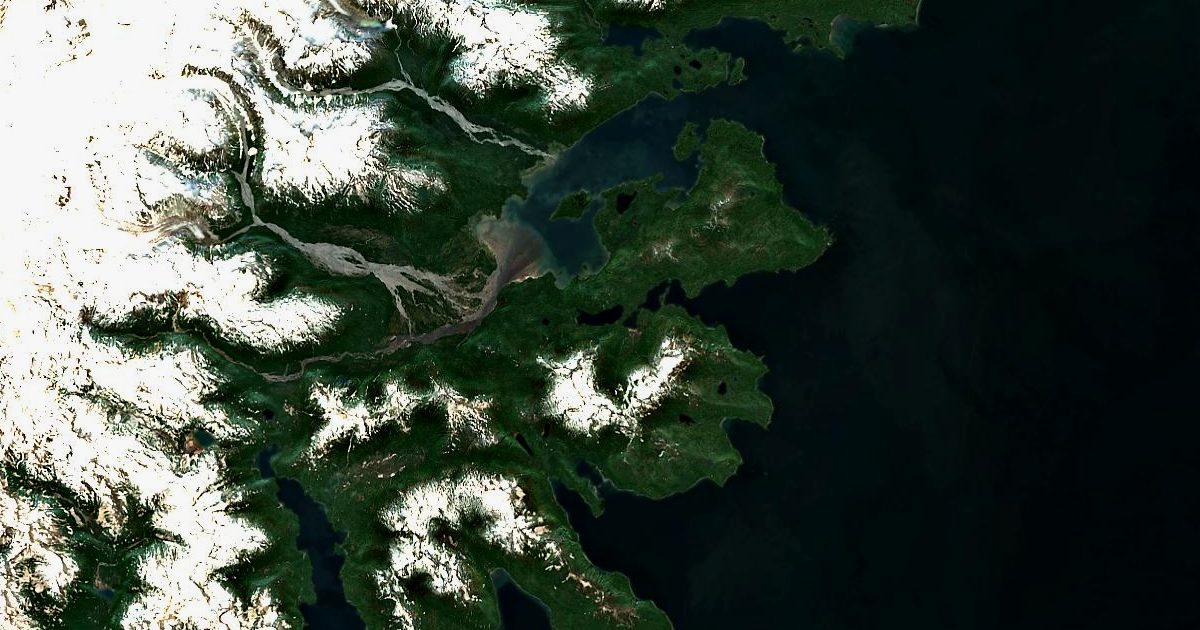
  • Reported locations along the way (illustrative)Schematic

Satellite imagery Sentinel-2 cloudless 2024 © EOX · Terrain AWS Terrain Tiles · Orange line is schematic · Place coordinates not individually verified

Route review

6 scenes to understand what happened

Scroll down and the map flies to where each part happened. The line is Schematic, Lines connect the locations mentioned in reports in sequence, showing only the approximate direction, not the actual track.

01

Full route

The locations mentioned in reports are connected in sequence to show the approximate course of events (illustrative).

02

A day trip

He parked his pickup at the Horseshoe Canyon trailhead and rode to the entrance of Bluejohn Canyon, planning to complete the trip in one day. He did not tell anyone where he was going.Facts it rests onF11Multiple sourcesHe parked his pickup truck at the Horseshoe Canyon trailhead and rode a mountain bike about 15 miles to the Bluejohn Canyon trailhead, where he locked the bike to a tree.F10Multiple sourcesThe trip was originally intended to last just one day.F12Multiple sourcesBefore setting out, Ralston did not tell anyone where he was going.

03

The boulder shifts

On 26 April, as he climbed over a boulder in a slot about 3 feet wide, it shifted and pinned his right arm. He made repeated attempts but could not free himself.Facts it rests onF15Multiple sourcesOn 26 April (Saturday), as Ralston was climbing over a boulder wedged between the walls of a slot about 3 feet wide in Bluejohn Canyon, the boulder moved and pinned his right arm against the rock wall, leaving him unable to free himself.F04Multiple sourcesAfter becoming trapped, he tried unsuccessfully to move the boulder using climbing equipment including ropes and anchors.

05

Freeing himself

On the morning of 1 May, he amputated his right forearm to free himself, descended to the canyon floor and walked along the canyon toward Horseshoe Canyon.Facts it rests onF23Multiple sourcesOn the morning of 1 May (Thursday), Ralston concluded that amputation was the only way he could survive. He severed his right forearm with the knife on his multitool, applied a tourniquet and administered first aid to himself.F26Multiple sourcesAfter reaching the canyon floor, he walked downstream into the neighboring Horseshoe Canyon.

06

Helicopter

He encountered a Dutch family of tourists in Horseshoe Canyon and was picked up by helicopter and taken for medical treatment at about 3 p.m.Facts it rests onF28Multiple sourcesIn Horseshoe Canyon, he met a family of tourists from the Netherlands (a couple and their son), who gave him water and helped signal the search and rescue helicopter.F29Multiple sourcesAt about 3 p.m. on 1 May, a Utah Department of Public Safety helicopter found him.F32Multiple sourcesThe helicopter took about 12 minutes to transport him to Allen Memorial Hospital in Moab, Utah. He walked into the emergency room himself and was later transferred to St. Mary's Hospital in Grand Junction, Colorado.

02Timeline

  1. Before setting out, Ralston did not tell anyone where he was going. F12

  2. On 26 April (Saturday), as Ralston was climbing over a boulder wedged between the walls of a slot about 3 feet wide in Bluejohn Canyon, the boulder moved and pinned his right arm against the rock wall, leaving him unable to free himself. F15

  3. He parked his pickup truck at the Horseshoe Canyon trailhead and rode a mountain bike about 15 miles to the Bluejohn Canyon trailhead, where he locked the bike to a tree. F11

  4. He ran out of water on 29 April (Tuesday). F17

  5. By tracing his credit card transactions, Aspen police found that he had bought fuel in Glenwood Springs and food in Moab, Utah, then notified local authorities to begin a search. F18

  6. At about 3 p.m. on 1 May, a Utah Department of Public Safety helicopter found him. F29

  7. On 1 May, search and rescue personnel found his pickup truck in the area of the Horseshoe Canyon trailhead. F22

  8. In Horseshoe Canyon, he met a family of tourists from the Netherlands (a couple and their son), who gave him water and helped signal the search and rescue helicopter. F28

  9. On the morning of 1 May (Thursday), Ralston concluded that amputation was the only way he could survive. He severed his right forearm with the knife on his multitool, applied a tourniquet and administered first aid to himself. F23

  10. The helicopter took about 12 minutes to transport him to Allen Memorial Hospital in Moab, Utah. He walked into the emergency room himself and was later transferred to St. Mary's Hospital in Grand Junction, Colorado. F32

  11. In 2004, Ralston published his autobiography, Between a Rock and a Hard Place, which Danny Boyle later adapted into the film 127 Hours, released in 2010. F39

  12. After the amputation, Ralston continued mountaineering and in March 2005 completed his plan to climb all of Colorado's peaks above 14000 feet alone in winter. F40

03Lessons

Communication and location

Leave your plans even for a short trip

Ralston did not tell anyone where he was going before setting out. Only after he had been missing for several days did the search begin with credit card records and the pickup parked at the trailhead. He later said he left a note almost every time, but did not do so this time. A note specifying the route and return time can help search and rescue start directly in the right place.Facts it rests onF12Multiple sourcesBefore setting out, Ralston did not tell anyone where he was going.F18Multiple sourcesBy tracing his credit card transactions, Aspen police found that he had bought fuel in Glenwood Springs and food in Moab, Utah, then notified local authorities to begin a search.F22Multiple sourcesOn 1 May, search and rescue personnel found his pickup truck in the area of the Horseshoe Canyon trailhead.F36Single sourceAt a press conference, Ralston said he regretted not leaving a note about where he was going, something he did almost every time but had not done on this occasion.

Rescue and self-rescue

People are hard to see from the air in a slot canyon

Rescuers believed that the slot where he was trapped was so deep and narrow that a helicopter would not have spotted him from the air if he had not walked out himself. When facing an emergency in a slot canyon, means of calling for help should be planned in advance; one cannot count on being seen by an aerial search.Facts it rests onF31Multiple sourcesRescuers believed that, because he was in a deep, narrow slot canyon, the helicopter would most likely not have been able to see him; if he had not freed himself, he would not have been found from the air.

Teams and decisions

Going alone into a remote canyon multiplies the risk

The local search and rescue leader believed that he could have left a note or found a companion, and said that people in this area often descend into places that are difficult to get back out of without telling anyone where they are going. When entering a remote canyon alone, an accident may occur without anyone knowing.Facts it rests onF37Single sourceGrand County search and rescue team leader Rex Tanner believed Ralston could have left a note or found a companion. He also said that people in this area often go into places that are difficult to get back from without telling anyone where they are going.F43Multiple sourcesBluejohn Canyon is a remote slot canyon in The Maze region of southeastern Utah, south of the Horseshoe Canyon unit of Canyonlands National Park.

Hypothermia and overnight gear

Prepare for an overnight stay even on a day trip

This was originally just a one-day trip, but he was trapped for five days. Nighttime temperatures fell to around zero degrees Celsius, and he ran out of water on the fourth day. When entering a remote canyon, carry enough extra water and warm clothing for an unexpected delay.Facts it rests onF10Multiple sourcesThe trip was originally intended to last just one day.F05Multiple sourcesWhile he was trapped, nighttime temperatures fell to around 30 degrees Fahrenheit (around zero degrees Celsius).F17Multiple sourcesHe ran out of water on 29 April (Tuesday).

04Fact list 44 facts

Under each fact is a verbatim quote from the original. "Single source" means only one outlet mentioned it; "Accounts differ" means sources contradict each other and this site adopts neither side; "Speculation" is an inference by a reporter or a person involved, not a fact.

  1. F01Multiple sourcesBackground

    Ralston was 27 at the time and lived in Aspen, Colorado. He was an experienced mountaineer and outdoor enthusiast.

    Quotes from the original 3

    “Aron Ralston, 27, of Aspen, Colo.”

    Deseret News · 2003-05-02

    “Ralston, a 27-year-old mountaineer from Aspen, Colorado, is an experienced outdoorsman”

    National Geographic · 2003-07-24

    “Aron Ralston, 27, of Aspen, Colorado”

    IOL · 2003-05-03
  2. F02Multiple sourcesBackground

    Before the incident, Ralston was preparing to climb Mount McKinley (Denali) in Alaska.

    Quotes from the original 2

    “He was training for an expedition in Alaska's Denali National Park.”

    Deseret News · 2003-05-02

    “this outing was a warm-up for an ascent of North America's highest mountain, 20,320-foot tall Mount McKinley”

    Climb-Utah ·
  3. F03Accounts differEvent

    Accounts of the boulder's weight differ: an early Deseret News report put it at 600 to 800 pounds; an Associated Press report cited police as saying 800 to 1,000 pounds; CBS cited police as saying rescuers who returned to the site found it weighed about 1,000 pounds, rather than the 200 pounds initially thought; National Geographic gave 800 pounds.

    Quotes from the original 4

    “free himself from a 600- to 800-pound boulder”

    Deseret News · 2003-05-02

    “an 800- to 1,000-pound boulder”

    Deseret News · 2003-05-04

    “discovered that the boulder weighed 1,000 pounds, not the 200 that they first believed”

    CBS News · 2003-05-04

    “Ralston dislodged an 800-pound (363-kilogram) chockstone”

    National Geographic · 2003-07-24
  4. F04Multiple sourcesEvent

    After becoming trapped, he tried unsuccessfully to move the boulder using climbing equipment including ropes and anchors.

    Quotes from the original 4

    “He tried to use his ropes and anchors to free himself, but couldn't.”

    Deseret News · 2003-05-04

    “Ralston's ropes and rigging equipment were found around the boulder, indicating he tried several times to pry himself out.”

    Deseret News · 2003-05-02

    “Ralston tried ropes, anchors, anything to move the boulder, but it wouldn't budge.”

    Climb-Utah ·

    “"At no point was I ever able to get that boulder to budge even microscopically," he said.”

    Los Angeles Times · 2003-05-03
  5. F05Multiple sourcesEvent

    While he was trapped, nighttime temperatures fell to around 30 degrees Fahrenheit (around zero degrees Celsius).

    Quotes from the original 2

    “He stood there, trapped, for five days, during which temperatures dropped to 30 degrees.”

    Los Angeles Times · 2003-05-03

    “Temperatures dipped into the 30's at night”

    Climb-Utah ·
  6. F06Single sourceEvent

    According to Deseret News, According to Ralston's later account, he quickly drank one-third of his water at the beginning and then panicked for a time.

    Quotes from the original 1

    “It happened after he quickly drank a third of his water supply — then panicked.”

    Deseret News · 2004-09-19
  7. F07Multiple sourcesEvent

    After concluding that his chances of survival were slim, he used a video camera to record a message for his family and carved his name, birth month and year, and what he thought would be his date of death into the rock wall.

    Quotes from the original 3

    “Knowing his chances of survival were slim, Aron picked up his video camera and began recording messages that he hoped would be found after his death.”

    NBC News ·

    “He resigned himself to death, videotaping goodbye messages for his family and scrawling his name, birthday, and presumed date of death into the canyon wall.”

    Outside ·

    “He pulled out his video camera and recorded a message to his parents.”

    Climb-Utah ·
  8. F08Multiple sourcesEvent

    Before the final amputation, he had made several unsuccessful attempts; Ralston said there were three in total.

    Quotes from the original 2

    “By the time I executed the amputation, I had made three unsuccessful attempts.”

    Deseret News · 2004-09-19

    “On the fourth day, he made last-ditch attempts to amputate his arm but came up short”

    Outside ·
  9. F09Multiple sourcesEvent

    Ralston's coworkers noticed that he had not come to work for several days and reported him missing to the authorities; the Emery County Sheriff's Office was notified.

    Quotes from the original 2

    “When Ralston was four days late for work, the Emery County Sheriff's Office was notified he was missing.”

    Deseret News · 2003-05-02

    “Ralston’s friends at the Ute Mountaineer store in Aspen began to worry when he failed to appear for work and called authorities.”

    Climb-Utah ·
  10. F10Multiple sourcesPlan

    The trip was originally intended to last just one day.

    Quotes from the original 4

    “The adventure was to last one day.”

    Deseret News · 2003-05-02

    “Ralston began what was to be a day hike.”

    Deseret News · 2003-05-04

    “what should have been an eight-hour, 13-mile (21-kilometer) day hike”

    National Geographic · 2003-07-24

    “The round trip would take perhaps eight hours.”

    Los Angeles Times · 2003-05-03
  11. F11Multiple sourcesMovement

    He parked his pickup truck at the Horseshoe Canyon trailhead and rode a mountain bike about 15 miles to the Bluejohn Canyon trailhead, where he locked the bike to a tree.

    Quotes from the original 2

    “parked his pickup truck at the Horseshoe Canyon Trailhead and took off on his mountain bike for the 15-mile ride to the Bluejohn Canyon Trailhead where he locked his mountain bike to a juniper tree”

    Climb-Utah ·

    “Ralston first rode his mountain bike about 15 miles cross-country, locking it to a tree at the head of the canyon.”

    Los Angeles Times · 2003-05-03
  12. F12Multiple sourcesPlan

    Before setting out, Ralston did not tell anyone where he was going.

    Quotes from the original 4

    “He had failed to leave word with anyone of where he was going that day.”

    National Geographic · 2003-07-24

    “But in a lapse from his normal routine, Aron had not told a soul.”

    NBC News ·

    “He had not informed any of his friends or family about his intended whereabouts, so rescue appeared unlikely.”

    Outside ·

    “he didn't bother to give his roommates a detailed itinerary, as was his practice on mountain climbs”

    Los Angeles Times · 2003-05-03
  13. F13Accounts differPlan

    Accounts of the supplies he carried differ: National Geographic said he had two burritos and 3 liters of water; Climb-Utah said he had two burritos, less than 1 liter of water, a cheap multi-tool, a small first-aid kit, a video camera and climbing equipment.

    Quotes from the original 2

    “His supplies—two burritos and three liters of water—were now gone”

    National Geographic · 2003-07-24

    “His backpack contained two burritos, less than a liter of water, a cheap imitation of a Leatherman brand multi-tool, a small first aid kit, a video camera, a digital camera and rock climbing gear.”

    Climb-Utah ·
  14. F14Single sourceMovement

    According to Los Angeles Times, He traveled with two young women for the first part of the route, then entered the more difficult section of the canyon alone.

    Quotes from the original 1

    “For the first leg of the climb, Ralston said he walked with two young women before taking on the tougher part of the canyon.”

    Los Angeles Times · 2003-05-03
  15. F15Multiple sourcesEvent

    On 26 April (Saturday), as Ralston was climbing over a boulder wedged between the walls of a slot about 3 feet wide in Bluejohn Canyon, the boulder moved and pinned his right arm against the rock wall, leaving him unable to free himself.

    Quotes from the original 5

    “But in a 3-foot section of the canyon, the 3 1/2-by-4 1/2-by-2 1/2-foot boulder crashed onto Ralston, pinning his right arm.”

    Deseret News · 2003-05-02

    “Ralston scrambled over the boulder and was lowering himself down when it shifted, pinning his arm.”

    Los Angeles Times · 2003-05-03

    “On April 26, 2003, the 27-year-old Ralston was canyoneering alone in Bluejohn Canyon.”

    Outside ·

    “As he began to climb down the opposite side the perfectly balanced 800-pound rock shifted several feet, pinning his right arm - he was trapped.”

    Climb-Utah ·

    “pinned April 26 by an 800- to 1,000-pound boulder that had shifted onto his right arm”

    Deseret News · 2003-05-04
  16. F16Single sourceEvent

    According to Los Angeles Times, According to Ralston at a press conference, he was climbing over a second boulder when it rolled and pinned his right hand against the rock wall.

    Quotes from the original 1

    “The second boulder rolled as he tried to scramble over it, trapping his right hand against the wall.”

    Los Angeles Times · 2003-05-03
  17. F17Multiple sourcesEvent

    He ran out of water on 29 April (Tuesday).

    Quotes from the original 4

    “He ran out of water on Tuesday, the statement said.”

    Deseret News · 2003-05-02

    “He ran out of water on Tuesday”

    CBS News · 2003-05-04

    “On Tuesday, he ran out of water.”

    Los Angeles Times · 2003-05-03

    “He ran out of water on Tuesday”

    IOL · 2003-05-03
  18. F18Multiple sourcesEvent

    By tracing his credit card transactions, Aspen police found that he had bought fuel in Glenwood Springs and food in Moab, Utah, then notified local authorities to begin a search.

    Quotes from the original 2

    “The charges indicated that he had purchased gas in Glenwood Springs, Colo., about 40 miles northwest of Aspen, and that he had then purchased groceries in Moab.”

    Los Angeles Times · 2003-05-03

    “Authorities in Aspen discovered he had used a credit card to buy groceries in Moab, Utah and notified authorities there to start searching for him.”

    Climb-Utah ·
  19. F19Multiple sourcesParticipant's view

    Emery County Sheriff's Office Sergeant Mitch Vetere said that if Ralston had stayed where he was, he would have died there.

    Quotes from the original 2

    “Aron Ralston, 27, of Aspen would have died had he stayed where he was”

    CBS News · 2003-05-04

    “The experienced outdoorsman would have died if he had stayed in the canyon”

    Deseret News · 2003-05-04
  20. F20Single sourceParticipant's view

    According to Los Angeles Times, National Park Ranger Jim Blazik criticized him for entering remote, rugged terrain alone without leaving friends a detailed itinerary.

    Blazik stressed that this was only his personal opinion and did not represent the National Park Service.

    Quotes from the original 1

    “Blazik chided him for hiking through such rugged, remote terrain alone and without leaving a detailed itinerary with friends.”

    Los Angeles Times · 2003-05-03
  21. F21Single sourceEvent

    According to Deseret News, At about 10 a.m. on 1 May (Thursday), personnel from the Utah Department of Public Safety, the Bureau of Land Management, the National Park Service, and Emery, Wayne and Grand counties began searching.

    Quotes from the original 1

    “Crews from the Utah Department of Public Safety, the Bureau of Land Management, the National Park Service, Emery, Wayne and Grand counties began searching for him about 10 a.m., Swanke said.”

    Deseret News · 2003-05-02
  22. F22Multiple sourcesEvent

    On 1 May, search and rescue personnel found his pickup truck in the area of the Horseshoe Canyon trailhead.

    Quotes from the original 3

    “On Thursday, one ranger said he remembered seeing the truck near Blue John Canyon in an area where many people leave their cars when they go hiking and camping.”

    Los Angeles Times · 2003-05-03

    “His truck had been found at the Horseshoe Canyon Trailhead, but no one had seen Ralston.”

    Climb-Utah ·

    “rescuers were converging near his truck, at the Horseshoe Canyon trailhead”

    NBC News ·
  23. F23Multiple sourcesEvent

    On the morning of 1 May (Thursday), Ralston concluded that amputation was the only way he could survive. He severed his right forearm with the knife on his multitool, applied a tourniquet and administered first aid to himself.

    Quotes from the original 4

    “on Thursday morning, he decided that his survival required drastic action.”

    CBS News · 2003-05-04

    “Using a pocketknife, Ralston cut off his right arm below the elbow and applied a tourniquet and administered first aid.”

    CBS News · 2003-05-04

    “By the morning of May 1st, after five days trapped beneath the massive boulder, Ralston resolved set himself free by amputating his own right hand using his only resource—a multitool.”

    National Geographic · 2003-07-24

    “That same day, however, Ralston amputated his arm, applied a tourniquet and administered first aid, the statement said.”

    Deseret News · 2003-05-02
  24. F24Multiple sourcesEvent

    According to Ralston, the amputation and bandaging took about an hour in all.

    Quotes from the original 2

    “It was a process that took about an hour.”

    Los Angeles Times · 2003-05-03

    “The entire procedure required approximately one hour.”

    Climb-Utah ·
  25. F25Accounts differMovement

    After freeing himself, he set an anchor, secured a rope and descended the cliff face to the canyon floor. Accounts differ on the height of the descent: CBS reported 60 feet, NBC and Outside reported 65 feet, and Climb-Utah reported nearly 70 feet.

    Quotes from the original 4

    “He then rigged anchors, fixed a rope and rappelled 60 feet to the canyon floor.”

    CBS News · 2003-05-04

    “That would be followed by a 65-foot rappel”

    NBC News ·

    “rappelled 65 feet down into another branch of the canyon”

    Outside ·

    “He rigged anchors and fixed a rope to rappel nearly 70-feet to the bottom of Bluejohn Canyon.”

    Climb-Utah ·
  26. F26Multiple sourcesMovement

    After reaching the canyon floor, he walked downstream into the neighboring Horseshoe Canyon.

    Quotes from the original 2

    “He continued hiking down the canyon and into Horseshoe Canyon, the statement said.”

    Deseret News · 2003-05-02

    “Leaving his rope hanging he hiked 5 miles downstream into adjacent Horseshoe Canyon”

    Climb-Utah ·
  27. F27Accounts differMovement

    Accounts differ on the distance he walked: the Los Angeles Times reported about 5 miles, Outside reported about 6 miles, and Deseret News reported 7 miles.

    Quotes from the original 3

    “He had walked about five miles when a helicopter search team spotted him”

    Los Angeles Times · 2003-05-03

    “After hiking approximately six miles, he came upon a family”

    Outside ·

    “walked seven miles before encountering other hikers and being spotted by a helicopter rescue unit”

    Deseret News · 2004-09-19
  28. F28Multiple sourcesEvent

    In Horseshoe Canyon, he met a family of tourists from the Netherlands (a couple and their son), who gave him water and helped signal the search and rescue helicopter.

    Quotes from the original 3

    “After walking about five miles, Ralston came across a Dutch couple and their son and together they hailed a helicopter flying overhead.”

    Los Angeles Times · 2003-05-03

    “where he encountered a Dutch family on vacation”

    Climb-Utah ·

    “They gave him water and walked with him until they could flag down a helicopter from the Utah Department of Public Safety.”

    Los Angeles Times · 2003-05-03
  29. F29Multiple sourcesEvent

    At about 3 p.m. on 1 May, a Utah Department of Public Safety helicopter found him.

    Quotes from the original 2

    “A Department of Public Safety helicopter found him about 3 p.m., the statement said.”

    Deseret News · 2003-05-02

    “Ralston was found about 3 p.m. Thursday with two other hikers, said Vetere”

    CBS News · 2003-05-04
  30. F30Multiple sourcesEvent

    He was rescued about four hours after amputating his arm.

    Quotes from the original 2

    “Rescuers reached Ralston approximately four hours after he cut off his arm.”

    Outside ·

    “I just cut off my hand four hours ago and I need medical attention.”

    Climb-Utah ·
  31. F31Multiple sourcesPost-incident analysis

    Rescuers believed that, because he was in a deep, narrow slot canyon, the helicopter would most likely not have been able to see him; if he had not freed himself, he would not have been found from the air.

    Quotes from the original 3

    “"If he wouldn't have gotten himself out of that mess," Vetere said, "they wouldn't have seen him from the air."”

    CBS News · 2003-05-04

    “Swanke said the canyon was so narrow, the helicopter pilot would never have spotted Ralston.”

    Los Angeles Times · 2003-05-03

    “A helicopter likely would not have found him because of his position in the deep and narrow slot canyon.”

    Climb-Utah ·
  32. F32Multiple sourcesAftermath

    The helicopter took about 12 minutes to transport him to Allen Memorial Hospital in Moab, Utah. He walked into the emergency room himself and was later transferred to St. Mary's Hospital in Grand Junction, Colorado.

    Quotes from the original 3

    “The rescuers tried to keep Ralston awake for the 12-minute flight to the hospital in Moab, Utah, by talking to him. He walked into the emergency room on his own.”

    CBS News · 2003-05-04

    “He was transported to Allen Memorial Hospital in Moab, then airlifted to St. Mary's Hospital in Grand Junction, Colo.”

    Deseret News · 2003-05-02

    “Twelve minutes later, the helicopter arrived at Allen Memorial Hospital in Moab, Utah. Ralston walked into the emergency room without help”

    Climb-Utah ·
  33. F33Multiple sourcesAftermath

    That day, rescuers returned to the canyon to retrieve the severed arm, but could not move the boulder.

    Quotes from the original 3

    “"They were unable to because it's a 600- to 800-pound rock."”

    Deseret News · 2003-05-02

    “A rescuer who went back to see if he could retrieve the arm said the boulder was too heavy to move.”

    IOL · 2003-05-03

    “Rescuers returned to the canyon later to try to retrieve the amputated limb; they saw it, but couldn't budge the boulder.”

    Los Angeles Times · 2003-05-03
  34. F34Single sourceAftermath

    According to Outside, By the time he was taken to hospital, he had lost about a quarter of his blood and more than 40 pounds in weight.

    Quotes from the original 1

    “By the time he arrived at the hospital, Ralston had lost 25% of his total blood volume and over 40 pounds.”

    Outside ·
  35. F35Single sourceAftermath

    According to Los Angeles Times, At a press conference, Ralston said doctors had told him that even without amputation, his trapped arm could not have been saved, because the boulder had cut off its blood supply and caused severe soft tissue damage.

    Quotes from the original 1

    “He also said doctors told him that he would have lost the arm anyway because the 800-pound boulder had cut off the blood and caused severe soft-tissue damage.”

    Los Angeles Times · 2003-05-03
  36. F36Single sourceParticipant's view

    According to Los Angeles Times, At a press conference, Ralston said he regretted not leaving a note about where he was going, something he did almost every time but had not done on this occasion.

    Quotes from the original 1

    “"This is something I almost always do, but I failed to do this time," he said.”

    Los Angeles Times · 2003-05-03
  37. F37Single sourceParticipant's view

    According to National Geographic, Grand County search and rescue team leader Rex Tanner believed Ralston could have left a note or found a companion. He also said that people in this area often go into places that are difficult to get back from without telling anyone where they are going.

    Quotes from the original 2

    “He could have left a note. He could have had a buddy.”

    National Geographic · 2003-07-24

    “Get themselves in a situation where they haven't told anybody where they're going, climb down into an area that's questionable, and not be able to get out.”

    National Geographic · 2003-07-24
  38. F38Single sourceParticipant's view

    According to National Geographic, Rex Tanner believed the most important thing Ralston did right while trapped was to stay calm.

    Quotes from the original 1

    “I think the number one thing is that he kept his head.”

    National Geographic · 2003-07-24
  39. F39Multiple sourcesAftermath

    In 2004, Ralston published his autobiography, Between a Rock and a Hard Place, which Danny Boyle later adapted into the film 127 Hours, released in 2010.

    Quotes from the original 4

    “In 2004, Ralston penned an autobiography, Between a Rock and a Hard Place”

    Outside ·

    “Released in 2010, 127 Hours was met with widespread critical acclaim and nominated for six Academy Awards.”

    Outside ·

    “In November 2010 the movie 127 HOURS, directed by Danny Boyle and starring James Franco was released.”

    Climb-Utah ·

    “Now Ralston has written a book about his ordeal”

    Deseret News · 2004-09-19
  40. F40Multiple sourcesAftermath

    After the amputation, Ralston continued mountaineering and in March 2005 completed his plan to climb all of Colorado's peaks above 14000 feet alone in winter.

    Quotes from the original 2

    “despite the loss of his arm, he completed on March 7, 2005”

    Backpacker · 2008-03-12

    “in 2005 Ralston became the first person to summit all of Colorado's 14,000-foot peaks alone and in winter”

    Outside ·
  41. F41Multiple sourcesBackground

    Ralston studied mechanical engineering and worked as an engineer at Intel before quitting, moving to Aspen and working at a mountaineering equipment store.

    Quotes from the original 2

    “Instead, Ralston moved to Aspen, took a job in a mountaineering store and packed his truck for the wilderness every chance he got.”

    Los Angeles Times · 2003-05-03

    “Ralston worked as a mechanical engineer for the technology company Intel in Arizona, Washington, and New Mexico for five years, before quitting in 2002 and moving to Aspen, Colorado to focus on climbing.”

    Outside ·
  42. F42Single sourceBackground

    According to National Geographic, Ralston had been a member of the Albuquerque Mountain Rescue Council.

    Quotes from the original 1

    “a former member of the Albuquerque Mountain Rescue Council”

    National Geographic · 2003-07-24
  43. F43Multiple sourcesBackground

    Bluejohn Canyon is a remote slot canyon in The Maze region of southeastern Utah, south of the Horseshoe Canyon unit of Canyonlands National Park.

    Quotes from the original 3

    “Bluejohn is a slot canyon in "The Maze" region, just south of the Horseshoe Canyon segment of Canyonlands National Park, in southeastern Utah.”

    Outside ·

    “near the Maze District of the Canyonlands just west of the Colorado River”

    Deseret News · 2003-05-02

    “He was in an area called the Maze. It's remote”

    National Geographic · 2003-07-24
  44. F44Single sourceAftermath

    According to Backpacker, The boulder at the site where he was trapped was later removed by workers to prevent anyone else from being endangered.

    Quotes from the original 1

    “a work crew removed the stone that had trapped his arm so that no one would suffer a similar fate”

    Backpacker · 2008-03-12