GuituluGlobal Outdoor Accident Archive 中文
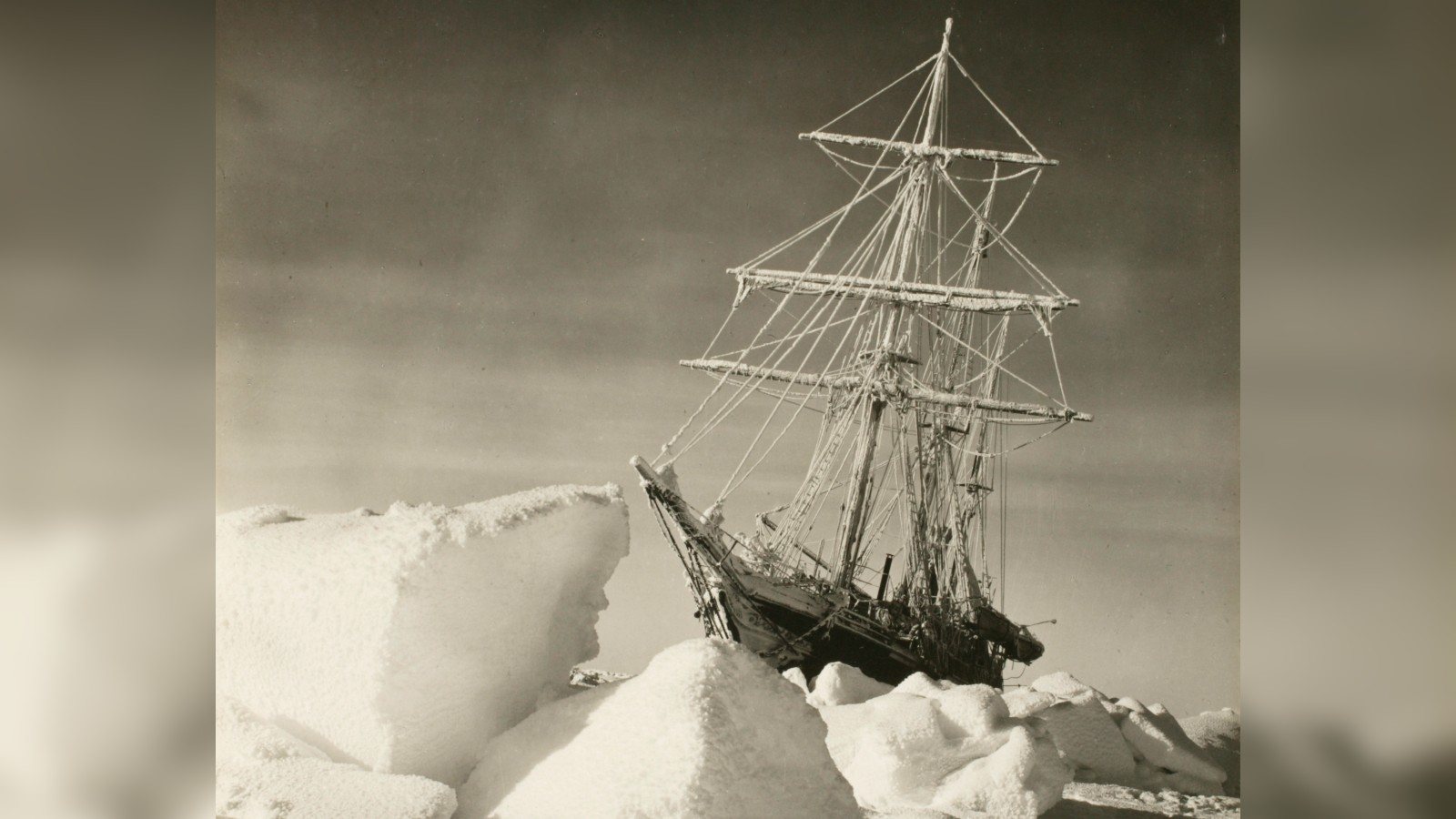
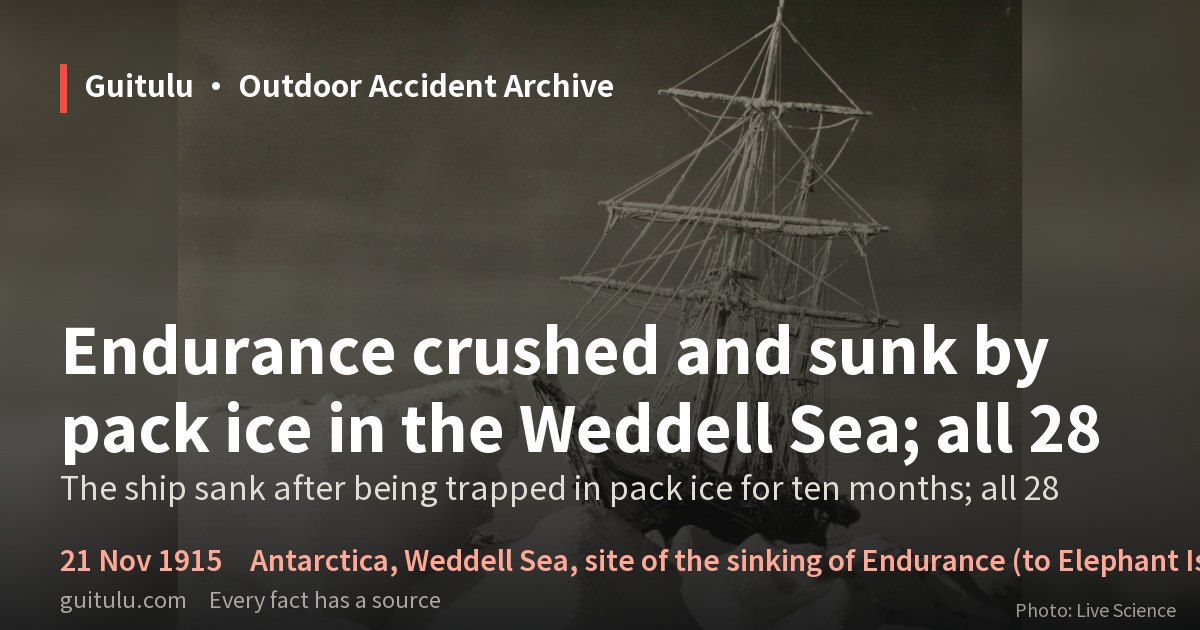
Endurance trapped in pack ice in the Weddell Sea after the Antarctic winter

Archive / Other

Endurance crushed and sunk by pack ice in the Weddell Sea; all 28 survive after reaching Elephant Island and a long small-boat voyage

The ship sank after being trapped in pack ice for ten months; all 28 survived through a long small-boat voyage and a mountain crossing to seek help

Ended: the last 22 people were rescued from Elephant Island on 30 August 1916

Photo: Live Science

Date
Southern Hemisphere spring
Place
Antarctica, Weddell Sea, site of the sinking of Endurance (to Elephant Island and South Georgia)Antarctica › Weddell Sea · Weddell Sea-52.330°E -68.739°N
Activity
Polar expeditionInvolves: Extreme weather28 people (the Weddell Sea party of Shackleton's Imperial Trans-Antarctic Expedition)
Casualties
No deathsAll 28 aboard Endurance survived; three members of the separate Ross Sea party died and are not included on this page
Material
45 facts · 9 sources4 accounts differ and are shown side by side

01What happened

In 1914, Shackleton set out with the Imperial Trans-Antarctic Expedition, aiming to make the first overland crossing of Antarctica, from the Weddell Sea via the South Pole to the Ross Sea; a separate Ross Sea party laid supplies from the other side of the continent. Endurance carried 28 people and sailed from Plymouth on 8 August. On South Georgia, Shackleton received a warning that ice conditions in the Weddell Sea were unusually severe that year. He nevertheless sailed for the Weddell Sea on 5 December and entered the pack ice two days later.Facts it rests onF01Multiple sourcesThe Imperial Trans-Antarctic Expedition aimed to make the first overland crossing of Antarctica, from the Weddell Sea via the South Pole to the Ross Sea.F02Multiple sourcesAnother party, the Ross Sea party, set out aboard Aurora from the other side of the continent, with responsibility for laying supply depots along the route.F03Multiple sourcesEndurance carried 28 people in all: 27 crew members and one person who had stowed away and became a steward on board. The ship was under the command of Captain Frank Worsley.F04Multiple sourcesEndurance sailed from Plymouth, England, on 8 August 1914.F05Multiple sourcesOn South Georgia, whalers warned Shackleton that ice conditions in the Weddell Sea were unusually severe that year, but he decided to continue south.F06Multiple sourcesOn 5 December 1914, Endurance left South Georgia for the Weddell Sea.F07Multiple sourcesTwo days after leaving South Georgia, Endurance entered an area of pack ice.

Endurance trapped in pack ice in the Weddell Sea after the Antarctic winterPhoto source: Live Science

Endurance was trapped in pack ice about 80 miles from its intended landing site at Vahsel Bay. After attempts to free it failed, the entire party spent the winter with the ship in the ice. In October 1915, ice pressure deformed the hull and caused severe leaks; on 27 October, the pressure reached its peak, the stern was lifted and the rudder was torn off, and Shackleton ordered the ship abandoned. The party set up 'Ocean Camp' on the sea ice beside the ship and salvaged lifeboats, sledges and supplies. On 21 November, Endurance sank in the Weddell Sea.Facts it rests onF10Multiple sourcesWhen Endurance became trapped, it was not far from its intended landing site at Vahsel Bay, reportedly only about 80 miles away.F08Multiple sourcesAfter attempts to free the ship failed, Shackleton decided that the whole party would spend the winter aboard it in the pack ice.F11Multiple sourcesIn October 1915, ice pressure formed ridges that pressed against the hull. Endurance began to deform and leak badly, and the crew pumped water in shifts day and night.F13Multiple sourcesOn 27 October 1915, ice pressure reached its peak, the stern was lifted, the rudder was torn off and seawater poured in. Shackleton ordered the ship abandoned.F12Multiple sourcesAfter abandoning ship, the party pitched tents on the drifting sea ice beside it and established “Ocean Camp”.F14Multiple sourcesBefore the ship sank, the party salvaged lifeboats, sledges and as many supplies as possible, and discarded everything that added weight.F15Multiple sourcesOn the evening of 21 November 1915, Endurance sank in the Weddell Sea.

The wreck of Endurance, crushed by ice in 1915, with deputy leader Wild standing alongsidePhoto source: Live Science

According to reports, Shackleton decided to head west on 20 December. The party hauled two lifeboats across ice ridges and crevasses, advancing only about 7.5 miles in seven days, while their rations would last only 42 days. They had to abandon the march and spent nearly another three and a half months at 'Patience Camp'. On 9 April 1916, the pack ice broke apart, and they took to the sea in three lifeboats. A few days later they landed on Elephant Island, setting foot on land for the first time in nearly 500 days.Facts it rests onF16Single sourceOn 20 December 1915, Shackleton announced that the whole party would travel west to shorten the distance to Paulet Island.F17Multiple sourcesFrom 3 a.m. on 23 December, the party travelled over the ice, dragging the two lifeboats “James Caird” and “Dudley Docker”. Ice ridges and crevasses made progress extremely slow.F18Multiple sourcesAfter seven days of travel, they had advanced only about 7.5 miles in a straight line, and their rations would last only 42 days. Shackleton decided to abandon the march and return to the pack ice to camp and wait.F19Multiple sourcesThe new camp was named “Patience Camp”. The party stayed there for nearly three and a half months, waiting for the sea ice to break up.F31Multiple sourcesOn 9 April 1916, the pack ice broke apart, and Shackleton ordered the three lifeboats launched into the sea to leave the ice.F24Multiple sourcesIt was the first time they had set foot on land in nearly 500 days since leaving South Georgia.

On 24 April 1916, James Caird is launched from Elephant Island for South Georgia to seek helpPhoto source: Live Science

Elephant Island was remote, and there was almost no chance of a passing ship arriving. On 24 April 1916, Shackleton set out with five men aboard the modified “James Caird”. The other 22, led by Wild, sheltered under overturned lifeboats. Navigating by dead reckoning and occasional observations of the sun, the boat reached the uninhabited southern coast of South Georgia Island against heavy seas and strong winds. Shackleton, Worsley and Crean then crossed the island's mountains, walking for 36 hours without stopping, and arrived at Stromness whaling station on 20 May.Facts it rests onF26Multiple sourcesElephant Island was remote and few ships passed by, so there was little hope of being rescued if they stayed on the island and waited.F32Multiple sourcesOn 24 April 1916, Shackleton and 5 crew members, including Captain Worsley, set out from Elephant Island aboard the “James Caird” for South Georgia to seek help.F27Multiple sourcesThe carpenter McNish modified the largest lifeboat, the “James Caird”: he raised its sides, fitted it with a mast from another boat, and added a canvas covering.F33Multiple sourcesThe remaining 22 men stayed on Elephant Island under the command of deputy leader Frank Wild, turning the two remaining lifeboats upside down to use as shelter.F29Multiple sourcesDuring the voyage, they could navigate only by dead reckoning and sextant observations of the sun when it occasionally appeared.F34Multiple sourcesThe small boat encountered large waves and force 9 winds. Ice formed on the hull, threatening to capsize it, and the men continually bailed out water and knocked ice off the sails.F38Multiple sourcesThe small boat landed at King Haakon Bay on the uninhabited southern coast of South Georgia, with the whaling station on the other side of the island.F39Multiple sourcesShackleton, Worsley and Crean crossed the mountains and glaciers of central South Georgia on foot to reach the Stromness whaling station.F40Multiple sourcesThe three walked continuously for 36 hours and arrived at the Stromness whaling station on 20 May 1916.

Endurance trapped in pack ice, with crew members walking on the icePhoto source: BBC · Getty Images/SPRI

Several subsequent rescue attempts were turned back by pack ice. On 30 August 1916, the Chilean tug 'Yelcho' reached Elephant Island and took off all 22 people. All 28 from Endurance survived; three members of the Ross Sea party on the other side of the continent died. The goal of crossing Antarctica was not achieved. In March 2022, the wreck of Endurance was found at a depth of 3008 metres in the Weddell Sea and is protected under the Antarctic Treaty.Facts it rests onF20Multiple sourcesThe first several attempts to rescue the men on Elephant Island were turned back by pack ice. One vessel provided by Uruguay came within about 100 miles of Elephant Island.F42Multiple sourcesOn 30 August 1916, the tug “Yelcho”, loaned by Chile, reached Elephant Island and picked up all 22 men who had stayed behind.F41Multiple sourcesAll 28 people from Endurance survived.F21Multiple sourcesMembers of the Ross Sea party on the other side of the continent died, including three men, among them commander Mackintosh.F43Multiple sourcesThe goal of crossing Antarctica was ultimately not achieved.F44Multiple sourcesIn March 2022, the Endurance22 search team found the wreck of Endurance at a depth of 3008 metres in the Weddell Sea, about 4 miles south of the sinking position recorded by Worsley at the time.F45Multiple sourcesThe wreck is protected under the Antarctic Treaty and is designated a Historic Site and Monument; it must not be disturbed.

The number at the end of a paragraph is how many facts it rests on; open it to see each fact and how well it is sourced: Multiple sourcesSingle source. Conflicting accounts and speculation are kept out of the narrative.

ImgScene photos all from news coverage; copyright belongs to the original authors

  • Reported locations along the route (schematic)Schematic

Satellite imagery Sentinel-2 cloudless 2024 © EOX · Terrain AWS Terrain Tiles · Orange line is schematic · Place coordinates not individually verified

Route review

7 scenes to understand what happened

Scroll down and the map flies to where each part happened. The line is Schematic, Lines connect the locations mentioned in reports in sequence and indicate only the approximate direction, not the actual track. Sources for the coordinates are in places.json.

01

The full journey

Locations mentioned in reports are connected in sequence to show the approximate route (illustrative).

04

Drifting on the ice

The party marched only about 7.5 miles in seven days on the ice, waited at Patience Camp for three and a half months, and took to the sea in lifeboats on 9 April 1916.Facts it rests onF18Multiple sourcesAfter seven days of travel, they had advanced only about 7.5 miles in a straight line, and their rations would last only 42 days. Shackleton decided to abandon the march and return to the pack ice to camp and wait.F19Multiple sourcesThe new camp was named “Patience Camp”. The party stayed there for nearly three and a half months, waiting for the sea ice to break up.F31Multiple sourcesOn 9 April 1916, the pack ice broke apart, and Shackleton ordered the three lifeboats launched into the sea to leave the ice.

05

Stranded on Elephant Island

The party landed on Elephant Island and later moved to Cape Wild; 22 men waited for rescue under overturned lifeboats.Facts it rests onF24Multiple sourcesIt was the first time they had set foot on land in nearly 500 days since leaving South Georgia.F25Single sourceThe party first landed at Cape Valentine, where conditions were poor, then moved to a more sheltered shingle beach about 9 miles away, which they named Cape Wild.F33Multiple sourcesThe remaining 22 men stayed on Elephant Island under the command of deputy leader Frank Wild, turning the two remaining lifeboats upside down to use as shelter.

06

Small-boat voyage for help

On 24 April, Shackleton set out in a small boat with five others, navigating by dead reckoning, and landed at King Haakon Bay on the south coast of South Georgia.Facts it rests onF32Multiple sourcesOn 24 April 1916, Shackleton and 5 crew members, including Captain Worsley, set out from Elephant Island aboard the “James Caird” for South Georgia to seek help.F29Multiple sourcesDuring the voyage, they could navigate only by dead reckoning and sextant observations of the sun when it occasionally appeared.F38Multiple sourcesThe small boat landed at King Haakon Bay on the uninhabited southern coast of South Georgia, with the whaling station on the other side of the island.

02Timeline

  1. Endurance sailed from Plymouth, England, on 8 August 1914. F04

  2. On 5 December 1914, Endurance left South Georgia for the Weddell Sea. F06

  3. In October 1915, ice pressure formed ridges that pressed against the hull. Endurance began to deform and leak badly, and the crew pumped water in shifts day and night. F11

  4. On 27 October 1915, ice pressure reached its peak, the stern was lifted, the rudder was torn off and seawater poured in. Shackleton ordered the ship abandoned. F13

  5. On the evening of 21 November 1915, Endurance sank in the Weddell Sea. F15

  6. On 20 December 1915, Shackleton announced that the whole party would travel west to shorten the distance to Paulet Island. F16

  7. The new camp was named “Patience Camp”. The party stayed there for nearly three and a half months, waiting for the sea ice to break up. F19

  8. On 9 April 1916, the pack ice broke apart, and Shackleton ordered the three lifeboats launched into the sea to leave the ice. F31

  9. On 24 April 1916, Shackleton and 5 crew members, including Captain Worsley, set out from Elephant Island aboard the “James Caird” for South Georgia to seek help. F32

  10. The small boat landed at King Haakon Bay on the uninhabited southern coast of South Georgia, with the whaling station on the other side of the island. F38

  11. The three walked continuously for 36 hours and arrived at the Stromness whaling station on 20 May 1916. F40

  12. On 30 August 1916, the tug “Yelcho”, loaned by Chile, reached Elephant Island and picked up all 22 men who had stayed behind. F42

  13. In March 2022, the Endurance22 search team found the wreck of Endurance at a depth of 3008 metres in the Weddell Sea, about 4 miles south of the sinking position recorded by Worsley at the time. F44

03Lessons

Weather and retreat

Take ice warnings seriously before setting out

On South Georgia, Endurance had already received a warning that ice conditions in the Weddell Sea were unusually severe that year. It nevertheless continued south as planned, and little more than a month later became trapped in pack ice not far from the landing site. Seasonal warnings about ice, snow and water conditions often determine the success or failure of an entire journey and are worth delaying or changing the route for.Facts it rests onF05Multiple sourcesOn South Georgia, whalers warned Shackleton that ice conditions in the Weddell Sea were unusually severe that year, but he decided to continue south.F06Multiple sourcesOn 5 December 1914, Endurance left South Georgia for the Weddell Sea.F10Multiple sourcesWhen Endurance became trapped, it was not far from its intended landing site at Vahsel Bay, reportedly only about 80 miles away.

Teams and decisions

Account carefully for strength and rations in a retreat plan

After seven days of marching on the ice, the party had advanced only about 7.5 miles, while their rations would last only 42 days. They stopped and made camp in time, rather than exhausting themselves on an impassable route. When stranded, first work out speed, distance and supplies, then decide whether to go or wait.Facts it rests onF18Multiple sourcesAfter seven days of travel, they had advanced only about 7.5 miles in a straight line, and their rations would last only 42 days. Shackleton decided to abandon the march and return to the pack ice to camp and wait.F19Multiple sourcesThe new camp was named “Patience Camp”. The party stayed there for nearly three and a half months, waiting for the sea ice to break up.

Rescue and self-rescue

When rescue is unlikely to come, send the smallest possible party for help

Elephant Island was remote, and ships almost never passed by. Shackleton took only five men in a modified small boat to seek help, while the other 22 stayed behind and waited. Those who stayed had shelter and a leader; those seeking help travelled light and fast. In the end, everyone was rescued.Facts it rests onF26Multiple sourcesElephant Island was remote and few ships passed by, so there was little hope of being rescued if they stayed on the island and waited.F32Multiple sourcesOn 24 April 1916, Shackleton and 5 crew members, including Captain Worsley, set out from Elephant Island aboard the “James Caird” for South Georgia to seek help.F33Multiple sourcesThe remaining 22 men stayed on Elephant Island under the command of deputy leader Frank Wild, turning the two remaining lifeboats upside down to use as shelter.F42Multiple sourcesOn 30 August 1916, the tug “Yelcho”, loaned by Chile, reached Elephant Island and picked up all 22 men who had stayed behind.

Communication and location

Where there is no means of determining position, navigation is a lifeline

The small boat bound for South Georgia could navigate only by dead reckoning and occasional observations of the sun; a deviation from course would have meant missing the island. Outdoor trips today likewise require reliable positioning and communications equipment, and someone who knows how to use it.Facts it rests onF29Multiple sourcesDuring the voyage, they could navigate only by dead reckoning and sextant observations of the sun when it occasionally appeared.F38Multiple sourcesThe small boat landed at King Haakon Bay on the uninhabited southern coast of South Georgia, with the whaling station on the other side of the island.

04Fact list 45 facts

Under each fact is a verbatim quote from the original. "Single source" means only one outlet mentioned it; "Accounts differ" means sources contradict each other and this site adopts neither side; "Speculation" is an inference by a reporter or a person involved, not a fact.

  1. F01Multiple sourcesPlan

    The Imperial Trans-Antarctic Expedition aimed to make the first overland crossing of Antarctica, from the Weddell Sea via the South Pole to the Ross Sea.

    Quotes from the original 2

    “The expedition was to be an attempt at the first land crossing of the Antarctic, from the Weddell Sea to the Ross Sea by way of the South Pole”

    Geographical ·

    “hoped to accomplish the first land crossing of the Antarctic continent”

    History Hit ·
  2. F02Multiple sourcesPlan

    Another party, the Ross Sea party, set out aboard Aurora from the other side of the continent, with responsibility for laying supply depots along the route.

    Quotes from the original 2

    “the second crew, called the Ross Sea Party, planned to drop off depot supplies from their ship Aurora”

    Live Science · 2022-03-09

    “with another team, the Ross Sea Party, sailing separately to McMurdo Sound and laying out supply depots across the Ross Ice Shelf to the Beardmore Glacier”

    Antarctica Cruises ·
  3. F03Multiple sourcesBackground

    Endurance carried 28 people in all: 27 crew members and one person who had stowed away and became a steward on board. The ship was under the command of Captain Frank Worsley.

    Quotes from the original 3

    “carrying 27 men (plus one stowaway, who became the ship’s steward), 69 dogs”

    HISTORY · 2020-10-21

    “with a crew of 28 men under the command of Captain Frank Worsley”

    Geographical ·

    “With a crew of 28 (including Shackleton)”

    Live Science · 2022-03-09
  4. F04Multiple sourcesMovement

    Endurance sailed from Plymouth, England, on 8 August 1914.

    Quotes from the original 3

    “The Endurance set forth out of Plymouth on August 8, 1914”

    Antarctica Cruises ·

    “On August 8, 1914, Ernest Shackleton and his crew set off from Plymouth, England”

    Explorersweb · 2015-12-17

    “set sail from Plymouth in August 1914”

    Geographical ·
  5. F05Multiple sourcesEvent

    On South Georgia, whalers warned Shackleton that ice conditions in the Weddell Sea were unusually severe that year, but he decided to continue south.

    Quotes from the original 3

    “There, Shackleton was informed of unusually severe ice conditions in the Weddell Sea, but nonetheless was determined to continue onward.”

    Antarctica Cruises ·

    “despite warnings from whalers in South Georgia that the Weddell Sea would be unnavigable due to the thick ice coverage that year.”

    History Hit ·

    “despite warnings of dangerous pack ice en route”

    State Library of New South Wales ·
  6. F06Multiple sourcesMovement

    On 5 December 1914, Endurance left South Georgia for the Weddell Sea.

    Quotes from the original 4

    “Endurance had left South Georgia for Antarctica on December 5, 1914”

    HISTORY · 2020-10-21

    “Leaving South Georgia on December 5”

    Antarctica Cruises ·

    “On 5 December 1914, Ernest Shackleton departed from South Georgia for Antarctica”

    History Hit ·

    “The Endurance departed from South Georgia for the Weddell Sea, Antarctica, on 5 December 1914”

    State Library of New South Wales ·
  7. F07Multiple sourcesMovement

    Two days after leaving South Georgia, Endurance entered an area of pack ice.

    Quotes from the original 2

    “Two days after leaving South Georgia, Endurance entered the pack ice”

    HISTORY · 2020-10-21

    “the Endurance encountered its first pack ice two days later”

    Antarctica Cruises ·
  8. F08Multiple sourcesEvent

    After attempts to free the ship failed, Shackleton decided that the whole party would spend the winter aboard it in the pack ice.

    Quotes from the original 2

    “After efforts to free the Endurance proved futile, Shackleton decided the crew would have to resign itself to overwintering on the pack ice with the ship.”

    Antarctica Cruises ·

    “There was nothing else to do but to establish a routine and wait out the winter.”

    HISTORY · 2020-10-21
  9. F09Accounts differEvent

    Accounts differ on when Endurance became trapped in pack ice: Live Science says December 1914; HISTORY, Antarctica Cruises and History Hit say 18 January 1915; and the State Library of New South Wales says between January and February 1915.

    Quotes from the original 4

    “became trapped in pack ice during Dec. 1914”

    Live Science · 2022-03-09

    “on January 18, a northerly gale pressed the pack hard against the land and pushed the floes tight against each other”

    HISTORY · 2020-10-21

    “on 18 January 1915, Endurance became trapped in the ice of the Weddell Sea”

    History Hit ·

    “During January and February of 1915, the ship became trapped in the ice.”

    State Library of New South Wales ·
  10. F10Multiple sourcesEvent

    When Endurance became trapped, it was not far from its intended landing site at Vahsel Bay, reportedly only about 80 miles away.

    Quotes from the original 2

    “only about 80 miles from their goal of Vahsel Bay”

    Antarctica Cruises ·

    “They had been within a day’s sailing of their landing place”

    HISTORY · 2020-10-21
  11. F11Multiple sourcesEvent

    In October 1915, ice pressure formed ridges that pressed against the hull. Endurance began to deform and leak badly, and the crew pumped water in shifts day and night.

    Quotes from the original 2

    “By October 1915, the ship was leaking badly and the men worked the pumps in shifts around the clock.”

    State Library of New South Wales ·

    “In October of 1915, after many months of entrapped drifting, the Endurance began buckling as pressure ridges formed in the pack ice.”

    Antarctica Cruises ·
  12. F12Multiple sourcesEvent

    After abandoning ship, the party pitched tents on the drifting sea ice beside it and established “Ocean Camp”.

    Quotes from the original 2

    “Shackleton ordered the men to move into tents on the ice, thereby establishing Ocean Camp.”

    Antarctica Cruises ·

    “A makeshift camp, known as 'Ocean Camp', was set up on the drifting sea ice near the sinking ship.”

    State Library of New South Wales ·
  13. F13Multiple sourcesEvent

    On 27 October 1915, ice pressure reached its peak, the stern was lifted, the rudder was torn off and seawater poured in. Shackleton ordered the ship abandoned.

    Quotes from the original 4

    “Finally, on October 27, 1915, a new wave of pressure rippled across the ice, lifting the ship’s stern and tearing off its rudder and its keel.”

    HISTORY · 2020-10-21

    “The pressure reached its height on 27 October 1915. The ship was pushed up and a floe moved across it destroying the rudder and the stern post.”

    State Library of New South Wales ·

    “until Shackleton ordered the crew to abandon ship on Oct. 27, 1915”

    Live Science · 2022-03-09

    “until an increase in pressure forced the ship’s stern into the air and tore off its rudder”

    History Hit ·
  14. F14Multiple sourcesEvent

    Before the ship sank, the party salvaged lifeboats, sledges and as many supplies as possible, and discarded everything that added weight.

    Quotes from the original 2

    “The lifeboats, sledges and as many supplies as could be gathered were salvaged from the ship before it eventually sank.”

    State Library of New South Wales ·

    “the crew salvaged as many provisions as they could, while sacrificing anything and everything that added weight”

    HISTORY · 2020-10-21
  15. F15Multiple sourcesEvent

    On the evening of 21 November 1915, Endurance sank in the Weddell Sea.

    Quotes from the original 5

    “‘She’s going, boys!’ Shackleton shouted the evening of November 21, 1915.”

    Explorersweb · 2015-12-17

    “On November 21, the partly crushed and leaking Endurance finally went down under the icy waters of the Weddell Sea.”

    Antarctica Cruises ·

    “Endurance was slowly crushed over the next month and sank on 21 November, 1915.”

    Geographical ·

    “Endurance sank on 21 November 1915.”

    History Hit ·

    “Twenty-five days later, what remained of the wreck convulsed once more, and the Endurance disappeared beneath the ice.”

    HISTORY · 2020-10-21
  16. F16Single sourcePlan

    According to Explorersweb, On 20 December 1915, Shackleton announced that the whole party would travel west to shorten the distance to Paulet Island.

    Quotes from the original 1

    “On December 20, Shackleton informed all hands that he intended to try and make a march to the west to reduce the distance between them and Paulet Island.”

    Explorersweb · 2015-12-17
  17. F17Multiple sourcesMovement

    From 3 a.m. on 23 December, the party travelled over the ice, dragging the two lifeboats “James Caird” and “Dudley Docker”. Ice ridges and crevasses made progress extremely slow.

    Quotes from the original 2

    “At 3 a.m. on December 23 all hands were roused for the purpose of sledging the two boats, the James Caird and the Dudley Docker”

    Explorersweb · 2015-12-17

    “the men managed just seven and a half miles in seven days”

    HISTORY · 2020-10-21
  18. F18Multiple sourcesEvent

    After seven days of travel, they had advanced only about 7.5 miles in a straight line, and their rations would last only 42 days. Shackleton decided to abandon the march and return to the pack ice to camp and wait.

    Quotes from the original 2

    “We had marched seven and a half miles in a direct line and at this rate it would take us over three hundred days to reach the land away to the west. As we only had food for forty-two days there was no alternative”

    Explorersweb · 2015-12-17

    “the men managed just seven and a half miles in seven days”

    HISTORY · 2020-10-21
  19. F19Multiple sourcesEvent

    The new camp was named “Patience Camp”. The party stayed there for nearly three and a half months, waiting for the sea ice to break up.

    Quotes from the original 2

    “Our new home, which we were to occupy for nearly three and a half months, we called Patience Camp.”

    Explorersweb · 2015-12-17

    “The crew moved from Ocean Camp to a new site, Patience Camp, resolving to wait for the ice to break up.”

    Antarctica Cruises ·
  20. F20Multiple sourcesAftermath

    The first several attempts to rescue the men on Elephant Island were turned back by pack ice. One vessel provided by Uruguay came within about 100 miles of Elephant Island.

    Quotes from the original 3

    “Ice also thwarted two subsequent rescue voyages in different ships.”

    Antarctica Cruises ·

    “The government of Uruguay proffered a vessel that came within 100 miles of Elephant Island before being beaten back by the ice.”

    HISTORY · 2020-10-21

    “After several aborted rescue attempts”

    Live Science · 2022-03-09
  21. F21Multiple sourcesAftermath

    Members of the Ross Sea party on the other side of the continent died, including three men, among them commander Mackintosh.

    The Ross Sea party was a separate group; its casualties are not included on this page.

    Quotes from the original 2

    “Three of the party (including the commander Aeneas Mackintosh) died”

    Live Science · 2022-03-09

    “endured its own terrible tribulations (with several lives lost)”

    Antarctica Cruises ·
  22. F22Single sourceEvent

    According to HISTORY, During the voyage across open water, everyone was exhausted; some were seasick and some had dysentery, and Captain Worsley had not slept for 80 hours.

    Quotes from the original 1

    “Worsley had by that stage not slept for 80 hours. And while some were crippled by seasickness, others were wracked with dysentery.”

    HISTORY · 2020-10-21
  23. F23Accounts differMovement

    Accounts differ on the date they landed on Elephant Island: Live Science says 14 April 1916; HISTORY and Antarctica Cruises say 15 April.

    Quotes from the original 3

    “reaching the uninhabited and remote Elephant Island on April 14”

    Live Science · 2022-03-09

    “on April 15, they clambered ashore on Elephant Island”

    HISTORY · 2020-10-21

    “This barren, farflung island the lifeboats reached on April 15, 1916”

    Antarctica Cruises ·
  24. F24Multiple sourcesEvent

    It was the first time they had set foot on land in nearly 500 days since leaving South Georgia.

    Quotes from the original 2

    “It was the first time they had been on dry land since leaving South Georgia 497 days previously.”

    HISTORY · 2020-10-21

    “able to set foot on terra firma for the first time in almost 500 days”

    Antarctica Cruises ·
  25. F25Single sourceMovement

    According to Antarctica Cruises, The party first landed at Cape Valentine, where conditions were poor, then moved to a more sheltered shingle beach about 9 miles away, which they named Cape Wild.

    Quotes from the original 1

    “Having first come ashore on Elephant Island at inhospitable Cape Valentine, the crew had trekked some nine miles away to a somewhat more sheltered gravel shore they named Cape Wild.”

    Antarctica Cruises ·
  26. F26Multiple sourcesPost-incident analysis

    Elephant Island was remote and few ships passed by, so there was little hope of being rescued if they stayed on the island and waited.

    Quotes from the original 3

    “The likelihood of anybody coming across them was vanishingly small”

    HISTORY · 2020-10-21

    “But Elephant Island, the men knew, was remote and little-visited.”

    Antarctica Cruises ·

    “With no hope of rescue there”

    Linda Hall Library ·
  27. F27Multiple sourcesEvent

    The carpenter McNish modified the largest lifeboat, the “James Caird”: he raised its sides, fitted it with a mast from another boat, and added a canvas covering.

    Quotes from the original 2

    “raising the gunwales, rigging it with a mast from the Stancomb Wills, and installing a canvas cover”

    Antarctica Cruises ·

    “Shackleton beefed up one of the lifeboats, the James Caird”

    Linda Hall Library ·
  28. F28Accounts differBackground

    Accounts differ on the distance of the voyage from Elephant Island to South Georgia: most sources say more than 800 miles; Antarctica Cruises says about 850 miles; Linda Hall Library says more than 900 miles.

    Quotes from the original 4

    “over 800 miles (1,300 km)”

    Live Science · 2022-03-09

    “sailed a gruelling 800 miles to South Georgia”

    Geographical ·

    “some 850 discouraging miles from Elephant Island”

    Antarctica Cruises ·

    “more than 900 miles away”

    Linda Hall Library ·
  29. F29Multiple sourcesEvent

    During the voyage, they could navigate only by dead reckoning and sextant observations of the sun when it occasionally appeared.

    Quotes from the original 2

    “Using only dead reckoning and a few sextant sightings of the sun when it chanced to appear”

    Linda Hall Library ·

    “grabbing only fleeting views of the Sun by which to navigate”

    Antarctica Cruises ·
  30. F30Single sourceEvent

    According to HISTORY, On 7 April 1916, the snow-covered peaks of Clarence Island and Elephant Island came into view.

    Quotes from the original 1

    “on April 7, 1916, the snow-capped peaks of Clarence and Elephant Islands came into view”

    HISTORY · 2020-10-21
  31. F31Multiple sourcesEvent

    On 9 April 1916, the pack ice broke apart, and Shackleton ordered the three lifeboats launched into the sea to leave the ice.

    Quotes from the original 4

    “On April 9, it did just that, splitting beneath them with an almighty crack.”

    HISTORY · 2020-10-21

    “Shackleton gave the order to launch the three lifeboats on 9 April 1916.”

    State Library of New South Wales ·

    “On April 9, 1916, the Endurance crew loaded themselves into the lost ship’s three lifeboats”

    Antarctica Cruises ·

    “On April 9 1916, the Endurance Expedition crew left the ice floe in the lifeboats”

    Live Science · 2022-03-09
  32. F32Multiple sourcesMovement

    On 24 April 1916, Shackleton and 5 crew members, including Captain Worsley, set out from Elephant Island aboard the “James Caird” for South Georgia to seek help.

    Quotes from the original 4

    “on Easter Monday April 24, 1916, Shackleton and five men he’d selected”

    Antarctica Cruises ·

    “It was Apr. 24, 1916”

    Linda Hall Library ·

    “Shackleton, Worsley and four others set out in one of the lifeboats, the James Caird”

    HISTORY · 2020-10-21

    “He selected five crew members to join him”

    Live Science · 2022-03-09
  33. F33Multiple sourcesEvent

    The remaining 22 men stayed on Elephant Island under the command of deputy leader Frank Wild, turning the two remaining lifeboats upside down to use as shelter.

    Quotes from the original 2

    “He left the remainder of his men in the care of his second-in-command Frank Wild, who upturned the two remaining lifeboats to use as shelter.”

    Live Science · 2022-03-09

    “the 22 men remaining on Elephant Island”

    HISTORY · 2020-10-21
  34. F34Multiple sourcesEvent

    The small boat encountered large waves and force 9 winds. Ice formed on the hull, threatening to capsize it, and the men continually bailed out water and knocked ice off the sails.

    Quotes from the original 2

    “Shackleton and his men endured heavy seas, Force-9 winds and ice build-ups on the hull that threatened to capsize their vessel.”

    Live Science · 2022-03-09

    “baling water out of the boat and beating ice off the sails”

    HISTORY · 2020-10-21
  35. F35Accounts differMovement

    Accounts differ on the number of days spent at sea: Live Science says 17 days; HISTORY, Geographical and Linda Hall Library say 16 days.

    Quotes from the original 4

    “After 17 days at sea”

    Live Science · 2022-03-09

    “For 16 days, they battled monstrous swells”

    HISTORY · 2020-10-21

    “which they reached 16 days later”

    Geographical ·

    “they arrived 16 days later”

    Linda Hall Library ·
  36. F36Multiple sourcesFound at scene

    This was the first recorded crossing of the interior of South Georgia, a journey of about 30 miles.

    Quotes from the original 2

    “He and his men made this first recorded traverse of the island’s interior in 36 hours, covering some 30 miles”

    Antarctica Cruises ·

    “a region that had never even been traversed before”

    Linda Hall Library ·
  37. F37Multiple sourcesAftermath

    The other three men who had stayed at King Haakon Bay were later picked up by a whaling boat.

    Quotes from the original 2

    “to pick up the three men who’d stayed behind at King Haakon Bay”

    Antarctica Cruises ·

    “Once the other three members of the James Caird had been retrieved”

    HISTORY · 2020-10-21
  38. F38Multiple sourcesMovement

    The small boat landed at King Haakon Bay on the uninhabited southern coast of South Georgia, with the whaling station on the other side of the island.

    Quotes from the original 3

    “The James Caird came ashore on South Georgia’s uninhabited southern coastline, at King Haakon Bay.”

    Antarctica Cruises ·

    “landed on the southern coast of South Georgia — the opposite side of the island from their destination”

    Live Science · 2022-03-09

    “They had landed on the south, uninhabited side of the island”

    Linda Hall Library ·
  39. F39Multiple sourcesMovement

    Shackleton, Worsley and Crean crossed the mountains and glaciers of central South Georgia on foot to reach the Stromness whaling station.

    Quotes from the original 2

    “And so Shackleton, Worsley and Tom Crean set off to reach it by foot”

    HISTORY · 2020-10-21

    “He enlisted the two companions of his in the best shape, Crean and Worsley”

    Antarctica Cruises ·
  40. F40Multiple sourcesMovement

    The three walked continuously for 36 hours and arrived at the Stromness whaling station on 20 May 1916.

    Quotes from the original 3

    “trekked for 36 hours across the island, reaching Stromness station on May 20”

    Live Science · 2022-03-09

    “for 36 straight hours before stumbling into the Stromness station on May 20, 1916”

    Linda Hall Library ·

    “after 36 hours of desperate hiking, they staggered into the station at Stromness”

    HISTORY · 2020-10-21
  41. F41Multiple sourcesAftermath

    All 28 people from Endurance survived.

    Quotes from the original 4

    “All 28 men survived.”

    History Hit ·

    “every one of the Endurance crew was alive and safe”

    HISTORY · 2020-10-21

    “Not a man was lost”

    Linda Hall Library ·

    “all of the crew of the Endurance survived their ordeal”

    Antarctica Cruises ·
  42. F42Multiple sourcesAftermath

    On 30 August 1916, the tug “Yelcho”, loaned by Chile, reached Elephant Island and picked up all 22 men who had stayed behind.

    Quotes from the original 4

    “he finally reached Elephant Island on August 30, 1916”

    Live Science · 2022-03-09

    “which was able to reach Elephant Island on the 30th and rescue all remaining 22 men”

    Antarctica Cruises ·

    “The rest of the crew were rescued on 30 August 1916”

    Geographical ·

    “But Shackleton procured a third ship, the Yelcho, from Chile”

    HISTORY · 2020-10-21
  43. F43Multiple sourcesAftermath

    The goal of crossing Antarctica was ultimately not achieved.

    Quotes from the original 2

    “his goal to cross the Antarctic on foot was never achieved.”

    Live Science · 2022-03-09

    “Ernest Shackleton never did reach the South Pole or crossed Antarctica.”

    HISTORY · 2020-10-21
  44. F44Multiple sourcesAftermath

    In March 2022, the Endurance22 search team found the wreck of Endurance at a depth of 3008 metres in the Weddell Sea, about 4 miles south of the sinking position recorded by Worsley at the time.

    Quotes from the original 4

    “Endurance was spotted in the Weddell Sea at a depth of 3,008m.”

    BBC · 2022-03-09

    “at a depth of 3,008m, approximately 4 miles/6.4km south of its last known location as recorded by Captain Worsley”

    Geographical ·

    “Endurance was found at a depth of 3,008m.”

    History Hit ·

    “approximately four miles south of the position originally recorded when Endurance sank”

    HISTORY · 2020-10-21
  45. F45Multiple sourcesAftermath

    The wreck is protected under the Antarctic Treaty and is designated a Historic Site and Monument; it must not be disturbed.

    Quotes from the original 2

    “The wreck itself is a designated monument under the international Antarctic Treaty and must not be disturbed in any way.”

    BBC · 2022-03-09

    “The wreck is protected by the Antarctic Treaty, under which it is classed as a ‘Historic Site and Monument’”

    History Hit ·