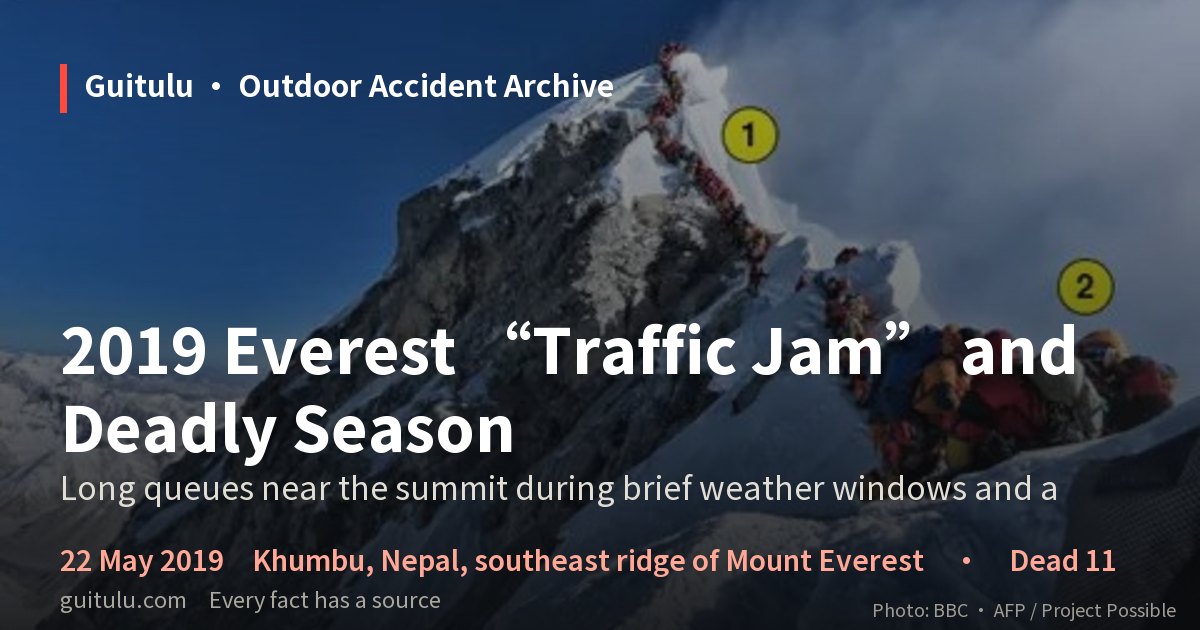
Dead 11 Multiple media outlets counted 11 people dead or missing on Everest in May 2019 (9 on the Nepalese side and 2 on the Chinese Tibet side); Chinese-language reports including China Newsweek gave a separate count of 14 dead and 3 missing
Material
45 facts · 15 sources6 accounts differ and are shown side by side
The number at the end of a paragraph is how many facts it rests on; open it to see each fact and how well it is sourced:
Multiple sourcesSingle source. Conflicting accounts and speculation are kept out of the narrative.
Reported locations along the route (schematic)Schematic
Scroll down and the map flies to where each part happened. The line is Schematic, Lines connect the reported locations in sequence and indicate only the approximate direction, not the actual route. Sources for the location coordinates are in places.json.
01
Full route
Locations mentioned in reports are connected in sequence to show the approximate route (illustrative).
In early May, the residual effects of Cyclone Fani reached the Himalayas, interrupting route-fixing work on both the south and north sides. F08
On 14 May, an 8-person Sherpa route-fixing team reached the summit from the south side, opening the route to the summit. F24
On 16 May, Irish climber Seamus Lawless fell near the “Balcony” and was presumed dead. F26
The first weather window closed around 16 May. During that period, more than 150 people reached the summit from the south side, most without encountering long waits in line. F25
An Indian climber was found dead in a tent at the highest camp on the south side (Camp 4). F28
The second window opened on 20 May, but strong winds at the summit made a summit push impossible, and climbers began accumulating at Camp 4 at an altitude of 7900 meters. F29
On the night of 21 May, large numbers of teams set out from South Col Camp 4 for the summit. Some teams left early hoping to avoid the crowds, but still found themselves among the main group. F30
After reaching the summit, Cash collapsed near the Hillary Step during the descent and could not be revived. F35
On 22 May (Wednesday), an American climber and an Indian climber died on summit day: Donald Cash of the United States and Anjali Kulkarni of India. F34
More than 200 people reached the summit from the south side on 22 May. F32
Indian climber Kalpana Das died during the descent after summiting on 23 May; her Sherpa guide reportedly urged her several times not to continue climbing, and the organizer said her death was unrelated to congestion. F42
On 23 May, Indian climber Nihal Bhagwan and his teammate Rahul Inamdar reached the summit; Inamdar said they encountered a “human traffic jam” on the descent, which took an extra two or three hours, and did not return to Camp 4 until nearly 21 hours after setting out. F39
On 27 May, Christopher Kulish, a lawyer from Colorado, USA, died after summiting and returning to South Col Camp 4. F43
In August 2019, a Nepalese government task force submitted a report recommending that Everest climbers be required to have basic and high-altitude mountaineering training, have climbed at least one Nepalese peak above 6500 meters, submit proof of health and physical fitness, and be accompanied by a trained Nepalese guide. It also recommended raising the Everest climbing fee to at least US$35,000. F44
Under each fact is a verbatim quote from the original. "Single source" means only one outlet mentioned it; "Accounts differ" means sources contradict each other and this site adopts neither side; "Speculation" is an inference by a reporter or a person involved, not a fact.
Nepal had no rules limiting the number of Everest permits, and applicants needed only to provide a medical certificate to obtain one.
Quotes from the original 2
“Nepal doesn’t have any regulations on the books to determine how many permits should be issued, so anyone with a doctor’s note can obtain one for a $11,000 fee”
The Chinese side (north slope) limited the number of permits that year and issued far fewer than the Nepalese side.
Quotes from the original 2
“Another factor was China’s limit on the number of permits it issued for routes in its territory on the north side of Everest this year for a clean-up.”
Reports of the death toll for the full season vary: most English-language media counted 11 deaths; China Newsweek counted 14 deaths and 3 missing; China Daily's website quoted The Himalayan Times as saying that 14 people had died during the congestion.
The counting criteria may differ, including the time period covered and whether missing people are included
Quotes from the original 3
“Eleven climbers were killed or went missing on the 8,850-metre mountain in May”
Alan Arnette gave differing estimates at different times of how many deaths were linked to congestion: National Geographic said he calculated that 5 of the 11 deaths may have been related to congestion; The Colorado Sun said he counted at least 3 people who died after being trapped in crowds; his season-end summary said 17 of 21 deaths in the Himalayas were unrelated to congestion.
Quotes from the original 3
“Alan Arnette calculated that five of the 11 deaths this season on Everest may have been related to the crowds.”
Officials from Nepal's tourism department said the climbers' deaths were not caused by the “traffic jam”, but by altitude sickness, heart disease, exhaustion and other causes.
Quotes from the original 2
“it is not because of the traffic jam that there were casualties”
Several experienced guides and climbing company leaders believed that a more fundamental problem than the number of people was the inexperience of climbers and some support teams.
Quotes from the original 3
“It's the lack of experience among people on the mountain”
“the remnants of Cyclone Fani struck the Himalaya the first week of May, delaying for a few days the climbing Sherpa team that sets up a series of fixed ropes used to reach the summit.”
There were markedly fewer days with weather suitable for summit attempts that season than in previous years: by late May there had been only five or six days, compared with the usual seven to twelve in recent years.
Quotes from the original 2
“This season, Everest only saw a six-day climbing window, with the last weather window on May 26. Usually, there are up to 12 climbing windows.”
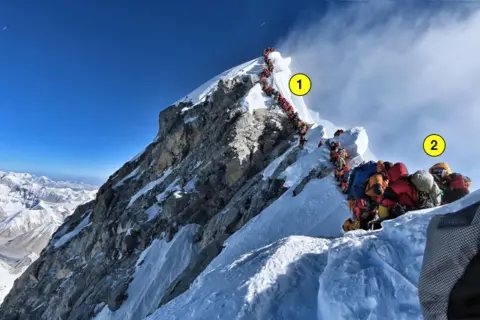
Nepalese climber Nirmal Purja published a photograph of the long queue at the Hillary Step, with a caption saying that he had reached the summit of Everest at 5:30 a.m. and the summit of Lhotse at 3:45 p.m., encountering traffic congestion involving about 320 people along the way.
Includes a low-credibility source
Quotes from the original 2
“I summited Everest at 5:30 am and Lhotse 3:45 pm despite the heavy traffic (roughly 320 people)”
I reached the summit of Everest at 5:30 in the morning, but only reached Lhotse at 3:45 in the afternoon while ‘surrounded’ by about 320 people (machine translation)
Accounts differ on the date Purja's photograph was taken or published: Daily Hive and The Colorado Sun said 22 May; Alan Arnette's season-end summary gave 23 May.
This may relate to the date the photograph was taken versus the date it was published, or to local time versus other time zones
Quotes from the original 3
“Climber Nirmal Purja posted the now-viral photo of Earth’s highest peak to Facebook on May 22”
The photograph spread rapidly online, prompting widespread discussion of whether Everest was too crowded and why Nepal had issued a record number of permits.
Quotes from the original 2
“The image went viral, sparking an instant debate about whether the mountain is too crowded”
“Nine people climbing on the Nepal side died on the mountain, the highest number of deaths in the past four years. Two people died on the Chinese side of the mountain.”
Several people who were there said that congestion and slow-moving climbers made the summit round trip take several hours longer than normal.
Quotes from the original 3
“He said what should have taken 12 hours took 17 hours because of struggling climbers who were clearly exhausted but had no one to guide or help them.”
Yu Shui estimated that, without congestion, the round trip from Camp C4 to the summit could be completed in 12 to 15 hours, but in fact it took her 20 hours. (machine translation)
German mountaineer David Göttler turned back approximately 200 meters from the summit during a climb without supplemental oxygen because he was unwilling to take risks in the congestion.
Quotes from the original 2
“Göttler was just a couple of hundred vertical metres from the top when he turned around.”
“Goettler was ultimately forced to turn around about 200 meters from the top. He was unwilling to accept the risks of continuing on because of the crowds.”
Experienced guiding teams adjust their summit day or departure time to avoid the crowds.
Quotes from the original 2
“Lowry credits his guide, Ben Jones, and his team’s Sherpas for recognizing the potential for traffic in the brief weather window and delaying their summit day to avoid a crowded route.”
According to China Newsweek, A Chinese expedition company anticipated possible congestion and prepared extra oxygen in advance for the sections from C3 to C4 and from C4 to the summit; some team members used 8 to 10 bottles, more than the standard allocation of 6.
Quotes from the original 2
“他提前在C3至C4,C4至顶峰阶段预备了更多氧气。”
He prepared more oxygen in advance for the stages from C3 to C4 and from C4 to the summit. (machine translation)
The standard allocation of 6 bottles of oxygen was not enough. Sister Mai in Sun Bin's group recalled that she used 8 bottles of oxygen, and three other teammates used 10 bottles. (machine translation)
The first weather window closed around 16 May. During that period, more than 150 people reached the summit from the south side, most without encountering long waits in line.
Quotes from the original 2
“The first two-day weather window closed on May 16 after over 150 climbers made it to the summit.”
According to The Kathmandu Post, The second window opened on 20 May, but strong winds at the summit made a summit push impossible, and climbers began accumulating at Camp 4 at an altitude of 7900 meters.
Quotes from the original 2
“The second climbing window opened on May 20 but strong winds made a summit push impossible.”
On the night of 21 May, large numbers of teams set out from South Col Camp 4 for the summit. Some teams left early hoping to avoid the crowds, but still found themselves among the main group.
Quotes from the original 2
“One by one they all moved to Camp 2, then 3 and the South Col for their push starting the night of May 21.”
According to China News Service, According to The New York Times, when Cash and his Sherpa guide reached the Hillary Step, they were forced to wait for at least two hours.
Quotes from the original 1
“当卡什和他的夏尔巴人向导到达希拉里台阶时,他们被迫等了至少两个小时。”
When Cash and his Sherpa guide reached the Hillary Step, they were forced to wait for at least two hours. (machine translation)
Accounts of Cash's cause of death differ: the expedition organizer said he died of exhaustion caused by congestion; according to The New York Times, his family believed he died of a heart attack.
Quotes from the original 2
“Both of them died from exhaustion caused by the traffic jam, said their expedition organisers.”
Accounts differ as to what happened to Kulkarni: the organizer said she died from exhaustion caused by congestion; The New York Times said she died after summiting with her husband; her Sherpa guide said she fell ill below the “Balcony” on the summit push and never reached the congested section.
Quotes from the original 3
“Both of them died from exhaustion caused by the traffic jam, said their expedition organisers.”
According to The Kathmandu Post, On 23 May, Indian climber Nihal Bhagwan and his teammate Rahul Inamdar reached the summit; Inamdar said they encountered a “human traffic jam” on the descent, which took an extra two or three hours, and did not return to Camp 4 until nearly 21 hours after setting out.
Quotes from the original 2
“It was like hold, move, hold. It took us an extra 2 to 3 hours to descend”
Accounts differ as to the role of congestion in Bhagwan's death: the head of the organizing company told AFP that he had been stuck in congestion for more than 12 hours and was exhausted; the same person told The Kathmandu Post that it was difficult to say whether congestion directly caused his death; his Sherpa guide said that it was his failure to heed advice, not congestion, that cost him his life.
Quotes from the original 3
“stuck in the traffic for more than 12 hours and was exhausted”
Indian climber Kalpana Das died during the descent after summiting on 23 May; her Sherpa guide reportedly urged her several times not to continue climbing, and the organizer said her death was unrelated to congestion.
Quotes from the original 2
“Kalpana Das, another Indian citizen who reached the summit on May 23, also died while descending the mountain, but her expedition organiser said her death was not due to the traffic jam.”
On 27 May, Christopher Kulish, a lawyer from Colorado, USA, died after summiting and returning to South Col Camp 4.
Quotes from the original 2
“On Monday, Christopher Kulish, a 62-year-old attorney from Boulder, Colorado, died at Camp 4, located on the South Col at 26,000 feet, after returning from the summit of Mount Everest.”
In August 2019, a Nepalese government task force submitted a report recommending that Everest climbers be required to have basic and high-altitude mountaineering training, have climbed at least one Nepalese peak above 6500 meters, submit proof of health and physical fitness, and be accompanied by a trained Nepalese guide. It also recommended raising the Everest climbing fee to at least US$35,000.
Quotes from the original 6
“must undergo basic and high altitude climbing training”
“The report said those hoping to climb Everest must climb at least one Nepali peak above 6,500 metres before getting a permit. Climbers must also submit a certificate of good health and physical fitness, and be accompanied by a trained Nepali guide, it added.”
“It said that those hoping to climb Qomolangma must have climbed at least one Nepalese peak of more than 6,500-metres before getting a permit. Climbers must also submit a certificate of good health and physical fitness and be accompanied by a trained Nepalese guide.”
 GuituluGlobal Outdoor Accident Archive