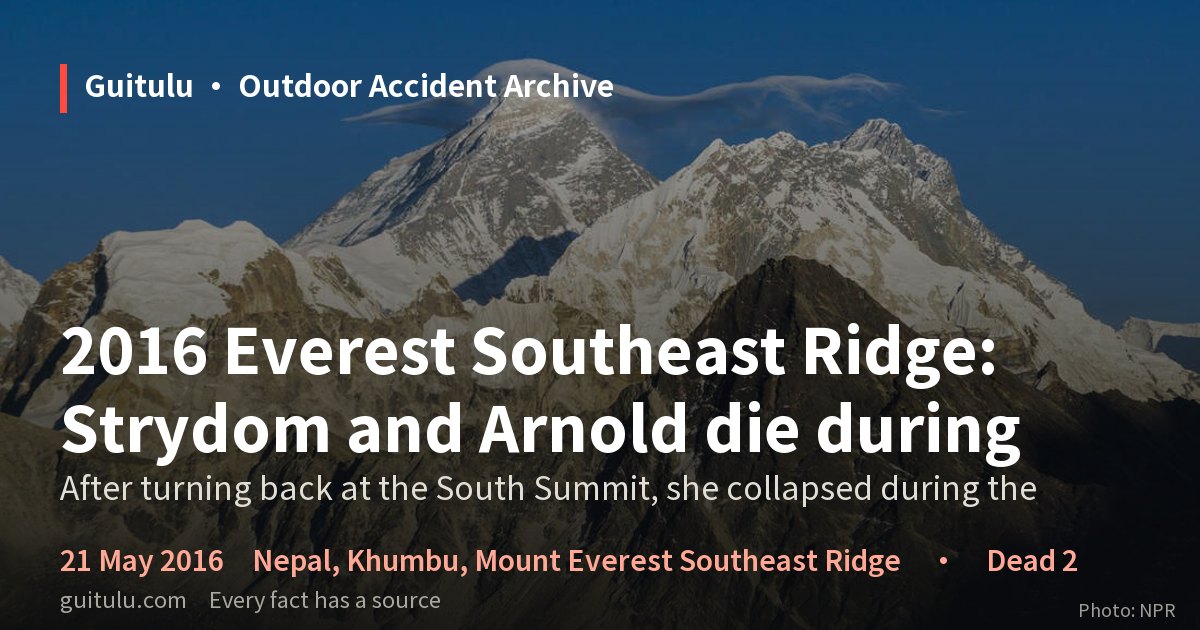
MountaineeringInvolves: Altitude illnessSeven Summit Treks commercial team (Strydom, her husband Gropel, and Dutch climber Arnold were on the same team)
Casualties
Dead 2 Injured 1Australian climber Maria Strydom and Dutch climber Eric Arnold died of altitude sickness; Strydom's husband, Robert Gropel, was rescued by helicopter after developing altitude sickness
Material
47 facts · 11 sources3 accounts differ and are shown side by side
The number at the end of a paragraph is how many facts it rests on; open it to see each fact and how well it is sourced:
Multiple sourcesSingle source. Conflicting accounts and speculation are kept out of the narrative.
Scroll down and the map flies to where each part happened. The line is Schematic, The waypoints mentioned in reports are connected in sequence, showing only the approximate direction, not the actual track. Sources for the waypoint coordinates are given in places.json.
01
Full route
Locations mentioned in reports are connected in sequence to show the approximate course of events (schematic).
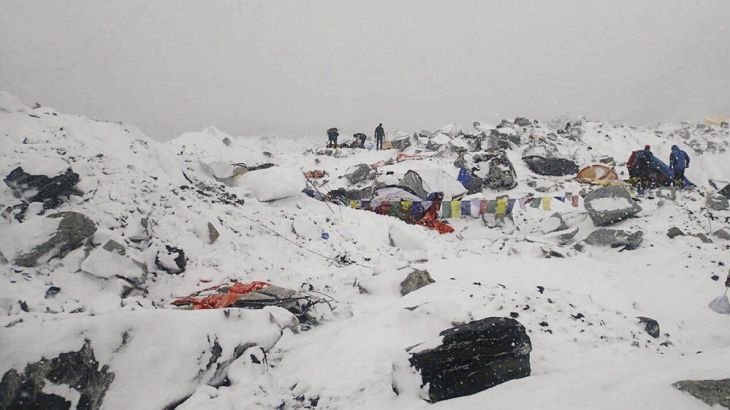
Arnold experienced and survived the avalanche at Everest Base Camp triggered by the 2015 Nepal earthquake. F02
By the time they reached Everest's South Summit, Strydom had developed altitude sickness and slowed down, and the couple decided to turn back and descend. F08
Strydom's body was carried by Sherpas to Camp II, then taken by helicopter to Kathmandu. F18
Gropel was subsequently evacuated to Kathmandu. F14
On the night of Friday, 20 May, the couple set out from Camp IV for the summit. F27
On the night of Friday, 20 May, Arnold died of altitude sickness in the area of Camp IV on the South Col. F24
On Friday, 20 May 2016, Arnold reached the summit of Everest on his fifth attempt. F21
Strydom could not be saved after she collapsed. F32
According to reports, that night guides tried to stabilise Arnold and Strydom in their respective tents. When Arnold's condition deteriorated and he died, Strydom appeared to have regained some strength and was able to walk on her own the next morning. F29
The next day, the team took her down towards Camp III, intending to evacuate her from there by helicopter; she suddenly collapsed on the way. F30
A rescue helicopter transported Strydom's body from Everest to Kathmandu. F36
Under each fact is a verbatim quote from the original. "Single source" means only one outlet mentioned it; "Accounts differ" means sources contradict each other and this site adopts neither side; "Speculation" is an inference by a reporter or a person involved, not a fact.
In an interview with local Dutch media before leaving, Arnold said that two-thirds of accidents happen on the descent, and that amid the elation of reaching the summit, the most dangerous part still lies ahead.
These remarks came from Arnold's interview with the local Rotterdam television station RTV Rijnmond; the reports all quoted the same interview.
Quotes from the original 2
“"Two-thirds of the accidents happen on the way down," he said. "If you get euphoric and think 'I have reached my goal,' the most dangerous part is still ahead of you."”
“"Two-thirds of the accidents happen on the way down," he said. "If you get euphoric and think 'I have reached my goal,' the most dangerous part is still ahead of you."”
Strydom's mother said the itinerary had originally recommended that they spend the night at Camp III to acclimatize to the altitude, but they did not do so, instead returning to Camp II after reaching the vicinity of Camp III.
Both media accounts came from Strydom's mother.
Quotes from the original 2
“In their itinerary it was suggested they would sleep over at camp 3 for their acclimatization. They didn’t.”
By the time they reached Everest's South Summit, Strydom had developed altitude sickness and slowed down, and the couple decided to turn back and descend.
Quotes from the original 3
“But Dr Strydom was stricken with altitude sickness when they came to the South Summit, at nearly 8,000 metres.”
Gropel gave his wife an injection of dexamethasone.
Quotes from the original 2
““It took a while for me to register that I had medication, and so as soon as I realised I gave her a dexamethasone injection,” Gropel told the Australian Broadcasting Corp.”
After the incident, there were various conflicting reports about the cause of Strydom's death and whether she had reached the summit before descending.
Quotes from the original 2
“There were a number of conflicting reports on the possible cause of death and whether she had indeed reached the top of the mountain before descending.”
“Sherpa climbers brought Strydom's body down the mountain to Camp 2 (6 400 metres) on Wednesday, from where a rescue helicopter plucked it to Kathmandu.”
During the 2016 season, more than 30 climbers on the south side of Everest needed assistance or evacuation because of frostbite, altitude sickness and other injuries or illnesses.
Quotes from the original 2
“Helicopters have hauled at least three dozen people off the South Side of the mountain this year—an unusually high count—for everything from frostbite to altitude sickness to diarrhea.”
“more than three dozen climbers have suffered injuries or illness, including frostbite and altitude sickness, in recent days, according to the Press Trust of India.”
According to NPR, According to the organiser, Arnold became progressively slower during the descent and was assisted down by two Sherpas. He showed symptoms of altitude sickness but appeared to recover for a time after returning to his tent at the highest camp.
Quotes from the original 2
“Then he started to descend — and his movements slowed, and slowed, according to the company that organized his trip. Two Sherpa guides helped him down.”
According to the organiser, Arnold had bottled oxygen and companions with him, but said he felt weak.
Both accounts came from information Seven Summit Treks gave to the Associated Press.
Quotes from the original 2
“Arnold had enough bottled oxygen with him as well as climbing partners, but he complained of getting weak and died before he was able to come down to a lower altitude, Phurba said.”
According to ABC, According to the Dutch news agency, after returning from the summit, Arnold told his teammates, “I have no strength left.” He appeared to have died in his sleep.
Quotes from the original 1
“The Dutch news agency ANP reported that Mr Arnold had told his team-mates after returning from the summit "my body has no energy left", adding he had apparently died in his sleep.”
According to NPR, According to reports, that night guides tried to stabilise Arnold and Strydom in their respective tents. When Arnold's condition deteriorated and he died, Strydom appeared to have regained some strength and was able to walk on her own the next morning.
Quotes from the original 2
“Overnight, guides worked in Arnold's tent and in Strydom's tent, trying to stabilize them both.”
Accounts differ on where Strydom died and the cause of her death: the organiser, Gropel and most media said she collapsed the next day during the descent towards Camp III; National Geographic said she died of a stroke at Camp IV; an announcement relayed by Alan Arnette said she developed snow blindness and died of a stroke after being assisted to the South Col.
Quotes from the original 3
“Two hours away from the evacuation site, Strydom collapsed.”
According to NPR, Ang Tshering of the Nepal Mountaineering Association believed that poor planning and crowding at the summit may have caused a bottleneck, leaving climbers stranded at the highest elevations; he called the deaths a man-made disaster that could be reduced through better management.
This was a general comment on multiple deaths that week, not an investigative finding about these two deaths.
Quotes from the original 2
“Poor planning and overcrowding on the world's tallest peak may have led to bottlenecks that kept people delayed at the highest reaches while waiting for the path to clear lower down”
Strydom and her husband, Robert Gropel, intended to climb the highest peaks on all seven continents to show that vegans are just as strong and can do anything.
Quotes from the original 3
“she and Gropel had decided to climb the highest peak on each of the seven continents – the so-called “seven summits” – to prove that vegans are strong.”
Strydom had previously climbed Denali, Aconcagua, Mount Ararat and Mount Kilimanjaro.
Quotes from the original 3
“Over the last eight years, Dr Strydom climbed Denali in Alaska, Aconcagua in Argentina, Mount Ararat in Turkey and Kilimanjaro in her continent of birth, Africa.”
According to Reuters, According to reports, expedition leader Koster said he had personally selected the climbers and that Strydom and her husband had three experienced Sherpas between them.
Quotes from the original 1
“The Dutch mountaineer said he had personally selected climbers, and Strydom and Gropel had three experienced sherpas between them.”
 GuituluGlobal Outdoor Accident Archive