GuituluGlobal Outdoor Accident Archive 中文
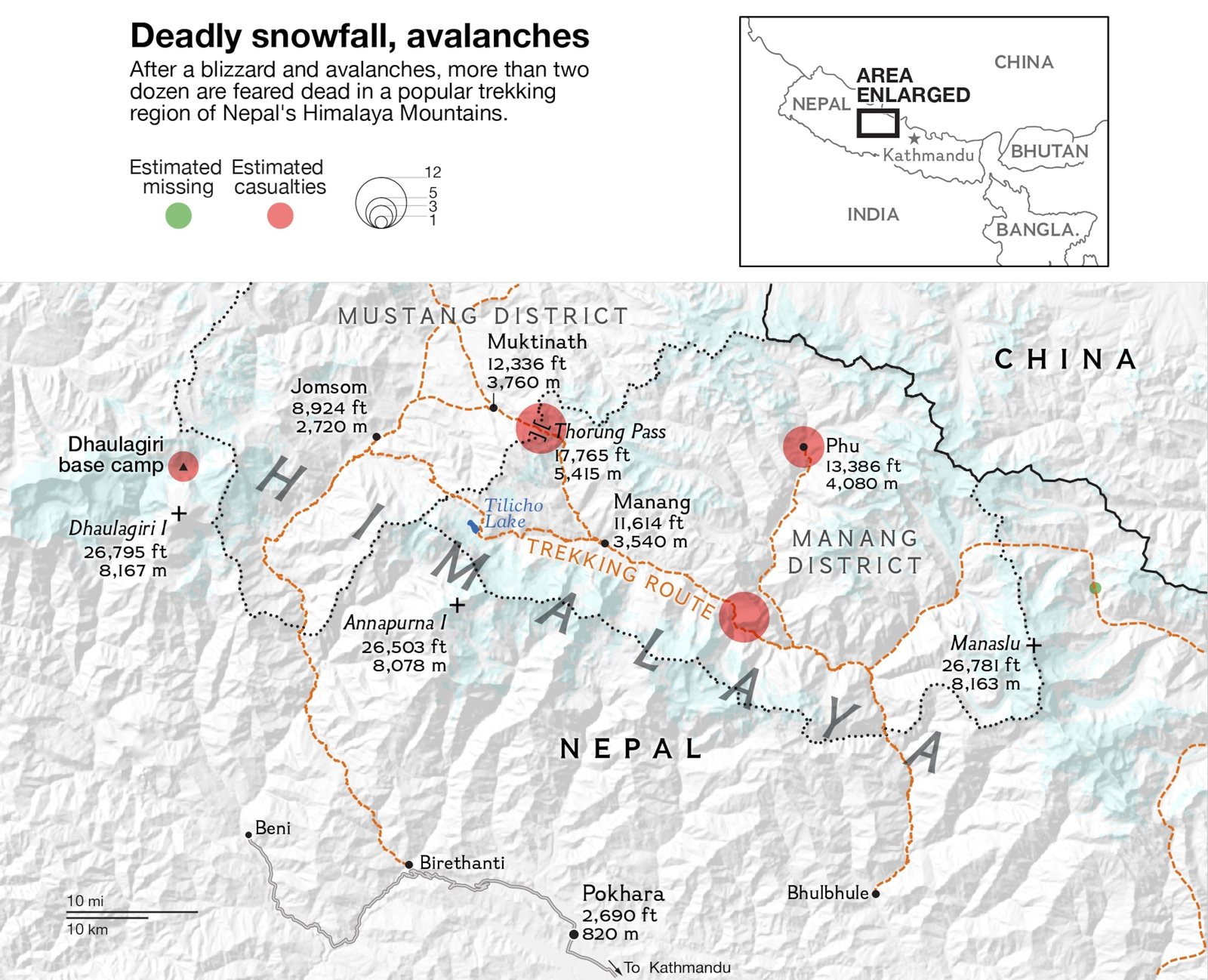
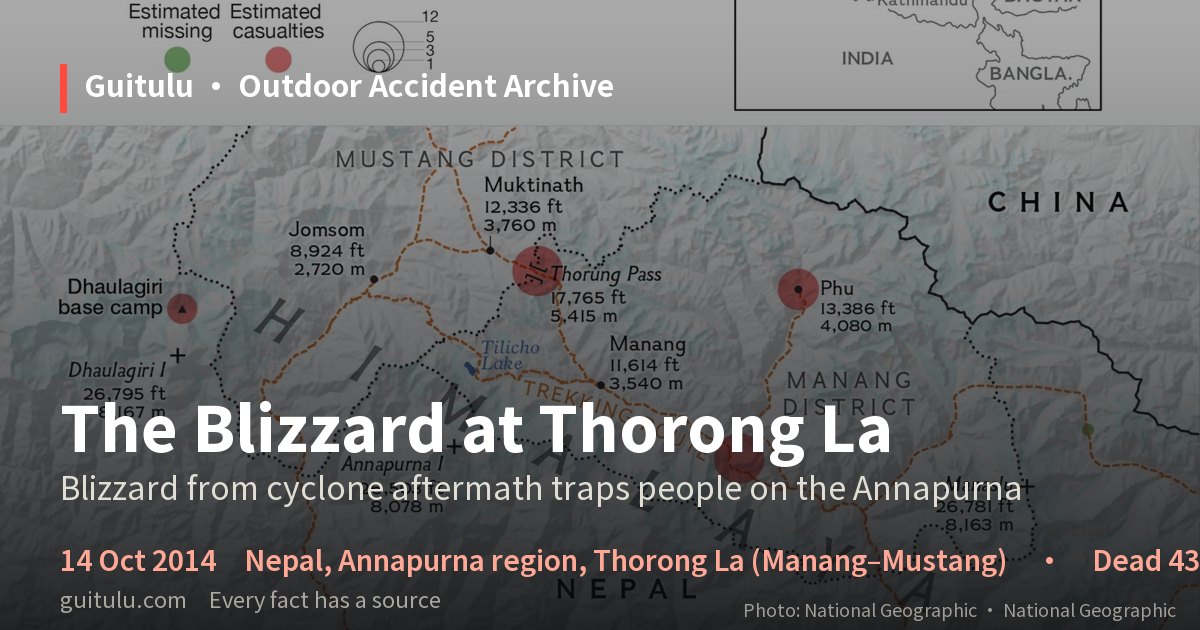
A map drawn by National Geographic showing where the October 2014 blizzard and avalanches caused casualties in the Annapurna region

Archive / Hiking

The Blizzard at Thorong La

Blizzard from cyclone aftermath traps people on the Annapurna Circuit, killing 43

Search and rescue ended in late October 2014; authorities reportedly did not conduct a formal accident investigation.

Photo: National Geographic · National Geographic

Date
Autumn (peak trekking season in October)
Place
Nepal, Annapurna region, Thorong La (Manang–Mustang)Nepal › Gandaki Province · Himalaya83.939°E 28.794°N
Activity
TrekkingInvolves: Hypothermia · Avalanche · Getting lost and losing contact · Extreme weatherHundreds of trekkers, guides and porters on the Annapurna Circuit, as well as nearby mountaineering teams and herders
Casualties
Dead 43 The British Mountaineering Council's late-October count was 43, including trekkers, guides and porters on the circuit, yak herders, and mountaineers caught in an avalanche at Dhaulagiri Base Camp; figures reported at different stages varied. Local porters and guides were also unaccounted for at one point.
Material
45 facts · 13 sourcesSources agree

01What happened

Thorong La is the highest point on the Annapurna Circuit, at an altitude of approximately 5416 metres. The weather is usually clear in October, when thousands of trekkers come to walk the circuit. According to reports, 345 trekkers registered at a checkpoint on the Manang side on 13 October 2014, heading for Yak Kharka and Thorong Phedi.Facts it rests onF29Multiple sourcesThorong La is the highest point on the Annapurna Circuit, at an altitude of about 5416 metres.F30Multiple sourcesThe weather is usually clear each October, when thousands of trekkers visit the Annapurna Circuit.F10Single sourceOn 13 October (Monday), 345 trekkers registered at the Annapurna Conservation Area checkpoint on the Manang side, heading for Yak Kharka and Thorung Phedi; as of the time of reporting, 85 of them had not yet crossed to the other side of the pass.

A map drawn by National Geographic showing where the October 2014 blizzard and avalanches caused casualties in the Annapurna regionPhoto source: National Geographic · National Geographic

On 14 October, unusually heavy snow associated with the aftermath of Cyclone Hudhud fell in the Annapurna region, reaching a depth of about three feet. Trekkers were still climbing towards and crossing the pass after it had begun to snow. According to reports, the small teahouse at the pass quickly filled up, and some people decided to descend; several of those who died were caught by heavy snow and whiteout conditions in severe cold while descending from Thorong La.Facts it rests onF11Multiple sourcesOn 14 October (Tuesday), an unusual heavy snowfall struck Nepal's Annapurna region, associated with the aftermath of Cyclone Hudhud, which had previously made landfall on India's east coast.F13Multiple sourcesSnow in the area was about three feet (approximately 91 centimeters) deep.F12Multiple sourcesOn 14 October, after the snow had already begun, trekkers were still climbing toward and crossing Thorong La.F15Single sourceMany trekkers took shelter from the snow in a small teahouse at the pass. The teahouse quickly filled up, and some people decided to descend.F34Multiple sourcesSeveral of those who died encountered heavy snow and freezing whiteout conditions while descending from Thorong La.

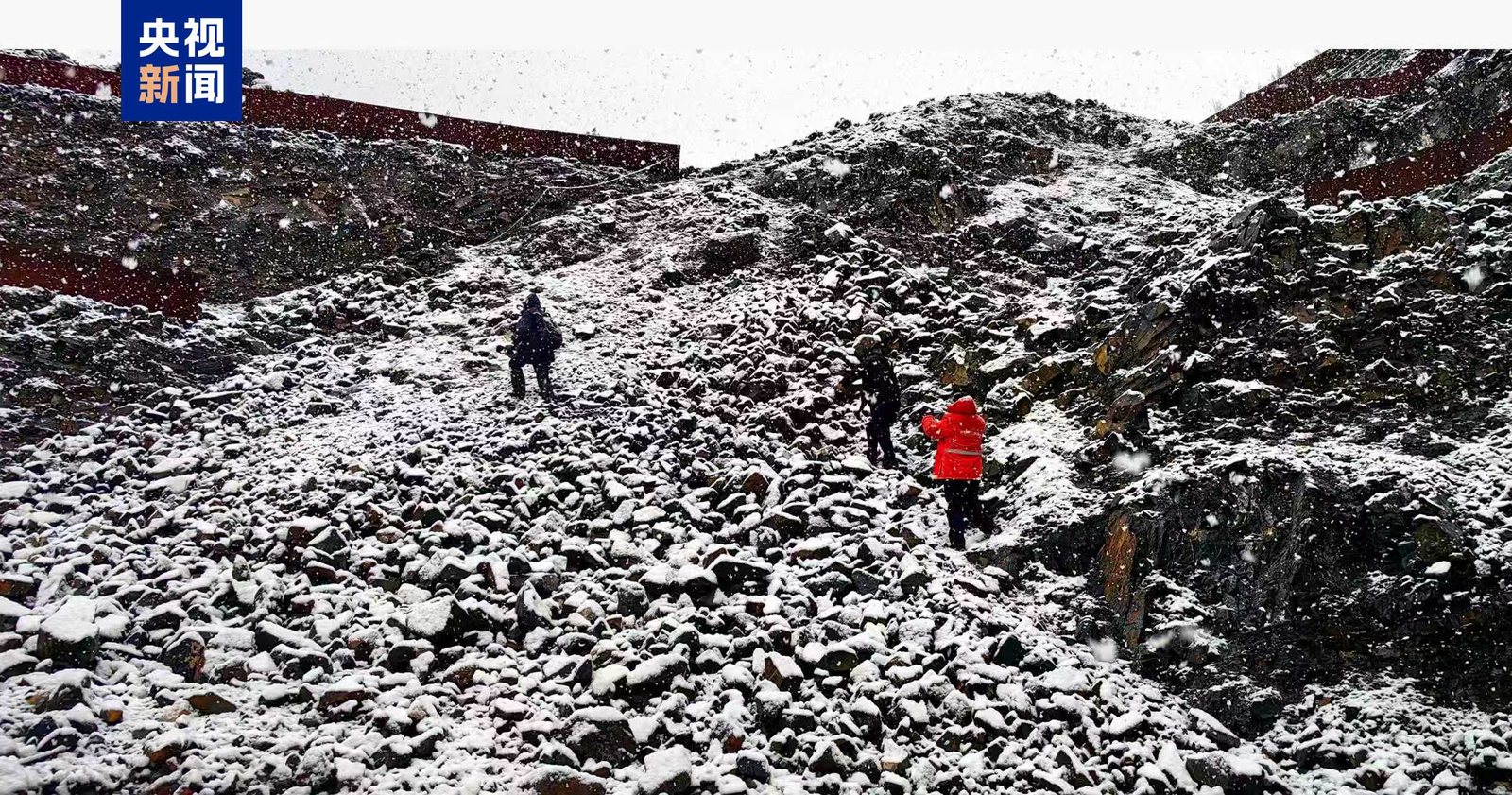
After the blizzard, two people make their way across a snow-covered mountainsidePhoto source: The Express Tribune

According to reports, rescue operations could not begin until the weather cleared on 15 October; communications were poor, and local officials could not contact dozens of people still stranded on the route. According to reports, a group of Israeli trekkers sheltered from the storm in a teahouse, then descended when the weather cleared the next day. They lost their way in chest-deep snow and were unable to get a phone call through until eight hours later; they appealed to a travel agency and an embassy for help, and, led by a porter, waited for a helicopter. Those who died were found at Thorong La and around Phu in Manang district. An avalanche also occurred at Dhaulagiri Base Camp, killing two Slovak mountaineers and three Nepali guides.Facts it rests onF22Single sourceRescue operations could not begin until the weather cleared on 15 October (Wednesday).F23Multiple sourcesBecause of poor communications, local officials were unable to contact dozens of people still stranded on the route.F18Single sourceA group of Israeli trekkers had planned to stay at a teahouse to shelter from the storm. The next morning, seeing clear skies, they decided to descend, but the snow was chest-deep. They became lost on the way down and managed to get through on a mobile phone only after eight hours.F19Multiple sourcesThe group of Israelis called a travel agency and the embassy to request a helicopter. While they waited, porters led them through the snow; the helicopter took them first to Muktinath and then to Kathmandu.F16Multiple sourcesThe first reported fatalities included two Polish people, one Israeli and one Nepalese person.F21Multiple sourcesPeople also died in the area around Phu in Manang District, including four Canadian trekkers.F17Multiple sourcesAn avalanche occurred at Dhaulagiri Base Camp, killing two Slovak mountaineers and three Nepalese guides.

By the end of October, the death toll from the blizzard was 43, most of them local Nepali trekking and expedition workers. More than 500 people were rescued, and helicopters flew approximately 70 sorties. After the disaster, Nepal's prime minister announced plans to establish a weather warning system, and the government also said it would require trekkers to hire trained, qualified guides in future.Facts it rests onF01Multiple sourcesBy the end of October, the death toll from the blizzard was 43.F37Multiple sourcesMost of the dead were local Nepalis working in trekking and expeditions, many of whom were untrained and poorly equipped; most of the local people who died were lightly dressed porters.F06Multiple sourcesMore than 500 people were rescued in the operation (the British Mountaineering Council reported 514 and PowderGuide 518), and helicopters made approximately 70 sorties; the Himalayan Rescue Association said it was the largest trekking and mountaineering rescue in the region.F02Multiple sourcesAfter the disaster, Nepalese Prime Minister Sushil Koirala announced that a weather warning system would be established.F05Multiple sourcesThe Nepalese government said that trekkers would be required to hire trained, qualified guides in the future.

The number at the end of a paragraph is how many facts it rests on; open it to see each fact and how well it is sourced: Multiple sourcesSingle source. Conflicting accounts and speculation are kept out of the narrative.

  • Reported locations along the route (schematic)Schematic

Satellite imagery Sentinel-2 cloudless 2024 © EOX · Terrain AWS Terrain Tiles · Orange line is schematic · Place coordinates not individually verified

Route review

7 scenes to understand what happened

Scroll down and the map flies to where each part happened. The line is Schematic, Connects the locations mentioned in reports in sequence, showing only the approximate direction, not the actual route. Sources for location coordinates are in places.json.

01

Full route

Places mentioned in reports are connected in sequence to show the approximate course of events (schematic).

03

Heavy snow reaches the pass

On 14 October, the aftermath of the cyclone brought heavy snow approximately three feet deep; trekkers were still climbing towards the pass after it had begun to snow.Facts it rests onF11Multiple sourcesOn 14 October (Tuesday), an unusual heavy snowfall struck Nepal's Annapurna region, associated with the aftermath of Cyclone Hudhud, which had previously made landfall on India's east coast.F13Multiple sourcesSnow in the area was about three feet (approximately 91 centimeters) deep.F12Multiple sourcesOn 14 October, after the snow had already begun, trekkers were still climbing toward and crossing Thorong La.

05

Lost and calling for help

According to reports, a group of Israelis lost their way in chest-deep snow while descending the next day and were later taken first to Muktinath by helicopter.Facts it rests onF18Single sourceA group of Israeli trekkers had planned to stay at a teahouse to shelter from the storm. The next morning, seeing clear skies, they decided to descend, but the snow was chest-deep. They became lost on the way down and managed to get through on a mobile phone only after eight hours.F19Multiple sourcesThe group of Israelis called a travel agency and the embassy to request a helicopter. While they waited, porters led them through the snow; the helicopter took them first to Muktinath and then to Kathmandu.

07

Large-scale rescue

By the end of October, the death toll was 43; more than 500 people were rescued, and helicopters made approximately 70 sorties.Facts it rests onF01Multiple sourcesBy the end of October, the death toll from the blizzard was 43.F06Multiple sourcesMore than 500 people were rescued in the operation (the British Mountaineering Council reported 514 and PowderGuide 518), and helicopters made approximately 70 sorties; the Himalayan Rescue Association said it was the largest trekking and mountaineering rescue in the region.

02Timeline

  1. By the end of October, the death toll from the blizzard was 43. F01

  2. Cyclone Hudhud made landfall at Visakhapatnam, India, on 11 October. F08

  3. On 13 October (Monday), 345 trekkers registered at the Annapurna Conservation Area checkpoint on the Manang side, heading for Yak Kharka and Thorung Phedi; as of the time of reporting, 85 of them had not yet crossed to the other side of the pass. F10

  4. On 13 October, Nepalese television warned people that they might need to harvest their crops quickly because rain and snow were coming. F09

  5. An avalanche occurred at Dhaulagiri Base Camp, killing two Slovak mountaineers and three Nepalese guides. F17

  6. On 14 October (Tuesday), an unusual heavy snowfall struck Nepal's Annapurna region, associated with the aftermath of Cyclone Hudhud, which had previously made landfall on India's east coast. F11

  7. On 14 October, after the snow had already begun, trekkers were still climbing toward and crossing Thorong La. F12

  8. On 15 October (Wednesday), the first rescued trekkers, including people from Israel and Hong Kong, were airlifted to Kathmandu and treated in hospital. F20

  9. Rescue operations could not begin until the weather cleared on 15 October (Wednesday). F22

  10. A group of Israeli trekkers had planned to stay at a teahouse to shelter from the storm. The next morning, seeing clear skies, they decided to descend, but the snow was chest-deep. They became lost on the way down and managed to get through on a mobile phone only after eight hours. F18

  11. The Nepali government formed a high-level group headed by Tourism Minister Amatya to assist with search and rescue. F26

  12. On 16 October (Thursday), Mustang police found nine bodies at an altitude of about 5400 metres near Thorong La, including three Nepalis, two Israelis and one Pole. F24

  13. On 16 October (Thursday), helicopters and rescue teams on foot rescued about 219 tourists and Nepali trekkers; another 37 people were rescued from Thorong La on 17 October (Friday). F25

  14. On 20 October, search and rescue entered its final day; small avalanches were still hampering the search for missing local porters and guides. F28

03Lessons

Weather and retreat

Stay in shelter during a storm

Several of those who died were caught by heavy snow while descending from Thorong La. The rescued Israeli trekkers believed their guide's advice to remain in the teahouse during the storm may have saved their lives; the veteran guide Gael's advice was not to leave shelter during a blizzard. According to reports, the group descended after seeing clear weather the next day but still lost their way in chest-deep snow.Facts it rests onF34Multiple sourcesSeveral of those who died encountered heavy snow and freezing whiteout conditions while descending from Thorong La.F35Multiple sourcesRescued Israeli trekkers believed that guides or porters may have saved their lives by urging them to stay inside the teahouse during the blizzard.F41Single sourceGurung, a trekking company owner who had been trapped at the pass by heavy snow, said not to leave shelter during a blizzard.F18Single sourceA group of Israeli trekkers had planned to stay at a teahouse to shelter from the storm. The next morning, seeing clear skies, they decided to descend, but the snow was chest-deep. They became lost on the way down and managed to get through on a mobile phone only after eight hours.

Weather and retreat

Early signs of a warning

After the cyclone made landfall in India, Nepali television warned on 13 October that rain and snow were coming; a climate expert said the meteorological department had issued warnings of strong winds and heavy rain. On 14 October, trekkers were still climbing towards the pass after it had begun to snow. Disaster authorities said the message reached local police stations too late.Facts it rests onF08Single sourceCyclone Hudhud made landfall at Visakhapatnam, India, on 11 October.F09Single sourceOn 13 October, Nepalese television warned people that they might need to harvest their crops quickly because rain and snow were coming.F32Single sourceDahal, a climate expert at Kathmandu University, said Nepal's meteorological department had issued warnings of strong winds and heavy rain, and that the weather had not been unexpected.F12Multiple sourcesOn 14 October, after the snow had already begun, trekkers were still climbing toward and crossing Thorong La.F45Single sourceNepal's natural disaster authority said it had contacted police stations in the Annapurna region, but the message arrived too late.

Hypothermia and overnight gear

Porters also need adequate equipment to cross the pass

Most of those who died were local Nepali trekking and expedition workers. Many were untrained and poorly equipped, and most of the local people who died were lightly dressed porters. According to reports, freelance porters had no insurance and often walked mountain trails in sandals and thin windbreakers; many stranded people also said they had encountered people suffering from hypothermia because of inadequate equipment.Facts it rests onF37Multiple sourcesMost of the dead were local Nepalis working in trekking and expeditions, many of whom were untrained and poorly equipped; most of the local people who died were lightly dressed porters.F40Single sourceThe Nepali government requires registered companies to insure porters, but freelance porters have no coverage and often walk mountain trails in sandals and thin windbreakers.F38Single sourceMany stranded people said they had encountered people suffering from hypothermia because of inadequate equipment.

Communication and location

Ways to call for help in the high mountains

Communications were poor after the blizzard, and local officials could not contact dozens of people still stranded on the route. Some trekkers used a satellite phone to contact Germany, from where the message was relayed to the Nepali army; the group of Israelis who lost their way also had to wait until they could finally get a mobile phone call through before asking a travel agency and an embassy to send a helicopter.Facts it rests onF23Multiple sourcesBecause of poor communications, local officials were unable to contact dozens of people still stranded on the route.F36Single sourceA trekker used a satellite phone to contact someone in Germany, saying that a large group was waiting for rescue at the pass. The information was then passed to the Nepali army.F18Single sourceA group of Israeli trekkers had planned to stay at a teahouse to shelter from the storm. The next morning, seeing clear skies, they decided to descend, but the snow was chest-deep. They became lost on the way down and managed to get through on a mobile phone only after eight hours.F19Multiple sourcesThe group of Israelis called a travel agency and the embassy to request a helicopter. While they waited, porters led them through the snow; the helicopter took them first to Muktinath and then to Kathmandu.

04Fact list 45 facts

Under each fact is a verbatim quote from the original. "Single source" means only one outlet mentioned it; "Accounts differ" means sources contradict each other and this site adopts neither side; "Speculation" is an inference by a reporter or a person involved, not a fact.

  1. F01Multiple sourcesAftermath

    By the end of October, the death toll from the blizzard was 43.

    Quotes from the original 2

    “The death toll from mid October’s snowstorm in the Annapurna region now stands at 43”

    BMC ·

    “at least 43 people who were hiking in the mountains died”

    PowderGuide · 2015-01-01
  2. F02Multiple sourcesAftermath

    After the disaster, Nepalese Prime Minister Sushil Koirala announced that a weather warning system would be established.

    Quotes from the original 3

    “The disaster prompted Nepal's Prime Minister Sushil Koirala to announce plans to set up a weather warning system across the country”

    The Express Tribune · 2014-10-18

    “prime minister Sushil Koirala promised a system of weather alerts that will reach lodges on the trail as well as police posts”

    BMC ·

    “the government of Nepal says it will introduce new regulations by April that will include a weather warning system”

    NPR · 2014-10-23
  3. F03Multiple sourcesParticipant's view

    Tourism Minister Amatya said that the disaster should not be blamed on bad weather, but on the entire system.

    Both quotes came from his interview with Reuters.

    Quotes from the original 3

    “There is no point blaming the hostile weather for the disaster,”

    Reuters · 2014-10-20

    “I blame our entire mechanism because it is our responsibility to protect tourists and Nepali citizens.”

    Reuters · 2014-10-20

    “There is no point blaming the hostile weather for the disaster. I blame our entire mechanism”

    BMC ·
  4. F04Single sourceAftermath

    According to Reuters, Nepal's Ministry of Tourism planned to build more than 200 shelters along trekking routes across the country, so that every visitor could find shelter within 3 kilometers.

    Quotes from the original 1

    “Amatya's ministry is working on a plan to build more than 200 shelters on all the trekking routes in Nepal, to ensure every tourist finds a shelter within a distance of 3km.”

    Reuters · 2014-10-20
  5. F05Multiple sourcesAftermath

    The Nepalese government said that trekkers would be required to hire trained, qualified guides in the future.

    Quotes from the original 2

    “trekkers will now be required to hire properly qualified guides”

    BMC ·

    “a requirement that all trekkers hire trained guides”

    NPR · 2014-10-23
  6. F06Multiple sourcesAftermath

    More than 500 people were rescued in the operation (the British Mountaineering Council reported 514 and PowderGuide 518), and helicopters made approximately 70 sorties; the Himalayan Rescue Association said it was the largest trekking and mountaineering rescue in the region.

    The two sources gave slightly different numbers of people rescued: 514 according to the British Mountaineering Council and 518 according to PowderGuide.

    Quotes from the original 2

    “the largest trekking and climbing rescue operation yet conducted in the region. The authorities say 514 people were rescued during 70 helicopter sorties”

    BMC ·

    “518 people, 304 of them foreigners, had to be rescued from the snow in over 70 helicopter flights”

    PowderGuide · 2015-01-01
  7. F07Single sourceAftermath

    According to BMC, No formal investigation was conducted afterward to establish exactly what happened.

    Quotes from the original 1

    “there has been no formal investigation to establish what actually happened”

    BMC ·
  8. F08Single sourceBackground

    According to PowderGuide, Cyclone Hudhud made landfall at Visakhapatnam, India, on 11 October.

    Quotes from the original 1

    “reaching the Indian coast in Vishakapatnam on October 11”

    PowderGuide · 2015-01-01
  9. F09Single sourceBackground

    According to PowderGuide, On 13 October, Nepalese television warned people that they might need to harvest their crops quickly because rain and snow were coming.

    Quotes from the original 1

    “On October 13, Nepalese television reports that people should possibly harvest their crops as rain or snow is imminent.”

    PowderGuide · 2015-01-01
  10. F10Single sourceMovement

    According to Nepali Times, On 13 October (Monday), 345 trekkers registered at the Annapurna Conservation Area checkpoint on the Manang side, heading for Yak Kharka and Thorung Phedi; as of the time of reporting, 85 of them had not yet crossed to the other side of the pass.

    Quotes from the original 1

    “Eighty-five of the 345 trekkers who registered at the ACAP checkpoint on Monday en route to Yak Kharka and Thorung Phedi haven’t made it over to the other side.”

    Nepali Times · 2014-10-17
  11. F11Multiple sourcesEvent

    On 14 October (Tuesday), an unusual heavy snowfall struck Nepal's Annapurna region, associated with the aftermath of Cyclone Hudhud, which had previously made landfall on India's east coast.

    Quotes from the original 4

    “Heavy and unexpected snowfall struck Nepal on Tuesday as Cyclone Hudhud wreaked havoc in South Asia.”

    BMC ·

    “the region has seen unusually heavy snowfall this week sparked by Cyclone Hudhud, which slammed into India's east coast last weekend.”

    The Express Tribune · 2014-10-18

    “Mustang has seen unusually heavy snowfall this week as a result of Cyclone Hudhud, which has struck neighbouring India’s eastern coast at the weekend.”

    Al Jazeera · 2014-10-15

    “triggered by the remnants of Cyclone Hudhud”

    National Geographic · 2014-10-18
  12. F12Multiple sourcesMovement

    On 14 October, after the snow had already begun, trekkers were still climbing toward and crossing Thorong La.

    Quotes from the original 2

    “On October 14, trekkers begin to ascend the popular Annapurna Circuit to Thorung La Pass, although it is already snowing.”

    PowderGuide · 2015-01-01

    “More than 100 tourists were crossing the nearly 18,000-foot-high Thorong La pass when heavy snow began to fall Tuesday”

    NPR · 2014-10-15
  13. F13Multiple sourcesEvent

    Snow in the area was about three feet (approximately 91 centimeters) deep.

    Quotes from the original 2

    “There has been heavy snowfall in the area, up to three feet (91cm)”

    Al Jazeera · 2014-10-15

    “At least three feet of snow fell on the mountains, stranding hikers dressed for fall weather”

    National Geographic · 2014-10-18
  14. F14Single sourceEvent

    According to NPR, According to the Himalayan Rescue Association, many people hurried down to lower ground when the heavy snow arrived, while others were trapped by the storm.

    Quotes from the original 1

    “Many rushed to descend to lower altitudes, but others were trapped as the storm closed in.”

    NPR · 2014-10-15
  15. F15Single sourceEvent

    According to PowderGuide, Many trekkers took shelter from the snow in a small teahouse at the pass. The teahouse quickly filled up, and some people decided to descend.

    Quotes from the original 1

    “Many trekkers seek shelter from the snow in a small tea hut at the pass, but the hut is quickly full and some decide to descend.”

    PowderGuide · 2015-01-01
  16. F16Multiple sourcesFound at scene

    The first reported fatalities included two Polish people, one Israeli and one Nepalese person.

    Quotes from the original 2

    “four trekkers, two Polish, one Israeli and one Nepali, were killed after being caught in a blizzard caused by the snowstorm”

    Al Jazeera · 2014-10-15

    “Rescuers say those killed include four Canadians, two Poles, an Israeli, an Indian and a Nepali.”

    NPR · 2014-10-15
  17. F17Multiple sourcesEvent

    An avalanche occurred at Dhaulagiri Base Camp, killing two Slovak mountaineers and three Nepalese guides.

    National Geographic's first report said there were five Slovaks; its follow-up report changed the number to two.

    Quotes from the original 2

    “killed two Slovakian mountain climbers and three Nepali guides at the base camp beneath Mount Dhaulagiri”

    National Geographic · 2014-10-18

    “In Myagdi, bodies of five people—three Nepalis and two Slovaks—were pulled out the snow.”

    The Kathmandu Post · 2014-10-17
  18. F18Single sourceEvent

    According to Nepali Times, A group of Israeli trekkers had planned to stay at a teahouse to shelter from the storm. The next morning, seeing clear skies, they decided to descend, but the snow was chest-deep. They became lost on the way down and managed to get through on a mobile phone only after eight hours.

    Quotes from the original 2

    “Our plan was to stay in the tea shop to ride out the storm, but when we saw that it was all clear and bright the next morning we decided to walk down”

    Nepali Times · 2014-10-17

    “But the snow was chest-deep and they got lost on their way down. After eight hours, they could finally make a call on their mobile.”

    Nepali Times · 2014-10-17
  19. F19Multiple sourcesEvent

    The group of Israelis called a travel agency and the embassy to request a helicopter. While they waited, porters led them through the snow; the helicopter took them first to Muktinath and then to Kathmandu.

    The British Mountaineering Council was recounting the same interview from Nepali Times.

    Quotes from the original 2

    “We called the travel agency and embassy, and asked them to send helicopters. Until then, we were guided through the snow by our porter. They picked us up on the mountain and flew first to Muktinath before bringing us to Kathmandu”

    Nepali Times · 2014-10-17

    “We called the travel agency and embassy, and asked them to send helicopters.”

    BMC ·
  20. F20Multiple sourcesEvent

    On 15 October (Wednesday), the first rescued trekkers, including people from Israel and Hong Kong, were airlifted to Kathmandu and treated in hospital.

    Quotes from the original 2

    “The first trekkers from Israel, Hong Kong, and Germany rescued from the Mustang side of Thorung La were brought to Kathmandu on Wednesday”

    Nepali Times · 2014-10-17

    “Two trekkers from Hong Kong and 12 Israelis were airlifted Wednesday to Katmandu, where they were being treated at a hospital.”

    NPR · 2014-10-16
  21. F21Multiple sourcesFound at scene

    People also died in the area around Phu in Manang District, including four Canadian trekkers.

    Quotes from the original 3

    “At Phu, four Canadians, three Indians and three Nepalis were killed.”

    Nepali Times · 2014-10-17

    “Nepali media reported that among the dead from the Phu area, four were Canadians and one Indian.”

    BMC ·

    “five bodies, which included four Canadian trekkers and one Indian trekker, were found in Manang”

    Al Jazeera · 2014-10-15
  22. F22Single sourceEvent

    According to Al Jazeera, Rescue operations could not begin until the weather cleared on 15 October (Wednesday).

    Quotes from the original 1

    “They were able to carry out efforts only after the weather cleared on Wednesday.”

    Al Jazeera · 2014-10-15
  23. F23Multiple sourcesEvent

    Because of poor communications, local officials were unable to contact dozens of people still stranded on the route.

    Quotes from the original 2

    “the phone network is not very good so we have not been able to get in touch with the missing”

    Al Jazeera · 2014-10-15

    “dozens of people were still stranded on the route and were out of contact because of poor communication”

    NPR · 2014-10-15
  24. F24Single sourceFound at scene

    According to The Kathmandu Post, On 16 October (Thursday), Mustang police found nine bodies at an altitude of about 5400 metres near Thorong La, including three Nepalis, two Israelis and one Pole.

    Quotes from the original 1

    “nine bodies, including those of three Nepalis, two Israelis and one Polish, were recovered near Thorong La pass at an altitude of 5,400 metres above the sea level”

    The Kathmandu Post · 2014-10-17
  25. F25Single sourceEvent

    According to National Geographic, On 16 October (Thursday), helicopters and rescue teams on foot rescued about 219 tourists and Nepali trekkers; another 37 people were rescued from Thorong La on 17 October (Friday).

    Quotes from the original 1

    “Helicopter and walking teams had rescued some 219 tourist and Nepali trekkers on Thursday. Another 37 trekkers were reported rescued from Nepal's Thorung La pass on Friday.”

    National Geographic · 2014-10-18
  26. F26Single sourceAftermath

    According to The Kathmandu Post, The Nepali government formed a high-level group headed by Tourism Minister Amatya to assist with search and rescue.

    Quotes from the original 1

    “the government has formed a high-level team under Tourism Minister Deepak Chandra Amatya to assist in the ongoing search and rescue mission”

    The Kathmandu Post · 2014-10-17
  27. F27Single sourceFound at scene

    According to The Express Tribune, The dead included at least 26 trekkers, guides and porters on the circuit, 3 yak herders, and 5 people mountaineering on nearby peaks.

    Quotes from the original 1

    “The dead include at least 26 hikers, guides and porters on the trekking circuit, three yak herders, and five people who were climbing a nearby mountain.”

    The Express Tribune · 2014-10-18
  28. F28Single sourceAftermath

    According to Reuters, On 20 October, search and rescue entered its final day; small avalanches were still hampering the search for missing local porters and guides.

    Quotes from the original 2

    “Small avalanches hampered the search for Nepali porters and guides missing for six days”

    Reuters · 2014-10-20

    “Today is the last day of the search and rescue operation,”

    Reuters · 2014-10-20
  29. F29Multiple sourcesBackground

    Thorong La is the highest point on the Annapurna Circuit, at an altitude of about 5416 metres.

    Quotes from the original 3

    “the highest point at 17,770 feet (5,416 meters) in elevation on the Annapurna hiking circuit”

    National Geographic · 2014-10-15

    “Thorung La (5416m)”

    Nepali Times · 2014-10-17

    “At around 5400 m, the Thorung La Pass is the highest point.”

    PowderGuide · 2015-01-01
  30. F30Multiple sourcesBackground

    The weather is usually clear each October, when thousands of trekkers visit the Annapurna Circuit.

    Quotes from the original 2

    “Thousands of people head to the Annapurna Circuit every October, when weather conditions are usually clear.”

    The Express Tribune · 2014-10-18

    “Thousands of trekkers visit the Annapurna section of the Himalayas every October, when weather conditions are deemed favourable for hiking trips.”

    Al Jazeera · 2014-10-15
  31. F31Single sourceParticipant's view

    According to National Geographic, American guide Ballinger believed that most trekkers on the Annapurna Circuit had no mountaineering experience at all; when a storm hits, the route becomes a real high-altitude mountaineering undertaking.

    Quotes from the original 2

    “Most trekkers on a route like the Annapurna circuit would have no mountaineering experience whatsoever.”

    National Geographic · 2014-10-18

    “"But in a storm condition, all of a sudden you're in extremely high altitude," he said. "It turns into real mountaineering."”

    National Geographic · 2014-10-18
  32. F32Single sourcePost-incident analysis

    According to BMC, Dahal, a climate expert at Kathmandu University, said Nepal's meteorological department had issued warnings of strong winds and heavy rain, and that the weather had not been unexpected.

    Quotes from the original 2

    “Nepal’s meteorological office had issued warnings of high winds and heavy rains”

    BMC ·

    “So this was not unexpected.”

    BMC ·
  33. F33Single sourceEvent

    According to BMC, According to an Israeli survivor, many people left the shelter after the teahouse owner offered to lead them down the mountain.

    Quotes from the original 1

    “Israeli survivors said many abandoned the hut after its owner offered to guide them down.”

    BMC ·
  34. F34Multiple sourcesEvent

    Several of those who died encountered heavy snow and freezing whiteout conditions while descending from Thorong La.

    Quotes from the original 2

    “At least some of those who died in the Muktinath area were descending from the Thorong La when they got caught in heavy snowfall”

    BMC ·

    “Survivors said many people perished trying to descend in freezing whiteout conditions from the highest pass”

    Reuters · 2014-10-20
  35. F35Multiple sourcesParticipant's view

    Rescued Israeli trekkers believed that guides or porters may have saved their lives by urging them to stay inside the teahouse during the blizzard.

    Quotes from the original 2

    “The Israelis credited their guides for probably saving their lives by advising them not to move out of the tea shop during the storm.”

    Nepali Times · 2014-10-17

    “their porter had persuaded them to take shelter during the storm”

    BMC ·
  36. F36Single sourceEvent

    According to Nepali Times, A trekker used a satellite phone to contact someone in Germany, saying that a large group was waiting for rescue at the pass. The information was then passed to the Nepali army.

    Quotes from the original 1

    “Trekkers contacted Germany through a satellite phone and said there was a “large group” of them on the pass waiting for rescue. The message was relayed to the Nepal Army”

    Nepali Times · 2014-10-17
  37. F37Multiple sourcesFound at scene

    Most of the dead were local Nepalis working in trekking and expeditions, many of whom were untrained and poorly equipped; most of the local people who died were lightly dressed porters.

    Quotes from the original 2

    “the majority of those who died were Nepali trekking and expedition workers. Many of them lacked any kind of training and were poorly equipped.”

    BMC ·

    “killed more than 16 foreign trekkers and 17 locals, most of them lightly-dressed porters who were carrying the trekkers’ gear”

    NPR · 2014-10-23
  38. F38Single sourceFound at scene

    According to BMC, Many stranded people said they had encountered people suffering from hypothermia because of inadequate equipment.

    Quotes from the original 1

    “Many of those caught up in the storm reported meeting people in a state of hypothermia because they weren’t properly equipped.”

    BMC ·
  39. F39Single sourceParticipant's view

    According to NPR, Tamang, a veteran porter who had crossed Thorong La more than 30 times, believed that the storm arrived too quickly and that many porters walked alone and lacked experience, which was why many people died.

    Quotes from the original 2

    ““The storm struck so fast, what could the porters do?””

    NPR · 2014-10-23

    “Many were walking alone, without experience, and that is why I think many of them died.”

    NPR · 2014-10-23
  40. F40Single sourceBackground

    According to NPR, The Nepali government requires registered companies to insure porters, but freelance porters have no coverage and often walk mountain trails in sandals and thin windbreakers.

    Quotes from the original 2

    “The government requires that registered companies insure their porters.”

    NPR · 2014-10-23

    “But there is no safety net for freelancers, who often trek in sandals and flimsy windbreakers.”

    NPR · 2014-10-23
  41. F41Single sourceParticipant's view

    According to NPR, Gurung, a trekking company owner who had been trapped at the pass by heavy snow, said not to leave shelter during a blizzard.

    Quotes from the original 1

    ““You don’t leave shelter in a storm,” he warns.”

    NPR · 2014-10-23
  42. F42SpeculationSpeculation

    A weather columnist speculated that the main causes of death may have been avalanches and hypothermia, with carbon monoxide poisoning also a factor.

    Quotes from the original 1

    “The main causes were probably avalanches and hypothermia as well as carbon monoxide poisoning.”

    PowderGuide · 2015-01-01
  43. F43Single sourcePost-incident analysis

    According to The Express Tribune, Some industry veterans believed that trekking companies could have done more for their clients' safety; Tashi Sherpa, head of Seven Summit Treks, had insisted that more than 40 clients postpone their circuit trip.

    Quotes from the original 2

    “Some industry veterans said trekking firms could have done more to ensure clients' safety.”

    The Express Tribune · 2014-10-18

    “Sherpa had insisted that four dozen clients postpone their trek up the Annapurna circuit”

    The Express Tribune · 2014-10-18
  44. F44Single sourcePost-incident analysis

    According to National Geographic, Hendrikx, a snow scientist at Montana State University, noted that Nepal lacked an avalanche warning network.

    Quotes from the original 1

    “Nepal lacks an avalanche warning network, says snow scientist Jordy Hendrikx of Montana State University in Bozeman.”

    National Geographic · 2014-10-18
  45. F45Single sourcePost-incident analysis

    According to BMC, Nepal's natural disaster authority said it had contacted police stations in the Annapurna region, but the message arrived too late.

    Quotes from the original 1

    “said police posts in the Annapurna region were contacted but that the message arrived too late”

    BMC ·