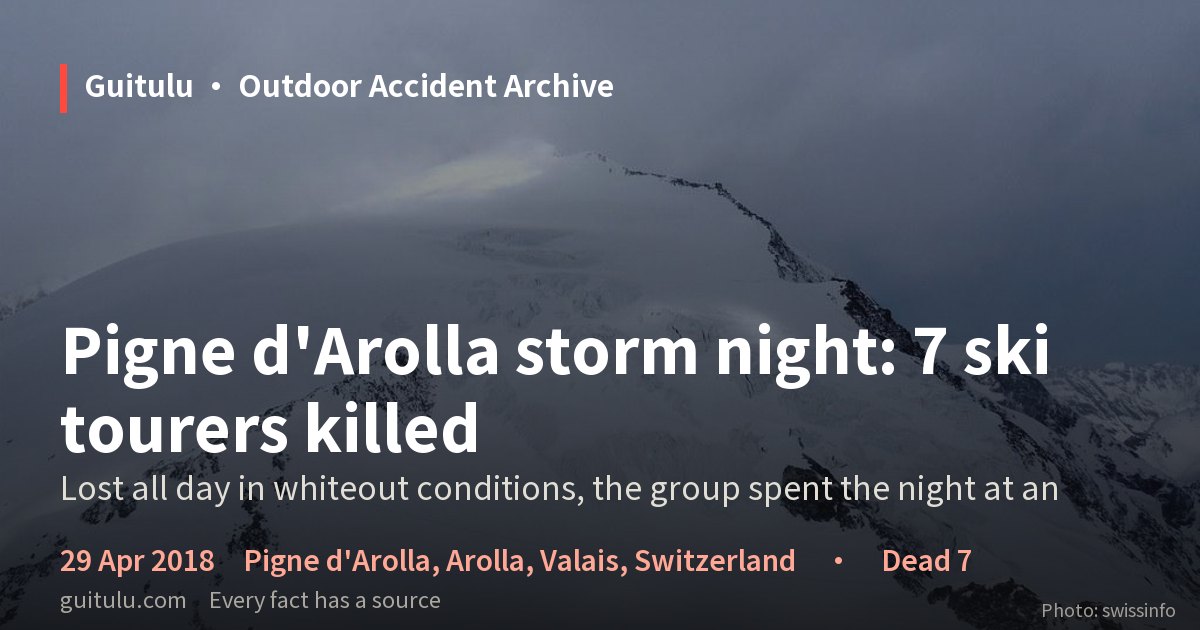
Dead 7 Injured 77 of the 14 died (the guide died in a fall, and the other 6 died of hypothermia in hospital); 2 were seriously injured and 5 had mild hypothermia
Material
44 facts · 12 sources1 account differs and are shown side by side
The number at the end of a paragraph is how many facts it rests on; open it to see each fact and how well it is sourced:
Multiple sourcesSingle source. Conflicting accounts and speculation are kept out of the narrative.
Reported places along the route (schematic)Schematic
Scroll down and the map flies to where each part happened. The line is Schematic, Connects the places mentioned in reports in sequence, showing only the approximate direction, not the actual track.
01
Full route
Approximate route shown by connecting the locations mentioned in reports in sequence (illustrative).
According to reports, the party arrived at Cabane des Dix, at an altitude of 2928 metres, at 16:00 on 28 April to spend the night. F03
The party took wrong turns and doubled back several times in the storm; survivor Tommaso Piccioli said they got lost four or five times. F11
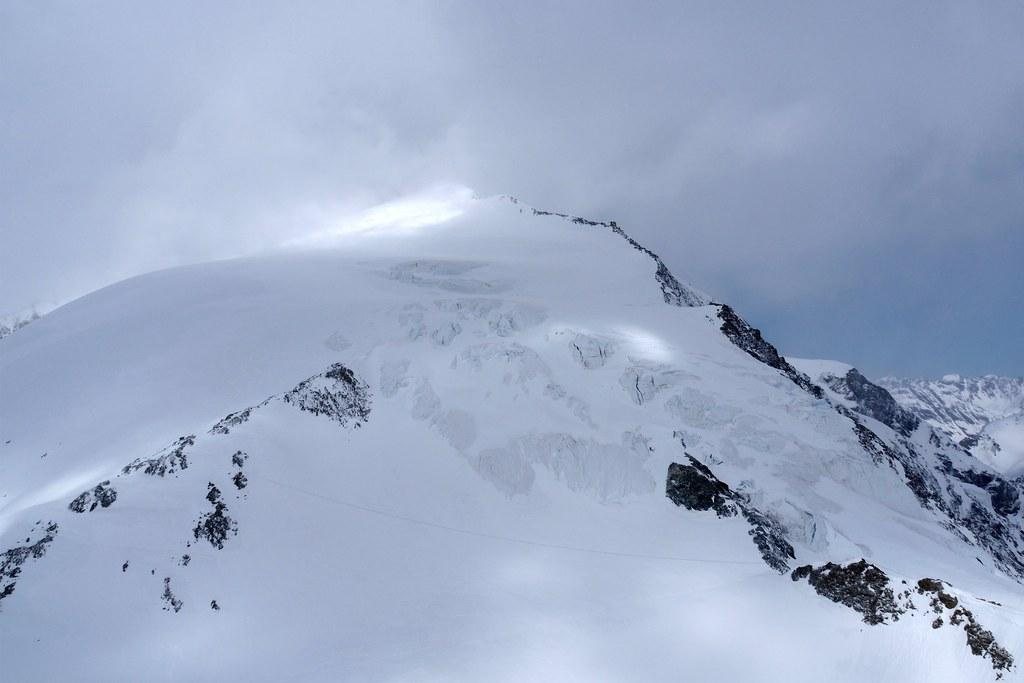
In the Pigne d'Arolla area, the party encountered a sudden storm, with strong winds, snowfall and severe cold. A whiteout also developed, and visibility dropped sharply. F08
During the storm, the guide's party joined the other group of 4, bringing the combined total to 14. F10
According to reports, after the party had wandered in the storm for more than 12 hours, the guide decided to spend the night on a ridge. F16
On Sunday, 29 April, the party set out from Cabane des Dix, planning to take the classic “Serpentine” route to Cabane des Vignettes, at an altitude of approximately 3160 metres, for the night. F05
The guide went alone to find Cabane des Vignettes and seek help, fell to his death on the way, and was found the next day. F23
The sky was clear and it was windy when they set out, but the weather did not hold. F07
The visibility and the storm prevented the party from continuing, forcing them to spend the night at an altitude of about 3270 metres. F17
Shortly before about 6:30 a.m. on Monday, 30 April, the warden of Cabane des Vignettes raised the alarm. F26
The rescue involved 7 helicopters from Air-Glaciers, Air Zermatt and REGA, carrying doctors and other personnel. It was one of the largest rescue operations in the Swiss Alps. F27
The death toll rose over several days: one person died at the scene, another three died shortly after being taken to hospital, the fifth died late on 30 April, and the sixth died on 1 May. F32
On 2 May, Valais police reported the death of the seventh victim, an Italian woman. In total, seven people died: six Italians and one Bulgarian. F33
In August 2019, at the conclusion of its investigation, the Valais prosecutor's office said that no criminal responsibility could be attributed to anyone still alive and notified the parties of its intention to close the case; reportedly, the deadline for the parties to submit additional evidence expired on 8 October, and the closure could still be appealed to the cantonal court. F35
Under each fact is a verbatim quote from the original. "Single source" means only one outlet mentioned it; "Accounts differ" means sources contradict each other and this site adopts neither side; "Speculation" is an inference by a reporter or a person involved, not a fact.
According to reports, the party changed its itinerary because of the weather: its original destination was another hut, but it changed course for Cabane des Vignettes.
The account in stol.it came from information that the sister of one of the people who died obtained from Swiss rescue services.
Quotes from the original 2
“They were not expected at the refuge having changed their route due to the weather conditions.”
On Sunday, 29 April, the party set out from Cabane des Dix, planning to take the classic “Serpentine” route to Cabane des Vignettes, at an altitude of approximately 3160 metres, for the night.
Quotes from the original 3
“left the Dix Hut (2,928m) on Sunday 29th April 2018. They planned to follow the Serpentine classic route to the Vignettes Hut (3,160m) where they intended to spend the night.”
“The group had set out from the Dix rest-stop and had intended to make it to the Cabanne de Vignettes refuge to sleep, trekking along a route called The Serpentine.”
“wollte am Sonntag von der 2928 Meter hoch gelegenen Hütte „Cabane des Dix“ über die klassische Route „La Serpentine“ zur Schutzhütte „Cabane des Vignettes“ (3157 Meter) aufsteigen.”
In the Pigne d'Arolla area, the party encountered a sudden storm, with strong winds, snowfall and severe cold. A whiteout also developed, and visibility dropped sharply.
Quotes from the original 3
“as they reached the Pigne d'Arolla area the group were engulfed in an unexpected storm with high winds, snow, and extreme cold.”
According to The Local, According to Valais mountain guide Pierre Mathey, there was no radio or mobile phone signal where the party was forced to stop.
Quotes from the original 1
“When they were forced to stop they found themselves in a location without radio or mobile phone coverage, Valais mountain guide Pierre Mathey told the Berner Zeitung.”
Accounts of the temperature and wind speed during the storm differ: The Local reported a temperature of minus 5 degrees and wind speeds of up to about 100 km/h; PisteHors reported minus 10 degrees, with a lower wind chill; stol.it reported minus 5 to 10 degrees; Outside.fr reported minus 20 degrees at night and gusts approaching 150 km/h; Blick also reported wind speeds of up to 150 km/h.
Estimates of temperature and wind speed vary considerably between reports and may refer to different times, different measuring locations or wind chill temperatures.
Quotes from the original 5
“14 skiers trapped outside in –5C temperatures in the Swiss canton of Valais after they were caught by a brutal storm with heavy snow and winds of up to 100 kilometres an hour.”
According to Blick, According to reports, after the party had wandered in the storm for more than 12 hours, the guide decided to spend the night on a ridge.
Quotes from the original 1
“Après plus de 12 heures d'errance, le guide de montagne décide de bivouaquer sur une crête.”
The guide's party stopped on an exposed saddle or ridge, where the ground was rocky and there was little snow. They could not dig a snow cave and could only shelter from the wind behind rocks and backpacks.
Quotes from the original 4
“When night fell, they found themselves on an exposed saddle.”
According to l'Adige, According to the prosecutor's office, the guide's party of 10 spent the night in the Col des Cairns saddle area, 15 to 20 metres below the French group; the wind was extremely strong, and equipment and several emergency blankets were blown away.
Quotes from the original 2
“la comitiva di dieci persone con la guida alpina Mario Castiglioni ha passato la notte «15-20 metri» più in basso, al «livello del colle» des Cairns”
According to l'Adige, According to the prosecutor's office, the 4 French skiers dug pits in the snow for shelter from the wind, built walls of snow and stones, and stayed awake all night. All survived.
Quotes from the original 1
“i quattro hanno «scavato una buca nella neve per ripararsi dal vento, si sono protetti costruendo un muro di neve e pietre e si sono tenuti svegli tutta la notte».”
According to l'Adige, According to the prosecutor's office, one member of the party left the others during the night and dug a snow cave alone; the others stayed together.
Quotes from the original 1
“Durante la notte un escursionista ha lasciato il gruppo e ha scavato un rifugio nella neve, mentre gli altri sono rimasti insieme.”
Survivor Piccioli kept moving throughout the night to prevent hypothermia and repeatedly woke a German woman beside him and got her to move her arms and legs. She also survived.
Quotes from the original 3
“described on Wednesday how he was forced to keep moving throughout the night, in order to keep his heart pumping and stave off hypothermia.”
The rescue involved 7 helicopters from Air-Glaciers, Air Zermatt and REGA, carrying doctors and other personnel. It was one of the largest rescue operations in the Swiss Alps.
Quotes from the original 3
“including 7 helicopters from Air-Glaciers, Air-Zermatt, and REGA with several SMUR doctors and gendarmes on board, were dispatched to the scene.”
Rescuers found 14 people, several of them hypothermic. The guide was already dead at the scene; police said he may have died in a fall. The injured were taken to hospitals in Valais and outside the canton (Bern, Lausanne).
Quotes from the original 3
“Rescuers then discovered 14 people, several of them in hypothermia and one person dead, apparently as a result of a fall.”
Apart from the guide, who died in a fall, the other victims died of hypothermia.
Quotes from the original 2
“un guide italien de 59 ans, décédé sur les lieux à la suite d'une chute, ainsi que deux couples d'Italiens, âgés de 53 ans et de 45 ans, et une Bulgare de 52 ans, morts d'hypothermie à l'hôpital”
The death toll rose over several days: one person died at the scene, another three died shortly after being taken to hospital, the fifth died late on 30 April, and the sixth died on 1 May.
Quotes from the original 3
“One person was already dead at the scene while three other people died not long after being transported to hospital. Police in Valais said a fifth person died late on Monday and a sixth person was reported dead on Tuesday.”
Of the 7 survivors, 2 were seriously injured (a 72-year-old Swiss man and a 56-year-old French woman), and 5 had mild hypothermia.
Quotes from the original 2
“2 people are still in serious condition: it is a 72-year-old Swiss, a 56-year-old Frenchwoman; 5 people slightly injured (mild hypothermia): 3 French, one German and one Italian.”
“Two others – a Swiss man and a French woman – are still in serious condition, but their lives are no longer in danger, police said. Five additional people are being treated for hypothermia”
In August 2019, at the conclusion of its investigation, the Valais prosecutor's office said that no criminal responsibility could be attributed to anyone still alive and notified the parties of its intention to close the case; reportedly, the deadline for the parties to submit additional evidence expired on 8 October, and the closure could still be appealed to the cantonal court.
Quotes from the original 2
““Nessuna responsabilità penale imputabile a un individuo vivente può essere presa in considerazione, per cui il ministero pubblico” del Canton Vallese (Svizzera) “ha informato le parti della sua intenzione di archiviare il caso”.”
“il 27 agosto scorso aveva già annunciato di voler archiviare il caso e l’8 ottobre sono scaduti i termini concessi alle parti per richiedere l’acquisizione di nuovi mezzi di prova.”
According to l'Adige, According to the prosecutor's office, the investigation ruled out the possibility that third-party involvement caused the deaths.
Quotes from the original 1
“L’intervento di una terza persona in questi decessi ha potuto essere escluso”
According to Outside.fr, According to reports, Swiss director Frank Senn later made a 90-minute documentary reconstructing the accident, using the party members' GPS data analysed in the official investigation report and first-hand accounts from three survivors.
Quotes from the original 2
“Grâce aux données GPS des participants analysées dans le rapport d’enquête officiel et aux récits des personnes impliquées, les dernières 24 heures sont ainsi minutieusement retracées.”
According to swissinfo, The Haute Route is a classic route from Chamonix, France, to Zermatt, Switzerland. It is approximately 180 kilometres long, passes through mountains and glaciers at altitudes of approximately 2450 to 3560 metres, and generally takes six days.
Quotes from the original 2
“The hikers were crossing from Chamonix (France) to the Swiss mountain resort of Zermatt on the classic 180km long Haute Route along the Italian border.”
The guide was Mario Castiglioni, 59, from Como, Italy. He had held an International Federation of Mountain Guides Associations (UIAGM) qualification since 1991 and founded the mountaineering travel agency MLG Mountain Guide.
Quotes from the original 3
“The victim is an experienced Italian guide from Como, Mario Castiglioni, 59 years old.”
The guide's Bulgarian wife was also in the party. She was also a mountain leader and organised mountain trips with the guide. She died in the accident.
Quotes from the original 2
“He used to organize mountain trails with his Bulgarian wife, who is also one of the dead victims.”
According to Outside.fr, Only 3 of the 10 people in the guide's party survived: a 49-year-old architect from Milan, a 72-year-old from Ticino, and a 47-year-old German woman.
Quotes from the original 2
“les trois survivants – un architecte milanais de 49 ans, un Tessinois de 72 ans et une Allemande de 47 ans”
Survivor Piccioli's view was that setting out despite knowing that bad weather would arrive at 10 am and stopping on the ridge in the wind were both mistakes; in a storm, they should have sought shelter from the wind on lower ground and dug snow caves.
Quotes from the original 3
“we should never have set out when we knew bad weather would start at 10am”
Outside.fr raised the question of whether the accident happened because the weather arrived sooner than forecast, or because of human error caused by the guide's overconfidence, insufficient communication and possibly incomplete equipment. This was only a speculative question, with no conclusion.
Quotes from the original 1
“S’agissait-il d’un accident dû au mauvais temps arrivé plus vite qu’annoncé ? Ou d’une erreur humaine de la part de Mario Castiglioni, de la société MLG Mountain Guide, guide trop confiant, peu communiquant et peut-être mal équipé ?”
 GuituluGlobal Outdoor Accident Archive