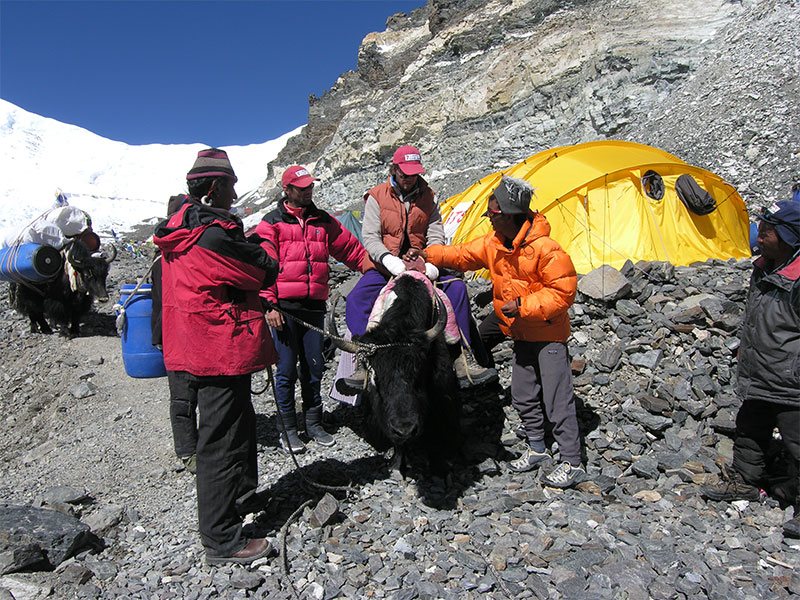
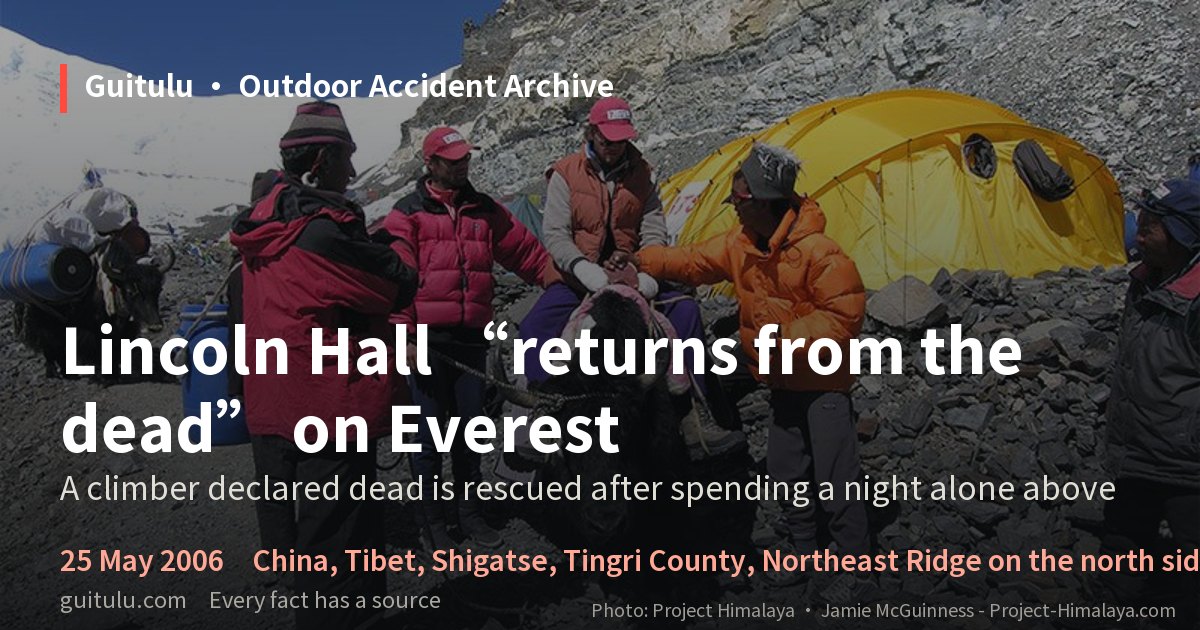
In May 2006, Hall prepares to descend by yak from Advanced Base Camp on Everest’s north side (about 6400 metres)Photo source: Project Himalaya · Jamie McGuinness - Project-Himalaya.com
The number at the end of a paragraph is how many facts it rests on; open it to see each fact and how well it is sourced:
Multiple sourcesSingle source. Conflicting accounts and speculation are kept out of the narrative.
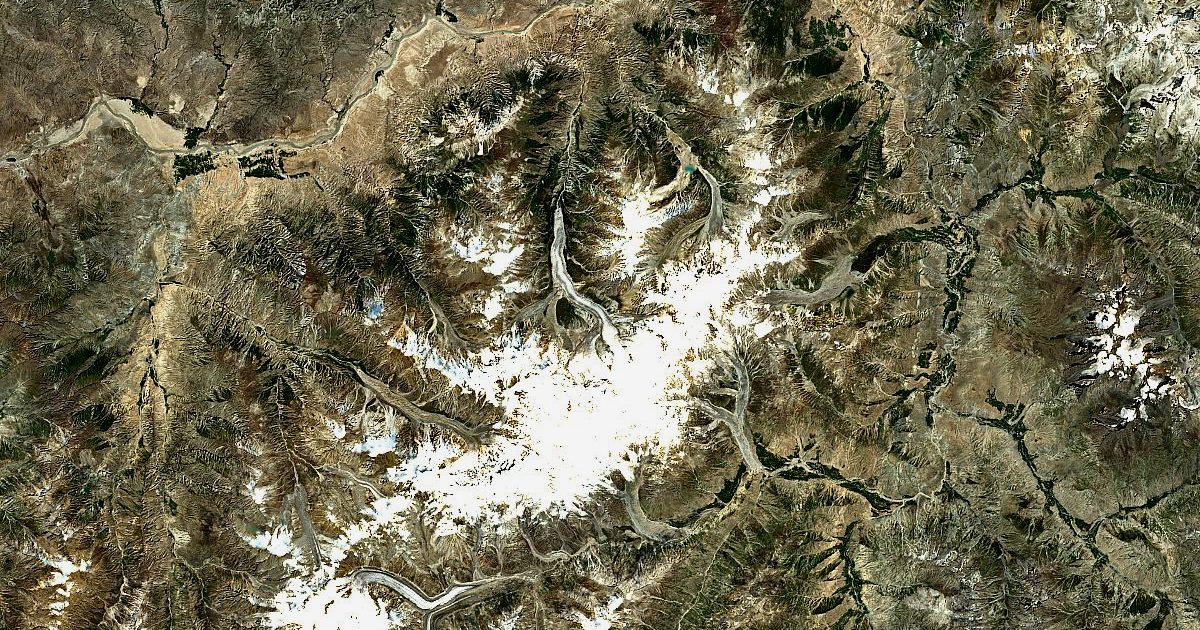
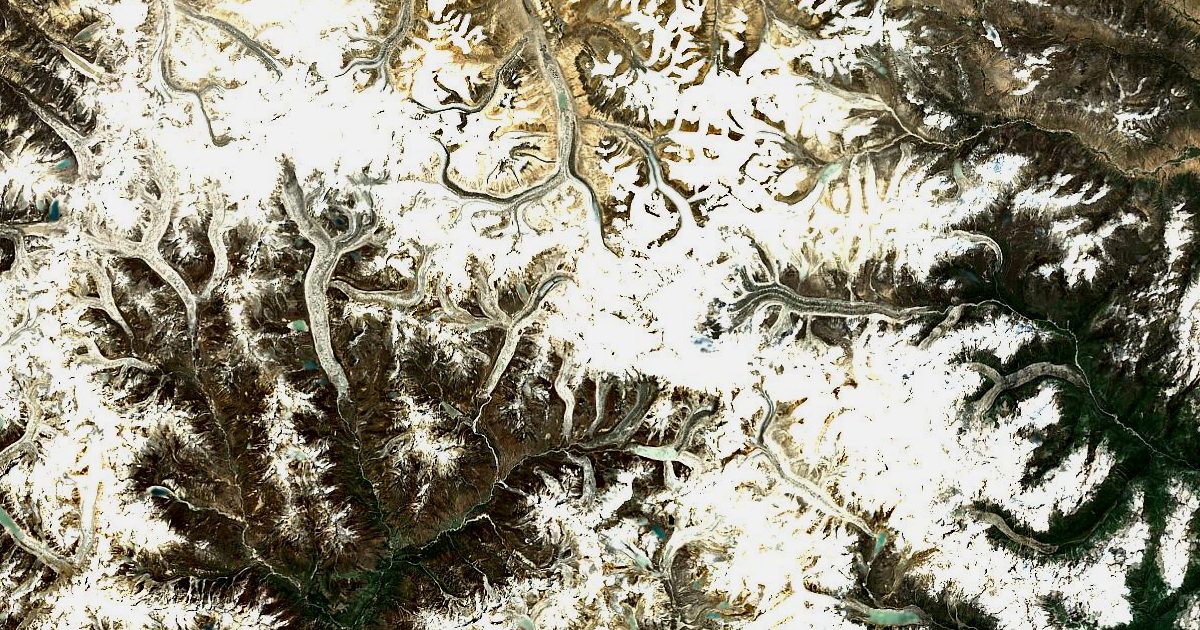
Reported locations along the route (schematic)Schematic
Scroll down and the map flies to where each part happened. The line is Schematic, The locations mentioned in reports are connected in sequence, showing only the approximate direction, not the actual track. Sources for the location coordinates are in places.json.
01
Full route
The locations mentioned in reports are connected in sequence to show the approximate course of events (schematic).
The Sherpas reported by radio that Hall had died, and the team subsequently notified his family. F07
Hall was then taken to Advanced Base Camp, where he spent another two nights under a doctor's care, before finally being carried down to base camp by yak. F08
Hall's condition grew worse, and he stopped moving and speaking; that evening the Sherpas concluded that he had died and left him on the mountain. F17
On 25 May 2006, Hall reached the summit of Everest from the north side (the Tibetan side), and his condition worsened during the descent. F12
Hall spent the night alone on the ridge, without oxygen, a sleeping bag or supplies, and wearing little clothing. F22
From approximately 10 a.m. to around 7 p.m. on 25 May, the Sherpas accompanying Hall helped him descend for about nine hours. F13
The first thing Hall said when he saw them was to the effect of “I imagine you’re surprised to see me here”. F30
On the evening of 26 May, Hall was escorted to the North Col camp at an altitude of about 7000 metres, where the team doctor cared for him overnight. F41
Early on 26 May, Dan Mazur, accompanied by two clients and a Sherpa, found Hall alive while on his way to the summit. F24
Mazur and his party radioed down the mountain to report that Hall was alive. F34
Mazur's team gave up their summit attempt and descended after handing Hall over to the rescuers. F37
In March 2012, Hall died of mesothelioma at the age of 56. F42
Under each fact is a verbatim quote from the original. "Single source" means only one outlet mentioned it; "Accounts differ" means sources contradict each other and this site adopts neither side; "Speculation" is an inference by a reporter or a person involved, not a fact.
Hall was then taken to Advanced Base Camp, where he spent another two nights under a doctor's care, before finally being carried down to base camp by yak.
The detail that he spent two nights at Advanced Base Camp appears only in Abramov's account; multiple sources mention the descent by yak.
Quotes from the original 3
“The following day the Sherpas brought Hall down to advanced base, where he spent two more nights under doctor’s supervision, before being carried by yak to base camp.”
Just over ten days earlier, British mountaineer David Sharp had died on the north side on 15 May; many climbers reportedly passed him, and Hall's rescue is often contrasted with this.
Quotes from the original 2
“Hall's rescue came just days after David Sharp, 34, died May 15, about 1,000 feet into his descent from the summit.”
According to AAJ (Abramov response), According to Abramov, the Sherpas took Hall from the “rock triangle” at 8800 metres to “Mushroom Rock” at 8550 metres; descending the Second Step alone took four hours.
Quotes from the original 1
“descending from the “Rock Triangle” at 8,800m to the “Mushroom Rock” at 8,550m. Bringing him down the Second Step alone took four hours.”
Accounts differ on the number of Sherpas accompanying Hall: Abramov said four, NBC said two, NZ Herald said three, and The Irish Times described a five-person team.
Quotes from the original 4
“four Sherpas who had accompanied Hall tried to help him down the mountain”
According to AAJ (Abramov response), During the day, Abramov also sent two Sherpas with oxygen from Advanced Base Camp to the highest camp at 8300 metres, and sent another 11 Sherpas to the North Col to stand by.
Quotes from the original 1
“he sent two more Sherpas, carrying oxygen, from advanced base to the top camp at 8,300m. Eleven more Sherpas were sent to the North Col (7,000m)”
Accounts differ on the altitude at which Hall was left: The Harvard Crimson and grough said approximately 8700 metres, The Irish Times said 8800 metres, Abramov said the Sherpas took him to Mushroom Rock at 8550 metres, and Osborne said he spent the night at 8600 metres.
Quotes from the original 5
“The guides left him at 8700 meters (28,543 feet)”
According to Alan Arnette, The Sherpas believed Hall had died and, when they left, took his backpack, water, food, headlamp, oxygen cylinder, mask and spare clothing.
Quotes from the original 1
“Assuming he was dead, they left him taking his pack, water, food, headlamp, oxygen bottle, mask, and extra clothes.”
Accounts of the weather that night differ: Abramov said it was unusually warm and Hall got some rest and sleep; the University of Colorado article said the temperature fell to minus 30 degrees overnight.
Quotes from the original 2
“Fortunately, the night was unusually warm, the Australian got some rest and a bit of sleep”
According to NBC News, Mazur said that at first he did not recognise Hall as a person; he saw only the colour of the jacket and thought it might be a tent.
Quotes from the original 1
“At first I didn't realize it was a person, I just saw the color of his jacket ... I thought it might be a tent,”
According to AAJ (Abramov response), According to Abramov, only two of the six Sherpas at the highest camp were strong enough to go up to rescue Hall; he also had 11 Sherpas at the North Col use the team's oxygen to climb to the Second Step as quickly as possible.
Quotes from the original 1
“Only two were fit enough to go. He then asked the 11 Sherpas at the North Col to climb to the Second Step, using expedition oxygen”
Accounts differ on how long Mazur and his party stayed with Hall while waiting for rescue: articles from NBC, the Harvard student newspaper and the University of Colorado say about four hours, while grough says two to three hours.
Quotes from the original 4
“Mazur's team spent the next four hours pulling Hall away from the slopes”
Accounts of the weather when the summit attempt was abandoned differ: the NZ Herald quoted Mazur as saying conditions were ideal; the University of Colorado article said the weather was good; the Harvard student newspaper said Osborne's party turned back because worsening weather was expected.
Accounts differ on the number of Sherpas in the rescue team sent to meet Hall: an AAP obituary says 12; Alan Arnette says Abramov sent 10; and the American Alpine Journal says at least 15 Sherpas and 50 bottles of oxygen were reportedly needed to get him to base camp.
Quotes from the original 3
“The team stayed with Hall until a rescue team of 12 sherpas arrived to help him to safety.”
At that altitude and on that terrain, it was impossible to carry Hall, so he had to walk down himself; with the Sherpas' assistance, he was able to move on his own.
Quotes from the original 2
“They could not carry Hall – not at that altitude or on such terrain – so the rescue depended on getting the dead man to walk.”
Hall's earlier Everest attempt turned back at 8300 metres, but accounts differ on the year: Alan Arnette writes that he was a member of the 1984 team and did not reach the summit at 8300 metres; The Irish Times writes that he attempted to climb without oxygen in 1983 and turned back at 8300 metres.
The two sources give different years
Quotes from the original 2
“He did not summit after reaching 8300 meters and dreamed of returning.”
According to AAJ (Abramov response), Abramov acknowledged that his Sherpas had mistakenly judged Hall to be dead, but believed that Hall must have been close to death at the time.
Quotes from the original 1
“Abramov admits there was a wrong diagnosis by his Sherpas but feels that at the time Hall must have been close to death.”
 GuituluGlobal Outdoor Accident Archive