GuituluGlobal Outdoor Accident Archive 中文
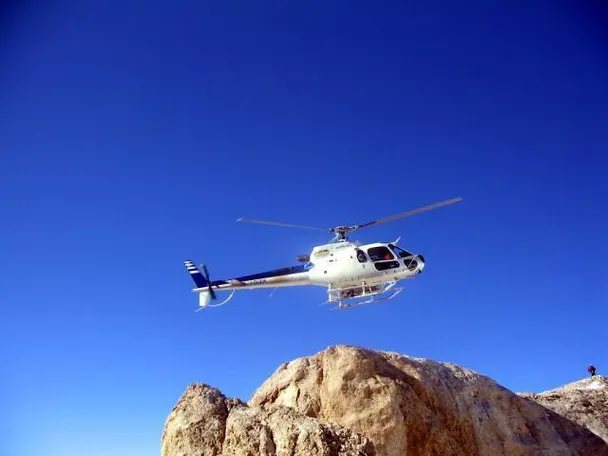
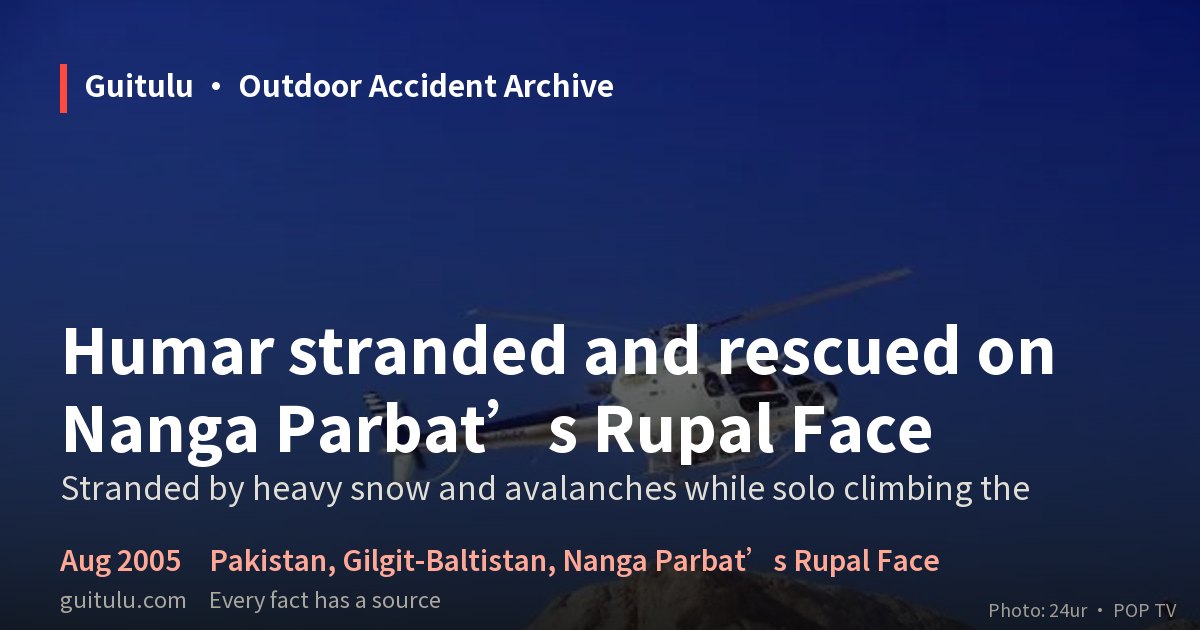
During the rescue, a helicopter flies over rocks at the foot of Nanga Parbat

Archive / Mountaineering

Humar stranded and rescued on Nanga Parbat’s Rupal Face

Stranded by heavy snow and avalanches while solo climbing the Rupal Face, he was rescued by a Pakistan Army helicopter using a sling

Rescued on 10 August 2005

Photo: 24ur · POP TV

Date
Summer
Place
Pakistan, Gilgit-Baltistan, Nanga Parbat’s Rupal FacePakistan › Gilgit-Baltistan · Himalaya74.590°E 35.238°N
Activity
MountaineeringInvolves: Avalanche · Rockfall and collapse · Extreme weather1 person climbing solo, with teammates, a team doctor and an accompanying journalist at base camp
Casualties
No deathsNo deaths; Humar was rescued and reportedly had dehydration and swollen or reddened hands and feet, but was otherwise unharmed; no rescue crew members were injured
Material
45 facts · 10 sources4 accounts differ and are shown side by side

01What happened

In 2005, Slovenian mountaineer Tomaž Humar attempted a solo climb of the Rupal Face of Nanga Parbat in Pakistan. Reportedly, this was his second attempt on the face; he abandoned the first in June 2003 because of bad weather. The expedition had more than twenty sponsors, and the climb’s progress was broadcast live from both Slovenia and base camp.Facts it rests onF05Multiple sourcesIn 2005, Slovenian mountaineer Tomaž Humar attempted to climb the Rupal Face of Nanga Parbat in Pakistan alone.F01Single sourceThis was Humar’s second attempt on the Rupal Face; his first attempt, in June 2003, was abandoned because of bad weather.F02Single sourceThe expedition had more than twenty sponsors and broadcast live updates on the climb from both Slovenia and base camp.

During the rescue, a helicopter flies over rocks at the foot of Nanga ParbatPhoto source: 24ur · POP TV

According to Alpinist, in the days before the climb Humar’s website had reported frequent avalanches on or near his planned route, and the weather forecast offered only a roughly three-day window of good weather; he nevertheless began the climb. When he reached the middle section of the face, he encountered heavy snow and became stranded, with avalanches and snow slides occurring repeatedly around him. Reportedly, he dug a hole in the snow slope and stayed there, waiting for the weather to improve; on 4 August, fragile mushroom-shaped snow cornices prevented him from climbing, and falling rocks injured his arm.Facts it rests onF06Single sourceIn the days before the climb, Humar’s website reported frequent avalanches on or near his planned route; despite the poor conditions and a weather forecast offering only about a three-day window of good weather, he began climbing.F08Multiple sourcesHumar encountered heavy snow while climbing the middle section of the Rupal Face and became stranded on the face.F10Multiple sourcesWhile he was stranded, avalanches and snow slides continued around him.F09Single sourceHe dug a hole in the snow slope and stayed there, waiting for the weather to improve and avalanches to subside.F18Single sourceOn 4 August, he was trapped among mushroom-shaped snow overhangs that were too fragile to climb; rocks fell when the sun reached the face, and one injured his arm.

Viewed from the base camp area, the Rupal Face is once again covered in cloud and mistPhoto source: 24ur · www.humar.com

On 5 August, Humar requested a helicopter rescue; earlier that day, the expedition website had posted that a rescue from the middle of the Rupal Face was impossible. A helicopter could not land at his location, and Slovenian and Pakistani parties coordinated the response, which developed into an international operation. While stranded, he was wet and cold throughout, and his food dwindled until he ran out. Reportedly, by 8 August he had only his last 4 batteries left.Facts it rests onF19Multiple sourcesOn 5 August, Humar, stranded on the face, requested a helicopter rescue.F20Multiple sourcesBefore the rescue request on 5 August, the expedition website said that a rescue from the middle of the Rupal Face was impossible, something Humar had said before setting out.F23Multiple sourcesA helicopter could not land where Humar was located.F21Multiple sourcesThe rescue was coordinated by contacts on both the Slovenian and Pakistani sides and developed into an international rescue operation.F12Multiple sourcesWhile he was stranded, he was wet and cold all over.F11Multiple sourcesWhile he was stranded, Humar’s food dwindled and eventually ran out.F27Single sourceOn 8 August, Humar had only 4 batteries left, so base camp had heard nothing from him after 10 p.m. the previous evening.

The approximate location on the Rupal Face where Humar was stranded, marked by the expeditionPhoto source: 24ur · www.humar.com

On 7 August, an Alouette helicopter flew up the face to reconnoitre and attempted to deliver supplies to him, but was stopped by strong winds. On 8 August, the weather was too bad for a helicopter to take off; a rescue attempt on 9 August was again hindered by cloud and bad weather. Reportedly, two Lama helicopters and a fuel-transport helicopter had arrived at base camp that day.Facts it rests onF24Multiple sourcesOn 7 August, an Alouette helicopter flew up the face to scout Humar’s location.F25Multiple sourcesDuring the reconnaissance on 7 August, the helicopter attempted to drop supplies to him, but was prevented by strong winds.F28Multiple sourcesOn 8 August, the weather was too bad for helicopters to take off.F29Multiple sourcesA rescue attempt on 9 August was hampered by cloud and bad weather.F30Single sourceOn 9 August, two Lama helicopters and a fuel-carrying helicopter flew to base camp; as the helicopters approached the rock face, they were blocked by fog, and the rescue was postponed until the following day.

A Pakistani Army helicopter above a grassy area at the foot of Nanga ParbatPhoto source: 24ur

Early on 10 August, Pakistan Army pilots Rashid Ullah Baig and Khalid Amir Rana flew a helicopter to rescue Humar from the Rupal Face. Reportedly, to reduce weight, the pilots carried less fuel, leaving only about 40 minutes for the rescue. They lowered a rope weighted at the end and swung it towards Humar. He connected to it but was unable to detach his personal safety tether from an ice screw, leaving the helicopter temporarily connected to the face. Fortunately, the tether eventually broke; the stretched rope recoiled, throwing him upwards as if bungee jumping, and he nearly struck the helicopter. He was taken back to base camp below the mountain and was otherwise unharmed.Facts it rests onF32Multiple sourcesEarly on 10 August 2005, a Pakistani Army helicopter rescued Humar from the Rupal Face.F31Multiple sourcesThe Pakistani Army pilots who carried out the rescue were Rashid Ullah Baig and Khalid Amir Rana.F33Single sourceThe helicopter’s weight limit prevented a winch from being taken to the required altitude. The pilots reduced the fuel load to save weight, leaving only about 40 minutes for the rescue.F34Multiple sourcesThe pilots lowered a rope with a weight attached and swung it toward Humar, who attached himself to the rope.F35Multiple sourcesHumar was unable to detach his self-protection from an ice screw, briefly leaving the helicopter connected to the rock face; the protection eventually came apart without causing an accident.F36Multiple sourcesAfter the protection came apart, the stretched rope recoiled, flinging Humar upward like a bungee jumper and nearly causing him to strike the helicopter.F37Multiple sourcesHumar was taken by helicopter back to base camp at the foot of the mountain.F38Multiple sourcesHumar was in generally good physical condition after his rescue.

The number at the end of a paragraph is how many facts it rests on; open it to see each fact and how well it is sourced: Multiple sourcesSingle source. Conflicting accounts and speculation are kept out of the narrative.

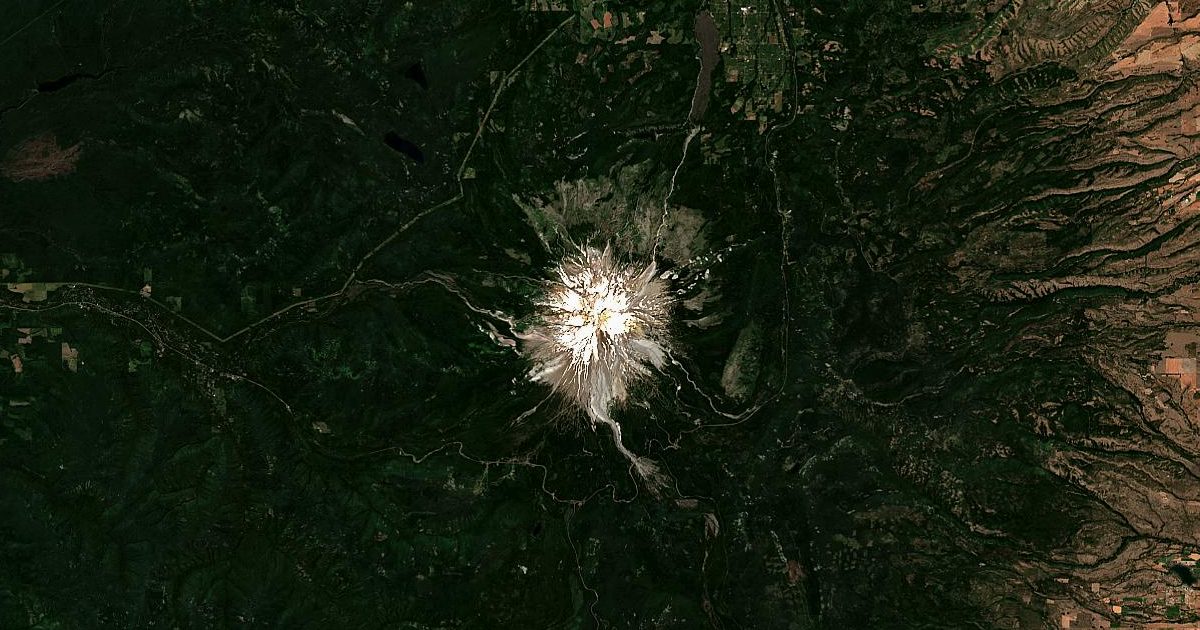
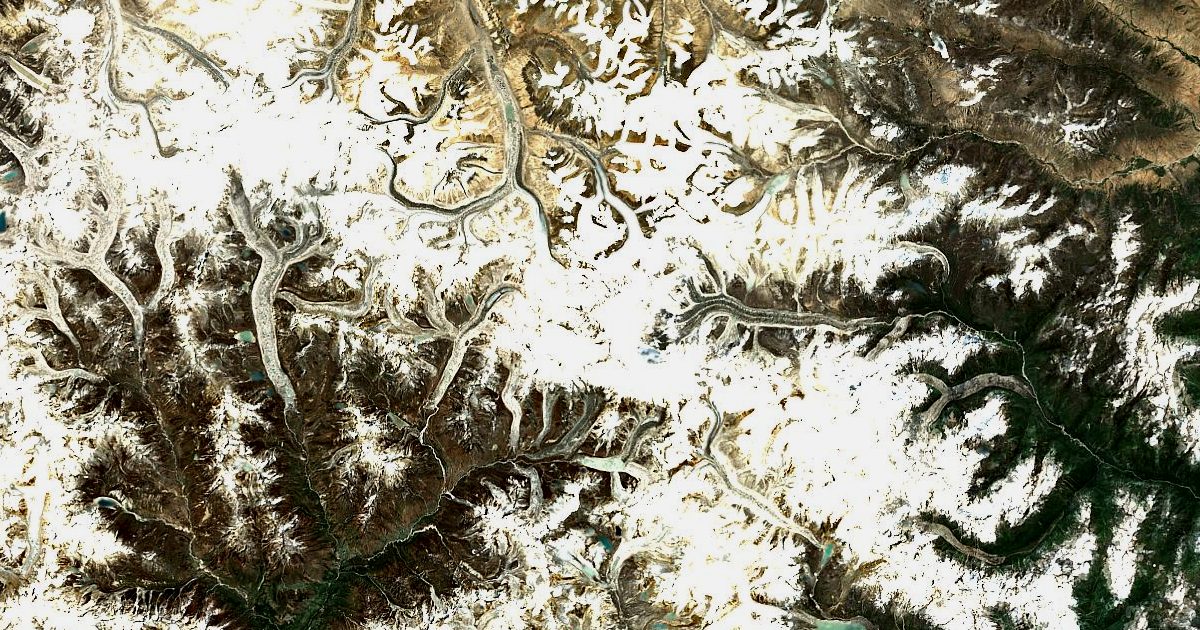
Satellite imagery Sentinel-2 cloudless 2024 © EOX · Terrain AWS Terrain Tiles · Position is schematic, geocoded from place names · Place coordinates not individually verified

Route review

6 scenes to understand what happened

Scroll down and the map flies to where each part happened.

01

The incident area

The reports do not provide enough locations along the route, so the map shows only the approximate location and terrain of the incident area.

04

Request for rescue

On 5 August, he requested a helicopter rescue. A helicopter could not land at his location, and Slovenian and Pakistani parties coordinated the rescue.Facts it rests onF19Multiple sourcesOn 5 August, Humar, stranded on the face, requested a helicopter rescue.F23Multiple sourcesA helicopter could not land where Humar was located.F21Multiple sourcesThe rescue was coordinated by contacts on both the Slovenian and Pakistani sides and developed into an international rescue operation.

05

Three days of setbacks

From 7 to 9 August, reconnaissance and supply drops, takeoffs and rescue attempts were successively prevented by strong winds, bad weather and cloud.Facts it rests onF25Multiple sourcesDuring the reconnaissance on 7 August, the helicopter attempted to drop supplies to him, but was prevented by strong winds.F28Multiple sourcesOn 8 August, the weather was too bad for helicopters to take off.F29Multiple sourcesA rescue attempt on 9 August was hampered by cloud and bad weather.

06

Rescued by rope

Early on 10 August, an army helicopter lowered a rope with a weight attached, lifted him off the rock face and took him back to base camp below the mountain.Facts it rests onF32Multiple sourcesEarly on 10 August 2005, a Pakistani Army helicopter rescued Humar from the Rupal Face.F34Multiple sourcesThe pilots lowered a rope with a weight attached and swung it toward Humar, who attached himself to the rope.F37Multiple sourcesHumar was taken by helicopter back to base camp at the foot of the mountain.

02Timeline

  1. At noon on 1 August, Humar left base camp, planning first to establish an advanced camp on a platform at about 4000 metres at the foot of the face. F17

  2. On 5 August, Humar, stranded on the face, requested a helicopter rescue. F19

  3. Eurocopter said it was willing to send a helicopter of the same model as the one that landed on Mount Everest in May 2005. F22

  4. The rescue was coordinated by contacts on both the Slovenian and Pakistani sides and developed into an international rescue operation. F21

  5. On 7 August, an Alouette helicopter flew up the face to scout Humar’s location. F24

  6. On 8 August, the weather was too bad for helicopters to take off. F28

  7. A rescue attempt on 9 August was hampered by cloud and bad weather. F29

  8. Humar was taken by helicopter back to base camp at the foot of the mountain. F37

  9. Early on 10 August 2005, a Pakistani Army helicopter rescued Humar from the Rupal Face. F32

  10. In June 2007, Slovenian President Drnovsek personally presented the two pilots with the Golden Order of Merit at the presidential palace in Ljubljana. F41

  11. In 2008, Baig, the lead pilot, called for Pakistan to establish a dedicated search and rescue agency trained to international standards; at the time, Pakistan had no search and rescue organisation, and stranded climbers could only rely on Army helicopter pilots. F43

  12. In November 2009, Humar died while climbing Langtang Lirung solo in Nepal. F44

03Lessons

Weather and retreat

Factor warning signs into the decision before setting out

Before the climb, Humar’s website had reported frequent avalanches near the route, and the forecast offered only a roughly three-day window of good weather. He encountered heavy snow in the middle section of the face and became stranded, with avalanches and snow slides occurring repeatedly around him. When the weather window is short and there are many signs of avalanche danger, plan how to retreat if the window closes before setting out.Facts it rests onF06Single sourceIn the days before the climb, Humar’s website reported frequent avalanches on or near his planned route; despite the poor conditions and a weather forecast offering only about a three-day window of good weather, he began climbing.F08Multiple sourcesHumar encountered heavy snow while climbing the middle section of the Rupal Face and became stranded on the face.F10Multiple sourcesWhile he was stranded, avalanches and snow slides continued around him.

Rescue and self-rescue

Do not count on high-altitude helicopter rescue as a fallback

Reportedly, helicopter rescues on the Pakistani side usually reach only about 5000 metres. A helicopter could not land at Humar’s location; from 7 to 9 August, attempts to deliver supplies, take off and rescue him were successively blocked by strong winds, bad weather and cloud. In the end, the pilots also had to carry less fuel to reduce weight. The rescue succeeded only after multiple setbacks.Facts it rests onF03Multiple sourcesHelicopter rescues by the Pakistani side usually only reached an altitude of around 5000 metres.F23Multiple sourcesA helicopter could not land where Humar was located.F25Multiple sourcesDuring the reconnaissance on 7 August, the helicopter attempted to drop supplies to him, but was prevented by strong winds.F28Multiple sourcesOn 8 August, the weather was too bad for helicopters to take off.F29Multiple sourcesA rescue attempt on 9 August was hampered by cloud and bad weather.F33Single sourceThe helicopter’s weight limit prevented a winch from being taken to the required altitude. The pilots reduced the fuel load to save weight, leaving only about 40 minutes for the rescue.

Communication and location

Battery power determines how long contact can be maintained

After becoming stranded, Humar relied on contact with base camp to request and await rescue. Reportedly, by 8 August he had only his last 4 batteries left, and base camp subsequently went for a time without hearing from him. When stranded for a long period, batteries and calls should be rationed for the worst case.Facts it rests onF19Multiple sourcesOn 5 August, Humar, stranded on the face, requested a helicopter rescue.F27Single sourceOn 8 August, Humar had only 4 batteries left, so base camp had heard nothing from him after 10 p.m. the previous evening.

Rescue and self-rescue

A personal safety tether can become a hazard during a sling rescue

After connecting to the rope lowered by the helicopter, Humar was unable to detach his personal safety tether from an ice screw, leaving the helicopter temporarily connected to the face. After the tether broke, the recoiling rope threw him upwards and he nearly struck the helicopter. Before being lifted away from the face, make sure you can detach your safety tether in time.Facts it rests onF34Multiple sourcesThe pilots lowered a rope with a weight attached and swung it toward Humar, who attached himself to the rope.F35Multiple sourcesHumar was unable to detach his self-protection from an ice screw, briefly leaving the helicopter connected to the rock face; the protection eventually came apart without causing an accident.F36Multiple sourcesAfter the protection came apart, the stretched rope recoiled, flinging Humar upward like a bungee jumper and nearly causing him to strike the helicopter.

04Fact list 45 facts

Under each fact is a verbatim quote from the original. "Single source" means only one outlet mentioned it; "Accounts differ" means sources contradict each other and this site adopts neither side; "Speculation" is an inference by a reporter or a person involved, not a fact.

  1. F01Single sourceBackground

    According to Unipath, This was Humar’s second attempt on the Rupal Face; his first attempt, in June 2003, was abandoned because of bad weather.

    Quotes from the original 1

    “Indeed, it was Humar’s second attempt; he had to abandon his first attempt in June 2003 because of bad weather.”

    Unipath · 2014-11-04
  2. F02Single sourceBackground

    According to Alpinist, The expedition had more than twenty sponsors and broadcast live updates on the climb from both Slovenia and base camp.

    Quotes from the original 2

    “Humar’s more than twenty sponsors on Nanga included the telecommunications company Mobitel”

    Alpinist · 2005-12-01

    “His expedition was covered in real time by live feeds coordinated from both Slovenia and base camp.”

    Alpinist · 2005-12-01
  3. F03Multiple sourcesBackground

    Helicopter rescues by the Pakistani side usually only reached an altitude of around 5000 metres.

    Quotes from the original 2

    “the contract clearly states the helicopter rescues only to the altitude of 5.000 meters”

    Mountain.RU · 2005-08-10

    “pakistanska vojska s helikopterjem sicer ne rešuje na višini nad 5000 metrov”

    24ur · 2007-06-18
  4. F04Multiple sourcesAftermath

    After the rescue, Humar was criticised by many mountaineering journalists and fellow climbers.

    Quotes from the original 3

    “But he was vilified by climbing journalists and his peers.”

    AAJ ·

    “„Das ist kein Alpinismus, das ist Showbusiness“, schimpfte Humars Landsmann Marko Prezelj”

    Outdoor · 2011-08-25

    “Packaged for an audience like a reality television show, Humar’s Nanga Parbat attempt was not alpinism, it was business.”

    Alpinist · 2005-12-01
  5. F05Multiple sourcesBackground

    In 2005, Slovenian mountaineer Tomaž Humar attempted to climb the Rupal Face of Nanga Parbat in Pakistan alone.

    Quotes from the original 3

    “attempted to solo climb Rupal Face on Nanga Parbat, the ninth tallest mountain in the world”

    Unipath · 2014-11-04

    “Later in 2005 he attempted a new route on the Rupal Face of Nanga Parbat.”

    AAJ ·

    “Humar left his ground crew in hopes of reaching the 8,125-meter Nanga Parbat peak alone”

    Arab News · 2005-08-11
  6. F06Single sourceEvent

    According to Alpinist, In the days before the climb, Humar’s website reported frequent avalanches on or near his planned route; despite the poor conditions and a weather forecast offering only about a three-day window of good weather, he began climbing.

    Quotes from the original 2

    “avalanches were prevalent on or near his intended route in the days immediately preceding his attempt”

    Alpinist · 2005-12-01

    “Despite his own reports of poor conditions and a limited, three-day weather window forecast, Humar began climbing on August 2.”

    Alpinist · 2005-12-01
  7. F07Accounts differMovement

    Accounts differ on the date he began climbing: Alpinist says 2 August; 24ur says 1 August.

    The starting points may differ (leaving base camp and entering the face)

    Quotes from the original 2

    “Humar began climbing on August 2”

    Alpinist · 2005-12-01

    “Humar, ki je svoj vzpon začel 1. avgusta”

    24ur · 2007-06-18
  8. F08Multiple sourcesEvent

    Humar encountered heavy snow while climbing the middle section of the Rupal Face and became stranded on the face.

    Quotes from the original 2

    “He climbed almost halfway up Rupal Face when the weather unleashed horrible snow and fog.”

    Unipath · 2014-11-04

    “se je zaradi močnega sneženja 3. avgusta znašel v”

    24ur · 2007-06-18
  9. F09Single sourceEvent

    According to AAJ, He dug a hole in the snow slope and stayed there, waiting for the weather to improve and avalanches to subside.

    Quotes from the original 1

    “He dug into the slope and hunkered down, waiting for a change in weather and reduced avalanche activity.”

    AAJ ·
  10. F10Multiple sourcesEvent

    While he was stranded, avalanches and snow slides continued around him.

    Quotes from the original 3

    “Thundering avalanches kept him from going up or down the steps he had used during his ascent.”

    Unipath · 2014-11-04

    “All around him the snow is sliding and at the moment he is safely on a ridge”

    Mountain.RU · 2005-08-10

    “Na obeh strenah šopajo plazovi”

    24ur · 2005-08-06
  11. F11Multiple sourcesEvent

    While he was stranded, Humar’s food dwindled and eventually ran out.

    Quotes from the original 3

    “his food supplies are getting really low”

    Mountain.RU · 2005-08-10

    “He had traveled very light, he had no food left and very little water.”

    Arab News · 2005-08-11

    “Nimam nič za žret”

    24ur · 2005-08-06
  12. F12Multiple sourcesEvent

    While he was stranded, he was wet and cold all over.

    Quotes from the original 2

    “Tomaž told us he is very cold, that he is wet and afraid of frostbite.”

    Mountain.RU · 2005-08-10

    “He was further jeopardized by not being able to sleep in the wet snowy conditions and could not dry his clothes.”

    Unipath · 2014-11-04
  13. F13Accounts differEvent

    Accounts differ on how long he was stranded: Arab News says 5 days; the expedition website and 24ur say 6 days; The National says 7 days; Outdoor says he spent a total of 10 days on the Rupal Face.

    The starting points may differ

    Quotes from the original 5

    “who had been trapped for five days”

    Arab News · 2005-08-11

    “where he had been trapped for six days”

    Mountain.RU · 2005-08-10

    “na višini 6300 metrov čakati na pomoč šest dni”

    24ur · 2007-06-18

    “Stranded for seven days in fog and storms”

    The National · 2008-09-08

    “Nach zehn Tagen in der 4500 Meter hohen Rupalwand”

    Outdoor · 2011-08-25
  14. F14Accounts differEvent

    Accounts differ on the altitude at which he was stranded or rescued: Alpinist says about 5700 metres; the expedition website says about 5900 metres; Arab News says about 6000 metres; The National says 6300 metres; 24ur says 6300 metres or 6350 metres.

    Quotes from the original 5

    “from a bivouac at ca. 5700 meters”

    Alpinist · 2005-12-01

    “at the altitude of approximately 5900”

    Mountain.RU · 2005-08-10

    “trapped in an icy shaft about 6,000-meters above sea level”

    Arab News · 2005-08-11

    “winched by helicopter at 6,300 metres from its Rupal Face”

    The National · 2008-09-08

    “na višini 6350 metrov obtičal v južni steni”

    24ur · 2007-06-18
  15. F15Single sourceAftermath

    According to Alpinist, After the rescue, Pakistani President Musharraf hosted Humar in Islamabad.

    Quotes from the original 1

    “General Pervez Musharraf, the Pakistani president, feted him in Islamabad.”

    Alpinist · 2005-12-01
  16. F16Multiple sourcesAftermath

    Humar’s rescue was warmly welcomed in Slovenia.

    Quotes from the original 3

    “when he was plucked from his icy coffin on the Rupal Face, he became a national hero”

    AAJ ·

    “As the news broke, the Slovenian people took to the streets to express their joy and cheer Humar and the pilots.”

    Unipath · 2014-11-04

    “a reception complete with a band and a crowd of admirers accompanied Humar’s return to Slovenia”

    Alpinist · 2005-12-01
  17. F17Single sourceMovement

    According to Mountain.RU, At noon on 1 August, Humar left base camp, planning first to establish an advanced camp on a platform at about 4000 metres at the foot of the face.

    Quotes from the original 2

    “Tomaz is leaving the base camp 1.8.05 12:01 CET It is about that time now.”

    Mountain.RU · 2005-08-10

    “Tomaz plans to reach the plateau at the foothill of the face at the altitude of 4000 meters.”

    Mountain.RU · 2005-08-10
  18. F18Single sourceEvent

    According to Mountain.RU, On 4 August, he was trapped among mushroom-shaped snow overhangs that were too fragile to climb; rocks fell when the sun reached the face, and one injured his arm.

    Quotes from the original 2

    “Mushroom-shaped-snow doesn't offer enough security to climb, because these forms are too fragile to climb.”

    Mountain.RU · 2005-08-10

    “there was a shower of stones that rained all over Tomaž one of them hurt his arm”

    Mountain.RU · 2005-08-10
  19. F19Multiple sourcesEvent

    On 5 August, Humar, stranded on the face, requested a helicopter rescue.

    Quotes from the original 3

    “At 6 p.m. August 5, he made a request over the radio for a helicopter rescue.”

    Unipath · 2014-11-04

    “when he heard the weather forecast for tomorrow; he decided to call for help”

    Mountain.RU · 2005-08-10

    “Later that day, he asked for the rescue.”

    Alpinist · 2005-12-01
  20. F20Multiple sourcesParticipant's view

    Before the rescue request on 5 August, the expedition website said that a rescue from the middle of the Rupal Face was impossible, something Humar had said before setting out.

    Alpinist’s quotation is taken from the expedition website

    Quotes from the original 2

    “Rescue from the middle part of the Rupal face is impossible. What Tomaž has already stated before he left on this expedition.”

    Mountain.RU · 2005-08-10

    “Rescue from the middle part of the Rupal [F]ace is impossible,” read August 5’s report.”

    Alpinist · 2005-12-01
  21. F21Multiple sourcesEvent

    The rescue was coordinated by contacts on both the Slovenian and Pakistani sides and developed into an international rescue operation.

    Quotes from the original 3

    “Reševanje Tomaža Humarja je preraslo v mednarodno akcijo”

    24ur · 2005-08-06

    “In Pakistan Nazir Sabir is trying to persuade and start the rescue, meanwhile Viki Grošelj is searching for someone in Slovenia.”

    Mountain.RU · 2005-08-10

    “Slovenian and Pakistani authorities discussed arrangements to save Humar by helicopter — the only option.”

    Unipath · 2014-11-04
  22. F22Multiple sourcesEvent

    Eurocopter said it was willing to send a helicopter of the same model as the one that landed on Mount Everest in May 2005.

    Quotes from the original 2

    “Ready to send the same helicopter that landed on Mount Everest o My 14, 2005.”

    Mountain.RU · 2005-08-10

    “Philip Messina iz Eurocopterja je povedal, da so pripravljeni poslati isti tip helikopterja, ki je bil na Everestu.”

    24ur · 2005-08-06
  23. F23Multiple sourcesFound at scene

    A helicopter could not land where Humar was located.

    Quotes from the original 2

    “Reševanje Humarja iz stene z vrvjo je trenutno edini način, saj helikopter na območju, kjer je Tomaž, ne bi mogel pristati.”

    24ur · 2005-08-06

    “The heights were very unfavorable for a helicopter operation, and there was no landing option.”

    Unipath · 2014-11-04
  24. F24Multiple sourcesEvent

    On 7 August, an Alouette helicopter flew up the face to scout Humar’s location.

    Quotes from the original 2

    “On August 7, the Pakistan Army sent up an Alouette helicopter for reconnaissance.”

    Unipath · 2014-11-04

    “The pilot flew over the altitude of 6100 meters, so risking his own life and the helicopter (Alouette) to help our mountaineer Tomaž Humar.”

    Mountain.RU · 2005-08-10
  25. F25Multiple sourcesEvent

    During the reconnaissance on 7 August, the helicopter attempted to drop supplies to him, but was prevented by strong winds.

    Quotes from the original 2

    “The helicopter attempted to deliver food and dry clothing to Humar, but was hindered by high winds.”

    Unipath · 2014-11-04

    “the strong winds around Nanga Parbat and the bad weather that started again had prevented them from doing so”

    Mountain.RU · 2005-08-10
  26. F26Single sourceEvent

    According to Mountain.RU, On 8 August, he said he was not lying in a cave, but had dug a U-shaped trench in the snow on a snow ledge and was lying in it with his head facing outward, so he could react quickly in an avalanche.

    Quotes from the original 1

    “He's not lying in a hole, as presumed, but on a shelf, where he digs out some sort of a U-shaped tunnel in which he then lies head-first, so he can react quicky, if an avalanche starts sliding.”

    Mountain.RU · 2005-08-10
  27. F27Single sourceEvent

    According to Mountain.RU, On 8 August, Humar had only 4 batteries left, so base camp had heard nothing from him after 10 p.m. the previous evening.

    Quotes from the original 1

    “Tomaz only has 4 batteries left - his last - therefore we haven't heard from him since 10.p.m yesterday.”

    Mountain.RU · 2005-08-10
  28. F28Multiple sourcesEvent

    On 8 August, the weather was too bad for helicopters to take off.

    Quotes from the original 2

    “However, the weather did not permit flight on August 8.”

    Unipath · 2014-11-04

    “Today the helicopter can't get of the ground - the weather is just too bad.”

    Mountain.RU · 2005-08-10
  29. F29Multiple sourcesEvent

    A rescue attempt on 9 August was hampered by cloud and bad weather.

    Quotes from the original 2

    “They tried to approach the wall at about 6000m but have then decided to postpone the rescue to tomorrow”

    Mountain.RU · 2005-08-10

    “Another attempt was made to reach Humar on August 9, but heavy snow, wind and blinding clouds hindered movement.”

    Unipath · 2014-11-04
  30. F30Single sourceEvent

    According to Mountain.RU, On 9 August, two Lama helicopters and a fuel-carrying helicopter flew to base camp; as the helicopters approached the rock face, they were blocked by fog, and the rescue was postponed until the following day.

    Quotes from the original 2

    “3 helicopters arrived to base camp. Two LAMA helicopters and a fuel carrier.”

    Mountain.RU · 2005-08-10

    “the fog obstructed them”

    Mountain.RU · 2005-08-10
  31. F31Multiple sourcesBackground

    The Pakistani Army pilots who carried out the rescue were Rashid Ullah Baig and Khalid Amir Rana.

    Quotes from the original 3

    “Lt. Col. Rashid Ullah Baig and Maj. Khalid Amir Rana as the lead team”

    Unipath · 2014-11-04

    “Col Rashidullah Baig was the chief pilot in Mr Humar's 2005 rescue.”

    The National · 2008-09-08

    “pakistanska pilota Rašida Ulaha Bega in Halida Amirja Rano”

    24ur · 2007-06-18
  32. F32Multiple sourcesEvent

    Early on 10 August 2005, a Pakistani Army helicopter rescued Humar from the Rupal Face.

    Quotes from the original 4

    “Around dawn yesterday, two Lama helicopters rescued Humar”

    Arab News · 2005-08-11

    “rescued Tomaћ Humar from the Rupal wall in the early morning hours”

    Mountain.RU · 2005-08-10

    “Finally, on the early morning of August 10, the pilots took off”

    Unipath · 2014-11-04

    “On August 10, 2005, Tomaz Humar was rescued off Nanga Parbat’s 4100-meter Rupal Face”

    Alpinist · 2005-12-01
  33. F33Single sourceEvent

    According to Unipath, The helicopter’s weight limit prevented a winch from being taken to the required altitude. The pilots reduced the fuel load to save weight, leaving only about 40 minutes for the rescue.

    Quotes from the original 2

    “the helicopter’s weight hampered carrying the winch to the required height”

    Unipath · 2014-11-04

    “They compensated for the weight problem with a reduction in fuel capacity that left only 40 minutes for the rescue.”

    Unipath · 2014-11-04
  34. F34Multiple sourcesEvent

    The pilots lowered a rope with a weight attached and swung it toward Humar, who attached himself to the rope.

    Quotes from the original 3

    “They dropped three ropes together from the chopper’s skids, with a bag of rocks to weigh the free end down.”

    Unipath · 2014-11-04

    “Po desetih minutah jima je uspelo zanihati vrv z utežjo, na katero se je Tomaž Humar s težavo pripel.”

    24ur · 2007-06-18

    “Humar’s ax hooked one of the ropes”

    Unipath · 2014-11-04
  35. F35Multiple sourcesEvent

    Humar was unable to detach his self-protection from an ice screw, briefly leaving the helicopter connected to the rock face; the protection eventually came apart without causing an accident.

    Quotes from the original 3

    “He was unable to remove the anchor, which meant that the helicopter was now tethered to the mountain.”

    Unipath · 2014-11-04

    “doch gelang es ihm nicht mehr, seine Selbstsicherung an zwei Eisschrauben zu kappen”

    Outdoor · 2011-08-25

    “Doch dann riss zum Glück Humars Selbstsicherung.”

    Outdoor · 2011-08-25
  36. F36Multiple sourcesEvent

    After the protection came apart, the stretched rope recoiled, flinging Humar upward like a bungee jumper and nearly causing him to strike the helicopter.

    Quotes from the original 2

    “wie bei einem Bungee-Sprung vom extrem überdehnten Seil hochgeschleudert und wäre beinahe am Hubschrauber zerschellt”

    Outdoor · 2011-08-25

    “the survivor swung in the air as if he were bungee jumping. The helicopter dipped right, which saved Humar from being slammed into the rotor.”

    Unipath · 2014-11-04
  37. F37Multiple sourcesEvent

    Humar was taken by helicopter back to base camp at the foot of the mountain.

    Quotes from the original 3

    “Tomaћ was rescued with a rope on which he hung all the way to touch down at base camp.”

    Mountain.RU · 2005-08-10

    “V nekaj minutah so vsi trije varno pristali v baznem taboru ob vznožju južne stene Nanga Parbata.”

    24ur · 2007-06-18

    “The mountaineer was brought back to the Army base camp, miraculously alive.”

    Unipath · 2014-11-04
  38. F38Multiple sourcesAftermath

    Humar was in generally good physical condition after his rescue.

    Quotes from the original 3

    “Tomaћ’s hands and legs have reddened, however, there seems to be nothing critical.”

    Mountain.RU · 2005-08-10

    “Humar was “perfectly all right” after the ordeal, the army official said.”

    Arab News · 2005-08-11

    “We are relieved that Humar emerged from the rescue unharmed and that none of his rescuers were injured in their work.”

    Alpinist · 2005-12-01
  39. F39Accounts differAftermath

    Accounts differ as to where he went after his rescue: Arab News cited the Pakistani military as saying he was taken to a military hospital in Gilgit, where he was treated for dehydration and swelling of his hands and feet; the expedition website said he stayed at base camp in the care of the team doctor and believed he did not need hospital treatment in Islamabad.

    Quotes from the original 3

    “two helicopters were sent in after dawn yesterday to sling-lift 36-yeas-old Tomaz Humar and evacuate him to a military hospital in the far northern town of Gilgit”

    Arab News · 2005-08-11

    “Humar was receiving medical treatment for dehydration and swollen feet and hands”

    Arab News · 2005-08-11

    “He feels he does not need to be admitted to the hospital in Islamabad.”

    Mountain.RU · 2005-08-10
  40. F40Single sourceParticipant's view

    According to Alpinist, An Alpinist editorial said that Humar had been reckless to set out in conditions he himself had described as dangerous, ultimately putting rescuers’ lives at risk.

    Quotes from the original 1

    “Humar’s decision to climb in conditions he himself had declared unreasonably dangerous was a rash one that ultimately jeopardized the lives of his rescuers.”

    Alpinist · 2005-12-01
  41. F41Single sourceAftermath

    According to 24ur, In June 2007, Slovenian President Drnovsek personally presented the two pilots with the Golden Order of Merit at the presidential palace in Ljubljana.

    Quotes from the original 2

    “Predsednik države Janez Drnovšek je danes z zlatim redom za zasluge odlikoval pakistanska pilota”

    24ur · 2007-06-18

    “Drnovšek je podpolkovnikoma osebno vročil odlikovanji v predsedniški palači v Ljubljani.”

    24ur · 2007-06-18
  42. F42Single sourcePost-incident analysis

    According to 24ur, The Slovenian presidential office’s citation for the award stated that this was the first rescue carried out directly from a Himalayan rock face, and the first rescue in the Himalayas using a sling-rope technique.

    Quotes from the original 1

    “izvedla prvo neposredno reševanje iz katerekoli himalajske stene, prvič pa so v Himalaji uporabili tudi tehniko reševanja s podvesno vrvjo”

    24ur · 2007-06-18
  43. F43Single sourceAftermath

    According to The National, In 2008, Baig, the lead pilot, called for Pakistan to establish a dedicated search and rescue agency trained to international standards; at the time, Pakistan had no search and rescue organisation, and stranded climbers could only rely on Army helicopter pilots.

    Quotes from the original 2

    “There is an urgent need for a single organisation which is solely responsible for search and rescue and is trained at international level.”

    The National · 2008-09-08

    “With no search and rescue organisation, the winching of injured or avalanche-stranded climbers from treacherous towers of rock and ice is left to Pakistan Army helicopter pilots.”

    The National · 2008-09-08
  44. F44Multiple sourcesAftermath

    In November 2009, Humar died while climbing Langtang Lirung solo in Nepal.

    Quotes from the original 3

    “His last expedition, again climbing solo, was in November 2009, to Langtang Lirung in Nepal.”

    AAJ ·

    “Sadly, four years later in 2009, Humar died in a climbing accident in Nepal.”

    Unipath · 2014-11-04

    “in November 2009 Tomaz Humar was attempting another solo climb on the 7,000 m high Langtang Lirung”

    Nepali Times · 2012-03-09
  45. F45Multiple sourcesAftermath

    Slovenia awarded state decorations to the two Pakistani pilots.

    Quotes from the original 2

    “Predsednik države Janez Drnovšek je danes z zlatim redom za zasluge odlikoval pakistanska pilota”

    24ur · 2007-06-18

    “This act of bravery and audacity was duly acknowledged by the Slovenian government, which bestowed its highest gallantry award on the pilots.”

    Unipath · 2014-11-04