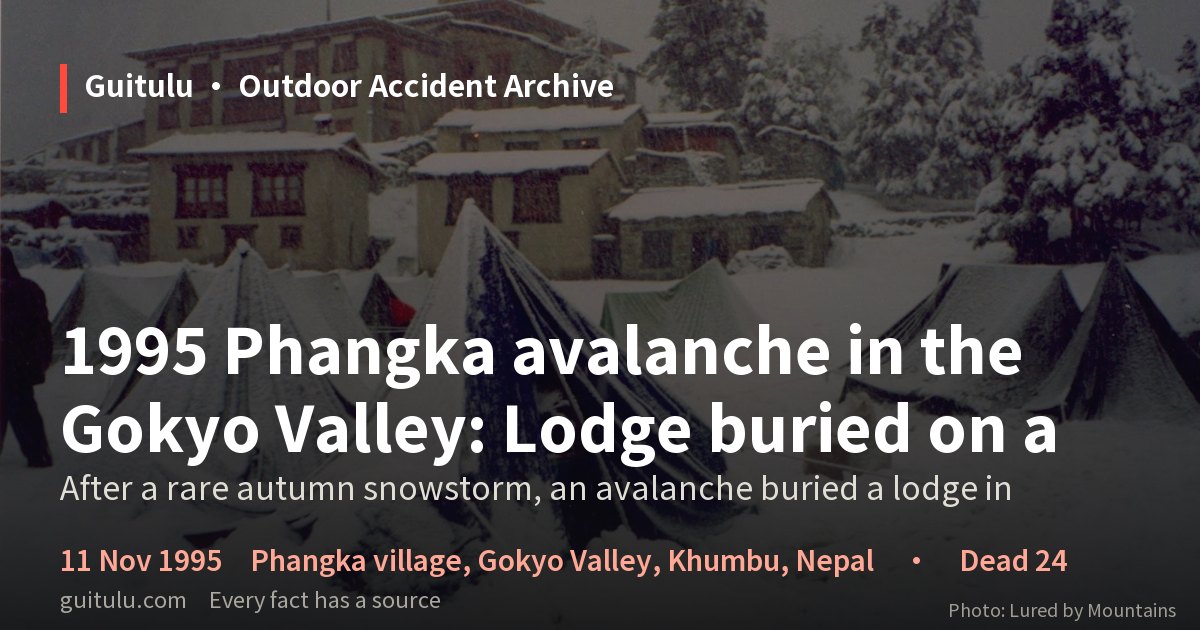
HikingInvolves: Avalanche · Extreme weatherA Japanese trekking group of 13 and Nepali guides, porters and local people
Casualties
Dead 24 Injured 1Accounts differ on the number killed: an avalanche research paper gives 24, an early Reuters report gives 26, and the recollection of a hiker who was present gives 29. The dead included 13 Japanese hikers. A Nepali boy was rescued after being buried and survived.
Material
38 facts · 5 sources5 accounts differ and are shown side by side
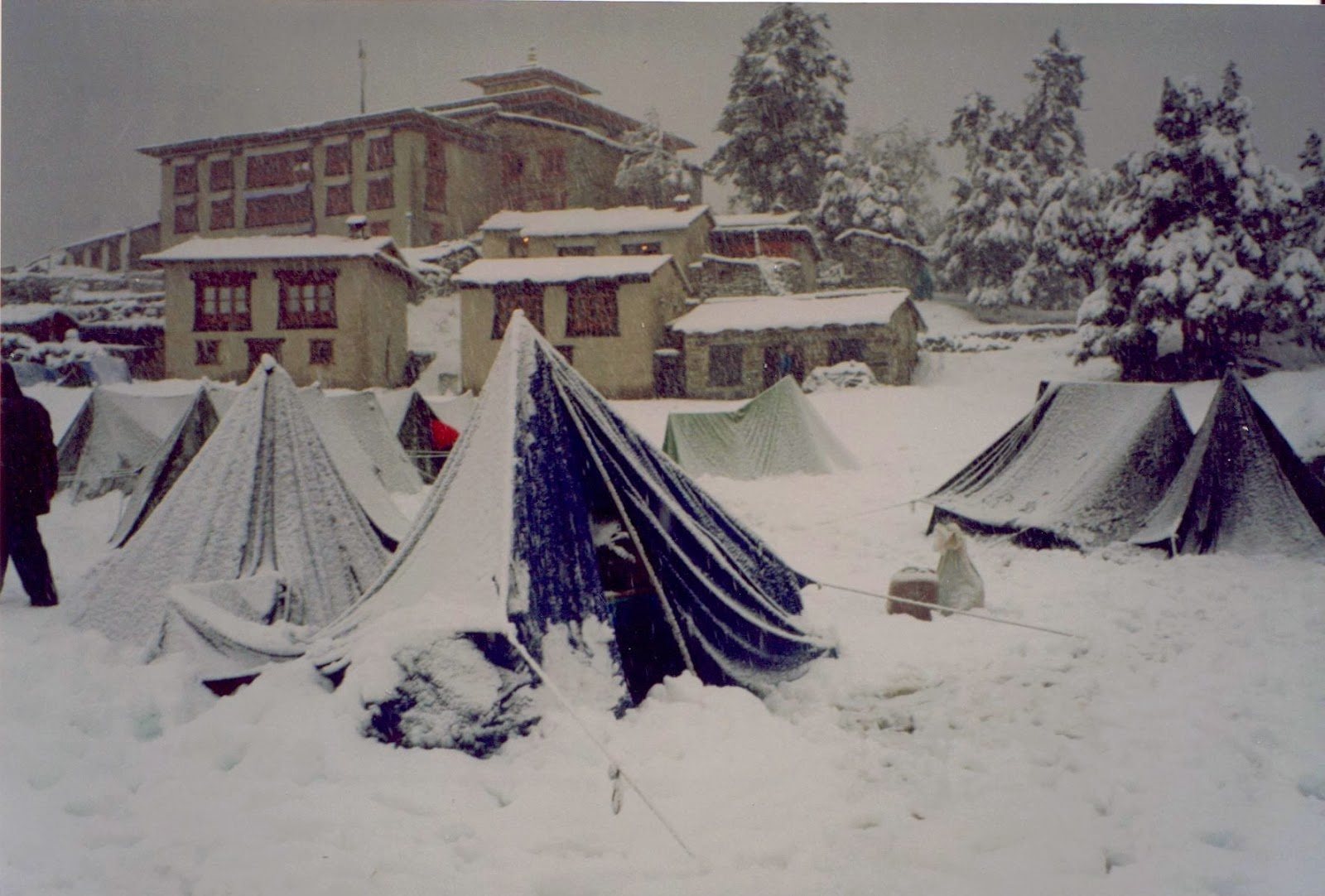
A tent camp in the Tengboche area of Khumbu, collapsed under heavy snow during the same November 1995 snowstorm (not the Phangka accident site)Photo source: Lured by Mountains
A trail in the Khumbu region buried under waist-deep snow after the November 1995 snowstorm (not the Phangka accident site)Photo source: Lured by Mountains
The number at the end of a paragraph is how many facts it rests on; open it to see each fact and how well it is sourced:
Multiple sourcesSingle source. Conflicting accounts and speculation are kept out of the narrative.
Reported places along the route (schematic)Schematic
Scroll down and the map flies to where each part happened. The line is Schematic, Lines connect the reported places along the route in order, showing only the approximate direction, not the actual track. Sources for place coordinates are given in places.json.
01
Full route
Locations mentioned in reports are connected in sequence to show the approximate course of events (schematic).
From 9 to 10 November 1995, a severe storm struck Nepal’s Himalayan region, bringing extremely heavy snowfall. F21
According to a hiker who was in Gokyo village at the time, a large group of hikers and staff set out down the valley from Gokyo village through the snow on the afternoon of the snowfall; he later learned that this was the group caught in the avalanche farther down the valley. F22
After the avalanche, 19 people, including 15 foreigners, were evacuated by helicopter from the area and taken to Syangboche. F28
According to Reuters, the avalanche occurred at around 1 a.m. on Saturday, 11 November, burying the Japanese hikers and Nepali guides and porters in snow as they slept overnight at Phangka. F24
Rescuers arrived at the scene by helicopter on 11 November; the head of the organizing company said the entire place was completely covered in snow, and only the roof of the lodge where the hikers had stayed could be seen. F26
A Nepali boy was rescued after being buried and survived with no serious injuries apart from frostbite. F29
According to The Kathmandu Post, snow around Gokyo was as deep as 3.5 meters. F31
After the incident, Nepal’s Ministry of Tourism, the Himalayan Rescue Association, the Trekking Agents Association, the Nepal Mountaineering School and the police formed a rescue task force in Kathmandu. F32
Bad weather and poor visibility briefly interrupted rescue work on 13 November; Nepali guides and rescuers used shovels to clear snow as they searched for the last Japanese victim. F34
By the afternoon of 13 November, rescuers had found 21 bodies, including those of 12 Japanese hikers. F33
Researchers noted that the remaining deep snowpack triggered another round of avalanches in March of the following year, when meltwater infiltration destabilized the slopes. F36
Under each fact is a verbatim quote from the original. "Single source" means only one outlet mentioned it; "Accounts differ" means sources contradict each other and this site adopts neither side; "Speculation" is an inference by a reporter or a person involved, not a fact.
According to ISSW 1996, According to the researchers' investigation, snowfall in the Khumbu region was approximately 30–50 centimetres at an altitude of 3800 metres, approximately 50–100 centimetres at around 4000 metres, and reached 100–200 centimetres above 5000 metres.
Quotes from the original 1
“About 30-50 em of snow fell at 3,800 m; 50-100 em of snow was found at about 4,000 m; and 100-200 cm of snow was deposited above 5,000 m.”
According to High Adventure, According to news reports at the time, the snowfall was caused by a strong cyclone in the Bay of Bengal, and approximately 6 feet (approximately 1.8 metres) of snow fell in the mountains that week.
Quotes from the original 1
“Triggered by a huge cyclone in the Bay of Bengal, some six feet of snow fell in the mountainous region this week”
According to High Adventure, According to a trekker stranded in Gokyo at the time, the Gokyo Valley faced the direction from which the storm came, with no mountains to block it, and was the worst-affected place.
Quotes from the original 1
“the Gokyo Valley was the worst affected as it lay directly in the direction of the storm unprotected by any intervening mountain range.”
According to High Adventure, The Japanese trekking group whose members died was organised by the Trans Himalayan trekking company and included local Sherpa guides and porters.
Quotes from the original 2
“The trekking party, which included local Sherpa guides and porters, was returning from Gokyo Valley”
Accounts differ on the direction in which the Japanese trekking group was travelling: an early Reuters report and the Associated Press said the group was returning from the direction of Gokyo; a later Reuters report said they were heading to the Gokyo Valley.
Reports by the same news agency gave differing accounts
Quotes from the original 2
“The group was returning from the 17,655 foot high Gokyo Peak, about 11 miles southwest of Everest”
According to ISSW 1996, Researchers said an isolated avalanche destroyed a fully occupied lodge near Phangka, making it the most serious incident during the storm.
Quotes from the original 1
“The worst incident occurred near the village of Pangkha in the Gokyo Valley where a crowded lodge was destroyed by an isolated avalanche.”
Accounts differ on the total number killed in the Phangka avalanche: an early Reuters report gave 26; the Associated Press reported 22 confirmed dead and 3 missing; an avalanche research paper gave 24; and a trekker who was in Gokyo at the time recalled 29 (13 Japanese and 16 Nepalis).
Figures differ between early news reports, subsequent research and personal recollections
Quotes from the original 4
“killing 26 people, including 13 Japanese, as they slept”
Accounts differ on how long the boy was buried: Reuters reported that he survived 24 hours; a trekking photography website said he was buried in the wreckage for 40 hours.
Quotes from the original 2
“A teenage boy given up for dead in an avalanche survived a 24-hour ordeal and was pulled from deep snow Sunday”
According to High Adventure, According to The Kathmandu Post, Nepal's meteorological department issued special weather forecasts only when requested, and the trekking company had made no request on this occasion; a meteorological department official also said that they had not foreseen bad weather in the Himalayan mountains that day.
Quotes from the original 2
“The Department puts out a special weather bulletin only on request, and department officials said tour operators sometimes ask for such bulletins.”
According to High Adventure, Reports at the time considered this the worst avalanche disaster to have befallen a trekking or mountaineering group in Nepal.
Quotes from the original 1
“It was believed to be the biggest avalanche disaster to hit a trekking or mountaineering expedition in Nepal”
According to High Adventure, According to the recollection of a trekker stranded in Gokyo, Gokyo village had no army or police post and could not communicate with the outside world.
Quotes from the original 1
“There was no army or police post in Gokyo village - no outward communication was possible.”
According to High Adventure, According to the same trekker's recollection, while they were stranded, a large avalanche swept down from Gokyo Peak into the lake, raising large waves on its surface.
Quotes from the original 1
“A massive avalanche had cascaded off Gokyo Peak into the lake sending a huge wave racing across the surface.”
According to High Adventure, According to the trekker's recollection, those stranded used wooden boards to compact the shoulder-deep snow and make a path, advancing only approximately 200 metres in two hours.
Quotes from the original 2
“Planks of wood were laid alternately and jumped upon to compact the shoulder-deep snow.”
According to High Adventure, According to the trekker's recollection, the helicopter evacuation from Gokyo village gave priority to people who had international flights to catch and those who were ill; the names of the others were put into a hat and drawn at random to determine the order.
Quotes from the original 2
“After giving priority to those with urgent international flights to catch and those who were sick”
According to High Adventure, According to the trekker's recollection, large Mi-17 helicopters evacuated approximately 30 people per flight; many trekkers were separated from their guides, tents and food when they were taken to Namche, and the scene was chaotic for a time.
Accounts differ on the number of deaths caused by the storm across Nepal: Reuters reported 42 on 12 November, rising to 49 on 14 November; a stranded trekker's recollection gave 61; and a British group leader recalled that British newspapers at the time gave 63.
Figures were compiled at different times and using different criteria
Quotes from the original 4
“made the death toll in weekend avalanches in the Himalayan kingdom 42, down from an earlier announced 43.”
According to High Adventure, The US Embassy in Kathmandu subsequently warned trekkers that even if trails had been cleared, they should be alert to avalanches on the slopes above and find out about conditions in high mountain areas before setting out.
Quotes from the original 2
“Although trails may be clear, trekkers should be alert to the possibility of avalanches from slopes above.”
According to High Adventure, According to a hiker who was in Gokyo village at the time, a large group of hikers and staff set out down the valley from Gokyo village through the snow on the afternoon of the snowfall; he later learned that this was the group caught in the avalanche farther down the valley.
Quotes from the original 2
“One large group of trekkers and their staff headed off down the valley.”
There were 26 people in the accommodation at Phangka when the avalanche occurred: 13 Japanese hikers, 11 Nepali guides and porters, and 2 local people.
Quotes from the original 2
“engulfing three lodges where 26 people were staying -- 13 Japanese, their 11 Nepalese guides and the two Nepalese lodge owners.”
According to High Adventure, According to Reuters, the avalanche occurred at around 1 a.m. on Saturday, 11 November, burying the Japanese hikers and Nepali guides and porters in snow as they slept overnight at Phangka.
The Associated Press reported Friday night; another local report gave the time as 1 p.m.
Quotes from the original 1
“The Japanese, their Sherpa guides and porters were buried in the snow as they slept in a camp at Pangka, some 170 miles northeast of Kathmandu about 1 a.m. Saturday.”
According to High Adventure, After arriving at the scene with the rescue team, the head of the organizing company said that three lodges had been buried by snow.
Quotes from the original 1
“Miyahara, who accompanied the rescue team to the site, said three lodges were buried under snow.”
According to High Adventure, Rescuers arrived at the scene by helicopter on 11 November; the head of the organizing company said the entire place was completely covered in snow, and only the roof of the lodge where the hikers had stayed could be seen.
Quotes from the original 2
“Rescuers reached the camping site on Saturday using a helicopter.”
According to High Adventure, After the avalanche, 19 people, including 15 foreigners, were evacuated by helicopter from the area and taken to Syangboche.
Quotes from the original 2
“In the latest disaster, 19 people, including 15 foreigners, were evacuated from the area after the avalanche swept over the camp at 1 a.m.”
According to High Adventure, After the incident, Nepal’s Ministry of Tourism, the Himalayan Rescue Association, the Trekking Agents Association, the Nepal Mountaineering School and the police formed a rescue task force in Kathmandu.
Quotes from the original 1
“a rescue task force has been formed here in the capital comprising the Tourism Ministry, Himalayan Rescue Association, Trekking Agents Association Nepal, Nepal Mountaineering Institute and the Nepal Police.”
According to High Adventure, Bad weather and poor visibility briefly interrupted rescue work on 13 November; Nepali guides and rescuers used shovels to clear snow as they searched for the last Japanese victim.
Quotes from the original 2
“Bad weather and poor visibility stalled rescue operations on Monday”
According to High Adventure, The hiker said the flight from Gokyo to Namche took only about 8 minutes; a month later, the trail in the valley had still not reopened.
According to ISSW 1996, Researchers noted that the remaining deep snowpack triggered another round of avalanches in March of the following year, when meltwater infiltration destabilized the slopes.
Quotes from the original 1
“The residual deep snows resulted in another avalanche cycle in March as percolating melt water destabilized slopes.”
Sources differ on the altitude of Phangka village: a trekking photography website gives 4480 metres; an Associated Press report gives 15,810 feet (approximately 4819 metres).
 GuituluGlobal Outdoor Accident Archive