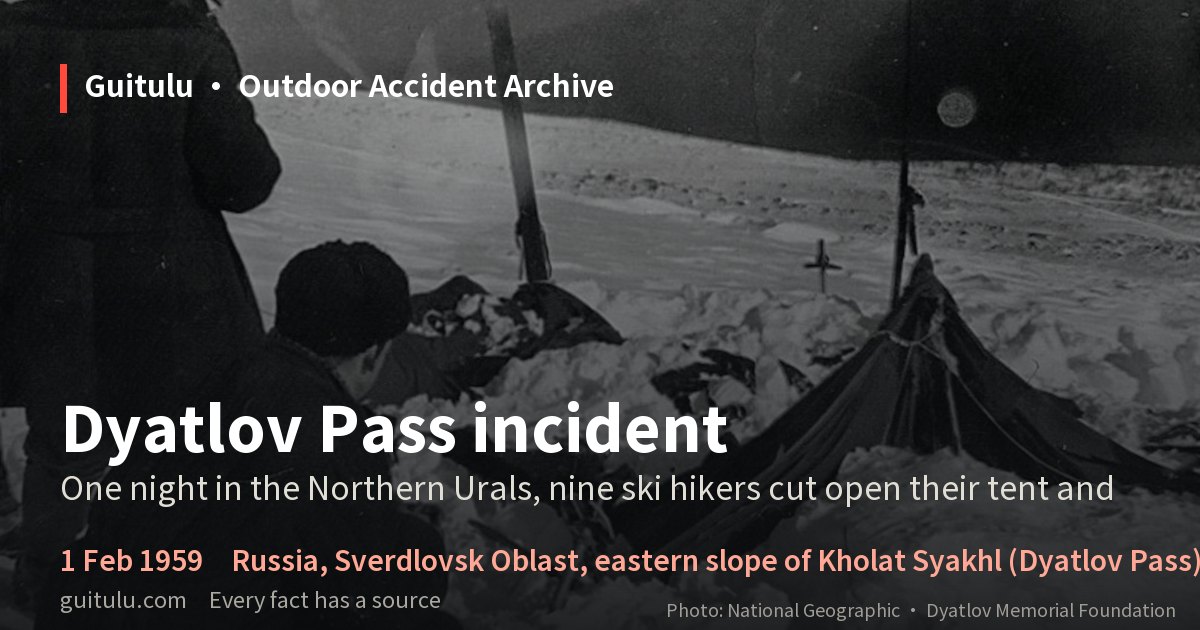
One night in the Northern Urals, nine ski hikers cut open their tent and walked into wind and snow in temperatures below −20°C
Russia’s Prosecutor General’s Office closed the case in 2020, finding that it was connected to an avalanche and severe weather; a 2021 Swiss study supported the avalanche theory, but it remains disputed
Winter ski traverseInvolves: Hypothermia · Extreme weatherA party of ten, mainly students from the Ural Polytechnic Institute, led by Igor Dyatlov; one turned back en route and nine died
Casualties
Dead 9 The party had ten members; one turned back en route and all nine others died
Material
45 facts · 7 sources5 accounts differ and are shown side by side
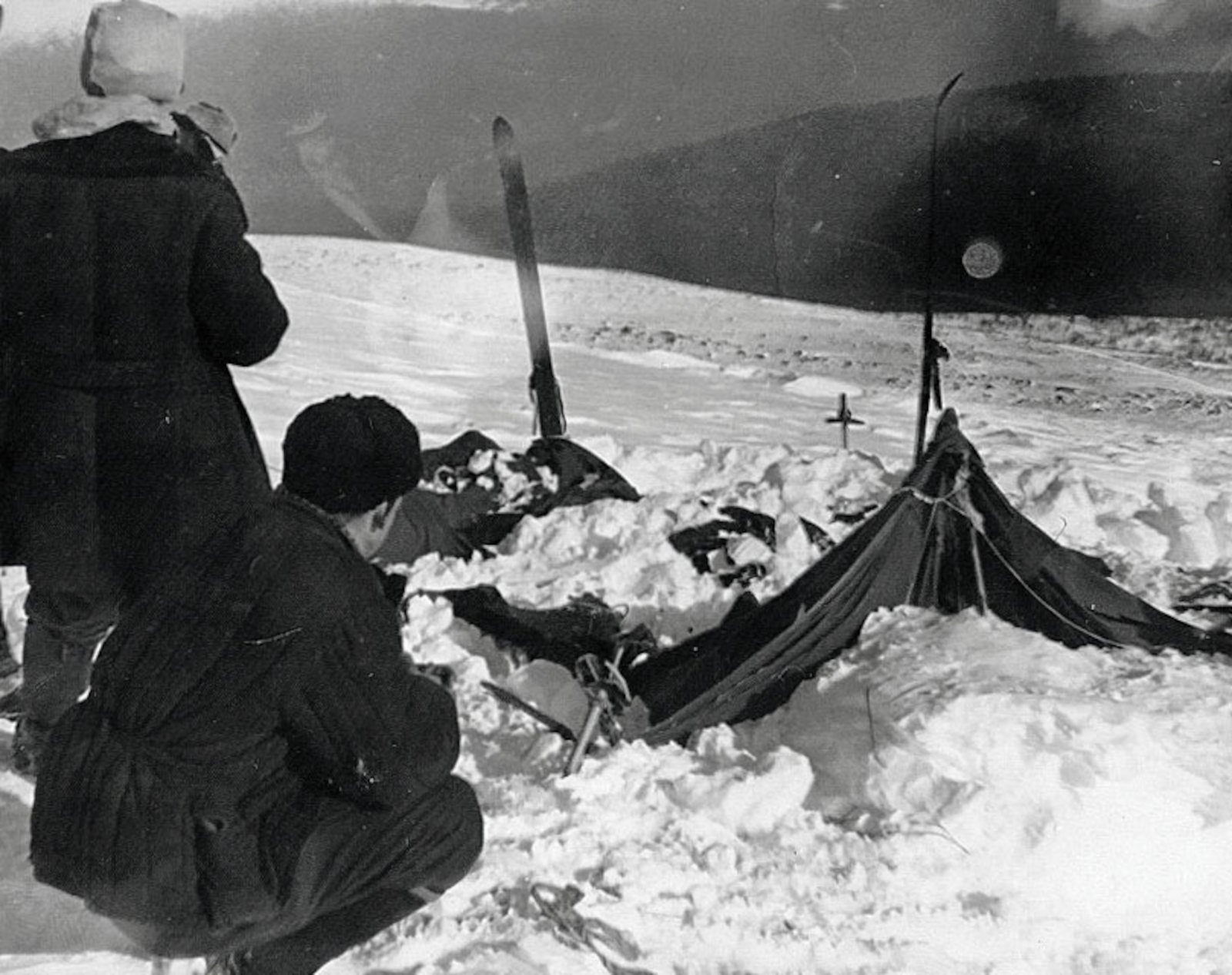
In 1959, search and rescue personnel found the collapsed tent half-buried in snow on the mountainsidePhoto source: National Geographic · Dyatlov Memorial Foundation
Diagram of the avalanche hypothesis: the slope above the tent was cut, and a wind-deposited snow slab slid over a weak layer and pressed against the tentPhoto source: swissinfo
Topographic map of the Dyatlov Pass area, marking the locations of the tent, the mountain shoulder and the bodies, as well as slope-angle statisticsPhoto source: Communications Earth & Environment · Gaume & Puzrin, Communications Earth & Environment (2021)
The number at the end of a paragraph is how many facts it rests on; open it to see each fact and how well it is sourced:
Multiple sourcesSingle source. Conflicting accounts and speculation are kept out of the narrative.
Reported locations along the route (schematic)Schematic
Scroll down and the map flies to where each part happened. The line is Schematic, Connects the locations mentioned in reports in sequence, showing only the approximate direction, not the actual track. Sources for the location coordinates are given in places.json.
01
Full route
Places mentioned in reports are connected in sequence to show the approximate route (schematic).
Party member Yuri Yudin turned back en route for health reasons; the other nine continued. F12
On 1 February, the group camped on the slope of Kholat Syakhl (meaning “Mountain of the Dead” in the Mansi language). F17
An incident occurred after midnight, and the party members cut open the tent from the inside and fled without suitable clothing to a wooded area more than one kilometre down the slope. F20
On 26 February, the search and rescue team found the badly damaged tent on the slope of Kholat Syakhl, cut open from the inside. F22
The search and rescue team found the first of those who died near an old cedar tree below the slope. F24
Five of those who died were initially found below the slope; the remaining four were found about two months later, when the snow melted. F25
The 2019 reinvestigation was launched at the request of the deceased's relatives. F28
In February 2019, the Russian Prosecutor General's Office announced that it was reopening the investigation. F29
In July 2020, Kuryakov, an official of the Russian Prosecutor General's Office in the Ural Federal District, announced that prosecutors had concluded that the incident was related to an avalanche. F32
On 28 January 2021, Johan Gaume of EPFL and Alexander Puzrin of ETH Zurich published a study in Communications Earth & Environment. F34
An expedition in January 2022 observed two new slab avalanches under conditions similar to those on the night of the incident. F41
Under each fact is a verbatim quote from the original. "Single source" means only one outlet mentioned it; "Accounts differ" means sources contradict each other and this site adopts neither side; "Speculation" is an inference by a reporter or a person involved, not a fact.
Accounts differ on the number of people with severe traumatic injuries: the paper says four had severe chest or skull injuries; RFE/RL says three showed signs of traumatic injury.
In 1959, Soviet authorities closed the case after an investigation lasting about three months, concluding only that the deaths were caused by “an irresistible natural force”.
Quotes from the original 3
“closed it after three months, concluding that a “compelling natural force” had caused the death of the hikers”
Accounts differ on the incident site: TASS says it was on the eastern shoulder of Mount Otorten; swissinfo says the tent was on the slope of Kholat Syakhl, about 20 kilometres south of the destination.
Quotes from the original 2
“a group of nine ski hikers disappeared on the eastern shoulder of Otorten Mount”
“They found the group’s tent on February 26, on the slopes of Kholat Syakhl – translated as “Death Mountain” – some 20 km south of the group’s destination.”
An incident occurred after midnight, and the party members cut open the tent from the inside and fled without suitable clothing to a wooded area more than one kilometre down the slope.
Quotes from the original 3
“Something unexpected happened after midnight that caused expedition members to cut the tent suddenly from the inside and escape towards a forest, more than 1 km downslope”
“At some point after midnight something unexpected caused expedition members to cut their way out of the tent and escape towards a forest, more than a kilometer downslope, without appropriate clothes.”
It is thought that after an avalanche, the party members cut open the tent, which had been trapped under the snow, and in panic sought temporary shelter at the tree line down the slope.
Quotes from the original 1
“What happened after the avalanche is speculation, but the current thinking is that the team cut themselves out of the smothered tent, fleeing in a panic toward temporary shelter in the treeline”
“Three weeks later, five bodies were found, some hundreds of meters down the slope from the original camp. It took two more months for investigators to find the other four bodies.”
According to Communications Earth & Environment, The Investigative Committee of the Russian Federation reopened the case in 2015 and concluded in 2019 that an avalanche was the most likely cause.
Quotes from the original 1
“In 2015, the Investigative Committee of the Russian Federation (ICRF) re-opened the investigation and in 2019 concluded that a snow avalanche was the most probable cause of the accident”
Accounts differ on when the Russian official review concluded that an avalanche was responsible: swissinfo and National Geographic say 2019; TASS reported that prosecutors announced the conclusion on 11 July 2020.
The paper in Communications Earth & Environment says that the Investigative Committee of the Russian Federation in 2019 and the Prosecutor General's Office in July 2020 reached the same conclusion in succession.
Quotes from the original 3
“In 2019, the Russian Public Prosecutor’s Office completed a second investigation into the accident”
The official conclusion did not provide a scientific explanation and continues to be questioned by relatives, the public and researchers.
Quotes from the original 2
“Both investigations have not, however, disclosed scientific explanations for the four counterarguments listed above and therefore keep being challenged by the relatives, public, and researchers.”
“One of the main reasons why the avalanche theory is still not fully accepted is that the authorities have not provided an explanation of how it happened.”
In July 2020, Kuryakov, an official of the Russian Prosecutor General's Office in the Ural Federal District, announced that prosecutors had concluded that the incident was related to an avalanche.
TASS said prosecutors concluded that an avalanche caused the deaths; according to RIA Novosti as cited by RFE/RL, prosecutors believed the party had left the tent in bad weather to escape a possible avalanche, then became disoriented and froze to death.
Quotes from the original 3
“The Russian Prosecutor General’s Office has come to a conclusion that an avalanche killed the Dyatlov group in the Ural Mountains in 1959”
“officials concluded that the hikers had left their tents in the night during brutal weather conditions to avoid a possible avalanche, but then became disoriented and froze”
According to National Geographic, Puzrin believes that Dyatlov's party were all capable and could not have foreseen that clearing a campsite on a seemingly gentle slope would be dangerous.
Quotes from the original 1
“The Dyatlov team members, Puzrin says, were very competent people who would never have foreseen the danger of clearing a space for their tent on what looked like a gentle slope.”
The study concluded that irregular terrain, the snow slope cut to pitch the tent, and snow deposited by strong katabatic winds together triggered a slab avalanche above the tent after a period of time.
Quotes from the original 2
“Here we show how a combination of irregular topography, a cut made in the slope to install the tent and the subsequent deposition of snow induced by strong katabatic winds contributed after a suitable time to the slab release”
“a combination of factors — including a cut made into the snow when the trekkers pitched their tent and a build-up of snow by strong, icy winds — triggered a delayed avalanche”
Estimates of when the avalanche occurred differ: the paper says 7.5 to 13.5 hours after the slope was cut; The Moscow Times says 9.5 to 13.5 hours after the camp was set up.
Quotes from the original 2
“the conditions for avalanche release can be met after a delay of 7.5 to 13.5 h from the moment the hikers made the cut in the slope”
Simulations showed that even a relatively small snow slab could cause severe but not immediately fatal chest and skull injuries, consistent with the autopsy findings.
Quotes from the original 3
“Dynamic avalanche simulations suggest that even a relatively small slab could have led to severe but non-lethal thorax and skull injuries, as reported by the post-mortem examination”
The researchers said they had not solved all the mysteries and that no one truly knows what happened that night.
Quotes from the original 2
“The truth, of course, is that no one really knows what happened that night. But we do provide strong quantitative evidence that the avalanche theory is plausible”
According to Communications Earth & Environment, The paper states that the study did not explain issues such as traces of radioactivity on clothing, the party members' actions after leaving the tent, and the locations of the bodies.
Quotes from the original 1
“we do not explain nor address other controversial elements surrounding the investigation such as traces of radioactivity found on the victims’ garments, the behavior of the hikers after leaving the tent, locations and states of bodies, etc.”
According to Communications Earth & Environment, The paper's authors believe that even on a gentle slope of less than 30 degrees, cutting into the slope to pitch a tent may be dangerous, and that digging a snow cave may be safer.
Quotes from the original 1
“This implies that building a tent even on a relatively mild slope (less than 30°) can be dangerous and should not be recommended when combined with a cut in the slope. Instead, digging a snow cave may be a safer solution”
According to National Geographic, An expedition in January 2022 observed two new slab avalanches under conditions similar to those on the night of the incident.
Quotes from the original 1
“two fresh slab avalanches were observed on a January 2022 expedition during conditions similar to those on the fateful night of February 1, 1959”
“Several theories have been proposed to explain this incident, including infrasound-induced panic, animals, attacks by Yetis or local tribesmen, katabatic winds, a snow avalanche, a romantic dispute, nuclear-weapons tests, etc.”
The avalanche theory has long been questioned: the search and rescue team saw no obvious signs of an avalanche, the average slope above the tent was less than 30 degrees, and the injuries were not typical of avalanche injuries.
Quotes from the original 3
“no obvious signs of an avalanche or debris were reported by the search team that arrived 26 days later”
“the rescue team did not find any obvious evidence of an avalanche or debris. Then the average angle of the slope above the tent site – less than 30° – was not steep enough for an avalanche.”
 GuituluGlobal Outdoor Accident Archive