Khumbu Icefall, south side of Mount Everest, Khumbu, NepalNepal › Koshi Province · Himalaya86.870°E 28.002°N
Activity
MountaineeringInvolves: Avalanche1970 Japanese Everest ski team (Yuichiro Miura ski descent expedition)
Casualties
Dead 6 Six Nepali Sherpas carrying loads for the ski team died; in the same season, an icefall porter from another Japanese team died on 9 April and a Japanese team member died of heart disease on 21 April. They are not included in this event's death toll.
Material
41 facts · 9 sources2 accounts differ and are shown side by side
The number at the end of a paragraph is how many facts it rests on; open it to see each fact and how well it is sourced:
Multiple sourcesSingle source. Conflicting accounts and speculation are kept out of the narrative.
Reported places along the way (schematic)Schematic
Scroll down and the map flies to where each part happened. The line is Schematic, Lines connect the reported places along the way in order, showing only the approximate direction, not the actual track. Sources for the place coordinates are in places.json.
01
Full route
Locations mentioned in reports are connected in sequence to show the approximate course of events (schematic).
On 18 October 1969, the ski team's Sherpa leader, Pu Dorje, died in the Khumbu Icefall. The American Alpine Journal records that he died in an ice collapse in the icefall. F01
On 23 March 1970, the Japanese Alpine Club's Everest team established base camp on the moraine below the icefall, at an altitude of 5350 metres. F13
The Japanese Alpine Club's Everest team established a supply relay camp halfway through the icefall at an altitude of 5800 metres and began carrying 12 tons of supplies upward from 1 April. F19
On 5 April 1970, an ice collapse occurred in the Khumbu Icefall, killing six Sherpas working for the Japanese Everest ski team. F21
By 5 April, the route through the Khumbu Icefall had been opened, and porters began carrying two tons of equipment up the mountain. F20
On 9 April, Kyak Tsering, an icefall porter with another Japanese team (the Japanese Alpine Club Everest team), was killed by a falling serac block. F25
During the same season, a Japanese member of the Japanese Alpine Club Everest team died of a heart attack. F27
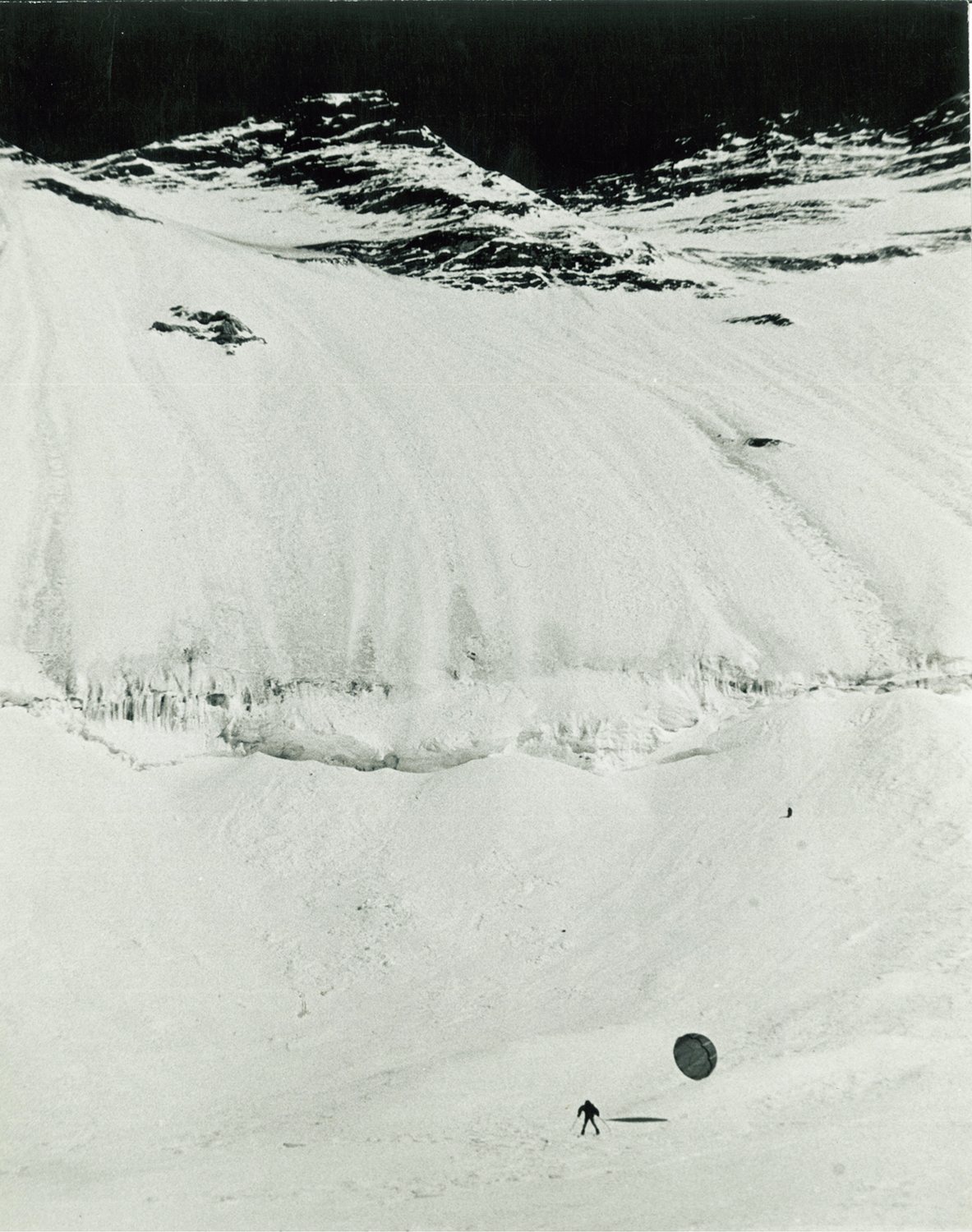
On 6 May, Miura skied down from the South Col area with the aid of a parachute, falling and tumbling on the slope along the way. F30
Under each fact is a verbatim quote from the original. "Single source" means only one outlet mentioned it; "Accounts differ" means sources contradict each other and this site adopts neither side; "Speculation" is an inference by a reporter or a person involved, not a fact.
On 18 October 1969, the ski team's Sherpa leader, Pu Dorje, died in the Khumbu Icefall. The American Alpine Journal records that he died in an ice collapse in the icefall.
In spring 1970 (pre-monsoon), two large teams from Japan entered the Khumbu Glacier and Western Cwm. They were the only two teams on Everest that season.
Quotes from the original 2
“In the pre-monsoon season of 1970, two big expeditions entered Khumbu glacier and Western Cwm from Japan.”
According to Himalayan Journal, One of them was officially named the “1970 Japanese Everest Ski Team” and had no connection with the Everest team organised by the Japanese Alpine Club.
Quotes from the original 1
“Another one was officially called 'The Japanese Everest Skiing Expedition 1970', which had no relation with our organization.”
According to BE-PAL, Miura team's project manager, Yukihiko Kato, negotiated with the Nepalese side over participation in the Osaka Expo. The Nepalese government subsequently approved the Miura team's Everest climbing permit.
Having thus gained the support of the now-enthusiastic Nepalese government, the Miura team was granted permission to climb Everest. (machine translation)
Accounts differ on the time taken to walk from Kathmandu to Everest Base Camp: Backcountry Magazine says it took 22 days over approximately 185 miles; Dennis Schwartz's film review says the walk took 62 days.
Quotes from the original 2
“It took Miura and his team—which included 800 porters—22 days to travel the 185 miles between Kathmandu and Everest Base Camp.”
According to Himalayan Journal, The Japanese Alpine Club team reported that there had been almost no snowfall during the preceding winter and that the weather was unusual.
Quotes from the original 1
“The weather was unusual since there was scarcely any snow during the previous winter.”
According to Himalayan Journal, All five members of the Japanese Alpine Club's Everest team who had crossed the icefall with the previous two reconnaissance parties considered conditions in the Everest icefall particularly dangerous that season.
Quotes from the original 1
“they all were of the opinion that the Icefall of Mt. Everest was in a particularly dangerous condition.”
According to Backcountry Magazine, While ski team members were installing ladders and ropes in the Khumbu Icefall, Miura adjusted his ski equipment on a nearby glacier and practised using a parachute to slow down.
Quotes from the original 1
“While his team was securing ladders and ropes through the ice fall, Miura dialed in his ski gear and made practice runs with his parachute on the nearby Shangri-la Glacier.”
According to Himalayan Journal, On 23 March 1970, the Japanese Alpine Club's Everest team established base camp on the moraine below the icefall, at an altitude of 5350 metres.
Quotes from the original 1
“On 23 March, the Base Camp was established amid the moraine just below the Icefall (5,350 m.).”
According to Backcountry Magazine, Miura said in the documentary that a shadow had fallen over the expedition and that he did not know how he could still justify the undertaking.
Quotes from the original 1
“A shadow covers the expedition. How can I justify this adventure now?”
According to Backcountry Magazine, Miura hesitated over whether to continue, but ultimately decided that abandoning the climb would be disrespectful to the Sherpas who had died, and chose to continue.
Quotes from the original 1
“After questioning if he should continue, Miura decided it would be a disgrace to the Sherpas’ memories to abandon the climb.”
According to Himalayan Journal, The Japanese Alpine Club team reported that these accidents were not only a heavy blow but also put the team behind schedule.
Quotes from the original 1
“On account of these accidents, we were not only given a bitter shock but also forced to be behind schedule.”
A Japanese team member died of a heart attack during the same season, but accounts differ as to which team he belonged to: the Japanese Alpine Club team's report and Explorersweb say he was a member of the club's Everest team; Wikipedia's documentary entry says that a Japanese member of the ski team died of a heart attack.
Quotes from the original 2
“Narita being one of the strongest and youngest member of the expedition”
According to Himalayan Journal, The Japanese Alpine Club's Everest team established a supply relay camp halfway through the icefall at an altitude of 5800 metres and began carrying 12 tons of supplies upward from 1 April.
Quotes from the original 1
“The depot-camp was placed half-way up the Icefall (5,800 m.) and the long slog began from 1 April to carry up 12 tons of load.”
According to Backcountry Magazine, By 5 April, the route through the Khumbu Icefall had been opened, and porters began carrying two tons of equipment up the mountain.
Quotes from the original 1
“On April 5, the route through the Khumbu Ice Fall was established, and porters began carrying two tons of equipment up the mountain.”
According to Himalayan Journal, The Japanese Alpine Club team's report records that the incident occurred at an altitude of approximately 5700 metres and was a massive glacier collapse.
Quotes from the original 1
“six Sherpas of the Japanese Skiing Expedition were killed at 5,700 m. by a huge glacier avalanche.”
According to Himalayan Journal, The Japanese Alpine Club team's report records that Kyak Tsering was killed at 7:20 am on 9 April, at an altitude of 5525 metres.
Quotes from the original 1
“One of our Icefall porters, Kyak Tsering (36), was killed at 5,525 m. by a fall of seracs.”
According to Himalayan Journal, The Japanese Alpine Club team's report records that on the evening of 21 April, team member Kiyoshi Narita, 28, died of a sudden heart attack while eating at Camp I.
Quotes from the original 1
“Kiyoshi Narita (28) had died of an unexpected heart attack while having his meal.”
Miura slid and fell approximately 1320 feet (approximately 400 metres) during the descent, finally stopping approximately 250 feet (approximately 76 metres) from a crevasse.
Quotes from the original 2
“He came to a full stop just 76 m (250 ft) from the edge of a bergschrund”
According to Himalayan Journal, The Japanese Alpine Club team's report considered the glacier's turning point at approximately 6100 metres at the top of the icefall and the collapse zone near approximately 5700 metres to be the two most dangerous places in the icefall.
Quotes from the original 1
“The head part of the Icefall where the glacier inclines around at 6,100 m. and the caved in area around 5,700 m. are two of the most dangerous places in the Icefall.”
According to Himalayan Journal, The author of the Japanese Alpine Club team's report believed that no one knew when or where a glacier collapse would occur.
Quotes from the original 1
“Nobody knows where or when the glacier collapse occurs.”
According to Himalayan Journal, The report noted that the accidents involving Breitenbach in 1963, the ski team's Sherpa leader Pu Dorje in 1969, and the ski team's six Sherpas all occurred in these dangerous areas and were cautionary lessons.
At this point, the original report gives the date of the six Sherpas' deaths as 5 April 1971, inconsistent with 5 April 1970 given earlier in the same report and in other sources.
Quotes from the original 1
“The fact that the accidents took place with John E. Breitenbach AMEE (23 March, 1963), Sirdar Phu Dorje JESE (18 October, 1969) and six Sherpas JESE (5 April, 1971) in these areas is a threatening lesson.”
According to Himalayan Journal, The Japanese Alpine Club team's report held that the icefall seriously hindered the team members' acclimatisation to high altitude.
Quotes from the original 1
“the existence of the Icefall is a great obstacle to the acclimatization of the members.”
According to Explorersweb, Explorersweb considered Miura's descent a high-risk stunt rather than a complete ski descent route, and said that tragedy also cast a shadow over the expedition.
Quotes from the original 1
“Ultimately, Miura’s spectacular feat was a high-risk stunt rather than a complete line, and this expedition was marred by tragedy.”
 GuituluGlobal Outdoor Accident Archive