GuituluGlobal Outdoor Accident Archive 中文
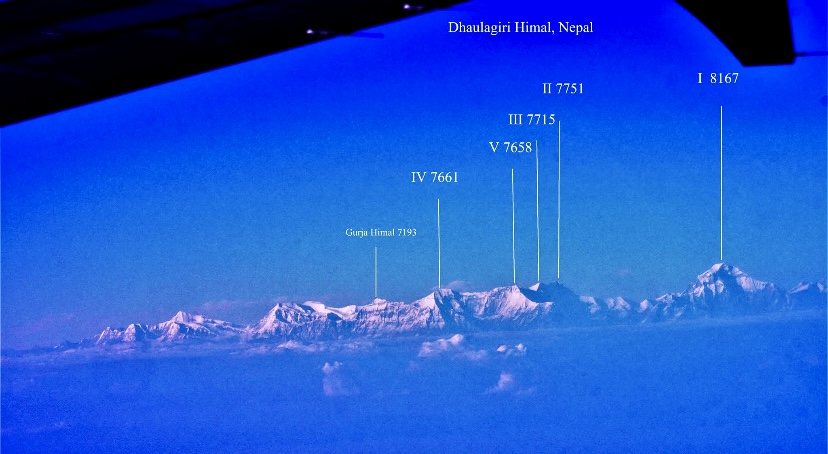
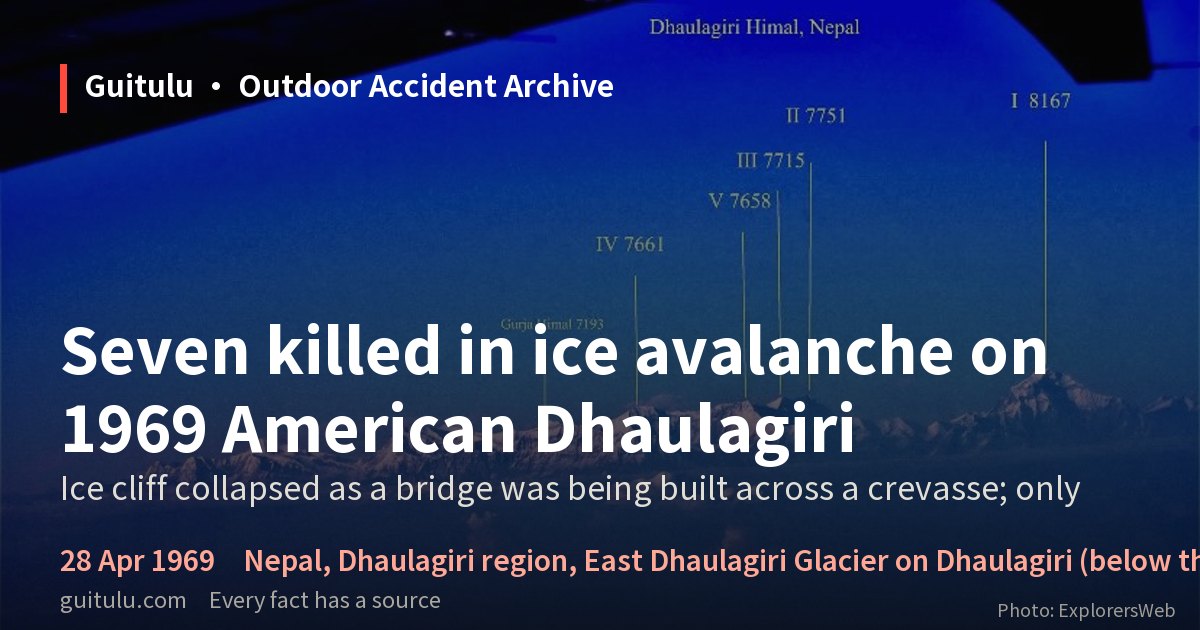
The Dhaulagiri massif seen from an airplane, with the main peaks labeled

Archive / Mountaineering

Seven killed in ice avalanche on 1969 American Dhaulagiri expedition

Ice cliff collapsed as a bridge was being built across a crevasse; only one of eight survived

The bodies remained buried in the ice avalanche debris and could not be recovered; the expedition then abandoned the climb

Photo: ExplorersWeb

Date
Spring
Place
Nepal, Dhaulagiri region, East Dhaulagiri Glacier on Dhaulagiri (below the southeast ridge)Nepal › Gandaki Province · Himalaya83.495°E 28.696°N
Activity
MountaineeringInvolves: Altitude illness · AvalancheAmerican Dhaulagiri expedition, 10 American members with Sherpa support
Casualties
Dead 7 Five American team members and two Sherpas died; their bodies were not recovered. One person survived.
Material
39 facts · 8 sources1 account differs and are shown side by side

01What happened

In spring 1969, Boyd Everett led 10 American members to Dhaulagiri I in Nepal, aiming for the then unclimbed southeast ridge. After failing to obtain a permit for their original objective, they turned to Nepal and received approval about three weeks after applying. The expedition was primarily a reconnaissance mission in preparation for a summit attempt in 1970.Facts it rests onF01Multiple sourcesThe expedition ultimately had 10 American members, led by Boyd Everett, with Al Read as deputy leader.F02Multiple sourcesUnable to obtain a permit for its original objective, the expedition turned to Nepal and received permission to climb the southeast ridge of Dhaulagiri I about three weeks after submitting its application.F03Multiple sourcesThe expedition was primarily intended as reconnaissance to lay the groundwork for a full attempt in 1970, with little expectation of reaching the summit.F04Single sourceThe expedition was sponsored by the American Alpine Club and aimed to climb the southeast ridge, which had not yet been climbed.

The Dhaulagiri massif seen from an airplane, with the main peaks labeledPhoto source: ExplorersWeb

On 15 April, the team flew from Kathmandu to Pokhara, then travelled north through the Kali Gandaki valley and established base camp near the end of the East Dhaulagiri Glacier at about 4570 meters. On 22 April, deputy leader Reed fell into a coma for about 32 hours due to pulmonary edema. His teammates urgently evacuated him downhill, and he later recovered.Facts it rests onF20Single sourceOn 15 April, the expedition flew from Kathmandu to Pokhara in two groups aboard a chartered DC-3 aircraft.F10Multiple sourcesThe expedition travelled north from Pokhara toward Dhaulagiri through the Kali Gandaki valley.F11Multiple sourcesThe advance party established base camp at the end of the East Dhaulagiri Glacier at an altitude of about 15000 feet (about 4570 metres).F21Multiple sourcesOn 22 April, deputy leader Reid fell into a coma due to pulmonary edema, and his teammates evacuated him from the glacier.F12Multiple sourcesRead was unconscious for about 32 hours.F05Multiple sourcesRead later recovered, with slight vision impairment in one eye.

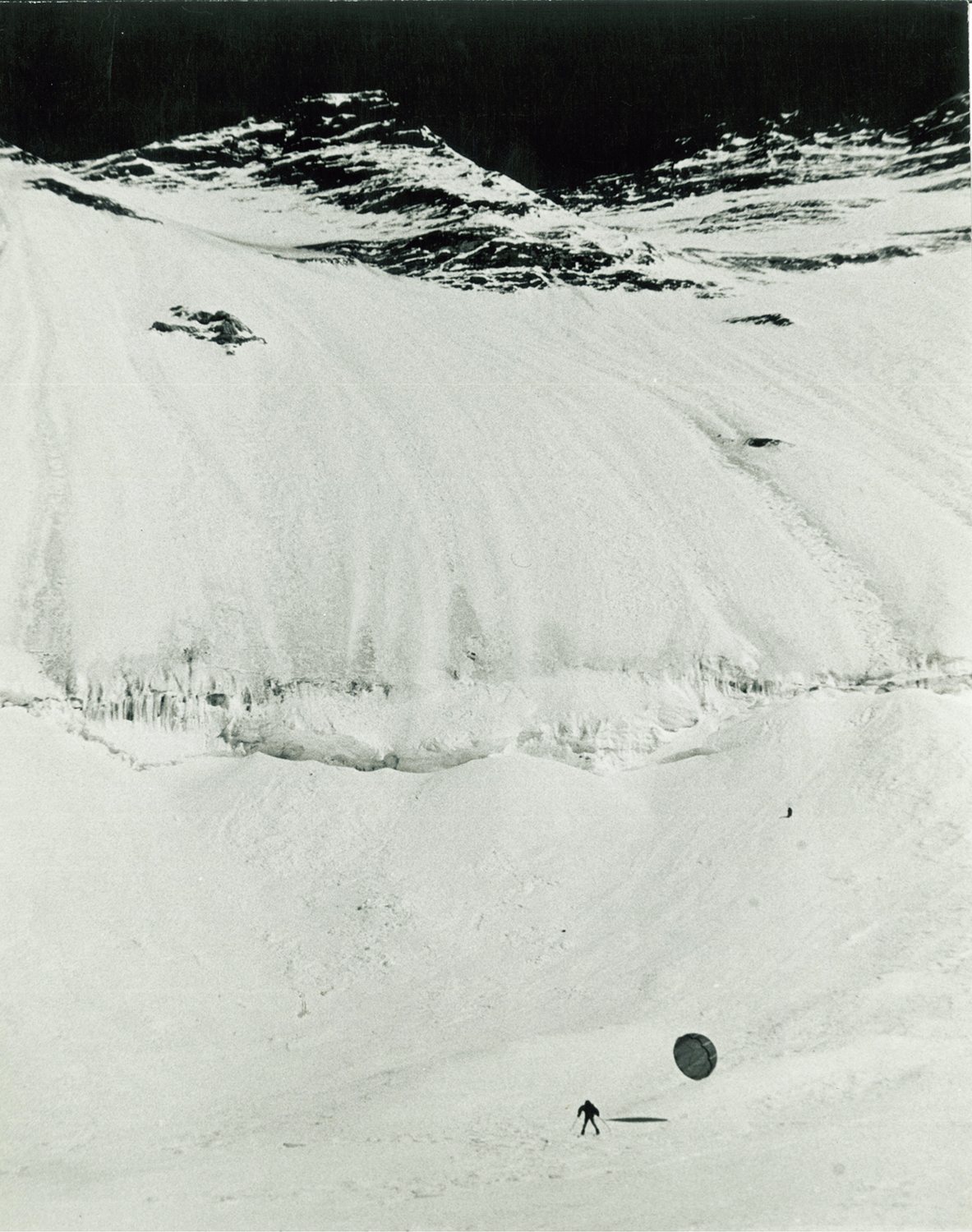
Glacier and rock face terrain on the lower slopes of Dhaulagiri IPhoto source: ExplorersWeb

Homan, Reichardt and Gerhard then climbed the glacier to about 5330 meters, where a large crevasse lay across the lower edge of a vast ice basin. They requested logs from below to build a bridge, and the Sherpas Pemba Putar and Tenzing also helped carry tents, food and equipment to the edge of the crevasse.Facts it rests onF13Multiple sourcesAfter Read descended, Homan and Reichardt climbed along the glacier to about 17000 feet (about 5180 metres), encountering few technical difficulties.F14Multiple sourcesThe next day, joined by Gerhard, the three climbed another 500 feet or so (to about 5330 metres) and found a large crevasse across the lower edge of a huge ice basin.F15Multiple sourcesTo make passage easier for the members following them, they asked for logs to be sent up from below and prepared to build a bridge over the crevasse.F16Multiple sourcesThe Sherpas Pemba Putar and Tenzing then joined them in carrying a small tent, food and climbing equipment to the edge of the crevasse.

Dhaulagiri I in full view above a sea of cloudsPhoto source: ExplorersWeb

On the afternoon of 28 April, eight people gathered at the edge of the crevasse as fog came in. Ross and Homan were moving a log across to the other side when a projecting triangular ice cliff above collapsed. The ice carved out a channel about 30 meters wide and filled the crevasse. Leader Everett, Gerhard, Homan, Ross, Seidman and two Sherpas were killed. Only Reichardt, who was at the edge of the ice avalanche, survived.Facts it rests onF23Multiple sourcesAll eight reached the edge of the crevasse, unloaded their equipment and examined the route. Fog came in during the afternoon.F24Multiple sourcesThe ice avalanche occurred just as Ross and Homan were moving the log to the far side of the crevasse.F25Multiple sourcesThe ice avalanche was caused by the collapse of a triangular ice cliff protruding from the glacier. The falling ice swept a channel about 100 feet (about 30 metres) wide through the ice basin and filled the crevasse.F26Multiple sourcesOn 28 April 1969, the ice avalanche killed 7 people: 5 American team members and 2 Sherpas.F27Multiple sourcesThe dead were five American team members, Everett, Gerhard, Homan, Ross and Seidman, and the Sherpas Pemba Putar and Tenzing.F28Multiple sourcesReichardt was the only survivor among the eight. He was at the edge of the ice avalanche, lying at a change in the glacier's slope, and his back was grazed by fragments several times.

After searching alone for about an hour, Reichardt went downhill for help. A further search also produced no results: the ice avalanche debris covered an area about the size of a football field and was 6 meters deep, and probes and ice axes were of no help. The bodies were never recovered. Surviving team members returned four years later, and on 12 May 1973 Reichardt reached the summit of Dhaulagiri via the northeast ridge.Facts it rests onF30Multiple sourcesReichardt searched alone for about an hour, then descended to seek help.F18Multiple sourcesHe returned with people and equipment to search again, but found nothing apart from a small amount of torn equipment.F19Multiple sourcesThe ice avalanche debris covered an area about the size of a football field and was 20 feet (about 6 metres) deep. Probes were of no use, and ice axes could not penetrate it.F06Multiple sourcesThe bodies of those who died were never recovered.F09Multiple sourcesThe surviving members decided to return to Dhaulagiri four years later and, before leaving Nepal, elected Morrissey to lead the next expedition.F35Multiple sourcesOn 12 May 1973, Reichardt, Roskelley and the Sherpa Nawang Samden reached the summit of Dhaulagiri via the northeast ridge.

The number at the end of a paragraph is how many facts it rests on; open it to see each fact and how well it is sourced: Multiple sourcesSingle source. Conflicting accounts and speculation are kept out of the narrative.

  • Reported locations along the route (illustrative)Schematic

Satellite imagery Sentinel-2 cloudless 2024 © EOX · Terrain AWS Terrain Tiles · Orange line is schematic · Place coordinates not individually verified

Route review

7 scenes to understand what happened

Scroll down and the map flies to where each part happened. The line is Schematic, A line connecting the places mentioned in the reports in sequence, showing only the approximate direction, not the actual track. Sources for place coordinates are listed in places.json.

01

Full route

Locations mentioned in the reports are connected in sequence to show the approximate route (schematic).

02

Turning to Nepal

Unable to obtain a permit for their original objective, the team turned to Nepal and received permission in about three weeks to climb the southeast ridge of Dhaulagiri I, with the expedition designated as reconnaissance.Facts it rests onF02Multiple sourcesUnable to obtain a permit for its original objective, the expedition turned to Nepal and received permission to climb the southeast ridge of Dhaulagiri I about three weeks after submitting its application.F03Multiple sourcesThe expedition was primarily intended as reconnaissance to lay the groundwork for a full attempt in 1970, with little expectation of reaching the summit.

04

Sudden illness on the glacier

Base camp was established near the end of the East Dhaulagiri Glacier at about 4570 meters. On 22 April, deputy leader Reed fell into a coma due to pulmonary edema and was urgently evacuated downhill.Facts it rests onF11Multiple sourcesThe advance party established base camp at the end of the East Dhaulagiri Glacier at an altitude of about 15000 feet (about 4570 metres).F21Multiple sourcesOn 22 April, deputy leader Reid fell into a coma due to pulmonary edema, and his teammates evacuated him from the glacier.

05

At the crevasse

Team members climbed to about 5330 meters, where a large crevasse blocked the lower edge of the ice basin. They requested logs from below to build a bridge.Facts it rests onF14Multiple sourcesThe next day, joined by Gerhard, the three climbed another 500 feet or so (to about 5330 metres) and found a large crevasse across the lower edge of a huge ice basin.F15Multiple sourcesTo make passage easier for the members following them, they asked for logs to be sent up from below and prepared to build a bridge over the crevasse.

06

Ice cliff collapse

On the afternoon of 28 April, an overhanging ice cliff collapsed, filling the crevasse with ice. Seven people died; only Reichardt survived.Facts it rests onF25Multiple sourcesThe ice avalanche was caused by the collapse of a triangular ice cliff protruding from the glacier. The falling ice swept a channel about 100 feet (about 30 metres) wide through the ice basin and filled the crevasse.F26Multiple sourcesOn 28 April 1969, the ice avalanche killed 7 people: 5 American team members and 2 Sherpas.F28Multiple sourcesReichardt was the only survivor among the eight. He was at the edge of the ice avalanche, lying at a change in the glacier's slope, and his back was grazed by fragments several times.

02Timeline

  1. Unable to obtain a permit for its original objective, the expedition turned to Nepal and received permission to climb the southeast ridge of Dhaulagiri I about three weeks after submitting its application. F02

  2. The surviving members decided to return to Dhaulagiri four years later and, before leaving Nepal, elected Morrissey to lead the next expedition. F09

  3. The next day, joined by Gerhard, the three climbed another 500 feet or so (to about 5330 metres) and found a large crevasse across the lower edge of a huge ice basin. F14

  4. The Sherpas Pemba Putar and Tenzing then joined them in carrying a small tent, food and climbing equipment to the edge of the crevasse. F16

  5. After Read descended, Homan and Reichardt climbed along the glacier to about 17000 feet (about 5180 metres), encountering few technical difficulties. F13

  6. The advance party established base camp at the end of the East Dhaulagiri Glacier at an altitude of about 15000 feet (about 4570 metres). F11

  7. On 15 April, the expedition flew from Kathmandu to Pokhara in two groups aboard a chartered DC-3 aircraft. F20

  8. On 22 April, deputy leader Reid fell into a coma due to pulmonary edema, and his teammates evacuated him from the glacier. F21

  9. On 28 April 1969, the ice avalanche killed 7 people: 5 American team members and 2 Sherpas. F26

  10. Reichardt searched alone for about an hour, then descended to seek help. F30

  11. The ice avalanche occurred just as Ross and Homan were moving the log to the far side of the crevasse. F24

  12. On the morning of the accident, after Mingma brought the log, Ross and Reichardt set out for the crevasse carrying the log, which was about 12 feet long. F22

  13. The surviving team members stayed on the mountain for about another week to recover equipment. F33

  14. On 12 May 1973, Reichardt, Roskelley and the Sherpa Nawang Samden reached the summit of Dhaulagiri via the northeast ridge. F35

03Lessons

Avalanche and high altitude

Do not linger below ice cliffs

The ice avalanche came from a projecting ice cliff on the glacier. What fell was hard ice, not snow, and the eight people were gathered at the crevasse below, building a bridge and examining the route. Collapses of hanging ice and ice cliffs are difficult to predict. When passing through the areas they threaten, spend as little time there as possible and do not gather below them.Facts it rests onF23Multiple sourcesAll eight reached the edge of the crevasse, unloaded their equipment and examined the route. Fog came in during the afternoon.F24Multiple sourcesThe ice avalanche occurred just as Ross and Homan were moving the log to the far side of the crevasse.F25Multiple sourcesThe ice avalanche was caused by the collapse of a triangular ice cliff protruding from the glacier. The falling ice swept a channel about 100 feet (about 30 metres) wide through the ice basin and filled the crevasse.F32Multiple sourcesThe ice avalanche was a collapse of glacial ice; what fell was ice, not snow.

Teams and decisions

Choose routes carefully on the approach too

The seven people killed had not yet begun climbing the southeast ridge itself; they were in the glacial ice basin leading to the ridge. When the team returned in 1973, they deliberately looked for a route avoiding the southeast glacier and ultimately reached the summit via the northeast ridge.Facts it rests onF14Multiple sourcesThe next day, joined by Gerhard, the three climbed another 500 feet or so (to about 5330 metres) and found a large crevasse across the lower edge of a huge ice basin.F26Multiple sourcesOn 28 April 1969, the ice avalanche killed 7 people: 5 American team members and 2 Sherpas.F34Single sourceWhen scouting a route for the 1973 expedition, they specifically looked for a route that avoided the southeast glacier, the site of the 1969 accident.F35Multiple sourcesOn 12 May 1973, Reichardt, Roskelley and the Sherpa Nawang Samden reached the summit of Dhaulagiri via the northeast ridge.

Avalanche and high altitude

Recognize pulmonary edema early

Deputy leader Reed fell into a coma at base camp and was out of danger only after an urgent evacuation to lower altitude. The expedition doctor concluded that the whole team should know the early signs of pulmonary edema and tell everyone as soon as possible if they have suspicious symptoms.Facts it rests onF21Multiple sourcesOn 22 April, deputy leader Reid fell into a coma due to pulmonary edema, and his teammates evacuated him from the glacier.F12Multiple sourcesRead was unconscious for about 32 hours.F38Single sourceExpedition doctor Morrissey concluded that all team members should know the early signs of pulmonary edema and tell the entire team as soon as possible if they notice suspicious symptoms.

04Fact list 39 facts

Under each fact is a verbatim quote from the original. "Single source" means only one outlet mentioned it; "Accounts differ" means sources contradict each other and this site adopts neither side; "Speculation" is an inference by a reporter or a person involved, not a fact.

  1. F01Multiple sourcesBackground

    The expedition ultimately had 10 American members, led by Boyd Everett, with Al Read as deputy leader.

    Quotes from the original 2

    “The final personnel consisted of Boyd Everett, leader, Al Read, deputy leader, Jeff Duenwald, Paul Gerhard, Vin Hoeman, Jim Janney, Jim Morrissey, M.D., Lou Reichardt, Bill Ross, M.D., and Dave Seidman.”

    AAJ · 1970

    “The team consisted of 10 climbers: Boyd Everett (leader), Al Read (deputy leader)”

    ExplorersWeb ·
  2. F02Multiple sourcesPlan

    Unable to obtain a permit for its original objective, the expedition turned to Nepal and received permission to climb the southeast ridge of Dhaulagiri I about three weeks after submitting its application.

    Quotes from the original 3

    “Only three weeks after submission of the application, Nepal granted him permission for Dhaulagiri I by the southeast ridge.”

    AAJ · 1970

    “after shifting from other peaks because of permission issues”

    ExplorersWeb ·

    “Permission for Dhaulagiri I and the Southeast Ridge came only weeks before departure.”

    Global Summit Guide · 2026-09-21
  3. F03Multiple sourcesPlan

    The expedition was primarily intended as reconnaissance to lay the groundwork for a full attempt in 1970, with little expectation of reaching the summit.

    Quotes from the original 2

    “Although we had only wild hopes for the summit, an extremely strong reconnaissance would lay the ground work for a big push in 1970.”

    AAJ · 1970

    “The American expedition in 1969 was initially planned as a reconnaissance for a potential summit push in 1970”

    ExplorersWeb ·
  4. F04Single sourceBackground

    According to ExplorersWeb, The expedition was sponsored by the American Alpine Club and aimed to climb the southeast ridge, which had not yet been climbed.

    Quotes from the original 1

    “Sponsored by the American Alpine Club and led by Boyd Nixon Everett Jr., the team would attempt the unclimbed Southeast Ridge”

    ExplorersWeb ·
  5. F05Multiple sourcesAftermath

    Read later recovered, with slight vision impairment in one eye.

    Quotes from the original 2

    “Aside from a slight visual deficit in one eye, he has no residual from his grave illness.”

    AAJ · 1970

    “Read recovered with some residual weakness and vision impairment in one eye.”

    ExplorersWeb ·
  6. F06Multiple sourcesAftermath

    The bodies of those who died were never recovered.

    Quotes from the original 3

    “No bodies were ever recovered.”

    UAA · 2014-12

    “The survivors determined that recovering the bodies from the ice was impossible.”

    ExplorersWeb ·

    “The avalanche debris consisted of deep, compact glacier ice and the expedition could not recover the seven bodies.”

    Global Summit Guide · 2026-09-21
  7. F07Single sourceAftermath

    According to ExplorersWeb, The expedition was subsequently abandoned.

    Quotes from the original 1

    “The expedition was abandoned soon after.”

    ExplorersWeb ·
  8. F08Multiple sourcesBackground

    In 1969, 13 people died in accidents involving two expeditions in the Dhaulagiri massif; the other was the disappearance of an Austrian team on Dhaulagiri IV in November that year.

    Includes a low-reliability source

    Quotes from the original 2

    “Thirteen climbers from two expeditions died in what was the deadliest year in Dhaulagiri’s history.”

    ExplorersWeb ·

    “Seven died on Dhaulagiri I in April, and six members of an Austrian Dhaulagiri IV expedition disappeared in November, for 13 deaths across two separate expeditions.”

    Global Summit Guide · 2026-09-21
  9. F09Multiple sourcesAftermath

    The surviving members decided to return to Dhaulagiri four years later and, before leaving Nepal, elected Morrissey to lead the next expedition.

    Includes a low-reliability source

    Quotes from the original 2

    “After the avalanche which killed Everett and six comrades, the remaining members resolved to return in four years’ time to assault the peak it had been everyone’s dream to climb.”

    AAJ · 1974

    “The remaining 1969 members resolved before leaving Nepal that they would return. James Morrissey became leader of the 1973 American Dhaulagiri Expedition.”

    Global Summit Guide · 2026-09-21
  10. F10Multiple sourcesMovement

    The expedition travelled north from Pokhara toward Dhaulagiri through the Kali Gandaki valley.

    Includes a low-reliability source

    Quotes from the original 2

    “the main party with 90 porters followed us north from Pokhara toward the Kali Gandaki and Dhaulagiri.”

    AAJ · 1970

    “The expedition moved north from Pokhara through the Kali Gandaki corridor, climbed out of the valley near Lete and established camps on the East Dhaulagiri Glacier.”

    Global Summit Guide · 2026-09-21
  11. F11Multiple sourcesMovement

    The advance party established base camp at the end of the East Dhaulagiri Glacier at an altitude of about 15000 feet (about 4570 metres).

    Quotes from the original 2

    “The advance team established a Base Camp at 15,000 feet on the snout of the East Dhaulagiri Glacier.”

    AAJ · 1970

    “establishing Base Camp at 4,570m on the East Dhaulagiri Glacier by mid-April.”

    ExplorersWeb ·
  12. F12Multiple sourcesEvent

    Read was unconscious for about 32 hours.

    Includes a low-reliability source

    Quotes from the original 2

    “For the next 32 hours he was unconscious.”

    AAJ · 1970

    “Read was unconscious for more than a day”

    Global Summit Guide · 2026-09-21
  13. F13Multiple sourcesMovement

    After Read descended, Homan and Reichardt climbed along the glacier to about 17000 feet (about 5180 metres), encountering few technical difficulties.

    Quotes from the original 2

    “as we climbed to 17,000 feet encountering few technical difficulties.”

    AAJ · 1970

    “Hoeman and Reichardt climbed alone to 5,180m on the glacier on moderately easy terrain.”

    ExplorersWeb ·
  14. F14Multiple sourcesMovement

    The next day, joined by Gerhard, the three climbed another 500 feet or so (to about 5330 metres) and found a large crevasse across the lower edge of a huge ice basin.

    Quotes from the original 2

    “A large crevasse cleft our path on the glacier at the lower rim of a huge basin that we would have to cross to reach the chute”

    AAJ · 1970

    “they advanced to 5,330m, where a large crevasse blocked the path at the lower rim of a huge basin.”

    ExplorersWeb ·
  15. F15Multiple sourcesPlan

    To make passage easier for the members following them, they asked for logs to be sent up from below and prepared to build a bridge over the crevasse.

    Quotes from the original 2

    “To forge a route which could be followed easily, we sent down a request for logs to Boyd”

    AAJ · 1970

    “They requested wooden logs from below to bridge it”

    ExplorersWeb ·
  16. F16Multiple sourcesMovement

    The Sherpas Pemba Putar and Tenzing then joined them in carrying a small tent, food and climbing equipment to the edge of the crevasse.

    Quotes from the original 2

    “Joined in the morning by Pemba Phutar and Tensing, we carried a small tent, food, and climbing equipment to the edge of the crevasse.”

    AAJ · 1970

    “Pemba Phutar Sherpa and Tenzing Sherpa carried a small tent, food, and climbing gear to the crevasse edge”

    ExplorersWeb ·
  17. F17Single sourcePlan

    According to AAJ, Expedition leader Everett, Seidman and Ross came up to the camp to inspect the route; Everett thought it might be easier to leave the glacier directly and gain altitude on the ridge.

    Quotes from the original 1

    “Boyd thought it might be easier to leave the glacier immediately and gain our elevation on the ridge.”

    AAJ · 1970
  18. F18Multiple sourcesEvent

    He returned with people and equipment to search again, but found nothing apart from a small amount of torn equipment.

    Quotes from the original 2

    “I returned with equipment and people to make a more thorough search of debris, but with no success.”

    AAJ · 1970

    “they found only scattered, shredded gear.”

    ExplorersWeb ·
  19. F19Multiple sourcesFound at scene

    The ice avalanche debris covered an area about the size of a football field and was 20 feet (about 6 metres) deep. Probes were of no use, and ice axes could not penetrate it.

    Includes a low-reliability source

    Quotes from the original 2

    “Probes were useless; even ice axes could not penetrate the huge ice mass, roughly the size of a football field and twenty feet deep.”

    AAJ · 1970

    “The American Alpine Journal account says the ice mass was about the size of a football field and roughly twenty feet deep.”

    Global Summit Guide · 2026-09-21
  20. F20Single sourceMovement

    According to AAJ, On 15 April, the expedition flew from Kathmandu to Pokhara in two groups aboard a chartered DC-3 aircraft.

    Quotes from the original 1

    “we left Kathmandu in two stages on a chartered DC-3 to Pokhara on April 15.”

    AAJ · 1970
  21. F21Multiple sourcesEvent

    On 22 April, deputy leader Reid fell into a coma due to pulmonary edema, and his teammates evacuated him from the glacier.

    Quotes from the original 3

    “At seven A.M. Vin reported by radio that Al was unconscious with pulmonary edema.”

    AAJ · 1970

    “He fell unconscious, and the team evacuated him down the glacier on April 22.”

    ExplorersWeb ·

    “On April 22, deputy leader Al Read became critically ill at the newly established high camp.”

    Global Summit Guide · 2026-09-21
  22. F22Multiple sourcesMovement

    On the morning of the accident, after Mingma brought the log, Ross and Reichardt set out for the crevasse carrying the log, which was about 12 feet long.

    ExplorersWeb's account is based mainly on Reichardt's firsthand account in the AAJ.

    Quotes from the original 2

    “Bill Ross and I had to wait in the morning for Mingma to bring the logs from below.”

    AAJ · 1970

    “Ross and Reichardt waited for Mingma Norbu to deliver the logs, then set out carrying them to the crevasse.”

    ExplorersWeb ·
  23. F23Multiple sourcesEvent

    All eight reached the edge of the crevasse, unloaded their equipment and examined the route. Fog came in during the afternoon.

    ExplorersWeb's account is based mainly on Reichardt's firsthand account in the AAJ.

    Quotes from the original 2

    “Then an afternoon fog descended upon us.”

    AAJ · 1970

    “There, the full group of eight rigged ropes, unloaded, and inspected the route as afternoon fog descended.”

    ExplorersWeb ·
  24. F24Multiple sourcesEvent

    The ice avalanche occurred just as Ross and Homan were moving the log to the far side of the crevasse.

    ExplorersWeb's account is based mainly on Reichardt's firsthand account in the AAJ.

    Quotes from the original 2

    “just as Bill and Vin were finishing the delicate pivoting of the timbers to the crevasse’s far rim, a roar entered our consciousnesses.”

    AAJ · 1970

    “Just as Ross and Hoeman finished pivoting the logs into place on the far rim of the crevasse, a massive ice avalanche, triggered by the collapse of a triangular ice cliff, roared down the mountain.”

    ExplorersWeb ·
  25. F25Multiple sourcesFound at scene

    The ice avalanche was caused by the collapse of a triangular ice cliff protruding from the glacier. The falling ice swept a channel about 100 feet (about 30 metres) wide through the ice basin and filled the crevasse.

    ExplorersWeb explicitly states that this is quoted from the AAJ account.

    Quotes from the original 3

    “A triangular cliff of ice, thrust out of the glacier by some invisible band of rock, had collapsed and the resulting debris had cut a 100-foot-wide swath across the broad basin, filled the crevasse, and overwhelmed us.”

    AAJ · 1970

    “the slide cut a 30m wide swath across the broad basin, filled the crevasse, and overwhelmed the group in an instant.”

    ExplorersWeb ·

    “A protruding cliff of glacier ice collapsed above them.”

    Global Summit Guide · 2026-09-21
  26. F26Multiple sourcesEvent

    On 28 April 1969, the ice avalanche killed 7 people: 5 American team members and 2 Sherpas.

    Quotes from the original 3

    “William Ross, along with six companions, was killed in an ice avalanche on the southeast ridge of Dhaulagiri on April 28, 1969”

    AAJ · 1969

    “Seven people vanished in the chaos: five Americans (Everett, Gerhard, Hoeman, Ross, and Seidman), and two Sherpas (Pemba Phutar Sherpa and Tenzing Sherpa).”

    ExplorersWeb ·

    “Vin, along with two Sherpas and four other members of the National Geographic-sponsored Everett Expedition, were caught in a massive ice avalanche.”

    UAA · 2014-12
  27. F27Multiple sourcesEvent

    The dead were five American team members, Everett, Gerhard, Homan, Ross and Seidman, and the Sherpas Pemba Putar and Tenzing.

    Includes a low-reliability source

    Quotes from the original 2

    “five Americans (Everett, Gerhard, Hoeman, Ross, and Seidman), and two Sherpas (Pemba Phutar Sherpa and Tenzing Sherpa)”

    ExplorersWeb ·

    “killing Boyd Everett, Paul Gerhard, John Vincent “Vin” Hoeman, William “Bill” Ross, David “Dave” Seidman, Pemba Phutar Sherpa and Panboche Tensing.”

    Global Summit Guide · 2026-09-21
  28. F28Multiple sourcesEvent

    Reichardt was the only survivor among the eight. He was at the edge of the ice avalanche, lying at a change in the glacier's slope, and his back was grazed by fragments several times.

    ExplorersWeb's account is based mainly on Reichardt's firsthand account in the AAJ.

    Quotes from the original 3

    “I found only a change of slope in the glacier for shelter and was repeatedly struck on my back with debris”

    AAJ · 1970

    “Of the eight men, only Reichardt survived, miraculously left unhurt at the very edge of the slide.”

    ExplorersWeb ·

    “Louis Reichardt survived at the edge of the slide.”

    Global Summit Guide · 2026-09-21
  29. F29Multiple sourcesFound at scene

    After the ice avalanche, his companions, their equipment and the snow beneath their feet had disappeared, leaving only hard glacial ice and scattered enormous blocks of ice.

    ExplorersWeb quotes Reichardt's own words in the AAJ.

    Quotes from the original 2

    “There was only dirty, hard glacial ice with dozens of fresh gouges and scattered huge ice blocks, the grit of the avalanche.”

    AAJ · 1970

    “everything that was familiar — friends, equipment, even the snow on which we had been standing — was gone.”

    ExplorersWeb ·
  30. F30Multiple sourcesEvent

    Reichardt searched alone for about an hour, then descended to seek help.

    Quotes from the original 3

    “I spent an hour in this search and in a less thorough one of the debris below”

    AAJ · 1970

    “After an hour futilely searching the football-field-sized, six-meter-deep ice mass, Reichardt made a lonely descent”

    ExplorersWeb ·

    “Reichardt spent about an hour searching above and below the cliff before descending to summon the rest of the expedition.”

    Global Summit Guide · 2026-09-21
  31. F31Accounts differEvent

    Accounts differ on where Reichardt descended to seek help: his own account in the AAJ says he descended to the acclimatization camp at an altitude of 12000 feet; ExplorersWeb says he descended to base camp.

    Quotes from the original 2

    “Then I made the loneliest of trips down the glacier and rock to the 12,000-foot acclimatization camp”

    AAJ · 1970

    “Reichardt made a lonely descent to Base Camp.”

    ExplorersWeb ·
  32. F32Multiple sourcesFound at scene

    The ice avalanche was a collapse of glacial ice; what fell was ice, not snow.

    Quotes from the original 2

    “The avalanche was ice, not snow.”

    AAJ · 1970

    “this disaster involved a large glacier-ice collapse”

    Global Summit Guide · 2026-09-21
  33. F33Multiple sourcesAftermath

    The surviving team members stayed on the mountain for about another week to recover equipment.

    Quotes from the original 2

    “We spent another week on the mountain retrieving equipment, not so much for its value but because of our reluctance to sever bonds with the past.”

    AAJ · 1970

    “Efforts continued over the next week to retrieve what equipment they could”

    ExplorersWeb ·
  34. F34Single sourceAftermath

    According to AAJ, When scouting a route for the 1973 expedition, they specifically looked for a route that avoided the southeast glacier, the site of the 1969 accident.

    Quotes from the original 1

    “Bech and his wife Cherie also surveyed approaches to the ridges which would avoid the southeast glacier, site of the 1969 accident.”

    AAJ · 1974
  35. F35Multiple sourcesAftermath

    On 12 May 1973, Reichardt, Roskelley and the Sherpa Nawang Samden reached the summit of Dhaulagiri via the northeast ridge.

    Quotes from the original 2

    “Ascent: Dhaulagiri, 26,795 feet, Third Ascent via Northeast ridge, May 1973 (Roskelley, Reichardt, Nawang Samden).”

    AAJ · 1974

    “summiting via the Northeast Ridge on May 12 alongside John Roskelley and Sherpa Nawang Samden Sherpa.”

    ExplorersWeb ·
  36. F36Multiple sourcesBackground

    Expedition leader Everett was a securities analyst who had climbed the four highest peaks in North America.

    Quotes from the original 2

    “Everett summited the four highest peaks in North America: Denali, Mount Logan, Pico de Orizaba, and Mount Saint Elias, often via new routes.”

    ExplorersWeb ·

    “During his thirty-five years he climbed the four highest peaks in North America”

    AAJ · 1969
  37. F37Multiple sourcesBackground

    Vin Homan, a team member who died, was the first person to reach the highest point in all 50 US states.

    Quotes from the original 2

    “he was the first person to climb the highest peak in each of the 50 U.S. states.”

    UAA · 2014-12

    “as the only person to have ascended them all, a guide to the highest point in each of the fifty states”

    AAJ · 1969
  38. F38Single sourcePost-incident analysis

    According to AAJ, Expedition doctor Morrissey concluded that all team members should know the early signs of pulmonary edema and tell the entire team as soon as possible if they notice suspicious symptoms.

    Quotes from the original 1

    “First and foremost, all members of a party must be aware of the early signs of pulmonary edema and be quick to bring suspicious symptoms to the attention of the entire group.”

    AAJ · 1970
  39. F39Single sourcePost-incident analysis

    According to ExplorersWeb, At the time, this was the accident with the most deaths in a single incident in Nepal's mountaineering history.

    Quotes from the original 1

    “The 1969 Dhaulagiri I incident was the worst single-event disaster in Nepalese mountaineering at the time.”

    ExplorersWeb ·