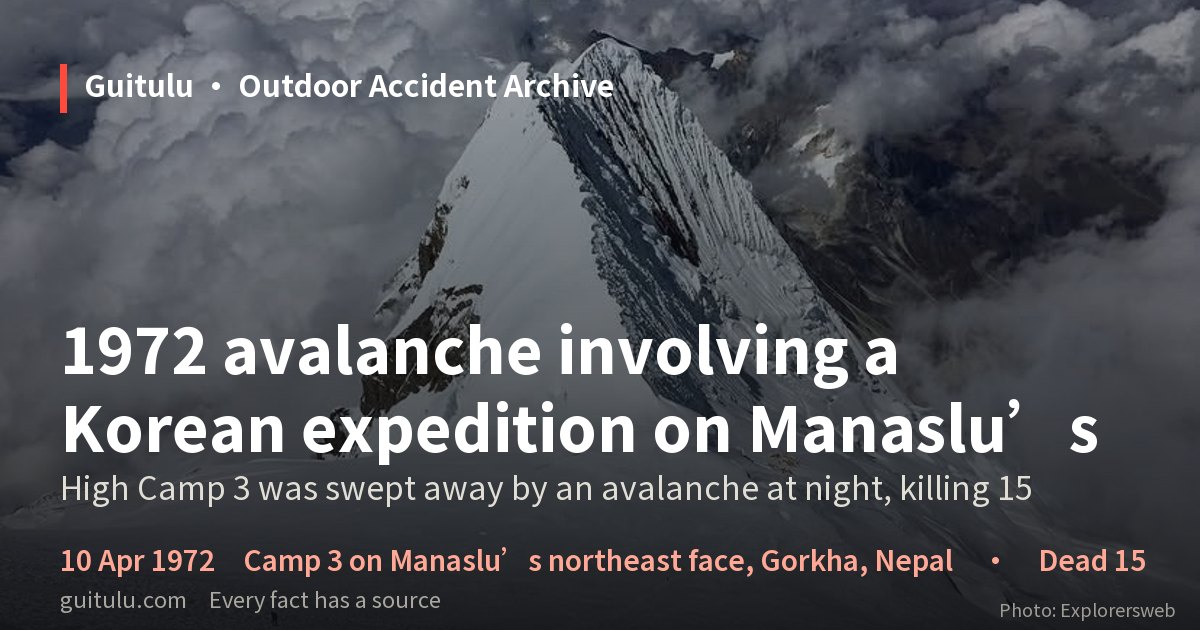
MountaineeringInvolves: AvalancheSecond Korean Manaslu Expedition (team members, a Japanese photographer and Sherpa personnel)
Casualties
Dead 15 Injured 115 people died: 4 Koreans, 1 Japanese photographer and 10 Nepali Sherpa personnel (reportedly 9 high-altitude Sherpas and 1 cook); 3 people survived from the camp.
Material
26 facts · 7 sources2 accounts differ and are shown side by side
The number at the end of a paragraph is how many facts it rests on; open it to see each fact and how well it is sourced:
Multiple sourcesSingle source. Conflicting accounts and speculation are kept out of the narrative.
Reported locations along the route (schematic)Schematic
Scroll down and the map flies to where each part happened. The line is Schematic, Lines connect the reported locations in sequence, indicating only the approximate direction, not the actual track. Sources for the location coordinates are in places.json.
01
Full route
The locations mentioned in reports are connected in sequence to show the approximate course of events (illustrative).
During the first expedition in 1971, Kim Ki-seop, one of the Kim brothers, fell into a crevasse at about 7600 metres and died. F01
The team left Kathmandu in late February, established base camp by 10 March, and originally planned to organise the first summit team in mid-April. F06
The expedition ended after the avalanche, and Kim Ye-seop was flown out of the mountains by helicopter. F09
The expedition had established Camp 4 at about 7200 metres by 7 April. F10
The night before the accident, two Sherpas told Kim Ye-seop that there was too much snow and expressed concern about the slope above. F11
The avalanche carried Kim Ye-seop down about 800 metres (about 2500 feet) before he came to a stop. F16
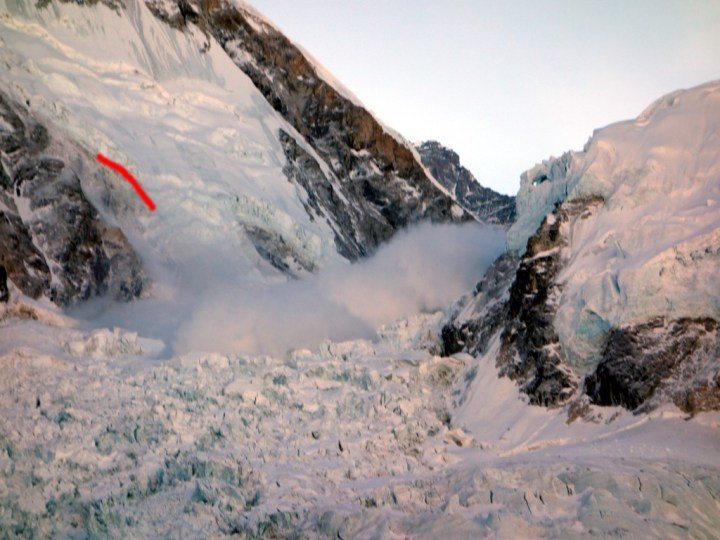
On 10 April 1972, an avalanche struck the Korean expedition's Camp 3 on Manaslu's northeast face, killing 15 people. F12
A second avalanche carried Kim Ye-seop down another 300 metres (about 1000 feet), and he climbed out of the snow himself. F17
After hearing a rumble, Kim Ye-seop woke Park Chang-hee and the Japanese photographer, who were sharing his tent, and tried to escape from the tent. F15
During the third expedition in 1976, the team moved the site of Camp 3 to the north side, in part because they remembered that 15 people had previously died at Camp 3. F22
Under each fact is a verbatim quote from the original. "Single source" means only one outlet mentioned it; "Accounts differ" means sources contradict each other and this site adopts neither side; "Speculation" is an inference by a reporter or a person involved, not a fact.
Kim Ho-seop is described as the team's climbing leader (some sources simply call him the leader); according to Explorersweb, his older brother Kim Jeong-seop was in charge of the expedition.
Sources use different terms for the leadership: Explorersweb says Kim Jeong-seop led the expedition and Kim Ho-seop was the climbing leader; OnlineKhabar calls Kim Ho-seop the expedition leader.
Quotes from the original 4
“The Koreans were led by Kim Jung-Sup, the eldest of three brothers on the mountain.”
According to Explorersweb, The team left Kathmandu in late February, established base camp by 10 March, and originally planned to organise the first summit team in mid-April.
Some team members were not at Camp 3 when the accident occurred; after the avalanche, the Korean team members who remained on the mountain gathered some equipment.
Two accounts differ on the number of people away from camp (7 and 4); no specific number is used here.
Quotes from the original 2
“Seven other members of the expedition were not in the camp”
The avalanche carried Kim Ye-seop down about 800 metres (about 2500 feet) before he came to a stop.
Two accounts differ on the identities of the “three people swept away together”: the American Alpine Journal identifies them as Kim Ye-seop and two Sherpas, while Explorersweb identifies them as Kim Ye-seop and the two people sharing his tent.
Quotes from the original 2
“It carried the three of them 800m down the mountain in three shattering bounces before they stopped.”
According to Himalayan Journal, During the third expedition in 1976, the team moved the site of Camp 3 to the north side, in part because they remembered that 15 people had previously died at Camp 3.
Quotes from the original 1
“Remembering that 15 members had been lost at this point, we decided to establish Camp 3 on the north side.”
According to Himalayan Journal, During the 1976 expedition, the team stipulated that no one could travel between Camp 2 and Camp 3 without a special reason, in order to avoid deaths on this dangerous section of the route.
Quotes from the original 2
“Until that day, no one had been allowed to pass between Camps 2 and 3 without a special reason.”
According to 서울신문, According to a review by a Korean newspaper, this was at the time the accident with the second-highest number of mountaineering deaths, after the 1937 German expedition accident on Nanga Parbat.
Quotes from the original 1
“이 사고는 1937년 낭가파르밧에 도전한 독일 원정대가 눈사태로 대원 7명과 셰르파 9명을 잃은 이후 당시까지 두 번째로 인명 피해가 컸다.”
 GuituluGlobal Outdoor Accident Archive