GuituluGlobal Outdoor Accident Archive 中文
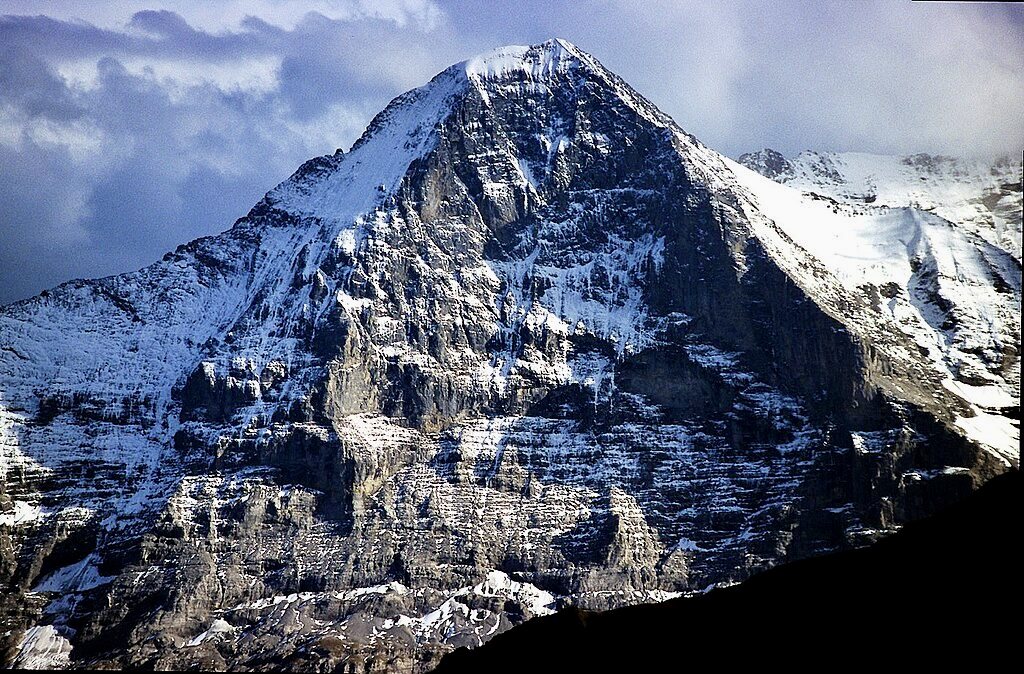
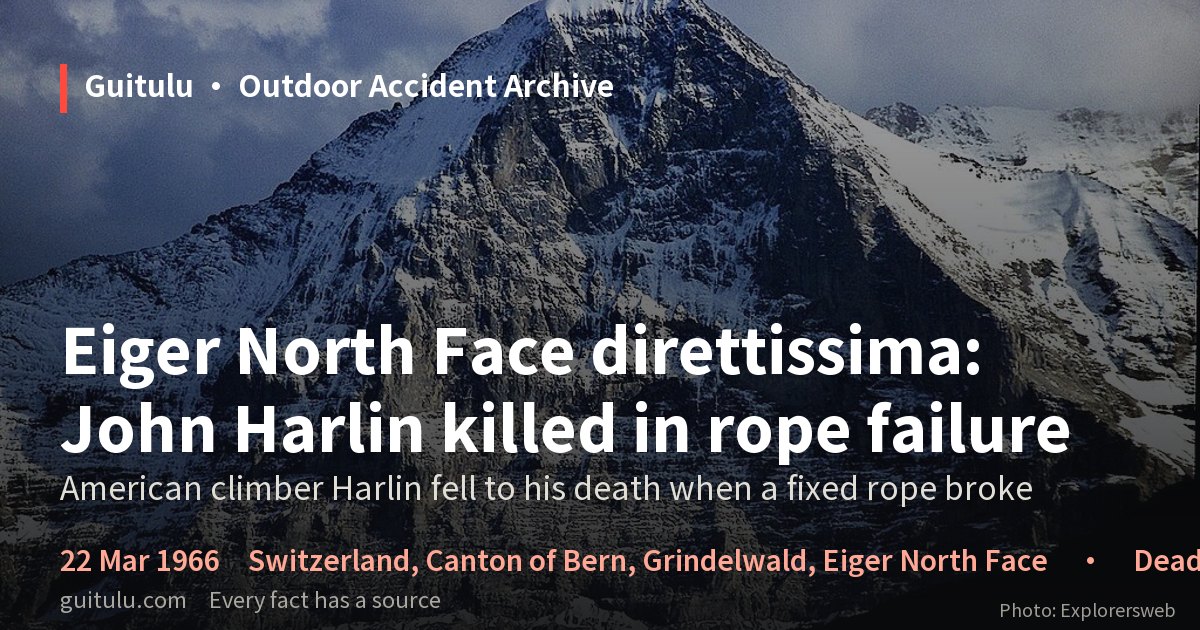
Full view of the Eiger North Face

Archive / Mountaineering

Eiger North Face direttissima: John Harlin killed in rope failure

American climber Harlin fell to his death when a fixed rope broke during a winter ascent of the Eiger North Face direttissima

Three days after Harlin's death, Haston and four German team members completed the direttissima, naming it the John Harlin Route

Photo: Explorersweb

Date
Winter
Place
Switzerland, Canton of Bern, Grindelwald, Eiger North FaceSwitzerland › Bern · Alps8.005°E 46.578°N
Activity
MountaineeringInvolves: Falls and slips · Extreme weatherAnglo-American team (Harlin, Haston and Corley, accompanied by Bonington) and an eight-person German team
Casualties
Dead 1 American climber John Harlin fell to his death when a rope broke as he was ascending it; some members of the subsequent summit party suffered frostbite
Material
45 facts · 11 sources2 accounts differ and are shown side by side

01What happened

In 1962, John Harlin became the first American to climb the Eiger North Face. He subsequently scouted the approximately 1800-metre-high face several times, envisioning a direttissima running straight from the base to the summit. In the winter of 1966, he brought Layton Corley and Dougal Haston to Kleine Scheidegg at the foot of the mountain. Their original plan was for the three to climb fast and light, completing the route in about 10 days.Facts it rests onF02Multiple sourcesIn 1962, Harlin became the first American to climb the Eiger North Face.F37Multiple sourcesThe Eiger North Face is about 1800 metres high from its base to the summit.F38Multiple sourcesBefore 1966, Harlin had reconnoitred and attempted the North Face direttissima several times.F03Multiple sourcesHarlin originally planned to use only a three-person team for speed, climbing in a straight line to the summit in about 10 days.F06Multiple sourcesHarlin's team members were American Layton Kor and Scotsman Dougal Haston, with support from Britons Chris Bonington and Don Whillans.F12Multiple sourcesIn early February 1966, Harlin's team arrived at Kleine Scheidegg at the foot of the Eiger.

Full view of the Eiger North FacePhoto source: Explorersweb

In February that year, an eight-person German team also set its sights on the same route. They dug snow caves, left fixed ropes and advanced expedition-style. Prolonged bad weather and competition led both teams to lay continuous fixed ropes on the face, repeatedly ascending and descending to carry supplies and going down the mountain to rest. The contest became known as “the slowest race in the world”. After several weeks, the two teams gradually began to cooperate, sharing ropes and bivouac sites.Facts it rests onF08Multiple sourcesIn February 1966, an eight-person German team also arrived at the foot of the Eiger, aiming for the same direttissima route.F09Multiple sourcesThe German team used expedition-style tactics: digging snow caves, leaving fixed ropes and carrying enough food and equipment for three weeks.F10Multiple sourcesPersistent bad weather and competition forced the two teams to install continuous fixed ropes on the face and repeatedly ascend and descend them to transport supplies and go down the mountain to rest.F11Multiple sourcesThe contest between the two teams was called “the slowest race in the world”.F13Multiple sourcesAfter several weeks of competition, the two teams gradually began to cooperate, sharing ropes and bivouac sites.

Eiger North FacePhoto source: Explorersweb

According to Bonington's account, the two teams reached the Flatiron on 9 March. Harlin and Haston then held out in a snow cave for six days before descending because Harlin had a fever from bronchitis and their food was running out. On 21 March, Corley and German team leader Lehne reached the Spider icefield. On 22 March, the weather was clear but the forecast was poor. Harlin decided to ascend the fixed ropes to the “Fly” icefield, join the German climbers ahead and make a summit attempt together the following day.Facts it rests onF17Single sourceOn 9 March, both teams reached the Flat Iron, the last place on the route where a snow cave could be dug for shelter.F18Single sourceAfter Harlin and Haston had held out in a snow cave for six days, Harlin developed bronchitis and a high fever, and their food was nearly exhausted. The two decided to descend.F20Single sourceOn 21 March, Kor and German team leader Jörg Lehne reached the Spider, while Harlin and Haston climbed back up towards the Flat Iron.F21Single sourceThe weather was fine on 22 March, but the forecast remained poor.F22Single sourceHarlin decided to ascend the fixed ropes to the Fly icefield, spend the night with the German climbers ahead, and join them in their summit attempt the next day.

Eiger North Face route diagram: 2 is the 1938 Heckmair route, 3 is the Harlin direttissimaPhoto source: Explorersweb

On 22 March, Haston ascended the fixed ropes first, followed later by Harlin alone. A 7-millimetre fixed rope above the Pillar, on the way to the Spider icefield, suddenly broke and Harlin fell to his death. The rope broke approximately 600 metres from the summit. According to Bonington's account, the rope had been ascended or descended only eight or nine times and was not the same brand as those used elsewhere on the face.Facts it rests onF23Multiple sourcesOn 22 March, Haston ascended the fixed ropes first; Harlin then followed alone on the fixed ropes to join the others.F24Multiple sourcesOn 22 March 1966, the fixed rope Harlin was climbing broke, and he fell to his death.F25Multiple sourcesThe rope that broke was the section of fixed rope above the Pillar, leading to the Spider icefield.F28Multiple sourcesThe rope that broke was 7 millimetres thick (Bonington called it a 7-millimetre Perlon rope).F26Multiple sourcesThe rope broke about 600 metres (about 2000 feet) below the summit.F40Single sourceBonington noted that this section of rope had been ascended and descended only eight or nine times, while the ropes below, which had been ascended and descended hundreds of times, were intact.F41Single sourceThe rope that broke was not the Mammoth brand used elsewhere on the face; it had been bought at a local climbing shop after the Mammoth rope ran out.

Kleine Scheidegg with the Eiger behind it, where the 1966 climbing team established its base campPhoto source: Explorersweb

After the accident, Haston and Lehne said by radio that they intended to continue climbing. On 25 March, Haston and four German team members reached the summit in a fierce snowstorm, completing the North Face direttissima and naming it the “John Harlin Route” after Harlin. Some climbers reportedly suffered severe frostbite.Facts it rests onF30Multiple sourcesAfter the accident, Haston and German team leader Lehne said over the radio that they would continue climbing.F33Multiple sourcesThe final summit push was completed in a severe storm.F34Multiple sourcesOn 25 March 1966, Haston and four German climbers reached the summit, completing the North Face direttissima.F36Multiple sourcesThe route was named the “John Harlin Route” after Harlin.F15Single sourceSome climbers suffered severe frostbite.

The number at the end of a paragraph is how many facts it rests on; open it to see each fact and how well it is sourced: Multiple sourcesSingle source. Conflicting accounts and speculation are kept out of the narrative.

  • Reported points along the route (schematic)Schematic

Satellite imagery Sentinel-2 cloudless 2024 © EOX · Terrain AWS Terrain Tiles · Orange line is schematic · Place coordinates not individually verified

Route review

6 scenes to understand what happened

Scroll down and the map flies to where each part happened. The line is Schematic, Lines connect the reported points along the route in sequence, indicating only the approximate direction, not the actual track. Sources for the location coordinates are listed in places.json.

01

Full route

Places mentioned in the reports are connected in order to show the approximate route (schematic).

03

The slowest race

The German team also came to compete for the route. In bad weather, both teams laid fixed ropes and repeatedly ascended and descended, later gradually beginning to cooperate.Facts it rests onF08Multiple sourcesIn February 1966, an eight-person German team also arrived at the foot of the Eiger, aiming for the same direttissima route.F10Multiple sourcesPersistent bad weather and competition forced the two teams to install continuous fixed ropes on the face and repeatedly ascend and descend them to transport supplies and go down the mountain to rest.F13Multiple sourcesAfter several weeks of competition, the two teams gradually began to cooperate, sharing ropes and bivouac sites.

04

The Flatiron and the snow cave

On 9 March, both teams reached the Flatiron. Harlin and Haston held out in a snow cave for six days before descending because of illness and a shortage of food.Facts it rests onF17Single sourceOn 9 March, both teams reached the Flat Iron, the last place on the route where a snow cave could be dug for shelter.F18Single sourceAfter Harlin and Haston had held out in a snow cave for six days, Harlin developed bronchitis and a high fever, and their food was nearly exhausted. The two decided to descend.

05

Rope failure

On 22 March, Harlin was ascending a fixed rope alone when a section leading to the Spider icefield broke, and he fell to his death.Facts it rests onF23Multiple sourcesOn 22 March, Haston ascended the fixed ropes first; Harlin then followed alone on the fixed ropes to join the others.F24Multiple sourcesOn 22 March 1966, the fixed rope Harlin was climbing broke, and he fell to his death.F25Multiple sourcesThe rope that broke was the section of fixed rope above the Pillar, leading to the Spider icefield.

02Timeline

  1. In early February 1966, Harlin's team arrived at Kleine Scheidegg at the foot of the Eiger. F12

  2. On 6 March, Harlin and Haston crossed the First Band. F16

  3. On 9 March, both teams reached the Flat Iron, the last place on the route where a snow cave could be dug for shelter. F17

  4. After Harlin and Haston had held out in a snow cave for six days, Harlin developed bronchitis and a high fever, and their food was nearly exhausted. The two decided to descend. F18

  5. On 20 March, Kor teamed up with German team member Karl Golikow and climbed to the top of the Pillar. F19

  6. On 21 March, Kor and German team leader Jörg Lehne reached the Spider, while Harlin and Haston climbed back up towards the Flat Iron. F20

  7. After the accident, Haston and German team leader Lehne said over the radio that they would continue climbing. F30

  8. On 22 March 1966, the fixed rope Harlin was climbing broke, and he fell to his death. F24

  9. The weather was fine on 22 March, but the forecast remained poor. F21

  10. On 22 March, Haston ascended the fixed ropes first; Harlin then followed alone on the fixed ropes to join the others. F23

  11. On 24 March, a temperature of minus 12 degrees Fahrenheit and wind gusts of up to 85 miles per hour were recorded at Kleine Scheidegg. F32

  12. On 25 March 1966, Haston and four German climbers reached the summit, completing the North Face direttissima. F34

  13. The route was named the “John Harlin Route” after Harlin. F36

03Lessons

Teams and decisions

Fixed ropes are consumables that can fail

The rope that broke was a 7-millimetre rope that had been ascended or descended only eight or nine times; the ropes below, which had been used repeatedly, remained intact. It was not the same brand as the other sections and had been purchased later as an addition. Fixed ropes left on a face for long periods should be inspected regularly. Ropes of unknown origin or thinner specifications call for extra caution, and backup protection should be used on critical sections wherever possible.Facts it rests onF28Multiple sourcesThe rope that broke was 7 millimetres thick (Bonington called it a 7-millimetre Perlon rope).F40Single sourceBonington noted that this section of rope had been ascended and descended only eight or nine times, while the ropes below, which had been ascended and descended hundreds of times, were intact.F41Single sourceThe rope that broke was not the Mammoth brand used elsewhere on the face; it had been bought at a local climbing shop after the Mammoth rope ran out.F25Multiple sourcesThe rope that broke was the section of fixed rope above the Pillar, leading to the Spider icefield.

Weather and retreat

Competitive pressure can change the original plan

Harlin originally intended for three climbers to travel light and wait for good weather before making a fast ascent. In the end, he ascended the fixed ropes despite a poor forecast to keep pace with his rivals' summit attempt. A competitive mindset can make people accept timing and risks they otherwise would not. Before setting out, it is worth asking again: If there were no rivals, would I still go now?Facts it rests onF03Multiple sourcesHarlin originally planned to use only a three-person team for speed, climbing in a straight line to the summit in about 10 days.F21Single sourceThe weather was fine on 22 March, but the forecast remained poor.F22Single sourceHarlin decided to ascend the fixed ropes to the Fly icefield, spend the night with the German climbers ahead, and join them in their summit attempt the next day.F10Multiple sourcesPersistent bad weather and competition forced the two teams to install continuous fixed ropes on the face and repeatedly ascend and descend them to transport supplies and go down the mountain to rest.

Hypothermia and overnight gear

Winter storms on the North Face are extremely fierce

During the summit attempt, a temperature of minus 12 degrees Fahrenheit and gusts of 85 miles per hour were measured at the foot of the mountain; some climbers suffered severe frostbite. Once trapped by a storm on a high mountain face in winter, retreat is difficult. Warm clothing and equipment, bivouac conditions and retreat routes should all be prepared for the worst case.Facts it rests onF32Single sourceOn 24 March, a temperature of minus 12 degrees Fahrenheit and wind gusts of up to 85 miles per hour were recorded at Kleine Scheidegg.F33Multiple sourcesThe final summit push was completed in a severe storm.F15Single sourceSome climbers suffered severe frostbite.

04Fact list 45 facts

Under each fact is a verbatim quote from the original. "Single source" means only one outlet mentioned it; "Accounts differ" means sources contradict each other and this site adopts neither side; "Speculation" is an inference by a reporter or a person involved, not a fact.

  1. F01Multiple sourcesBackground

    Harlin was born on 30 June 1935 and was 30 when he died.

    Quotes from the original 3

    “John Elvis Harlin II (June 30, 1935 – March 22, 1966)”

    Wikipedia ·

    “John Elvis Harlin II was born in Kansas City on June 30, 1935.”

    Explorersweb · 2025-03-22

    “Harlin was 30 when he died”

    SnowBrains · 2026-03-23
  2. F02Multiple sourcesBackground

    In 1962, Harlin became the first American to climb the Eiger North Face.

    Quotes from the original 3

    “In 1962, after several attempts, he became the first—and still the only American to scale it.”

    AAC ·

    “In the summer of 1962, Harlin became the first American to climb the North Face of the Eiger.”

    Explorersweb · 2025-03-22

    “He was the first American to climb it in 1962”

    CBS News · 2007-03-04
  3. F03Multiple sourcesPlan

    Harlin originally planned to use only a three-person team for speed, climbing in a straight line to the summit in about 10 days.

    Quotes from the original 2

    “To ensure speed he wanted to keep the party as small as possible and decided on three as the best number.”

    AAC ·

    “limiting the number of climbers to three to ensure speed. His aim was to follow a vertical line straight up to the summit in about 10 days.”

    swissinfo.ch · 2016-03-25
  4. F04Single sourcePlan

    According to AAC, According to Bonington, Harlin chose to climb in winter because he believed there was no rockfall and the weather was more stable in winter.

    Quotes from the original 1

    “he favoured the winter since there was then no stonefall and the weather was more settled.”

    AAC ·
  5. F05Single sourceAftermath

    According to AAC, The climb was criticised in the mountaineering community and the media, mainly for its expedition-style tactics involving extensive use of fixed ropes and its public promotion.

    Several quotations come from different reports by the same media outlet and are counted as one source

    Quotes from the original 2

    “It was said that unfair means had been used to conquer an Alpine face.”

    AAC ·

    “Particularly singled out for criticism have been the open publicity-seeking ( to defray expenses, we are told), and the use of fixed ropes.”

    AAC ·
  6. F06Multiple sourcesBackground

    Harlin's team members were American Layton Kor and Scotsman Dougal Haston, with support from Britons Chris Bonington and Don Whillans.

    Quotes from the original 3

    “With John were Dougal Haston, a twenty-five year old Scottish climber, and Layton Kor from Colorado.”

    AAC ·

    “His partners in this were fellow-American Layton Kor and Scotsman Dougal Haston, with Englishmen Chris Bonington and Don Whillans in support.”

    AAC ·

    “the team comprised American aid-specialist Layton Kor and the renowned Scottish mountaineer Dougal Haston”

    Climber · 2022-01-24
  7. F07Multiple sourcesBackground

    Bonington was initially a photographer commissioned by Britain's Telegraph to photograph the climb.

    Quotes from the original 2

    “I came out as photographer for the Weekend Telegraph which was sponsoring the project.”

    AAC ·

    “was employed by the Daily Telegraph to photograph the climb.”

    Climber · 2022-01-24
  8. F08Multiple sourcesEvent

    In February 1966, an eight-person German team also arrived at the foot of the Eiger, aiming for the same direttissima route.

    Quotes from the original 2

    “A competing eight-man German party arrived at the foot of the mountain around the same time in February”

    swissinfo.ch · 2016-03-25

    “We had heard rumours that there were eight climbers from Stuttgart in training for the climb”

    AAC ·
  9. F09Multiple sourcesPlan

    The German team used expedition-style tactics: digging snow caves, leaving fixed ropes and carrying enough food and equipment for three weeks.

    Quotes from the original 2

    “They planned to dig snow holes, leave fixed rope in position, and carry enough food and equipment for three weeks.”

    AAC ·

    “the Germans planned a relentless ascent with fixed ropes, regardless of conditions.”

    Explorersweb · 2025-03-22
  10. F10Multiple sourcesEvent

    Persistent bad weather and competition forced the two teams to install continuous fixed ropes on the face and repeatedly ascend and descend them to transport supplies and go down the mountain to rest.

    Quotes from the original 2

    “it was the constant bad weather combined with an element of competition that forced the two parties to put out a continuous line of fixed rope”

    AAC ·

    “Members would even descend for rest at the hotels near the base of the mountain, before climbing back up again.”

    swissinfo.ch · 2016-03-25
  11. F11Multiple sourcesEvent

    The contest between the two teams was called “the slowest race in the world”.

    Quotes from the original 2

    “it was a race, the slowest race on earth, as one newspaper headlined it.”

    AAC ·

    “It became known as the slowest race on earth”

    swissinfo.ch · 2016-03-25
  12. F12Multiple sourcesMovement

    In early February 1966, Harlin's team arrived at Kleine Scheidegg at the foot of the Eiger.

    Quotes from the original 2

    “Harlin’s team arrived at Kleine Scheidegg, February 3, 1966”

    AAC ·

    “In early February, Harlin’s party headed to Kleine Scheidegg”

    Explorersweb · 2025-03-22
  13. F13Multiple sourcesEvent

    After several weeks of competition, the two teams gradually began to cooperate, sharing ropes and bivouac sites.

    Quotes from the original 3

    “Around March 15, after weeks of rivalry, the teams began sharing ropes and bivouac sites”

    Explorersweb · 2025-03-22

    “The two parties, therefore, had started to work together”

    AAC ·

    “What began as a rivalry between Harlin’s American-led team and a German group soon turned into a cooperative effort”

    SnowBrains · 2026-03-23
  14. F14Single sourceAftermath

    According to Explorersweb, Kor descended shortly after the accident, effectively withdrawing from the climb.

    Quotes from the original 1

    “Kor descended soon after, effectively leaving the climb.”

    Explorersweb · 2025-03-22
  15. F15Single sourceAftermath

    According to Explorersweb, Some climbers suffered severe frostbite.

    Quotes from the original 1

    “The climbers, some suffering serious frostbite”

    Explorersweb · 2025-03-22
  16. F16Single sourceMovement

    According to AAC, On 6 March, Harlin and Haston crossed the First Band.

    From a first-hand account published in the American Alpine Journal in 1967 by Bonington, the accompanying photographer and team member

    Quotes from the original 1

    “Harlin and Haston got above First Band, March 6”

    AAC ·
  17. F17Single sourceMovement

    According to AAC, On 9 March, both teams reached the Flat Iron, the last place on the route where a snow cave could be dug for shelter.

    From a first-hand account published in the American Alpine Journal in 1967 by Bonington, the accompanying photographer and team member

    Quotes from the original 1

    “We reached the Flat Iron on March 9. This was the last point where we could shelter in snow holes.”

    AAC ·
  18. F18Single sourceEvent

    According to AAC, After Harlin and Haston had held out in a snow cave for six days, Harlin developed bronchitis and a high fever, and their food was nearly exhausted. The two decided to descend.

    From a first-hand account published in the American Alpine Journal in 1967 by Bonington, the accompanying photographer and team member

    Quotes from the original 1

    “John had contracted bronchitis and at the end of six days was running a high temperature. They had nearly run out of food and therefore decided to come down.”

    AAC ·
  19. F19Single sourceMovement

    According to AAC, On 20 March, Kor teamed up with German team member Karl Golikow and climbed to the top of the Pillar.

    From a first-hand account published in the American Alpine Journal in 1967 by Bonington, the accompanying photographer and team member

    Quotes from the original 1

    “Kor and Golikow climbed together to top of Pillar, March 20”

    AAC ·
  20. F20Single sourceMovement

    According to AAC, On 21 March, Kor and German team leader Jörg Lehne reached the Spider, while Harlin and Haston climbed back up towards the Flat Iron.

    From a firsthand account published in the American Alpine Journal in 1967 by Bonington, a team member and accompanying photographer

    Quotes from the original 1

    “John and Dougal, now well rested, set out for the Flat Iron, while Layton, climbing with Jörg Lehne reached the Spider.”

    AAC ·
  21. F21Single sourceEvent

    According to AAC, The weather was fine on 22 March, but the forecast remained poor.

    From a firsthand account published in the American Alpine Journal in 1967 by Bonington, a team member and accompanying photographer

    Quotes from the original 1

    “The 22nd dawned fine, but the forecast remained bad.”

    AAC ·
  22. F22Single sourcePlan

    According to AAC, Harlin decided to ascend the fixed ropes to the Fly icefield, spend the night with the German climbers ahead, and join them in their summit attempt the next day.

    From a firsthand account published in the American Alpine Journal in 1967 by Bonington, a team member and accompanying photographer

    Quotes from the original 1

    “He, therefore, decided to climb the fixed ropes to the Fly, spend the night there with the leading Germans, and join them in their summit dash, the next day.”

    AAC ·
  23. F23Multiple sourcesMovement

    On 22 March, Haston ascended the fixed ropes first; Harlin then followed alone on the fixed ropes to join the others.

    Quotes from the original 3

    “Dougal went up the ropes first and John followed.”

    AAC ·

    “John was ascending alone, to rejoin the others”

    AAC ·

    “Harlin was ascending a fixed rope alone. He was on his way to join the others”

    Explorersweb · 2025-03-22
  24. F24Multiple sourcesEvent

    On 22 March 1966, the fixed rope Harlin was climbing broke, and he fell to his death.

    Quotes from the original 4

    “a fixed rope broke while John was ascending alone”

    AAC ·

    “claimed the life of Harlin when he fell about 1,200m to his death after his rope broke.”

    swissinfo.ch · 2016-03-25

    “After Harlin’s death, when a rope he was jumarring broke”

    Gripped · 2022-01-20

    “Harlin's larger-than-life father fell 4,000 feet to his death when his climbing rope severed on a rocky ledge.”

    CBS News · 2007-03-04
  25. F25Multiple sourcesFound at scene

    The rope that broke was the section of fixed rope above the Pillar, leading to the Spider icefield.

    Quotes from the original 2

    “The fixed rope immediately above the Pillar, leading up to the Spider, broke and he fell.”

    AAC ·

    “John Harlin fell to his death as a result of a jumaring accident whilst climbing up to the White Spider.”

    Climber · 2022-01-24
  26. F26Multiple sourcesFound at scene

    The rope broke about 600 metres (about 2000 feet) below the summit.

    Quotes from the original 3

    “approximately 610m below the summit, at 3,360m”

    Explorersweb · 2025-03-22

    “Two thousand feet from the summit, his rope broke and he fell to his death in 1966.”

    Wikipedia ·

    “He fell to his death about 2,000 feet from the summit”

    SnowBrains · 2026-03-23
  27. F27Accounts differFound at scene

    Accounts of the fall distance differ: an American Alpine Journal obituary gives about 4000 feet, swissinfo gives about 1200 metres, and Explorersweb gives 1000 metres.

    Estimates differ among sources

    Quotes from the original 3

    “he fell four thousand feet to the foot of the mountain”

    AAC ·

    “he fell about 1,200m to his death”

    swissinfo.ch · 2016-03-25

    “American climber John Harlin fell 1,000m to his death on the Eiger’s North Face”

    Explorersweb · 2025-03-22
  28. F28Multiple sourcesFound at scene

    The rope that broke was 7 millimetres thick (Bonington called it a 7-millimetre Perlon rope).

    Quotes from the original 2

    “for we were only using 7mm Perlon”

    AAC ·

    “But the 7mm rope snapped”

    Explorersweb · 2025-03-22
  29. F29Single sourceEvent

    According to Explorersweb, Journalist Peter Gillman was watching the climbers through a telescope from Kleine Scheidegg and witnessed Harlin's fall.

    Quotes from the original 1

    “Gillman, who was at Kleine Scheidegg watching the climbers with a telescope, saw Harlin fall”

    Explorersweb · 2025-03-22
  30. F30Multiple sourcesAftermath

    After the accident, Haston and German team leader Lehne said over the radio that they would continue climbing.

    Quotes from the original 2

    “when I talked to Dougal and Jörg Lehne over the wireless, they told me that they intended to go on.”

    AAC ·

    “Dougal Haston – who had by now joined forces with some of the Germans – decided to press on.”

    swissinfo.ch · 2016-03-25
  31. F31Single sourceParticipant's view

    According to AAC, Haston's view was that if they retreated now, John would have died in vain, and he believed John would have wanted them to continue.

    From a firsthand account published in the American Alpine Journal in 1967 by Bonington, a team member and accompanying photographer

    Quotes from the original 1

    “John’s life will have been completely wasted. I’m sure John would want us to go on.”

    AAC ·
  32. F32Single sourceEvent

    According to AAC, On 24 March, a temperature of minus 12 degrees Fahrenheit and wind gusts of up to 85 miles per hour were recorded at Kleine Scheidegg.

    From a firsthand account published in the American Alpine Journal in 1967 by Bonington, a team member and accompanying photographer

    Quotes from the original 1

    “-12° Fahrenheit were recorded at Scheidegg and there were gusts of 85 m.p.h.”

    AAC ·
  33. F33Multiple sourcesEvent

    The final summit push was completed in a severe storm.

    Quotes from the original 2

    “It was the most savage storm I have ever experienced.”

    AAC ·

    “in the teeth of a horrific storm”

    Climber · 2022-01-24
  34. F34Multiple sourcesAftermath

    On 25 March 1966, Haston and four German climbers reached the summit, completing the North Face direttissima.

    Quotes from the original 3

    “Three days later, Haston and four of the Germans reached its summit”

    AAC ·

    “He and four of the Germans reached the summit three days later”

    swissinfo.ch · 2016-03-25

    “The reached the top on March 25”

    Gripped · 2022-01-20
  35. F35Accounts differAftermath

    Accounts differ on the names of the four German climbers who reached the summit: Bonington, Climber and Gripped list Lehne, Strobel, Hupfauer and Votteler; Explorersweb lists Lehne, Strobel, Hupfauer and Huber.

    The name of the fifth climber to reach the summit differs among accounts

    Quotes from the original 3

    “Direct climbed by Haston, Lehne, Strobel, Hupfauer, Votteler, March 25.”

    AAC ·

    “a group comprising Dougal Haston and Siegfried Hupfauer, Jörg Lehne, Günter Strobel and Roland Votteler”

    Climber · 2022-01-24

    “Haston, Lehne, Strobel, Hupfauer, and Huba reached the summit”

    Explorersweb · 2025-03-22
  36. F36Multiple sourcesAftermath

    The route was named the “John Harlin Route” after Harlin.

    Quotes from the original 3

    “named the line The John Harlin Route.”

    Explorersweb · 2025-03-22

    “They named the route after the American in his honour.”

    swissinfo.ch · 2016-03-25

    “afterward named the Harlin route in his honor.”

    Wikipedia ·
  37. F37Multiple sourcesBackground

    The Eiger North Face is about 1800 metres high from its base to the summit.

    Quotes from the original 2

    “The North Face of the Eiger, rising 1,800m from its base to the summit at 3,967m”

    Explorersweb · 2025-03-22

    “the imposing 1,800m high wall”

    swissinfo.ch · 2016-03-25
  38. F38Multiple sourcesBackground

    Before 1966, Harlin had reconnoitred and attempted the North Face direttissima several times.

    Quotes from the original 2

    “following many more reconnaissances and attempts, he was the prime mover of the now celebrated "Eiger Direct"”

    AAC ·

    “Harlin made several reconnaissance climbs on the North Face.”

    Explorersweb · 2025-03-22
  39. F39Single sourcePost-incident analysis

    According to AAC, Bonington considered three possible causes, but thought it unlikely that a small stone had struck the rope.

    From a firsthand account published in the American Alpine Journal in 1967 by Bonington, a team member and accompanying photographer

    Quotes from the original 1

    “There could have been three causes — a small stone could have hit the rope, but that was unlikely.”

    AAC ·
  40. F40Single sourcePost-incident analysis

    According to AAC, Bonington noted that this section of rope had been ascended and descended only eight or nine times, while the ropes below, which had been ascended and descended hundreds of times, were intact.

    From a firsthand account published in the American Alpine Journal in 1967 by Bonington, a team member and accompanying photographer

    Quotes from the original 1

    “this rope, which had only been used on eight or nine ascents should have parted, when the ropes further down the face, which had been ascended many hundreds of times, should have remained firm.”

    AAC ·
  41. F41Single sourcePost-incident analysis

    According to AAC, The rope that broke was not the Mammoth brand used elsewhere on the face; it had been bought at a local climbing shop after the Mammoth rope ran out.

    From a firsthand account by expedition photographer and team member Bonington, published in the American Alpine Journal in 1967

    Quotes from the original 1

    “It was not the same make — Mammoth — as we had used on the rest of the face. We had bought this rope in a local climbing shop when we had run out of the Mammoth rope.”

    AAC ·
  42. F42SpeculationSpeculation

    Explorersweb speculates that the rope may have broken because of abrasion, ice damage or rockfall.

    Quotes from the original 1

    “likely because of wear, ice damage, or rockfall.”

    Explorersweb · 2025-03-22
  43. F43Single sourcePost-incident analysis

    According to Explorersweb, Harlin had selected the fixed rope that broke, while Haston had originally preferred a thicker rope.

    Quotes from the original 1

    “one that Harlin had chosen even though Haston had preferred thicker ropes.”

    Explorersweb · 2026-04-19
  44. F44Single sourceParticipant's view

    According to AAC, Bonington's view was that it would have been impossible to complete the climb by any other method that winter.

    From a firsthand account by expedition photographer and team member Bonington, published in the American Alpine Journal in 1967

    Quotes from the original 1

    “I am convinced that the climb could not possibly have been completed by any other methods last winter”

    AAC ·
  45. F45Multiple sourcesBackground

    Harlin had founded the International School of Modern Mountaineering in Leysin, Switzerland.

    Quotes from the original 2

    “also founded his own International School of Modern Mountaineering”

    AAC ·

    “He also founded the International School of Modern Mountaineering.”

    Explorersweb · 2025-03-22