GuituluGlobal Outdoor Accident Archive 中文
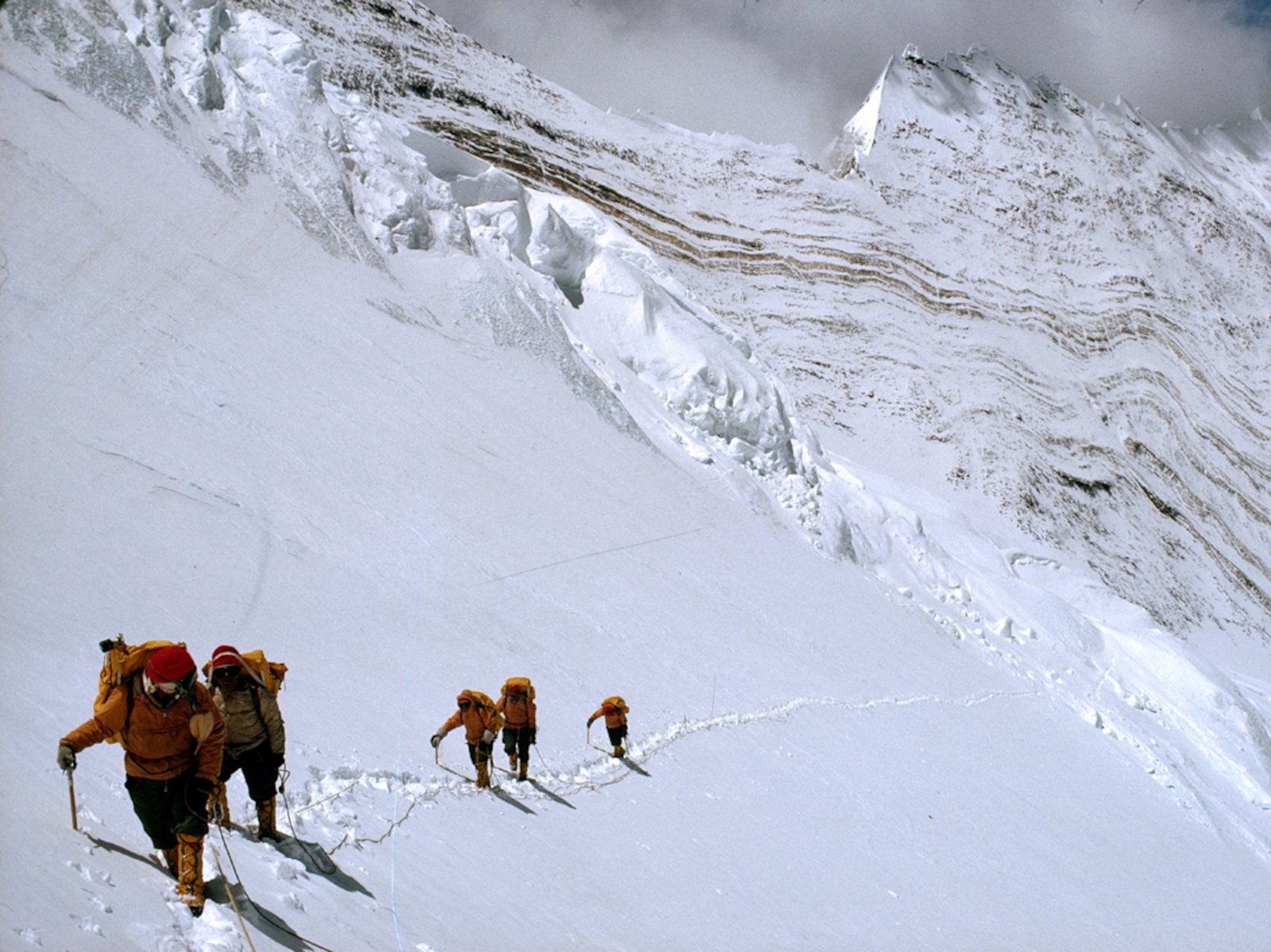
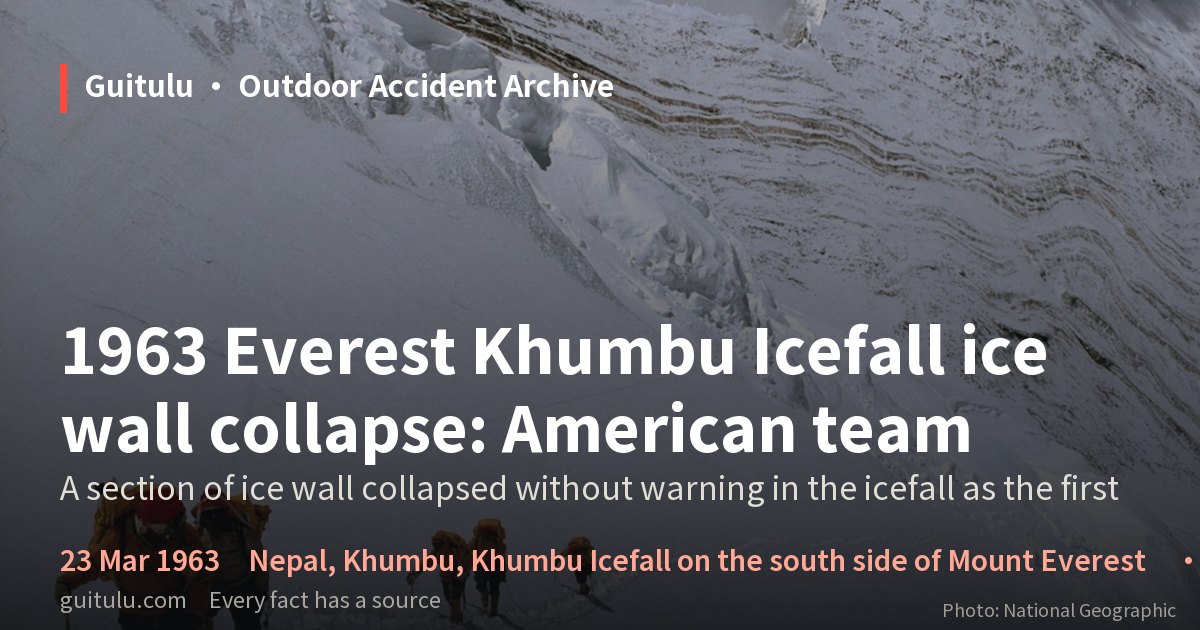
Members of the 1963 American Mount Everest Expedition climbing roped together on Everest

Archive / Mountaineering

1963 Everest Khumbu Icefall ice wall collapse: American team member Jake Breitenbach killed

A section of ice wall collapsed without warning in the icefall as the first American Everest expedition was establishing a route

Incident concluded; remains reappeared at the bottom of the icefall years later and were buried near Dingboche Monastery

Photo: National Geographic

Date
Spring
Place
Nepal, Khumbu, Khumbu Icefall on the south side of Mount EverestNepal › Koshi Province · Himalaya86.870°E 28.002°N
Activity
Mountaineering (establishing a route through the icefall)Involves: AvalancheIcefall route-setting team of the 1963 American Mount Everest Expedition, led by Norman Dyhrenfurth: Breitenbach, Dick Pownall, Gil Roberts, and Sherpas Ang Pemba and Ila Tsering
Casualties
Dead 1 Injured 2Jake Breitenbach was killed, and his body could not be recovered at the time. According to the expedition leader's account, Sherpa Ang Pemba was seriously injured and Dick Pownall suffered minor injuries.
Material
40 facts · 10 sources3 accounts differ and are shown side by side

01What happened

In 1963, the American Mount Everest Expedition led by Norman Dyhrenfurth had 19 American members, one of whom was Jake Breitenbach. He lived in Jackson, Wyoming, worked as a mountaineering guide on Grand Teton in summer, and was assigned to the West Ridge team on the expedition. The Khumbu Icefall is a jumble of unstable ice towers and crevasses, with ice constantly moving. On 21 March, the expedition established base camp below the icefall at an altitude of 17800 feet.Facts it rests onF01Multiple sourcesThe 1963 American Mount Everest Expedition was organized and led by Norman Dyhrenfurth and included 19 Americans.F33Multiple sourcesJake Breitenbach lived in Jackson, Wyoming, and worked as a climbing guide on Grand Teton in the summer.F05Multiple sourcesThe expedition split into two groups, and Breitenbach was assigned to the West Ridge group.F34Multiple sourcesThe Khumbu Icefall is a jumble of unstable ice towers and crevasses, dropping about 2,000 feet between Everest and Lhotse, with blocks of ice constantly moving.F09Multiple sourcesOn 21 March 1963, the expedition established base camp below the Khumbu Icefall at an altitude of 17800 feet.

Members of the 1963 American Mount Everest Expedition climbing roped together on EverestPhoto source: National Geographic

According to the leader's account, the first group entered the icefall on 22 March to establish a route, cutting steps, setting fixed ropes and placing marker poles. On 23 March, Breitenbach, Dick Pownall, Gil Roberts, and Sherpas Ang Pemba and Ila Tsering formed a second group and went up to improve and extend the route. At around 2 p.m., they reached a steep ice wall about 30 feet high. According to Pownall's own account, the wall looked dangerous, but there was no other way. He asked Breitenbach to untie the end of the fixed rope so it could be secured more firmly; they had been climbing on similar terrain all day without any movement in the ice.Facts it rests onF10Single sourceOn 22 March, Unsoeld, Whittaker, Jerstad, Nawang Gombu and others were the first to enter the icefall to establish a route, cutting steps, fixing ropes and placing marker poles.F11Single sourceOn 23 March, a second group went up into the icefall to improve and extend the route. Its members were Breitenbach, Dick Pownall, Dr Gil Roberts, and Sherpas Ang Pemba and Ila Tsering.F13Single sourceAt around 2 p.m., the second group reached a steep ice wall about 30 feet high, where the first group had fixed a rope, near what later became a supply transfer point.F15Single sourceAccording to Pownall's own account, he thought this section of the ice wall looked dangerous and asked whether they could go around it. After being told there was no other route, he continued and asked Breitenbach to untie the end of the fixed rope so it could be secured more firmly with ice screws.F16Single sourceAccording to Pownall's own account, they had been climbing on similar terrain all day and the ice had shown no movement, so his first reaction when the collapse occurred was disbelief.

Khumbu Icefall route diagram (illustration accompanying a 2014 report on the ice avalanche, showing the route and danger zones at the time)Photo source: National Geographic

A large section of the ice wall then collapsed without warning, burying Breitenbach under a large amount of ice and killing him. His teammates tried unsuccessfully to recover his body. According to the leader's account, Roberts and Ila Tsering were uninjured, Pownall suffered minor injuries, and Ang Pemba was carried back to base camp by a rescue team sent out urgently after he was injured. According to reports, Breitenbach was the first American to die on Everest.Facts it rests onF17Multiple sourcesOn 23 March 1963, a large section of an ice wall (serac) collapsed in the Khumbu Icefall, and Jake Breitenbach was buried under a large amount of ice and killed.F18Multiple sourcesThe ice wall collapsed without warning.F20Multiple sourcesHis teammates tried to dig out his body but were unsuccessful, and it remained under the ice.F22Single sourceRoberts and Ila Tsering were uninjured, and Pownall sustained minor injuries.F23Single sourceSherpa Ang Pemba suffered severe facial cuts and a mild concussion and was carried back to base camp by an urgently dispatched rescue team.F25Single sourceBreitenbach was the first American to die on Everest.

According to reports, the accident led several members to feel that they should stop, and the leader called a meeting of the entire team to discuss whether to continue. No one entered the icefall for two days after the accident; the team members and Sherpas then returned to work in the icefall, and the expedition continued. On 1 May, Jim Whittaker and Nawang Gombu reached the summit via the South Col route; later that month, Unsoeld and Hornbein reached the summit via the West Ridge, completing the first traverse of Everest.Facts it rests onF06Single sourceBreitenbach's death led several team members to feel that the climb should stop there.F07Single sourceExpedition leader Dyhrenfurth called a meeting of all team members and asked each person to give their view on whether to continue.F08Multiple sourcesNo one entered the icefall for two days after the accident. A few days later, team members and Sherpas returned to work in the icefall, and the expedition continued.F28Multiple sourcesOn 1 May 1963, Jim Whittaker and Nawang Gombu reached the summit of Everest via the South Col route.F29Multiple sourcesIn May of the same year, Unsoeld and Hornbein reached the summit via the West Ridge, completing the first traverse of Everest.

At the end of the expedition, Breitenbach's body remained buried in the icefall. Years later, his remains reappeared from the Khumbu Glacier. According to the American Alpine Journal, the body was found by one of the Japanese climbing teams then active on the glacier; according to reports, the remains were identified by the clothing. He was eventually buried near Dingboche Monastery.Facts it rests onF04Multiple sourcesAt the end of the expedition, Breitenbach's body was still buried in the Khumbu Icefall.F36Multiple sourcesMany years later, Breitenbach's remains reappeared from the Khumbu Glacier and were found.F38Single sourceAccording to the American Alpine Journal, the body was found by one of the Japanese climbing teams active on the Khumbu Glacier at the time.F39Single sourceThe remains were identified by the clothing.F40Multiple sourcesBreitenbach was eventually buried near Dingboche Monastery.

The number at the end of a paragraph is how many facts it rests on; open it to see each fact and how well it is sourced: Multiple sourcesSingle source. Conflicting accounts and speculation are kept out of the narrative.

  • Reported places along the route (schematic)Schematic

Satellite imagery Sentinel-2 cloudless 2024 © EOX · Terrain AWS Terrain Tiles · Orange line is schematic · Place coordinates not individually verified

Route review

6 scenes to understand what happened

Scroll down and the map flies to where each part happened. The line is Schematic, Lines connect the places mentioned in reports in sequence, showing only the approximate direction, not the actual track. Sources for place coordinates are listed in places.json.

01

Full route

Locations mentioned in reports are connected in order to show the approximate course of events (schematic).

03

Second group enters the icefall

On 23 March, Breitenbach and four others entered the icefall to improve and extend the route established the previous day.Facts it rests onF10Single sourceOn 22 March, Unsoeld, Whittaker, Jerstad, Nawang Gombu and others were the first to enter the icefall to establish a route, cutting steps, fixing ropes and placing marker poles.F11Single sourceOn 23 March, a second group went up into the icefall to improve and extend the route. Its members were Breitenbach, Dick Pownall, Dr Gil Roberts, and Sherpas Ang Pemba and Ila Tsering.

04

Ice wall collapse

At around 2 p.m., a large section of ice wall collapsed without warning, burying Breitenbach under the ice and killing him.Facts it rests onF13Single sourceAt around 2 p.m., the second group reached a steep ice wall about 30 feet high, where the first group had fixed a rope, near what later became a supply transfer point.F17Multiple sourcesOn 23 March 1963, a large section of an ice wall (serac) collapsed in the Khumbu Icefall, and Jake Breitenbach was buried under a large amount of ice and killed.F18Multiple sourcesThe ice wall collapsed without warning.

02Timeline

  1. On 21 March 1963, the expedition established base camp below the Khumbu Icefall at an altitude of 17800 feet. F09

  2. On 22 March, Unsoeld, Whittaker, Jerstad, Nawang Gombu and others were the first to enter the icefall to establish a route, cutting steps, fixing ropes and placing marker poles. F10

  3. On 23 March 1963, a large section of an ice wall (serac) collapsed in the Khumbu Icefall, and Jake Breitenbach was buried under a large amount of ice and killed. F17

  4. At around 2 p.m., the second group reached a steep ice wall about 30 feet high, where the first group had fixed a rope, near what later became a supply transfer point. F13

  5. On 23 March, a second group went up into the icefall to improve and extend the route. Its members were Breitenbach, Dick Pownall, Dr Gil Roberts, and Sherpas Ang Pemba and Ila Tsering. F11

  6. Sherpa Ang Pemba suffered severe facial cuts and a mild concussion and was carried back to base camp by an urgently dispatched rescue team. F23

  7. Roberts and Ila Tsering were uninjured, and Pownall sustained minor injuries. F22

  8. Dyhrenfurth had already decided not to establish a formal camp in the icefall and became more determined after the accident. He established only a supply transfer point at about 19,200 feet, where a small tent was reserved for emergency use. F26

  9. On 1 May 1963, Jim Whittaker and Nawang Gombu reached the summit of Everest via the South Col route. F28

  10. In May of the same year, Unsoeld and Hornbein reached the summit via the West Ridge, completing the first traverse of Everest. F29

  11. Others later died in the Khumbu Icefall: in 1969, Sherpa Phu Dorji was killed by an ice collapse in the icefall, and in 1970, six Sherpas from a Japanese ski team were killed. F30

  12. By 1971, there was a memorial stone bearing the names of Breitenbach and Phu Dorji. F31

03Lessons

Avalanche and high altitude

A calm moment in the icefall does not mean it is safe

According to Pownall's own account, they had climbed on similar terrain all day without any movement in the ice, yet the ice wall collapsed without warning. According to reports, it is impossible to predict whether the icefall will move while people are passing through.Facts it rests onF16Single sourceAccording to Pownall's own account, they had been climbing on similar terrain all day and the ice had shown no movement, so his first reaction when the collapse occurred was disbelief.F18Multiple sourcesThe ice wall collapsed without warning.F35Single sourceAccording to reports, it is impossible to predict whether the icefall will move while climbers are passing through, pushing blocks of ice the size of buildings.

Avalanche and high altitude

Limit time and repeated trips in the icefall

The leader decided not to establish a formal camp in the icefall and held more firmly to that decision after the accident; the small tent at the transfer point was for emergency use only. Team member Whittaker stayed above the icefall throughout the climb, passing through it only once, during his descent after summiting. According to a 2014 report, Sherpas crossed the icefall 30 to 40 times per climbing season, while client climbers crossed it only 6 to 10 times.Facts it rests onF26Single sourceDyhrenfurth had already decided not to establish a formal camp in the icefall and became more determined after the accident. He established only a supply transfer point at about 19,200 feet, where a small tent was reserved for emergency use.F03Single sourceWhittaker disliked the icefall and chose to remain above it throughout the climb, passing through it only once during the descent after reaching the summit.F32Single sourceAccording to a 2014 report, Sherpas crossed the icefall 30 to 40 times each climbing season, while client climbers crossed it only 6 to 10 times.

Avalanche and high altitude

The icefall route needs continuous maintenance

After the accident, Sherpa Ang Nuru led a “route-setting team” dedicated to maintaining the icefall route, cutting away threatening ice towers and rebuilding collapsed bridges. Deaths continued in the icefall: Sherpa Phu Dorji was killed by an ice collapse in 1969, and six more Sherpas were killed in 1970.Facts it rests onF27Single sourceA “route-setting team” later led by Sherpa Ang Nuru was dedicated to maintaining the passage through the icefall, cutting away threatening ice towers and rebuilding collapsed bridges.F30Single sourceOthers later died in the Khumbu Icefall: in 1969, Sherpa Phu Dorji was killed by an ice collapse in the icefall, and in 1970, six Sherpas from a Japanese ski team were killed.

Teams and decisions

After an accident, stop and discuss it together

After Breitenbach was killed, several members felt they should stop. The leader called a meeting of the entire team, giving everyone a chance to express their views before discussing whether to continue.Facts it rests onF06Single sourceBreitenbach's death led several team members to feel that the climb should stop there.F07Single sourceExpedition leader Dyhrenfurth called a meeting of all team members and asked each person to give their view on whether to continue.

04Fact list 40 facts

Under each fact is a verbatim quote from the original. "Single source" means only one outlet mentioned it; "Accounts differ" means sources contradict each other and this site adopts neither side; "Speculation" is an inference by a reporter or a person involved, not a fact.

  1. F01Multiple sourcesBackground

    The 1963 American Mount Everest Expedition was organized and led by Norman Dyhrenfurth and included 19 Americans.

    Quotes from the original 5

    “I applied to His Majesty's Government ol Nepal for permission to lead an American team to Everest”

    Himalayan Journal ·

    “The final team was composed of nineteen Americans, one Britisher and one Nepalese liaison officer.”

    Himalayan Journal ·

    “There were 19.”

    WyoFile · 2025-03-23

    “Forge on they did, as plotted by expedition leader Norman Dyhrenfurth”

    WyoFile · 2025-03-23

    “Of the nineteen American members of the Everest expedition, only eighteen returned to the United States.”

    Alpinist · 2023-05-01
  2. F02Accounts differBackground

    Accounts differ on Breitenbach's age when he died: WyoFile and Alpinist say he was 27; a 2014 National Geographic article says he was 25.

    Quotes from the original 3

    “John Edgar Breitenbach was only 27 when a tower of ice collapsed”

    WyoFile · 2025-03-23

    “Just twenty-seven when he died”

    Alpinist · 2023-05-01

    “Jake Breitenbach, 25, from Jackson Hole, Wyoming, was killed in the Khumbu.”

    National Geographic · 2014-04-21
  3. F03Single sourceParticipant's view

    According to National Geographic, Whittaker disliked the icefall and chose to remain above it throughout the climb, passing through it only once during the descent after reaching the summit.

    Quotes from the original 2

    “Whittaker, unlike the rest, chose to stay above the icefall the whole time.”

    National Geographic · 2003-05-01

    ““I didn’t like that icefall.” It scared him. Better to come back down through it only once, after summiting.”

    National Geographic · 2003-05-01
  4. F04Multiple sourcesAftermath

    At the end of the expedition, Breitenbach's body was still buried in the Khumbu Icefall.

    Quotes from the original 2

    “Jake Breitenbach remained buried in the Khumbu Icefall.”

    Alpinist · 2023-05-01

    “only Breitenbach, buried in the Khumbu Icefall”

    American Heritage · 2007-02-01
  5. F05Multiple sourcesPlan

    The expedition split into two groups, and Breitenbach was assigned to the West Ridge group.

    Quotes from the original 2

    “On the West Ridge Willi Unsoeld would be in charge of operations, with Tom Hornbein, Barry Corbet, Jake Breitenbach”

    Himalayan Journal ·

    “Barry [Corbet] and I are both on the West Ridge and happy about it.”

    WyoFile · 2025-03-23
  6. F06Single sourceAftermath

    According to National Geographic, Breitenbach's death led several team members to feel that the climb should stop there.

    Quotes from the original 1

    “Breitenbach’s death was a shock and, to several of the team, reason enough to stop right there.”

    National Geographic · 2003-05-01
  7. F07Single sourceAftermath

    According to Rauner Library, Expedition leader Dyhrenfurth called a meeting of all team members and asked each person to give their view on whether to continue.

    Quotes from the original 1

    “called a meeting of the rest of the members to discuss the loss of Breitenbach, let everyone speak in response to the tragedy, and see if people wanted to continue”

    Rauner Library · 2021-07-18
  8. F08Multiple sourcesAftermath

    No one entered the icefall for two days after the accident. A few days later, team members and Sherpas returned to work in the icefall, and the expedition continued.

    Quotes from the original 3

    “During the next two days, while we were trying to find our way back to life and purpose, there was no movement of men in the Icefall.”

    Himalayan Journal ·

    “Nevertheless, three days later, Americans and Sherpas were back at work in the icefall”

    American Heritage · 2007-02-01

    “The team ultimately decided to continue”

    Rauner Library · 2021-07-18
  9. F09Multiple sourcesMovement

    On 21 March 1963, the expedition established base camp below the Khumbu Icefall at an altitude of 17800 feet.

    Quotes from the original 2

    “on March 21 some of us established and occupied Base Camp at 17,800 feet”

    Himalayan Journal ·

    “On March 21, the Americans established their base camp at 17,800 feet, below the Khumbu Icefall.”

    American Heritage · 2007-02-01
  10. F10Single sourceMovement

    According to Himalayan Journal, On 22 March, Unsoeld, Whittaker, Jerstad, Nawang Gombu and others were the first to enter the icefall to establish a route, cutting steps, fixing ropes and placing marker poles.

    Quotes from the original 2

    “On March 22, Willi Unsoeld, Jim Whittaker, Lute Jerstad, Nawang Gombu and two Solu Khumbu men entered the Icefall”

    Himalayan Journal ·

    “They hacked steps, placed fixed ropes and marked the route with willow wands.”

    Himalayan Journal ·
  11. F11Single sourceMovement

    According to Himalayan Journal, On 23 March, a second group went up into the icefall to improve and extend the route. Its members were Breitenbach, Dick Pownall, Dr Gil Roberts, and Sherpas Ang Pemba and Ila Tsering.

    Quotes from the original 1

    “The next day a second team went up to improve and continue the route. This consisted of Jake Breitenbach, Dick Pownall, Dr. Gil Roberts and the Sherpas Ang Pema and Ila Tsering.”

    Himalayan Journal ·
  12. F12Accounts differEvent

    Accounts differ on which day after the expedition entered the icefall the accident occurred: WyoFile says it was the expedition's first day of climbing; National Geographic quotes Whittaker's recollection that it was the second day; Dyhrenfurth's account says the first group entered the icefall on 22 March and the accident occurred the following day.

    Quotes from the original 3

    “on the first climbing day of the American’s 1963 expedition to Everest”

    WyoFile · 2025-03-23

    “On their second day, their worst fear came true”

    National Geographic · 2003-05-01

    “The next day a second team went up to improve and continue the route.”

    Himalayan Journal ·
  13. F13Single sourceEvent

    According to Himalayan Journal, At around 2 p.m., the second group reached a steep ice wall about 30 feet high, where the first group had fixed a rope, near what later became a supply transfer point.

    Quotes from the original 2

    “At about 2 p.m. they found themselves at a steep wall of ice, some thirty feet high, to which the first party had attached”

    Himalayan Journal ·

    “This was near the future site of a supply dump”

    Himalayan Journal ·
  14. F14Single sourceEvent

    According to Himalayan Journal, Pownall, Ang Pemba and Breitenbach were tied to the same rope.

    The original is text recognized from a scan, and some names are misspelled.

    Quotes from the original 1

    “Pownall, Aug Pema and Breitenbach were on one rope”

    Himalayan Journal ·
  15. F15Single sourceEvent

    According to Himalayan Journal, According to Pownall's own account, he thought this section of the ice wall looked dangerous and asked whether they could go around it. After being told there was no other route, he continued and asked Breitenbach to untie the end of the fixed rope so it could be secured more firmly with ice screws.

    Quotes from the original 2

    “if there was a way around this spot; it looked spooky. There was no other way, so we proceeded”

    Himalayan Journal ·

    “I asked Jake to untie the end of the fixed line so I could use some slack and ice-screws to secure it better to the cliff.”

    Himalayan Journal ·
  16. F16Single sourceEvent

    According to Himalayan Journal, According to Pownall's own account, they had been climbing on similar terrain all day and the ice had shown no movement, so his first reaction when the collapse occurred was disbelief.

    Quotes from the original 1

    “Since we had been climbing over similar terrain all day without the slightest movement, my first impression was shocked disbelief.”

    Himalayan Journal ·
  17. F17Multiple sourcesEvent

    On 23 March 1963, a large section of an ice wall (serac) collapsed in the Khumbu Icefall, and Jake Breitenbach was buried under a large amount of ice and killed.

    Quotes from the original 5

    “A huge section of the wall collapsed, burying Jake Breitenbach under tons of ice.”

    Himalayan Journal ·

    “On March 23, an ice cliff collapsed on a party of climbers, and Jake Breitenbach”

    American Heritage · 2007-02-01

    “burying climber Jake Breitenbach under tons of ice”

    National Geographic · 2003-05-01

    “a tower of ice collapsed and entombed his body among the crevasses of the Khumbu Glacier”

    WyoFile · 2025-03-23

    “a serac, or massive block of ice, unexpectedly collapsed on top of him”

    Rauner Library · 2021-07-18
  18. F18Multiple sourcesEvent

    The ice wall collapsed without warning.

    Quotes from the original 2

    “Jake Breitenbach was killed when an ice-wall collapsed on him without warning”

    The New York Review of Books · 1964-07-30

    “unexpectedly collapsed on top of him”

    Rauner Library · 2021-07-18
  19. F19Single sourceFound at scene

    According to Himalayan Journal, According to the expedition leader's account, Breitenbach died at the scene.

    Quotes from the original 1

    “Death was instantaneous.”

    Himalayan Journal ·
  20. F20Multiple sourcesEvent

    His teammates tried to dig out his body but were unsuccessful, and it remained under the ice.

    Quotes from the original 2

    “Recovery of the body was attempted but proved impossible.”

    Himalayan Journal ·

    “was buried under tons of ice, his body unrecoverable”

    American Heritage · 2007-02-01
  21. F21Single sourceEvent

    According to WyoFile, His companions cut his rope where it disappeared into the ice.

    Quotes from the original 1

    “Breitenbach’s partners cut his rope where the twisted nylon disappeared under tons of ice”

    WyoFile · 2025-03-23
  22. F22Single sourceEvent

    According to Himalayan Journal, Roberts and Ila Tsering were uninjured, and Pownall sustained minor injuries.

    Quotes from the original 1

    “Neither Gil Roberts nor Ila Tsering were hurt. Dick Pownall suffered minor injuries”

    Himalayan Journal ·
  23. F23Single sourceAftermath

    According to Himalayan Journal, Sherpa Ang Pemba suffered severe facial cuts and a mild concussion and was carried back to base camp by an urgently dispatched rescue team.

    Quotes from the original 1

    “Ang Pema, with deep facial lacerations and a mild concussion, had to be carried down to Base Camp by a hurriedly dispatched rescue team”

    Himalayan Journal ·
  24. F24Single sourceEvent

    According to National Geographic, This movement of the icefall also nearly killed a Sherpa.

    Quotes from the original 1

    “nearly killing a Sherpa with him”

    National Geographic · 2003-05-01
  25. F25Single sourceFound at scene

    According to American Heritage, Breitenbach was the first American to die on Everest.

    Quotes from the original 1

    “He was the 16th climber and the first American to die on Everest.”

    American Heritage · 2007-02-01
  26. F26Single sourcePost-incident analysis

    According to Himalayan Journal, Dyhrenfurth had already decided not to establish a formal camp in the icefall and became more determined after the accident. He established only a supply transfer point at about 19,200 feet, where a small tent was reserved for emergency use.

    Quotes from the original 3

    “1 had been determined not to have a regular camp in the Icefall, and now I was more so than ever.”

    Himalayan Journal ·

    “it became necessary to place a supply dump at about 19,200 feet, better than halfway to the top”

    Himalayan Journal ·

    “put up a small tent at the Dump for emergency use only”

    Himalayan Journal ·
  27. F27Single sourceAftermath

    According to Himalayan Journal, A “route-setting team” later led by Sherpa Ang Nuru was dedicated to maintaining the passage through the icefall, cutting away threatening ice towers and rebuilding collapsed bridges.

    Quotes from the original 1

    “Anullu and his 'road gang'—he had volunteered for the dangerous and important job of keeping the Icefall open-were busily hacking away threatening seracs and rebuilding collapsed bridges.”

    Himalayan Journal ·
  28. F28Multiple sourcesAftermath

    On 1 May 1963, Jim Whittaker and Nawang Gombu reached the summit of Everest via the South Col route.

    Quotes from the original 2

    “At 1:00 p.m. on May 1, 1963, Jim Whittaker, a 34-year-old native of Seattle on his first Himalayan expedition, stepped onto the summit of Mount Everest.”

    American Heritage · 2007-02-01

    “On May 1, the mismatched “big Jim and little Gombu,” made good on their Mutt-and-Jeff diversities and climbed Hillary and Tenzing’s South Col route”

    WyoFile · 2025-03-23
  29. F29Multiple sourcesAftermath

    In May of the same year, Unsoeld and Hornbein reached the summit via the West Ridge, completing the first traverse of Everest.

    Quotes from the original 3

    “It would be the first traverse of the peak.”

    WyoFile · 2025-03-23

    “On May 22, Unsoeld and Hornbein set off”

    WyoFile · 2025-03-23

    “Willi Unsoeld and Tom Hornbein completed the first traverse of Everest by ascending via the West Ridge”

    Rauner Library · 2021-07-18
  30. F30Single sourceAftermath

    According to AAJ, Others later died in the Khumbu Icefall: in 1969, Sherpa Phu Dorji was killed by an ice collapse in the icefall, and in 1970, six Sherpas from a Japanese ski team were killed.

    Several quotations come from different reports by the same media outlet and are counted as one source

    Quotes from the original 2

    “Jake Breitenbach met his death here in 1963, Phu Dorje in 1969, and six Sherpas of the Japanese Ski Expedition in 1970.”

    AAJ · 1972-01-01

    “The Sherpa Phu Dorje was killed when ice collapsed in the Khumbu icefall.”

    AAJ · 1970-01-01
  31. F31Single sourceAftermath

    According to AAJ, By 1971, there was a memorial stone bearing the names of Breitenbach and Phu Dorji.

    Quotes from the original 1

    “A commemorative carving was made on the stone that already bore inscriptions to Jake Breitenbach and Phu Dorje.”

    AAJ · 1972-01-01
  32. F32Single sourcePost-incident analysis

    According to National Geographic, According to a 2014 report, Sherpas crossed the icefall 30 to 40 times each climbing season, while client climbers crossed it only 6 to 10 times.

    Quotes from the original 1

    “Each climbing season, they pass through the icefall 30 to 40 times, whereas client climbers pass through only 6 to 10 times.”

    National Geographic · 2014-04-21
  33. F33Multiple sourcesBackground

    Jake Breitenbach lived in Jackson, Wyoming, and worked as a climbing guide on Grand Teton in the summer.

    Quotes from the original 3

    “Jake Breitenbach, a 27-year-old mountain guide from Jackson, Wyoming”

    American Heritage · 2007-02-01

    “guided clients up the 13,775-foot high Grand Teton in the summer”

    WyoFile · 2025-03-23

    “he opened a skiing and mountaineering equipment shop in Jackson, Wyoming.”

    Rauner Library · 2021-07-18
  34. F34Multiple sourcesBackground

    The Khumbu Icefall is a jumble of unstable ice towers and crevasses, dropping about 2,000 feet between Everest and Lhotse, with blocks of ice constantly moving.

    Quotes from the original 2

    “began at about 18,000 feet at the foot of the Khumbu Icefall, a jumbled mass of unstable ice towers and crevasses that dropped down 2000 feet between Everest and the neighboring peak of Nuptse”

    American Heritage · 2007-02-01

    “There is no safe route through the tumble of ever-shifting, jagged, building-size blocks of ice.”

    National Geographic · 2014-04-21
  35. F35Single sourcePost-incident analysis

    According to National Geographic, According to reports, it is impossible to predict whether the icefall will move while climbers are passing through, pushing blocks of ice the size of buildings.

    Quotes from the original 1

    “There was, however, no way to predict whether the Khumbu would shift, moving blocks as big as buildings, as the climbers passed through it.”

    National Geographic · 2003-05-01
  36. F36Multiple sourcesFound at scene

    Many years later, Breitenbach's remains reappeared from the Khumbu Glacier and were found.

    Quotes from the original 3

    “His body would emerge, six years later, at the base of the Icefall”

    Alpinist · 2023-05-01

    “the Khumbu disgorged Breitenbach’s remains”

    WyoFile · 2025-03-23

    “One of these groups found the body of Jake Breitenbach, who had been killed in the Khumbu icefall in 1963.”

    AAJ · 1970-01-01
  37. F37Accounts differFound at scene

    Accounts differ on the year the remains reappeared: Alpinist says it was six years after the accident (1969); WyoFile says it was seven years later, in 1970.

    Quotes from the original 2

    “His body would emerge, six years later, at the base of the Icefall”

    Alpinist · 2023-05-01

    “Seven years later, in 1970, the Khumbu disgorged Breitenbach’s remains.”

    WyoFile · 2025-03-23
  38. F38Single sourceFound at scene

    According to AAJ, According to the American Alpine Journal, the body was found by one of the Japanese climbing teams active on the Khumbu Glacier at the time.

    Quotes from the original 2

    “There were Japanese climbers on Mount Everest both before and after the monsoon.”

    AAJ · 1970-01-01

    “One of these groups found the body of Jake Breitenbach”

    AAJ · 1970-01-01
  39. F39Single sourceFound at scene

    According to WyoFile, The remains were identified by the clothing.

    Quotes from the original 1

    “They identified him from his clothing.”

    WyoFile · 2025-03-23
  40. F40Multiple sourcesAftermath

    Breitenbach was eventually buried near Dingboche Monastery.

    Quotes from the original 2

    “he would be reburied at the Tengboche monastery”

    Alpinist · 2023-05-01

    “Bishop went to Nepal and buried Breitenbach above Tengboche.”

    WyoFile · 2025-03-23