GuituluGlobal Outdoor Accident Archive 中文
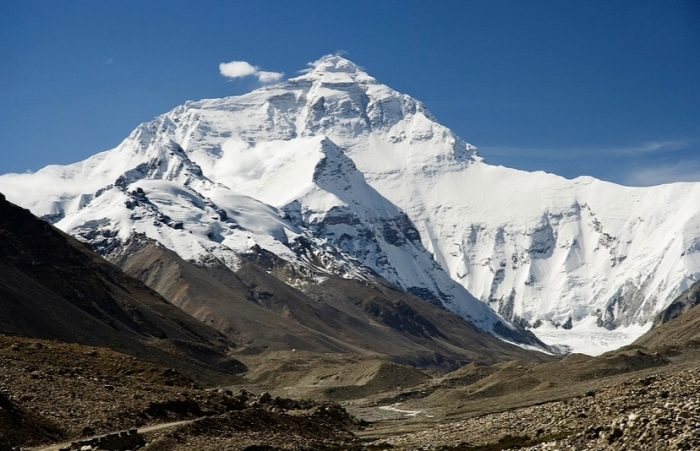
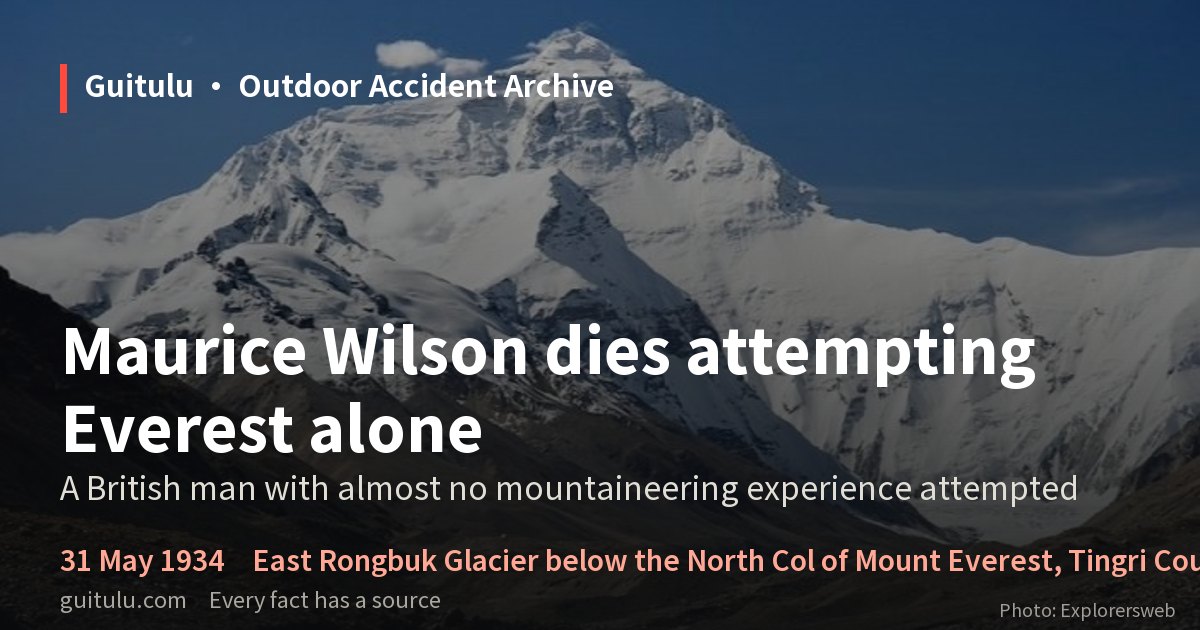
The north face of Everest seen on the way to Base Camp from the Tibet side

Archive / Mountaineering

Maurice Wilson dies attempting Everest alone

A British man with almost no mountaineering experience attempted the North Col of Everest alone and died at its foot

There is no doubt that Wilson died; the exact date of his death is unknown. His last legible diary entry was written on 31 May 1934.

Photo: Explorersweb

Date
Late May, before the monsoon
Place
East Rongbuk Glacier below the North Col of Mount Everest, Tingri County, Shigatse, Tibet, ChinaChina › Tibet · Himalaya86.923°E 28.016°N
Activity
MountaineeringInvolves: Extreme weather · Sudden illness and exhaustion1 solo climber (Maurice Wilson), accompanied by 3 porters to the foot of the mountain and Camp III
Casualties
Dead 1 Wilson died; his body was found by a British reconnaissance party in 1935
Material
43 facts · 10 sources3 accounts differ and are shown side by side

01What happened

Maurice Wilson was a First World War veteran who had been awarded the Military Cross and had suffered gunshot wounds to his back and left arm. He believed strongly in fasting and prayer and wanted to demonstrate the power of faith by climbing Everest. He had almost no mountaineering experience but intended to climb alone. His original plan was to fly to Everest, make a forced landing on the mountain and then climb to the summit on foot.Facts it rests onF01Multiple sourcesWilson served in the First World War and was awarded the Military Cross. He was wounded in the back and left arm by machine-gun fire, leaving him with limited movement in his arm.F02Multiple sourcesWilson believed firmly in fasting and prayer and wanted to demonstrate the power of faith by climbing Everest.F41Multiple sourcesMaurice Wilson had almost no mountaineering experience, yet planned to climb Everest alone.F03Multiple sourcesHis original plan was to fly his own plane to Everest, make a forced landing on the mountain, and then climb to the summit alone on foot.

The north face of Everest seen on the way to Base Camp from the Tibet sidePhoto source: Explorersweb

He bought a second-hand Gipsy Moth biplane and named it Ever Wrest. The British government, concerned that his flight over Nepal would cause a diplomatic incident, tried to stop him, but he took off from Britain on 21 May 1933. After he reached India, the authorities impounded his plane. He spent the winter in Darjeeling, and his permit to enter Tibet was not approved.Facts it rests onF04Multiple sourcesHe bought a second-hand de Havilland Gipsy Moth biplane, named it “Ever Wrest”, and learned to fly for the purpose.F06Multiple sourcesThe British government, concerned that his flight over Nepal could cause a diplomatic incident, tried to stop him.F09Multiple sourcesOn 21 May 1933, Wilson took off from Britain in his plane despite official attempts to stop him.F07Multiple sourcesAfter he flew to India, his plane was impounded by the authorities.F08Multiple sourcesHe then spent the winter in Darjeeling, and his application for permission to enter Tibet from the north to climb Everest was not approved.

Everest seen from the Rongbuk Valley, near Base Camp and the end of the Rongbuk GlacierPhoto source: Explorersweb

On 21 March 1934, he and three porters who had taken part in the 1933 Everest expedition disguised themselves as monks and set out on foot from Darjeeling into Tibet, reaching Rongbuk Monastery on 14 April. On 16 April he went up the mountain alone. He lost his way repeatedly on the glacier, found an old pair of crampons but discarded them, and was eventually stopped by the weather about two miles from Camp III. When he returned to the monastery, he was suffering from snow blindness and a sprained ankle; he rested for about 18 days.Facts it rests onF10Multiple sourcesIn Darjeeling, he found three companions who had served as porters for the 1933 Ruttledge Everest expedition: Tewang, Rinzing and Tsering.F12Multiple sourcesOn 21 March 1934, Wilson and his companions set out on foot from Darjeeling disguised as Buddhist monks and entered Tibet secretly via Sikkim.F16Multiple sourcesOn 14 April 1934, they reached Rongbuk Monastery at the foot of Everest, where they were welcomed.F17Multiple sourcesOn 16 April 1934, carrying a pack weighing about 45 pounds (about 20 kilograms), he set out alone from Rongbuk Monastery for Everest, leaving his companions behind.F13Multiple sourcesDuring his first attempt, he repeatedly lost his way and came to dead ends on the glacier, and was trapped by a blizzard.F14Multiple sourcesAlong the way, he found a pair of crampons at an old camp used by an earlier expedition, but put them aside.F18Multiple sourcesHe was stopped by the weather about two miles from Camp III below the North Col. He wrote in his diary that the weather had defeated him, then retreated.F15Multiple sourcesWhen he retreated to Rongbuk Monastery, he was suffering from snow blindness and a severely sprained ankle. He rested for about two and a half weeks (18 days).

Maurice Wilson's 1934 diaryPhoto source: Explorersweb

On 12 May, he set out again with two companions, reached Camp III below the North Col, and found food left in 1933. After that, he made several attempts alone to climb the ice slope to the North Col. The steps and fixed ropes he had expected to find were gone, and he was eventually stopped by an ice wall at about 22,700 feet. His companions begged him to retreat, but he refused. On 29 May, he set out alone again, but ran out of strength that day and camped at the foot of the North Col, a few hundred yards from camp. His last legible diary entry, dated 31 May, read: “Off again, beautiful day.”Facts it rests onF24Multiple sourcesOn 12 May 1934, he set out again with Tewang and Rinzing, reaching Camp III below the North Col.F19Multiple sourcesRinzing led him to food supplies left near Camp III by the 1933 expedition.F25Multiple sourcesHe had expected the steps and fixed ropes left by the 1933 expedition on the ice slope to the North Col to still be there, but found when he went up that they were gone.F21Multiple sourcesHe left the porters at Camp III and made several attempts to climb the ice slope to the North Col alone, all unsuccessful. He was finally stopped by an ice wall at approximately 22,700 feet (approximately 6,900 metres).F22Multiple sourcesAfter he returned to camp, two companions begged him to retreat with them to Rongbuk Monastery, but he refused.F26Multiple sourcesOn 29 May 1934, he wrote in his diary, “This will be the last effort”, and set out alone again.F27Multiple sourcesThat day, he was too exhausted to climb the North Col and camped at its foot, a few hundred yards from Camp III.F28Multiple sourcesHis last legible diary entry was written on 31 May 1934 and consisted of one sentence: “Off again, gorgeous day”.

Wilson's aircraft Ever-Wrest overturned in an accident in Britain in 1933Photo source: Hayden Rue

Wilson did not return. His companions descended and brought news to Kalimpong in late July. In July 1935, a British reconnaissance party led by Eric Shipton reached Camp III and found his body nearby. His tent had been blown away, and his diary and camera were beside him. The party buried him in a crevasse; his remains have since been exposed again several times as the East Rongbuk Glacier has moved.Facts it rests onF29Multiple sourcesWilson did not return. His companions descended the mountain and reached Kalimpong, India, in late July, bringing back news of him.F30Multiple sourcesIn 1935, Eric Shipton led a small British reconnaissance expedition to Tibet to investigate Everest.F38Single sourceOn 8 July 1935, the reconnaissance expedition reached Camp III at the foot of the North Col.F32Multiple sourcesThe reconnaissance expedition found Wilson's body near Camp III, about a year after his death.F34Multiple sourcesHe was in his tent when he died, but the tent had been blown away, leaving only fragments beside his body.F35Multiple sourcesHis diary and camera were found with his body.F37Multiple sourcesThe reconnaissance expedition buried his body in a nearby crevasse.F43Multiple sourcesAs the East Rongbuk Glacier moved downward, his remains were repeatedly exposed again and were often seen below Advanced Base Camp over the years.

The number at the end of a paragraph is how many facts it rests on; open it to see each fact and how well it is sourced: Multiple sourcesSingle source. Conflicting accounts and speculation are kept out of the narrative.

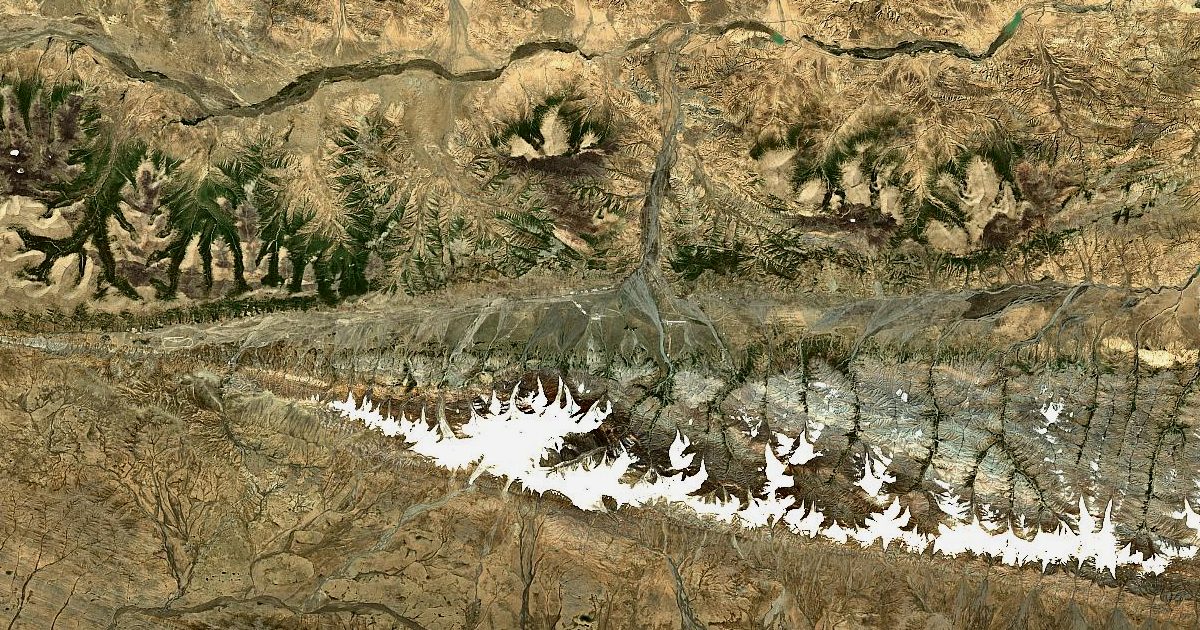
  • Reported places passed through (schematic)Schematic

Satellite imagery Sentinel-2 cloudless 2024 © EOX · Terrain AWS Terrain Tiles · Orange line is schematic · Place coordinates not individually verified

Route review

7 scenes to understand what happened

Scroll down and the map flies to where each part happened. The line is Schematic, Lines connect the places mentioned in reports in sequence, indicating only the approximate direction, not the actual route. Sources for the place coordinates are in places.json.

01

Full route

The places mentioned in reports are connected in sequence to show the approximate route (schematic).

03

First setback

He lost his way repeatedly on the glacier and was stopped by the weather about two miles from Camp III. He returned to the monastery and rested for about 18 days.Facts it rests onF13Multiple sourcesDuring his first attempt, he repeatedly lost his way and came to dead ends on the glacier, and was trapped by a blizzard.F18Multiple sourcesHe was stopped by the weather about two miles from Camp III below the North Col. He wrote in his diary that the weather had defeated him, then retreated.F15Multiple sourcesWhen he retreated to Rongbuk Monastery, he was suffering from snow blindness and a severely sprained ankle. He rested for about two and a half weeks (18 days).

05

North Col ice wall

He made several solo attempts to climb the ice slope to the North Col, but was stopped by an ice wall at about 22,700 feet. He continued to refuse his companions' pleas to turn back.Facts it rests onF21Multiple sourcesHe left the porters at Camp III and made several attempts to climb the ice slope to the North Col alone, all unsuccessful. He was finally stopped by an ice wall at approximately 22,700 feet (approximately 6,900 metres).F22Multiple sourcesAfter he returned to camp, two companions begged him to retreat with them to Rongbuk Monastery, but he refused.

06

The last diary entry

On 29 May, he set out alone for the last time and camped at the foot of the North Col; on 31 May, he wrote the last line in his diary.Facts it rests onF26Multiple sourcesOn 29 May 1934, he wrote in his diary, “This will be the last effort”, and set out alone again.F27Multiple sourcesThat day, he was too exhausted to climb the North Col and camped at its foot, a few hundred yards from Camp III.F28Multiple sourcesHis last legible diary entry was written on 31 May 1934 and consisted of one sentence: “Off again, gorgeous day”.

02Timeline

  1. On 21 May 1933, Wilson took off from Britain in his plane despite official attempts to stop him. F09

  2. On 21 March 1934, Wilson and his companions set out on foot from Darjeeling disguised as Buddhist monks and entered Tibet secretly via Sikkim. F12

  3. On 14 April 1934, they reached Rongbuk Monastery at the foot of Everest, where they were welcomed. F16

  4. On 16 April 1934, carrying a pack weighing about 45 pounds (about 20 kilograms), he set out alone from Rongbuk Monastery for Everest, leaving his companions behind. F17

  5. He was stopped by the weather about two miles from Camp III below the North Col. He wrote in his diary that the weather had defeated him, then retreated. F18

  6. On 12 May 1934, he set out again with Tewang and Rinzing, reaching Camp III below the North Col. F24

  7. He had expected the steps and fixed ropes left by the 1933 expedition on the ice slope to the North Col to still be there, but found when he went up that they were gone. F25

  8. On 29 May 1934, he wrote in his diary, “This will be the last effort”, and set out alone again. F26

  9. His last legible diary entry was written on 31 May 1934 and consisted of one sentence: “Off again, gorgeous day”. F28

  10. Wilson did not return. His companions descended the mountain and reached Kalimpong, India, in late July, bringing back news of him. F29

  11. The reconnaissance expedition found Wilson's body near Camp III, about a year after his death. F32

  12. On 8 July 1935, the reconnaissance expedition reached Camp III at the foot of the North Col. F38

  13. In May 1999, Jochen Hemmleb and others from the Mallory and Irvine Research Expedition found Wilson's remains on the glacier below Advanced Base Camp. F39

03Lessons

Avalanche and high altitude

Willpower cannot replace snow and ice skills

Before setting out, Wilson had spent only a few weeks hiking in mountains without snow. He had not learned to use an ice axe or crampons, and discarded the crampons he found along the way. The icy slope of the North Col ultimately stopped him. High-altitude snow and ice routes require systematic training beforehand, as well as knowing how to use the equipment.Facts it rests onF05Multiple sourcesHis only preparation for the climb was about five weeks of hiking in the mountains of Wales and northern England; he did not learn to use an ice axe or crampons.F14Multiple sourcesAlong the way, he found a pair of crampons at an old camp used by an earlier expedition, but put them aside.F21Multiple sourcesHe left the porters at Camp III and made several attempts to climb the ice slope to the North Col alone, all unsuccessful. He was finally stopped by an ice wall at approximately 22,700 feet (approximately 6,900 metres).

Weather and retreat

Retreat is itself a success

After the weather stopped his first attempt, he returned to the monastery and survived. On the second attempt, his companions begged him to turn back, but he insisted on continuing alone and still did not descend after becoming exhausted. Setting clear conditions for turning back and acting on them when they occur is more important than the plan itself.Facts it rests onF18Multiple sourcesHe was stopped by the weather about two miles from Camp III below the North Col. He wrote in his diary that the weather had defeated him, then retreated.F15Multiple sourcesWhen he retreated to Rongbuk Monastery, he was suffering from snow blindness and a severely sprained ankle. He rested for about two and a half weeks (18 days).F22Multiple sourcesAfter he returned to camp, two companions begged him to retreat with them to Rongbuk Monastery, but he refused.F27Multiple sourcesThat day, he was too exhausted to climb the North Col and camped at its foot, a few hundred yards from Camp III.

Rescue and self-rescue

Going alone means no rescue

After he separated from his companions, no one knew how he was faring on the mountain. His companions could only wait and eventually descended to report what had happened; his body was not found until a year later. When going alone at high altitude, there is almost no chance of being found and rescued if something goes wrong.Facts it rests onF26Multiple sourcesOn 29 May 1934, he wrote in his diary, “This will be the last effort”, and set out alone again.F29Multiple sourcesWilson did not return. His companions descended the mountain and reached Kalimpong, India, in late July, bringing back news of him.F32Multiple sourcesThe reconnaissance expedition found Wilson's body near Camp III, about a year after his death.

Closed areas and rules

A trip without permission receives no support

His permit to enter Tibet was not approved, so he had to disguise himself as a monk and travel there secretly, without any official or expedition support. High-altitude climbing today likewise requires permits and registration. These are rules, but also prerequisites for being found if something goes wrong.Facts it rests onF08Multiple sourcesHe then spent the winter in Darjeeling, and his application for permission to enter Tibet from the north to climb Everest was not approved.F12Multiple sourcesOn 21 March 1934, Wilson and his companions set out on foot from Darjeeling disguised as Buddhist monks and entered Tibet secretly via Sikkim.

04Fact list 43 facts

Under each fact is a verbatim quote from the original. "Single source" means only one outlet mentioned it; "Accounts differ" means sources contradict each other and this site adopts neither side; "Speculation" is an inference by a reporter or a person involved, not a fact.

  1. F01Multiple sourcesBackground

    Wilson served in the First World War and was awarded the Military Cross. He was wounded in the back and left arm by machine-gun fire, leaving him with limited movement in his arm.

    Quotes from the original 3

    “Wilson fought with distinction, winning a Military Cross, but lost the use of an arm”

    The Spectator · 2020-11-14

    “Wilson was hit across the back and left arm, but he survived. The injuries left him with pain and loss of function in his arm”

    Damn Interesting · 2022

    “机枪射击伤到了他的背部和左臂,使他此后行动受限。”

    Machine-gun fire wounded his back and left arm, leaving him with limited mobility thereafter. (machine translation)

    NetEase · 2026-06-15
  2. F02Multiple sourcesBackground

    Wilson believed firmly in fasting and prayer and wanted to demonstrate the power of faith by climbing Everest.

    Quotes from the original 2

    “A devotee of fasting and Eastern religions, and a fervent believer in building character through self-denial and physical hardship”

    The New York Review of Books · 2020-10-08

    “He believed that he could use fasting and prayer to succeed where Mallory, Irvine, and other climbers before them had failed”

    Damn Interesting · 2022
  3. F03Multiple sourcesPlan

    His original plan was to fly his own plane to Everest, make a forced landing on the mountain, and then climb to the summit alone on foot.

    Includes a low-reliability source

    Quotes from the original 2

    “he would fly his own plane from England to Tibet, crash-land it partway up the mountain at about 14,000 feet, and climb solo to the summit.”

    Damn Interesting · 2022

    “He intended to fly a small aircraft to Tibet, crash-land it on Everest’s upper slopes, and then trek to the summit.”

    Hayden Rue ·
  4. F04Multiple sourcesBackground

    He bought a second-hand de Havilland Gipsy Moth biplane, named it “Ever Wrest”, and learned to fly for the purpose.

    Quotes from the original 3

    “He learned to fly a single-engine, open cockpit de Havilland Gipsy Moth, which he named Ever Wrest”

    The New York Review of Books · 2020-10-08

    “威尔逊买下一架二手 de Havilland Gipsy Moth 双翼飞机”

    Wilson bought a second-hand de Havilland Gipsy Moth biplane (machine translation)

    NetEase · 2026-06-15

    “Wilson bought a second-hand Gipsy Moth airplane, took his first and only course of flying lessons”

    PBS NOVA · 1999-05-13
  5. F05Multiple sourcesBackground

    His only preparation for the climb was about five weeks of hiking in the mountains of Wales and northern England; he did not learn to use an ice axe or crampons.

    Includes a low-reliability source

    Quotes from the original 3

    “he made no effort to learn how to use technical mountaineering gear like ice axes or crampons”

    Damn Interesting · 2022

    “他只在威尔士和湖区做过一些徒步,从未真正攀登过高山,不会熟练使用冰爪和冰镐。”

    He had only done some hiking in Wales and the Lake District, had never really climbed a high mountain, and was not proficient in using crampons and an ice axe. (machine translation)

    NetEase · 2026-06-15

    “he spent a mere five weeks wandering the hills of Snowdonia and the Lake District before deeming himself ready.”

    Hayden Rue ·
  6. F06Multiple sourcesEvent

    The British government, concerned that his flight over Nepal could cause a diplomatic incident, tried to stop him.

    Quotes from the original 2

    “His Majesty’s Government, worried that Wilson’s plan to overfly self-isolated Nepal would touch off a diplomatic incident, ordered him to call it off.”

    The New York Review of Books · 2020-10-08

    “British authorities tried to thwart him for fear he might spark a diplomatic incident”

    The Spectator · 2020-11-14
  7. F07Multiple sourcesEvent

    After he flew to India, his plane was impounded by the authorities.

    Quotes from the original 3

    “抵达印度北部普尔尼亚后,飞机被英印当局扣留。”

    After he arrived in Purnia in northern India, the plane was impounded by the British Indian authorities. (machine translation)

    NetEase · 2026-06-15

    “Local police officers waiting at the airstrip impounded the Ever-Wrest”

    Damn Interesting · 2022

    “before his plane, with its fuel range of 740 miles, was confiscated.”

    The Spectator · 2020-11-14
  8. F08Multiple sourcesMovement

    He then spent the winter in Darjeeling, and his application for permission to enter Tibet from the north to climb Everest was not approved.

    Includes a low-reliability source

    Quotes from the original 2

    “Wilson spent the winter in Darjeeling, India, fasting and praying and trying unsuccessfully to get a permit to enter Tibet to climb Everest from the north.”

    Damn Interesting · 2022

    “After facing disappointment in his attempts to gain permission to enter Tibet by foot, Wilson spent the winter in Darjeeling”

    Hayden Rue ·
  9. F09Multiple sourcesMovement

    On 21 May 1933, Wilson took off from Britain in his plane despite official attempts to stop him.

    Includes a low-reliability source

    Quotes from the original 3

    “1933年5月21日,威尔逊起飞,开始了这次旅程。”

    On 21 May 1933, Wilson took off and began the journey. (machine translation)

    NetEase · 2026-06-15

    “Wilson set off on May 21, against the efforts of the British government.”

    Hayden Rue ·

    “So on 21 May 1933, plane repaired and his will rewritten”

    Damn Interesting · 2022
  10. F10Multiple sourcesBackground

    In Darjeeling, he found three companions who had served as porters for the 1933 Ruttledge Everest expedition: Tewang, Rinzing and Tsering.

    Includes a low-reliability source

    Quotes from the original 2

    “He hired three experienced Bhutia porters: Tewang, Rinzing, and Tsering. The men had all worked on the 1933 Ruttledge expedition to Everest”

    Damn Interesting · 2022

    “He encountered three Sherpas—Tewang, Rinzing, and Tsering—who had previously served as porters on the 1933 Everest expedition led by Hugh Ruttledge.”

    Hayden Rue ·
  11. F11Accounts differBackground

    Accounts differ on the number of companions: most sources say there were three; a NetEase article says there were two Bhutanese companions.

    Accounts differ on the number of companions

    Quotes from the original 3

    “with his trio of Bhutia helpers en route to Everest.”

    The Spectator · 2020-11-14

    “joined by three Sherpa guides”

    The New York Review of Books · 2020-10-08

    “他一度伪装成僧侣,并带着两名不丹同伴同行。”

    He disguised himself as a monk for a time and travelled with two Bhutanese companions. (machine translation)

    NetEase · 2026-06-15
  12. F12Multiple sourcesMovement

    On 21 March 1934, Wilson and his companions set out on foot from Darjeeling disguised as Buddhist monks and entered Tibet secretly via Sikkim.

    Quotes from the original 3

    “On 21 March 1934, the four men disguised themselves as Buddhist monks and set out on foot to cross the Kingdom of Sikkim (now part of northern India) into Tibet.”

    Damn Interesting · 2022

    “On March 21, 1934, Wilson and his three sherpas discreetly departed from Darjeeling, disguising themselves as Buddhist monks.”

    Hayden Rue ·

    “disguised as a Tibetan monk and joined by three Sherpa guides, he trekked for a month across the bleak Tibetan plateau.”

    The New York Review of Books · 2020-10-08
  13. F13Multiple sourcesEvent

    During his first attempt, he repeatedly lost his way and came to dead ends on the glacier, and was trapped by a blizzard.

    Some sources are of low reliability

    Quotes from the original 2

    “he lost his way in a maze of ice pinnacles, wandered into cul-de-sacs, became pinned down in a blizzard, sprained an ankle, and ran out of food.”

    The New York Review of Books · 2020-10-08

    “Frequently losing his way, he had to retrace his steps repeatedly.”

    Hayden Rue ·
  14. F14Multiple sourcesEvent

    Along the way, he found a pair of crampons at an old camp used by an earlier expedition, but put them aside.

    Some sources are of low reliability

    Quotes from the original 2

    “he turned up a pair of crampons. Inexplicably, he tossed them aside and continued upward.”

    Damn Interesting · 2022

    “he stumbled upon a pair of crampons at an old 1933 expedition camp, and then discarded them.”

    Hayden Rue ·
  15. F15Multiple sourcesEvent

    When he retreated to Rongbuk Monastery, he was suffering from snow blindness and a severely sprained ankle. He rested for about two and a half weeks (18 days).

    Quotes from the original 3

    “spent 18 days recovering from snowblindness, a twisted ankle, and his exacerbated war wound.”

    Damn Interesting · 2022

    “Upon his return to the monastery, he was physically drained, suffering from snow blindness, and a badly twisted ankle.”

    Hayden Rue ·

    “He managed to hobble back to the monastery, rested for two and a half weeks, and then started afresh.”

    The New York Review of Books · 2020-10-08
  16. F16Multiple sourcesMovement

    On 14 April 1934, they reached Rongbuk Monastery at the foot of Everest, where they were welcomed.

    Quotes from the original 3

    “the four men reached the Rongbuk monastery at the foot of Mount Everest, where they were warmly welcomed by the lama of the monastery”

    Damn Interesting · 2022

    “Finally, on April 14, they arrived at the Rongbuk Monastery, where they were warmly welcomed”

    Hayden Rue ·

    “In mid-April he arrived at the 16,000-foot-high Rongbuk Monastery at the foot of Everest, where he received a blessing from the head lama.”

    The New York Review of Books · 2020-10-08
  17. F17Multiple sourcesMovement

    On 16 April 1934, carrying a pack weighing about 45 pounds (about 20 kilograms), he set out alone from Rongbuk Monastery for Everest, leaving his companions behind.

    Quotes from the original 3

    “On April 16, 1934, carrying a forty-five-pound backpack filled with a tent, two stoves, a camera, a few days’ worth of food, a sleeping bag”

    The New York Review of Books · 2020-10-08

    “into a 45-pound pack”

    Damn Interesting · 2022

    “After a mere two days, he embarked alone towards Mount Everest, leaving the monastery behind.”

    Hayden Rue ·
  18. F18Multiple sourcesEvent

    He was stopped by the weather about two miles from Camp III below the North Col. He wrote in his diary that the weather had defeated him, then retreated.

    Some sources are of low reliability

    Quotes from the original 3

    “two miles short of Camp III below the North Col”

    Damn Interesting · 2022

    ““It’s the weather that’s beaten me—what damned bad luck,” he wrote in his diary, as he began his retreat.”

    Damn Interesting · 2022

    “Wilson found himself two miles away from Ruttledge’s Camp III below the North Col.”

    Hayden Rue ·
  19. F19Multiple sourcesFound at scene

    Rinzing led him to food supplies left near Camp III by the 1933 expedition.

    Quotes from the original 2

    “Rinzing had shown him the whereabouts of the food dump near Camp III.”

    Himalayan Journal ·

    “they spent the time ransacking the food stores left behind by Ruttledge’s team.”

    Damn Interesting · 2022
  20. F20Multiple sourcesEvent

    Bad weather trapped them at Camp III for several days.

    Some sources are of low reliability

    Quotes from the original 2

    “Bad weather kept them stuck for several days at Camp III”

    Damn Interesting · 2022

    “Adverse weather conditions confined them to camp for several days”

    Hayden Rue ·
  21. F21Multiple sourcesEvent

    He left the porters at Camp III and made several attempts to climb the ice slope to the North Col alone, all unsuccessful. He was finally stopped by an ice wall at approximately 22,700 feet (approximately 6,900 metres).

    Quotes from the original 3

    “Leaving his porters there he had started alone to make repeated unsuccessful attempts to climb the ice slopes of the North Col.”

    Himalayan Journal ·

    “after four more days of chopping steps into the ice, he was stymied by a massive ice wall around an elevation of 22,700 feet.”

    Damn Interesting · 2022

    “he was ultimately defeated by a forty-foot ice wall at approximately 22,700 feet”

    Hayden Rue ·
  22. F22Multiple sourcesEvent

    After he returned to camp, two companions begged him to retreat with them to Rongbuk Monastery, but he refused.

    Some sources are of low reliability

    Quotes from the original 2

    “his companions begged him to return with them to the monastery, but he refused.”

    Damn Interesting · 2022

    “Although the Sherpas implored Wilson to abandon his pursuit and return to the monastery, he refused.”

    Hayden Rue ·
  23. F23Accounts differPlan

    Accounts differ on how long he and his companions agreed they would wait: everest1924.com says ten days, while Damn Interesting says two weeks.

    Accounts differ on the waiting period

    Quotes from the original 2

    “Wilson asks his Sherpas to wait ten days for him to return, after which they would be free to leave.”

    everest1924.com ·

    “Wilson had left instructions with the Bhutias that if he did not return after two weeks, they were to assume he was dead.”

    Damn Interesting · 2022
  24. F24Multiple sourcesMovement

    On 12 May 1934, he set out again with Tewang and Rinzing, reaching Camp III below the North Col.

    Quotes from the original 3

    “On 12 May, Wilson set out again, this time bringing Tewang and Rinzing with him”

    Damn Interesting · 2022

    “Wilson ventured forth once again on May 12, accompanied by Tewand and Rinzing.”

    Hayden Rue ·

    “From his diary it appeared that he had gone to Camp III with Rinzing and Tewang, both of whom were now with us in 1935.”

    Himalayan Journal ·
  25. F25Multiple sourcesEvent

    He had expected the steps and fixed ropes left by the 1933 expedition on the ice slope to the North Col to still be there, but found when he went up that they were gone.

    Some sources are of low reliability

    Quotes from the original 2

    “He was naively disappointed to find that the steps and fixed ropes left by Ruttledge’s team the year before had not survived the weather.”

    Damn Interesting · 2022

    “On the 21st, Wilson made a fruitless attempt to reach the North Col, only to discover the absence of the rope and steps he had anticipated.”

    Hayden Rue ·
  26. F26Multiple sourcesEvent

    On 29 May 1934, he wrote in his diary, “This will be the last effort”, and set out alone again.

    Some sources are of low reliability

    Quotes from the original 2

    ““This will be a last effort, and I feel successful,” Wilson wrote in his diary, and set out alone on 29 May.”

    Damn Interesting · 2022

    “In his diary, Wilson wrote, “This will be a last effort, and I feel successful,” before setting off alone for the final time on May 29.”

    Hayden Rue ·
  27. F27Multiple sourcesEvent

    That day, he was too exhausted to climb the North Col and camped at its foot, a few hundred yards from Camp III.

    Some sources are of low reliability

    Quotes from the original 2

    “He made it a few hundred yards from Camp III before setting up camp, too weak to attempt the North Col.”

    Damn Interesting · 2022

    “Weakened and unable to attempt the Col that day, he established camp at its base, a mere few hundred yards from where the Sherpas were encamped.”

    Hayden Rue ·
  28. F28Multiple sourcesFound at scene

    His last legible diary entry was written on 31 May 1934 and consisted of one sentence: “Off again, gorgeous day”.

    Quotes from the original 4

    ““Off again, gorgeous day,” he wrote in his diary on the morning of May 31, 1934”

    The New York Review of Books · 2020-10-08

    “The last entry in his diary, dated 31 May 1934, said “Off again, gorgeous day.””

    Damn Interesting · 2022

    “In his diary, found beside his body, the last entry was: “Off again. Gorgeous day.””

    Explorersweb · 2023-06-03

    “‘Off again, gorgeous day,’ read the laconic last diary entry.”

    The Spectator · 2020-11-14
  29. F29Multiple sourcesAftermath

    Wilson did not return. His companions descended the mountain and reached Kalimpong, India, in late July, bringing back news of him.

    Some sources are of low reliability

    Quotes from the original 2

    “They brought news of Wilson’s death to Kalimpong, India, in late July”

    Damn Interesting · 2022

    “They arrived in Kalimpong in late July, they told the world of what happened to Maurice Wilson on Everest.”

    Hayden Rue ·
  30. F30Multiple sourcesBackground

    In 1935, Eric Shipton led a small British reconnaissance expedition to Tibet to investigate Everest.

    Quotes from the original 3

    “a small group, under the leadership of E. E. Shipton, was despatched to Tibet to make a reconnaissance”

    AAC ·

    “The party assembled inDarjeeling about the 21st May, and moved off three days later.”

    Himalayan Journal ·

    “A small post-monsoon expedition led by Eric Shipton”

    everest1924.com ·
  31. F31Multiple sourcesParticipant's view

    After reading the diary, Shipton wrote that there was no point in judging his plan from a mountaineering perspective, but that one could not help admiring his courage.

    Quotes from the original 2

    ““it is obviously futile to judge his project from a mountaineering standpoint,” Eric Shipton wrote after finding Wilson’s diary, “…we cannot fail to admire his courage.””

    Damn Interesting · 2022

    “We cannot fail to admire his courage.”

    PBS NOVA · 1999-05-13
  32. F32Multiple sourcesFound at scene

    The reconnaissance expedition found Wilson's body near Camp III, about a year after his death.

    Quotes from the original 4

    “A few hundred yards above Camp III, in fact within sight and hail of it, we came upon the body of Maurice Wilson.”

    Himalayan Journal ·

    “They also discovered the body of Capt. Maurice Wilson, lost on a solo attempt to climb the mountain in 1934”

    AAC ·

    “they establish Camp III at the base of the North Col, where they find the remains of Maurice Wilson.”

    everest1924.com ·

    “was discovered a year later by a British Reconnaissance Expedition.”

    PBS NOVA · 1999-05-13
  33. F33Accounts differFound at scene

    Accounts differ on the location and altitude of his body: Shipton said it was a few hundred yards above Camp III; the American Alpine Club said it was at approximately 23,000 feet, about 300 feet below Camp III; everest1924.com said approximately 21,000 feet (6400 metres), below the North Col; PBS NOVA said approximately 22,000 feet; Explorersweb said he died at 6500 metres.

    Sources give different locations and altitudes

    Quotes from the original 5

    “A few hundred yards above Camp III”

    Himalayan Journal ·

    “at 23,000 feet, about 300 feet below Camp III”

    AAC ·

    “Wilson's body is later found at approximately 21,000 feet (6400 meters) below the North Col”

    everest1924.com ·

    “He died alone at 22,000 feet”

    PBS NOVA · 1999-05-13

    “Wilson died at 6,500m of exposure.”

    Explorersweb · 2023-06-03
  34. F34Multiple sourcesFound at scene

    He was in his tent when he died, but the tent had been blown away, leaving only fragments beside his body.

    Quotes from the original 3

    “He had been in a tent when he died, but it had been blown away from over his body.”

    Himalayan Journal ·

    “accompanied by the remnants of a tattered tent”

    Hayden Rue ·

    “surrounded by his rucksack, his diary, and the remnants of his tent.”

    Damn Interesting · 2022
  35. F35Multiple sourcesFound at scene

    His diary and camera were found with his body.

    Quotes from the original 3

    “and with it his diary and camera.”

    AAC ·

    “a rucksack containing Wilson’s diary and camera film was discovered in close proximity.”

    Hayden Rue ·

    “In his diary, found beside his body”

    Explorersweb · 2023-06-03
  36. F36SpeculationSpeculation

    Shipton suggested that Wilson may have died of exhaustion in his sleep rather than of starvation, because he had found food left in 1933 and still had ample supplies.

    Quotes from the original 1

    “It would seem that he had died in his sleep from exhaustion rather than from starvation, since he had found the cache of food which had been left in 1933, and the dump was still well stocked.”

    Himalayan Journal ·
  37. F37Multiple sourcesAftermath

    The reconnaissance expedition buried his body in a nearby crevasse.

    According to PBS NOVA, his body was wrapped in his tent before being placed in the crevasse.

    Quotes from the original 3

    “They wrapped him in his tent and placed him in a crevasse.”

    PBS NOVA · 1999-05-13

    “As a final resting place, the team chose to inter his body in a nearby crevasse.”

    Hayden Rue ·

    “His body was buried in a crevasse”

    everest1924.com ·
  38. F38Single sourceMovement

    According to Himalayan Journal, On 8 July 1935, the reconnaissance expedition reached Camp III at the foot of the North Col.

    Quotes from the original 1

    “no difficulty whatsoever in reaching Camp III, where we arrived on the 8th July.”

    Himalayan Journal ·
  39. F39Single sourceAftermath

    According to PBS NOVA, In May 1999, Jochen Hemmleb and others from the Mallory and Irvine Research Expedition found Wilson's remains on the glacier below Advanced Base Camp.

    Quotes from the original 1

    “Today, Jochen Hemmleb and expedition doctor Lee Meyers, found Wilson's remains on the glacier just below Advance Base Camp.”

    PBS NOVA · 1999-05-13
  40. F40SpeculationSpeculation

    In 2003, historical researcher Thomas Noy speculated that Wilson may have reached the summit and died during the descent. This speculation has not been generally accepted by the mountaineering community.

    Some sources have low credibility

    Quotes from the original 2

    “In 2003, historian Thomas Noy proposed that Wilson may have actually reached the summit and died on his way down.”

    Damn Interesting · 2022

    “However, Noy’s theory has not garnered widespread acceptance within the mountaineering community.”

    Hayden Rue ·
  41. F41Multiple sourcesBackground

    Maurice Wilson had almost no mountaineering experience, yet planned to climb Everest alone.

    Quotes from the original 3

    “Maurice Wilson was full of self-confidence but had very little climbing experience. With rubbish equipment, he tried to climb Everest alone, from the north.”

    Explorersweb · 2023-06-03

    “威尔逊几乎没有登山经验。”

    Wilson had almost no mountaineering experience. (machine translation)

    NetEase · 2026-06-15

    “The eccentric Maurice Wilson attempts to solo Everest, having no mountaineering experience but possessing an inner faith to succeed.”

    everest1924.com ·
  42. F43Multiple sourcesAftermath

    As the East Rongbuk Glacier moved downward, his remains were repeatedly exposed again and were often seen below Advanced Base Camp over the years.

    Quotes from the original 3

    “it periodically resurfaces over the years as the East Rongbuk Glacier continues its steady advance downhill.”

    everest1924.com ·

    “his frozen corpse has emerged five times from its glacial tomb on the slopes where he died”

    The Spectator · 2020-11-14

    “For years, Wilson's remains have been seen and photographed just below Advance Base Camp.”

    PBS NOVA · 1999-05-13
  43. F45Multiple sourcesParticipant's view

    His contemporary, mountaineer Frank Smythe, commented: That was not mountaineering, but it was magnificent.

    Quotes from the original 2

    ““It wasn’t mountaineering,” proclaimed Frank Smythe, one of the era’s leading Himalayan climbers, “yet it was magnificent.””

    The New York Review of Books · 2020-10-08

    ““It was not mountaineering, yet it was magnificent.””

    Damn Interesting · 2022