GuituluGlobal Outdoor Accident Archive 中文
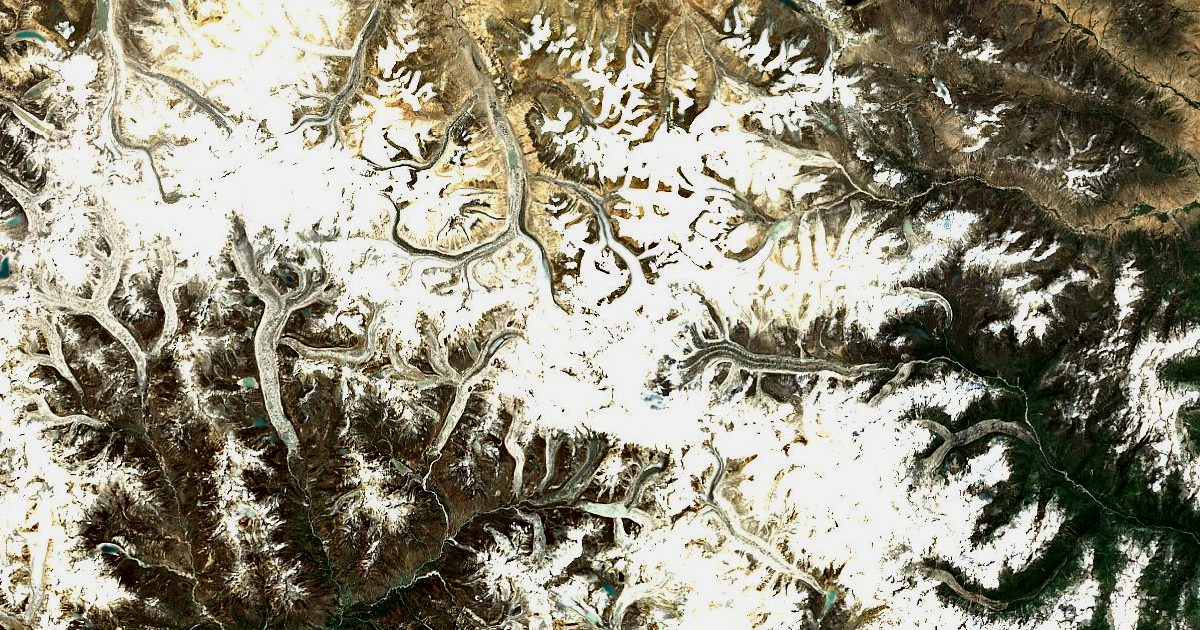
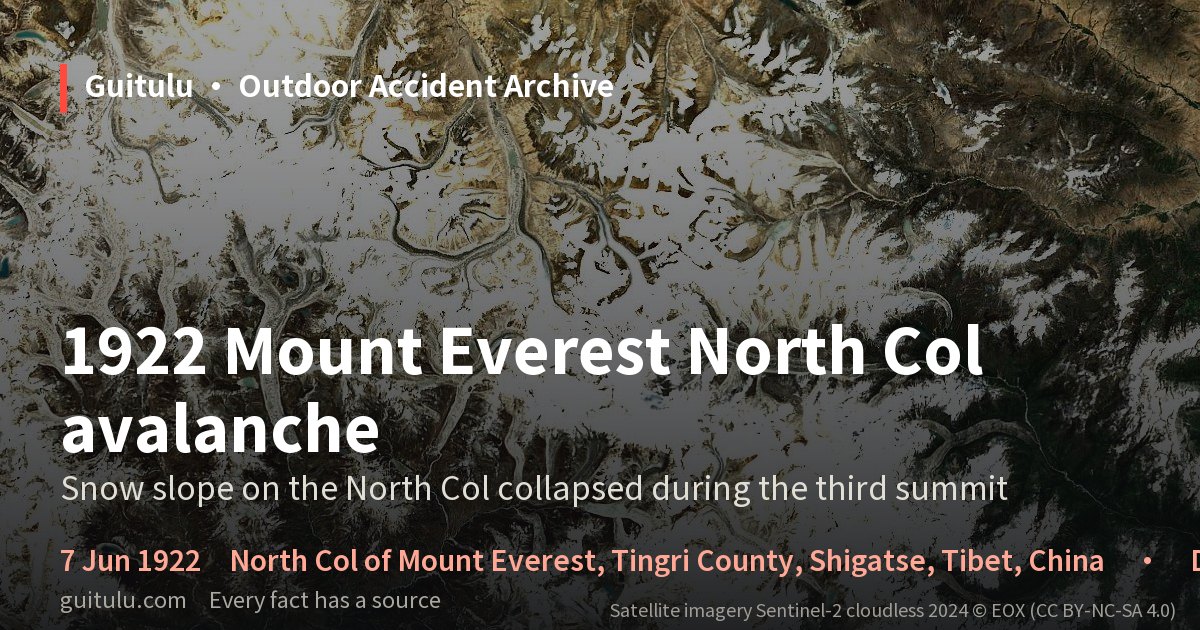
Satellite view of the area around North Col of Mount Everest, Tingri County, Shigatse, Tibet, China

Archive / Mountaineering

1922 Mount Everest North Col avalanche

Snow slope on the North Col collapsed during the third summit attempt, killing seven porters

A historical event documented in firsthand accounts and historical studies.

Satellite imagery Sentinel-2 cloudless 2024 © EOX (CC BY-NC-SA 4.0)

Date
June, around the arrival of the monsoon
Place
North Col of Mount Everest, Tingri County, Shigatse, Tibet, ChinaChina › Tibet · Himalaya86.923°E 28.016°N
Activity
MountaineeringInvolves: AvalancheThird summit party of the 1922 British Mount Everest Expedition: George Mallory, Howard Somervell, Colin Crawford and 14 porters
Casualties
Dead 7 Seven porters, including Sherpas, died; the three British climbers were swept down by the snow but were not seriously injured.
Material
35 facts · 7 sourcesSources agree

01What happened

The 1922 British Mount Everest Expedition, led by Charles Bruce, was the first human attempt to reach the summit of Everest. George Mallory was also on the team. In late May, Mallory, Norton and Somervell made the first summit attempt, turning back after reaching close to 27000 feet. Finch and Geoffrey Bruce then made another attempt using oxygen equipment, reaching above 27000 feet and setting a new altitude record, but they too failed to reach the summit.Facts it rests onF01Multiple sourcesThe 1922 British Mount Everest Expedition was led by Charles Bruce, with Norton and Mallory among the British climbers; it was the first human attempt to reach the summit of Mount Everest.F02Multiple sourcesGeorge Mallory was the only climber to take part in all three British Mount Everest expeditions of the 1920s: the 1921 reconnaissance and the 1922 and 1924 expeditions.F06Single sourceOn the first summit attempt, Mallory, Norton and Somervell reached an altitude close to 27000 feet, still more than 2000 feet from the summit, before turning back.F05Multiple sourcesOn the second summit attempt, George Finch and Geoffrey Bruce used oxygen equipment to reach above 27000 feet, surpassing the altitude record set by Mallory's party a few days earlier.

After the team returned to base camp, it was reported that they had encountered only two clear, windless days in a month on the mountain, the monsoon appeared to have arrived early, and most of the climbers were ill or exhausted. Mallory believed a final attempt was worthwhile and strongly advocated a third summit attempt. On 7 June, Mallory, Somervell and Crawford set out for the North Col with 14 porters, planning to use oxygen at a higher altitude, make camp and then attempt the summit.Facts it rests onF08Single sourceBy the time the party returned to base camp, they had encountered only two clear, windless days in a month on the mountain, and the monsoon appeared to have arrived early.F10Single sourceBy this time, most of the climbers were ill or exhausted, and only a few were still able to return to high altitude.F09Multiple sourcesAfter the first two summit attempts failed, Mallory believed one last attempt was worthwhile and strongly advocated a third.F15Multiple sourcesOn 7 June, the three British climbers Mallory, Somervell and Crawford set out with 14 porters to climb to the North Col.F16Single sourceThey planned to use oxygen above 25000 feet, camp at 26000 feet and attempt the summit from there.

Heavy snow had fallen shortly before they set out, and fresh snow had accumulated on the slope leading to the North Col. On the way up, the climbers tested what they considered the most dangerous snow slope. The snow did not move, so they believed they had passed the riskiest section. At around 1:30 p.m., about 600 feet below the North Col camp, the snow slope gave a muffled sound and then collapsed.Facts it rests onF11Multiple sourcesHeavy snow had fallen shortly before departure, covering the snow slope leading to the North Col with fresh snow and increasing the risk of avalanche.F17Multiple sourcesOn the way up, the climbers inspected and tested the most dangerous snow slope, trying to trigger an avalanche by stamping on it and cutting a trench. The slope did not move, so they believed they had passed the most hazardous section.F20Multiple sourcesAt around 1:30 p.m., about 600 feet below Camp IV on the North Col, the snow slope made a sound like an explosion, and an avalanche followed.

The three British climbers and the porter nearest to them freed themselves from the snow, but other porters were swept over an ice cliff and buried below. Somervell, Mallory and Crawford climbed down and dug; some were rescued alive, but seven porters died. According to Somervell's recollection, the first person dug out was his accompanying porter, Norbu.Facts it rests onF23Single sourceSomervell, Crawford and the nearest porter emerged from the snow apparently uninjured.F24Multiple sourcesSome porters were swept over an ice cliff by the avalanche and buried below.F26Multiple sourcesSomervell, Mallory and Crawford climbed down to the foot of the ice cliff and urgently dug for those buried. Some were alive when dug out, but seven died.F28Multiple sourcesThe avalanche killed seven porters in total; all the British climbers survived.F27Single sourceAccording to Somervell's account, the first person dug out was his accompanying porter Norbu, who had already died and still had four oxygen cylinders strapped to his back.

The surviving team members were shocked and grief-stricken, and the 1922 expedition ended. Mallory felt deeply responsible. According to reports, the names of the seven porters who died did not appear in the official report; they were later inscribed, alongside those of Kellas, Mallory and Irvine, on a memorial cairn at Everest base camp.Facts it rests onF12Multiple sourcesAfter the avalanche, the surviving team members were shocked and grief-stricken, and the 1922 expedition ended.F13Multiple sourcesMallory felt deeply responsible for the accident.F33Multiple sourcesThe names of the seven porters who died did not appear in the official report, and their identities were also largely omitted from later heroic narratives.F35Single sourceThe names of the seven porters who died are inscribed alongside those of Kellas, Mallory and Irvine on a memorial cairn at Everest Base Camp.

The number at the end of a paragraph is how many facts it rests on; open it to see each fact and how well it is sourced: Multiple sourcesSingle source. Conflicting accounts and speculation are kept out of the narrative.

Satellite imagery Sentinel-2 cloudless 2024 © EOX · Terrain AWS Terrain Tiles · Position is schematic, geocoded from place names · Place coordinates not individually verified

Route review

6 scenes to understand what happened

Scroll down and the map flies to where each part happened.

01

The incident area

The reports do not provide enough locations along the route, so the map shows only the approximate location and terrain of the incident area.

02

Two summit attempts fall short

In late May, two groups of climbers ascended from the North Col in succession. Both reached around or above 27000 feet, but neither reached the summit.Facts it rests onF06Single sourceOn the first summit attempt, Mallory, Norton and Somervell reached an altitude close to 27000 feet, still more than 2000 feet from the summit, before turning back.F05Multiple sourcesOn the second summit attempt, George Finch and Geoffrey Bruce used oxygen equipment to reach above 27000 feet, surpassing the altitude record set by Mallory's party a few days earlier.

03

A final attempt is decided

Most team members were tired and ill, and the monsoon was approaching, but Mallory nevertheless strongly advocated a third summit attempt. On 7 June, three climbers set out with 14 porters.Facts it rests onF10Single sourceBy this time, most of the climbers were ill or exhausted, and only a few were still able to return to high altitude.F09Multiple sourcesAfter the first two summit attempts failed, Mallory believed one last attempt was worthwhile and strongly advocated a third.F15Multiple sourcesOn 7 June, the three British climbers Mallory, Somervell and Crawford set out with 14 porters to climb to the North Col.

04

Fresh snow on the slope

Fresh snow had accumulated on the slope after heavy snowfall. The team tested the slope and found nothing unusual, believing they had passed the most dangerous section.Facts it rests onF11Multiple sourcesHeavy snow had fallen shortly before departure, covering the snow slope leading to the North Col with fresh snow and increasing the risk of avalanche.F17Multiple sourcesOn the way up, the climbers inspected and tested the most dangerous snow slope, trying to trigger an avalanche by stamping on it and cutting a trench. The slope did not move, so they believed they had passed the most hazardous section.

06

Seven did not return

The survivors climbed down and dug through the snow. Some were rescued, but seven porters died, and the expedition ended.Facts it rests onF26Multiple sourcesSomervell, Mallory and Crawford climbed down to the foot of the ice cliff and urgently dug for those buried. Some were alive when dug out, but seven died.F28Multiple sourcesThe avalanche killed seven porters in total; all the British climbers survived.F12Multiple sourcesAfter the avalanche, the surviving team members were shocked and grief-stricken, and the 1922 expedition ended.

02Timeline

  1. On the second summit attempt, George Finch and Geoffrey Bruce used oxygen equipment to reach above 27000 feet, surpassing the altitude record set by Mallory's party a few days earlier. F05

  2. On the first summit attempt, Mallory, Norton and Somervell reached an altitude close to 27000 feet, still more than 2000 feet from the summit, before turning back. F06

  3. After the avalanche, the surviving team members were shocked and grief-stricken, and the 1922 expedition ended. F12

  4. On 7 June, the three British climbers Mallory, Somervell and Crawford set out with 14 porters to climb to the North Col. F15

  5. According to Somervell's recollection, they began climbing the snow slope to the North Col at 10:15 a.m. and believed the steepest section at the bottom was the most likely to avalanche. F18

  6. At around 1:30 p.m., about 600 feet below Camp IV on the North Col, the snow slope made a sound like an explosion, and an avalanche followed. F20

  7. Some porters were swept over an ice cliff by the avalanche and buried below. F24

  8. Somervell, Mallory and Crawford climbed down to the foot of the ice cliff and urgently dug for those buried. Some were alive when dug out, but seven died. F26

03Lessons

Avalanche and high altitude

Wait several days before crossing snow slopes after heavy snowfall

The avalanche occurred shortly after heavy snowfall, when fresh snow had accumulated on the slope. Fresh snow takes time to bond with the old snow surface. The days immediately after heavy snowfall are the period of highest avalanche risk, and being pressed for time often means taking risks during this window.Facts it rests onF11Multiple sourcesHeavy snow had fallen shortly before departure, covering the snow slope leading to the North Col with fresh snow and increasing the risk of avalanche.F20Multiple sourcesAt around 1:30 p.m., about 600 feet below Camp IV on the North Col, the snow slope made a sound like an explosion, and an avalanche followed.

Avalanche and high altitude

Snow that does not move when tested is not necessarily safe

The climbers had stamped on the slope and dug trenches to try to trigger an avalanche. The snow did not move, and they believed they had passed the most dangerous section, but the avalanche occurred higher up. A local test can show only the condition of that small patch of snow; it cannot represent the whole slope.Facts it rests onF17Multiple sourcesOn the way up, the climbers inspected and tested the most dangerous snow slope, trying to trigger an avalanche by stamping on it and cutting a trench. The slope did not move, so they believed they had passed the most hazardous section.F20Multiple sourcesAt around 1:30 p.m., about 600 feet below Camp IV on the North Col, the snow slope made a sound like an explosion, and an avalanche followed.

Avalanche and high altitude

Many people carrying loads on the same slope multiply the risk

Three climbers and more than ten porters carrying loads were walking in a line on the same snow slope. If it collapsed, everyone would be in the avalanche path. On slopes with avalanche risk, people should spread out and cross one at a time, reducing the number exposed at once.Facts it rests onF15Multiple sourcesOn 7 June, the three British climbers Mallory, Somervell and Crawford set out with 14 porters to climb to the North Col.F19Single sourceAs they climbed, Somervell was followed, in order, by Mallory, one porter, Crawford, and another 13 porters carrying loads.F24Multiple sourcesSome porters were swept over an ice cliff by the avalanche and buried below.

Teams and decisions

Beware of a 'final attempt' when exhausted

Before the third summit attempt, most team members were already ill or tired, and the monsoon also appeared to be arriving early, but the team decided to try again. When conditions are deteriorating and people are tired, the desire not to return empty-handed can easily override risk assessment.Facts it rests onF08Single sourceBy the time the party returned to base camp, they had encountered only two clear, windless days in a month on the mountain, and the monsoon appeared to have arrived early.F09Multiple sourcesAfter the first two summit attempts failed, Mallory believed one last attempt was worthwhile and strongly advocated a third.F10Single sourceBy this time, most of the climbers were ill or exhausted, and only a few were still able to return to high altitude.

04Fact list 35 facts

Under each fact is a verbatim quote from the original. "Single source" means only one outlet mentioned it; "Accounts differ" means sources contradict each other and this site adopts neither side; "Speculation" is an inference by a reporter or a person involved, not a fact.

  1. F01Multiple sourcesBackground

    The 1922 British Mount Everest Expedition was led by Charles Bruce, with Norton and Mallory among the British climbers; it was the first human attempt to reach the summit of Mount Everest.

    Quotes from the original 2

    “Led by Charles Bruce with Edward Norton and George Mallory among the British climbers. The 1922 expedition was the first attempt at the summit”

    Kandoo Adventures · 2025-10-01

    “Charles Granville Bruce (leader)”

    RSGS ·
  2. F02Multiple sourcesBackground

    George Mallory was the only climber to take part in all three British Mount Everest expeditions of the 1920s: the 1921 reconnaissance and the 1922 and 1924 expeditions.

    Quotes from the original 2

    “George Mallory was the only climber present on all three of Britain’s Everest expeditions in the 1920s”

    RSGS ·

    “He was later invited back to Everest in 1922 and 1924.”

    Climbing · 2022-05-31
  3. F03Single sourceParticipant's view

    According to Outside, Mallory later wrote in a letter to his wife Ruth that there was no duty he wanted to fulfil more than taking good care of those men.

    Quotes from the original 1

    “There is no obligation I have so much wanted to honor as taking care of those men.”

    Outside · 2012-04-26
  4. F04Single sourceAftermath

    According to Climbing, After the avalanche, both expedition doctor Tom Longstaff and leader Charles Bruce criticised Mallory; Bruce questioned his judgement.

    Quotes from the original 1

    “After the avalanche in 1922, the expedition doctor, Tom Longstaff, called him a “great stout hearted baby” and the expedition leader, Charles Bruce, questioned his judgment”

    Climbing · 2022-05-31
  5. F05Multiple sourcesEvent

    On the second summit attempt, George Finch and Geoffrey Bruce used oxygen equipment to reach above 27000 feet, surpassing the altitude record set by Mallory's party a few days earlier.

    Quotes from the original 2

    “In '22, George Ingle Finch and Geoffrey Bruce reached the historic height of over 27,000 feet, using flimsy and cumbersome oxygen apparatus.”

    PBS NOVA · 2000-11-01

    “Having broken the record set by Mallory’s party a few days before, they were within half a mile of the summit”

    RSGS ·
  6. F06Single sourceEvent

    According to RSGS, On the first summit attempt, Mallory, Norton and Somervell reached an altitude close to 27000 feet, still more than 2000 feet from the summit, before turning back.

    Quotes from the original 2

    “They were at an altitude of just under 27,000 feet; they still had over 2,000 feet to climb”

    RSGS ·

    “They had no option but to turn back.”

    RSGS ·
  7. F07Single sourceEvent

    According to RSGS, While the first summit party was descending, one person slipped on an unfamiliar snow slope, pulling two or three others down with him. Mallory stopped the fall by planting his ice axe in the snow and looping the rope around it.

    Quotes from the original 2

    “On an unfamiliar snow slope, one man lost his footing and in an instant two, then three of them were falling towards the East Rongbuk Glacier some 3,500 feet below.”

    RSGS ·

    “Mallory, still in position, struck his axe into the snow, hitched the rope around it, and leaned on it for all he was worth.”

    RSGS ·
  8. F08Single sourceBackground

    According to RSGS, By the time the party returned to base camp, they had encountered only two clear, windless days in a month on the mountain, and the monsoon appeared to have arrived early.

    Quotes from the original 1

    “They had been on Everest for a month, and in that time they had only had two clear, calm days. It looked as if the monsoon was arriving early”

    RSGS ·
  9. F09Multiple sourcesPlan

    After the first two summit attempts failed, Mallory believed one last attempt was worthwhile and strongly advocated a third.

    Quotes from the original 2

    “In both 1922 and 1924 it was Mallory who agitated for a third attempt after the first two summit bids had been unsuccessful.”

    Climbing · 2022-05-31

    “Even the sceptical Mallory was convinced that it was worth having a final try.”

    RSGS ·
  10. F10Single sourceBackground

    According to RSGS, By this time, most of the climbers were ill or exhausted, and only a few were still able to return to high altitude.

    Quotes from the original 1

    “The only problem was that most of the mountaineers were now ill or exhausted, or both; only a handful could face another high-altitude climb.”

    RSGS ·
  11. F11Multiple sourcesBackground

    Heavy snow had fallen shortly before departure, covering the snow slope leading to the North Col with fresh snow and increasing the risk of avalanche.

    Quotes from the original 3

    “Heavy snowfall two days previously had increased the risk of avalanche.”

    RSGS ·

    “When a further attempt was launched by Mallory and others after heavy snowfall”

    PBS NOVA · 2000-11-01

    “with the slopes leading up to the North Col laden with fresh snow”

    MountEverest.info · 2021-10-26
  12. F12Multiple sourcesAftermath

    After the avalanche, the surviving team members were shocked and grief-stricken, and the 1922 expedition ended.

    Quotes from the original 2

    “With its surviving members shocked and grief-stricken, the expedition was now at an end.”

    RSGS ·

    “Like it’s later counterpart, the expedition ended in tragedy: On their third bid for the top, Mallory’s party was hit by an avalanche that left seven men dead.”

    Climbing · 2022-05-31
  13. F13Multiple sourcesAftermath

    Mallory felt deeply responsible for the accident.

    Quotes from the original 2

    “Mallory was devastated with guilt.”

    PBS NOVA · 2000-11-01

    “Mallory blamed himself for the accident”

    Outside · 2012-04-26
  14. F14Single sourceAftermath

    According to MountEverest.info, Norbu's body was buried on the East Rongbuk Glacier in Tibet.

    Quotes from the original 1

    “His body was buried in the East Rongbuk Glacier in Tibet.”

    MountEverest.info · 2021-10-26
  15. F15Multiple sourcesMovement

    On 7 June, the three British climbers Mallory, Somervell and Crawford set out with 14 porters to climb to the North Col.

    Quotes from the original 2

    “Of these, Mallory, Somervell and a third climber, Colin Crawford, set out with 14 porters on 7th June.”

    RSGS ·

    “On June 7, while George Mallory, two British teammates, and 14 Sherpas were plodding through waist-deep snow, approaching the North Col at 23,000 feet”

    Outside · 2012-04-26
  16. F16Single sourcePlan

    According to RSGS, They planned to use oxygen above 25000 feet, camp at 26000 feet and attempt the summit from there.

    Quotes from the original 1

    “They intended to use oxygen above 25,000 feet, and were aiming to camp at 26,000 feet, striking from there to the summit.”

    RSGS ·
  17. F17Multiple sourcesEvent

    On the way up, the climbers inspected and tested the most dangerous snow slope, trying to trigger an avalanche by stamping on it and cutting a trench. The slope did not move, so they believed they had passed the most hazardous section.

    Quotes from the original 2

    “The climbers inspected and tested the most vulnerable areas as they ascended, and believed that they had passed the areas of worst risk.”

    RSGS ·

    “We tried to start one by stamping and jerking and treading out long trenches across the slope. But the snow would not budge”

    MountEverest.info · 2021-10-26
  18. F18Single sourceMovement

    According to MountEverest.info, According to Somervell's recollection, they began climbing the snow slope to the North Col at 10:15 a.m. and believed the steepest section at the bottom was the most likely to avalanche.

    Quotes from the original 1

    “At 10.15 we started the ascent of the snowy slopes of the North Col, which are steepest near their lowest part. Here we considered it most likely that an avalanche would occur.”

    MountEverest.info · 2021-10-26
  19. F19Single sourceMovement

    According to MountEverest.info, As they climbed, Somervell was followed, in order, by Mallory, one porter, Crawford, and another 13 porters carrying loads.

    Quotes from the original 1

    “He was followed by Mallory, then a porter, then Crawford, and behind him thirteen more porters, all heavily laden.”

    MountEverest.info · 2021-10-26
  20. F20Multiple sourcesEvent

    At around 1:30 p.m., about 600 feet below Camp IV on the North Col, the snow slope made a sound like an explosion, and an avalanche followed.

    Quotes from the original 3

    “But at 1.30 pm, about 600 feet below Camp IV on the North Col, Mallory heard a noise like exploding gunpowder.”

    RSGS ·

    “I had reached a point only 600 feet below our objective, the camp on the Col, when, with a subdued report ominous in the softness of its violence, a crack suddenly appeared about 20 feet above me.”

    MountEverest.info · 2021-10-26

    “they heard a loud report and the mountain started sliding over them.”

    Outside · 2012-04-26
  21. F21Single sourceEvent

    According to RSGS, During the avalanche, Mallory struggled with his hands and feet and got free of the snow.

    Quotes from the original 1

    “Mallory fought with his arms and legs and managed to free himself.”

    RSGS ·
  22. F22Single sourceEvent

    According to MountEverest.info, Somervell was swept up in the snow, tumbling and sliding down. He recalled that he was certain at the time that he could not escape death.

    Quotes from the original 1

    “I was rolled over, and slid down under the snow on a swift journey which I was convinced was my last.”

    MountEverest.info · 2021-10-26
  23. F23Single sourceEvent

    According to RSGS, Somervell, Crawford and the nearest porter emerged from the snow apparently uninjured.

    Quotes from the original 1

    “he saw Somervell, Crawford and the nearest porter emerging, apparently unscathed.”

    RSGS ·
  24. F24Multiple sourcesEvent

    Some porters were swept over an ice cliff by the avalanche and buried below.

    Quotes from the original 2

    “Some of their companions had been swept over, and were still buried.”

    RSGS ·

    “To Somervell’s horror, he saw that some of the porters had been swept over an ice-cliff.”

    MountEverest.info · 2021-10-26
  25. F25Single sourceEvent

    According to Outside, The avalanche swept away nine porters, carrying them into a crevasse several hundred feet below. The survivors found two of them alive.

    RSGS and Somervell's account say the porters were swept over an ice cliff; Outside says it was a crevasse. Only Outside gives the number of people swept away.

    Quotes from the original 1

    “A massive avalanche swept away nine of the porters, flushing them into a crevasse a few hundred feet below. Remarkably, the survivors managed to find two of them alive”

    Outside · 2012-04-26
  26. F26Multiple sourcesEvent

    Somervell, Mallory and Crawford climbed down to the foot of the ice cliff and urgently dug for those buried. Some were alive when dug out, but seven died.

    Quotes from the original 2

    “He down-climbed with Mallory and Crawford and frantically dug for the men”

    MountEverest.info · 2021-10-26

    “A desperate quest began. Some men were pulled out alive, but seven had died.”

    RSGS ·
  27. F27Single sourceFound at scene

    According to MountEverest.info, According to Somervell's account, the first person dug out was his accompanying porter Norbu, who had already died and still had four oxygen cylinders strapped to his back.

    Quotes from the original 1

    “The first to be dug out was my servant, Norbu. He was dead, poor fellow; with four cylinders of oxygen still tied to his back”

    MountEverest.info · 2021-10-26
  28. F28Multiple sourcesEvent

    The avalanche killed seven porters in total; all the British climbers survived.

    Quotes from the original 3

    “Seven Sherpa porters were killed”

    PBS NOVA · 2000-11-01

    “In 1922 seven porters died in an avalanche just below the North Col with Mallory and the British climbers a few feet above them.”

    Climbing · 2022-05-31

    “Tragedy struck during the 1922 expedition when an avalanche killed seven Sherpas and porters.”

    Kandoo Adventures · 2025-10-01
  29. F29Single sourcePost-incident analysis

    According to PBS NOVA, The avalanche was triggered by the climbing party on the snow-covered slopes of the North Col.

    Quotes from the original 1

    “the team triggered an avalanche from the laden slopes of the North Col.”

    PBS NOVA · 2000-11-01
  30. F30Single sourceFound at scene

    According to MountEverest.info, At the moment the avalanche occurred, someone at the advanced base camp took a photograph showing a long crack in the snow surface above the climbers.

    Quotes from the original 1

    “Quite extraordinarily there was a photograph taken from Advanced Base Camp at the very moment of the avalanche. You can clearly see a long crack in the snow above the climbers.”

    MountEverest.info · 2021-10-26
  31. F31Single sourceParticipant's view

    According to MountEverest.info, Somervell recalled repeatedly wondering why only Sherpa and Bhutia porters had died, and not one British man had shared their fate.

    Quotes from the original 1

    “‘Only Sherpas and Bhotia killed – why, oh why could not one of us Britishers have shared their fate?’”

    MountEverest.info · 2021-10-26
  32. F32Single sourcePost-incident analysis

    According to Outside, In a retrospective on a later incident in which Sherpas died, Outside called it the worst tragedy suffered by the Sherpa community since the 1922 British expedition.

    Quotes from the original 1

    “It was the worst tragedy to befall that sherpa community since the 1922 British expedition”

    Outside · 2012-04-26
  33. F33Multiple sourcesAftermath

    The names of the seven porters who died did not appear in the official report, and their identities were also largely omitted from later heroic narratives.

    Quotes from the original 2

    “Nor does it include the names of the seven porters killed on the slopes of the North col on Everest in 1922. Their names were not given in the official report.”

    Himalayan Journal ·

    “yet their identities were largely erased from heroic accounts”

    Kandoo Adventures · 2025-10-01
  34. F34Single sourceAftermath

    According to Kandoo Adventures, The names of those who died in the committee records are Dorje, Lhakpa, Norbu, Pasang, Pema, Sange and Damba.

    Quotes from the original 1

    “Those killed in the avalanche were named in committee records as: Dorje, Lhakpa, Norbu, Pasang, Pema, Sange, Temba”

    Kandoo Adventures · 2025-10-01
  35. F35Single sourceAftermath

    According to Himalayan Journal, The names of the seven porters who died are inscribed alongside those of Kellas, Mallory and Irvine on a memorial cairn at Everest Base Camp.

    Quotes from the original 1

    “They are inscribed, alongside those of Kellas, Mallory, and Irvine, on the Memorial Cairn at the Base Camp.”

    Himalayan Journal ·