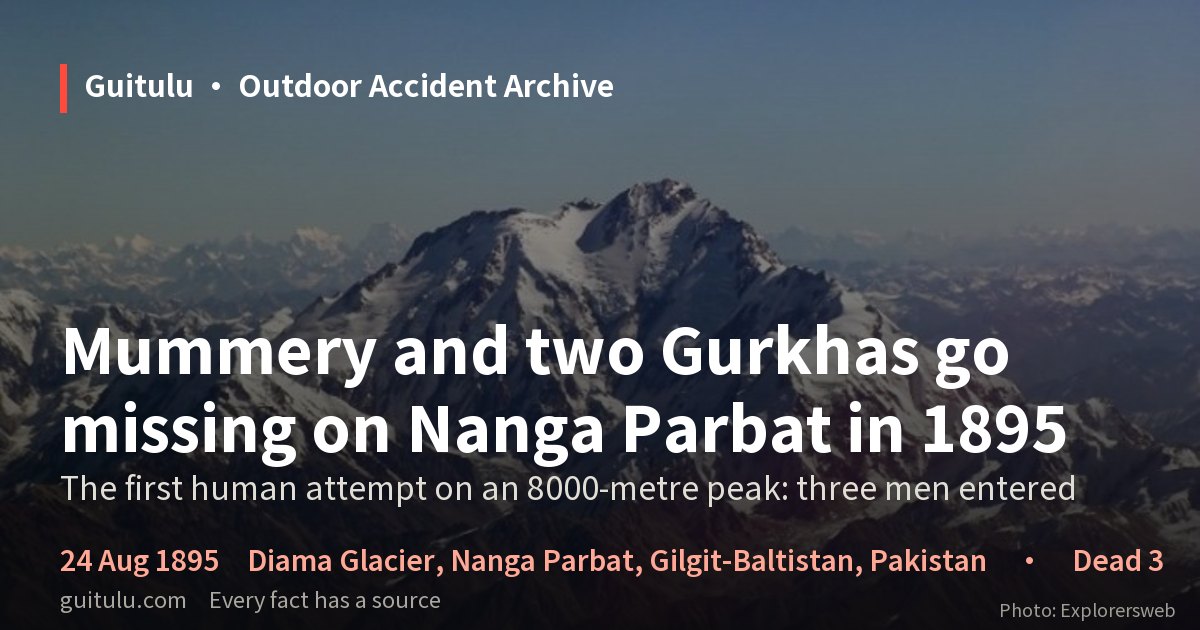
Mummery and two Gurkhas go missing on Nanga Parbat in 1895
The first human attempt on an 8000-metre peak: three men entered the Diama Glacier and never returned
The three men's bodies were never found, and the exact location and cause of their deaths are unknown; their companion Collie thought an avalanche was most likely
MountaineeringInvolves: Avalanche · Getting lost and losing contactBritish climbers Mummery, Collie and Hastings (Bruce joined briefly), and Gurkhas Ragobir Thapa and Goman Singh
Casualties
Dead 3 Mummery and the two Gurkhas, Ragobir Thapa and Goman Singh, were never seen again after entering the Diama Glacier on 24 August. Their bodies were never found, and they are generally believed to have died. The names of the two Gurkhas are spelled differently across sources (Ragobir/Raghobir, Goman/Guman/Gaman/Gorman).
Material
40 facts · 11 sources2 accounts differ and are shown side by side
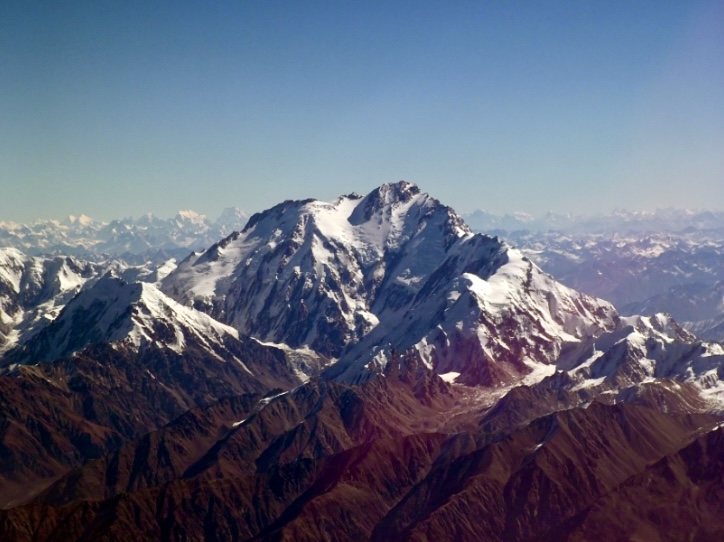
Historical illustration of the 1895 expedition: Nanga Parbat from the Diamir Glacier, with the climbing route on the Mummery Rib markedPhoto source: Explorersweb
The number at the end of a paragraph is how many facts it rests on; open it to see each fact and how well it is sourced:
Multiple sourcesSingle source. Conflicting accounts and speculation are kept out of the narrative.
ImgScene photos all from news coverage; copyright belongs to the original authors
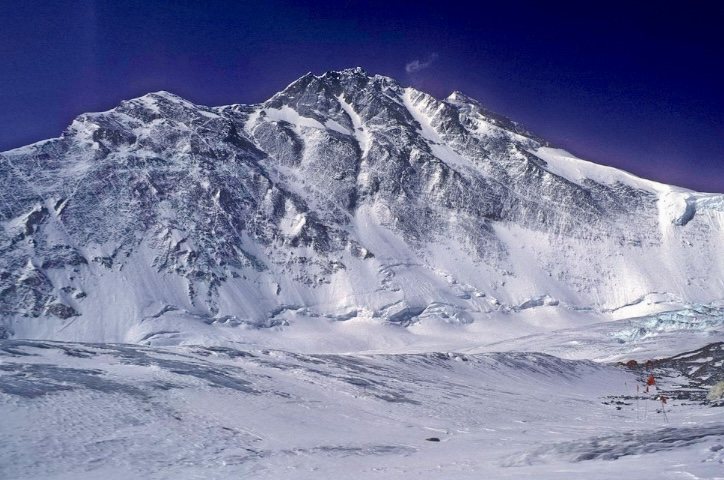
Route diagram of the northwest side of Nanga Parbat, showing the Diama GlacierPhoto source: CAAI
On returning from the first reconnaissance over Mazeno Pass, Collie was the first to stagger back to camp, on the afternoon of 23 July. F08
On 5 August, Bruce left the party and returned to Abbottabad via Mazeno Pass; on the same day, Mummery and Collie began exploring the upper Diamir Glacier with the Gurkhas. F17
On 8–9 August, team members carried a bag of supplies up the second rock rib and left it at about 17150 feet. F18
Collie was unwell because of the rough food of the previous three weeks and could not join the summit attempt; Mummery and Ragobir set out together on 19 August. F19
During the summit attempt, Ragobir fell ill at altitude, and Mummery had to take him down; this was Mummery's only summit attempt. F21
After descending, Mummery decided to abandon the route on the Diamir Glacier side, and the whole party decided to move to the Rakhiot Valley. F24
On the evening of 23 August, Ragobir and Goman Singh, who had retrieved the pack, joined Mummery. F27
On 24 August, Lor Khan and Rosamir watched Mummery, Ragobir and Goman Singh head east up the Diama Valley. The three were never seen again. F28
Collie received a telegram from Hastings on 5 September, and the two met at Doyan on 6 September. F35
In November 1895, British newspapers and periodicals described the expedition and Mummery's disappearance based on a report in The Times. F36
Under each fact is a verbatim quote from the original. "Single source" means only one outlet mentioned it; "Accounts differ" means sources contradict each other and this site adopts neither side; "Speculation" is an inference by a reporter or a person involved, not a fact.
“Mummery with three other British mountaineers, John Normann Collie, Geoffrey Hastings and Charles Bruce and two porters Gurkhas Raghobir Thapa and Gaman Singh”
According to The Himalayan Journal, Bruce said that of the two Gurkhas, Ragobir had only roped up once or twice, while the other had never used a rope or seen an ice axe before reaching Astor.
Quotes from the original 1
“Raghobir had been on the rope once or twice, but his companion had never used one nor seen an ice-axe until his arrival in Astor.”
During a subsequent attempt to cross the west ridge, Collie, Bruce and Ragobir were forced to bivouac on a rocky ridge at about 19000 feet; the food they had brought had already been eaten at breakfast on the day they set out.
Bruce's article quotes Collie's account of this bivouac from his book.
Quotes from the original 2
“Roughly we were 19,000 feet, or 1000 feet higher than the Mazeno La, and about two to three miles to the eastward of it.”
According to The Himalayan Journal, On returning from the first reconnaissance over Mazeno Pass, Collie was the first to stagger back to camp, on the afternoon of 23 July.
Quotes from the original 1
“In the afternoon of the 23rd July I saw a figure stumbling along towards the camp, the first of the party, Collie.”
According to Collie, On their first reconnaissance, Mummery and Ragobir reached the top of the second rock rib directly below the summit, at about 17000 to 18000 feet.
Quotes from the original 1
“During the day they managed to reach the top of the second rib of rocks that lie directly under the summit, a height of about 17,000 to 18,000 feet.”
According to The Himalayan Journal, While climbing Diamir Peak, the local guide Lor Khan, wearing only foot coverings made of wrapped rawhide, suddenly slipped out of a foothold on a steep ice slope.
Quotes from the original 1
“Lor Khan, wearing his native taoties, nothing more than strips of raw hide wound round his feet, suddenly slipped out of his steps when crossing a steep ice-slope.”
According to The Himalayan Journal, In the gullies on both sides of the rock rib Mummery and Ragobir were climbing, avalanches continually fell past them.
Quotes from the original 1
“Avalanches passed them tearing down the troughs on either side of them.”
According to The Himalayan Journal, Bruce believed that Mummery discovered only two days after setting out that Ragobir had brought no food (or had eaten it all at the first bivouac).
Quotes from the original 1
“Mummery did not discover until they had been out two days that Raghobir had either brought no food with him”
Collie observed from the Rakhiot side through a telescope for about half an hour and found no cut steps on the only ridge that looked feasible; he realised that Mummery's party could hardly have descended from that pass.
Bruce's account was relayed from Collie.
Quotes from the original 2
“I spent about half an hour looking through a powerful telescope for any traces of steps cut down the only ridge that looked at all feasible. I could see none.”
On 5 August, Bruce left the party and returned to Abbottabad via Mazeno Pass; on the same day, Mummery and Collie began exploring the upper Diamir Glacier with the Gurkhas.
Quotes from the original 2
“On 5th August, to my grief and disappointment, I was obliged to trudge back over the Mazeno pass and away to Abbottabad.”
Collie was unwell because of the rough food of the previous three weeks and could not join the summit attempt; Mummery and Ragobir set out together on 19 August.
Quotes from the original 2
“next morning they went on alone, for the coarse food of the previous three weeks had not agreed with me”
Accounts differ on the height reached during this summit attempt: Collie and The Spectator say it was above about 20000 feet, the American Alpine Journal and Explorersweb give about 6100 metres, and Bruce's recollection gives 21000 feet.
Sources give different figures for the highest point, possibly because of differences in estimates.
“had not the latter been taken ill at that great height, Mr. Mummery might have then effected his purpose ; but he was forced to return with the invalid.”
According to Collie, According to Collie's account, Mummery thought that if they could reach the snowfield above and spend another night on the mountain, they might be able to reach the summit the next day.
Quotes from the original 1
“he was confident that had he reached these upper snows and been able to spend another night on the mountain, he might have reached the summit on the following day”
Collie led the main party around the mountain; Mummery planned to ascend the Diama Glacier between Nanga Parbat and Ganalo Peak, cross the Diama Pass and reach the Rakhiot side to the north.
Quotes from the original 4
“from this point he could go up the Diama glacier which lay between Nanga Parbat and the Ganalo peak, 21,650 feet high”
“headed up the Diama Glacier in an attempt to reach the northern (Rakhiot) side of the mountain via 6,300m Diama Pass on the east ridge of Ganalo Peak”
Mummery left a pack containing food along the way for the return journey. He had said he would turn back if the pass was dangerous or too difficult, and had enough food for three days so that he could catch up with the main party along its route.
Quotes from the original 3
“This he had told us he intended to do should he find the pass either dangerous or very difficult”
Sources differ on which face and glacier the three were on when they went missing: Collie, Bruce and the American Alpine Journal wrote that they ascended the Diama Glacier from the Diamir side; one Explorersweb article says they set out up the Rakhiot Glacier, while another source summarises their deaths as occurring while they were scouting the Rakhiot Face.
Accounts by those involved point to the Diama Glacier; later review articles give abbreviated accounts
Quotes from the original 3
“Lor Khan and Rosamir, having seen them start off up the Diama valley to the east”
Conjecture: Collie thought the most likely cause was an avalanche from the north face of Nanga Parbat; other sources also suggest that the three may have been swept away by an avalanche.
Quotes from the original 4
“an avalanche falling from the north face of Nanga Parbat seems the most probable explanation”
Hastings returned to the Diamir Valley and found the food Mummery had left at the upper camp on the morning of the 24th untouched, indicating that the three had not turned back.
Quotes from the original 2
“there he found the extra provisions and some other things exactly as they had been placed by Mummery on the morning of the 24th”
According to The Himalayan Journal, Afterwards, heavy snow fell in the Diama area and avalanches continued, preventing searchers from entering the Diama Valley.
Quotes from the original 2
“Snow had fallen in great quantities. Avalanches tore down the face of Nanga Parbat.”
According to The Spectator, In November 1895, British newspapers and periodicals described the expedition and Mummery's disappearance based on a report in The Times.
Quotes from the original 1
“The Times of Tuesday gives a very interesting account of”
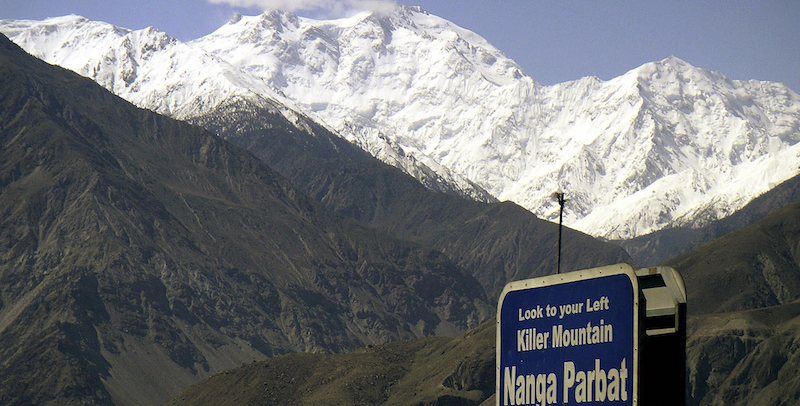
According to Gripped, Nanga Parbat is in Gilgit-Baltistan in northern Pakistan, at the western end of the Himalayas. It has three major faces: Diamir, Rakhiot and Rupal.
Quotes from the original 1
“Nanga Parbat lies at the western end of the Himalayan Range in the Gilgit-Baltistan region of northern Pakistan. It has three major faces, Diamir, Rakhiot and Rupal.”
 GuituluGlobal Outdoor Accident Archive