GuituluGlobal Outdoor Accident Archive 中文
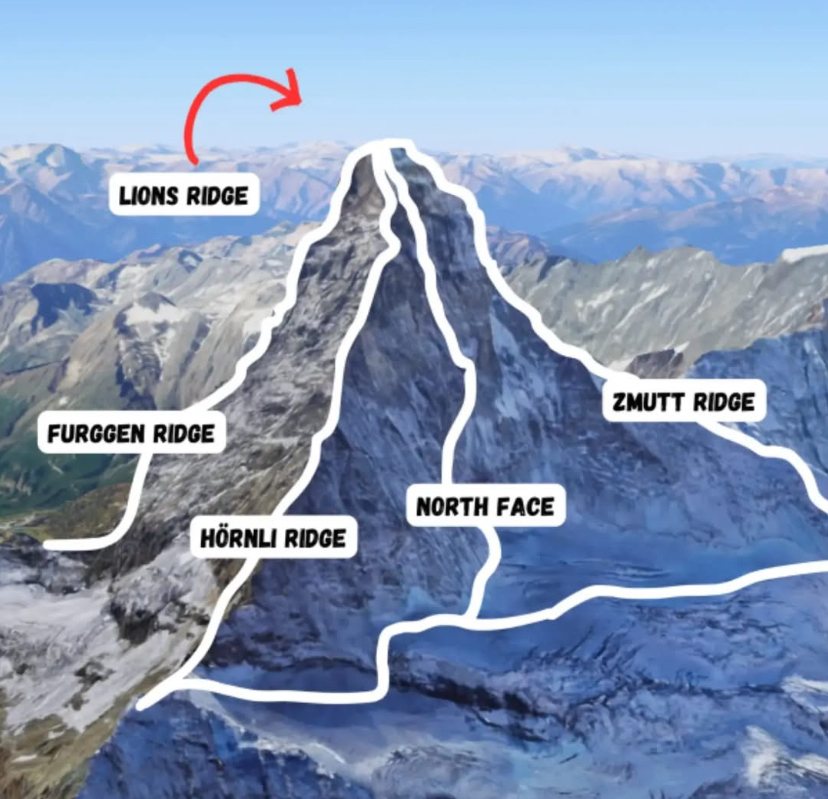
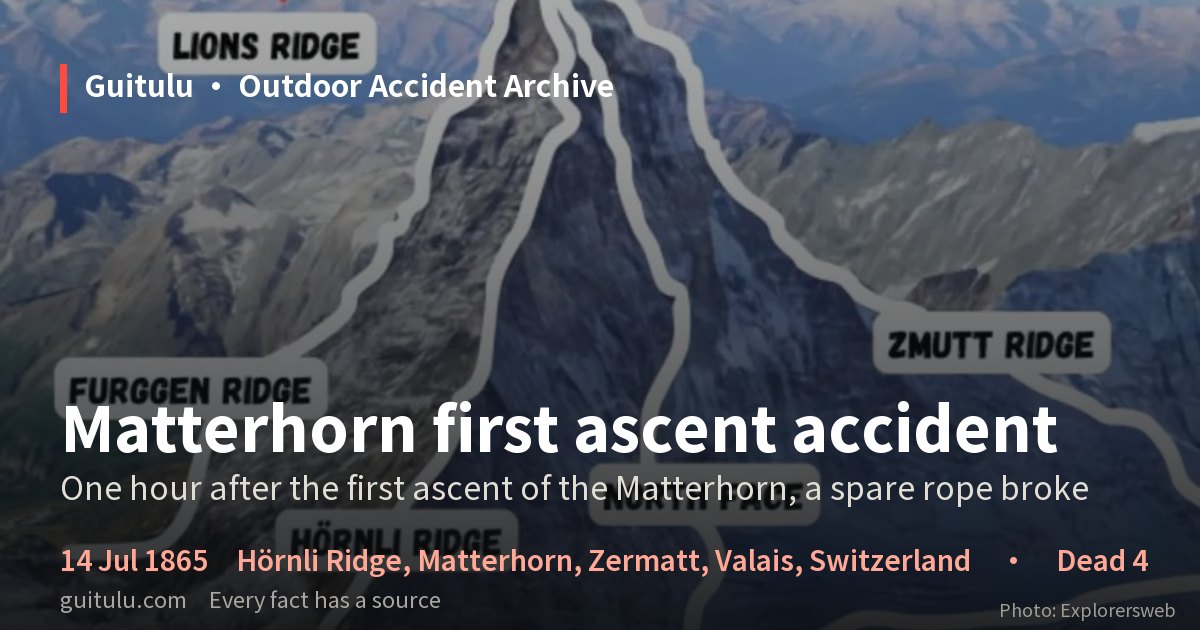
Annotated diagram of the Matterhorn's ridges and north face, with the Hörnli Ridge as the first ascent route

Archive / Mountaineering

Matterhorn first ascent accident

One hour after the first ascent of the Matterhorn, a spare rope broke and four people fell to their deaths

An official investigation in Zermatt in 1865 found no fault with the survivors, but rumours that the rope had been cut persisted for a long time

Photo: Explorersweb

Date
Summer
Place
Hörnli Ridge, Matterhorn, Zermatt, Valais, SwitzerlandSwitzerland › Valais · Alps7.659°E 45.976°N
Activity
MountaineeringInvolves: Falls and slipsSeven-person climbing party (Whymper, Croz, Hadow, Hudson, Lord Douglas, and Taugwalder father and son)
Casualties
Dead 4 Four people fell to their deaths; Lord Douglas's body was never found. Whymper and the Taugwalders, father and son, survived
Material
44 facts · 11 sources6 accounts differ and are shown side by side

01What happened

In the summer of 1865, the Matterhorn, 4478 metres high and straddling the border between Switzerland and Italy, was one of the last major Alpine peaks yet to be climbed. The Englishman Whymper had made several attempts since 1861, mostly from the Italian side, and had previously climbed with the Italian guide Carrel. That year, Carrel instead led an Italian party up the Italian side.Facts it rests onF41Multiple sourcesThe Matterhorn is 4478 metres high and lies on the border between Switzerland and Italy. The Hörnli Ridge is the standard route from Zermatt.F02Multiple sourcesBefore the summer of 1865, the Matterhorn was one of the last major peaks in the Alps that had not been climbed.F01Multiple sourcesMost early attempts followed the Lion Ridge on the Italian side. The Englishman Whymper made several attempts beginning in 1861 and climbed with the Italian guide Carrel.F10Multiple sourcesIn 1865, Carrel stopped working with Whymper and instead led an Italian party up the Italian side.

Annotated diagram of the Matterhorn's ridges and north face, with the Hörnli Ridge as the first ascent routePhoto source: Explorersweb

Whymper assembled a team at short notice in Zermatt: Lord Douglas, the Reverend Hudson, Hadow, the French guide Croz, and the Swiss guides Taugwalder and his son. Hadow was a novice with little experience. On 13 July, the team set out from Zermatt along the Hörnli Ridge on the Swiss side. At daybreak on 14 July, the seven continued climbing, reaching about 14000 feet at 9:55 a.m.; a section near the summit moved onto the north face, where snow had accumulated in cracks and a thin layer of ice covered the rocks.Facts it rests onF11Multiple sourcesWhymper assembled a party at short notice in Zermatt: Lord Douglas, the Reverend Hudson, Hadow, the French guide Croz, and the two Swiss guides, Taugwalder father and son.F12Multiple sourcesThe party member Hadow was a novice with little experience.F13Multiple sourcesOn 13 July 1865, the party set out from Zermatt, taking the Hörnli Ridge on the Swiss side.F15Multiple sourcesThe party set out at daybreak on 14 July. One of Taugwalder's sons returned to Zermatt, while the remaining seven continued climbing.F16Multiple sourcesAt 9:55 a.m., the party reached about 14000 feet, at the base of the steep section below the summit.F17Multiple sourcesA section near the summit turned onto the north face, where snow had accumulated in cracks and thin ice covered the rocks, requiring careful climbing.

Hörnli Ridge: the route taken on the first ascent in 1865Photo source: Explorersweb

On 14 July, the first-ascent team reached the summit of the Matterhorn via the Hörnli Ridge, with Whymper and Croz arriving at the same time. From the summit, they saw that Carrel's team was still below the ridge on the Italian side; according to Whymper's own account, the two shouted down and pushed rocks over the edge, after which Carrel turned back. The first-ascent team began descending after spending about an hour on the summit.Facts it rests onF20Multiple sourcesThe first-ascent party reached the summit of the Matterhorn via the Hörnli Ridge on 14 July 1865.F18Multiple sourcesAfter the final section became less steep, Whymper and Croz rushed toward the summit and reached it at the same time.F21Multiple sourcesFrom the summit, Whymper and Croz saw that Carrel's party was still lower down on the ridge on the Italian side. Carrel then turned back.F23Single sourceAccording to Whymper's own account, he and Croz shouted down to the Italian party from the summit and pushed rocks down; the Italians then turned back.F24Multiple sourcesThe first-ascent party began descending after spending about an hour on the summit.

Lights illuminate the Matterhorn along the first ascent route for the 150th anniversary in 2015Photo source: CSMonitor

On the descent, Croz led, followed by Hadow, Hudson, Lord Douglas and the elder Taugwalder. According to Whymper's own account, he had proposed fixing a rope to the rock for extra protection on difficult sections, but this was ultimately not done. After someone ahead slipped, Whymper and the elder Taugwalder briefly held the four people below them, but the rope then broke between the elder Taugwalder and Lord Douglas. Croz, Hadow, Hudson and Lord Douglas fell approximately 4000 feet onto the Matterhorn Glacier below. It was established afterward that the section that broke was the oldest and weakest rope, originally intended only as a spare.Facts it rests onF25Multiple sourcesOn the descent, Croz led, followed by Hadow, Hudson, Lord Douglas and the elder Taugwalder.F26Single sourceAccording to Whymper's own account, he proposed to Hudson that they fix a rope to the rock as extra protection on difficult sections. Hudson agreed, but no definite decision was made, and they did not do so later.F30Multiple sourcesWhymper and the elder Taugwalder held the four men below for a time, before the rope broke between the elder Taugwalder and Lord Douglas.F31Multiple sourcesAfter the rope broke, Croz, Hadow, Hudson and Lord Douglas fell to their deaths; Whymper and the Taugwalders survived.F32Multiple sourcesThe four fell onto the Matterhorn Glacier below, a drop of about 4000 feet (about 1200 metres).F03Multiple sourcesThe rope that broke was the oldest and weakest of the three, intended only as a spare and much thinner than the other two safety ropes used by the party.

Red lights illuminate the first ascent route on the Matterhorn (150th anniversary commemoration in 2015)Photo source: swissinfo

The three survivors continued their descent by fixing the rope to the rock, spent another night on the mountain and returned to Zermatt on the morning of 15 July. Lord Douglas's body was never found. An official investigation in Zermatt found no fault with the survivors, but rumours that the rope had been cut never subsided, and the reputations of the Taugwalders, father and son, suffered for a long time. Three days later, on 17 July, Carrel completed the first ascent from the Italian side via the Lion Ridge.Facts it rests onF34Multiple sourcesThe three then fixed the rope to the rock and continued their descent.F35Multiple sourcesThe three spent another night on the mountain and returned to Zermatt on the morning of 15 July.F04Multiple sourcesLord Douglas's body was never found.F07Multiple sourcesThe authorities conducted an official investigation in Zermatt and concluded that the survivors were not at fault, but the rumors that the rope had been cut did not subside.F05Multiple sourcesAfterward, rumors claimed that the rope had been cut, pointing to the elder Taugwalder or Whymper.F43Multiple sourcesAlthough the investigation found no wrongdoing, the reputations of the Taugwalders suffered lasting damage, and the elder Taugwalder's life was nearly ruined.F37Multiple sourcesThree days later, on 17 July, Carrel completed the first ascent of the Lion Ridge route on the Italian side.

The number at the end of a paragraph is how many facts it rests on; open it to see each fact and how well it is sourced: Multiple sourcesSingle source. Conflicting accounts and speculation are kept out of the narrative.

ImgScene photos all from news coverage; copyright belongs to the original authors

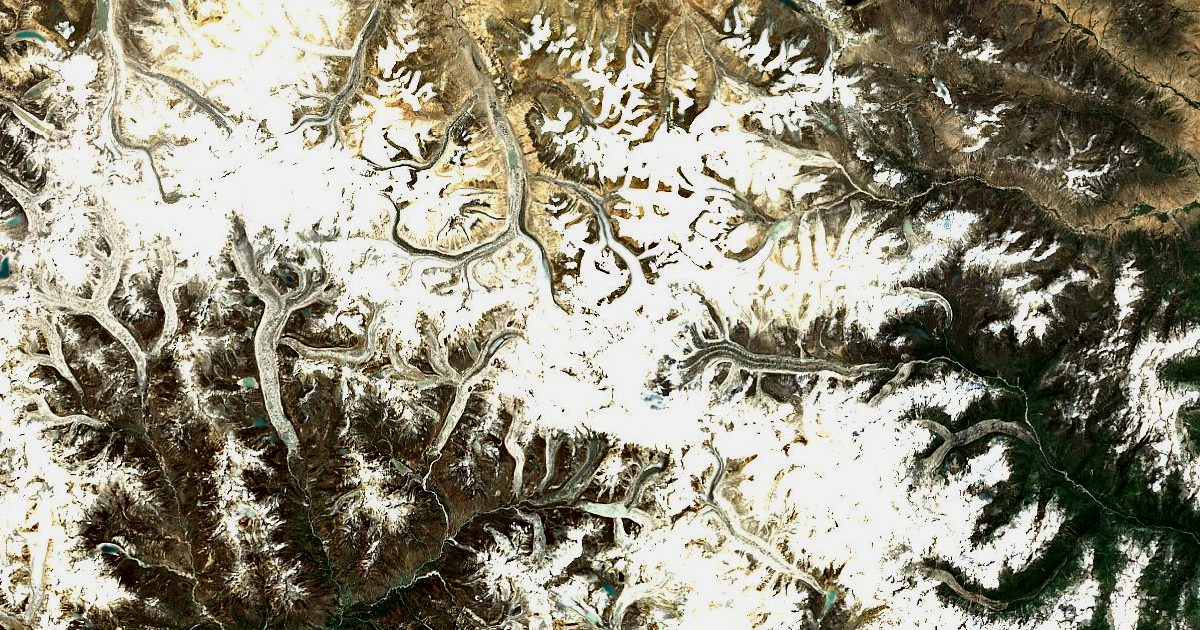
  • Reported locations along the route (illustrative)Schematic

Satellite imagery Sentinel-2 cloudless 2024 © EOX · Terrain AWS Terrain Tiles · Orange line is schematic · Place coordinates not individually verified

Route review

6 scenes to understand what happened

Scroll down and the map flies to where each part happened. The line is Schematic, Connects the reported locations in sequence, showing only the approximate direction, not the actual track.

01

Full route

The locations mentioned in the reports are connected in sequence to show the approximate route (schematic).

05

The rope breaks

During the descent, someone near the front slipped. The rope broke between the elder Taugwalder and Lord Douglas, and four people fell onto the Matterhorn Glacier.Facts it rests onF30Multiple sourcesWhymper and the elder Taugwalder held the four men below for a time, before the rope broke between the elder Taugwalder and Lord Douglas.F31Multiple sourcesAfter the rope broke, Croz, Hadow, Hudson and Lord Douglas fell to their deaths; Whymper and the Taugwalders survived.F32Multiple sourcesThe four fell onto the Matterhorn Glacier below, a drop of about 4000 feet (about 1200 metres).

02Timeline

  1. Most early attempts followed the Lion Ridge on the Italian side. The Englishman Whymper made several attempts beginning in 1861 and climbed with the Italian guide Carrel. F01

  2. The authorities conducted an official investigation in Zermatt and concluded that the survivors were not at fault, but the rumors that the rope had been cut did not subside. F07

  3. On 13 July 1865, the party set out from Zermatt, taking the Hörnli Ridge on the Swiss side. F13

  4. The first-ascent party began descending after spending about an hour on the summit. F24

  5. At 9:55 a.m., the party reached about 14000 feet, at the base of the steep section below the summit. F16

  6. The first-ascent party reached the summit of the Matterhorn via the Hörnli Ridge on 14 July 1865. F20

  7. The party set out at daybreak on 14 July. One of Taugwalder's sons returned to Zermatt, while the remaining seven continued climbing. F15

  8. After the rope broke, Croz, Hadow, Hudson and Lord Douglas fell to their deaths; Whymper and the Taugwalders survived. F31

  9. The three spent another night on the mountain and returned to Zermatt on the morning of 15 July. F35

  10. Afterward, Whymper returned to the mountain with a search party, which found Croz, Hadow and Hudson. They were brought down the mountain on 19 July. F36

  11. Three days later, on 17 July, Carrel completed the first ascent of the Lion Ridge route on the Italian side. F37

  12. On 14 July 2015, the 150th anniversary of the first ascent, Swiss authorities closed the Matterhorn for one day to commemorate the more than 500 climbers who had died on the mountain. F40

03Lessons

Teams and decisions

Set protection before difficult sections

According to Whymper's own account, before the descent he proposed fixing a rope to the rock for extra protection on difficult sections, but this was not carried out. After the accident, the three survivors descended by fixing the rope to the rock. If a roped party has no anchor, one person's slip may pull the whole party down.Facts it rests onF26Single sourceAccording to Whymper's own account, he proposed to Hudson that they fix a rope to the rock as extra protection on difficult sections. Hudson agreed, but no definite decision was made, and they did not do so later.F34Multiple sourcesThe three then fixed the rope to the rock and continued their descent.F30Multiple sourcesWhymper and the elder Taugwalder held the four men below for a time, before the rope broke between the elder Taugwalder and Lord Douglas.

Teams and decisions

Check every section of rope before setting out

The section that broke was the party's oldest and weakest rope, originally intended only as a spare, and was much thinner than the other two safety ropes. The weakest link in the system determines how much the entire protection chain can withstand. Check the purpose and condition of each piece of equipment before setting out.Facts it rests onF03Multiple sourcesThe rope that broke was the oldest and weakest of the three, intended only as a spare and much thinner than the other two safety ropes used by the party.

Teams and decisions

Recognise experience gaps in hastily assembled parties

The party was hastily assembled, and Hadow was a novice with very little experience who was second in line on the descent. When experience varies widely within a party, the route, rope order and protection methods should all be arranged around the weakest member.Facts it rests onF11Multiple sourcesWhymper assembled a party at short notice in Zermatt: Lord Douglas, the Reverend Hudson, Hadow, the French guide Croz, and the two Swiss guides, Taugwalder father and son.F12Multiple sourcesThe party member Hadow was a novice with little experience.F25Multiple sourcesOn the descent, Croz led, followed by Hadow, Hudson, Lord Douglas and the elder Taugwalder.

Avalanche and high altitude

Reaching the summit is only halfway

The first-ascent party descended after spending about an hour on the summit, and the accident occurred during the descent. On the section near the summit, snow had accumulated in cracks and the rocks were covered with thin ice. With fatigue and a relaxation of vigilance after reaching the summit compounded by slippery terrain, descending is often more dangerous than ascending.Facts it rests onF24Multiple sourcesThe first-ascent party began descending after spending about an hour on the summit.F31Multiple sourcesAfter the rope broke, Croz, Hadow, Hudson and Lord Douglas fell to their deaths; Whymper and the Taugwalders survived.F17Multiple sourcesA section near the summit turned onto the north face, where snow had accumulated in cracks and thin ice covered the rocks, requiring careful climbing.

04Fact list 44 facts

Under each fact is a verbatim quote from the original. "Single source" means only one outlet mentioned it; "Accounts differ" means sources contradict each other and this site adopts neither side; "Speculation" is an inference by a reporter or a person involved, not a fact.

  1. F01Multiple sourcesBackground

    Most early attempts followed the Lion Ridge on the Italian side. The Englishman Whymper made several attempts beginning in 1861 and climbed with the Italian guide Carrel.

    Quotes from the original 3

    “Before its first ascent, most attempts took place via the Lion Ridge on the Italian side.”

    Explorersweb · 2026-04-27

    “Between 1861 and 1865, he made seven attempts, most of them on the Italian side and often in the company of Carrel.”

    Explorersweb · 2026-04-27

    “from 1861 to 1865, made several attempts to summit the Matterhorn. He initially teamed up with Italian guide Jean-Antoine Carrel”

    On Verticality · 2021-12-30
  2. F02Multiple sourcesBackground

    Before the summer of 1865, the Matterhorn was one of the last major peaks in the Alps that had not been climbed.

    Quotes from the original 2

    “By the summer of 1865, almost every major peak in the Alps had been climbed. The Matterhorn was the only big one left.”

    Explorersweb · 2026-04-27

    “It was one of the last major Alpine peaks to be conquered.”

    The Local · 2015-05-25
  3. F03Multiple sourcesFound at scene

    The rope that broke was the oldest and weakest of the three, intended only as a spare and much thinner than the other two safety ropes used by the party.

    Quotes from the original 4

    “the rope between the survivors and the four men that fell was the oldest and weakest they had brought with, only meant as a reserve”

    On Verticality · 2021-12-30

    “The full rope was supposed to be used only as a spare. It was about half the width and much weaker than the two other safety ropes”

    swissinfo · 2015-07-01

    “Why was the rope used not the one intended for the purpose, but a somewhat battered spare?”

    inalto ·

    “the thin backup rope snapped”

    Explorersweb · 2026-04-27
  4. F04Multiple sourcesAftermath

    Lord Douglas's body was never found.

    Quotes from the original 2

    “The body of Douglas was never recovered.”

    On Verticality · 2021-12-30

    “Lord Douglas' body has never been found.”

    Mark Twain, A Tramp Abroad ·
  5. F05Multiple sourcesAftermath

    Afterward, rumors claimed that the rope had been cut, pointing to the elder Taugwalder or Whymper.

    Quotes from the original 3

    “Rumors started and Taugwalder Sr. and Whymper were accused of cutting the rope.”

    National Geographic · 2015-07-14

    “Zermatt gossip darkly hints that the elder Taugwalder cut the rope”

    Mark Twain, A Tramp Abroad ·

    “Could it have been that old Taugwalder panicked and deliberately cut the rope?”

    inalto ·
  6. F06Single sourceFound at scene

    According to Mark Twain, A Tramp Abroad, According to Whymper, the broken ends of the rope showed no signs of having been cut, only of having broken.

    Quotes from the original 1

    “Mr. Whymper says that the ends of the rope showed no evidence of cutting, but only of breaking”

    Mark Twain, A Tramp Abroad ·
  7. F07Multiple sourcesAftermath

    The authorities conducted an official investigation in Zermatt and concluded that the survivors were not at fault, but the rumors that the rope had been cut did not subside.

    Quotes from the original 3

    “An official inquiry was opened in Zermatt to determine what happened to the rope. Although the survivors were cleared, the rumors never went away.”

    Explorersweb · 2026-04-27

    “In the end, Whymper and Taugwalder were exonerated, but the controversy continued.”

    National Geographic · 2015-07-14

    “despite formal inquiries that cleared the guides”

    swissinfo · 2015-07-01
  8. F08Multiple sourcesAftermath

    The accident caused an uproar in Britain. The Times criticized mountaineering as useless, and Queen Victoria reportedly considered banning it.

    Quotes from the original 3

    “Queen Victoria considered outlawing the climbing of mountains.”

    National Geographic · 2015-07-14

    “she asked the government to consider banning mountaineering”

    Explorersweb · 2026-04-27

    “The Times of London denounced the ascent and deplored “the utter uselessness” of the sport of mountaineering.”

    National Geographic · 2015-07-14
  9. F09Multiple sourcesPost-incident analysis

    The first ascent of the Matterhorn and the subsequent climbing accident are regarded as the end of the “golden age” of Alpine mountaineering.

    Quotes from the original 4

    “The first ascent of the Matterhorn marked the end of the Golden Age of Alpinism.”

    Explorersweb · 2026-04-27

    “The first ascent of the Matterhorn marked the end of the golden age of alpinism.”

    On Verticality · 2021-12-30

    “Although this marked the end of the Golden Age of alpinism”

    Outlook Traveller · 2014-09-08

    “is seen as marking the end of the ‘Golden Era of Climbing’ from 1854 to 1865”

    Snow Magazine · 2015-03-09
  10. F10Multiple sourcesBackground

    In 1865, Carrel stopped working with Whymper and instead led an Italian party up the Italian side.

    Quotes from the original 3

    “Carrel withdrew at the last moment to lead an Italian team up the Italian side of the mountain”

    On Verticality · 2021-12-30

    “Unbeknownst to Whymper, Carrel was quietly mounting his own attempt on the Matterhorn with an Italian team.”

    National Geographic · 2015-07-14

    “when Whymper and Carrel's paths parted”

    inalto ·
  11. F11Multiple sourcesPlan

    Whymper assembled a party at short notice in Zermatt: Lord Douglas, the Reverend Hudson, Hadow, the French guide Croz, and the two Swiss guides, Taugwalder father and son.

    Quotes from the original 3

    “Whymper’s group included Lord Francis Douglas, Charles Hudson, and Douglas Hadow, along with French guide Michel Croz and father-and-son Swiss guides, the Taugwalders (both named Peter).”

    Explorersweb · 2026-04-27

    “put together a patchwork team of climbers”

    On Verticality · 2021-12-30

    “Whymper managed to cobble together an unwieldy team of seven men of varying experience”

    National Geographic · 2015-07-14
  12. F12Multiple sourcesBackground

    The party member Hadow was a novice with little experience.

    Quotes from the original 3

    “novice climber Douglas Hadow slipped”

    The Local · 2015-05-25

    “his young and inexperienced companion, Douglas Robert Hadow”

    Snow Magazine · 2015-03-09

    “the least experienced climber, Douglas Hadow”

    National Geographic · 2015-07-14
  13. F13Multiple sourcesMovement

    On 13 July 1865, the party set out from Zermatt, taking the Hörnli Ridge on the Swiss side.

    Quotes from the original 3

    “We started from Zermatt on the 13th of July, at half past five”

    Mark Twain, A Tramp Abroad ·

    “in the morning of July 13, they set off up the Hörnli Ridge”

    Explorersweb · 2026-04-27

    “Together, they set off on 13 July to make their attempt on the summit.”

    On Verticality · 2021-12-30
  14. F14Accounts differMovement

    Accounts differ on the first night's campsite: Whymper wrote that they pitched a tent at about 11000 feet; On Verticality says it was at 3380 meters; Snow Magazine says it was roughly at the site of today's Hörnli Hut; National Geographic says it was at Schwarzsee, at an altitude of 8000 feet.

    Quotes from the original 4

    “we had found a good position for the tent, at a height of eleven thousand feet”

    Mark Twain, A Tramp Abroad ·

    “They first climbed up to 3,380 meters (11,090 feet) and set up a bivouac for the night.”

    On Verticality · 2021-12-30

    “After camping for the night, roughly where the Hörnli Hut is situated now”

    Snow Magazine · 2015-03-09

    “They camped at 8,000 feet (2,438 meters) at Schwarzsee on July 13”

    National Geographic · 2015-07-14
  15. F15Multiple sourcesMovement

    The party set out at daybreak on 14 July. One of Taugwalder's sons returned to Zermatt, while the remaining seven continued climbing.

    Quotes from the original 2

    “One of the young Taugwalders returned to Zermatt.”

    Mark Twain, A Tramp Abroad ·

    “The next morning, they set off at dawn with Joseph Taugwalder returning to Zermatt.”

    On Verticality · 2021-12-30
  16. F16Multiple sourcesMovement

    At 9:55 a.m., the party reached about 14000 feet, at the base of the steep section below the summit.

    Quotes from the original 3

    “nine-fifty-five, when we stopped for fifty minutes, at a height of fourteen thousand feet”

    Mark Twain, A Tramp Abroad ·

    “at 09:55 they reached the foot of the upper peak, at roughly 4,265 meters (14,000 feet)”

    On Verticality · 2021-12-30

    “By 9:55 am they were at nearly 14,000 feet”

    National Geographic · 2015-07-14
  17. F17Multiple sourcesEvent

    A section near the summit turned onto the north face, where snow had accumulated in cracks and thin ice covered the rocks, requiring careful climbing.

    Quotes from the original 3

    “These were at times covered with a thin film of ice.”

    Mark Twain, A Tramp Abroad ·

    “a layer of snow had filled the crevices and thin film of ice had formed over the rock”

    National Geographic · 2015-07-14

    “They crossed over the ridgeline to the north face and ascended until the slope eased off.”

    On Verticality · 2021-12-30
  18. F18Multiple sourcesEvent

    After the final section became less steep, Whymper and Croz rushed toward the summit and reached it at the same time.

    Quotes from the original 3

    “Croz and I, dashed away, ran a neck-and-neck race, which ended in a dead heat.”

    Mark Twain, A Tramp Abroad ·

    “Whymper and Croz made a mad dash for the summit, and reached it at the same time.”

    On Verticality · 2021-12-30

    “arriving at the top in a dead heat to share the glory”

    Snow Magazine · 2015-03-09
  19. F19Accounts differEvent

    Accounts differ on the time of the summit: Whymper's own account and several reports give 1:40 p.m.; a contemporary 1865 report in The Manchester Guardian says 2 p.m.

    The Manchester Guardian account appears in an excerpt republished by CSMonitor

    Quotes from the original 3

    “At 1:40 P.M., the world was at our feet, and the Matterhorn was conquered!”

    Mark Twain, A Tramp Abroad ·

    “Whymper and his party reached the top at 1.40pm via the Hörnli ridge”

    Snow Magazine · 2015-03-09

    “arrived at the summit at two p.m.”

    CSMonitor · 2015-07-14
  20. F20Multiple sourcesEvent

    The first-ascent party reached the summit of the Matterhorn via the Hörnli Ridge on 14 July 1865.

    Quotes from the original 3

    “on July 14, 1865, a seven-man team led by Edward Whymper topped out”

    Explorersweb · 2026-04-27

    “A group of seven mountaineers led by Briton Edward Whymper became the first to scale the peak on July 14, 1865.”

    CSMonitor · 2015-07-14

    “on 14 July, successfully ascended the peak following the Hörnligrat shoulder and then the north wall”

    Outlook Traveller · 2014-09-08
  21. F21Multiple sourcesEvent

    From the summit, Whymper and Croz saw that Carrel's party was still lower down on the ridge on the Italian side. Carrel then turned back.

    Quotes from the original 3

    “they spotted Carrel’s party on the opposite ridge, still 200 meters below the summit”

    On Verticality · 2021-12-30

    “Carrel was so distraught he immediately turned around and began descending.”

    National Geographic · 2015-07-14

    “they halted their ascent and went back down to Breuil”

    Snow Magazine · 2015-03-09
  22. F22Accounts differEvent

    Accounts differ on how far the Italian party was from the summit at the time: Explorersweb and On Verticality say about 200 meters; Snow Magazine says 400 meters; National Geographic says 600 feet.

    Quotes from the original 3

    “The two men spotted Carrel’s party some 200m below.”

    Explorersweb · 2026-04-27

    “the Italian party were still 400 metres below on the more technical Italian ridge”

    Snow Magazine · 2015-03-09

    “When they peered down over the edge, 600 feet below, they spotted Carrel and his team”

    National Geographic · 2015-07-14
  23. F23Single sourceEvent

    According to Explorersweb, According to Whymper's own account, he and Croz shouted down to the Italian party from the summit and pushed rocks down; the Italians then turned back.

    Quotes from the original 2

    “I seized a block of rock and hurled it down, and called upon my companion, in the name of friendship, to do the same.”

    Explorersweb · 2026-04-27

    “The Italians turned and fled.”

    Explorersweb · 2026-04-27
  24. F24Multiple sourcesMovement

    The first-ascent party began descending after spending about an hour on the summit.

    Quotes from the original 3

    “We remained on the summit for one hour”

    Mark Twain, A Tramp Abroad ·

    “Whymper’s group spent one hour on the summit.”

    Explorersweb · 2026-04-27

    “Whymper’s team remained on the summit for an hour”

    National Geographic · 2015-07-14
  25. F25Multiple sourcesPlan

    On the descent, Croz led, followed by Hadow, Hudson, Lord Douglas and the elder Taugwalder.

    Quotes from the original 3

    “We agreed that it was best for Croz to go first, and Hadow second; Hudson, who was almost equal to a guide in sureness of foot, wished to be third; Lord Douglas was placed next”

    Mark Twain, A Tramp Abroad ·

    “They descended in a rope line, with Michel Croz first, followed by Douglas Hadow, Charles Hudson, Lord Francis Douglas, Peter Taugwalder senior”

    On Verticality · 2021-12-30

    “Douglas Hadow, who was in second position”

    National Geographic · 2015-07-14
  26. F26Single sourcePlan

    According to Mark Twain, A Tramp Abroad, According to Whymper's own account, he proposed to Hudson that they fix a rope to the rock as extra protection on difficult sections. Hudson agreed, but no definite decision was made, and they did not do so later.

    Quotes from the original 2

    “I suggested to Hudson that we should attach a rope to the rocks on our arrival at the difficult bit, and hold it as we descended, as an additional protection.”

    Mark Twain, A Tramp Abroad ·

    “They had not, however, attached the additional rope to rocks, and nothing was said about it.”

    Mark Twain, A Tramp Abroad ·
  27. F27Single sourceMovement

    According to Mark Twain, A Tramp Abroad, According to Whymper's own account, only one person moved at a time on difficult sections. At around 3 pm, Lord Douglas, concerned that the elder Taugwalder might not be able to hold his footing if someone slipped, asked Whymper to tie in to the elder Taugwalder's rope as well.

    Quotes from the original 2

    “Only one man was moving at a time”

    Mark Twain, A Tramp Abroad ·

    “had not Lord Douglas asked me, about 3 P.M., to tie on to old Peter, as he feared, he said, that Taugwalder would not be able to hold his ground if a slip occurred”

    Mark Twain, A Tramp Abroad ·
  28. F28Accounts differEvent

    Accounts differ on the order of the three survivors in the rope team: Whymper's own account says he and the younger Taugwalder were tied in behind the elder Taugwalder; On Verticality says the elder Taugwalder was followed by the younger Taugwalder, with Whymper last; swissinfo says Whymper was tied in between the father and son, with the younger Taugwalder highest up; and The Manchester Guardian in 1865 said Whymper was ahead, followed by the Taugwalders.

    Quotes from the original 4

    “A few minutes afterward I tied myself to young Peter”

    Mark Twain, A Tramp Abroad ·

    “Peter Taugwalder senior, then junior and Whymper last”

    On Verticality · 2021-12-30

    “Above him was Whymper, tied between the Taugwalders; the younger Taugwalder was at the top of the rope.”

    swissinfo · 2015-07-01

    “Messrs, Haddo, Hudson; and Whymper, and the two Tangevalds”

    CSMonitor · 2015-07-14
  29. F29Accounts differEvent

    During the descent, someone near the front of the rope team slipped, pulling Croz off his feet and then dragging Hudson and Lord Douglas down. Accounts differ on who slipped first: Whymper's own account and most reports say it was Hadow; a contemporary report in The Manchester Guardian in 1865 said it was Lord Douglas.

    The Manchester Guardian's account appears in an excerpt reproduced by CSMonitor

    Quotes from the original 4

    “at this moment Mr. Hadow slipped, fell against him, and knocked him over”

    Mark Twain, A Tramp Abroad ·

    “Hadow slipped, knocking over Croz and dragging Hudson and Douglas with them”

    Explorersweb · 2026-04-27

    “Douglas Hadow, who was in second position, slipped and knocked Croz off his feet”

    National Geographic · 2015-07-14

    “Lord Francis Douglas happening to slip caused Croz and Messrs. Haddo and Hudson to fall”

    CSMonitor · 2015-07-14
  30. F30Multiple sourcesEvent

    Whymper and the elder Taugwalder held the four men below for a time, before the rope broke between the elder Taugwalder and Lord Douglas.

    Quotes from the original 2

    “We held; but the rope broke midway between Taugwalder and Lord Francis Douglas.”

    Mark Twain, A Tramp Abroad ·

    “for a few short moments they held the men below them. Then the rope broke under Taugwalder”

    On Verticality · 2021-12-30
  31. F31Multiple sourcesEvent

    After the rope broke, Croz, Hadow, Hudson and Lord Douglas fell to their deaths; Whymper and the Taugwalders survived.

    Quotes from the original 4

    “Taugwalder senior, his son, and Whymper were left alive because the rope linking them to the other four snapped.”

    Snow Magazine · 2015-03-09

    “It snapped, and the trio looked on helplessly as their companions fell to their deaths.”

    The Local · 2015-05-25

    “The four men fell to their deaths.”

    National Geographic · 2015-07-14

    “Four members of the team died on the descent.”

    CSMonitor · 2015-07-14
  32. F32Multiple sourcesEvent

    The four fell onto the Matterhorn Glacier below, a drop of about 4000 feet (about 1200 metres).

    Quotes from the original 3

    “onto the Matterhorn glacier below, a distance of nearly four thousand feet in height”

    Mark Twain, A Tramp Abroad ·

    “their four companions fell 1,200m down the north face to their deaths”

    Explorersweb · 2026-04-27

    “to a depth of 4,000 feet”

    CSMonitor · 2015-07-14
  33. F33Accounts differEvent

    After the accident, the three survivors were almost unable to move for a time. Accounts differ on who was more distressed: Whymper said the Taugwalders had broken down; the younger Taugwalder's own account, written more than half a century later, said Whymper was trembling and could barely keep his footing.

    Quotes from the original 3

    “the Taugwalders, utterly unnerved, were not only incapable of giving assistance”

    Mark Twain, A Tramp Abroad ·

    “But Whymper was trembling and could scarcely take another safe step.”

    swissinfo · 2015-07-01

    “The three survivors were so traumatized they could not move for more than half an hour.”

    National Geographic · 2015-07-14
  34. F34Multiple sourcesMovement

    The three then fixed the rope to the rock and continued their descent.

    Quotes from the original 2

    “fixed rope to firm rocks, in addition to being tied together”

    Mark Twain, A Tramp Abroad ·

    “fixed some rope to the rocks, and resumed their descent”

    On Verticality · 2021-12-30
  35. F35Multiple sourcesMovement

    The three spent another night on the mountain and returned to Zermatt on the morning of 15 July.

    Quotes from the original 4

    “They made it back to Zermatt on the morning of 15 July.”

    On Verticality · 2021-12-30

    “The survivors arrived at Zermatt on the morning of the 15th.”

    CSMonitor · 2015-07-14

    “after another night on the mountain, Whymper and the Taugwalders made it back down to Zermatt”

    Snow Magazine · 2015-03-09

    “finally bivouacking on a thin ledge”

    National Geographic · 2015-07-14
  36. F36Single sourceAftermath

    According to On Verticality, Afterward, Whymper returned to the mountain with a search party, which found Croz, Hadow and Hudson. They were brought down the mountain on 19 July.

    Sources differ on the exact date of the search; the account relayed by Mark Twain says they were found “the next morning”.

    Quotes from the original 1

    “The following day a rescue expedition, which included Whymper, went back up the mountain. The bodies of Croz, Hadow and Hudson were found, and were brought down on 19 July.”

    On Verticality · 2021-12-30
  37. F37Multiple sourcesAftermath

    Three days later, on 17 July, Carrel completed the first ascent of the Lion Ridge route on the Italian side.

    Quotes from the original 2

    “Three days later, on July 17, Carrel returned, and with Bich, completed a fine first ascent of the Italian route.”

    Explorersweb · 2026-04-27

    “He would return three days later to make the first ascent of the Italian Ridge.”

    National Geographic · 2015-07-14
  38. F38Single sourcePost-incident analysis

    According to swissinfo, According to reports, on the 140th anniversary of the first ascent, the Swiss company Mammut reproduced the type of rope that broke for a test. The rope broke at 300 kilograms, and the test results favoured an accidental break rather than a cut.

    Quotes from the original 2

    “For the 140th anniversary of the climb, Swiss manufacturer Mammut tested a rope built to resemble the one that broke. It said the rope snapped at 300 kilograms”

    swissinfo · 2015-07-01

    “The test suggests an accident rather than a cut rope.”

    swissinfo · 2015-07-01
  39. F39Single sourceParticipant's view

    According to swissinfo, David Taugwalder, a descendant of the Taugwalder family, said the family considered a more likely scenario to be that Whymper, eager to be the first to reach the summit, cut the rope on the ascent, leaving the elder Taugwalder without enough suitable rope for the descent.

    This is the view of a descendant of the Taugwalder family.

    Quotes from the original 1

    “what we think is the most likely – that Whymper wanted to be the first to the top of the Matterhorn so he cut the rope on the ascent and then Taugwalder Snr. didn’t have enough of the right kind of rope for the descent”

    swissinfo · 2015-07-09
  40. F40Multiple sourcesAftermath

    On 14 July 2015, the 150th anniversary of the first ascent, Swiss authorities closed the Matterhorn for one day to commemorate the more than 500 climbers who had died on the mountain.

    Quotes from the original 3

    “authorities declared a daylong 'silence' on the 150th anniversary of the first ascent to honor more than 500 climbers who have died trying to reach the top”

    CSMonitor · 2015-07-14

    “The Matterhorn itself will be closed to climbers on the day – as a mark of respect to those who died”

    The Local · 2015-05-25

    “more than 500 have died trying”

    National Geographic · 2015-07-14
  41. F41Multiple sourcesBackground

    The Matterhorn is 4478 metres high and lies on the border between Switzerland and Italy. The Hörnli Ridge is the standard route from Zermatt.

    Quotes from the original 3

    “The 4,478m Matterhorn (known as Cervino in Italy) lies on the border between Switzerland and Italy.”

    Explorersweb · 2026-04-27

    “the Hörnli Ridge on the northeast side is the normal route from Zermatt”

    Explorersweb · 2026-04-27

    “the iconic 4,478-meter (14,692-foot) Alpine peak that Switzerland shares with neighboring Italy”

    CSMonitor · 2015-07-14
  42. F42SpeculationSpeculation

    The author of On Verticality speculates that the use of the wrong rope was most likely simply an oversight.

    Quotes from the original 1

    “It was most likely a simple oversight”

    On Verticality · 2021-12-30
  43. F43Multiple sourcesAftermath

    Although the investigation found no wrongdoing, the reputations of the Taugwalders suffered lasting damage, and the elder Taugwalder's life was nearly ruined.

    Quotes from the original 2

    “The notoriety virtually ruined the elder Taugwalder’s life and threatened his son’s guiding career.”

    swissinfo · 2015-07-01

    “Certainly the two Swiss became a kind of pariah, shunned by all”

    inalto ·
  44. F44Multiple sourcesAftermath

    A section of the broken rope is now displayed at the Matterhorn Museum (Zermatlantis) in Zermatt.

    Quotes from the original 2

    “coiled up in its glass case in the Zermatlantis Museum”

    The Local · 2015-05-25

    “A section of rope that broke on the first ascent of the Matterhorn is displayed in the Zermatt museum.”

    swissinfo · 2015-07-01