The number at the end of a paragraph is how many facts it rests on; open it to see each fact and how well it is sourced:
Multiple sourcesSingle source. Conflicting accounts and speculation are kept out of the narrative.
Scroll down and the map flies to where each part happened. The line is Schematic, The waypoints mentioned in reports are connected in sequence, showing only the approximate direction, not the actual track.
01
Full route
The locations mentioned in reports are connected in sequence to show the approximate course (schematic).
On 5 August, Guan Jing's team set out from Base Camp for the summit. F15
According to a teammate's recollection, she reached Camp 2 at an altitude of 6700 metres on 6 August and began her summit push at 10:30 p.m. on 10 August. F18
At 3:32 p.m. Pakistan time on 11 August, the summit team reached the top of K2. F20
All 15 members of the Imagine Nepal team, including Guan Jing, reached the summit on 11 August. F21
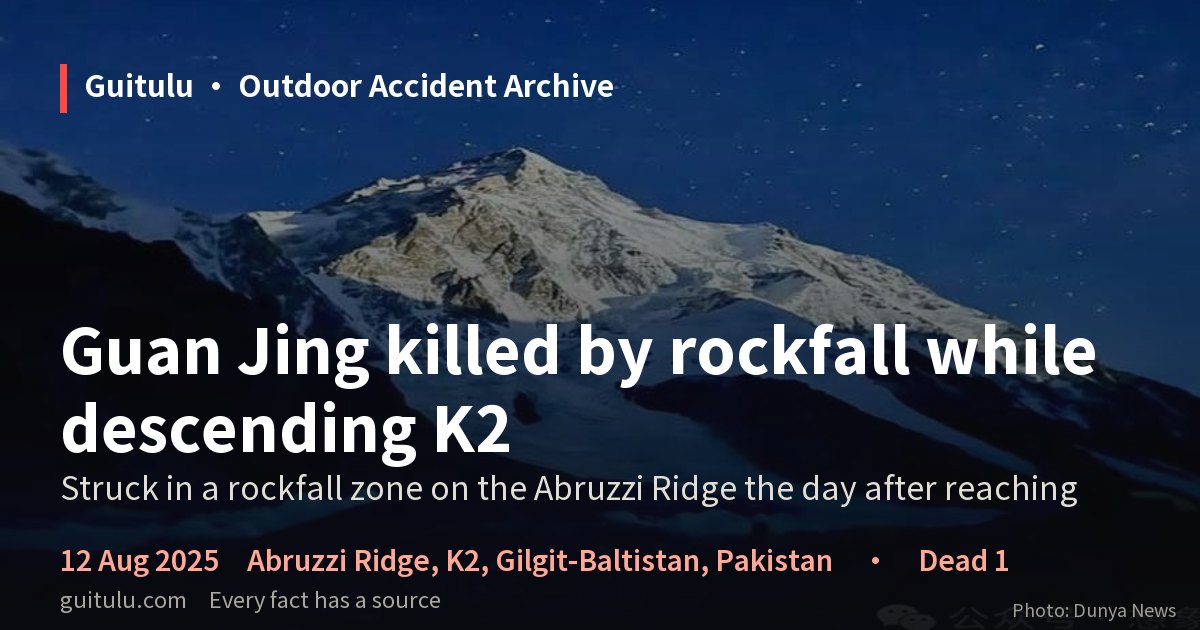
On the evening of 12 August (Tuesday), Guan Jing was struck and killed by rockfall while descending from the summit of K2. F26
The incident occurred between Camp 1 and Advance Base Camp on the Abruzzi Ridge route, a section known for frequent rockfalls. F27
On 13 August, a Nepali Sherpa named Jangbu was sent to recover the body. He was injured and stranded on the way, then rescued by helicopter and taken to a hospital in Skardu for treatment. F31
Bad weather prevented helicopters from taking off, delaying the recovery operation. On 14 August, a climbing team set out on foot to recover the body, while Army Aviation stood by for the weather to improve. F33
Under each fact is a verbatim quote from the original. "Single source" means only one outlet mentioned it; "Accounts differ" means sources contradict each other and this site adopts neither side; "Speculation" is an inference by a reporter or a person involved, not a fact.
On 12 May 2024, Guan Jing summited Everest via the south side with the Imagine Nepal team and performed a handstand at the summit for about 20 seconds.
Quotes from the original 2
“2024年5月12日,她曾跟随“想象尼泊尔”团队从南坡成功登顶珠峰,并在世界之巅倒立20秒。”
On 12 May 2024, she successfully summited Everest via the south side with the Imagine Nepal team and performed a handstand on top of the world for 20 seconds. (machine translation)
The Karakoram region was unusually dry and hot during this climbing season, with less snow than usual. Many rocks previously covered by snow were exposed, and rockfall occurred throughout the season.
Quotes from the original 4
“这个登山季,喀喇昆仑山脉异乎寻常地炎热”
This climbing season, the Karakoram Range was unusually hot (machine translation)
K2 summits generally take place in July, but this season, strong winds brought by the high-altitude jet stream forced climbers to wait at base camp, and summits were delayed until August.
Quotes from the original 3
“The 2025 season faced challenges from the jet stream, with high winds limiting opportunities and forcing climbers to wait at base camp.”
Because of the risk of rockfall and the prolonged absence of a weather window, many K2 climbers abandoned their climbs, broke camp and left this season.
Quotes from the original 3
“Many climbers quit due to consistent rockfall this season.”
According to China Newsweek, After obtaining climbing permits on 2 July, the team first travelled by jeep for about 7 hours, then trekked for 5 days, reaching K2 Base Camp on 8 July.
Quotes from the original 1
“7月2日办理好登山许可后,他们先乘坐7小时吉普车,随后徒步5天,于7月8日抵达乔戈里峰大本营。”
After obtaining climbing permits on 2 July, they first travelled by jeep for 7 hours, then trekked for 5 days, reaching K2 Base Camp on 8 July. (machine translation)
According to Sanxiang Metropolis Daily, A person familiar with the situation said that the weather was suitable during the summit push and descent, but rockfall was unpredictable; the area above the passage where the incident occurred was shaped like a “chimney”, making falling rocks difficult to avoid.
The account comes from an anonymous person familiar with the situation interviewed by Sanxiang City News.
Quotes from the original 2
“正式冲顶以及下撤的这段时间,天气是符合要求的,但是因为落石确实无法预测”
During the actual summit push and descent, the weather met the requirements, but rockfall really cannot be predicted (machine translation)
Above the passage where Guan Jing had the accident and died, it is like a ‘chimney’; if rocks from above fall directly through this ‘chimney’, they are difficult even to dodge (machine translation)
According to Everest Chronicle, Nepalese climbers attempted to bring her body back on foot; it was ultimately transported out from the Concordia area by a Pakistan Army helicopter.
Quotes from the original 1
“A team of Nepali mountaineers had attempted to retrieve her body on foot before a Pakistan Army’s helicopter was eventually able to evacuate her remains from the Concordia region.”
According to Everest Chronicle, Karrar Haidri, senior vice president of the Alpine Club of Pakistan, confirmed that her body had been recovered and said the Chinese embassy and relevant authorities had been notified.
Quotes from the original 2
“Karrar Haidri, Senior Vice President of the Alpine Club of Pakistan, confirmed the successful recovery”
According to China Newsweek, According to a teammate's recollection, the section from Advanced Base Camp to Camp 1 had the highest risk of rockfall, and they chose to pass through at 3 a.m., when temperatures were low and the rocks were frozen.
The account came from teammate Li Hong (a pseudonym).
Because the section from Advanced Base Camp to Camp 1 had the highest risk of rockfall, they chose to set out for it at 3 a.m. on 5 August, when temperatures were lower and the rocks were frozen, making it relatively safer. (machine translation)
According to China Newsweek, According to a teammate's recollection, on the way to Camp 1, her guide was struck on the thigh by falling rock but was still able to continue climbing.
The account came from teammate Li Hong (a pseudonym).
Quotes from the original 1
“在前往一号营地途中,她的向导还是被落石砸中大腿,但仍能继续攀登”
On the way to Camp 1, her guide was nevertheless struck on the thigh by falling rock, but was still able to continue climbing (machine translation)
According to China Newsweek, According to a teammate's recollection, she reached Camp 2 at an altitude of 6700 metres on 6 August and began her summit push at 10:30 p.m. on 10 August.
The account came from teammate Li Hong (a pseudonym).
Quotes from the original 2
“8月6日到达海拔6700米的二号营地”
Reached Camp 2 at an altitude of 6700 metres on 6 August (machine translation)
By around 6:32 p.m. on 11 August, all six members of “Imagine Nepal”, including Guan Jing, and the other team members had reached the summit. (machine translation)
According to China Newsweek, According to the recollection of a climber who reached the summit the same day, Guan Jing had not yet reached the summit when he was there and was behind him.
The account came from Hu Tao, who reached the summit the same day.
Quotes from the original 1
“胡涛在峰顶时,管静尚未登顶。”
When Hu Tao was at the summit, Guan Jing had not yet reached it. (machine translation)
Accounts differ on the number of people who reached the summit of K2 on 11 August: Aaj News said 32; AFP said 30; Geo Super said more than 30; and China Newsweek cited a climber who reached the summit that day as recalling approximately 40.
Quotes from the original 4
“A total of 32 climbers reached the peak on Monday”
According to China Newsweek, According to a climber who descended on the same day, at midday on 12 August the guides cited frequent rockfalls and told them to rest at Camp 1 until 3 p.m. before setting off. They then spent most of the descent avoiding rockfalls.
The account came from Hu Tao, who descended on the same day.
Quotes from the original 2
“向导称中午落石频发,非常危险,让大家休息到下午3时再出发”
The guides said rockfalls were frequent at midday and it was very dangerous, and told everyone to rest until 3 p.m. before setting off (machine translation)
On Tuesday evening (12 August) local time, Chinese climber Guan Jing died after being struck by rockfall while descending from the world's second-highest peak, K2 (altitude 8611 metres) (machine translation)
According to China Newsweek, According to expedition leader Mingma G, Guan Jing's guide was beside her when she was struck by rockfall, and the guide was not injured.
The account came from expedition leader Mingma G.
Quotes from the original 1
“管静被落石击中时,她的向导就在身边,向导未受伤。”
When Guan Jing was struck by rockfall, her guide was beside her, and the guide was not injured. (machine translation)
According to China Newsweek, According to a teammate, early on 13 August she was told to wait until the other climbers had all come down before descending together from Camp 1, to minimise rockfalls caused by people.
The account came from teammate Li Hong (a pseudonym).
Quotes from the original 1
“8月13日一早,她被告知要等其他登山者都下来后一起下撤,尽可能减少人为导致的落石。”
Early on 13 August, she was told to wait until the other climbers had all come down before descending together, to minimise rockfalls caused by people. (machine translation)
According to AP, On 13 August, a Nepali Sherpa named Jangbu was sent to recover the body. He was injured and stranded on the way, then rescued by helicopter and taken to a hospital in Skardu for treatment.
Quotes from the original 2
“He said a Nepali Sherpa, Jangbu, was sent on Wednesday to recover her body but was injured on the way and stranded.”
According to China Newsweek, On 13 August, Sun Bin, a former national mountaineering team member, published a post saying that there may have been problems with the Imagine Nepal team's risk management and climbing decisions, and that the tragedy might have been avoided if the team had broken camp like the other teams.
Sun Bin, a former national mountaineering team member, published an article on his public account, saying that there may have been problems with risk management and climbing decisions, among other aspects, in the Nepali “Imagine Nepal” guiding team that Guan Jing was with. (machine translation)
Bad weather prevented helicopters from taking off, delaying the recovery operation. On 14 August, a climbing team set out on foot to recover the body, while Army Aviation stood by for the weather to improve.
Quotes from the original 3
“A team of mountaineers set off on foot Thursday to recover the body of a Chinese climber from the world's second-highest peak after bad weather grounded helicopter flights”
According to China Newsweek, Expedition leader Mingma G denied that Guan Jing's death was related to risk management and published a lengthy response on 8 September, calling Sun Bin's statements groundless accusations.
This is Mingma G's account.
Quotes from the original 2
“明玛·G否认管静遇难是因为风险管理存在问题”
Mingma G denied that Guan Jing's death was due to problems with risk management (machine translation)
Late on 8 September, Mingma G, the leader of the “Imagine Nepal” team, published a lengthy response denying Sun Bin's accusations and saying that they were all “groundless accusations”. (machine translation)
K2 has an altitude of 8611 metres and is the world's second-highest peak. It lies on the border between China and Pakistan and is considered technically more difficult than Everest.
Quotes from the original 2
“At 8,611 metres, K2 on the Pakistan-China border sits 238 metres shy of world-topping Himalayan giant Everest but is considered more technically challenging.”
It is located on the border between China and Pakistan, is also known as K2, has an altitude of 8611 metres, and ranks second among the world's 14 peaks of the 8000-metre class (machine translation)
She was born in 1987 in Qidong County, Hengyang, Hunan Province, had lived in the United States for about 10 years, worked as a yoga instructor, and had summited Everest in 2024. (machine translation)
Guan Jing was from Qidong, Hunan, and had worked as a yoga instructor in the San Francisco Bay Area in the United States in recent years. (machine translation)
On 12 August, 38-year-old mountaineer Guan Jing was struck on the head by falling rocks and killed while descending after summiting K2. (machine translation)
According to World Journal, Mountaineer Liu Yongzhong said that the route on K2 is longer and steeper, and that rockfall is relatively more frequent in the area from Base Camp to Camp 1.
This account comes from mountaineer Liu Yongzhong.
Quotes from the original 1
“它的登山線路更長,更加陡峭,特別是大本營至一號營地的區域,落石也會相對多一些。”
Its climbing route is longer and steeper, and there is also relatively more rockfall, especially in the area from Base Camp to Camp 1. (machine translation)
 GuituluGlobal Outdoor Accident Archive