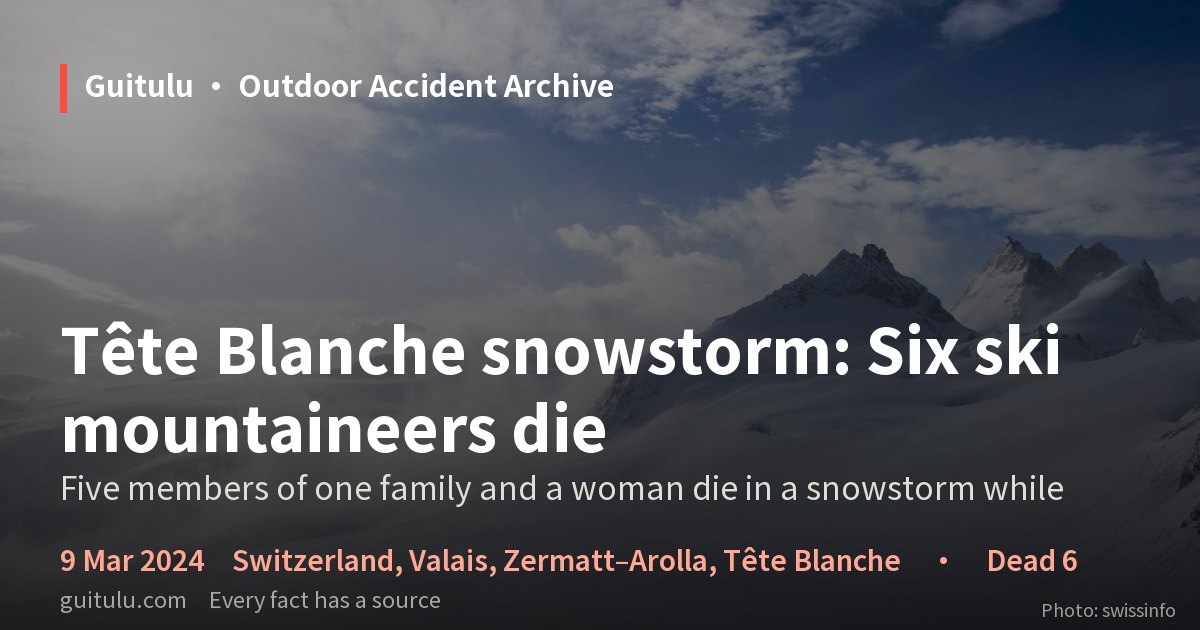
Five members of one family and a woman die in a snowstorm while training on the Haute Route
All six bodies have been found; the Valais cantonal prosecutor's office announced the case closed in June 2025, having found no grounds to suspect anyone else of a crime
The number at the end of a paragraph is how many facts it rests on; open it to see each fact and how well it is sourced:
Multiple sourcesSingle source. Conflicting accounts and speculation are kept out of the narrative.
Scroll down and the map flies to where each part happened. The line is Schematic, Lines connect the waypoints mentioned in reports in sequence, showing only the approximate direction, not the actual track. Sources for the location coordinates are listed in places.json.
01
Full route
The places mentioned in reports are connected in sequence to show the approximate course of events (schematic).
On the morning of 9 March 2024 (Saturday), the group of six set out from Zermatt for Arolla along a ski mountaineering route. F02
On the evening of 9 March, a ground rescue team set out from Zermatt. At an altitude of around 3000 metres, it abandoned the attempt at around 21:00 because the weather was extremely poor and the risk too great. F18
At around 17:19, one member of the group contacted rescue services, who used the call to establish their location in the Tête Blanche pass area, at an altitude of about 3500 metres. F11
At around 16:00 on 9 March, rescue services received an alert. F09
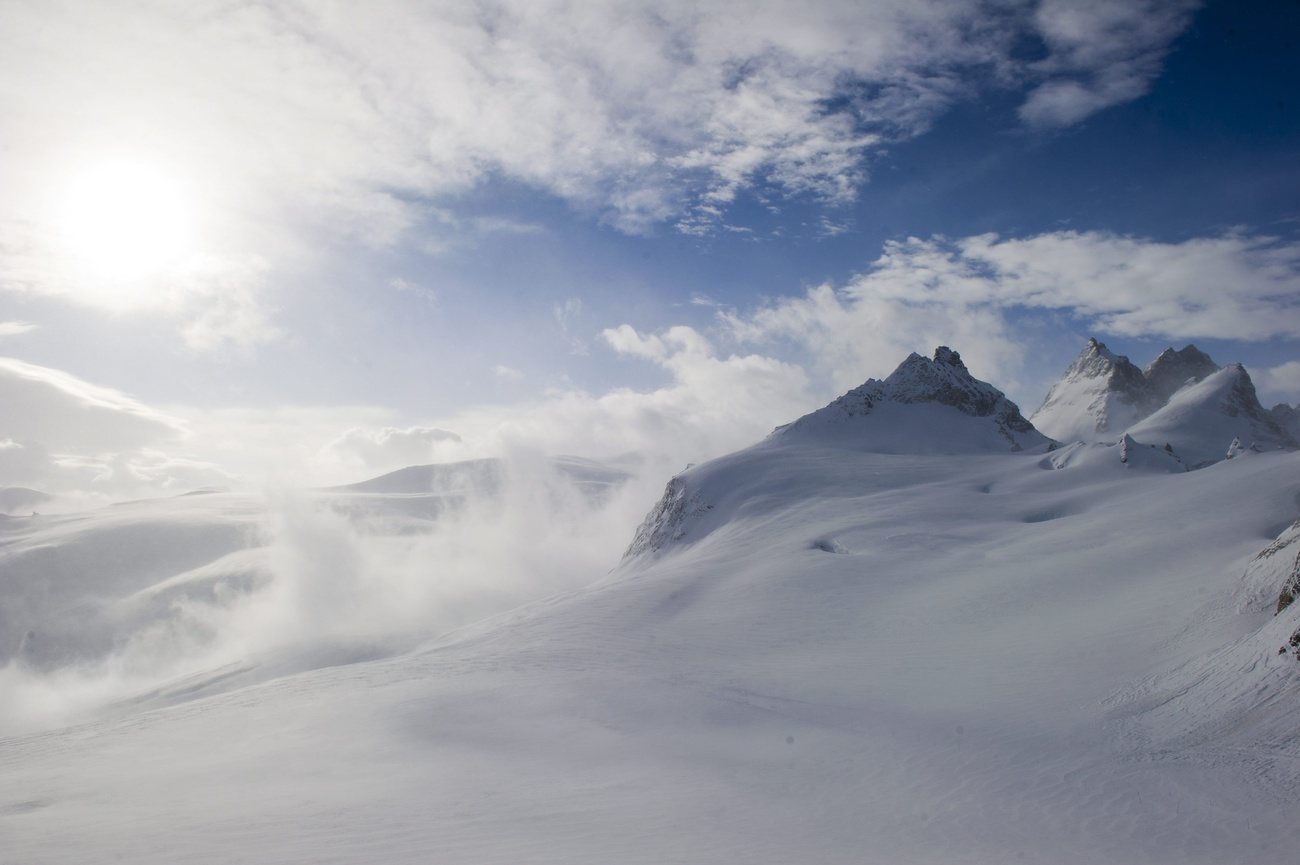
Late in the afternoon of 9 March, the group encountered rapidly worsening weather near Tête Blanche, at an altitude of about 3500 metres, and became trapped in a snowstorm. F06
On the evening of 10 March, rescuers were flown by helicopter to near the Dent Blanche hut, then proceeded towards the Tête Blanche area. F19
At around 21:20 on 10 March, rescuers reached the Tête Blanche area and quickly found five of the six people, all showing no signs of life. F20
On 14 March, rescue services stopped searching for the sixth person. F32
On 10 August 2024, a helicopter from the Valais rescue organisation and Air-Glaciers spotted an item of clothing protruding from the snow while flying over Tête Blanche. F33
In June 2025, the Valais Attorney General issued a press release announcing that the case had been closed: the investigations had not established the involvement of any other person sufficient to give rise to suspicion of a crime. F35
Under each fact is a verbatim quote from the original. "Single source" means only one outlet mentioned it; "Accounts differ" means sources contradict each other and this site adopts neither side; "Speculation" is an inference by a reporter or a person involved, not a fact.
Late in the afternoon of 9 March, the group encountered rapidly worsening weather near Tête Blanche, at an altitude of about 3500 metres, and became trapped in a snowstorm.
Quotes from the original 2
“On the route from Zermatt to Arolla in the late afternoon of 9 March 2024, they got caught in a storm not far from the summit of Tête-Blanche at an altitude of 3,550 meters.”
A foehn storm on the southern side of the Alps and the risk of avalanches prevented helicopters and rescue teams from approaching the area for a long time.
Quotes from the original 3
“la tempête de foehn qui a sévi dans le sud des Alpes ainsi que le danger d’avalanches ont longtemps empêché les hélicoptères et les colonnes de secours de pouvoir approcher la zone”
“But the storm on the southern side of the Alps and the risk of avalanches prevented helicopters and rescue teams from approaching the area on Saturday”
“Der Sturm auf der Alpensüdseite und die Lawinengefahr verhinderten am Samstag aber, dass sich Helikopter und Rettungskolonnen dem Gebiet nähern konnten.”
According to Le News, Wind speeds on the mountain reportedly exceeded 100 kilometres per hour, and temperatures fell as low as minus 18 degrees Celsius.
Quotes from the original 1
“winds of more than 100 km/h and temperatures as low as -18 degrees”
Accounts differ as to who raised the alarm at around 16:00: Le Temps said a family member who was preparing to meet the group in Arolla raised the alarm when they did not arrive; Le News said a member of the group raised the alarm.
Reports differ on the identity of the person who first raised the alarm
Quotes from the original 2
“Les secours avaient été alertés samedi aux alentours de 16h par un membre de la famille qui devait récupérer le groupe à Arolla et qui s’inquiétait de ne pas voir arriver ses proches.”
At around 17:19, one member of the group contacted rescue services, who used the call to establish their location in the Tête Blanche pass area, at an altitude of about 3500 metres.
Quotes from the original 2
“A member of the group had managed to contact the rescue teams at 5.19 pm on Saturday, allowing them to locate the ski tourers in the Tête Blanche area.”
“A 17h20, les randonneurs ont pu être localisés dans le secteur du col de Tête-Blanche, à 3500 mètres d’altitude environ, car l’un d’entre eux était parvenu à joindre les secours.”
According to blue News, According to the head of the Valais rescue organisation, the caller's voice was calm, and the caller explained that they were trapped in a snowstorm.
Quotes from the original 1
“«Die Stimme war ruhig, es gab keinen grossen Stress. Die Person hat uns die Situation erklärt. Sie steckten im Sturm fest»”
According to blue News, They reportedly said over the phone that they were carrying emergency thermal blankets and snow shovels. The call then ended abruptly, and further attempts to contact them were unsuccessful.
Quotes from the original 1
“Die Wintersportler hätten erklärt, Rettungsdecken und Schaufeln dabei zu haben. Danach sei das Gespräch abrupt abgebrochen. Versuche, erneut den Kontakt aufzunehmen, seien erfolglos geblieben.”
On the evening of 9 March, a ground rescue team set out from Zermatt. At an altitude of around 3000 metres, it abandoned the attempt at around 21:00 because the weather was extremely poor and the risk too great.
Quotes from the original 3
“Une colonne de secours, composée de cinq sauveteurs, est partie de Zermatt samedi à 18h en direction de la zone de recherche, mais a dû renoncer vers 21h”
“Gegen 21.20 Uhr erreichten sie gemäss Polizei das Gebiet des Tête Blanche, wo sie rasch fünf der sechs seit Samstag vermissten Personen ohne Lebenszeichen entdeckten.”
According to Blick, Rescue chief Truffer said the group was found slightly off the original route, near an alternative descent couloir that was not part of the planned route.
Quotes from the original 1
“Le groupe a été découvert légèrement à l'écart de l'itinéraire. Ils ont été trouvés près d'un couloir de descente alternatif.”
Air Zermatt rescue chief Anjan Truffer believed it was almost impossible to dig a snow cave in the hard snow with the small, lightweight snow shovels the group carried.
The two reports relay the same person's assessment
Quotes from the original 2
“«Mit diesen kleinen Schaufeln in dem harten Schnee war das ziemlich sinnlos.»”
“the head of Air Zermatt told media that it would have been almost impossible to dig a cave in the hard snow with the light avalanche shovels carried by the group”
Truffer speculated that the group may have panicked because of the weather and wanted to descend early, or may have planned to take this descent route all along; he said it was not currently possible to determine which.
Quotes from the original 1
“C'est une possibilité. Mais il se peut aussi que la descente ait été prévue dès le début. Je ne peux rien dire de concret à ce sujet pour le moment.”
At a police press conference on 11 March, police said the cause of death had not yet been established and it was not yet possible to determine whether they had frozen to death or died in an avalanche.
Quotes from the original 2
“Es sei nicht klar, ob die Verunglückten erfroren, oder ob eine Lawine zu ihrem Tod führte.”
Valais Attorney General Beatrice Pilloud announced that an investigation had been opened into the precise circumstances of the accident.
Quotes from the original 2
“Une instruction a été ouverte pour connaître les circonstances exactes de cette tragédie, a pour sa part détaillé Beatrice Pilloud, procureure générale du Valais.”
Truffer speculated that the group may have completely misjudged the weather forecast or overestimated their abilities, perhaps thinking they could finish before the bad weather arrived.
Quotes from the original 1
“Je pense simplement que soit ils ont totalement mal évalué les prévisions météorologiques, soit ils se sont surestimés. Ils pensaient peut-être pouvoir avancer plus vite avant l'arrivée du mauvais temps.”
According to Nau.ch, Pierre Mathey, head of the Swiss Mountain Guides Association, said he himself would also have set out from Zermatt that Saturday because the weather was not particularly bad; however, conditions such as the wind are always a danger and can deteriorate rapidly.
Quotes from the original 2
“«Am Samstag hätte ich persönlich auch eine Tour in Zermatt gestartet, denn das Wetter war nicht so schlecht», sagt Pierre Mathey”
On 10 August 2024, a helicopter from the Valais rescue organisation and Air-Glaciers spotted an item of clothing protruding from the snow while flying over Tête Blanche.
Quotes from the original 2
“During a helicopter flight over the Tête Blanche by the Rescue Organisation of the Canton Valais/Wallis (KWRO) and Air-Glacier on August 10, a piece of clothing was spotted in the snow.”
According to blue News, In June 2025, the Valais Attorney General issued a press release announcing that the case had been closed: the investigations had not established the involvement of any other person sufficient to give rise to suspicion of a crime.
Quotes from the original 1
“In a press release issued on Monday, the Attorney General of the Canton of Valais, Beatrice Pilloud, wrote that the various investigations had not been able to prove the involvement of any other persons that would give rise to suspicion of a criminal offense.”
According to blue News, Prosecutors said the investigation had also failed to establish the exact circumstances of the accident; rapidly deteriorating weather may have made it harder to find the ideal route.
Quotes from the original 1
“The investigation was also unable to clarify the exact circumstances of this drama. The rapidly deteriorating weather conditions may have contributed to the fact that the search for the ideal route was made more difficult, the public prosecutor's office said.”
According to ExplorersWeb, According to reports, ski mountaineers typically take two days to cover this section, staying overnight in a mountain hut along the way.
Quotes from the original 1
“Average skiers need two days, stopping for the night in a mountain hut along the way.”
Assessments of their equipment differed: rescue chief Truffer believed the group was poorly equipped and their clothing was insufficient to withstand strong winds and low temperatures; SnowBrains said they had travelled light for training but were otherwise well equipped.
Quotes from the original 3
“Wie Truffer gegenüber SRF erklärt, sei die Gruppe aber sehr schlecht ausgerüstet gewesen.”
According to Blick, Truffer noted that the Haute Route is in high alpine terrain, with crevasses on the glaciers and a risk of avalanches; in good conditions, it is not a particularly long or difficult route.
Quotes from the original 1
“Là où il y a des glaciers, il y a aussi des crevasses. De plus, il y a un risque d'avalanche. En principe, il ne s'agit pas d'une grande randonnée ou d'une randonnée particulièrement difficile si on l'aborde dans de bonnes conditions.”
 GuituluGlobal Outdoor Accident Archive