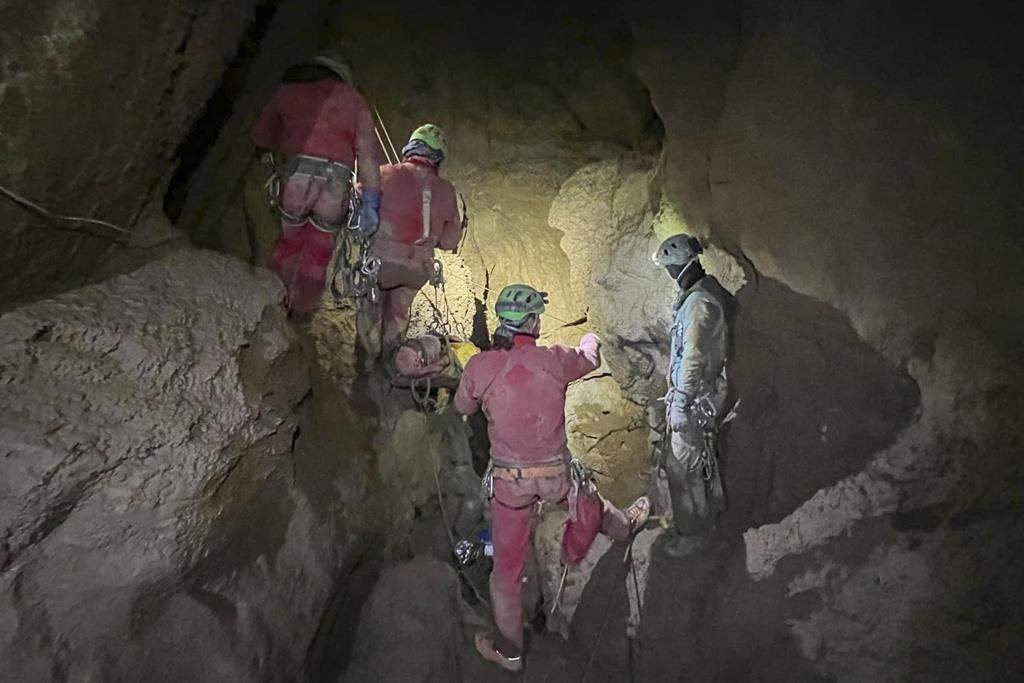
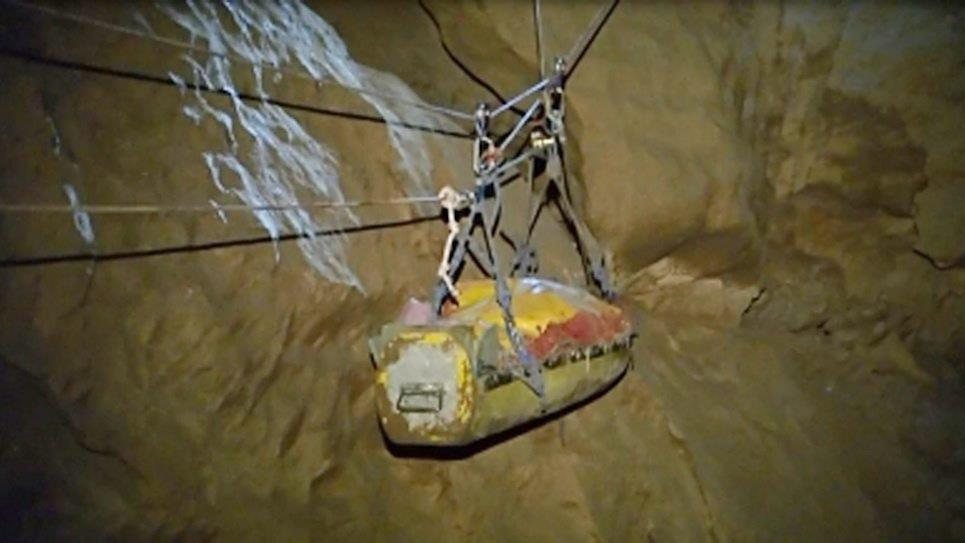
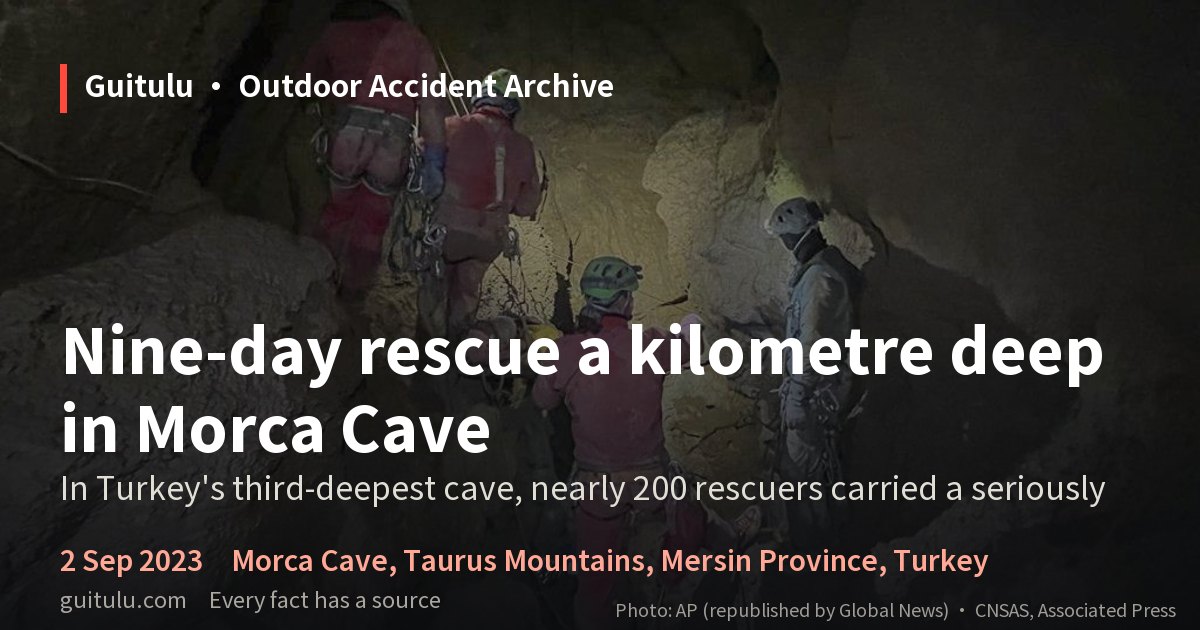
Members of Italy's National Alpine and Cave Rescue Corps (CNSAS) moving a stretcher inside Morca CavePhoto source: AP (republished by Global News) · CNSAS, Associated Press
The number at the end of a paragraph is how many facts it rests on; open it to see each fact and how well it is sourced:
Multiple sourcesSingle source. Conflicting accounts and speculation are kept out of the narrative.
ImgScene photos all from news coverage; copyright belongs to the original authors
The entrance to Morca Cave, cordoned off with yellow ropePhoto source: National GeographicA rescuer holding a diagram of Morca Cave showing its length, depth and difficult sectionsPhoto source: National GeographicA rescuer descending on a rope into the entrance of Morca CavePhoto source: National GeographicA rescuer arranging a harness, ropes and equipment before entering the cavePhoto source: National GeographicA stretcher being raised up a shaft using a rope and pulley systemPhoto source: National GeographicA rescuer working on a rope in a fissure shaft in Morca CavePhoto source: NPRViews of the entrance and interior of the cave during the rescuePhoto source: ExplorersWeb
Reported locations along the route (illustrative)Schematic
Scroll down and the map flies to where each part happened. The line is Schematic, Lines connect the locations mentioned in reports in sequence, showing only the approximate direction, not the actual route.
01
Full route
The locations mentioned in reports are connected in sequence to show the approximate route (schematic).
Dickey suddenly suffered gastrointestinal bleeding at a depth of about 1000 metres in the cave and was unable to get out on his own. F14
After arriving, the Hungarian medical team gave Dickey medication to suppress stomach acid and stop the bleeding, and gave him a blood transfusion. F19
Turkey's Disaster and Emergency Management Authority (AFAD) launched an operation and formally authorised the European Cave Rescue Association to coordinate the rescue teams from different countries. F21
On 3 September, a four-person medical team from the Hungarian Cave Rescue Service began descending into the cave and took about seven hours to reach Dickey. F18
By around 7 September, the Bulgarian cave rescue team said Dickey's condition had improved, the bleeding had stopped and he could walk on his own. F22
The rescue route was divided into seven sections, with different teams responsible for each section. F25
After doctors gave Dickey fluids and blood transfusions and determined that he could withstand the ascent, they began moving him to the surface on 9 September (Saturday). F26
On 10 September (Sunday), the team carrying the stretcher passed a camp approximately 500 metres underground. F28
After leaving the cave, Dickey was taken by helicopter to a hospital in Mersin, where he underwent further examinations in the intensive care unit. F31
At 0:37 a.m. local time on 12 September, Dickey was carried out through the cave's final exit. F30
Under each fact is a verbatim quote from the original. "Single source" means only one outlet mentioned it; "Accounts differ" means sources contradict each other and this site adopts neither side; "Speculation" is an inference by a reporter or a person involved, not a fact.
The 2014 rescue in Germany's Riesending Cave involved more than 700 people and took nearly two weeks to rescue an injured German speleologist; according to a member of the European Cave Rescue Association, that experience helped them complete the rescue at Morca more quickly.
Quotes from the original 2
“A similar rescue in Germany in 2014 took nearly two weeks to complete.”
Dickey and several others took part in an expedition to survey the approximately 1276-metre-deep Morca Cave system for the Anatolian Speleology Group Association.
Quotes from the original 2
“He and several other people on the expedition were mapping the 1,276-meter (4,186-foot) deep Morca cave system for the Anatolian Speleology Group Association.”
Accounts differ on the date Dickey became ill: an Associated Press report and the Hungarian Cave Rescue Service record it as 2 September (Saturday), while the New Jersey Initial Response Team and some US media say he had been trapped since 31 August.
Different starting dates: the request for help was recorded late on 2 September; another account gives 31 August
Quotes from the original 4
“became seriously ill on Sept. 2 with stomach bleeding”
Over the following week, rescue teams from Bulgaria, Italy, Croatia, Poland and Turkey arrived in succession, laid telephone lines, installed rope systems and established underground camps.
Quotes from the original 2
“teams from Bulgaria, Italy, Croatia, Poland and Turkey joined the rescue effort”
According to National Geographic, Rescuers installed telephone lines and a wireless text messaging system in the cave to maintain communication between the inside and outside.
Quotes from the original 1
“a phone cable and an additional wireless communication system”
According to National Geographic, For this rescue, rescuers were instead organised into self-sufficient teams that travelled from one camp to the next over longer sections of the cave.
Quotes from the original 1
“organize rescuers in self-sufficient teams that would move through longer parts of the cave”
According to National Geographic, During the evacuation, a large rock came loose in a vertical shaft section and trapped a Bulgarian rescuer's ankle; fortunately, he escaped life-threatening injury.
Quotes from the original 1
“a large piece of rock detached, squeezing the ankle of a Bulgarian rescuer who narrowly evaded life-threatening injury”
According to Al Jazeera, The greatest difficulties rescuers faced were the steep vertical sections of the cave and the muddy water in the horizontal sections at low temperatures.
Quotes from the original 1
“The biggest challenges for the rescuers were the steep vertical sections inside the cave and navigating through mud and water at low temperatures”
According to an experienced rescuer who took part, this was one of the most difficult and complex cave rescues ever; the Turkish Caving Federation called it one of the largest cave rescue operations in recent years.
Assessments by a rescue participant and the Turkish Caving Federation
Quotes from the original 2
“It was one of the most difficult and complex cave rescue missions ever executed, according to veteran rescuers involved in the effort.”
According to NPR, According to NPR, citing the New Jersey Initial Response Team, it took about eight hours to walk from Dickey's location back to the cave entrance.
Quotes from the original 1
“the hike back to the cave's entrance from his location takes about eight hours”
According to Lufthansa Systems, After the Hungarian Cave Rescue Service received the emergency request for help, the European Cave Rescue Association immediately looked for a team that could arrive at once, descend below 1000 metres and provide specialist medical care.
Quotes from the original 1
“The European Cave Rescue Association (ECRA) immediately started looking for a cave rescue team that could immediately go to the location, get down to a depth of over 1000 metres and provide Mark with professional care.”
On 3 September, a four-person medical team from the Hungarian Cave Rescue Service began descending into the cave and took about seven hours to reach Dickey.
Quotes from the original 2
“a four-person medical team from the Hungarian Cave Rescue Service immediately started a seven-hour descent to reach Dickey”
According to National Geographic, According to National Geographic, the medical team gave Dickey four units of blood and plasma and used a camp gas stove to warm the blood bags.
Quotes from the original 1
“gave Dickey four units of blood and plasma, warming the blood bags with the help of a camp gas stove”
According to National Geographic, Turkey's Disaster and Emergency Management Authority (AFAD) launched an operation and formally authorised the European Cave Rescue Association to coordinate the rescue teams from different countries.
Quotes from the original 1
“officially giving ECRA authority to coordinate international teams rescue teams”
According to NPR, By around 7 September, the Bulgarian cave rescue team said Dickey's condition had improved, the bleeding had stopped and he could walk on his own.
Quotes from the original 1
“Cave Rescue Bulgaria said Dickey's condition was improving, adding that his bleeding had stopped and he was able to walk alone”
According to AP (republished by Global News), After doctors gave Dickey fluids and blood transfusions and determined that he could withstand the ascent, they began moving him to the surface on 9 September (Saturday).
Quotes from the original 1
“The rescue began on Saturday after doctors, who administered IV fluids and blood, determined that Dickey could make the arduous ascent.”
According to AP (republished by Global News), He was moved on a stretcher, with several stops at temporary camps along the way; a team consisting of one doctor and three to four rescuers remained by his side throughout, working in shifts.
Quotes from the original 2
“so rescuers carried him with the help of a stretcher, making frequent stops at temporary camps set up along the way”
Accounts of the number of people involved in the rescue vary: an Associated Press report said about 190 specialists came from six countries, National Geographic said about 200 volunteers came from nine countries, and Al Jazeera said there were more than 150 rescuers.
The sources use different counting methods
Quotes from the original 3
“Around 190 experts from Bulgaria, Croatia, Hungary, Italy, Poland and Turkey took part in the rescue”
Accounts of the rescue's duration vary: Al Jazeera said the rescue lasted nine days, National Geographic said it was nine days from the call for help, and ABC said he was trapped for 12 days.
Different starting dates (the day help was requested and 31 August)
According to National Geographic, National Geographic said that moving Dickey to the surface, the most complex stage, was carried out by 90 people and took just over two days.
Quotes from the original 1
“was executed by 90 people and took just over two days”
According to AP (republished by Global News), Mark Dickey was a 40-year-old experienced cave explorer from New York state and a cave rescuer who had taken part in multiple international expeditions.
Quotes from the original 1
“Dickey, who is from Croton-on-Hudson, New York, is a well-known cave researcher and a cave rescuer himself who had participated in many international expeditions.”
According to National Geographic, According to National Geographic, the cave entrance is in a remote location in the Taurus Mountains at an altitude of about 6,800 feet.
Quotes from the original 1
“remote spot at 6800 feet above sea level in the Taurus mountains”
According to CNN Türk, According to CNN Türk, Dickey became unwell at a depth of approximately 1,200 metres and was moved to 1,040 metres for treatment by doctors.
Other reports give the rescue depth as approximately 1,000 to 1,040 metres; only this source mentions 1,200 metres
Quotes from the original 1
“1200 metre derinlikte rahatsızlanıp, getirildiği 1040 metrede doktorların tedavisi yapılan”
 GuituluGlobal Outdoor Accident Archive