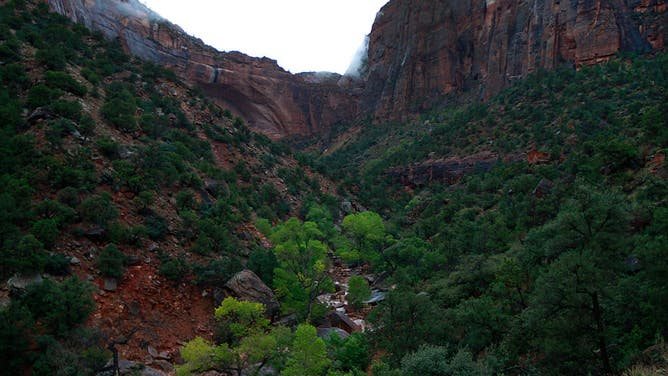
Water flowing in Pine Creek in Zion National Park on 15 September 2015, when it was a possible search location for the missing canyoneersPhoto source: FOX Weather
The number at the end of a paragraph is how many facts it rests on; open it to see each fact and how well it is sourced:
Multiple sourcesSingle source. Conflicting accounts and speculation are kept out of the narrative.
Reported locations along the route (illustrative)Schematic
Scroll down and the map flies to where each part happened. The line is Schematic, Connects the locations mentioned in reports in sequence, showing only the approximate direction, not the actual track.
01
Full route
The locations mentioned in reports are connected in sequence to show the approximate course of events (schematic).
Between 4:30 p.m. and 5:30 p.m., Zion Canyon received 0.63 inches of rain in less than an hour, and flash floods began in Keyhole Canyon and several other canyons. F14
At 7:40 a.m. on 14 September, the seven obtained a canyoneering permit for Keyhole Canyon. F02
At around 2:22 p.m., the National Weather Service issued a flash flood warning for the area, and the park closed the canyons and halted canyoneering. F07
The seven entered Keyhole Canyon between 3:30 p.m. and 4:30 p.m. F09
On 14 September, six of the seven attended an introductory course called Keyhole/Subway Ground School at Zion Adventure Company in Springdale. F01
At 5:30 p.m., another canyoneering group that had just passed through Keyhole Canyon ahead of the flash flood reported to a ranger that they had passed a group of seven and believed the seven might be trapped by the flood. F18
The flow of the North Fork Virgin River rose sharply from 55 cubic feet per second to 2,630 cubic feet per second in 15 minutes. F15
That evening, rangers found the seven people's vehicles but found no sign of the people. Because of the weather, a rescue could not safely be launched throughout the night. F20
The search began at 7 a.m. on 15 September. Because of the weather and high water levels, search and rescue personnel were still unable to enter Keyhole Canyon. They called out but received no response, then searched downstream in Clear Creek. F22
Four people who had died were found on 15 September: Steve Arthur, Gary Favela, Muku Reynolds and Don Teichner. F23
On 16 September, Robin Brum and Mark MacKenzie were found in the Pine Creek drainage. That day, the technical sections of Keyhole Canyon and Pine Creek Canyon remained inaccessible because of the weather and high water levels. F25
The weather improved on 17 September, and search and rescue personnel entered the technical sections. That morning, they found the last person who had died, Linda Arthur, downstream in Pine Creek Canyon. F27
The search and rescue operation ended at 6 p.m. on 17 September. F30
Under each fact is a verbatim quote from the original. "Single source" means only one outlet mentioned it; "Accounts differ" means sources contradict each other and this site adopts neither side; "Speculation" is an inference by a reporter or a person involved, not a fact.
On 14 September, six of the seven attended an introductory course called Keyhole/Subway Ground School at Zion Adventure Company in Springdale.
Quotes from the original 2
“six of the seven VHC members enrolled in an introductory course called Keyhole/Subway Ground School at the Zion Adventure Company (ZAC), in the nearby community of Springdale”
When they obtained the permit, the group was told about the danger of flash floods. The park provides all permit holders with safety information including the current weather forecast and flash flood potential rating.
Quotes from the original 2
“The group was told of the danger of flash flooding when they got their entry permit, a common warning during the rainy season, park officials say.”
“All individuals who pick up permits are given safety information, including the current forecast and flash flood potential rating at the time they pick up the permit.”
That morning's weather forecast had already warned of the risk of thunderstorms and flash floods: the National Weather Service's Salt Lake City office issued a moderate flash flood risk, with a higher risk in slot canyons.
Quotes from the original 2
“On the morning of Sept. 14, the NWS office in Salt Lake City issued a moderate risk of flash flooding, including a higher risk for flash flooding in slot canyons that Zion is known for.”
According to Outside, Before setting out that day, MacKenzie had checked a National Oceanic and Atmospheric Administration weather forecast on a phone that listed Zion as dry.
Quotes from the original 1
“MacKenzie then pulled up a Keyhole guidebook page on his phone, along with a NOAA weather report that listed Zion as dry.”
“While flash flood warnings for the area were issued by the National Weather Service around 2:20 p.m., and park authorities say the canyon areas were closed”
According to Outside, The storm associated with the 2:22 warning caused a dry riverbed in the Colorado City area to begin flooding, but did not pass over Zion at all.
Quotes from the original 1
“That storm set the dry washes in Colorado City flowing but missed Zion entirely.”
According to Outside, A group led by guide Jim Clery caught up with the group of seven at the first rappel and, with MacKenzie's agreement, passed them. The two groups had no further contact.
Quotes from the original 3
“When Clery reached the opening, the California group had just started down the first rappel.”
According to Outside, When Clery's group reached the third rappel, they heard a nearby clap of thunder. Heavy rain then fell suddenly, with almost no warning.
Quotes from the original 2
“At the third rappel everything changed. A clear, close thunderclap peeled down the canyon walls.”
Between 4:30 p.m. and 5:30 p.m., Zion Canyon received 0.63 inches of rain in less than an hour, and flash floods began in Keyhole Canyon and several other canyons.
Quotes from the original 3
“4:30 to 5:30 p.m. Zion Canyon received 0.63 inches of rain in less than one hour. Rangers noted Keyhole Canyon and several other canyons began to flash flood.”
At 5:30 p.m., another canyoneering group that had just passed through Keyhole Canyon ahead of the flash flood reported to a ranger that they had passed a group of seven and believed the seven might be trapped by the flood.
Quotes from the original 2
“5:30 p.m. Another canyoneering group who had been through Keyhole Canyon just before the flood reported to park rangers that they had passed a group of seven canyoneers and believed that they may have been caught in the flood.”
According to Outside, When Clery and his companions reported to a ranger, the ranger on duty tried to relay the report by radio, but the channel was occupied.
Quotes from the original 1
“The ranger on duty tried the radio to relay their report, but the frequency was jammed with traffic.”
That evening, rangers found the seven people's vehicles but found no sign of the people. Because of the weather, a rescue could not safely be launched throughout the night.
Quotes from the original 3
“Rangers located the group's vehicles, but did not see any sign of the group. Keyhole Canyon was already flash flooding. Due to weather at the time and through the evening, it was determined that rescue operations could not be safely initiated.”
The same storm also caused flash flooding in the Hildale area on the Utah–Arizona border. Two vehicles were swept away, and 13 women and children were killed.
Quotes from the original 2
“The same storm that sparked the flooding in the park also caused flash flooding near Hildale, which killed 13 women and children in two cars that were washed away by the raging waters.”
According to NPS, The search began at 7 a.m. on 15 September. Because of the weather and high water levels, search and rescue personnel were still unable to enter Keyhole Canyon. They called out but received no response, then searched downstream in Clear Creek.
Quotes from the original 2
“7:00 a.m. The search began. Keyhole Canyon was still inaccessible to Search and Rescue crews due to weather and high water levels.”
On the afternoon of 15 September, a private canyoneering party passing through Keyhole Canyon found a person who had died inside the canyon, later identified as Gary Favela.
Quotes from the original 2
“2:30 p.m. A private canyoneering group went through Keyhole Canyon and reported the location of an individual who was later identified as Gary Favela.”
On 16 September, Robin Brum and Mark MacKenzie were found in the Pine Creek drainage. That day, the technical sections of Keyhole Canyon and Pine Creek Canyon remained inaccessible because of the weather and high water levels.
Quotes from the original 3
“Due to weather conditions and high water levels, the technical sections of Keyhole Canyon and Pine Creek Canyon were not accessible.”
The National Park Service released the identities of the seven canyoneers who died: Mark MacKenzie, Linda Arthur, Steve Arthur, Gary Favela, Don Teichner, Muku Reynolds and Robin Brum.
Quotes from the original 3
“The seven Keyhole Canyon canyoneers who were overtaken by a flash flood in Zion National Park, have been identified.”
“The park identified the hikers as Mark MacKenzie, 56, of Valencia; Linda Arthur, 57, of Camarillo; Steve Arthur, 58, of Camarillo; Robin Brum, 53, of Camarillo;”
The weather improved on 17 September, and search and rescue personnel entered the technical sections. That morning, they found the last person who had died, Linda Arthur, downstream in Pine Creek Canyon.
Quotes from the original 3
“Improved weather conditions allowed rescuers to enter the technical sections of Keyhole Canyon and Pine Creek Canyon.”
Linda Arthur was found several miles from Keyhole Canyon, in Pine Creek Canyon via the Clear Creek drainage, farther from the accident site than any of the other six.
Quotes from the original 2
“had traveled the farthest: five miles downstream, through the Clear Creek drainage into Pine Creek Canyon”
According to AP, Afterward, the park said it was investigating the cause of the accident and reviewing relevant policies, but that the canyon permit system was determined at the national level and any changes might have to be made from the top down.
Several quotations come from different reports by the same media outlet and are counted as one source
Quotes from the original 2
“The park is investigating what led to the deaths and reviewing its policies, but the process for canyon entry permits is decided at the national level and any changes would likely need to come from the top down”
According to Outside, Gary Favela's family filed a claim against the National Park Service, arguing that the park should have had a way to warn those who died that a flood was coming.
Quotes from the original 1
“Favela’s family has filed a claim for damages against the Park Service, alleging that it should have had a way to alert the victims that a flood was coming.”
According to Outside, Allison Bottcher, the daughter of the Arthurs, who both died, hoped there could be a way for people to obtain weather information in steep canyons when there was no mobile phone or radio signal.
Quotes from the original 1
“She’d like for there to be a way for people to get weather info even when they’re out of cell and radio range in the steep canyons.”
According to Outside, Park rangers completed a 27-page accident report, but the National Park Service denied a freedom of information request to release it because litigation was pending.
Quotes from the original 1
“completed a 27-page report on the incident. But because of the pending lawsuit, the Park Service denied a Freedom of Information Act request to make it public.”
A permit is required to travel through Keyhole Canyon. The route involves several short rappels of less than 30 feet and swims through several pools.
Both media outlets cited a park statement
Quotes from the original 2
“A permit is required for traveling through Keyhole Canyon and individuals must complete several short rappels under 30 feet and swim through several pools of water.”
“A permit is required for traveling through Keyhole Canyon and individuals must complete several short rappels under 30 feet and swim through several pools of water.”
According to Outside, The canyon is approximately 1200 feet long and requires three 30-foot rappels, plus some climbing and swimming. It is only about a five-minute walk from the Zion–Mount Carmel Highway.
Quotes from the original 1
“Five minutes off the park’s Zion–Mount Carmel Highway, the slot canyon is only 1,200 feet long and requires just three 30-foot rappels and a bit of scrambling and swimming”
Of the seven people who died, six were from California and one was from Nevada. They were between 51 and 59 years old.
Quotes from the original 2
“The hikers — six from California and one from Nevada — were killed when fast-moving floodwaters rushed through a narrow park canyon Monday afternoon.”
According to Outside, The seven-person party came from Valencia Hiking Crew, a Southern California hiking club that organized activities through Meetup.
Quotes from the original 2
“members of Southern California’s Valencia Hiking Crew”
All seven were experienced hikers, but most were not technical canyoneers proficient in rappelling. Only Mark MacKenzie had extensive canyoneering experience; some members had only recently taken up rappelling.
Quotes from the original 3
“The seven people who died in Keyhole Canyon were experienced hikers. Most of them were not, however, technical canyoneers, well versed in rappelling techniques.”
The park operated a “shall issue” permit policy: permits were issued to applicants as long as there was no official flash flood warning. Rangers could advise against entering, but under the policy they could not assess permit holders' technical skills or prevent them from entering.
Quotes from the original 2
“unless there’s an actual flash-flood warning in effect, it will give permits to those who want them, though the rangers may try to dissuade people from going”
 GuituluGlobal Outdoor Accident Archive