He walked alone into the Alaskan wilderness and spent his final summer in an abandoned bus
The autopsy report identified starvation as the probable cause of death; the writer Krakauer believes a neurotoxin in wild potato seeds was an important cause, a claim that remains disputed. The bus was airlifted away by the state government in 2020.
Dead 1 The sole person involved died and was found by hunters on 6 September 1992. Among hikers who later travelled to the bus, 1 person drowned crossing the Teklanika River in 2010 and another in 2019.
Material
41 facts · 15 sources1 account differs and are shown side by side
The number at the end of a paragraph is how many facts it rests on; open it to see each fact and how well it is sourced:
Multiple sourcesSingle source. Conflicting accounts and speculation are kept out of the narrative.
Reported locations along the way (schematic)Schematic
Scroll down and the map flies to where each part happened. The line is Schematic, Connects the locations mentioned in reports in sequence. It shows only the approximate direction, not the actual route.
01
The full route
The locations mentioned in reports are connected in sequence to show the approximate route (schematic).
The bus was abandoned beside the trail in the early 1960s and subsequently became a temporary shelter for hunters, trappers and others passing through the wilderness. F01
In April 1992, McCandless walked into the Alaskan wilderness along the Stampede Trail. F08
According to his diary and photographs, from 24 June 1992, the roots of wild potato (Hedysarum alpinum) became his daily staple food; from 14 July, he also began gathering and eating its seeds. F10
He tried to walk back to the road, but the Teklanika River had risen too high to cross, forcing him to return to the bus; Krakauer says this was in early July. F11
His diary entry on 30 July said that he was extremely weak, that it was the potato seeds' fault, that he could barely stand up, that he was starving and that he was in extreme danger. F12
McCandless died in the bus in mid-August 1992; the date Krakauer gave in an interview was 18 August. F14
On 6 September 1992, moose hunters found his body in the bus. F16
Outside magazine commissioned Krakauer to investigate the case, and he published a long article in January 1993; Into the Wild was published in January 1996 and adapted into a film by Sean Penn in 2007. F19
In 2010, a Swiss woman drowned while crossing the Teklanika River on her way to the bus; she and her companion had tied themselves to a rope spanning the river, and she lost her footing halfway across. F21
In 2013, three hikers returning from the bus were stranded after one injured an ankle and the river rose. After two days without food, they attracted the attention of a passing military helicopter with a signal mirror and were rescued. F25
In July 2019, a 24-year-old Belarusian woman and her husband were travelling to the bus when she was swept away and drowned while crossing the Teklanika River; state troopers said the river was high and swift because of recent rainfall. F28
In February 2020, state troopers rescued five Italian hikers stranded near the bus, one of whom had severe frostbite. F30
On 18 June 2020, the Alaska Army National Guard, working with the Department of Natural Resources, used a CH-47 Chinook helicopter to airlift the bus from a location west of the Teklanika River, in an operation code-named “Yutan”. F33
Under each fact is a verbatim quote from the original. "Single source" means only one outlet mentioned it; "Accounts differ" means sources contradict each other and this site adopts neither side; "Speculation" is an inference by a reporter or a person involved, not a fact.
The bus was abandoned beside the trail in the early 1960s and subsequently became a temporary shelter for hunters, trappers and others passing through the wilderness.
Quotes from the original 3
“The bus was abandoned in 1961 and had become an emergency shelter for those using the backcountry to recreate or hunt.”
“The bus had been abandoned along the Stampede Trail, then a rough road to a now-defunct mine, in the early 1960s. It became a popular fall and winter shelter for hunters and trappers”
While at the bus, he kept a diary and took photographs, recording the animals he hunted and the plants he ate; the diary and photographs were found with his body.
Quotes from the original 3
“he recorded all the food that he killed. He noted the plants that he ate.”
He took little food or equipment into the wilderness; according to Outside, the only food he brought was rice, and he also left his topographic map and compass behind.
Quotes from the original 2
“who hiked into the Alaska wilderness with little food and equipment”
According to The New Yorker, According to his diary and photographs, from 24 June 1992, the roots of wild potato (Hedysarum alpinum) became his daily staple food; from 14 July, he also began gathering and eating its seeds.
Quotes from the original 1
“beginning on June 24, 1992, the roots of the Hedysarum alpinum plant became a staple of his daily diet. On July 14th, he started harvesting and eating Hedysarum alpinum seeds as well.”
He tried to walk back to the road, but the Teklanika River had risen too high to cross, forcing him to return to the bus; Krakauer says this was in early July.
Quotes from the original 3
“But a raging Teklanika prevented him from crossing, so he returned to the bus and hunkered down.”
His diary entry on 30 July said that he was extremely weak, that it was the potato seeds' fault, that he could barely stand up, that he was starving and that he was in extreme danger.
Both quotations come from Krakauer's transcription of the diary.
Quotes from the original 2
“On July 30th, McCandless wrote in his journal, “EXTREMELY WEAK. FAULT OF POT[ATO] SEED. MUCH TROUBLE JUST TO STAND UP. STARVING. GREAT JEOPARDY.””
According to Craig Medred, Among the words he left behind was a sentence saying that he was too weak to walk out and was truly trapped in the wilderness.
Quotes from the original 1
““TOO WEAK TO WALK OUT, HAVE LITERALLY BECOME TRAPPED IN THE WILD.””
According to The New Yorker, His driver's license, issued eight months earlier, recorded his weight as 140 pounds; after his body was brought out, an autopsy measured his weight at 67 pounds, and the autopsy report identified the probable cause of death as starvation.
Quotes from the original 2
“A driver’s license issued eight months before he perished indicated that he was twenty-four years old and weighed a hundred and forty pounds.”
“Krakauer wrote that the young man probably confused wild potato seeds (Latin name: Hedysarum alpinum), which were thought to be safe to eat, with the possibly toxic seeds of the wild sweet pea plant”
Outside magazine commissioned Krakauer to investigate the case, and he published a long article in January 1993; Into the Wild was published in January 1996 and adapted into a film by Sean Penn in 2007.
A 2013 Outside report gave the book's publication year as 1997; the author himself and other sources give 1996.
Quotes from the original 4
“Working on a tight deadline, I researched and wrote an eighty-four-hundred-word piece, published in January, 1993.”
After the book and film were released, many people hiked along the trail to the bus on a “pilgrimage”, with numbers increasing markedly after the film's release.
Quotes from the original 2
“When the movie version of Into the Wild was released in 2007, their numbers increased significantly.”
In 2010, a Swiss woman drowned while crossing the Teklanika River on her way to the bus; she and her companion had tied themselves to a rope spanning the river, and she lost her footing halfway across.
Quotes from the original 3
“They tied themselves to a rope that somebody had run from one bank to the other, to aid such attempts. The Teklanika is powerful in summertime, and about halfway across they lost their footing.”
On this basis, Krakauer speculated that McCandless may have developed lathyrism, a form of neurotoxicity that can cause paralysis, from eating wild potato seeds, rather than simply starving to death.
ADN's report is a review of Krakauer's article; the autopsy report identified starvation as the probable cause of death.
Quotes from the original 2
“there is ample reason to believe that McCandless contracted lathyrism from eating those seeds”
“Krakauer cites recent new evidence supporting his long-held conviction that McCandless did not starve to death but was poisoned by seeds he had gathered and eaten.”
According to Alaska Public Media, A U.S. Army spokesperson said that if those stranded had brought a satellite phone or an emergency locator beacon, they would not have had to take such a great risk, and that it was very lucky that a signal mirror alone attracted a pilot's attention.
Quotes from the original 1
“If they’d had something as simple as a satellite phone or an emergency locator beacon, then they wouldn’t be taking so much of a chance”
In 2013, three hikers returning from the bus were stranded after one injured an ankle and the river rose. After two days without food, they attracted the attention of a passing military helicopter with a signal mirror and were rescued.
Quotes from the original 3
“The group was stranded, and had been out of food for two days before rescue arrived.”
In 2013, Krakauer sent freshly collected wild potato seeds to a laboratory in Michigan for testing, which found that they contained approximately 0.394% of the neurotoxin β-ODAP by weight.
Quotes from the original 2
“the seeds contained .394 per cent beta-ODAP by weight, a concentration well within the levels known to cause lathyrism in humans”
According to figures from the Alaska Department of Natural Resources, the state government carried out 15 bus-related search and rescue operations from 2009 to 2017.
The reports cite the same Department of Natural Resources data.
Quotes from the original 2
“There were 15 bus-related search-and-rescue operations by the state between 2009 and 2017, according to DNR reports.”
In July 2019, a 24-year-old Belarusian woman and her husband were travelling to the bus when she was swept away and drowned while crossing the Teklanika River; state troopers said the river was high and swift because of recent rainfall.
State troopers later corrected the spelling of the deceased woman's name; the spelling varies among reports.
Quotes from the original 3
“The couple was trying to cross the Teklanika River along the Stampede Trail near Healy when the woman was swept under water, the troopers said. The river was flowing high and fast because of recent rains.”
According to Dermot Cole, Alaska commentator Dermot Cole believes that McCandless died because he was young and reckless and inadequately prepared for the wilderness, and criticised Krakauer for proposing five poisoning explanations in succession.
Quotes from the original 2
“He died because he was reckless and young and ill-prepared to deal with the wilderness.”
According to Alaska's News Source, According to the mayor of the Denali Borough, in March 2020 the borough assembly rejected a proposal to build a footbridge over the river and asked the state government to remove the bus.
Quotes from the original 1
“Walker says the Borough Assembly was given a proposal to build a footbridge over the river, which it declined. At the same time, he said, the Assembly asked the state to remove the derelict bus.”
Department of Natural Resources Commissioner Feige said that the abandoned, increasingly deteriorated bus had required dangerous and costly rescues and had also led to the deaths of some visitors, so the decision was made to remove it.
The reports cite the same official statement.
Quotes from the original 2
“However, this is an abandoned and deteriorating vehicle that was requiring dangerous and costly rescue efforts, but more importantly, was costing some visitors their lives.”
“However, this is an abandoned and deteriorating vehicle that was requiring dangerous and costly rescue efforts, but more importantly, was costing some visitors their lives.”
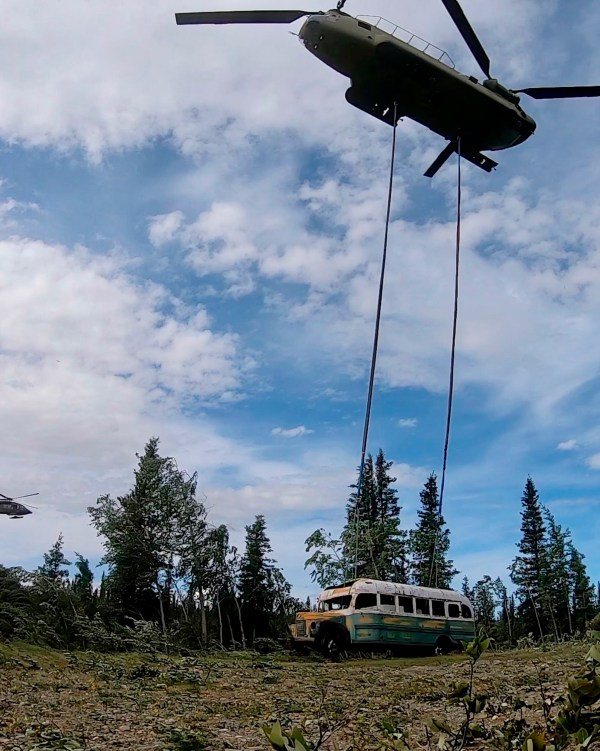
On 18 June 2020, the Alaska Army National Guard, working with the Department of Natural Resources, used a CH-47 Chinook helicopter to airlift the bus from a location west of the Teklanika River, in an operation code-named “Yutan”.
Quotes from the original 4
“was extracted from the Stampede Trail west of the Teklanika River by the Alaska National Guard June 18”
He left his middle-class suburban life, donated $24,000 in savings to charity, and began a two-year hitchhiking journey that eventually took him to Alaska.
Quotes from the original 2
“donated his $24,000 in savings to charity, and embarked on a two-year hitchhiking odyssey that led him to Alaska”
The bus dated from the 1940s and had been Fairbanks city bus 142; it was used as workers' quarters during construction of a road to a mining area, and had bunks and a barrel stove inside.
Quotes from the original 2
“The 1940s-era bus, sometimes called “Bus 142” or “The Magic Bus,” was used to house employees by the Yutan Construction Co. when it built an access road”
“Fitted with bunks and a barrel stove, Fairbanks 142 and two other buses housed workers who were building a road out to an antimony mine on Stampede Creek.”
The bus was about 25 miles west of the Parks Highway, west of the Teklanika River, and a short distance outside the northern boundary of Denali National Park.
Quotes from the original 3
“The abandoned vehicle that sat 25 miles west of the Parks Highway near Healy”
According to The New Yorker, His diary was written on blank pages in a field guide to local edible plants, which warned that wild sweet pea and wild potato look similar and must be carefully distinguished.
Quotes from the original 2
“He wrote his diary on blank pages in the back of an exhaustively researched field guide to the region’s edible plants”
Clausen, a chemist at the University of Alaska Fairbanks, tested wild potato seeds collected by Krakauer near the bus and found no alkaloids or other toxins.
Both accounts come from Krakauer himself.
Quotes from the original 2
“When Clausen and Treadwell completed their analysis of wild-potato seeds, though, they found no trace of swainsonine or any other alkaloids.”
The Teklanika River is cold and fast-flowing. In summer, snowmelt and rain can cause it to rise rapidly, trapping people who have crossed it on the opposite bank or sweeping them away.
Quotes from the original 2
“It’s cold and fast, and it can rise quickly, slamming the door shut behind hikers who have already crossed to the bus side, or sweeping them off their feet and downstream.”
 GuituluGlobal Outdoor Accident Archive