GuituluGlobal Outdoor Accident Archive 中文
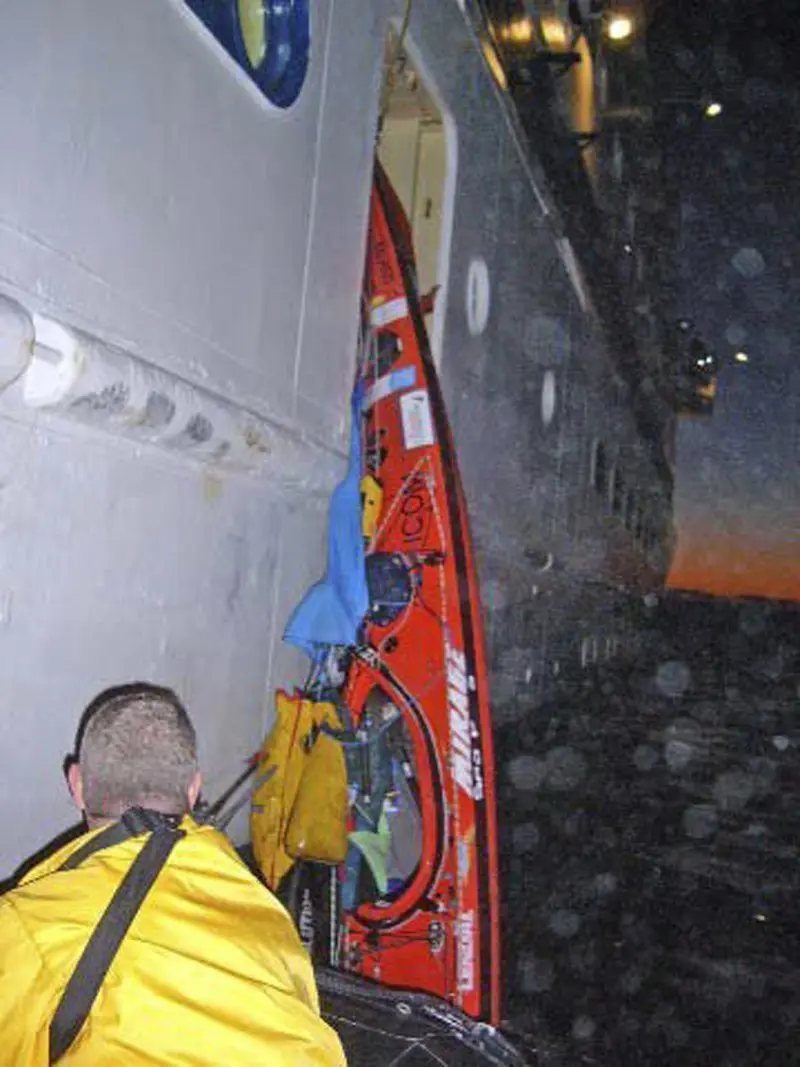
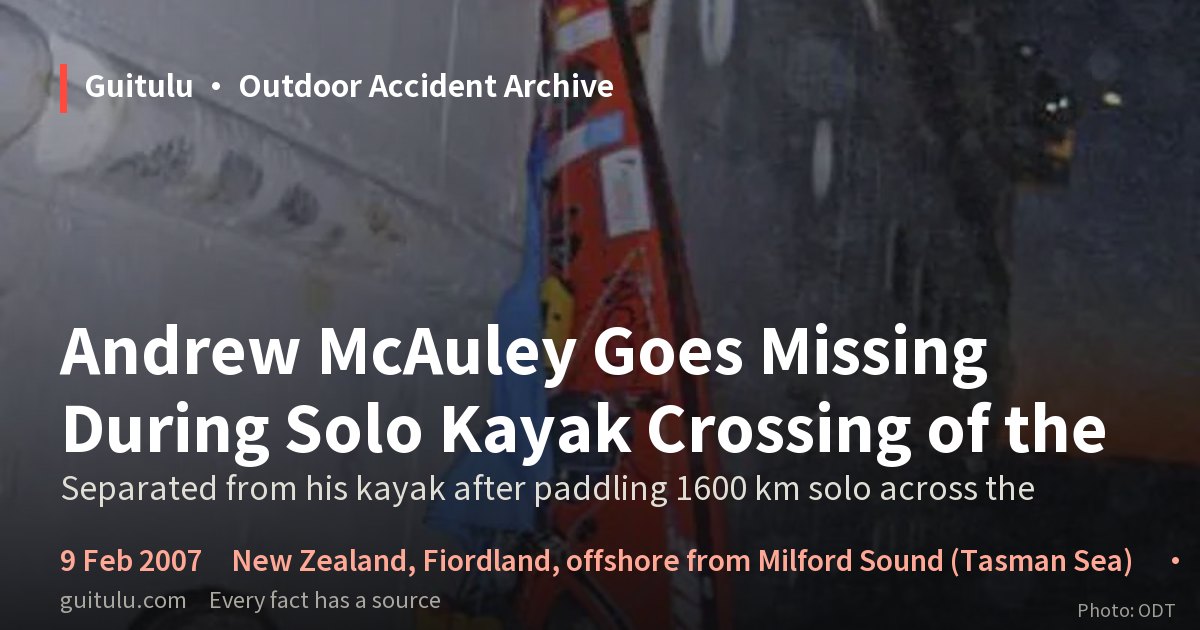
Crew of the cruise ship Clipper Odyssey recover McAuley's kayak offshore from Milford Sound

Archive / Other

Andrew McAuley Goes Missing During Solo Kayak Crossing of the Tasman Sea

Separated from his kayak after paddling 1600 km solo across the Tasman Sea, with the New Zealand coast in sight

In February 2008, a New Zealand inquest found that he drowned after accidentally becoming separated from his capsized kayak

Photo: ODT

Date
Summer
Place
New Zealand, Fiordland, offshore from Milford Sound (Tasman Sea)New Zealand › Southland · Tasman Sea167.869°E -44.619°N
Activity
Sea kayakingInvolves: Drowning and diving · Extreme weather1 person paddling solo
Casualties
Dead 1 His body was never found; a New Zealand inquest found that he drowned
Material
45 facts · 12 sources2 accounts differ and are shown side by side

01What happened

Andrew McAuley was an Australian mountaineer and sea kayaker who had paddled nonstop across Bass Strait and the Gulf of Carpentaria. He received the Australian Geographic Adventurer of the Year award in 2005. He wanted to become the first person to kayak solo across the Tasman Sea, from Australia to Milford Sound in New Zealand. He used a Mirage touring kayak modified so that he could sleep in the cockpit, with a yellow fibreglass canopy that could be fastened over it while he slept. Australian search and rescue authorities had reportedly strongly advised him against making the trip beforehand.Facts it rests onF02Multiple sourcesMcAuley was an Australian mountaineer and sea kayaker who received Australian Geographic magazine's Adventurer of the Year award in 2005.F01Multiple sourcesHe had previously paddled across Bass Strait nonstop in 2003 and crossed the Gulf of Carpentaria in 2004.F05Multiple sourcesHis goal was to become the first person to kayak solo across the Tasman Sea, from Australia to Milford Sound.F37Multiple sourcesHe used a 19-foot-long Mirage touring sea kayak, modified so he could sleep in the cockpit and fitted with a cover to close it while he slept.F38Multiple sourcesThe yellow fibreglass cover was fastened over the cockpit while he slept, providing self-righting capability and protection from wind and waves. He called it “Casper”.F39Single sourceThe Australian search and rescue agency (AusSAR) had strongly advised him beforehand not to make the trip, considering the crossing itself dangerous; authorities tested the kayak's self-righting performance and ultimately deemed it seaworthy.

Crew of the cruise ship Clipper Odyssey recover McAuley's kayak offshore from Milford SoundPhoto source: ODT

After setting out for the first time in December 2006, he turned back because he was too cold. On 11 January 2007, he set out again from Fortescue Bay, Tasmania, on a journey of about 1600 km. He capsized several times along the way and encountered a severe storm in late January, spending more than 27 hours inside the enclosed kayak. His backup satellite phone and tracking beacon were reportedly damaged in the storm.Facts it rests onF03Multiple sourcesHe first set out in December 2006, but abandoned the attempt because it was too cold and returned to Tasmania.F11Multiple sourcesOn 11 January 2007, he set out again from Fortescue Bay in Tasmania, on a journey of about 1,600 kilometres.F06Single sourceDuring the crossing, he encountered severe weather, capsized several times, and had sharks approach him.F07Multiple sourcesAt the end of January, about two-thirds of the way through the crossing, he encountered a severe storm and was enclosed inside the kayak for more than 27 hours.F08Single sourceThe winds of about 40 knots damaged his spare satellite phone and tracking beacon.F09Multiple sourcesDuring the storm, the enclosed kayak was overturned by large waves several times and righted itself each time.

Camera and equipment on a kayak deck on the Tasman SeaPhoto source: All That's Interesting

On 8 February, about 120 km from his destination, he sent his wife an encouraging message, while family and friends waited for him at Milford Sound. At about 7 pm on 9 February, New Zealand authorities received a severely distorted radio call from someone identifying himself as “Kayak One”, who mentioned that the kayak was sinking. This was not a formal Mayday call, and the emergency beacon was never activated.Facts it rests onF13Multiple sourcesOn 8 February, about 120 kilometres from the finish, he sent his wife a message sharing the good news.F25Multiple sourcesHe was expected to arrive at Milford Sound at 9 am on 11 February (Sunday), where his wife, family and friends were waiting to welcome him.F14Multiple sourcesAt about 7 pm on Friday, 9 February, New Zealand authorities received a severely distorted, barely intelligible radio call.F15Multiple sourcesThe caller identified himself as “Kayak One” (McAuley's call sign) and said he needed rescue and the kayak was sinking.F16Multiple sourcesThe call was not a formal Mayday distress call, and he never activated the emergency position-indicating radio beacon (EPIRB).

On the evening of 10 February, a New Zealand Air Force patrol aircraft spotted the kayak floating upside down, and a cruise ship launched an inflatable boat to recover it. The kayak was partially flooded but had no apparent damage; only the cockpit cover was missing. The paddle, phone, GPS and emergency beacon were all inside the kayak, but the life jacket was not. Aircraft, helicopters and boats searched approximately 25,000 square kilometres of sea over three days. Search and rescue was suspended on 12 February, and his body was never found.Facts it rests onF19Multiple sourcesAt about 8 pm on 10 February, a Royal New Zealand Air Force P-3 Orion patrol aircraft spotted the orange kayak floating in the water.F20Single sourceThe helicopter could not lift the kayak because of sea conditions, so the nearby cruise ship “Clipper Odyssey” was called in. At about 11 pm that night, it launched an inflatable boat to recover the kayak, which was confirmed to be McAuley's.F23Multiple sourcesThe kayak was partially flooded when it was found.F22Multiple sourcesThe recovered kayak was in good condition, with no obvious damage; only the cockpit cover was missing. The paddle, phone, GPS and emergency beacon were all inside the kayak.F24Single sourceHis life jacket was not on the kayak; his family said he had not taken a full-body immersion suit.F27Multiple sourcesOver three days, aircraft, helicopters and boats searched approximately 25,000 square kilometres of sea west of Milford Sound.F28Multiple sourcesThe search and rescue was suspended on 12 February. A Maritime New Zealand official said he had likely been in seawater of approximately 15 degrees Celsius for about 70 hours.F40Multiple sourcesHis body was never found.

In February 2008, a New Zealand inquest found that he drowned in the Tasman Sea after accidentally becoming separated from his capsized kayak.Facts it rests onF33Single sourceIn February 2008, a New Zealand inquest found that he had drowned in the Tasman Sea off the New Zealand coast after accidentally becoming separated from his capsized kayak.

The number at the end of a paragraph is how many facts it rests on; open it to see each fact and how well it is sourced: Multiple sourcesSingle source. Conflicting accounts and speculation are kept out of the narrative.

Satellite imagery Sentinel-2 cloudless 2024 © EOX · Terrain AWS Terrain Tiles · Position is schematic, geocoded from place names · Place coordinates not individually verified

Route review

5 scenes to understand what happened

Scroll down and the map flies to where each part happened.

01

Incident area

The reports do not provide enough locations along the way, so the map shows only the approximate location and terrain of the incident area.

04

The distorted call

On the evening of 9 February, a distorted call was received from someone identifying himself as Kayak One, who mentioned that the kayak was sinking. The following evening, the air force found the empty kayak upside down offshore from the sound.Facts it rests onF14Multiple sourcesAt about 7 pm on Friday, 9 February, New Zealand authorities received a severely distorted, barely intelligible radio call.F15Multiple sourcesThe caller identified himself as “Kayak One” (McAuley's call sign) and said he needed rescue and the kayak was sinking.F19Multiple sourcesAt about 8 pm on 10 February, a Royal New Zealand Air Force P-3 Orion patrol aircraft spotted the orange kayak floating in the water.

05

Search and rescue suspended

About 25,000 square kilometres of sea were searched over three days. The search was suspended on 12 February, and his body was never found.Facts it rests onF27Multiple sourcesOver three days, aircraft, helicopters and boats searched approximately 25,000 square kilometres of sea west of Milford Sound.F28Multiple sourcesThe search and rescue was suspended on 12 February. A Maritime New Zealand official said he had likely been in seawater of approximately 15 degrees Celsius for about 70 hours.F40Multiple sourcesHis body was never found.

02Timeline

  1. He first set out in December 2006, but abandoned the attempt because it was too cold and returned to Tasmania. F03

  2. At the end of January, about two-thirds of the way through the crossing, he encountered a severe storm and was enclosed inside the kayak for more than 27 hours. F07

  3. On 11 January 2007, he set out again from Fortescue Bay in Tasmania, on a journey of about 1,600 kilometres. F11

  4. On 8 February, about 120 kilometres from the finish, he sent his wife a message sharing the good news. F13

  5. At about 7 pm on Friday, 9 February, New Zealand authorities received a severely distorted, barely intelligible radio call. F14

  6. At about 8 pm on 10 February, a Royal New Zealand Air Force P-3 Orion patrol aircraft spotted the orange kayak floating in the water. F19

  7. The search and rescue was suspended on 12 February. A Maritime New Zealand official said he had likely been in seawater of approximately 15 degrees Celsius for about 70 hours. F28

  8. A Tasmanian coroner opened and then suspended the Australian inquest in March; in June, Te Anau coroner Trevor Savage announced that an inquest would be held in New Zealand. F30

  9. In February 2008, a New Zealand inquest found that he had drowned in the Tasman Sea off the New Zealand coast after accidentally becoming separated from his capsized kayak. F33

03Lessons

Communication and location

Attach the beacon to your person

The emergency beacon, phone and GPS in the recovered kayak were all intact, but all had been left on the kayak. Once a person becomes separated from the kayak, communication equipment left on board cannot help. When going to sea alone, carry at least one device capable of calling for help on your person.Facts it rests onF22Multiple sourcesThe recovered kayak was in good condition, with no obvious damage; only the cockpit cover was missing. The paddle, phone, GPS and emergency beacon were all inside the kayak.F44Single sourceAn analysis by Paddling Magazine noted that the emergency beacon was kept on the kayak rather than attached to him, so it became separated from him when he and the kayak parted.F33Single sourceIn February 2008, a New Zealand inquest found that he had drowned in the Tasman Sea off the New Zealand coast after accidentally becoming separated from his capsized kayak.

Water, streams and caves

Modifications for sleeping also removed the ability to self-rescue

To allow him to sleep in the kayak, the cockpit was enlarged and the seat removed. As a result, he could not roll the kayak upright, and he had also said that re-entering it after a capsize was difficult. When modifying equipment, account for the effect of every change on self-rescue after a capsize.Facts it rests onF43Single sourceTo allow him to sleep inside the kayak, the cockpit was enlarged and the standard seat removed, making a self-rescue roll impossible; he had previously described how difficult it was to re-enter the kayak after a capsize.F37Multiple sourcesHe used a 19-foot-long Mirage touring sea kayak, modified so he could sleep in the cockpit and fitted with a cover to close it while he slept.

Teams and decisions

The final stretch is just as dangerous

He endured a severe storm, but the incident occurred when he was only a few dozen kilometres from shore and the weather was improving. Near the finish, people are at their most fatigued and most likely to relax their guard. Protective equipment and procedures must not be skipped simply because the destination is close.Facts it rests onF07Multiple sourcesAt the end of January, about two-thirds of the way through the crossing, he encountered a severe storm and was enclosed inside the kayak for more than 27 hours.F13Multiple sourcesOn 8 February, about 120 kilometres from the finish, he sent his wife a message sharing the good news.F33Single sourceIn February 2008, a New Zealand inquest found that he had drowned in the Tasman Sea off the New Zealand coast after accidentally becoming separated from his capsized kayak.

Hypothermia and overnight gear

Without an immersion suit, time in cold water is short

He reportedly did not carry a full-body immersion suit. When the search and rescue operation was suspended, officials estimated that he had been in seawater of about 15 degrees Celsius for about 70 hours. How long someone can survive after falling into the open sea depends to a large extent on what they are wearing.Facts it rests onF24Single sourceHis life jacket was not on the kayak; his family said he had not taken a full-body immersion suit.F28Multiple sourcesThe search and rescue was suspended on 12 February. A Maritime New Zealand official said he had likely been in seawater of approximately 15 degrees Celsius for about 70 hours.

04Fact list 45 facts

Under each fact is a verbatim quote from the original. "Single source" means only one outlet mentioned it; "Accounts differ" means sources contradict each other and this site adopts neither side; "Speculation" is an inference by a reporter or a person involved, not a fact.

  1. F01Multiple sourcesBackground

    He had previously paddled across Bass Strait nonstop in 2003 and crossed the Gulf of Carpentaria in 2004.

    Includes a low-reliability source

    Quotes from the original 2

    “He had already made a name for himself by kayaking non-stop across Bass Strait in 2003 and the Gulf of Carpentaria in 2004.”

    ODT · 2021-01-07

    “In 2003, Andrew McAuley became the first person to kayak a direct, non-stop crossing of the Bass Strait”

    All That's Interesting · 2023-07-13
  2. F02Multiple sourcesBackground

    McAuley was an Australian mountaineer and sea kayaker who received Australian Geographic magazine's Adventurer of the Year award in 2005.

    Quotes from the original 2

    “earning him Australian Geographic’s 2005 Adventurer of the Year Award”

    Paddling Magazine · 2025-04-10

    “The Australian Geographic Adventurer of the Year in 2005”

    NZ Herald · 2007-02-12
  3. F03Multiple sourcesMovement

    He first set out in December 2006, but abandoned the attempt because it was too cold and returned to Tasmania.

    Quotes from the original 3

    “has been forced by cold weather to abandon his bid to become the first person to kayak from Australia to New Zealand”

    NZ Herald · 2006-12-06

    “He set out in December but turned back after just 48 hours when he found his sleeping arrangement to be too cold.”

    Paddling Magazine · 2025-04-10

    “McAuley bailed on the first attempt after one night”

    Explorersweb · 2023-01-16
  4. F04Accounts differMovement

    Accounts differ on how long the first attempt lasted: NZ Herald says he turned back after travelling about 80 kilometres; Paddling Magazine says he turned back 48 hours after setting out; Explorersweb says he abandoned the attempt after one night.

    Sources differ on the time and distance of his first return

    Quotes from the original 3

    “In December, he turned back to Tasmania just 80km into his journey because he was too cold to continue.”

    NZ Herald · 2007-02-11

    “turned back after just 48 hours”

    Paddling Magazine · 2025-04-10

    “McAuley bailed on the first attempt after one night”

    Explorersweb · 2023-01-16
  5. F05Multiple sourcesPlan

    His goal was to become the first person to kayak solo across the Tasman Sea, from Australia to Milford Sound.

    Quotes from the original 2

    “He was aiming to be the first person to kayak solo across the Tasman Sea, from Australia to Milford Sound.”

    ODT · 2021-01-07

    “Mr McAuley was trying to becoming the first solo kayaker to cross the Tasman Sea”

    NZ Herald · 2007-06-12
  6. F06Single sourceEvent

    According to NZ Herald, During the crossing, he encountered severe weather, capsized several times, and had sharks approach him.

    Quotes from the original 1

    “had encountered bad weather, numerous capsizes and attention from sharks”

    NZ Herald · 2007-02-10
  7. F07Multiple sourcesEvent

    At the end of January, about two-thirds of the way through the crossing, he encountered a severe storm and was enclosed inside the kayak for more than 27 hours.

    Includes a low-reliability source

    Quotes from the original 2

    “McAuley entered the 28th hour locked up in his kayak as the storm raged”

    Paddling Magazine · 2025-04-10

    “spending over 27 hours entombed in his kayak”

    All That's Interesting · 2023-07-13
  8. F08Single sourceEvent

    According to Paddling Magazine, The winds of about 40 knots damaged his spare satellite phone and tracking beacon.

    Quotes from the original 1

    “McAuley endured a 40-knot gale that knocked out his spare satellite phone and tracking beacon”

    Paddling Magazine · 2025-04-10
  9. F09Multiple sourcesEvent

    During the storm, the enclosed kayak was overturned by large waves several times and righted itself each time.

    Includes a low-reliability source

    Quotes from the original 2

    “For a third time, the kayak slid up the face of a monstrous wave, perched perilously on edge, then inverted and slowly righted once more.”

    Paddling Magazine · 2025-04-10

    “The waves plunged the kayak into multiple barrel rolls”

    All That's Interesting · 2023-07-13
  10. F10Single sourceEvent

    According to NZ Herald, An inquest heard that Australian search and rescue authorities had asked him to turn back early in the crossing after his kayak and equipment were damaged.

    Quotes from the original 1

    “Australian search and rescue authorities had asked an Australian kayaker to turn back early in his trans-tasman attempt after his boat and equipment were damaged”

    NZ Herald · 2007-12-10
  11. F11Multiple sourcesMovement

    On 11 January 2007, he set out again from Fortescue Bay in Tasmania, on a journey of about 1,600 kilometres.

    Quotes from the original 2

    “He left Fortescue Bay, Tasmania, on January 11, a 1600km journey.”

    NZ Herald · 2007-02-10

    “On January 11, 2007, he set off on his attempt to cross the Tasman”

    ODT · 2021-01-07
  12. F12Multiple sourcesFound at scene

    In the video and audio recordings he left behind, he repeatedly said he hoped he had not “bitten off more than he could chew”.

    Quotes from the original 2

    “I may have bitten off more than I can chew.”

    Paddling Magazine · 2025-04-10

    “I just hope I haven’t bitten off more than I can chew”

    All That's Interesting · 2023-07-13
  13. F13Multiple sourcesEvent

    On 8 February, about 120 kilometres from the finish, he sent his wife a message sharing the good news.

    Quotes from the original 2

    “On Thursday, February 8, with only 120 kilometres (100 miles) to go, he sent a triumphant text message to his wife”

    Paddling Magazine · 2025-04-10

    “With only about 120km of his epic 1600km journey to go”

    NZ Herald · 2007-02-11
  14. F14Multiple sourcesEvent

    At about 7 pm on Friday, 9 February, New Zealand authorities received a severely distorted, barely intelligible radio call.

    Quotes from the original 3

    “At 7 p.m. on Friday, February 9, New Zealand Coast Guard received a scrambled, unintelligible radio call.”

    Paddling Magazine · 2025-04-10

    “a distorted distress call, which the rescue centre received at 7.19pm on Friday”

    NZ Herald · 2007-02-11

    “it came in on the maritime band and was heavily distorted”

    NZ Herald · 2007-02-10
  15. F15Multiple sourcesEvent

    The caller identified himself as “Kayak One” (McAuley's call sign) and said he needed rescue and the kayak was sinking.

    Quotes from the original 3

    “the message came from "Kayak One", McAuley's callsign”

    NZ Herald · 2007-02-11

    “Among them: “help” and “sinking.””

    Paddling Magazine · 2025-04-10

    “I need a rescue. My kayak's sinking.”

    ODT · 2021-01-07
  16. F16Multiple sourcesEvent

    The call was not a formal Mayday distress call, and he never activated the emergency position-indicating radio beacon (EPIRB).

    Quotes from the original 2

    “The call was not a mayday and McAuley did not set off his locator beacon”

    NZ Herald · 2007-02-11

    “emergency position-indicating radio beacon (EPIRB)—not activated”

    Paddling Magazine · 2025-04-10
  17. F17Single sourceEvent

    According to NZ Herald, On the night of 9 February, a helicopter equipped with night-vision equipment began searching at a position the rescue centre had calculated from his speed and course.

    Quotes from the original 1

    “The search began on Friday night with the helicopter, piloted by Richard Hayes and equipped with night vision equipment, searching at McAuley's last-known position”

    NZ Herald · 2007-02-11
  18. F18Single sourceEvent

    According to NZ Herald, At the time, his brother said the voice on the recording did not sound like him.

    Quotes from the original 1

    “McAuley's brother Michael said earlier that the voice on the message did not sound like his brother”

    NZ Herald · 2007-02-11
  19. F19Multiple sourcesFound at scene

    At about 8 pm on 10 February, a Royal New Zealand Air Force P-3 Orion patrol aircraft spotted the orange kayak floating in the water.

    Quotes from the original 2

    “about 8pm last night an orange kayak was spotted by a Royal New Zealand Air Force P3 Orion”

    NZ Herald · 2007-02-10

    “On Saturday night, Rescue Coordination Centre New Zealand found McAuley’s upturned kayak”

    Paddling Magazine · 2025-04-10
  20. F20Single sourceFound at scene

    According to NZ Herald, The helicopter could not lift the kayak because of sea conditions, so the nearby cruise ship “Clipper Odyssey” was called in. At about 11 pm that night, it launched an inflatable boat to recover the kayak, which was confirmed to be McAuley's.

    Several quotations come from different reports by the same media outlet and are counted as one source

    Quotes from the original 2

    “At about 11pm last night, an inflatable was sent from the ship to recover the vessel which was positively identified as McAuley's.”

    NZ Herald · 2007-02-10

    “The helicopter could not winch up the kayak because of the choppy seas”

    NZ Herald · 2007-02-11
  21. F21Accounts differFound at scene

    Accounts differ on how far the kayak was found from Milford Sound: NZ Herald says about 80 kilometres; Paddling Magazine says about 54 kilometres; ODT and Explorersweb say about 56 kilometres; another NZ Herald report says he got into trouble about 50 nautical miles offshore.

    The distances given in the reports differ, possibly because of different starting points and conversion methods

    Quotes from the original 4

    “Mr McAuley's kayak, locator beacon and GPS tracking system were found about 80km west of Milford Sound on Saturday.”

    NZ Herald · 2007-02-12

    “just 54 kilometres (34 miles) offshore of Milford Sound”

    Paddling Magazine · 2025-04-10

    “only about 56km short of his destination”

    ODT · 2021-01-07

    “got into distress about 50 nautical miles off the coast of Milford Sound”

    NZ Herald · 2007-06-12
  22. F22Multiple sourcesFound at scene

    The recovered kayak was in good condition, with no obvious damage; only the cockpit cover was missing. The paddle, phone, GPS and emergency beacon were all inside the kayak.

    Quotes from the original 3

    “It was missing only the cockpit canopy.”

    Paddling Magazine · 2025-04-10

    “the kayak was in good condition, with no obvious signs of damage”

    NZ Herald · 2007-02-11

    “His paddle, phone, GPS tracker, and emergency radio were all inside the kayak.”

    All That's Interesting · 2023-07-13
  23. F23Multiple sourcesFound at scene

    The kayak was partially flooded when it was found.

    Quotes from the original 2

    “His partly flooded kayak was discovered by rescuers on February 10”

    ODT · 2021-01-07

    “his kayak was found partially flooded”

    Explorersweb · 2023-01-16
  24. F24Single sourceFound at scene

    According to NZ Herald, His life jacket was not on the kayak; his family said he had not taken a full-body immersion suit.

    Several quotations come from different reports by the same news outlet and are counted as one source

    Quotes from the original 2

    “His life jacket was not found.”

    NZ Herald · 2007-02-10

    “rescuers had initially thought McAuley had a full-body immersion suit but the family had said this was not so”

    NZ Herald · 2007-02-11
  25. F25Multiple sourcesPlan

    He was expected to arrive at Milford Sound at 9 am on 11 February (Sunday), where his wife, family and friends were waiting to welcome him.

    Quotes from the original 2

    “He was expected to arrive at Milford Sound at 9am today, where wife Vicki McAuley was to meet and congratulate him”

    NZ Herald · 2007-02-10

    “Vicki and Finlay gathered with friends and family in Milford Sound to celebrate.”

    Paddling Magazine · 2025-04-10
  26. F26Single sourceAftermath

    According to NZ Herald, The Australian government requested through its High Commission in New Zealand that the search and rescue continue; New Zealand rescue authorities said continuing the search was an operational decision.

    Several quotations come from different reports by the same news outlet and are counted as one source

    Quotes from the original 2

    “The Australian Government, through its high commission in New Zealand, yesterday asked authorities here to keep the search going.”

    NZ Herald · 2007-02-12

    “it was purely an operational matter”

    NZ Herald · 2007-02-11
  27. F27Multiple sourcesEvent

    Over three days, aircraft, helicopters and boats searched approximately 25,000 square kilometres of sea west of Milford Sound.

    Quotes from the original 2

    “about 25,000sq km of ocean west of Milford had been searched over the past three days, by plane, helicopter and ship”

    NZ Herald · 2007-02-12

    “Planes combed 25,000 square kilometres of wind-tossed ocean.”

    Paddling Magazine · 2025-04-10
  28. F28Multiple sourcesAftermath

    The search and rescue was suspended on 12 February. A Maritime New Zealand official said he had likely been in seawater of approximately 15 degrees Celsius for about 70 hours.

    Quotes from the original 3

    “Andrew has now most likely been in 15-degree seas for around 70 hours, we have decided to suspend the aerial search”

    NZ Herald · 2007-02-12

    “On Monday, February 12, after three days of waiting and hoping to find McAuley alive, the search was called off.”

    Paddling Magazine · 2025-04-10

    “Searches continued until February 12 but his body was never recovered.”

    NZ Herald · 2007-06-12
  29. F29Multiple sourcesAftermath

    Family and friends held a memorial service for him at Macquarie Lighthouse in Sydney.

    Quotes from the original 2

    “On February 26, 2007, they held a memorial service for him at Sydney’s Macquarie Lighthouse.”

    All That's Interesting · 2023-07-13

    “At a memorial service held under grey skies at Sydney’s Macquarie Lighthouse”

    Paddling Magazine · 2025-04-10
  30. F30Single sourceAftermath

    According to NZ Herald, A Tasmanian coroner opened and then suspended the Australian inquest in March; in June, Te Anau coroner Trevor Savage announced that an inquest would be held in New Zealand.

    Quotes from the original 2

    “An Australian inquest into Mr McAuley's death was opened and adjourned by Tasmanian coroner Stephen Carey in March”

    NZ Herald · 2007-06-12

    “A New Zealand inquest will be held into the death of Australian kayaker Andrew McAuley”

    NZ Herald · 2007-06-12
  31. F31Multiple sourcesAftermath

    The crossing later became the subject of a book and the 2008 documentary “Solo: Lost at Sea”, which aired on Australia's ABC1.

    Quotes from the original 2

    “it was the subject of a book and a 2008 documentary film called Solo: Lost at Sea”

    ODT · 2021-01-07

    “The documentary of Andrew McAuley’s trip, Solo, was broadcast on ABC1 last month”

    New Matilda · 2009-05-28
  32. F32Multiple sourcesAftermath

    In 2008, Justin Jones and James Castrission became the first to successfully cross the Tasman Sea by sea kayak.

    Quotes from the original 2

    “In 2008, adventurers Justin Jones and James Castrission were the first on record to successfully cross “the ditch” in a sea kayak”

    Explorersweb · 2023-01-16

    “Justin Jones and James Castrission in 2008”

    Paddling Magazine · 2025-04-10
  33. F33Single sourceFound at scene

    According to NZ Herald, In February 2008, a New Zealand inquest found that he had drowned in the Tasman Sea off the New Zealand coast after accidentally becoming separated from his capsized kayak.

    Quotes from the original 1

    “Australian kayaker Andrew McAuley drowned in the Tasman Sea off the New Zealand coast in February last year when he was accidentally separated from his capsized craft, an inquest has found.”

    NZ Herald · 2008-02-08
  34. F34Single sourceBackground

    According to ODT, Over nearly 138 years, 73 people have gone missing in Fiordland and never been found; McAuley is one of the best known among them.

    Quotes from the original 1

    “is probably one of the best known of the 73 people who have disappeared in Fiordland over the past 138 years”

    ODT · 2021-01-07
  35. F35Single sourceBackground

    According to Paddling Magazine, Previously, only New Zealand kayaker Paul Caffyn had attempted this route, twice without success.

    Quotes from the original 1

    “only two previous attempts had been made, both by New Zealander Paul Caffyn, both unsuccessful”

    Paddling Magazine · 2025-04-10
  36. F36Single sourceBackground

    According to Paddling Magazine, His entire route was south of 40 degrees south, in the “Roaring Forties”, which are known for severe weather.

    Quotes from the original 1

    “Andrew McAuley’s entire route travelled below the 40th parallel, the heart of the Roaring Forties”

    Paddling Magazine · 2025-04-10
  37. F37Multiple sourcesBackground

    He used a 19-foot-long Mirage touring sea kayak, modified so he could sleep in the cockpit and fitted with a cover to close it while he slept.

    Quotes from the original 3

    “The vessel was a standard touring kayak, a 19-foot Mirage, modified for sleeping inside the cockpit.”

    Paddling Magazine · 2025-04-10

    “Andrew McAuley’s vessel for the trip was a 19-foot Mirage kayak, modified for sleeping inside.”

    All That's Interesting · 2023-07-13

    “Fitted with bubble cover hatch which sealed cockpit while McAuley slept.”

    NZ Herald · 2007-02-11
  38. F38Multiple sourcesBackground

    The yellow fibreglass cover was fastened over the cockpit while he slept, providing self-righting capability and protection from wind and waves. He called it “Casper”.

    Quotes from the original 2

    “could be clamped down onto the cockpit for sleeping, providing self-righting capability and protection from the roughest storms”

    Paddling Magazine · 2025-04-10

    “A yellow fiberglass canopy with a cartoon face (McAuley called him “Casper”) was seated on the cockpit”

    All That's Interesting · 2023-07-13
  39. F39Single sourceBackground

    According to Paddling Magazine, The Australian search and rescue agency (AusSAR) had strongly advised him beforehand not to make the trip, considering the crossing itself dangerous; authorities tested the kayak's self-righting performance and ultimately deemed it seaworthy.

    Quotes from the original 2

    “We had strongly advised against the trip to start with because we believed it was inherently dangerous.”

    Paddling Magazine · 2025-04-10

    “they ultimately concluded that the boat was seaworthy”

    Paddling Magazine · 2025-04-10
  40. F40Multiple sourcesAftermath

    His body was never found.

    Quotes from the original 2

    “but his body was never found”

    ODT · 2021-01-07

    “His body was never recovered.”

    Explorersweb · 2023-01-16
  41. F41SpeculationSpeculation

    Speculation: Kayak manufacturer Hewitson believed he may have capsized without the cover fastened, been unable to get back into the kayak, and then become separated from it; a family spokesperson also said it appeared he had been capsized by a wave and separated from the kayak while the cover was off.

    Quotes from the original 2

    “McAuley capsized while the cockpit cover was not in place and was unable to get back in his kayak”

    Paddling Magazine · 2025-04-10

    “he was definitely hit by a wave while he didn't have the bubble on, that's capsized him and he's been separated from the boat”

    NZ Herald · 2007-02-11
  42. F42SpeculationSpeculation

    Speculation: Another account holds that he may have been thrown out of the kayak by an unusually large wave.

    Includes a low-credibility source

    Quotes from the original 2

    “It is believed he may have been tipped out of the kayak by a freak wave.”

    NZ Herald · 2007-02-12

    “Other theories speculate that a rogue wave may have caused McAuley to become separated from the kayak.”

    All That's Interesting · 2023-07-13
  43. F43Single sourcePost-incident analysis

    According to Paddling Magazine, To allow him to sleep inside the kayak, the cockpit was enlarged and the standard seat removed, making a self-rescue roll impossible; he had previously described how difficult it was to re-enter the kayak after a capsize.

    Quotes from the original 2

    “An oversized cockpit and lack of a standard seat made it impossible to roll.”

    Paddling Magazine · 2025-04-10

    “described the re-entry procedure as “gnarly,” complicated by the cockpit cover”

    Paddling Magazine · 2025-04-10
  44. F44Single sourcePost-incident analysis

    According to Paddling Magazine, An analysis by Paddling Magazine noted that the emergency beacon was kept on the kayak rather than attached to him, so it became separated from him when he and the kayak parted.

    Quotes from the original 1

    “McAuley had overlooked the critical detail of attaching the EPIRB to himself, not the boat.”

    Paddling Magazine · 2025-04-10
  45. F45Single sourceParticipant's view

    According to New Matilda, A New Matilda commentator believed that insufficient room for error had been left in the planning or execution of the trip.

    Quotes from the original 1

    “somewhere in the planning or the execution, there was not sufficient margin for error”

    New Matilda · 2009-05-28