GuituluGlobal Outdoor Accident Archive 中文
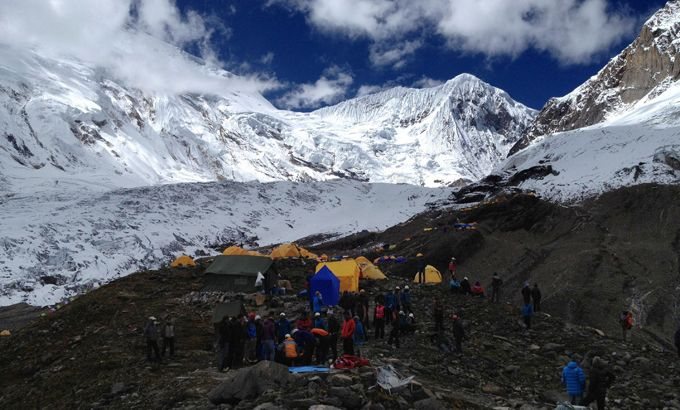
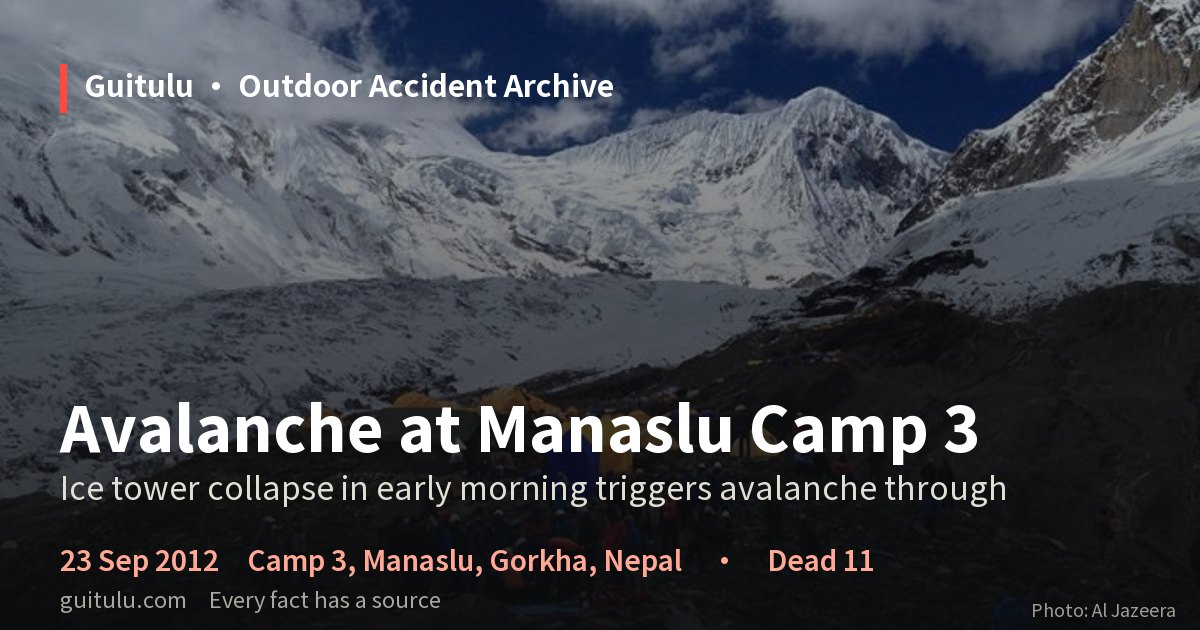
Camps and climbers gathered in the Manaslu Base Camp area

Archive / Mountaineering

Avalanche at Manaslu Camp 3

Ice tower collapse in early morning triggers avalanche through sleeping Camp 3, killing 11

Search and rescue suspended on 24 September 2012; 3 missing people presumed dead

Photo: Al Jazeera

Date
Autumn (post-monsoon climbing season)
Place
Camp 3, Manaslu, Gorkha, NepalNepal › Gorkha · Himalaya84.642°E 28.587°N
Activity
MountaineeringInvolves: AvalancheCommercial and private climbing teams from multiple countries; about 30 people at Camp 3
Casualties
Dead 11 The bodies of 8 people were found and identified; another 3 were missing and presumed dead, for a total of 11. Reports of the number injured vary (10 to 19).
Material
45 facts · 9 sources4 accounts differ and are shown side by side

01What happened

In autumn 2012, the post-monsoon climbing season began on Manaslu. According to CNN, citing a Nepalese tourism official, 25 teams and 231 foreign climbers were climbing that season. In the days before the avalanche, a storm brought heavy fresh snow to the mountain and base camp. The teams slowed their pace and began returning to the mountain around 21 September.Facts it rests onF04Multiple sourcesIn the days before the avalanche, a storm brought substantial fresh snow to the mountain and Base Camp, including to avalanche-prone slopes.F07Multiple sourcesAfter the storm, teams went back up the mountain; according to Himalayan Ascent, most teams were back on the mountain by 21 September.F01Single sourceAccording to CNN, citing a Nepalese tourism official, 25 teams and 231 foreign climbers were climbing Manaslu that autumn.

Camps and climbers gathered in the Manaslu Base Camp areaPhoto source: Al Jazeera

On the night of 22 September and in the early hours of 23 September, climbers from about six teams were sleeping at Camp 3, at an altitude of about 6800 meters. About 30 people were in tents at the camp. Sources differ on the exact time, but between approximately 4:00 and 4:30 a.m., an ice tower above the camp collapsed, triggering a major avalanche that swept through the entire camp.Facts it rests onF08Multiple sourcesFrom the night of 22 September into the early hours of 23 September, climbers from about six teams were sleeping in tents at Camp 3.F10Multiple sourcesWhen the avalanche occurred, about 30 people were sleeping in tents at Camp 3 and were caught in it.F12Multiple sourcesA serac above Camp 3 collapsed, triggering a large avalanche that swept through Camp 3.

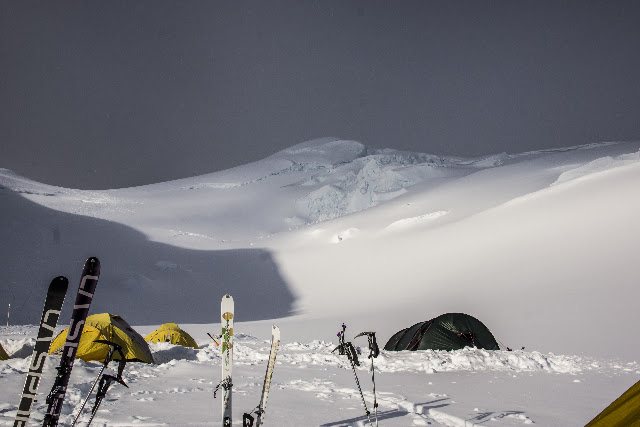
The snow slope where the remains of Camp 3 lay after the avalanchePhoto source: Alpinist · Alpine Ascents International

Tents, together with the people inside them, were swept hundreds of meters down the slope. All 25 tents at Camp 3 were reportedly destroyed. Camp 2 below was hit by the air blast and debris, but no one died there.Facts it rests onF15Multiple sourcesThe avalanche destroyed all 25 tents at Camp 3, and about 12 more tents at Camp 2 were hit.F16Multiple sourcesTents and the people inside them were swept hundreds of metres down the slope; according to Himalayan Ascent, the remains of Camp 3 were pushed about 300 metres below.F17Multiple sourcesCamp 2 avoided the main body of the avalanche but was hit by debris and the air blast. Tents were overturned or flattened, and no one died there.

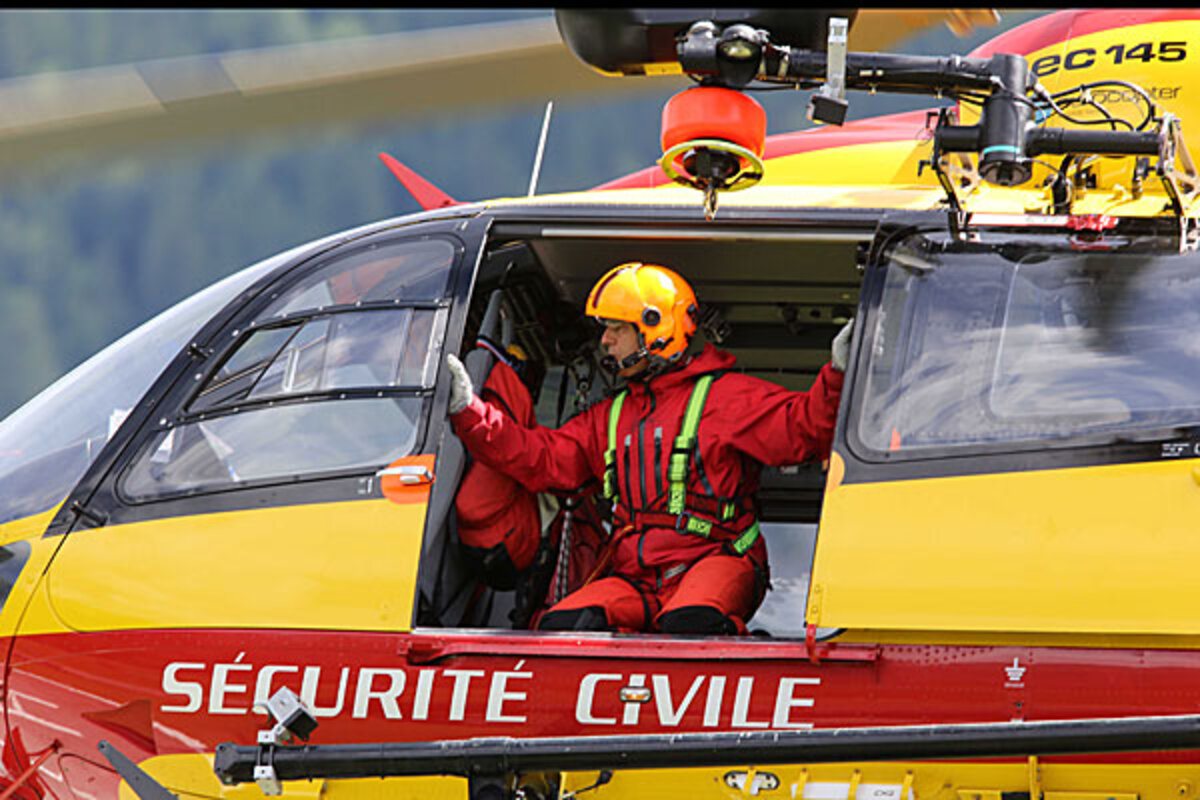
A helicopter evacuates injured people near Camp 3Photo source: Alpinist · Alpine Ascents International

Guides and team leaders from Camp 2 climbed to Camp 3 to help with the rescue shortly after the avalanche. That day, several helicopters made multiple trips to evacuate injured climbers down the mountain; bad weather and thick cloud hampered the rescue at times.Facts it rests onF26Multiple sourcesGuides and leaders stationed at Camp 2 went up to Camp 3 shortly after the avalanche, found extensive avalanche debris and many climbers in distress, and joined the rescue effort.F27Multiple sourcesThat day, several helicopters made multiple trips to carry injured climbers down from near Camp 3.F29Multiple sourcesBad weather and thick cloud hampered the rescue.

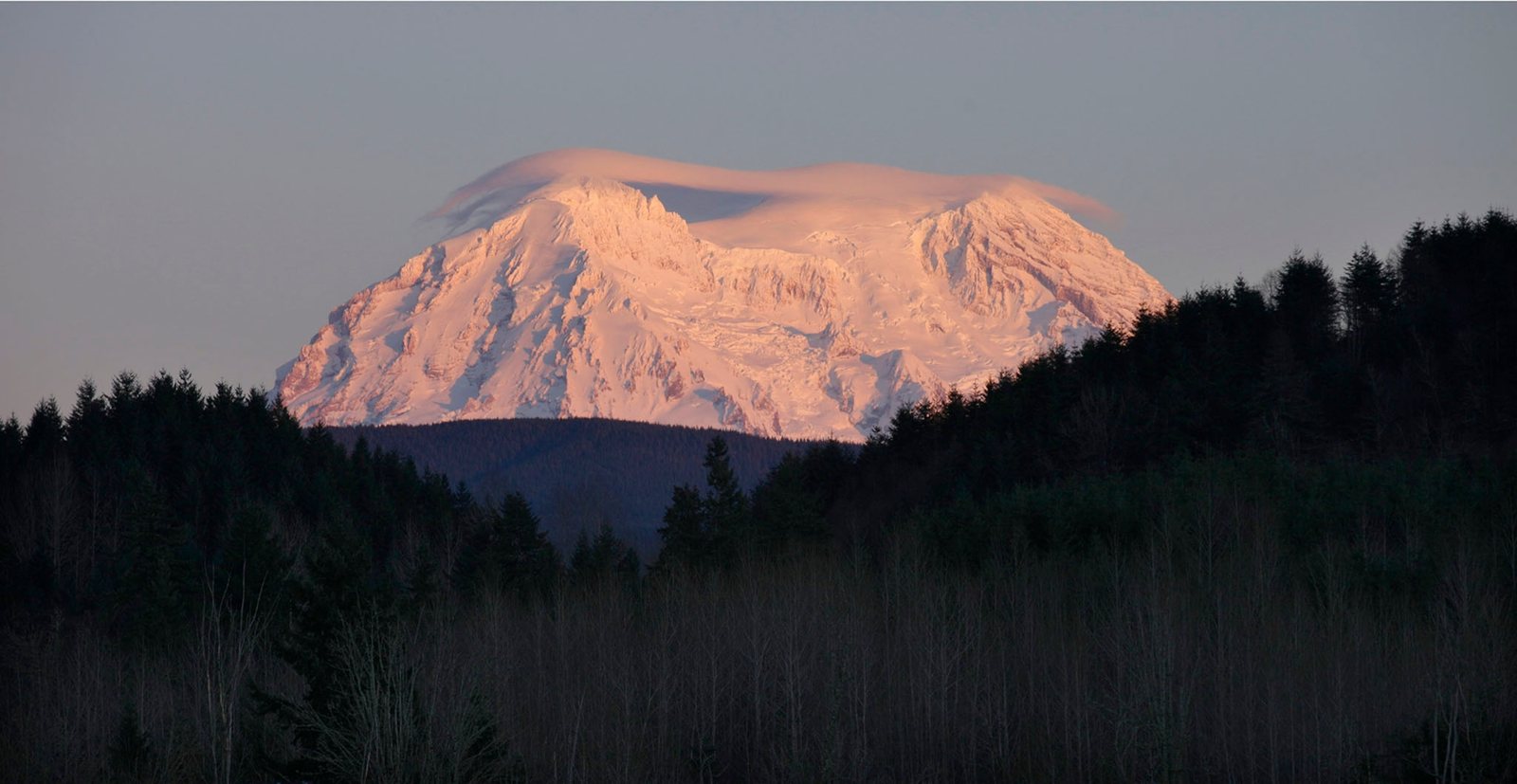
Photograph of Manaslu marking Camps 2 and 3 and the possible avalanche areaPhoto source: Mark Horrell · Mark Horrell

By 24 September, officials had confirmed that 8 people from France, Germany, Italy, Spain and Nepal had died. Another 3 climbers remained missing. Search and rescue personnel suspended the search that day, believing they may have died, bringing the recorded death toll to 11.Facts it rests onF37Multiple sourcesBy 24 September, eight deaths had been officially confirmed: four French nationals and one person each from Germany, Italy, Spain and Nepal.F38Multiple sourcesOn 24 September, search and rescue personnel suspended the search for three missing climbers, two French nationals and one Canadian, believing that they may have died.F05Multiple sourcesThe avalanche left 11 people dead in total (8 confirmed dead and 3 missing and presumed dead).

The number at the end of a paragraph is how many facts it rests on; open it to see each fact and how well it is sourced: Multiple sourcesSingle source. Conflicting accounts and speculation are kept out of the narrative.

ImgScene photos all from news coverage; copyright belongs to the original authors

  • Reported locations along the route (schematic)Schematic

Satellite imagery Sentinel-2 cloudless 2024 © EOX · Terrain AWS Terrain Tiles · Orange line is schematic · Place coordinates not individually verified

Route review

5 scenes to understand what happened

Scroll down and the map flies to where each part happened. The line is Schematic, Lines connect the reported locations in sequence and show only the approximate direction, not the actual track.

01

Full route

The locations mentioned in reports are connected in sequence to show the approximate course of events (schematic).

02

Returning to the mountain after the storm

The storm brought heavy fresh snow. After waiting for the snowpack to stabilize, the teams began returning to the mountain around 21 September.Facts it rests onF04Multiple sourcesIn the days before the avalanche, a storm brought substantial fresh snow to the mountain and Base Camp, including to avalanche-prone slopes.F07Multiple sourcesAfter the storm, teams went back up the mountain; according to Himalayan Ascent, most teams were back on the mountain by 21 September.

05

Rescue and search

Helicopters made multiple trips to transport the injured that day; search and rescue was suspended on 24 September, and officials confirmed that 8 people had died.Facts it rests onF27Multiple sourcesThat day, several helicopters made multiple trips to carry injured climbers down from near Camp 3.F37Multiple sourcesBy 24 September, eight deaths had been officially confirmed: four French nationals and one person each from Germany, Italy, Spain and Nepal.F38Multiple sourcesOn 24 September, search and rescue personnel suspended the search for three missing climbers, two French nationals and one Canadian, believing that they may have died.

02Timeline

  1. In the days before the avalanche, a storm brought substantial fresh snow to the mountain and Base Camp, including to avalanche-prone slopes. F04

  2. After the storm, teams went back up the mountain; according to Himalayan Ascent, most teams were back on the mountain by 21 September. F07

  3. From the night of 22 September into the early hours of 23 September, climbers from about six teams were sleeping in tents at Camp 3. F08

  4. A serac above Camp 3 collapsed, triggering a large avalanche that swept through Camp 3. F12

  5. That day, several helicopters made multiple trips to carry injured climbers down from near Camp 3. F27

  6. Tents and the people inside them were swept hundreds of metres down the slope; according to Himalayan Ascent, the remains of Camp 3 were pushed about 300 metres below. F16

  7. Guides and leaders stationed at Camp 2 went up to Camp 3 shortly after the avalanche, found extensive avalanche debris and many climbers in distress, and joined the rescue effort. F26

  8. Camp 2 avoided the main body of the avalanche but was hit by debris and the air blast. Tents were overturned or flattened, and no one died there. F17

  9. By 24 September, eight deaths had been officially confirmed: four French nationals and one person each from Germany, Italy, Spain and Nepal. F37

  10. On 24 September, search and rescue personnel suspended the search for three missing climbers, two French nationals and one Canadian, believing that they may have died. F38

03Lessons

Avalanche and high altitude

After fresh snow, waiting does not mean safety

After heavy snowfall, climbing teams usually wait several days for the fresh snow to stabilize before going up the mountain, and the teams did so on this occasion. But according to Himalayan Ascent, no one expected the avalanche to be triggered by an ice tower collapse, showing that hanging ice above a camp is also a risk, even when the snowpack is stable.Facts it rests onF04Multiple sourcesIn the days before the avalanche, a storm brought substantial fresh snow to the mountain and Base Camp, including to avalanche-prone slopes.F44Multiple sourcesAfter heavy snowfall, climbing teams usually wait several days for the new snow to stabilise before heading up the mountain.F14Single sourceAccording to Himalayan Ascent, no one had anticipated that a serac collapse would trigger the avalanche.

Avalanche and high altitude

Consider the terrain overhead at high camps

Camp 3 was reportedly set up in its usual location, directly below hanging ice on the north ridge. Choosing a campsite involves not only finding shelter from the wind but also assessing whether ice masses or snow slopes above could collapse.Facts it rests onF03Single sourceAccording to ExplorersWeb, Camp 3 was set up in its usual location, directly below the hanging ice on the north ridge.F12Multiple sourcesA serac above Camp 3 collapsed, triggering a large avalanche that swept through Camp 3.

Rescue and self-rescue

Mutual aid between camps determined the first few hours

Guides and team leaders from Camp 2 climbed to Camp 3 shortly after the avalanche, and guides from the teams then worked together on the rescue. The first rescuers at high-altitude camps are often trained fellow climbers from nearby camps.Facts it rests onF26Multiple sourcesGuides and leaders stationed at Camp 2 went up to Camp 3 shortly after the avalanche, found extensive avalanche debris and many climbers in distress, and joined the rescue effort.F27Multiple sourcesThat day, several helicopters made multiple trips to carry injured climbers down from near Camp 3.

Rescue and self-rescue

Helicopter rescue depends on the weather

Helicopters evacuated a group of injured people down the mountain that day, but bad weather and thick cloud also hampered the rescue, and the 3 missing people were never found. The window for high-altitude rescue is short and cannot be guaranteed.Facts it rests onF27Multiple sourcesThat day, several helicopters made multiple trips to carry injured climbers down from near Camp 3.F29Multiple sourcesBad weather and thick cloud hampered the rescue.F38Multiple sourcesOn 24 September, search and rescue personnel suspended the search for three missing climbers, two French nationals and one Canadian, believing that they may have died.

04Fact list 45 facts

Under each fact is a verbatim quote from the original. "Single source" means only one outlet mentioned it; "Accounts differ" means sources contradict each other and this site adopts neither side; "Speculation" is an inference by a reporter or a person involved, not a fact.

  1. F01Single sourceBackground

    According to CNN, According to CNN, citing a Nepalese tourism official, 25 teams and 231 foreign climbers were climbing Manaslu that autumn.

    Quotes from the original 1

    “231 foreign mountaineers from 25 teams were attempting to climb the mountain”

    CNN · 2012-09-24
  2. F02Single sourcePost-incident analysis

    According to ExplorersWeb, According to The Himalayan Database, 2012 was the second-deadliest year on record for Manaslu, after 1972.

    Quotes from the original 1

    “the second-worst death toll in the mountain’s recorded history after 1972”

    ExplorersWeb ·
  3. F03Single sourceBackground

    According to ExplorersWeb, According to ExplorersWeb, Camp 3 was set up in its usual location, directly below the hanging ice on the north ridge.

    Quotes from the original 1

    “directly below hanging ice on the North Ridge”

    ExplorersWeb ·
  4. F04Multiple sourcesBackground

    In the days before the avalanche, a storm brought substantial fresh snow to the mountain and Base Camp, including to avalanche-prone slopes.

    Quotes from the original 3

    “the mountain and base camp endured a storm that dropped metres of fresh snow including on its avalanche prone slopes”

    Himalayan Ascent · 2012-09-27

    “prior to the avalanche climbers waited for many days at Base Camp while it snowed”

    Mark Horrell · 2012-09-26

    “quite high levels of snow on the mountain”

    CNN · 2012-09-24
  5. F05Multiple sourcesAftermath

    The avalanche left 11 people dead in total (8 confirmed dead and 3 missing and presumed dead).

    Quotes from the original 2

    “In total, 11 climbers died in the avalanche.”

    ExplorersWeb ·

    “8 are confirmed dead and 3 more are missing, presumed dead”

    Mark Horrell · 2012-09-26
  6. F06Multiple sourcesAftermath

    After the avalanche, some teams remained on the mountain to continue climbing that season.

    Quotes from the original 2

    “The season continued for some teams after the debris was cleared.”

    ExplorersWeb ·

    “others are still there, hopeful of another chance to climb the mountain”

    Mark Horrell · 2012-09-26
  7. F07Multiple sourcesMovement

    After the storm, teams went back up the mountain; according to Himalayan Ascent, most teams were back on the mountain by 21 September.

    Quotes from the original 2

    “Eventually by September 21st most expeditions were back on the mountain”

    Himalayan Ascent · 2012-09-27

    “After waiting out a storm, the teams moved back up.”

    ExplorersWeb ·
  8. F08Multiple sourcesEvent

    From the night of 22 September into the early hours of 23 September, climbers from about six teams were sleeping in tents at Camp 3.

    Quotes from the original 2

    “climbers from half a dozen expeditions were sleeping in their tents at Camp 3”

    ExplorersWeb ·

    “more than two dozen climbers were sleeping in tents at Camp 3”

    AP · 2012-09-24
  9. F09Single sourceEvent

    According to ExplorersWeb, According to ExplorersWeb, many Sherpas were assigned to descend to make room at the camp.

    Quotes from the original 1

    “while many Sherpas had been sent down to make room”

    ExplorersWeb ·
  10. F10Multiple sourcesEvent

    When the avalanche occurred, about 30 people were sleeping in tents at Camp 3 and were caught in it.

    Quotes from the original 2

    “About 30 people were inside their tents sleeping at the time and were caught in the avalanche.”

    Mark Horrell · 2012-09-26

    “The 31 people at Camp 3 were caught sleeping in their tents.”

    Himalayan Ascent · 2012-09-27
  11. F11Accounts differEvent

    Accounts differ on the time of the avalanche: AP and AFP said about 4 a.m.; Himalayan Ascent said about 4:15 a.m.; Alpinist, Mark Horrell and ExplorersWeb said about 4:30 a.m.; survivor Plake said it was 4:45 a.m.; CNN said about 5 a.m.

    It was dark in the early hours and most of those involved were asleep; the times recorded by different sources vary by about an hour.

    Quotes from the original 6

    “The avalanche hit at about 4 a.m. Sunday”

    AP · 2012-09-24

    “It was 4:00 am on Sunday.”

    AFP · 2012-09-24

    “seracs from 7400m ~4.15am”

    Himalayan Ascent · 2012-09-27

    “At 4:30 a.m. (local time) on Sunday, September 23”

    Alpinist · 2012-09-26

    “It was 4:45am”

    Chamonix.net · 2012-09-23

    “The avalanche, which struck around 5 a.m. Sunday”

    CNN · 2012-09-24
  12. F12Multiple sourcesEvent

    A serac above Camp 3 collapsed, triggering a large avalanche that swept through Camp 3.

    Quotes from the original 3

    “It was a serac somewhere above Camp 3 which caused the avalanche.”

    Mark Horrell · 2012-09-26

    “It triggered a large slab avalanche that swept through the camp.”

    ExplorersWeb ·

    “a serac fall at 7000m triggered an avalanche”

    Alpinist · 2012-09-26
  13. F13Accounts differEvent

    Accounts differ on the altitude of the serac collapse: Alpinist said about 7000 metres; Himalayan Ascent and Trommsdorff of the French mountain guides' association said about 7400 metres; ExplorersWeb said about 7500 metres.

    Quotes from the original 4

    “a serac fall at 7000m”

    Alpinist · 2012-09-26

    “seracs from 7400m”

    Himalayan Ascent · 2012-09-27

    “the avalanche happened at about 7,400 metres”

    AFP · 2012-09-24

    “a serac collapsed at about 7,500m”

    ExplorersWeb ·
  14. F14Single sourcePost-incident analysis

    According to Himalayan Ascent, According to Himalayan Ascent, no one had anticipated that a serac collapse would trigger the avalanche.

    Quotes from the original 1

    “Unfortunately, no one anticipated that it would be seracs”

    Himalayan Ascent · 2012-09-27
  15. F15Multiple sourcesEvent

    The avalanche destroyed all 25 tents at Camp 3, and about 12 more tents at Camp 2 were hit.

    The tent numbers come primarily from survivor Glen Plake's account to EpicTV.

    Quotes from the original 3

    “There were 25 tents at camp three and all of them were destroyed”

    AFP · 2012-09-24

    “the avalanche destroyed all 25 tents at one of the camping zones and bashed and moved 12 tents in the other”

    CNN · 2012-09-24

    “buried all twenty-five tents in Camp 3”

    Alpinist · 2012-09-26
  16. F16Multiple sourcesEvent

    Tents and the people inside them were swept hundreds of metres down the slope; according to Himalayan Ascent, the remains of Camp 3 were pushed about 300 metres below.

    Quotes from the original 2

    “carrying them and their occupants hundreds of meters down the slope”

    ExplorersWeb ·

    “the remains of Camp 3 pushed off its ledge to some 300m below”

    Himalayan Ascent · 2012-09-27
  17. F17Multiple sourcesEvent

    Camp 2 avoided the main body of the avalanche but was hit by debris and the air blast. Tents were overturned or flattened, and no one died there.

    Quotes from the original 3

    “Climbers at Camp 2 were relatively safe from the main body of the avalanche”

    Mark Horrell · 2012-09-26

    “The air blast flattened tents at Camp 2 but caused no deaths there.”

    ExplorersWeb ·

    “Wind and snow piling over tents woke up most people at Camp 2.”

    Himalayan Ascent · 2012-09-27
  18. F18Single sourceFound at scene

    According to Himalayan Ascent, According to Himalayan Ascent, Camp 2 had 30 to 35 tents and about 100 to 150 people, and three large crevasses above the camp swallowed most of the avalanche debris.

    Quotes from the original 1

    “were saved by 3 large crevasses that consumed most of the avalanche debris above the campsite”

    Himalayan Ascent · 2012-09-27
  19. F19Multiple sourcesEvent

    American skier Glen Plake said he was reading by headlamp in his tent before the avalanche, then was swept about 300 metres down with his tent, over a serac, and was still in his sleeping bag and tent when he stopped.

    Several reports repeat the same account Plake gave to EpicTV.

    Quotes from the original 3

    “I was swept 300 meters over a serac and down the mountain and came to a stop still in my sleeping bag, still inside the tent.”

    Chamonix.net · 2012-09-23

    “I was swept 300 metres over a serac and down the mountain and came to a stop still in my sleeping bag”

    AFP · 2012-09-24

    “was inside his tent reading Bible verses when the avalanche swept 300 meters (985 feet) down the mountain”

    CNN · 2012-09-24
  20. F20Single sourceEvent

    According to Chamonix.net, Plake said they all wore avalanche beacons while sleeping, and that he began searching for his companions after fighting his way out of his tent.

    Quotes from the original 1

    “We all went to sleep with avalanche transceivers on so I punched my way out of the tent and started searching.”

    Chamonix.net · 2012-09-23
  21. F21Single sourceEvent

    According to CNN, French survivor Arnaud Manel said he shared a tent with two others, broke through the tent and crawled out after the snow pressed down on it, then rolled about 200 metres in the snow.

    Quotes from the original 1

    “he managed to break the icy tent open and get out, and then rolled for what he thought was about 200 meters (655 feet) in the snow”

    CNN · 2012-09-24
  22. F22Single sourceEvent

    According to AP, Italian climber Silvio Mondinelli said he and his companions heard a loud noise in their sleep, and their tent began sliding, travelling more than 650 feet (about 200 metres) within seconds.

    Quotes from the original 1

    “It was only a few seconds and we did not know what happened, but we had slid more than 650 feet”

    AP · 2012-09-24
  23. F23Single sourceEvent

    According to AP, According to AP, survivors waited in the dark for about an hour and could only see the tent fragments and the dead and injured scattered across the snow slope after daybreak.

    Quotes from the original 1

    “they waited an hour for the sun to rise”

    AP · 2012-09-24
  24. F24Single sourceEvent

    According to AFP, German climber Andreas Reiter said they were sleeping in their tents after dinner when they suddenly heard other climbers shouting, and the avalanche arrived moments later.

    Quotes from the original 1

    “We were sleeping in our tent after having dinner, when all of a sudden we heard the noise of other climbers screaming. Within moments, we were hit by the avalanche”

    AFP · 2012-09-24
  25. F25Multiple sourcesAftermath

    Reiter suffered a spinal injury and was flown by helicopter to Kathmandu for treatment.

    Quotes from the original 2

    “Andreas Reiter fractured a vertebra and was helicoptered to Kathmandu”

    ExplorersWeb ·

    “Reiter's spinal cord was broken”

    AFP · 2012-09-24
  26. F26Multiple sourcesEvent

    Guides and leaders stationed at Camp 2 went up to Camp 3 shortly after the avalanche, found extensive avalanche debris and many climbers in distress, and joined the rescue effort.

    Quotes from the original 2

    “Lakpa and Angkaji left to assist in rescue at 4.30am joining guides from other expeditions”

    Himalayan Ascent · 2012-09-27

    “when we climbed up to camp three shortly after to investigate we discovered the debris from a massive avalanche and found many climbers in distress”

    AFP · 2012-09-24
  27. F27Multiple sourcesEvent

    That day, several helicopters made multiple trips to carry injured climbers down from near Camp 3.

    Quotes from the original 3

    “Five helicopters spent the day ferrying injured climbers from the wreckage of Camp 3”

    Alpinist · 2012-09-26

    “assist evacuating over a dozen climbers on 10 helicopter flights from just below camp three”

    AFP · 2012-09-24

    “Rescue helicopters flew multiple sorties that day.”

    ExplorersWeb ·
  28. F28Multiple sourcesEvent

    Russell Brice of the Himex (Himalayan Experience) expedition coordinated the rescue, with the rescue command based at the team's base camp.

    Quotes from the original 2

    “Russell has been coordinating the rescue operation.”

    Mark Horrell · 2012-09-26

    “working with the main rescue operation based at Himalayan Experience”

    Himalayan Ascent · 2012-09-27
  29. F29Multiple sourcesEvent

    Bad weather and thick cloud hampered the rescue.

    Quotes from the original 2

    “Bad weather with thick clouds are hampering the rescue efforts.”

    Chamonix.net · 2012-09-23

    “The rescue efforts were hampered due to bad weather yesterday.”

    Al Jazeera · 2012-09-24
  30. F30Single sourceAftermath

    According to ExplorersWeb, According to ExplorersWeb, five members of a French-led team died, including its leader, Fabrice Prier.

    Quotes from the original 1

    “A French-led team lost five people.”

    ExplorersWeb ·
  31. F31Multiple sourcesAftermath

    Greg Costa and Rémy Lécluse of the French-American ski team went missing along with their tent; their teammate Praz survived.

    Quotes from the original 2

    “Costa and Lecluse vanished with their tents.”

    ExplorersWeb ·

    “Rémy and his tent are nowhere to be found.”

    Chamonix.net · 2012-09-23
  32. F32Multiple sourcesAftermath

    Spanish climber Martí Gasull died; Karma, the Sherpa who shared his tent, survived uninjured.

    Quotes from the original 2

    “Gasull died, while Karma Sherpa survived uninjured.”

    ExplorersWeb ·

    “Among those confirmed dead was Marti Gasull of Spain”

    CNN · 2012-09-24
  33. F33Multiple sourcesAftermath

    Alberto Magliano of the Italian team and Dawa Dorje, the Sherpa who shared his tent, were buried and died; their teammates Mondinelli and Gobbi survived.

    Quotes from the original 2

    “a third Italian climber and their Sherpa guide were sleeping in another tent and both were buried by the avalanche and died”

    AP · 2012-09-24

    “Silvio Mondinelli and Christian Gobbi survived.”

    ExplorersWeb ·
  34. F34Multiple sourcesAftermath

    German team member Christian Mittermeier died.

    Quotes from the original 2

    “another member, Christian Mittermeyer, was killed”

    ExplorersWeb ·

    “German Christian Mittermeyer”

    AP · 2012-09-24
  35. F35SpeculationSpeculation

    Trommsdorff, vice-president of the French mountain guides' association, speculated that the avalanche was very likely caused by a mass of ice approximately six or seven football fields in size falling from a glacier above the camp.

    Quotes from the original 1

    “was most likely caused by a piece of ice the size of six or seven football fields that fell from a glacier above the camp”

    CNN · 2012-09-24
  36. F36Accounts differAftermath

    Accounts of the number injured or rescued differ: CNN cited Nepalese police as saying 12 people were injured; AFP cited police as saying 13 people were rescued; AP said most of the 10 survivors were injured; and Alpinist said at least 19 injured people were carried down the mountain.

    The counts used different criteria during the first two days after the incident, and the figures kept changing.

    Quotes from the original 4

    “Twelve climbers were injured, said Binod Singh, a Nepali police spokesman.”

    CNN · 2012-09-24

    “So far, 13 people have been rescued alive”

    Al Jazeera · 2012-09-24

    “Many of the 10 survivors were injured”

    AP · 2012-09-24

    “At least nineteen injured climbers have been ferried off the mountain”

    Alpinist · 2012-09-26
  37. F37Multiple sourcesAftermath

    By 24 September, eight deaths had been officially confirmed: four French nationals and one person each from Germany, Italy, Spain and Nepal.

    Quotes from the original 2

    “officials have confirmed eight deaths: four French citizens, one German, one Italian, one Nepali and one Spanish”

    CNN · 2012-09-24

    “four French, one each from Germany, Italy and Spain and a Nepali guide”

    AP · 2012-09-24
  38. F38Multiple sourcesAftermath

    On 24 September, search and rescue personnel suspended the search for three missing climbers, two French nationals and one Canadian, believing that they may have died.

    Quotes from the original 2

    “Searchers on Monday suspended efforts to find three mountaineers still missing”

    CNN · 2012-09-24

    “Rescuers scaled down the search Monday for two French climbers and a Canadian still missing”

    AFP · 2012-09-24
  39. F39Single sourceAftermath

    According to Himalayan Ascent, An aerial search by helicopter on 24 September did not locate the three missing people.

    Quotes from the original 1

    “Unfortunately they did not spot the 3 missing climbers.”

    Himalayan Ascent · 2012-09-27
  40. F40Single sourceAftermath

    According to Himalayan Ascent, According to Himalayan Ascent, most Sherpas were unwilling to climb higher after the incident, and the team ended its expedition because dangerous seracs remained on the route.

    Quotes from the original 1

    “Most Sherpas were unwilling to climb further”

    Himalayan Ascent · 2012-09-27
  41. F41Multiple sourcesBackground

    Manaslu is the world's eighth-highest mountain and is located in Nepal.

    Quotes from the original 3

    “the world’s eighth-highest peak”

    CNN · 2012-09-24

    “Manaslu, the eighth highest mountain in the world”

    Al Jazeera · 2012-09-24

    “8163m Manaslu in Nepal, the world’s eighth highest mountain”

    Mark Horrell · 2012-09-26
  42. F42Multiple sourcesBackground

    The standard route has four camps above base camp: Camp 1 at about 5800 metres, Camp 2 at about 6400 metres, Camp 3 at about 6800 metres and Camp 4 at about 7450 metres.

    Quotes from the original 2

    “Camp 1 at 5800m, Camp 2 at 6400m, Camp 3 at 6800m and Camp 4 at 7450m”

    Mark Horrell · 2012-09-26

    “Camp 2 (6400m)”

    Himalayan Ascent · 2012-09-27
  43. F43Accounts differBackground

    Accounts of Camp 3's altitude differ: Alpinist gives 6248 metres; Al Jazeera cites a Nepalese official as saying about 7000 metres; Himalayan Ascent gives 6800 metres; and ExplorersWeb gives 6700 to 6800 metres.

    Sources record different altitudes for Camp 3.

    Quotes from the original 4

    “Camp 3 (6248m)”

    Alpinist · 2012-09-26

    “camp three of the Manaslu peak located at 7,000 metres”

    Al Jazeera · 2012-09-24

    “Camp 3 (6800m)”

    Himalayan Ascent · 2012-09-27

    “Camp 3 was established in its usual location at 6,700–6,800m”

    ExplorersWeb ·
  44. F44Multiple sourcesPost-incident analysis

    After heavy snowfall, climbing teams usually wait several days for the new snow to stabilise before heading up the mountain.

    Quotes from the original 2

    “it’s necessary to wait a few more days for the snow to consolidate before going back up”

    Mark Horrell · 2012-09-26

    “Teams normally wait for new snow to settle before leaving camp.”

    CNN · 2012-09-24
  45. F45SpeculationSpeculation

    Mark Horrell speculated that greater snowfall than in previous years may have overloaded the icefall that year, increasing the risk of serac collapse.

    Quotes from the original 1

    “It’s speculation, but this may have overloaded the ice in the serac fields, creating a greater risk of them breaking off.”

    Mark Horrell · 2012-09-26